Implications
A major proportion of sheep population is located in the arid and semi-arid regions and is subjected to harsh environmental conditions and scarce feeding resources during most part of the year. Sheep in these regions are reared under extensive system, that is, grazing on crop residue or stubbles and remain undernourished. The undernourishment restricts growth and development of the testes in growing ram lambs and delays attainment of puberty. Better nutrition during the growing period will help in the attainment of early puberty in males that will allow them to inseminate a large number of ewes. Furthermore, early sexual maturity of younger males for breeding will also reduce production cost, thus accelerating the benefits of genetic selection and permit earlier progeny testing.
Introduction
Nutrition has an important impact on reproductive performance in sheep. Improved energy and/or protein nutrition can accelerate the growth and development of the testes (Galmessa et al., Reference Galmessa, Duguma, Abegaz, Gizaw and Raina2003) and improve daily sperm production (Fernandez et al., Reference Fernandez, Giralde, Frutos, Lavin and Mantecon2004; Kheradmand et al., Reference Kheradmand, Babaei and Batavani2006). In Merino rams, Braden et al. (Reference Braden, Turnbull, Mattner and Moule1974) found that daily sperm production was not affected by increasing the protein intake alone, but was significantly increased by increasing the intake of energy alone or of both protein and energy. However, energy level had no effect on semen quality or quantity in young Dorper rams (Bester et al., Reference Bester, Schwalbach, van der Merwe, Greyling and Fair2004). Furthermore, Fourie et al. (Reference Fourie, Schwalbach, Neser and Van der Westhuizen2004) demonstrated detrimental effects of high-energy diets on the fertility of Dorper rams with both semen quantity and quality decreased at high-energy levels.
Lambs during their early age develop more muscle, which requires higher amount of protein in the diet, whereas older lambs deposit more fat, which requires higher energy in the diet. Dam’s milk is not sufficient for harnessing higher gains, and hence milk-replacer feeding to preweaning lambs resulted in higher gains (Bhatt et al., Reference Bhatt, Tripathi, Verma and Karim2009). Rumen inert fat aimed to enrich energy in finisher lambs ration resulted in faster gains in the Malpura lambs (Bhatt et al., Reference Bhatt, Sahoo, Shinde and Karim2013). The aim of the present study was to assess the effect of plane of nutrition (use of milk replacer before weaning and rumen inert fat after weaning) on growth, testicular development, puberty, semen production and sperm motion characteristics, to improve reproductive performance of growing Malpura ram lambs under semi-arid climatic conditions.
Material and methods
Location of study
This study was carried out at sheep farm, Central Sheep and Wool Research Institute, Avikanagar, situated at a longitude of 75º-28′E, latitude of 26º-26′N and an altitude of 320 m above mean sea level in the hot semi-arid region of India.
Animals and their management
A total of 20 male lambs (7-day old) of the Malpura breed were randomly allocated to the 2 groups, that is, G1 (Control; n=10) and G2 (treatment; n=10). Lambs in the G1 group were fed ad libitum concentrate (15.5% CP and 12.4 MJ, ME/kg dry matter), green khejri (Prosopis cineraria) leaves and cowpea (Vigna unguiculata) hay along with the suckling of dams up to weaning. In G2, lambs were fed reconstituted milk at 17 g/lamb per day for the 1st week and at 34 g/lamb per day from 2nd week up to weaning along with free suckling in addition to the feed inputs given in G1. Milk replacer was prepared in the laboratory using skim milk powder, protein cakes, grain flour and vegetable oils consisting of 26.1% CP and 10.5% fat (ether extract) and reconstituted at the rate of 170 g/l. Weaning was at 3 months of age. After weaning, the lambs in the control group were given ad libitum control finisher ration made of maize, peanut cake, mustard cake, sesamum cake and mineral mixture (14.1% CP and 13.6 MJ, ME/kg dry matter) in mash form along with dry pala (Zizyphus nummularia) and ardu (Ailanthus excelsa) leaves. In G2, lambs were fed control ration with 40 g rumen inert fat/kg feed, having a total of 13.9% CP and 14.0 MJ, ME/kg dry matter. Rumen inert fat was a calcium salt prepared from rice bran oil by the method of Bhatt et al. (Reference Bhatt, Sahoo, Shinde and Karim2013). The process involved anhydrous calcium hydroxide (40% of the amount of oil to be treated) dissolved in 15 times tap water mixed with warm oil and sulfuric acid (3% of the amount of oil dissolved in five times tap water) stirred for 25 min on flame, filtered through muslin cloth, washed and dried. The prepared granular product consists of 63% oil and 37% mineral. BWs of lambs were recorded weekly from the start of experiment up to 6 months of age.
Testicular measurement, semen collection and evaluation
At the age of 5 months, ram lambs were trained to serve into an artificial vagina (AV) and semen collections were then attempted at weekly interval until they started donating semen. The age at first ejaculate (puberty age) was calculated accordingly. Thereafter, the semen was collected weekly up to 8 weeks. Simultaneously testicular measurements (circumference, length, breadth and volume) of ram lambs were recorded fortnightly. Scrotal circumference was measured with flexible plastic tape after pushing the testicles to the bottom of the scrotum. Testicular length and breadth were measured with the aid of a Vernier’s calliper. Testicular volume was estimated by the amount of water displaced by immersing the whole scrotal sac into a water-filled plastic beaker of 2-l capacity.
For semen collection in AV, ram lambs were scheduled in a random order for single ejaculation. It was ensured that the evaluation of the previous ejaculate was first completed before the next semen sample was collected. After ejaculation, the semen samples were transferred immediately to the laboratory and assessed for: (i) volume: measured directly to the nearest 0.1 ml using a graduated glass collection cup; (ii) mass motility: graded on a 0 to 5-point scale; (iii) concentration: determined using a spectrophotometer, previously calibrated with a hemocytometer and expressed as 106/ml; and (iv) sperm motion characteristics: objectively evaluated by computer-assisted sperm analysis (CASA) technique using Hamilton–Thorn Biosciences HTM-IVOS version 12.1 M, Beverly, MA, USA, motility analyser.
Before CASA analysis, it was ensured that each sample was diluted to ~25×106 sperm/ml with normal saline solution at 37°C so that the time elapse between semen dilution and CASA was very small and the sperm survive till the completion of the analysis. The semen analyser was set up as follows: Image type: Phase contrast; Frames at frame rate: 30 at 60/s; Minimum contrast: 60; Low and high static size gates: 0.8 to 6.25; Low and high static intensity gates: 0.25 to 1.50; Low and high static elongation gates: 20 and 70; Default cell size: 5 pixels; Default cell intensity: 55; Magnification: 1.89. Twenty µl of the diluted sample was placed in a prewarmed Makler counting chamber (10 µm deep, Sefi-Medical Instruments Ltd., Haifa, Israel) and five fields per chamber were examined at 37°C in the analyser.
The parameters measured with the analyser were: curvilinear velocity (VCL, µm/s), average path velocity (VAP, µm/s), straight line velocity (VSL, µm/s), % motility, % rapid motility (VAP>75 µm/s), % medium motility (10<VAP<75 µm/s), % slow motility (0<VAP<10 µm/s), % linearity (LIN), % straightness (STR), % elongation (ratio of minor axis/major axis×100), area µm2 (major axis×minor axis), beat frequency (BF, Hz) and amplitude of lateral head displacement (ALH, µm) of the spermatozoa.
Statistical analysis
The data were analysed statistically for ANOVA using the GLM procedure of SPSS 15.0 (SPSS Inc. Headquarters, Chicago, IL, USA) to determine the effect of plane of nutrition on BW, testicular measurement and semen characteristics. Mean values of age at puberty were compared using Student’s t-test.
Results
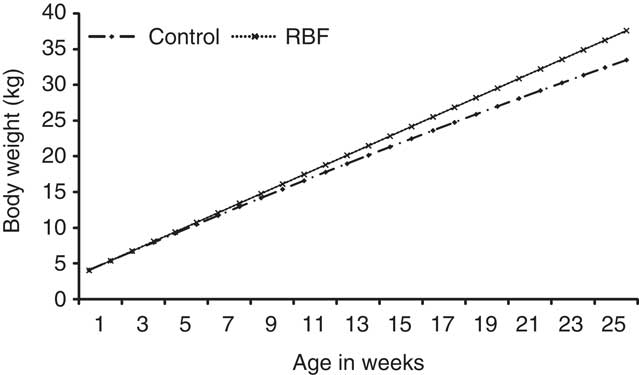
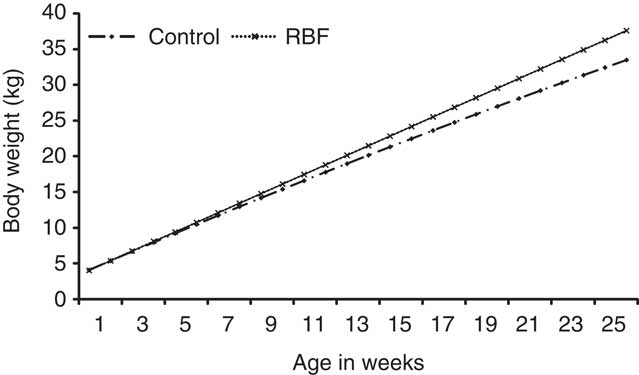
The initial BWs of lamb were similar in both the groups and this trend continued up to 6 weeks of age after which G2 superseded in weight (Figure 1). No effect of milk-replacer feeding on weaning weight of lambs was observed; however, at 6 months of age, BWs and average daily gain were significantly (P<0.05) higher in G2. Milk-replacer feeding in G2 increased dry matter and protein intake as concentrate and roughage intake in both the groups were equal.
Weekly BW of lambs in two planes of nutrition. G1 (Control) ··●·· Y=−0.005x2+1.311x+2.47 (R 2=0.996) G2 (RBF) ──×── Y=−0.000x2+1.343x+2.653 (R 2=0.995).
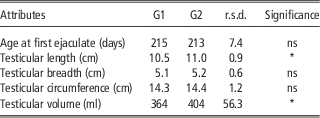
Plane of nutrition had significant (P<0.05) positive effect on testicular length and testicular volume, but no significant effect was observed on testicular breadth, scrotal circumference and age of puberty (Table 1). The average age of ram lambs at the time of first ejaculation was 215 days in G1 and 213 days in G2.
Effect of milk-replacer and rumen inert fat feeding on puberty and testicular development of Malpura ram lambs

Values are mean; *P<0.05; ns: P>0.05; G1: Control; G2: treatment.
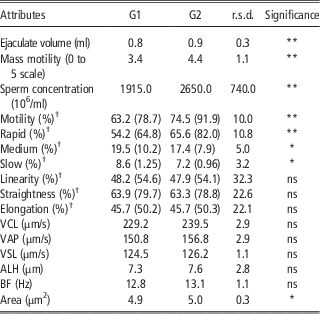
The effect of higher plane of nutrition was highly significant (P<0.01) on semen volume, sperm concentration, mass motility, % motility and % rapid motile spermatozoa (Table 2). The effect was also noted to be significant (P<0.05) on % medium and slow motile spermatozoa, and area of sperm head.
Effect of milk-replacer and rumen inert fat feeding on semen production and sperm motion characteristics of Malpura ram lambs
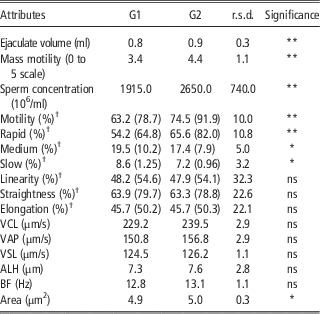
Values are mean; *P<0.05; **P<0.01; ns: P>0.05; G1: Control; G2: treatment.
† Values are means of the arc sin transformed values in percentage, whereas values in parenthesis are actual means of data.
Discussion
Growth and testicular development
Bhatt et al. (Reference Bhatt, Tripathi, Verma and Karim2009) reported higher preweaning gains with milk-replacer feeding and preweaning gain has an effect on postweaning growth performance. Similar BW of lambs in the two groups up to 6 weeks of age suggests that suckling met nutrient requirement up to this time. However, after 6 weeks, owing to decreasing milk yield (Bhatt et al., Reference Bhatt, Tripathi, Verma and Karim2007) and higher nutrient demands, lambs supplemented with milk replacer and rumen inert fat grew faster than unsupplemented lambs. Conventional (unprotected) fat has negative effect on voluntary intake and fibre digestibility (Johnson and McClure, Reference Johnson and Mcclure1973) because of change in microbial population. Bhatt et al. (Reference Bhatt, Sahoo, Shinde and Karim2013) reported higher lamb finisher weight in response to rumen inert fat. Earlier reports have shown greater testicular development in rams fed a high-energy diet compared with those fed a low-energy diet (Fernandez et al., Reference Fernandez, Giralde, Frutos, Lavin and Mantecon2004; Fourie et al., Reference Fourie, Schwalbach, Neser and Van der Westhuizen2004). High food intake stimulates GnRH–LH pulse frequency for only 10 to 20 days but continues to promote testicular growth over several months in mature male sheep (Blache et al., Reference Blache, Chagas, Blackberry, Vercoe and Martin2000). However, the increased testicular length and volume of ram lambs fed milk replacer and rumen inert fat in the present study is contrary to the results of Bielli et al. (Reference Bielli, Pedrana, Gastel, Castrillejo, Morana, Lundeheim, Forsberg and Rodriguez-Martinez1999) and Tufarelli et al. (Reference Tufarelli, Lacalandra, Aiudi, Binetti and Laudadio2011). The differences between these studies might be because of variations in breed, age, plane of nutrition and other environmental factors.
Undernourishment restricts the growth and development of the testes in growing ram lambs and delays attainment of puberty (Pretorius and Marincowitz, Reference Pretorius and Marincowitz1968). Testicular dimension and size of the ram lamb can be used as criteria for early selection of ram lambs to be used in breeding at relatively younger age (Elmaz et al., Reference Elmaz, Cirit and Demir2007). Moreover, reproductive activity of rams is dependent and significantly correlated with postweaning growth and size of the testes (Elmaz et al., Reference Elmaz, Dikmen, Cirit and Demir2008). Even when adequate feeding follows nutritional restriction, young rams have the ability to compensate quickly in terms of reproductive development (Sutama and Edey, Reference Sutama and Edey1985). Thwaites (Reference Thwaites1995) described that undernutrition negatively influenced the testicular volume of rams and the decline was more in proportion to the decline in BW. Emsen (Reference Emsen2005) showed that sheep with relatively higher growth rate can considerably improve the early pubertal development of ram and undernutrition (only grazing), during 6 to 9 months of age, decreased the body growth and scrotal circumference. Although scrotal circumference is considered as one of the best indicators of sexual development in rams (Notter et al., Reference Notter, Lucas and Mc Claugherg1981), more reliable parameters of sexual development in growing rams include both scrotal circumference and testicular volume, as the testicular tissue occupies small proportion of scrotal volume. In the present study, scrotal circumference of the ram lambs did not increase with feeding milk replacer and rumen inert fat regime. In agreement with our results, Tufarelli et al. (Reference Tufarelli, Lacalandra, Aiudi, Binetti and Laudadio2011) also did not find any significant effect of high feeding levels on scrotal circumference of the Sardinian rams.
Puberty age and semen quality
The literature on the influence of plane of nutrition on CASA-derived sperm motion characteristics is scarce, and therefore it is difficult to compare our results with other values. The age at puberty in ram lambs varies between 3 and 11 months and depends on several factors including breed, management conditions, nutrition and the reproductive parameters used to define puberty (Salhab et. al., Reference Salhab, Zarkawi, Wardeh, Al-Masri and Kassem2003; Kumar et al., Reference Kumar, Joshi and Naqvi2010). In this study, the ram lamb’s ability to ejaculate in an AV was considered as a puberty criterion and it was well within the range.
It is well established that male sheep reared on high as opposed to low planes of nutrition attain puberty earlier in life. However, in the present study, we could not find any significant effect of improved feeding on puberty age in the Malpura ram lambs, possibly owing to achievement of critical weight by ram lambs required for attainment of puberty in both the groups, as the growth rate has little effect on the rate of sexual maturation after a certain critical weight has been achieved (Schillo et al., Reference Schillo, Hall and Hileman1992).
The evaluation of spermatozoa is an important factor that must be accurately analysed to ensure the use of breeding rams with good fertility. These evaluations often include measuring volume, concentration, motility and other characteristics that influence sperm functionality. CASA provides rapid, precise and validated objective sperm motion characteristics and has been applied in our laboratory for ram lamb semen (Kumar et al., Reference Kumar, Joshi and Naqvi2010). Developments in CASA technique have shown that it provides powerful insights into sperm function and semen heterogeneity (Holt et al., Reference Holt, O’Brien and Abaigar2007). Sperm velocity and motility are among the most important essential parameters in the examination of sperm quality and in the establishment of a correlation between sperm quality and fertility (Vestergen et al., Reference Vestergen, Iguer-Ouada and Onclin2002).
The results of our study showed that semen volume, sperm concentration and sperm motility were higher in experimental improved feeding than in the control group. Similar effects of high feeding levels on sperm production and total number of spermatozoa per ejaculate has been reported by Tufarelli et al. (Reference Tufarelli, Lacalandra, Aiudi, Binetti and Laudadio2011). The acquisition of progressive motility is considered to be one of the strongest evidences for sperm maturation and a useful determinant of fertility. High feeding level generally improved the nutritional condition of the rams consequently improving motility of spermatozoa (Dana et al., Reference Dana, Tegegne and Shenkoru2000). In agreement with our results, Speake et al. (Reference Speake, Surai and Rooke2003) reported significant improvements in spermatogenesis of rams with dietary protein and fatty-acid supplementation. The improved semen quality of ram lambs fed milk replacer and rumen inert fat might be attributed to caloric effects on energy balance and the non-caloric effects related to the synthesis of testosterone in the Leydig cells and phospholipids in the spermatozoa cell membrane. Production of this hormone was stated to be seriously suppressed as a result of feeding poor-quality diets for a prolonged period (Parker and Thwaites, Reference Parker and Thwaites1972). Increasing sperm concentration is generally considered to be positive because it allows insemination of a larger number of females (Robinson et al., Reference Robinson, Ashworth, Rooke, Mitchell and McEvoy2006).
In conclusion, the present study indicates that the plane of nutrition of growing ram lambs enhances their growth, testicular development and sperm characteristics, and increases their post-pubertal reproductive performance in the semi-arid areas.
Acknowledgements
The authors are indebted to the Director of the institute for providing all the research facilities and to Mr Munir Ahmed for rendering the technical assistance in carrying out this study.