

Introduction
Patterns of wool variations found in modern sheep breeds may shed some light on the history of circum-Mediterranean migrations, which at present are largely unknown. But there are not many reports in the literature regarding the relationships among Mediterranean sheep. For instance, Álvarez et al. (Reference Álvarez, Royo, Fernández, Gutiérrez, Gómez and Goyache2004) sampled from six Spanish sheep breeds included in the ancestral Iberian Churra sheep group, Gaouar et al. (Reference Gaouar, Tabet-Aoul, Derrar, Goudarzy-Moazami, Saïdi-Mehtar, Makkar and Viljoen2005) sampled from two Algerian breeds, El Nahas et al. (Reference El Nahas, Hassan, Mossallam, Mahfouz, Bibars, Oraby and de Hondt2008) sampled only from Egyptian breeds and Ali et al. (Reference Ali, El-Hanafy and Salem2009) also sampled from Egyptian sheep. They all analysed microsatellites or structural genes.
Moreover, there is very little information about fleece characteristics for the Mediterranean breeds. The few existing studies on comparative fleece characteristics for some of these breeds have been done by Parés (Reference Parés2008) and Perezgrovas et al. (Reference Perezgrovas, Parés, Rodríguez and Zaragoza2010). Among the authors' drawbacks is that the fleece analysis can be used not only to describe single isolated breeds, but also to contribute to the study of phenotypical groups.
Taking into account rapid genetic erosion (Scherf, Reference Scherf2000) and the importance of animal genetic resources for the future (Notter, Reference Notter1999), it may not be possible to wait for specific and detailed information on some of the less studied Mediterranean breeds and ecotypes. In this study, we concentrate on a preliminary comparative analysis of fibre and staple characteristics for the red Mediterranean breeds with the aim of establishing fibre morphologic relationships. One of our hypotheses is that differentiation between these red breeds is clearly due to more than colour pattern alone. The approach to apply conventional multivariate analysis remains valuable as these red breeds can be viewed as relatively closely related.
Materials and methods
Breeds studied
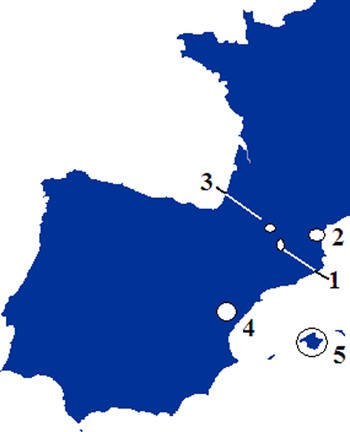
Samples were taken from five different local European breeds (Figure 1): Aranese (ARA), Castillonnais (CAST), Levant Red (GUIR), Roussillon Red (BERB) and Majorcan Red (ROJM), the last two being funnel tailed. Except for the ARA, they yield red wool. The ARA, which is also a medium-woolled type (Parés, Reference Parés2008), was taken as a comparative group, its coat generally being white in colour (other phenotypes are allowed, but none is red).
Origin of studied breeds: 1, ARA; 2, BERB; 3, CAST; 4, GUIR; 5, ROJM.

The ARA thrives in the Aran Valley, in the Central Pyrenees. Husbandry is similar to that for the CAST, i.e. during winter each flock is pastured at the owner's farm in the valley, with feed provided in the stall, and for four months during the summer, the flocks of sheep graze normally in the sub-Alpine and Alpine grasslands. Although it is quite possible that the origin of the Aran breed may include some elements of the Merino, it is necessary to look for the presence of other stock in its formation (Parés, Reference Parés2008).
The BERB (in Spain known as the Berberina) is a semifine woolled breed from the lowlands of southwestern France, especially concentrated between Narbonne and Perpignan (Babo, Reference Babo2000). The 2 percent of the breed that are black are not accepted as pure BERB (Brooke and Ryder, Reference Brooke and Ryder1977). Head, legs and belly are bare of fleece and reddish-brown (Brooke and Ryder, Reference Brooke and Ryder1977). The origin of the breed is unknown. Pujol (Reference Pujol1974) accepts as valid the traditional belief that the BERB is of North African origin, introduced into France via Spain. Sánchez Belda (Reference Sánchez Belda1976a, Reference Sánchez Belda1976b) postulates that both the BERB and the ROJM have Barbary ancestry, and he also rejects the suggestion that the BERB and the GUIR are closely related. Babo (Reference Babo2000) puts forward the possibility of Solognote or Cobourg influence. In France, the breed has been declining for many years: From more than 50 000 in 1900 (Pujol, Reference Pujol1974) to 3 000 in 1963 (Ministere de l'Agriculture, 1963), but its survival is not at critical levels in Spain, where many pure flocks exist, mainly in the eastern Pyrenees of Catalonia.
The CAST (formerly Saint Gironnaise and locally known as Castelhonesa or Tête Rouge), a breed (like the ARA) from the Central Pyrenees, is found in the Lez valley, southwest of St Geronç (Ariège) (Babo, Reference Babo2000). The main breeding area is near the villages of Castillon-en-Couserans and Bordes (Brooke and Ryder, Reference Brooke and Ryder1978). The Castillon breed is described by Quittet (Reference Quittet1965), Mason (Reference Mason1967) and Babo (Reference Babo2000): Coat is white; the head, legs, and belly are reddish-brown or partly reddish-brown; the shade varies from dark to light. Lambs are born entirely reddish-brown, and mature animals are not considered pure-bred unless the head is at least partly red, a recessive characteristic (Brooke and Ryder, Reference Brooke and Ryder1978). It has received influences from the Southdown breed (Babo, Reference Babo2000). With a count of about 1 000 animals, its survival is critical (Babo, Reference Babo2000).
The GUIR (also known as Guirra and Sudat) sheep is an autochthonous breed distributed throughout southeast Spain. The GUIR is characterized by a reddish coat colour and very oily wool (Sánchez Belda, Reference Sánchez Belda1976a, Reference Sánchez Belda1976b; Esteban, Reference Esteban2003) (“Guirra” is the word for “reddish” in the Valencian dialect; “Sudat” means “greasy”, in reference to the oily condition of the uncleaned wool – Sánchez Belda, Reference Sánchez Belda1976a, Reference Sánchez Belda1976b; Brooke and Ryder, Reference Brooke and Ryder1977). Its numbers have been decreasing in recent years (Esteban, Reference Esteban2003). The colour of the fleece of the animals varies from reddish-brown to yellow-white (Sánchez Belda, Reference Sánchez Belda1976a, Reference Sánchez Belda1976b; Brooke and Ryder, Reference Brooke and Ryder1977). The colour of newborn lambs is dark reddish-brown (Sánchez Belda, Reference Sánchez Belda1976a, Reference Sánchez Belda1976b; Esteban, Reference Esteban2003). With age, the coat lightens, becoming a dirty cream colour at full maturity (Sánchez Belda, Reference Sánchez Belda1976a, Reference Sánchez Belda1976b; Brooke and Ryder, Reference Brooke and Ryder1977). Both sexes lack horns (Sánchez Belda, Reference Sánchez Belda1976a, Reference Sánchez Belda1976b). Years ago it was believed that the GUIR breed was a pigmented variety of the Segureña breed or a similar breed to the Manchega variety (Sánchez Belda, Reference Sánchez Belda1976a, Reference Sánchez Belda1976b), but nowadays it is considered ethnically independent with African ancestry, consistent with the close ties between the Spanish central Mediterranean coast and the Maghreb (Sánchez Belda, Reference Sánchez Belda1976a, Reference Sánchez Belda1976b). Specifically, it would have originated on the Atlantic coast of Morocco from the Beni Ahsen breed, which has exactly the same colour and wool characteristics (Sánchez Belda, Reference Sánchez Belda1976a, Reference Sánchez Belda1976b; Esteban, Reference Esteban2003).
The ROJM (also known as Coete) is a breed found on the island of Majorca. In recent decades, the breed has steadily declined to such an extent that its survival is uncertain (Esteban, Reference Esteban2003). The ROJM developed from crossing the island animals with funnel-tailed and chestnut North African breeds (Sánchez Belda, Reference Sánchez Belda1976a, Reference Sánchez Belda1976b; Esteban, Reference Esteban2003). Both sexes lack horns (Sánchez Belda, Reference Sánchez Belda1976a, Reference Sánchez Belda1976b). The tail is funnel shaped and the wool has hairy fibres (Esteban, Reference Esteban2003).
Additional breed descriptions are available from Esteban (Reference Esteban2003) for Spanish breeds and Babo (Reference Babo2000) for French ones.
Meat and/or milk production are the unique traits for these sheep, with wool production being unimportant. Farmers shear their flocks once a year between late April and June.
Sampling
Adult animals were randomly chosen (a herd for each breed). Staples were taken before sharing from the shoulder and stored in plastic bags for further analysis. Subsamples were taken to measure fibre length and diameter. A total of 88 animals were sampled.
To identify differences between fibres, macroscopic and microscopic features were analysed using the method as described in Rojas et al. (Reference Rojas, Perezgrovas, Rodríguez, Russo-Almeida and Anzola2005).
Traits studied
The following traits were considered in the study: length of long-coarse, short-fine and kemp fibres; percentage of long-coarse, short-fine and kemp fibres (staple composition); percentage of clean yield using isoalcohol; fibre:kemp ratio; average fibre diameter; and F30 (fibres with diameter >30 µm). Formal statistical requirements, such as covariance homogeneity between samples and multivariate normality of distribution, are assumed to be met.
A more precise view of relationships can be gleaned from the similarity coefficients. So to compare differences between breeds, a principal coordinate (PCO) scatter diagram and a paired cluster analysis were done based on the Gower distance matrix, considering each breed as a group. F30 was not considered in this case. Used data from ARA, CAST and BERB were previously compiled by Parés (Reference Parés2008) and data from GUIR and ROJM by Perezgrovas et al. (Reference Perezgrovas, Parés, Rodríguez and Zaragoza2010). All crude values are available from the first author upon request. Data were analysed using PAST® v. 1.94b (http://palaeo-electronica.org/2001_1/past/issue1_01.htm).
Results and discussion
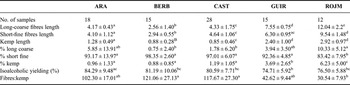
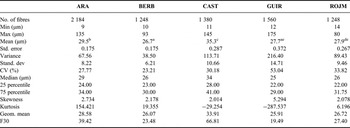
The descriptive statistics obtained are shown in Tables 1 and 2. Statistical differences for some of the studied traits were detected. The results for the breeds studied showed an overall fibre diameter of 29.5 ± 10.65 µm. The rather symmetrical diameter distribution makes them a short, fine wool type. The histograms for frequency of diameter distribution (not presented here) confirm the macroscopic findings, with a lower proportion of long-coarse fibres, although ROJM also shows the highest percentage of long-coarse fibres, indicating a slight tendency towards the double coat (important percentages of both long-coarse and short-fine fibres). It is also surprising that the ROJM, with the highest percentages of long-coarse and kemp fibres, has a more uniform fleece in terms of SD of fibre diameter than the CAST and GUIR and a more desirable value for F30 than the CAST. All can be classified as “entrefine” wool (medium quality, fibre diameter from 24 to 36 µm) according to the Spanish classification, with the CAST wool being the coarsest (as described by Quittet, Reference Quittet1965; Mason, Reference Mason1967) and with kemp, and ARA being the finest with nearly no kemp. GUIR and ROJM show the lowest yield after clean yielding with isoalcohol (74.7 and 76.5percent, respectively), thus confirming the “oily wool” that characterizes these breeds (Perezgrovas et al., Reference Perezgrovas, Parés, Rodríguez and Zaragoza2010). The fleece of GUIR is also the least uniform among the studied breeds in fibre diameter. Its fibre lengths appeared slightly longer than those reported by Esteban (Reference Esteban2003), which are of 5–6 cm. Obtained fibre lengths for ROJM appeared too longer than those reported by Esteban (Reference Esteban2003), which are of 8–9 cm.
Descriptive statistics obtained from fleece analysis (mean ± SE) (breed abbreviations in the text).

Fibre lengths in cm.
Different letters in the same row indicate significant differences ANOVA (P < 0.05) among each breed.
Some descriptive traits obtained from fibre diameter analysis (breed abbreviations in the text).

All fibre types are included.
Different letters in the row indicate significant differences ANOVA (P < 0.05) between means among each breed.
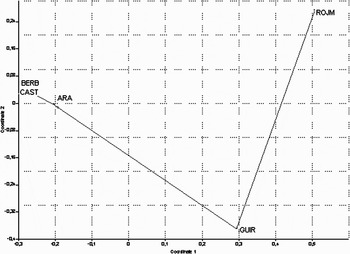
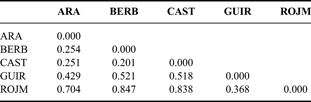
Table 3 shows the Gower distances between breeds. Figure 2 presents the PCO scatter diagram. The results of the PCO analysis are eminently interpretable in terms of function of all analysed traits. The first PCO accounts for about three-quarters of the total variance. The first component variate explains the majority of the variance (79.5percent) and acts to separate the two Iberian red breeds (GUIR and ROJM) from the French ones (CAST and BERB).
PCO scatter diagram of the first two PCOs based on the Gower distance matrix, considering each breed as a group (breed abbreviations in the text). Note that on the 1 coordinate (explaining the majority of the total variance) the two Iberian red breeds (GUIR and ROJM) are very far separated from the French ones (CAST and BERB) and ARA.

Matrix of Gower distances (abbreviations in the text).
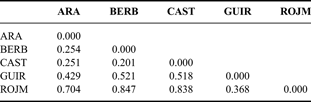
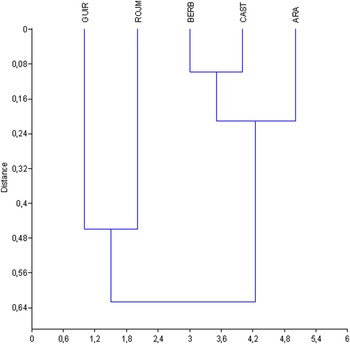
Figure 3 displays the paired clustering obtained (ρ = 0.941). Iberian and French breeds are widely separated from each other, GUIR and ROJM having a low fibre-to-kemp ratio (high percentage of kemp and low percentage of short-fine fibres). Their fibre diameter also tends to be lower; the wool is markedly greasy and the staple longer. GUIR and ROJM could be grouped as “hairy and high-greasy medium-wool” breeds. BERB and CAST could be defined as “low-greasy medium-wool” breeds with the CAST having very coarse fibres.
Paired cluster analysis based on the Gower distance matrix depicting the results of the cluster analysis described in the text. Each breed is considered as a group (breed abbreviations in the text). Note the initial bifurcation between Iberian red breeds (GUIR and ROJM) and French ones (CAST and BERB). Note also that GUIR and ROJM are in a cluster of long branches. ρ = 0.941.

The results of the clustering analysis here are similar to one of those done by Parés (Reference Parés2008) with ARA and French breeds, but differ slightly from Parés (Reference Parés, Perezgrovas and Jordana2010) who investigated 31 Iberoamerican breeds (that include the studied breeds in this research). One reason that the results of this study differ is that the resulting dendrogram may strongly vary according to the selected clustering methods.
Discussion
The very early breeds of sheep had two coats: an outer coat of kemp and an under coat of fine wool or down that is shed in the spring (McManus, Rezende and Olegário de Araújo, Reference McManus, Rezende and Olegário de Araújo2010). The kemp has been gradually bred out of most sheep so that they have coats that are all wool (McManus, Rezende and Olegário de Araújo, Reference McManus, Rezende and Olegário de Araújo2010). Fleece characteristics offer a glimpse of possible historic relationships among the breeds studied beyond their similarity in colour and geographical proximity.
The geographic location of the Iberian Peninsula makes it a natural link between Europe and North Africa. However, it is a matter of debate to what extent African influences via the Strait of Gibraltar affected Iberia's prehistoric development. Because early African pastoralist communities were dedicated to sheep breeding, a possible means of detecting prehistoric African–Iberian contacts might be to analyse the origin of ovine breeds on the Iberian Peninsula. But because we still know very little about the nature of the fleece patterns of Atlantic West and North African breeds, the importance of the African influence on modern European red sheep remains to be clarified.
Evidence from the Cairo Genizah indicates quite clearly that in the eleventh and twelfth centuries the Mediterranean world was a kind of medieval common market, forming a free trade area (Goitein, Reference Goitein1967). This communications network, shared by Christians, Jews and Moslems, expressed the notion that there was blessing in movement “fi'l-haraka baraka” (Glick, Reference Glick1979). In addition, the Atlantic maritime trade between Spain, Portugal and the Maghreb at this time is well documented by Picard (Reference Picard1997). All these influences would have left different traces, with a less frequent influence on Pyrenean breeds. It seems possible that different breeds, as they spread northward, were the origin of different European breeds. Subsequent selective breeding for desirable traits such as wool, milk and meat production as well as environmental tolerance was responsible for the development of more differentiated sheep populations. A loss of wool improvement can be assumed, at least in recent decades. The influx of stocks through different pathways is compatible with this hypothesis as the southernmost breeds (GUIR and ROJM) displaying a high degree of interbreed Gower distances. Moreover, it seems difficult to suppose that the funnel-tailed ROJM and the thin-tailed GUIR, which appear in the same cluster, are closely related. Because very little is still known about the nature of the patterns of the fleece of Atlantic West and North African sheep, the importance of the African influence on existing European red sheep breeds remains to be clarified. A plausible hypothesis is that different African influences would have left different traces, with a lesser impact on Pyrenean breeds. DNAmt finds could further clarify the links between African and Iberian cultures.
More red sheep breeds from the Mediterranean basin and Atlantic African coast had to be included in further studies to achieve a good general study of red sheep breeds: Beni Ahsen breed (Atlantic Morocco); Anatolian Red and Red Karaman breeds (Turkey); Tunisia, Libya, Lebanon and Algeria sheep, etc.
Conclusions
A shortcoming of the methodology used here is that the sampling scheme did not include all the red sheep breeds in the geographical area under study (Mediterranean basin). Nevertheless, the characterization of wool in these five sheep breeds will allow comparison with other breeds as done by Parés (Reference Parés2008) and Parés (Reference Parés, Perezgrovas and Jordana2010).
Other traits as staple colour, as used by Perezgrovas et al. (Reference Perezgrovas, Parés, Rodríguez and Zaragoza2010), would be tested as discriminative parameters in view of comparing breeds.
Acknowledgements
Very special thanks are extended to the Spanish and French farmers who allowed us to collect samples from their herds. Special thanks are offered to the staff at CEAGA in Castielfabib (Rincón de Ademuz, Valencia) for providing the superior facilities for sampling their GUIR animals and to Guillem Riera from the Universitat de Lleida, who kindly supplied us with ROJM samples.