Introduction
The community composition of intertidal organisms is affected by various factors, including biological interactions and environmental stresses. In the past, trophic and competitive interactions, along with habitat environmental factors, have been investigated; however, more recently, the roles of ‘ecosystem engineers’ in community organisation are increasingly recognised (Gutiérrez et al., Reference Gutiérrez, Jones, Strayer and Iribarne2003; Bogdanski et al., Reference Bogdanski, Marcos-Almansa and Flores2024). Epibiosis is one of the strategies seen in ecosystem engineers; it is the growth of organisms attached to the hard surfaces (e.g., shells) of other organisms, called ‘basibionts’ (Walker and Miller, Reference Walker and Miller1992; Wahl, Reference Wahl2009). Epibionts (the attached organisms) take advantage of the basibionts as settlement space. Basibionts also provide improved protection from predation and environmental stresses, better access to resources such as light and nutrients, and may act as a means of dispersal, etc. (Romagnoli et al., Reference Romagnoli, Bavestrello, Cucchiari, De Stefano, Di Camillo, Pennesi and Totti2007; Totti et al., Reference Totti, Romagnoli, Stefano, Camillo, Bavestrello, Seckbach and Dubinsky2010; Falasco et al., Reference Falasco, Bo, Ghia, Gruppuso, Bona and Fenoglio2018; Bogdanski et al., Reference Bogdanski, Marcos-Almansa and Flores2024). Thus, the epibiont community benefits from the environment provided by the basibiont organisms. Because the epibionts are parts of the intertidal community, it is important to understand their diversity and community structure to improve our knowledge of the overall intertidal ecosystem.
The establishment of an epibiont community on basibionts depends on various factors, both biotic and abiotic. These include basibiont behaviour (Creed JC, 2000; Gribben et al., Reference Gribben, Byers, Clements, McKenzie, Steinberg and Wright2009), shell morphology and surface characteristics (Wahl, Reference Wahl2009; Thyrring et al., Reference Thyrring, Thomsen and Wernberg2013), basibionts size (Dougherty and Russell, Reference Dougherty and Russell2005; Martins et al., Reference Martins, Faria, Furtado and Neto2014), antifouling properties (Wahl, Reference Wahl1989), grazing pressure and competition (Rosemond et al., Reference Rosemond, Mulholland and Elwood1993; Burgmer et al., Reference Burgmer, Reiss, Wickham and Hillebrand2010), depth of locality (Reiss et al., Reference Reiss, Knauper and Kröncke2003), water flow (Wahl, Reference Wahl1996; Wilson, Reference Wilson2021), season (Cabral et al., Reference Cabral, Dias, Utz, Alves and D’Agosto2010), and other factors (reviewed in Wahl, Reference Wahl1989). These multiple factors indicate that the epibiont community is likely to have some host specificity (Majewska et al., Reference Majewska, Zgrundo, Lemke and De Stefano2012). Takada and Kanavillil (Reference Takada and Kanavillil2024) recently demonstrated that the community of microscopic epibionts on molluscan shells varied according to the basibiont species, and also to their general shell shape (categorised as bivalves, chitons, and limpets that are flat in shape, in contrast to more globose gastropods). Among the various groups of epibionts, diatoms are the most intensely studied group with more than 10,000 species described (Mann, Reference Mann1999; D’Alelio et al., Reference D’Alelio, Cante, Russo, Totti, Stefano, Seckbach and Dubinsky2010; Majewska et al., Reference Majewska, de Vijver, Nasrolahi, Ehsanpour, Afkhami, Bolaños and De Stefano2017; Falasco et al., Reference Falasco, Bo, Ghia, Gruppuso, Bona and Fenoglio2018). For diatoms, growth forms (attached or unattached) and growth characteristics (colonial or solitary) are known to affect the community organisation (D’Alelio et al., Reference D’Alelio, Cante, Russo, Totti, Stefano, Seckbach and Dubinsky2010). Thus, knowledge of the effects of surface characteristics of basibionts on the epibiont community is still lacking.
Decades ago, the shore of Niigata, Japan, was dominated by long stretches of sandy beaches; however, man-made seawalls which were constructed using natural rocks and concrete tetrapods to prevent beach erosion predominate today (Uda, Reference Uda2017). Various macroscopic organisms (e.g., molluscs and echinoderms) have colonised these artificial rocky shores. In spring, the wave height gradually decreases from the stormy winter due to change in wind pattern (Naganuma, Reference Naganuma2000). In addition, as the temperature increases, the salinity decreases due to increased freshwater run-off from the nearby rivers. Spring is a transitional season showing changes in environmental parameters which stimulate growth in the phytoplankton community, a process known as ‘spring bloom’ (Yamada et al., Reference Yamada, Ishizaka, Yoo, Kim and Chiba2004; Terauchi et al., Reference Terauchi, Tsujimoto, Ishizaka and Nakata2014). On the other hand, organisms on the intertidal rocky shores are exposed to desiccation, higher temperatures, and lower salinity stresses in spring (Yajima, Reference Yajima1978; Naganuma, Reference Naganuma2000). Epibionts on the intertidal organisms on the rocky shore of Niigata are also thought to respond to these seasonal changes; however, detailed information on this is lacking. In addition, the epibiont community may be affected by various characteristics of basibiont species mentioned above.
A previous study showed that microscopic epibionts are more abundant than macroscopic ones in the intertidal zone of Niigata (Takada and Kanavillil, Reference Takada and Kanavillil2024). Microscopic epibionts are thought to have a common source of propagules (e.g., phytoplankton) in a coastal ecosystem. Several studies showed that most of the microscopic epibionts are generalists in terms of the substratum surfaces that are suitable for settlement, including the natural rocks (Wahl and Mark, Reference Wahl and Mark1999; McGowan and Iyengar, Reference McGowan and Iyengar2017). On the other hand, some may be specialists, adapted to grow on a particular shell surface provided by one or more of the basibiont species mentioned above. Thus, the degree and sources of variations observed in the epibiont community may be complex and require more detailed study. Investigations of factors affecting the epibiont community are especially important for achieving an understanding of the biodiversity and functioning of the artificially constructed rocky intertidal zone.
The goal of this study was to characterise the microscopic epibiont communities found on shell surfaces of various intertidal benthic organisms belonging to various taxonomic groups, such as Gastropoda, Bivalvia, Polyplacophora, and Echinoidea. Therefore, the objectives of the study were to (1) characterise variations in microscopic epibiont communities found on shells of various intertidal organisms, (2) assess temporal changes in the epibiont community, and (3) evaluate the variations in epibiont communities in relation to the basibiont species and the habitat characteristics of the shell surface. The habitat characteristics considered in this study were: (1) mobility of the basibiont species (mobile vs. non-mobile), (2) size of the basibiont individuals, and (3) roughness of the basibiont shell surfaces (smooth vs. rough). For the diatoms, one of the major groups of epibionts, variability in the composition of life forms, such as attached vs. unattached cells and colonial vs. solitary growth, was also considered.
Materials and methods
Study site and field techniques
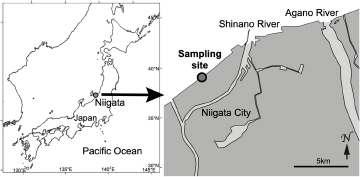
The study was conducted on the Sekiya shore, near the mouth of the Shinano River, Niigata City, Japan (37°55′N, 139°02′E; Figure 1). The shore is an artificial rocky shore exposed to micro-tidal fluctuations (0.3 m). To study epibionts, intertidal organisms (basibionts) belonging to Gastropoda, Bivalvia, Polyplacophora, and Echinoidea were collected randomly in replicates using a chisel and hammer (when necessary). Random samples of basibionts were obtained in April (April 5 and April 10, late winter to early spring) and May (May 16, late spring) in 2019. The second April sampling, on April 10, was carried out because only a small number of samples were obtained on April 5. Care was taken not to damage the organisms and their epibionts during collection. After collection, individuals belonging to different species were put in different plastic bags with seawater collected from the sampling site to prevent drying. A portable probe (YSI Model 63, YSI, Yellow Springs, OH) was used to measure water temperature, salinity, and pH at the time of sampling. Seawater temperature ranged from 10.8°C (April) to 16.7°C (May), pH ranged from 8.49 (May) to 8.63 (April), and the measurements of salinity were 18.4‰ (May) to 22.2‰ (April).
Map showing the sampling site.

Extraction of epibiont and epilithic micro-organisms
After the host samples were brought back to the laboratory, they were immediately identified to the species level using identification keys (Okutani, Reference Okutani2017). The correct species names for each of the basibionts were checked based on WoRMS (WoRMS Editorial Board, 2024, assessed on 25 January 2024). After identification, the lengths and widths of individuals were measured with Vernier callipers, which measure to an accuracy of 0.1 mm. The sizes of chitons were evaluated by measuring their shell valves. Next, the epibionts were scraped from the shell using a clean toothbrush and a known quantity of aged seawater (filtered through Whatman No. 1 filter paper). This was done by brushing and rinsing the shell surfaces four times to collect all epibionts growing on the shell surfaces. For chitons, only the shell valves were scraped. This method was standardised following the methodology of our previous studies (e.g., Takada and Kanavillil, Reference Takada and Kanavillil2024). We were able to test the efficacy of epibiont removal by repeated brushing and rinsing, and observing the shell surfaces and the filtrate, showing the presence of epibionts. Four brushings, each followed by rinsing with 2.5 ml of filtered, aged seawater (which had been aged in the refrigerator), were found to be an adequate technique to remove most of the epibionts from the shell surfaces. When larger surfaces were encountered (for example, shells of Magallana and Mytilus), a known area of 20 mm × 20 mm from the edges was scraped. After collecting the whole extracts (10 ml/shell), these samples were labelled and kept in the refrigerator. All the sample analyses were completed within 24–36 h after extraction. During sample analysis, they were concentrated by centrifugation (∼2000 rpm for 5 min) followed by carefully removing the supernatant. Subsamples were drawn from the concentrated samples after mixing them thoroughly for observation in a haemocytometer at 200×, 400×, and 1000× magnifications under a compound microscope (Olympus, Japan). In this study, the major groups of epibionts examined included diatoms, unicellular and filamentous green algae, cyanobacteria, and red algae (Supplemental Table S1). When protozoans were present, they were counted but not identified. Each sample was scanned eight times, and an average was taken to calculate the cell density of each taxonomic entity. The cell density of each epibiont was expressed as Number per mm2, and these values were used for the statistical analysis. Altogether, 83 samples were observed during this study. The epibionts were identified with the help of several identification keys that include both freshwater and marine benthic forms (Prescot, Reference Prescot1978; Yamaji, Reference Yamaji1984; Round et al., Reference Round, Crawford and Mann1990; Hasle et al., Reference Hasle, Syvertsen, Steidinger, Tangen and Tomas1996; Chihara and Murano, Reference Chihara and Murano1997; Witkowski et al., Reference Witkowski, Lange-Bertalot and Metzeltin2000; Scott and Thomas, Reference Scott, Thomas, Scott and Marchant2005). The species names of the epibionts were checked with reference to AlgaeBase (Guiry and Guiry, Reference Guiry and Guiry2024, assessed on 26 January 2024); a key that included species found in brackish and freshwater environments as well as marine species. Growth characteristics (colonial or solitary) and growth forms (attached or unattached) of the diatoms were also noted (Prescot, Reference Prescot1978; Round et al., Reference Round, Crawford and Mann1990; Spaulding et al., Reference Spaulding, Potapova, Bishop, Lee, Gasperak and Jovanoska2021). Although some specimens of diatoms and other algae could not be identified to the species level, these organisms were identified to the lowest possible taxonomic level.
Data analysis
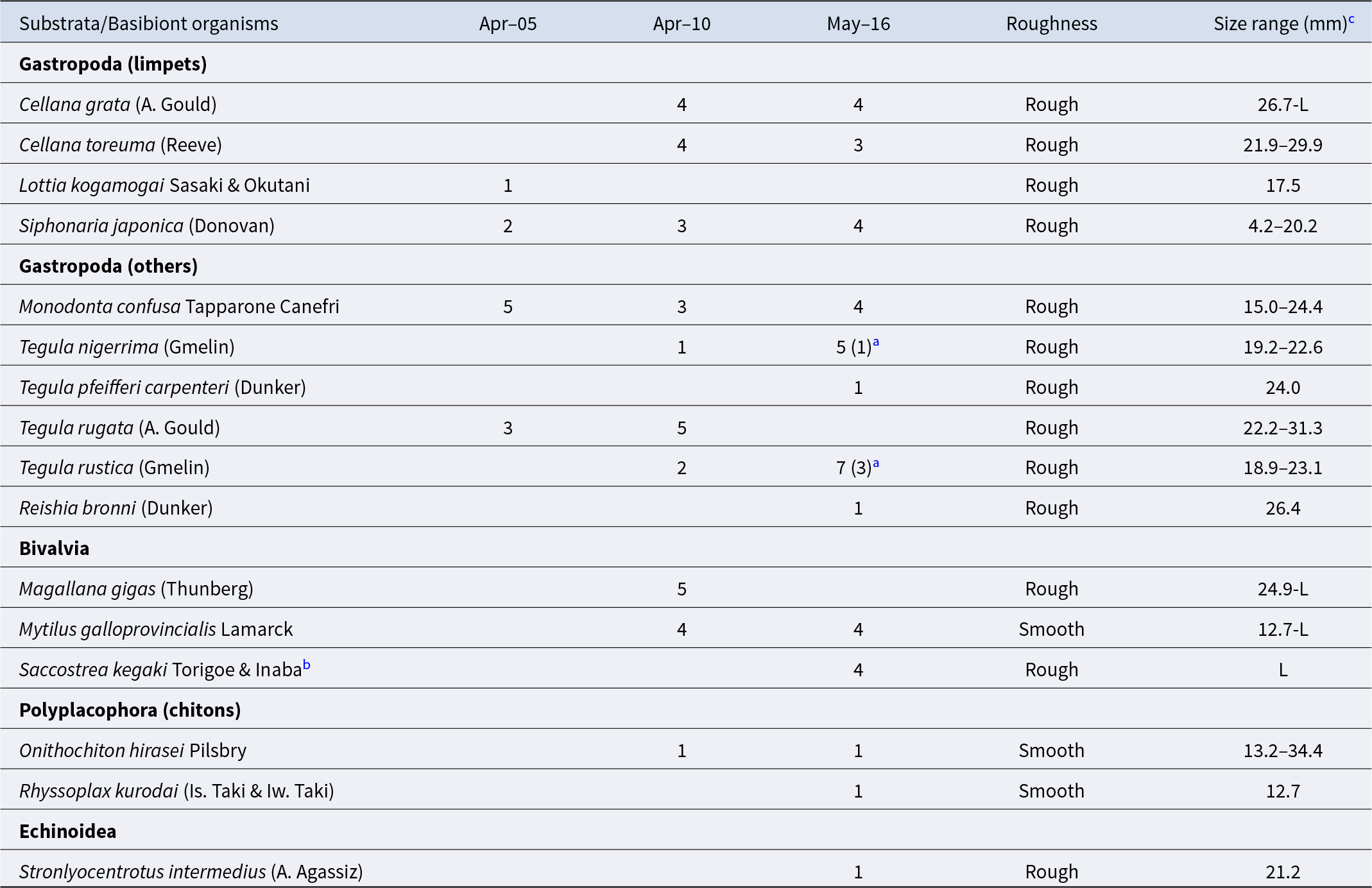
To assess the importance of various physical and biological characteristics of the basibiont species in determining the community composition of their epibionts, the basibiont samples were categorised according to their mobility, size, and roughness of the shell surface, before carrying out the statistical analysis. The basibiont species were therefore divided into mobile (Gastropoda, Polyplacophora, Echinoidea, and gastropod shells occupied by hermit crabs) and non-mobile (Bivalvia) species. The samples were then divided according to the individual shell size of the basibiont: small (basibiont individuals with shell size <48 mm in terms of length/width) and large (shell size ≥48 mm length and width). In addition, according to the roughness of the shell surface of the basibiont species, the samples were divided into two categories judged by finger touch: smooth (e.g., Mytilus galloprovincialis and Polyplacophora) and rough with sharper shell grooves (e.g., Gastropoda) (Table 1).
Number of substrata (shells of basibionts and plastic) sampled at the rocky shore in Niigata during each of the three sampling occasions (April 5, 10, and May 16). Gastropoda, Polyplacophora, and Echinoidea are mobile substrata, while Bivalvia and plastic substrates are non-mobile ones

a Shells occupied by hermit crabs.
b Dead shells.
c L: size larger than 48 mm.
The communities of epibiont micro-organisms observed on basibionts were examined using univariate and multivariate statistical analyses. In the univariate analyses, the effects of month (April vs. May) on taxonomic richness, Simpson diversity index (inverse Simpson) (Chao et al., Reference Chao, Chiu and Hsieh2012), and cell density of the epibionts (number of cells of all the taxonomic entities per mm2) on the basibiont shells were tested using one-way ANOVAs. Then, the community data were further examined in terms of 1) mobility (mobile vs. non-mobile), 2) shell size (small vs. large shells), and 3) roughness of shell surface (smooth vs. rough surfaces) of basibionts. Assuming a large effect of month, two-way ANOVAs with the factors of month and each of the other three factors (mobility, shell size, and roughness of shell surface) were performed. When the ANOVAs showed significant differences (p < 0.05), Tukey-HSD tests were done for a post-hoc comparison. In addition, because hermit crabs were collected only in the month of May, taxonomic richness, Simpson diversity index, and cell density of the community data were compared between shells of living gastropods (Tegula nigerrima and T. rustica), and the dead shells inhabited by hermit crabs were carried out for the month of May using one-way ANOVAs. Before these analyses, the taxonomic richness and the Simpson diversity index were transformed to square-root values, and the cell density was transformed to log values to reduce heteroscedasticity between samples, and then, tested using the Levene test. In addition, within-sample diversity (alpha diversity), total diversity (gamma diversity), and between-sample diversity (multiplicative beta diversity) (Jost, Reference Jost2007) were calculated for epibiont taxonomic richness and Simpson diversity indices.
In the multivariate analyses, abundance data of the taxonomical units were used to estimate dissimilarity values of the communities between all pairs of the samples by calculating the Bray–Curtis dissimilarity values (Jost et al., Reference Jost, Chao, Chazdon, Magurran and McGill2011). Based on the dissimilarity values, ordinations in reduced spaces were generated by nonmetric multidimensional scaling (nMDS). The data were log (x + 1) transformed before running the analysis. The assemblages were clustered into several groups by K-medoids (Borcard et al., Reference Borcard, Gillet and Legendre2011). The average silhouette values were calculated to decide the appropriate number of groups. If the whole assemblage had been divided into too many sub-groups, some clusters may not have their indicator species that characterise the assemblage of the groups. On the other hand, if the number of groups was too few, then we might not see a meaningful distribution of groups and their indicator species. In order to avoid these two extreme situations, we decided to maximise the number of groups until a sharp drop in silhouette values was noticed. This modification has allowed us to identify a meaningful number of groups with their indicator species. The indicator taxonomic entities of the assemblages (groups) were selected using the indicator value (IndVal) (Dufrêne and Legendre, Reference Dufrêne and Legendre1997). The significance of a taxonomic entity as an indicator of an estimated group of assemblages was evaluated by using a randomisation procedure (n = 9999). The higher the IndVal, the stronger their presence and specificity in the group (Dufrêne and Legendre, Reference Dufrêne and Legendre1997). The composition of epibiont species on natural substrates was also compared by using PERMANOVA (Anderson, Reference Anderson2001; McArdle and Anderson, Reference McArdle and Anderson2001). To clearly understand the effect of sampling month (April vs. May), one-way PERMANOVA was conducted with month as a fixed factor. Assuming a large effect of month, two-way PERMANOVAs were carried out with month and the characteristics of basibionts (mobility, shell size, and roughness of shell surface) as fixed factors. In addition, the effects of hermit crabs on their epibiont communities were tested by one-way PERMANOVAs using the samples obtained in May, as well as in the univariate analyses. For the PERMANOVAs, the Bray–Curtis dissimilarity with log(x + 1)-transformed abundance data was used.
The establishment of an epibiont community, especially diatoms, depends on their growth forms (attached or unattached cells) and growth characteristics (solitary or colonial) (Prescot, Reference Prescot1978; Round et al., Reference Round, Crawford and Mann1990; Spaulding et al., Reference Spaulding, Potapova, Bishop, Lee, Gasperak and Jovanoska2021). In order to study the significance of the growth forms and characteristics of diatoms in the community composition, they were grouped (placed in one of four groups): as attached or unattached, and as solitary or colonial. The taxonomic richness and densities of diatoms in the groups identified by K-medoid were studied with respect to their growth forms and characteristics. The analyses were performed using R 4.2.1 software and packages cluster, labdsv, and vegan (R Core Team, 2022).
Results
The basibionts collected include 10 Gastropoda species, three Bivalvia species, two Polyplacophora species and one species of Echinoidea (Table 1), resulting in 83 samples in total. Among basibionts, eight species were found both in April and May. Four samples of gastropods’ shells were occupied by hermit crabs.
In total, 95 taxonomic entities of microscopic epibiont and periphytic micro-organisms were observed in this study (Supplemental Table S1). The number of taxonomic entities observed on April (5 and 10 combined) and May 16 were 61 and 62, respectively. Diatoms comprised 89.5% of the total taxonomic entities encountered, followed by Cyanobacteria, green algae, and red algae. Green and red algae were also microscopic; no macroscopic attached organisms were observed. Among the substrates examined, Cellana toreuma had the highest cell density of the total epibionts (5820.2 ± 9222.2 cells mm−2, n = 7 mean ± SD), followed by Saccostrea kegaki (1726.6 ± 1521.5, n = 4), Reishia bronni (1602.1, n = 1), and Mytilus galloprovincialis (1310.1 ± 625.8, n = 8). For each taxonomic entity, in April, Meuniera membranacea (967.4 ± 3594.2) had the highest average cell density of the epibionts (n = 43), followed by Licmophora abbreviata (69.7 ± 163.0) and Melosira nummuloides (53.6 ± 169.4). In May, M. membranacea (118.2 ± 152.7) also had the highest average cell density of the epibionts (N = 44), followed by Fragilariopsis oceanica (67.5 ± 117.4) and Cocconeis pseudomarginata (45.1 ± 62.3).
The overall mean epibiont taxonomic richness during this study was 10.01 ± 4.71 (n = 83, alpha diversity) with a minimum of 3 taxonomic entities on Siphonaria japonica in April and a maximum of 24 taxonomic entities on M. galloprovincialis in May. The beta diversity (between samples) of species richness was 9.49 in 95 gamma (total) diversity. As for Simpson diversity, the alpha, beta, and gamma diversities were 3.19, 1.75, and 5.58, respectively.
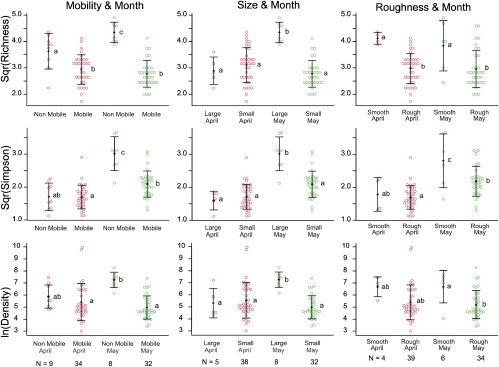
The results of one-way ANOVA demonstrated that Simpson diversity of epibionts showed statistically significant differences (p < 0.05) between April and May, but taxonomic richness and density of the epibionts did not differ between months (Supplemental Table S2). Taxonomic richness, Simpson diversity, and cell density of the epibionts showed statistically significant differences (p < 0.05) according to basibiont characteristics such as mobility, shell size, and roughness of the shell surface (Figure 2, Supplemental Table S2). Generally, the results indicated that shells of non-mobile basibionts, basibionts with large shells, and basibionts with smooth shell surfaces carried epibiont communities of greater taxonomic richness, Simpson diversity, and cell density of the epibionts than shells of mobile basibionts, basibionts with small shells, and basibionts with rough shell surfaces (Figure 2). The differences were more evident in May than in April (Figure 2). Taxonomic richness, Simpson diversity, and cell density of the epibionts on non-mobile basibionts and on larger shells in May were found to be significantly different (p < 0.05) from those on non-mobile, mobile, and small-shelled basibionts in the month of April (Figure 2). These differences were supported by statistically significant (p < 0.05) interaction terms in the two-way ANOVAs (Supplemental Table S2).
Mean (± SD) of epibiont taxonomic richness, Simpson diversity, and cell density on natural substrata (shells). Differences between mobile basibionts (Gastropoda, Polyplacophora, and Echinoidea) and non-mobile basibionts (Bivalvia), between large (shell size ≥ 48 mm) and small (< 48 mm), and between smooth- and rough-surfaced basibionts (Table 1) are compared with the interaction of month (April and May). Different letters (a, b, and c) at the top-right of the bars in each figure indicate significant differences (p < 0.05) detected by Tukey-HSD tests after two-way ANOVAs.

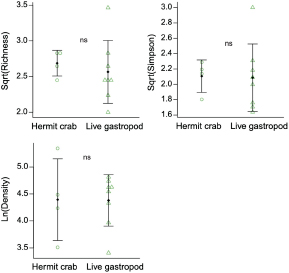
In May, Simpson diversity and cell density of the epibionts did not show statistically significant differences (p ≥ 0.05) between the gastropod shells occupied by hermit crabs and the live gastropod shells (Figure 3, Supplemental Table S2). Taxonomic richness did not differ significantly between the gastropod shells occupied by hermit crabs and the shells of living gastropods (p ≥ 0.05) (Figure 3, Supplemental Table S2).
Mean (± SD) of epibiont taxonomic richness, Simpson diversity, and cell density on live gastropods Tegula spp. (T. nigerrima and T. rustica) and shells occupied by hermit crabs in May. Results of one-way ANOVA (*: p < 0.05, ns: not significant) are also shown at the top of each figure.

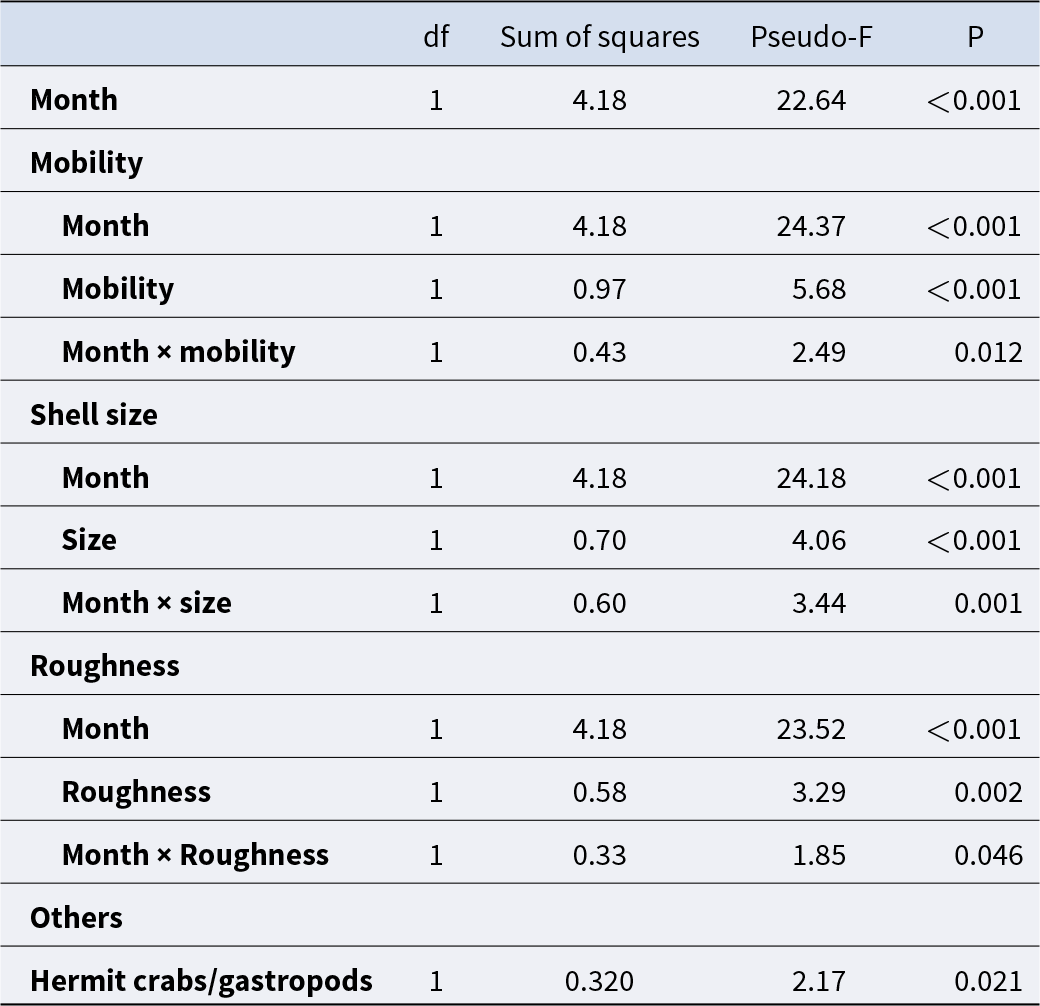
In the multivariate analysis, the one-way PERMANOVA showed statistically significant differences (p < 0.05) in the epibiont community according to month (April vs. May) (Table 2). Results of the two-way PERMANOVA demonstrated that the epibiont community showed statistically significant differences (p < 0.05) according to month, basibiont characteristics (mobility, shell size, and roughness of shell surface), and interactions among these factors. In addition, in May, the results of the one-way PERMANOVA showed statistically significant effects (p < 0.05) of the hermit crab on the epibiont community (Table 2).
Results of PERMANOVAs (9999 permutations) for epibiont assemblages: one-way analysis with month as a factor (April vs. May), and two-way analyses with month and other basibiont characteristics, namely: mobility (mobile and non-mobile), shell size (small and large shells), and roughness of shell surface (smooth and rough surfaces). Also included are results of one-way PERMANOVA to analyse effects of Hermit crabs on epibiont assemblages in May

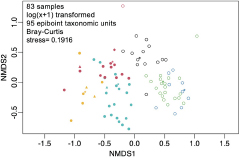
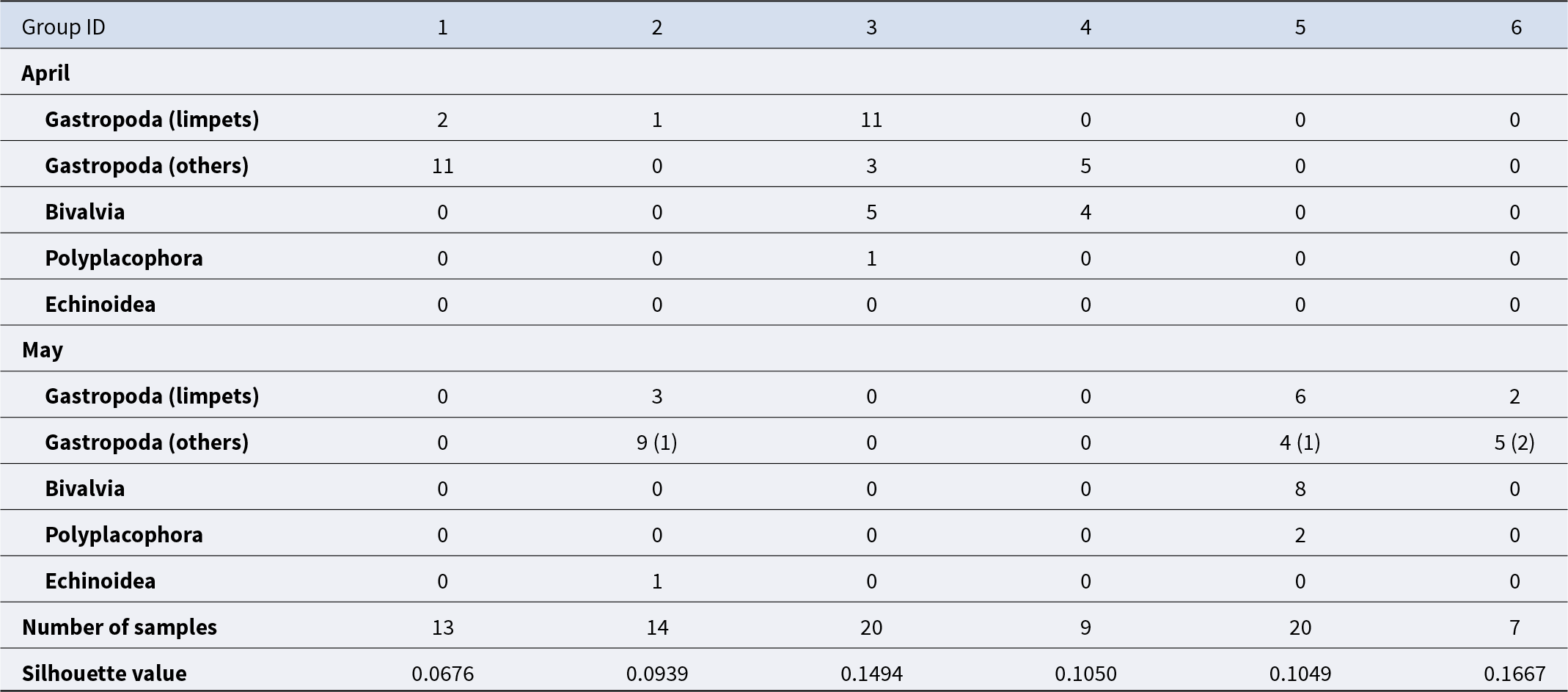
The two-dimensional ordination plot of nMDS using the Bray–Curtis dissimilarity (stress = 0.192) showed a usable representation of the variation of the community of epibiont and epilithic micro-organisms found on the shells and the plastic surfaces (Figure 4). Generally, the community composition differed between the sampling months (April and May). Six groups of assemblages based on the dissimilarity values were identified by the K-medoid cluster analysis (Figure 4 and Table 3). The number of samples in each of the groups ranged from 7 to 20 (Table 3). These groups are generally well separated from each other on the nMDS plot, except groups 3 and 4, which overlapped significantly (Figure 4). Medoid samples of each group were generally located at the centre of the points of the group (Figure 4). All samples belonging to groups 1, 3, and 4 were from April (Table 3). On the other hand, all samples belonging to groups 5 and 6, as well as most samples of group 2, were from May. The Bivalvia, Polyplacophora, and limpet-shaped Gastropoda samples were mainly categorised in group 3 (in April) or group 5 (in May), while the remaining Gastropoda samples were found in other groups.
Ordination by nonmetric multidimensional scaling (nMDS) of the assemblages of epibionts and periphitic micro-organisms (95 taxonomic entities). Open symbols are samples taken in April, and closed symbols are those taken in May. Circles are live molluscan substrates, triangles are shells occupied by hermit crabs, and a diamond is sea urchin. Colours indicate six groups identified by the K-medoid cluster analysis: black = group 1; red = group 2; green = group 3; dark blue = group 4; light blue = group 5; and yellow = group 6. Six symbols with asterisks on the upper-right indicate the medoid samples of each of the groups.

Number of samples and average silhouette values of K-medoid clusters for assemblages on invertebrate shells, hermit crabs, and plastics in April and May

Numbers in parentheses show gastropod shells inhabited by hermit crabs.
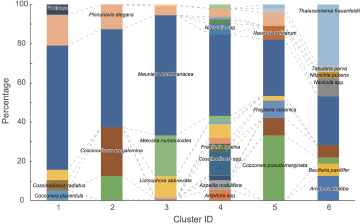
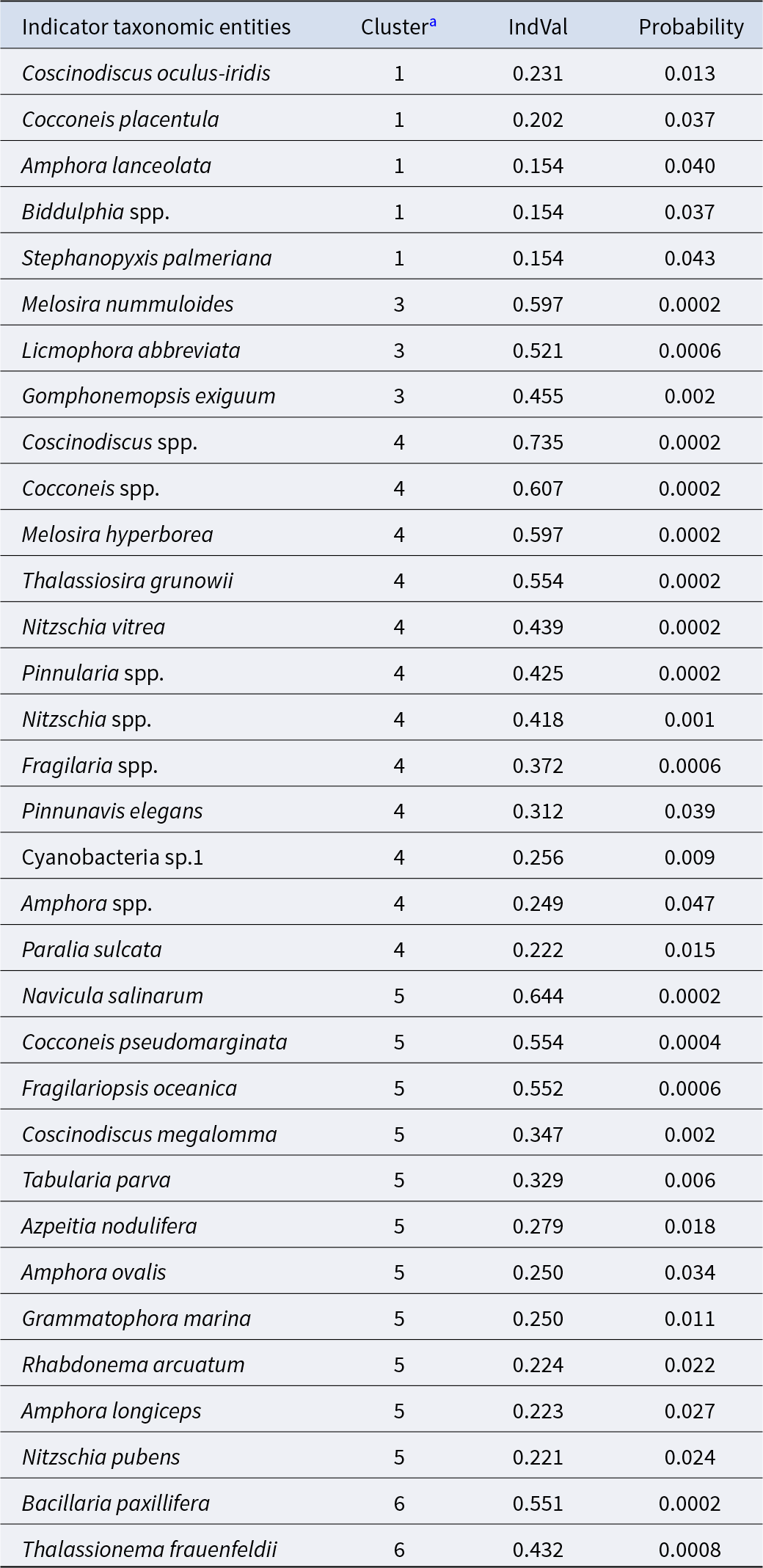
The analysis of IndVals identified indicator taxonomic entities in all the groups except for group 2 (Table 4). Several taxonomic entities appear to be distinctive representatives of each group (Table 4, Figure 5). Meuniera membranaceae showed a significant presence in all the medoid samples of the six groups (Figure 5); as a result, that species was not a useful indicator of any groups. On the other hand, some taxonomic entities occupied a high percentage of one medoid sample of the group (e.g., Cocconeis pseudomarginata in group 5, IndVal 0.554; Thalassionema frauenfeldii in group 6, IndVal 0.432), while several other taxonomic entities are seen in more than one group (Table 4, Figure 5).
The percentage composition of epibiont species observed in the medoid sample of the six groups, as shown in the nMDS plot.

Indicator taxonomic entities with their indicator value (IndVal) for the six clusters (permutation p < 0.05)

a Cluster 2 does not have any indicator taxonomic entities.
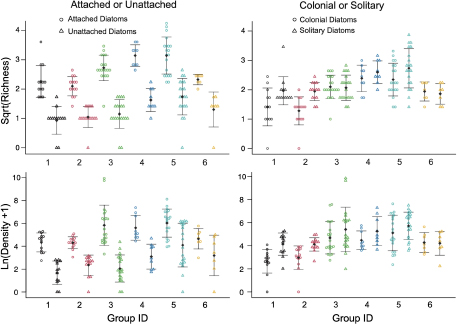
Diatoms were subdivided into 1) attached (62 taxonomic entities), 2) unattached (23 taxonomic entities), 3) colonial (41 taxonomic entities), and 4) solitary (44 taxonomic entities). Some substrates did not have unattached or colonial diatoms. So, comparisons to the original (95 taxonomic entities) assemblage by Mantel correlation and nMDS ordinations were carried out only for the attached and solitary diatoms. The attached diatoms showed a higher correlation (Mantel Pearson, 0.941, log (+1) transformed Bray–Curtis) with the original epibionts than the solitary diatoms (Mantel Pearson, 0.7849). The correlation between attached diatoms and solitary diatoms was 0.807 (Mantel Pearson), where only 31 species were common.
The taxonomic richness of attached diatoms was higher than unattached diatoms in all six groups (Figure 6). The lowest taxonomic richness of unattached diatoms was in group 1, while the highest was in group 5. The taxonomic richness of diatoms among the solitary and colony-forming diatoms did not differ much in any of the six groups. Similarly, the density of attached diatoms was generally higher than the unattached ones in all the six groups (Figure 6). The lowest density of unattached diatoms was observed in group 1. The densities remained more or less the same in solitary and colony-forming diatoms in all six groups.
Mean (±SD) of taxonomic richness and cell density of diatoms in the six groups identified by K-medoid analysis. Diatoms are divided into attached or unattached, and colonial or solitary taxonomic groups.

Discussion
In this study, 16 basibiont species (Gastropoda, Bivalvia, Polyplacophora, and Echinoidea) were analysed in terms of the community composition of microscopic epibionts. The results of this study provided a comprehensive picture of the epibiont communities on a variety of intertidal basibionts on the shore in spring. The communities exhibited significant temporal changes within a month (from April to May) and showed significant differences depending on the characteristics of the basibionts.
K-medoid groups
The multiplicative beta diversity of taxonomic richness (9.49) observed in this study was rather large in comparison to the beta of Simpson diversity (1.75). This indicated that variation between samples appeared to be smaller when focusing on the abundant taxonomic entities than when giving equal weighting to all the taxonomic entities (Chao et al., Reference Chao, Chiu and Hsieh2012; Jost, Reference Jost2007). In fact, Meuniera membranacea, the most abundant taxonomic unit, occurred in all six of the medoid samples (Figure 5). Despite this similarity in the abundant taxonomic unit, our K-mediod analysis allowed us to identify six groups of epibiont communities. Commonness of the abundant epibiont species on molluscan shells was also observed in the previous study we carried out in three geographical regions in Japan (Takada and Kanavillil, Reference Takada and Kanavillil2024).
The six groups identified by K-medoids analysis were generally separated according to the two sampling months (April and May), indicating the changing effects of season (early April and mid-May) on taxonomic richness, Simpson diversity, density, and community composition. The present result also showed a correlation between the K-medoid groups and the basibionts’ higher taxonomic group (Table 3). This supports the earlier finding of Takada and Kanavillil (Reference Takada and Kanavillil2024) that the epibiont community differed according to the general morphology of molluscan basibionts: that is, the distinction between bivalves and globose gastropods, and limpets and chitons (the latter two are flat in shape).
Indicator taxonomic entities were recognised for five of the six groups. They characterised the identified groups. Melosira nummuloides, the highest IndVal species of group 3, is a benthic diatom exhibiting euryhaline and eurithermal properties that help it colonise the sea-land transition zones (Prelle et al., Reference Prelle, Albrecht, Karsten, Damer, Giese, Jähns and Glaser2021). Similarly, Licmophora abbreviata, the second-highest IndVal species of group 3, is reported to survive well at low seawater temperatures, typically in spring (between 10 and 17°C) (Jung et al., Reference Jung, Safavi, Tam and Tsai2017). Because group 3 mostly comprised samples taken in April, it is reasonable to assume that these species were representative of group 3. Coscinodiscus oculus-iridis, the highest IndVal species of group 1, is known to survive in neritic marine water with high light availability (Medvedeva and Nikulina Tand Genkal, Reference Medvedeva and Nikulina Tand Genkal2009). In addition, Bacillaria paxillifera, the highest IndVal species of group 6, a motile euribiontic diatom found living in both freshwater and marine water, is capable of surviving in turbid waters (Ussing et al., Reference Ussing, Gordon, Ector, Buczkó and VanLandingham2005), indicating a possibility that the assemblage of group 6 was a product of the environmental fluctuation caused by frequent runoff of turbid freshwater from rivers in May (Naganuma, Reference Naganuma2000).
Community composition may also be influenced by the growth forms (attached or unattached) and growth characteristics (colonial or solitary) of diatoms (D’Alelio et al., Reference D’Alelio, Cante, Russo, Totti, Stefano, Seckbach and Dubinsky2010). The ability of diatoms to colonise a surface depends on their attachment properties, such as the type of attachment, namely prostrate vs. stalked or unattached. Additionally, the mobility or immobility of diatoms has an important role to play in the colonisation process (D’Alelio et al., Reference D’Alelio, Cante, Russo, Totti, Stefano, Seckbach and Dubinsky2010). This study showed that diatoms were the major component of epibiont communities. Among diatoms, the attached and solitary forms were predominant and outnumbered the colonial and unattached forms. This is an expected result as the attachment property facilitates the colonisation and growth of epibionts. The taxonomic unit that contributed the highest densities includes Meuniera membranacea (attached and solitary), L. abbreviata (attached and colonial), and Fragilariopsis oceanica (attached and colonial), showing that unattached diatoms were not among the abundant species. However, things changed by May; instead of the general dominance of the attached diatoms, the unattached ones increased their presence in groups 5 and 6 (made up entirely of May samples), indicating a temporal change in the epibiont community. However, this study was not designed to examine the detailed mechanisms affecting the relative increase in the taxonomic richness and density of unattached diatoms in May. For this, future study is needed, with more separate sampling events through spring and summer.
Temporal changes
In spring, coastal environmental conditions at Niigata change rapidly (Naganuma, Reference Naganuma2000). This study was conducted in April and May, when the ‘spring bloom’ of offshore phytoplankton was coming to an end (Yamada et al., Reference Yamada, Ishizaka, Yoo, Kim and Chiba2004; Terauchi et al., Reference Terauchi, Tsujimoto, Ishizaka and Nakata2014). Abundance of epilithic microalgae on temperate rocky shores generally increases in winter and decreases in summer (Hill and Hawkins, Reference Hill and Hawkins1991; Jenkins et al., Reference Jenkins, Arenas, Arrontes, Bussell, Castro, Coleman, Hawkins, Kay, Martínez, Oliveros, Roberts, Sousa, Thompson and Hartnoll2001; Thompson et al., Reference Thompson, Moschella, Jenkins, Norton and Hawkins2005). Warmer water temperatures and the arrival of water runoff from agriculture fields with higher nutrient content may drive changes in the epibiont community (Martins et al., Reference Martins, Faria, Furtado and Neto2014; Bulleri et al., Reference Bulleri, Pardi, Tamburello and Ravaglioli2020). In this study, a temporal change in epibiont community composition was also observed (PERMANOVA, Table 2). On the other hand, the univariate one-way analysis did not detect any significant effects of month on the taxonomic richness and the cell density of the epibionts (Supplemental Table S2). This may partly be due to the brevity of the research period (one month), making it hard to observe seasonal differences or major shifts in the data. However, significant interaction terms in certain combinations of factors (Month × Mobility and Month × Size) indicated that the temporal effects may be a function of basibiont characteristics. This study, spanning over a month during rapidly changing environmental conditions, indicates that the impacts of changing environmental conditions result in variation of epibiont communities. However, as mentioned above, the brevity of the study period throws limitations to generalising the trends observed in this study to other areas and those with longer observation periods.
Along with the environmental changes during the study period in spring, physiological and behavioural features of basibionts were likely to change during this period, which may, in turn, affect the epibiont community as detected in the interaction terms. With increasing temperature, the activity of basibionts is likely to increase. For example, the weight of soft body and gonad of Mytilus galloprovincialis, a filter-feeding bivalve, increases in spring (Sumikawa et al., Reference Sumikawa, Sakamoto and Shiraishi1985; Tokairin, Reference Tokairin2019). The amplitude of the vertical distribution zone in the intertidal area of some grazing gastropods (Cellana grata, C. toreuma, Monodonta confusa, Siphonaria japonica, and Tegula pfeifferi carpenteri) decreases in spring, thereby providing access to more epilithic microalgae as food (Yajima and Kosaka, Reference Yajima and Kosaka1979). Increase in the grazing activity of mobile gastropods can result in increased grazing of epibionts, which may, in turn, change the composition of the epibiont community (Wahl and Sönnichsen, Reference Wahl and Sönnichsen1992; McGowan and Iyengar, Reference McGowan and Iyengar2017).
Basibiont characteristics
Epibiont community has been studied on various aquatic organisms previously. However, most of these studies involved only a limited number of substrates, such as seagrass (De Stefano et al., Reference De Stefano, Marino and Mazzella2000), Porifera (McClintock et al., Reference McClintock, Amsler, Baker and Van Soest2005), Hydrozoa (Romagnoli et al., Reference Romagnoli, Bavestrello, Cucchiari, De Stefano, Di Camillo, Pennesi and Totti2007), Bryozoans (Wuchter et al., Reference Wuchter, Marquardt and Krumbein2003), gastropods (Gillan DC and Cadée GC, 2000; D’Alelio et al., Reference D’Alelio, Cante, Russo, Totti, Stefano, Seckbach and Dubinsky2010; Thyrring et al., Reference Thyrring, Thomsen, Brunbjerg and Wernberg2015; Kagawa et al., Reference Kagawa, Uchida, Yamazaki, Osawa, Ito and Chiba2020), bivalves (Barillé et al., Reference Barillé, Le Bris, Méléder, Launeau, Robin, Louvrou and Ribeiro2017), and crustaceans (Stachowitsch, Reference Stachowitsch1980; Gutiérrez and Palomo, Reference Gutiérrez and Palomo2016). Takada and Kanavillil (Reference Takada and Kanavillil2024) studied the epibiont community on 31 molluscan species at three sites across a large geographic range in Japan; however, only molluscan shells were examined.
This study revealed the composition of epibiont communities on 16 basibiont species which co-occurred in the intertidal zone in Niigata. The samples were thought to represent the overall local epibiont community; however, each of the community samples can vary from individual to individual of the same basibiont unit (species) depending on the microenvironment they are in. For example, individual basibionts belonging to the same species found on exposed rock surfaces may have a different epibiont community from those found in crevices. The result of this study demonstrated that the alpha diversity values, both of the taxonomic richness and the Simpson diversity, were found to be much smaller than the gamma (overall) diversity values, resulting in the large beta diversity.
Assuming that the epibiont community is affected by the behaviour, shell morphology, and shell surface texture of the basibiont species (Stachowitsch, Reference Stachowitsch1980; Wahl, Reference Wahl1989; Bell, Reference Bell2005; D’Alelio et al., Reference D’Alelio, Cante, Russo, Totti, Stefano, Seckbach and Dubinsky2010; Thyrring et al., Reference Thyrring, Thomsen, Brunbjerg and Wernberg2015; Pereira et al., Reference Pereira, Piló, Carvalho, Rufino, Moura, Vasconcelos and Gaspar2022), it is reasonable to assume that a similar epibiont community develops on the shell of the same basibiont species. In support of this, Takada and Kanavillil (Reference Takada and Kanavillil2024) found that the beta diversity within the same basibiont species was relatively smaller than the diversity between basibiont species. The results of this study explored the relative importance of basibiont characteristics (mobility, shell size, and roughness of shell surface) as the explanation for the beta diversity.
Intertidal grazing gastropods show an activity pattern that matches tidal and diurnal cycles (Iwasaki, Reference Iwasaki1994; Takada, Reference Takada2001): generally, they are active during submerged or swashed tidal conditions at night and inactive when tides are low in daytime. At the sampling site in Niigata, the grazing gastropods hide in crevices when they are inactive. Thus, this activity pattern is a possible mechanism affecting the epibiont community. The result would be low light intensity for the epibiont microalgae found on the grazing gastropod shells during their inactive phase (which would be mostly in daytime) in comparison to conditions on the immobile bivalve shells. Thus, temporal changes in the bivalves’ activity may be a source of significant interaction terms.
The communities of epibiont micro-organisms on shells occupied by hermit crabs fell into several groups (Figure 4), indicating a high variability in the community composition of these samples. The taxonomic richness of epibionts was significantly higher on these natural shell surfaces.
For hermit crabs, as well as gastropods, variability in activity pattern and microhabitat use (Stachowitsch, Reference Stachowitsch1980; Hazlett, Reference Hazlett1981; Barnes, Reference Barnes1997; Turra and Denadai, Reference Turra and Denadai2003) affect the epibiont community (Creed JC, 2000). On the other hand, macroscopic epibionts affect shell use by hermit crabs (Stachowitsch, Reference Stachowitsch1980). These factors may be responsible for the large variability of the epibiont community on the shells occupied by hermit crabs in this study; however, the shortage of data prevented further exploration of this issue. The variation in epibiont community observed between the moving and sessile basibiont shells has to be viewed with caution as it has the potential to get confounded by the taxonomical variation among the basibionts being studied (Takada and Kanavillil, Reference Takada and Kanavillil2024). In addition, the epibiont community might also be influenced by the antifouling secretions of basibionts (Ogunola and Onada, Reference Ogunola and Onada2016).
Looking at the basibiont shell as an ‘island’, the size of a basibiont can affect the taxonomic richness, diversity, and density of its epibionts (MacArthur and Wilson, Reference MacArthur and Wilson1963; Martins et al., Reference Martins, Faria, Furtado and Neto2014; Relyea, Reference Relyea2021). In an aquatic environment, this is an expected result as larger shells provide more chance for settlement of propagules, survival, and surface stability compared to smaller ones, thereby leading to a higher taxonomic richness, diversity, and cell density of the epibionts on them (Martins et al., Reference Martins, Faria, Furtado and Neto2014). The alternative explanation that larger shells provide a longer period for settlement and development for the epibionts during shell development can be rejected because of the larger variations observed between samples in May and April. The present result indicated that the strength of the size effect changed over time. This was also supported by the fact that no macroscopic epibionts, which generally required longer period to develop than microscopic ones, were found in this study. In this study, the size effect can be more clearly perceived in May than in April (Figure 2), implying that the chance of epibiont settlement, survival, and stability may change during this period. On the other hand, the samples of the large basibionts in this study were (unintentionally) biased in favour of bivalves and non-mobile basibionts. Thus, the present results may be a possible by-product of this sampling bias in terms of basibiont species, and further research will be needed to clarify the effects of basibiont size alone.
The surface roughness of a substrate has been described as an important surface characteristic that can influence the settlement and growth of diatoms on wet surfaces (Sweat and Johnson, Reference Sweat and Johnson2013). The importance of roughness has also been demonstrated by observations of epibionts on molluscan shells (D’Alelio et al., Reference D’Alelio, Cante, Russo, Totti, Stefano, Seckbach and Dubinsky2010). The result of this study showed a higher cell density of the epibionts on smooth shell surfaces than on rough shell surfaces (Figure 2). A similar pattern of diatom settlement was reported by Sweat and Johnson (Reference Sweat and Johnson2013), who also observed higher diatom settlement on smooth surfaces than the rough ones. Scardino et al. (Reference Scardino, Harvey and de Nys2006), using attachment point theory, explained the higher diatom settlement on smooth surfaces as follows. Smooth surfaces, according to Scardino et al. (Reference Scardino, Harvey and de Nys2006), offer more points of contact for diatoms, leading to more diatom settlement. In addition, the taxonomic richness and Simpson diversity of epibionts were found to be higher on smooth shell surfaces than on rough shell surfaces. However, an important fact to consider here is the relative diversity of basibiont species composition on which the epibiont communities were studied. Generally, smooth shells belonged to some bivalves and chitons (Table 1) while rough ones were typical of gastropods. Thus, the observed trend might be due to the associations between roughness and particular taxa, basibiont behaviour, or other factors. At any rate, given the community composition of intertidal basibionts on the shores of Niigata, the loss of bivalves could have a greater effect on the overall community of epibionts than would the loss of gastropods. In this study, three factors, basibiont mobility, size, and surface roughness, were investigated. These are only a subset of the characteristics of engineered habitats that are provided by basibionts. Different basibiont characteristics may correlate with each other or may have phylogenetic constraints. Some other factors that might influence the epibiont community include the metabolic by-products of organisms such as the antifouling agents that limit the growth of epibionts on their shell surface (Ogunola and Onada, Reference Ogunola and Onada2016), grazing activities (Wahl et al., Reference Wahl, Kroger and Lenz1998), tidal exposures, etc.
This example of basibiont-epibiont community dynamics demonstrates the conceptual context of a ‘facilitation cascade’ via habitat formation and modification as outlined by Thomsen et al (Reference Thomsen, Wernberg, Altieri, Tuya, Gulbransen, McGlathery, Holmer and Silliman2010). Here, the shells of invertebrates in the intertidal zones act as primary habitat-formers, while the epibionts act as the secondary habitat-formers leading to higher species diversity and abundance in the habitat overall. This process has been noted in other ‘biological engineer-driven’ habitats such as forests, seagrass meadows, salt marshes, and seaweed beds. For microscopic diatoms, relatively larger diatoms can act as an attachment substrate (Tiffany and Lange, Reference Tiffany and Lange2002). Habitat cascade like this may further increase the diversity of epibiont community on the shore. Because basibiont shells provide ‘ecologically engineered’ habitats for epibionts, changes in the basibiont community on a shore will produce changes in the epibiont community. Yajima (Reference Yajima1978) and Yajima and Kosaka (Reference Yajima and Kosaka1979) showed spatial and temporal variations in macro-benthic communities on rocky shores in Ishikawa, an area adjacent to our study site in Niigata, Japan. In addition, long-term changes in the molluscan fauna of rocky shores have been recognised around Japan, as seawater temperatures rise (Kurihara et al., Reference Kurihara, Takami, Kosuge, Chiba, Iseda and Sasaki2011). Such changes in basibiont communities may, in turn, change the overall epibiont community on the shore. On the other hand, there is some evidence that the growth of macroscopic epibionts affects basibionts (Wahl et al., Reference Wahl, Hay and Enderlein1997; Dougherty and Russell, Reference Dougherty and Russell2005; Barillé et al., Reference Barillé, Le Bris, Méléder, Launeau, Robin, Louvrou and Ribeiro2017). Microscopic epibionts can also affect the basibionts (Wahl et al., Reference Wahl, Goecke, Labes, Dobretsov and Weinberger2012; Golubic and Schneider, Reference Golubic, Schneider, Krumbein, Paterson and Zavarzin2003).
In conclusion, this study revealed high variability in the epibiont community on intertidal shelled organisms. Some of the differences could be explained by the relative mobility, size, and surface roughness of the basibionts. The effects of these factors changed over a one-month period in spring. It is reasonable to expect that changes in the basibiont community will promote further changes in the epibiont community on these shores.
Supplementary material
The supplementary material for this article can be found at https://doi.org/10.1017/S0025315425100994.
Acknowledgements
Dr. Lesley Lovett-Doust, Nipissing University, Dr. Todd Stubbs and Dr. Tim Kaiser of Lakehead University, Canada, and Dr. V.P. Venugopalan, Former OS & Director, Bioscience Group, Bhabha Atomic Research Centre, Mumbai, are thanked for their edits and comments. Lakehead University, Canada, is also acknowledged for all the support and encouragement.
Author contributions
NK and YT designed the research project and performed fieldwork. NK identified and counted epibiont microalgae. YT analysed the data. Then, NK and YT wrote the manuscript.
Funding
This study was partly supported by the Japanese Society for Promotion of Science Invitational Fellowship to NK (2019, #S19014).
Competing interests
The authors have no relevant financial or non-financial interests to disclose and have no conflicts of interest.
Data availability
The datasets generated during and/or analysed during the current study are available from the corresponding author upon request.
Ethical standard
This manuscript does not have any ethical standard issues to report.