

Introduction
The name Asplenium falcatum Lam. has been applied in the literature to plants found from the Comoros Archipelago, Madagascar and the Mascarenes to Sri Lanka, South and Northeast India, South China, Southeast Asia and Malesia, including the Philippines. This name has had a complex history of adoption and rejection by fern taxonomists, so the Philippine material under this name has been studied to determine its true identity.
Taxonomic Treatment
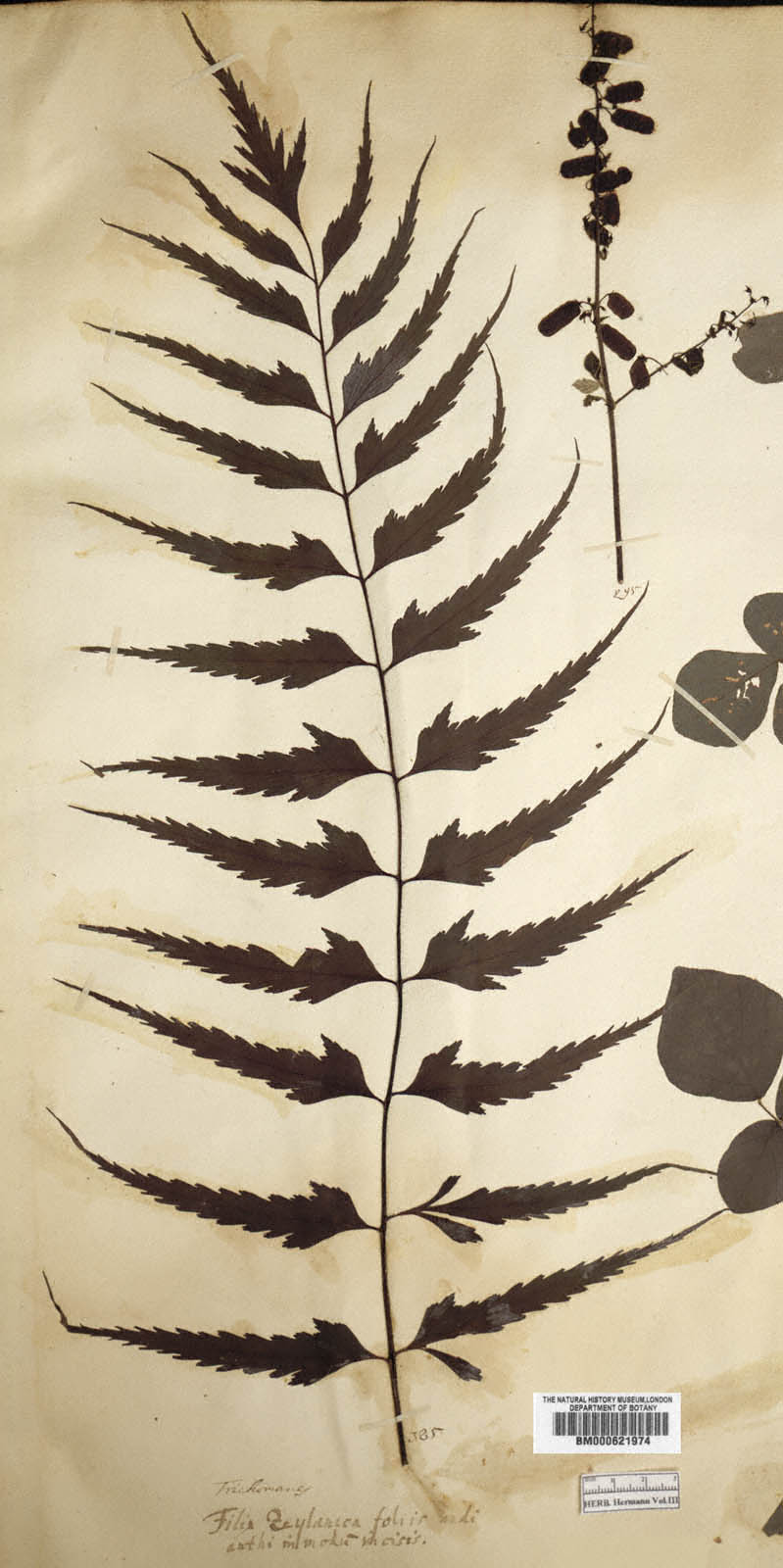
Linnaeus (Reference Linnaeus1753) initiated this confusion of identity and nomenclature by naming two different species Trichomanes adiantoides. In his Encyclopédie Méthodique, Lamarck (Reference Lamarck1786) recognised two errors in Linnaeus's protologue. First, the plants described are not in Trichomanes but in Asplenium, and second, the specimens cited by Linnaeus belong to two species, one from Africa and the other from Sri Lanka. Lamarck transferred the two species to Asplenium, naming the African species Asplenium adiantoides and the Sri Lankan one Asplenium falcatum. The Linnaean species from Sri Lanka is based on a drawing by Burman (Reference Burman1737), which in turn was made from a plant collected by Paulus Hermann (Reference Hermann1717). Linnaeus (Reference Linnaeus1747) studied the Hermann specimen, which is now found in Herb. Hermann 3: 47, no. 385, at BM-SL Historical Collection, and annotated it with the number 385, the same number he used for Trichomanes adiantoides in his Flora Zeylanica (1747). For a detailed history of this nomenclatural problem, see Salgado & Fraser-Jenkins (Reference Salgado and Fraser-Jenkins2013).
Lamarck, however, created two new taxonomic and nomenclatural problems when, on page 306 of the Encyclopédie (1786), he confused plants collected by Commerson in Mauritius (Commerson s.n. in Herb. Lamarck and Herb. Jussieu, P; Muséum national d'histoire naturelle, no date) with the plant collected by Hermann in Sri Lanka (Natural History Museum, no date), which he, Lamarck, had named Asplenium falcatum. Commerson's and Hermann's plants are superficially similar but differ in the shape and serration of the pinna margin, shape and margin serration of the apical segment, and morphology of the sori. They are different species (Salgado & Fraser-Jenkins, Reference Salgado and Fraser-Jenkins2013). Salgado and Fraser-Jenkins (Reference Salgado and Fraser-Jenkins2013) selected the drawing in Burman's Thesaurus Zeylanicus, t. 43 (1737) as the lectotype of Asplenium falcatum Lam., the plant from Sri Lanka. A new name, therefore, must be provided for the species collected by Commerson in Mauritius.
Lamarck (Reference Lamarck1786) also used the name Asplenium falcatum twice, first on page 306, no. 19, and again on page 308, no. 29. Both plants had been collected by Commerson; no. 19 on the Île de France (Mauritius), and no. 29 on the Île de Bourbon (La Réunion). By simultaneously publishing the name Asplenium falcatum twice, Lamarck added to the confusion of names and species.
Morton (Reference Morton1967) proposed the epithet polyodon to replace falcatum, which he considered illegitimate (Salgado & Fraser-Jenkins, Reference Salgado and Fraser-Jenkins2013). It is reported here that Asplenium falcatum, based on a Sri Lankan type, is not found in Malesia, which includes the Philippines. Most Southeast Asian and Malesian collections assigned to Asplenium falcatum belong to A. macrophyllum Sw., A. oxyphyllum Kunze or unnamed species from Luzon, Borneo or the Lesser Sunda Islands. Asplenium falcatum is found in Sri Lanka, South, Central and Northeast India, Myanmar and Thailand, but not in the Philippines.
Smith (Reference Smith1841) published the name Asplenium oxyphyllum without a description in his Enumeratio Filicum Philippinarum, a list of ferns collected by H. Cuming during his expedition to the Philippines and Malaysia between the years 1836 and 1840. Gustav Kunze (Reference Kunze1846) validly published Asplenium oxyphyllum 5 years later, using the name given by Smith in 1841. Christensen (Reference Christensen1905) lists Asplenium oxyphyllum Kunze as a synonym of A. macrophyllum Sw., which it is not. Asplenium oxyphyllum (Cuming 42, BM, K, P, L, US) from Luzon, the Philippines, agrees in every character with Commerson's specimens mentioned by Lamarck (Reference Lamarck1786) as A. falcatum. Asplenium oxyphyllum is the earliest of all the available names that can be used unequivocally. The name Asplenium oxyphyllum Kunze is here applied to the specimen collected by Commerson in the Île de France (Mauritius) and mentioned by Lamarck on page 306, no. 19 (1786). Asplenium oxyphyllum is found in Madagascar, the Mascarenes, Southeast Asia, West Malesia, the Philippines, South China (Hainan and Hong Kong) and Taiwan. As far as can be confirmed at this time, it is absent east of Java and from the Lesser Sunda Islands.
The following key distinguishes three commonly confused species of Asplenium in Southeast Asia and the Philippines.
Diagnostic Key to the Species
-
1a. Fronds simple or pinnate; stipe as long as or longer than lamina; pinnae 0–5(9) pairs, trapezoid-elongate to lanceolate, straight, 2.5–7 cm wide near the base, (7.7–)12–21.6 cm long; pinna base acroscopic side rounded or broadly cuneate, basiscopic side cuneate; pinna apex acute to acuminate; apical segment occasionally deltoid in young plants, much larger than the pinna, 4–10 cm at the widest point, usually with one or two prominent acute lobes near the base, margin finely and unevenly serrate to crenate, base cordate to very broadly and evenly cuneate or truncate; sori of different lengths_________________________A. macrophyllum
-
1b. Fronds always pinnate; stipe equal to or shorter than lamina; pinnae 6–16 pairs, lanceolate-elongate, falcate, (0.5–)1–2 cm wide near the base, (5)6–12(15) cm long; pinna base cuneate, pinna apex acuminate; apical segment slightly wider than pinnae, 1–2(3.2) cm wide at the widest point, with one or two rounded or acute lobes near the base, margin sharply toothed, base evenly cuneate, never truncate or cordate; sori extending from near the costa to near the margin_________________________2
-
2a. Pinna base with an acroscopic prominent acute tooth, pinna margin doubly dentate with prominent teeth and small acute apical teeth; lamina apical segment margin doubly and sharply dentate, basal teeth large; sori not always contiguous, short and long sori mixed, long sori extending from near the costa to near the margin_________________________A. falcatum
-
2b. Pinna base with or without a rounded acroscopic lobe, prominent acute tooth never present; pinna margin notched, unevenly serrate or dentate; lamina of apical segment margin finely dentate, with or without one or two basal teeth; sori contiguous, short sori absent, long sori extending from costa to near the margin_________________________A. oxyphyllum
Acknowledgements
The author is most grateful to Ms Alison Paul (BM), Dr Germinal Rouhan (P), Dr Peter Hovenkamp (L), Ms Roxali Bijmoer (L) and the staff of the Natural History Museum, London, the Royal Botanic Gardens, Kew, England, the Muséum national d'histoire naturelle, Paris, and the Naturalis Biodiversity Centre, Leiden, for their assistance and for providing access to their collections.