Implications
Feed supplementation with thymol could be a useful strategy to ameliorate the negative consequences that sustained elevated environmental temperatures induce on endocrine, biochemical and immune-related variables. In the current global warming scenario, heat waves and elevated temperatures are at times unavoidable, even more in tropical and sub-tropical countries. Particularly, the poultry industry could benefit from the use of thymol as a new functional feed strategy providing it improves bird’s antioxidant status, enhances inflammatory processes, prevents the organism from the excessive energy expenditure related to humoral activation, and helps to better cope with chronic heat stress (CHS) challenges.
Introduction
Exposure to high environmental temperatures for extended periods of time induces a number of physiological changes described as CHS, impacting on poultry species’ production, health and welfare (Mashaly et al., Reference Mashaly, Hendricks, Kalama, Gehad, Abbas and Patterson2004; Quinteiro-Filho et al., Reference Quinteiro-Filho, Ribeiro, Ferraz-de-Paula, Pinheiro, Sakai, Sá, Ferreira and Palermo-Neto2010; Calefi et al., Reference Calefi, Quinteiro-Filho, Ferreira and Palermo-Neto2017). As other stressors, heat stress is perceived and then integrated in the avian’ immune-neuroendocrine (INE) interplay, which involves an interaction between three main systems: immune, nervous and endocrine (Elenkov et al., Reference Elenkov, Wilder, Chrousos and Vizi2000; Calefi et al., Reference Calefi, Quinteiro-Filho, Ferreira and Palermo-Neto2017). Once the stress response is triggered, the physiological reaction comprises the release of several mediators, such as corticosterone, catecholamines, cytokines, etc., which are initially aimed to overcome the challenging situation. Afterward a recover of basal levels is expected to sustain the homeostasis (Elenkov et al., Reference Elenkov, Wilder, Chrousos and Vizi2000; Calefi et al., Reference Calefi, Quinteiro-Filho, Ferreira and Palermo-Neto2017).
The maintenance of avian’ health and welfare is closely related to the immune competence (innate and acquire components). The innate component (characterized by a prompt response and low specificity) allows a rapid elimination or neutralization of foreign antigens. If this is not effective enough, the acquired component would then be activated (involving high specificity and memory) mediated by cells and antibody production and therefore requiring more time to develop an optimal response (Davison, Reference Davison2013; Scanes, Reference Scanes2014). Negative CHS impacts have been associated with the sustained activation of the hypothalamic-pituitary-adrenal axis, especially elevated corticosterone concentrations, which induces long-term changes in energy, lipid and proteins components (Sahin et al., Reference Sahin, Onderci, Sahin, Gursu, Khachik and Kucuk2006; Ma et al., Reference Ma, Lin, Zhang, Chen, Wang, Ruan and Jiang2014). Several negative CHS effects have been described: modulation of metabolic variables indicative of oxidative damage (Azad et al., Reference Azad, Kikusato, Maekawa, Shirakawa and Toyomizu2010), alterations in the microflora and intestinal mucosa morphology (Quinteiro-Filho et al., Reference Quinteiro-Filho, Ribeiro, Ferraz-de-Paula, Pinheiro, Sakai, Sá, Ferreira and Palermo-Neto2010), increases in heterophil to lymphocyte (H/L) ratio (Campo and Dávila, Reference Campo and Dávila2002; Mashaly et al., Reference Mashaly, Hendricks, Kalama, Gehad, Abbas and Patterson2004; Zulkifli et al., Reference Zulkifli, Al-Aqil, Omar, Sazili and Rajion2009; Prieto and Campo, Reference Prieto and Campo2010), decreases in inflammatory response to phytohemagglutinin-p (PHA-P) together with diminishes macrophage activity (Sandhu et al., Reference Sandhu, Mirza, Afzal and Mukhtar2012), and lower antibody titers against sheep red blood cells (SRBC), Newcastle virus, and infectious bursitis (Sahin et al., Reference Sahin, Onderci, Sahin, Gursu, Khachik and Kucuk2006; Gasparino et al., Reference Gasparino, Voltolini, Del Vesco, Guimarães, do Nascimento and de Oliveira Neto2013; Nazar et al., Reference Nazar, Videla, Fernandez, Labaque and Marin2018). A recent report with juvenile Japanese quail exposed to the same CHS protocol applied in the present study showed that corticosterone, as well as cellular and humoral immune variables, were strongly affected by the stress exposure (Nazar et al., Reference Nazar, Videla, Fernandez, Labaque and Marin2018). Furthermore, some of those variables were still affected even 9 days after the CHS exposure.
Several strategies have been proposed in order to alleviate or compensate the negative effects of chronic heat exposure on poultry species. For example, environmental enrichment, changes in food and water provision, and genetic selection of heat-resistant strains are some of the proposed approaches (Renaudeau et al., Reference Renaudeau, Collin, Yahav, de Basilio, Gourdine and Collier2012). Dietary supplementation with components with antioxidant properties such as tocopherol, vitamins C and E, tomato powder, curcumin, niacin, capsaicin and allicin have been already tested (Campo and Dávila, Reference Campo and Dávila2002; Prieto and Campo, Reference Prieto and Campo2010; Dai et al., Reference Dai, Gao, Zhang, Song, Xu and Zhou2011; Sahin et al., Reference Sahin, Onderci, Sahin, Gursu, Khachik and Kucuk2006 and Reference Sahin, Orhan, Tuzcu, Tuzcu and Sahin2012; Sandhu et al., Reference Sandhu, Mirza, Afzal and Mukhtar2012). Thymol (a major component of oregano (Origanum vulgare)) has been shown in broilers and quail to induce changes in performance parameters and immune responses (Hashemipour et al., Reference Hashemipour, Kermanshahi, Golian and Veldkamp2013; Lábaque et al., Reference Lábaque, Kembro, Luna and Marin2013). Besides its antioxidant activity, thymol has also shown antiviral, bactericidal and stress/anxiety reducing properties (García et al., Reference García, Bujons, Vale and Suñol2006; Lábaque et al., Reference Lábaque, Kembro, Luna and Marin2013; Ezzat Abd El-Hack et al., Reference Ezzat Abd El-Hack, Alagawany, Ragab Farag, Tiwari, Karthik, Dhama, Zorriehzahra and Adel2016). However, at present, there is no information whether thymol can actually help to modulate the effects of a CHS exposure. Thus, considering that in many of the poultry production systems, exposure to high environmental temperatures is practically unavoidable, this study aims to assess whether a thymol dietary supplementation can be used as a strategy to mitigate heat stress related deleterious effects on INE-related variables such as inflammatory response, antibody production, H/L, plasma corticosterone, albumin, total proteins and globulins and glucose concentrations. We hypothesize that immune and biochemical variables in adult quail will still be affected 3 days after the CHS protocol ended and that the supplementation with thymol will also influence the mentioned variables interacting with the heat stressor. We predict that plasma corticosterone concentrations will show basal levels as soon as 3 days after CHS protocol ended. However, some components of the immune and biochemical responses will still show alterations minimized by the thymol supplementation.
Material and methods
Animals and husbandry
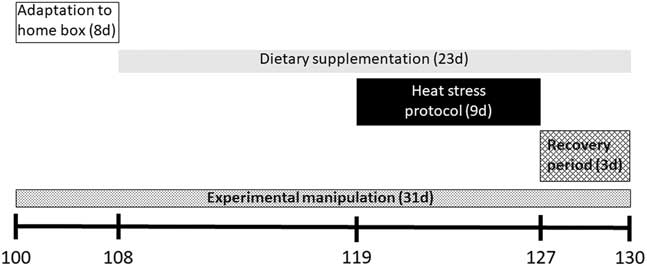
Adult female Japanese quail were used in this study as a laboratory animal, because of its small size, short life cycle and low maintenance costs (Huss et al., Reference Huss, Poynter and Lansford2008). Quail were raised according to laboratory routines described elsewhere (Lábaque et al., Reference Lábaque, Kembro, Luna and Marin2013; Nazar et al., Reference Nazar, Barrios, Kaiser, Marin and Correa2015). A total of 48 100-days-old female quail were randomly selected from an initial group of 120 chicks. In all, 48 home boxes were distributed in the experimental rooms. Although in each home box only one female quail was housed, two boxes were positioned (paired) facing each other and separated by a metal mesh to avoid quail’s visual and auditory isolation. Boxes were covered by a mesh lid to avoid potential escapes. Quail were allowed 8 days to habituate to the home cages before experimental manipulations started (see Figure 1 for timeline scheme). White wooden cages measured 45×45×45 cm (high×width×long), and contained a feeder and a nipple drinker that provided free access to food and water during the whole experiment. Wooden shaves were used as litter and partially renewed weekly. The photoperiod was 14 h light and 10 h dark. The environmental temperature was maintained at 24±2°C.
Timeline scheme. Dietary supplementation began at 108 days of age (12 days before chronic heat stress started, 119 days of age) and continued until after samples were taken (130 days of age). Quail received a thymol dose equivalent to 80 mg/quail per day. Heat stress protocol was applied during 9 consecutive days (119 to 127 days of age) and achieved by increasing room temperature from 24°C to 34°C during daylight h.

Experimental design
A 2×2 factorial experimental design was established with dietary supplementation (Non-supplemented v. Supplemented) and CHS exposure (Non-stressed v. Stressed) as factors. Thus, four treatments combinations were evaluated with 12 female quail randomly assigned to each of them (48 quail total) as follows: Non-Supplemented–Non-Stressed, Non-supplemented–Stressed, Supplemented–Non-Stressed and Supplemented–Stressed.
Dietary supplementation
Thymol was commercially obtained from Sigma-Aldrich (SAFC®, ⩾99%; FCC, Saint Louis, MO, USA). Two g of thymol per kg of feed (equivalent to a dose of ≈80 mg of thymol/day per quail) was provided to supplemented quail. Thymol was prepared in a 2.4% w/v ethanolic solution and uniformly sprayed on fresh feed (Lábaque et al., Reference Lábaque, Kembro, Luna and Marin2013). The feed was weighted and provided weekly in a ratio of ≈40 g/quail per day, according to the dietary treatment. The supplementation started 12 days before the beginning of the CHS protocol (starting at 108 days of age) to reach the physiological plateau or stationary state of thymol in the organism (Krause et al., Reference Krause, Ternes, Krause and Ternes1999). The supplementation continued until after blood samples were obtained (130 days of age, see below).
Chronic heat stress protocol
Heat stress was applied during daylight h along 9 days (119 to 127 days of age, see Figure 1) and simulating a potential oscillation in the environmental temperature along a series of hot summer days. Thus, heat stress was daily induced by increasing the ambient temperature (from 24°C to 34°C) starting at 0830 h. The temperature was increased during a 2-h period (about +0.1°C/min) and maintained at 34±1°C until 1630 h. At 1630 h temperature was gradually lowered returning to 24°C approximately by 1930 h Control females remained unaltered during the completely experimental period (at comfort temperature, 24±2°C). The following 3 days (127 to 130 days of age) were used as a recovery period, reestablishing the thermoneutral temperatures (24±2°C). On the 3rd day of the recovery period, blood samples were obtained (see below).
Sampling procedures: endocrine, immune and biochemical determinations
Blood samples (~1 ml from the left brachial vein) were taken 3 days after CHS protocol ended (130 days of age), with syringes previously treated with ethylendiaminetetraacetic acid to prevent blood coagulation. Each quail was sampled only once. Quail were sampled in random order and in all cases, blood withdraw took less than 120 sec to avoid changes in plasma corticosterone concentrations due to the handling effects. One blood drop was used for smears preparation, and the rest was centrifuged at 2000×g for 15 min to obtain plasma samples for later determinations as blood metabolites, plasma corticosterone concentration and titers against SRBC (HEMO-G; Rafaela, Santa Fe, Argentina).
Corticosterone concentrations in plasma samples were determined following the methodology described in Nazar et al. (Reference Nazar, Videla, Fernandez, Labaque and Marin2018) and validated for Japanese quail. In brief, an ELISA Immune Assay using polyclonal antibodies, standards and their corresponding horseradish peroxidase conjugates (anti-corticosterone CJM006; Department of Population Health and Reproduction, C. Munro, UC Davis, CA, USA) was used. The polyclonal CJM006 antibody cross-react with: corticosterone 100%, desoxycorticosterone 14.25%, progesterone 2.65%, tetrahydrocorticosterone 0.90%, testosterone 0.64%, cortisol 0.23%, prednisolone 0.07%, 11-desoxycortisol 0.03%, prednisone <0.01%, cortisone <0.01% and oestradiol <0.01%. The intra- and interassay CV were <12% and 5.1%, respectively. Assay sensitivity was 0.078 ng/ml.
Blood metabolites: glucose, total proteins, total globulins and albumin concentrations were determined in the obtained plasma samples (Nazar et al., Reference Nazar, Videla, Fernandez, Labaque and Marin2018). These concentrations were determined with a clinical chemistry analyzer (Wiener Lab, Rosario, Argentina, Commercial kit: 2000, a Calorimetric method for determination of total protein, albumin and plasma transaminase) according to the manufacturer’s recommended procedure. Sensibility for each target molecule was: glucose=0.54 mg/dl; total proteins and total globulins=0.01 g/dl; albumin=0.01 g/dl. Intra- and inter-assay variability for each target molecule were 1.25% and 1.77% (glucose), 0.48% and 1% (total proteins and total globulins) and 2.27% and 3.78% (albumin). It is important to mention that based on the time chosen for sampling, results represented the regulatory metabolism of energetic and protein components and not the basal metabolism after fasting.
Inflammatory response to PHA-P (Sigma Chemical, St Louis, MO, USA; pH: 7.1) was assessed in the right wing-web as follows: 24 h before blood samples were obtained, the wing-web was measured with a digital caliper, then 0.05 ml of a 1 mg/ml PHA-P solution in phosphate saline buffer (PBS) was injected. A period of 24 h later and after blood sample withdrawal, the corresponding wing-web was measured again to determine the percentage of inflammation as follows:
Percentage of inflammation=(wing-web measurement (mm) 24 h before sampling day/wing-web measurement (mm) on the sampling day)×100 (Vinkler et al., Reference Vinkler, Bainova, Bainová and Albrecht2010; Nazar et al., Reference Nazar, Barrios, Kaiser, Marin and Correa2015).
Titers against SRBC were analyzed in plasma samples by a microagglutination assay in U bottom microagglutination plates. A week before blood samples were obtained each female was injected intraperitoneally with 0.3 ml of a 10% SRBC solution in PBS. Plasma obtained from blood centrifugation was previously complement inactivated by heating samples at 55°C for 30 min. A 30-µl plasma aliquot was used as pure sample, and other 30 µl were serially diluted in 30 µl PBS. Then, 30 µl of a 2% suspension of SRBC in PBS was added to each well. Microagglutination plates were incubated at 40°C for 45 min. Agglutination of the tested plasma samples was compared with the blanks (PBS only) and negative controls (wells with no SRBC suspension). Antibody titers were reported as log2 of the highest dilution yielding agglutination (Adriaansen-Tennekes et al., Reference Adriaansen-Tennekes, Decuypere, Parmentier and Savelkoul2009).
Blood smears were stained with May-Grünwald Giemsa to count and differentiate main white blood cells (heterophils, eosinophils, basophils, monocytes and lymphocytes). A total of 100 cells were counted per each smear using a white light optical microscope. Heterophil to lymphocyte ratio was then calculated for each female (Gross and Siegel, Reference Gross and Siegel1983).
Statistical analysis
Mixed GLM were used in order to analyze the effects of heat stress and dietary treatments of each biochemical, endocrine and immune variable. Dietary supplementation and CHS exposure were included as fixed effects and paired home cages were included as a random effect (code for the statistical model: see Supplementary Material S1). Data were analyzed according to their distribution and assumptions of the tests were verified. Heterophil to lymphocyte ratio and antibody titer data were transformed before analysis (Log10 and Square root, respectively). A P-value of<0.05 was considered to represent significant differences. Newman–Keuls test was used for post hoc comparisons. All statistical analyses were performed with an ‘R’ (The R Foundation for Statistical Computing) user-friendly interface implemented in InfoStat (Di Rienzo et al., Reference Di Rienzo, Casanoves, Balzarini, Gonzalez, Tablada and Robledo2016).
Results
Corticosterone
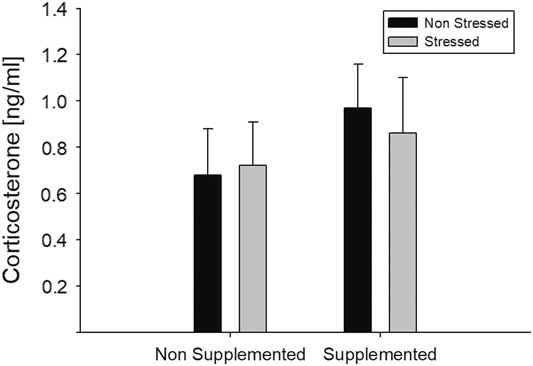
A period of 3 days after CHS ended, neither supplementation nor CHS treatment effects were observed (F 1,44=0.01; P=0.91, and F 1,44=0.64; P=0.42, respectively) on corticosterone concentrations (Figure 2). No interaction between those factors was detected either (F 1,44=0.08, P=0.77).
Corticosterone concentration in female Japanese quail supplemented with thymol 3 days after a chronic heat stress exposure was ended. Dietary supplementation started 12 days before chronic heat stress began, and lasted until the end of the study (130 days of age). Chronic heat stress was achieved increasing room temperature from 24°C to 34°C during 9 consecutive days (119 to 127 days of age). A total of 12 females were evaluated within each treatment combination. Bars represent the mean value and lines represent standard error.

Biochemical parameters
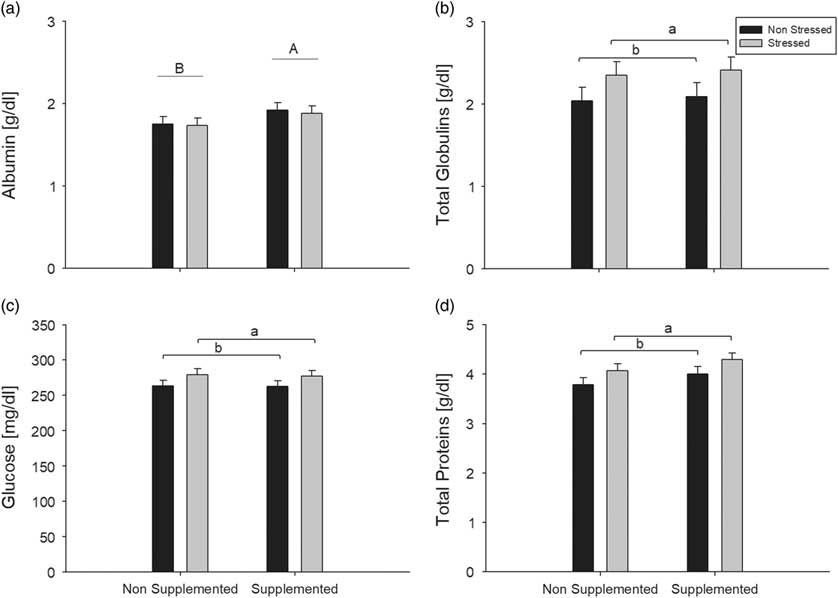
The effects of dietary supplementation with thymol and a prior CHS exposure on glucose, total proteins, total globulins and albumin are shown in Figure 3. A significant effect of dietary supplementation was found for albumin (F 1,44=3.98; P=0.05). Feed supplemented females showed higher albumin concentrations than their non-feed supplemented counterparts. Significant CHS effects were found for glucose (F 1,44=9.60; P=0.03), total proteins (F 1,44=4.14; P=0.04) and total globulins (F 1,44=7.91; P=0.007). Specifically, quail under heat stress had higher glucose, total proteins and total globulins concentrations than their control counterparts. No interactions between treatments were found in any of the mentioned variables (albumin: F 1,44=0.03; P=0.87; glucose: F 1,44=0.94; P=0.34; total proteins: F 1,44<0.001; P=0.99; total globulins: F 1,44=0.01; P=0.91).
Effects of dietary supplementation with thymol and prior chronic heat stress exposure on albumin (a), total globulins (b), glucose (c) and total proteins (d) in female Japanese quail. Dietary supplementation started 12 days before chronic heat stress began, and lasted until the end of the study (130 days of age). Chronic heat stress was achieved increasing room temperature from 24°C to 34°C during 9 consecutive days (119 to 127 days of age). A total of 12 females were evaluated within each treatment combination. Bars represent the mean value and lines represent standard error. a,b and A,BDifferent letters represent statistical differences (P<0.05) between groups.

Percentage of inflammation
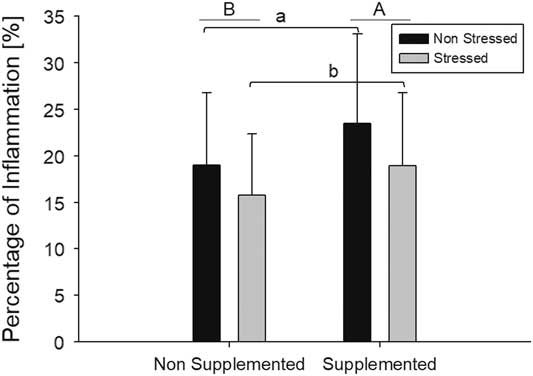
A period of 3 days after CHS ended, main effects of dietary supplementation (F 1,44=10.08; P=0.003) and prior CHS exposure (F 1,44=7.73; P=0.008) on the percentage of inflammation were detected with no interaction (F 1,44=0.06; P=0.81) between them. Female quail that were feed supplemented with thymol had the highest inflammatory responses against the mitogen compared with the quail receiving non-supplemented feed (Figure 4). Female quail exposed to CHS showed lower inflammation values compared with their non-stressed counterparts (Figure 4).
Effects of dietary supplementation with thymol and prior chronic heat stress exposure on the percentage of inflammation against phytohemagglutinin-p (PHA-P) in female Japanese quail. Dietary supplementation started 12 days before chronic heat stress began, and lasted until the end of the study (130 days of age). Chronic heat stress was achieved increasing room temperature from 24°C to 34°C during 9 consecutive days (119 to 127 days of age). A total of 12 females were evaluated within each treatment combination. Bars represent the mean value and lines represent standard error. a,b and A,BDifferent letters represent differences (P<0.05) between treatments.

Antibody titers against sheep red blood cells
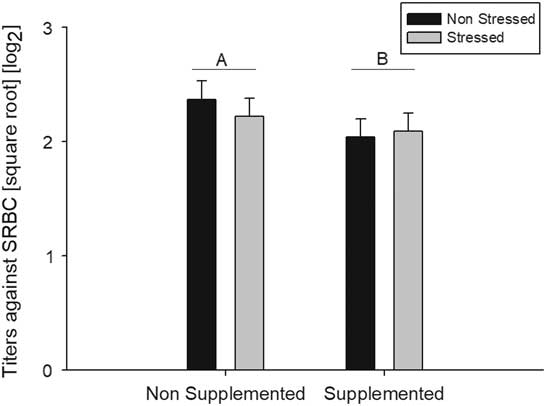
A period of 3 days after CHS ended, the main effect of dietary supplementation (F 1,44=4.64, P=0.04) on female quail antibody production against SRBC was found. Quail that were supplemented had lower titers than their non-supplemented counterparts (Figure 5). Neither a CHS effect (F 1,44=0.18; P=0.68) nor an interaction between dietary supplementation and CHS exposure were detected (F 1,44=0.76; P=0.39).
Effects of dietary supplementation with thymol and prior chronic heat stress exposure on the female quail titers against sheep red blood cells (SRBC). Dietary supplementation started 12 days before chronic heat stress began, and lasted until the end of the study (130 days of age). Chronic heat stress was achieved increasing room temperature from 24°C to 34°C during 9 consecutive days (119 to 127 days of age). A total of 12 females were evaluated within each treatment combination. Bars represent the mean value and lines represent standard error. A,BDifferent letters represent statistical differences (P<0.05) between supplemented and non-supplemented groups.

Heterophil to lymphocyte ratio
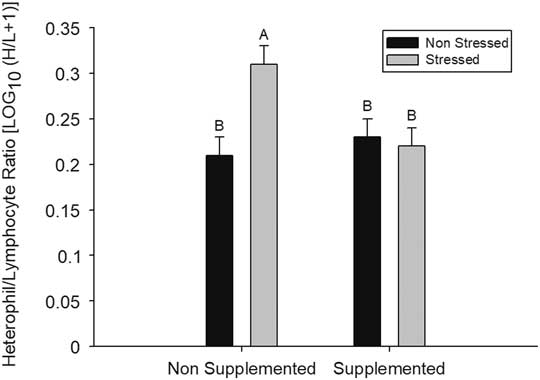
A significant interaction between the effects of dietary supplementation and prior CHS exposure on the H/L ratio was found 3 days after stressor ended (F 1,44=5.05; P=0.029). Newman–Keuls post hoc analysis determined that female quail that were exposed to CHS and did not receive a dietary supplementation with thymol showed the highest H/L ratio, whereas the quail with the other treatment combinations showed lower ratios, and similar among them (Figure 6).
Effects of dietary supplementation with thymol and prior chronic heat stress exposure on the Heterophil to Lymphocyte (H/L) ratio in female Japanese quail. Dietary supplementation started 12 days before chronic heat stress began, and lasted until the end of the study (130 days of age). Chronic heat stress was achieved increasing room temperature from 24°C to 34°C during 9 consecutive days (119 to 127 days of age). A total of 12 females were evaluated within each treatment combination. Bars represent the mean value and lines represent standard error. A,BDifferent letters represent statistical differences (P<0.05) between groups (Newman–Keuls Test).

Discussion
In this study, we report whether a thymol dietary supplementation can be used as a strategy to mitigate CHS deleterious effects on INE-related variables. Endocrine, immune and biochemical variables were determined 3 days after the CHS exposure was ended when, according to a recent previous study (Nazar et al., Reference Nazar, Videla, Fernandez, Labaque and Marin2018), most of the variables are expected to be affected by the CHS treatment. Similarly to our previous study with juvenile female quail (Nazar et al., Reference Nazar, Videla, Fernandez, Labaque and Marin2018), the current study using fully adult females showed no differences in plasma corticosterone concentrations 3 days after the CHS exposure was finished. This finding suggests that 3 days is enough time for the quail to recover adrenocortical basal activity. This fast recovery can certainly be considered advantageous providing that a sustained elevation in corticosterone concentration is related to impaired homeostasis, a reduced ability to respond to external stimuli and in extreme cases can even lead to death (Romero et al., Reference Romero, Dickens and Cyr2009; Scanes, Reference Scanes2014). No changes in corticosterone concentrations due to the thymol feed supplementation were found either. Nevertheless, providing corticosterone concentrations were only determined 3 days after the stressor ended (and only under basal conditions: <120 s between handling and blood withdrawal), whether dietary supplementation could have helped to mitigate the CHS impact on the adrenocortical activity remain unknown.
Although corticosterone concentrations were recovered 3 days after CHS ended, some immune and biochemical variables appear affected either by the CHS exposure, the thymol supplementation or both. Specifically, glucose, total proteins and total globulins were altered by the influence of the CHS exposure showing increased values in the previously stressed groups. These results are consistent with the literature, informing that alterations on the energy and relative protein content are induced with a heat stress exposure (Sahin et al., Reference Sahin, Onderci, Sahin, Gursu, Khachik and Kucuk2006; Ma et al., Reference Ma, Lin, Zhang, Chen, Wang, Ruan and Jiang2014). Mid-term alterations, as shown in the present study, can also be expected due to the strong nature of the stressor applied that require a series of biochemical and physiological adjustments to overcome the induced misbalance (Romero et al., Reference Romero, Dickens and Cyr2009; Davison, Reference Davison2013; Scanes, Reference Scanes2016).
Albumin deserves a particular analysis because it was not affected by heat stress, however, it was increased in the thymol feed supplemented quail groups. It has been reported that albumin has antioxidant properties (besides its role as a carrier of hormones, proteins and lipids) (Casagrande et al., Reference Casagrande, Pinxten, Zaid and Eens2014). Because thymol also has antioxidant properties associated with its molecular structure (Ezzat Abd El-Hack et al., Reference Ezzat Abd El-Hack, Alagawany, Ragab Farag, Tiwari, Karthik, Dhama, Zorriehzahra and Adel2016), it is conceivable that the highest values of albumin in supplemented quail could be the consequence of the improved antioxidant environment. This phenomenon could be particularly helpful under heat stress conditions, when (according to literature) reactive oxygen species and free radicals are oftently increased (Belhadj Slimen et al., 2016).
A period of 3 days after the heat stress protocol was ended, negative impacts on the inflammatory response against PHA-P were registered. According to Vinkler et al. (Reference Vinkler, Bainova, Bainová and Albrecht2010), the percentage of inflammation is related to the potential pro-inflammatory status of the challenged quail. Feed supplemented animals showed higher inflammation values, a phenomenon that can be related to the bioactive properties of thymol as immune stimulatory (on inflammatory processes) and regardless the quail environmental condition (Ezzat Abd El-Hack et al., Reference Ezzat Abd El-Hack, Alagawany, Ragab Farag, Tiwari, Karthik, Dhama, Zorriehzahra and Adel2016). In the feed supplemented groups, the neutralization and/or elimination of pathogens requiring pro-inflammatory mileus to be cleared would be enhanced. However, further experimentation is needed to confirm that hypothesis.
Regarding the humoral component of the immune system, quail fed with thymol showed lower SRBC antibody titers. Among all the bioactive properties, thymol has also shown antimicrobial activity associated with its phenolic lipophilic structure (Dorman and Deans, Reference Dorman and Deans2000; Ezzat Abd El-Hack et al., Reference Ezzat Abd El-Hack, Alagawany, Ragab Farag, Tiwari, Karthik, Dhama, Zorriehzahra and Adel2016). Thus, the lower SRBC titers could be related to the fact that thymol is able to penetrate in biological layers, generate tension and affect the membrane structure’s stability (Sánchez et al., Reference Sánchez, Turina, García, Nolan and Perillo2004). A proposed mechanism of action could be through membrane alterations that could have led to an altered antigen presentation in the supplemented groups, thus explaining the diminished titer. Another possible explanation for this phenomenon could also be related to an already informed increased in the macrophages phagocytic activity in the supplemented quail (Chauhan et al., Reference Chauhan, Jakhar, Paul and Kang2014). Furthermore, these two proposed mechanisms could have co-occurred, in order to rapidly clear the foreign cells avoiding an exacerbated humoral response. However, more research is needed to test this hypothesis.
The inflammatory response is an innate immune mechanism which has low antigen-specificity and acts as a first defense barrier (Vinkler et al., Reference Vinkler, Bainova, Bainová and Albrecht2010; Davison, Reference Davison2013). Antibody production, on the other hand, is an acquired mechanism which has higher antigens specificity. It involves activation, differentiation and proliferation of B cells with the posterior synthesis of antibodies (Davison, Reference Davison2013). In the context of our results, it could be hypothesized that thymol have improved the innate component of the immune system, leading to a robust response, strong enough to neutralize or minimize the foreign antigens. Therefore, if this were the case, it would not be necessary to activate the acquired component of the immune system, as the threatens would be effectively neutralized or eliminated only through the inflammatory response.
The H/L ratio has been reported as an hematological index of chronic stress: the higher the values of this ratio, the higher the concentrations of stress response mediators (Gross and Siegel, Reference Gross and Siegel1983). The bibliography related to CHS is already informing increased values of the H/L ratio in quail under chronic high environmental temperatures that are related to the augmented stress response mediators (Mashaly et al., Reference Mashaly, Hendricks, Kalama, Gehad, Abbas and Patterson2004; Nazar et al., Reference Nazar, Videla, Fernandez, Labaque and Marin2018). Although in our study the adult quail female were evaluated 3 days after the CHS ended, the H/L values in the Non-supplemented–Stressed group strongly suggest that those females were not fully recovered from the prior heat stress exposure. Interestingly, our findings showed that the feed supplementation with thymol allowed the recovery (similar to Non-stressed group, supplemented or not) of the H/L ratio in previously stressed (Supplemented–Stressed) quail. A possible mechanism that could explain this result is related to the reported stress/anxiety reducing properties already proposed for thymol both behaviorally and through modulation in the gamma-aminobutyric acid (GABA) ergic system (García et al., Reference García, Bujons, Vale and Suñol2006; Lábaque et al., Reference Lábaque, Kembro, Luna and Marin2013). The proposed reduction in the anxiety would allow the quail to minimize the stressor impact, and therefore, reducing the alteration of the leukocytes populations.
As mentioned, previous research informs numerous bioactive properties of thymol, such as antioxidant, antiviral, bactericidal, GABA modulator and immuno-stimulatory (Dorman and Deans, Reference Dorman and Deans2000; Chauhan et al., Reference Chauhan, Jakhar, Paul and Kang2014; Ezzat Abd El-Hack et al., Reference Ezzat Abd El-Hack, Alagawany, Ragab Farag, Tiwari, Karthik, Dhama, Zorriehzahra and Adel2016). Findings shown in this study are also consistent with improved antioxidant status, enhanced inflammatory processes, and minimized CHS alterations in leukocytes populations. Nevertheless, further specific studies are needed to better characterize the mechanisms underlying the observed changes. The present findings together with the already reported thymol bioactive properties, suggest that feed supplementation with this compound could be a useful strategy to help overcoming some of the CHS induced alterations.
Acknowledgments
The authors wish to thank the technical assistance of Julia Ortiz, Pablo Prokopiuk and Dario C. Arbelo during the development of this study. F.N.N and R.H.M are career members of Consejo Nacional de Investigaciones Científicas y Técnicas (CONICET) Argentina. E.A.V. holds a research fellowship from Fondo para la Investigación Científica y Tecnológica (FonCyT- Project 2014-2764). This research was supported by grants from FonCyT (Project 2014-2764) and Secretaría de Ciencia y Técnica, Universidad Nacional de Córdoba (SECyT – UNC, Project 30820150100031CB).
Declaration of interests
The authors report no conflicts of interest. The authors alone are responsible for the content and writing of the paper.
Ethics statement
Animal care was provided in adherence with Institutional animal Care and Use Committee guidelines. The experiment was approved by the ethical committee at Instituto de Investigaciones Biológicas y Tecnológicas (IIByT) in compliance with the legislation regarding the use of animals for experimental and other scientific purposes (Acta 7, 17/11/2016). The temperature used in this study was chosen from a range of previous informed temperatures (from 34°C to 42°C) (Sandhu et al., Reference Sandhu, Mirza, Afzal and Mukhtar2012; Gasparino et al., Reference Gasparino, Voltolini, Del Vesco, Guimarães, do Nascimento and de Oliveira Neto2013). The 34°C stress temperature was chosen because physiological changes were already registered with that temperature while minimizing potential compromise of later welfare and survival (Nazar et al., Reference Nazar, Videla, Fernandez, Labaque and Marin2018). It is worthy to mention that no mortalities were registered during or after stress exposure. The animals in this experiment were part of a larger study that evaluated stress and supplementation effects on reproductive variables which required an individualization of the eggs laid by each female. As a welfare-related practice, neutral contacts were developed weekly in order to habituate animals to a minimum of experimental manipulation.
Software and data repository resources
None of the data were deposited yet in an official repository.
Supplementary material
To view supplementary material for this article, please visit https://doi.org/10.1017/S175173111800157X