Introduction
The high prevalence and increasing rise in childhood obesity calls for a better understanding of its determinants,Reference Troiano, Flegal, Kuczmarski, Campbell and Johnson 1 , Reference Hedley, Ogden and Johnson 2 particularly as obesity in later childhood can track to adulthood.Reference Whitaker, Wright, Pepe, Seidel and Dietz 3 , Reference Guo, Wu, Chumlea and Roche 4 Although secular changes in children's diet and physical activity patterns may account for a large part of the increase in childhood obesity, factors even earlier in life and possibly prenatally may also account for some of this change. Accumulating data from epidemiologic studies and animal studies suggest that the origins of childhood obesity may be partially rooted in the intrauterine environment and early postnatal period, particularly as this is the period where the rate of adipose cell transformation is rapidly increasing.Reference Strauss 5 – Reference Whitaker and Dietz 7 It is becoming increasingly clear, however, that while crude proxies of the intrauterine environment like birth weight may be positively associated with later childhood body size, maternal factors such as body size and pregnancy weight gain as well as early infant growth are also very important predictors of later body size.Reference Monteiro and Victora 8 – Reference Gillman and Kleinman 10 Thus, failure to capture the complex interplay among these pre- and postnatal factors may lead to incomplete inferences about the role of the intrauterine environment and early life in shaping childhood body size.
Using prospectively collected data on 20,523 participants (10,327 boys; 10,196 girls) of the Collaborative Perinatal Project (CPP), we examined the associations between maternal [body mass index (BMI), pregnancy weight gain, preeclampsia, gestational diabetes, pregnancy smoking, placental weight], birth (birth weight, birth length) and postnatal growth changes (measured as percentile changes in weight and height from birth to 4 months, 4–12 months and 1–4 years) and BMI at age 7 years. We further examined whether individual differences in pre- and postnatal factors could explain body size differences between same-sex siblings (n = 571 boy sets; n = 651 girl sets). Specifically, we investigated (1) whether maternal factors such as body size and pregnancy weight gain were independent predictors of childhood body size after accounting for postnatal weight change patterns, (2) whether rapid weight gain during certain postnatal time periods was more important than weight gain during other times and (3) whether body size differences between same-sex siblings were related to changes in pre- and postnatal environment. As maternal body size, pregnancy weight gain and birth weight have all been increasing over time, these factors, if important, may also explain some of the secular changes in childhood body size as well.
Methods
Study participants
We used prospectively collected data from families who were part of the CPP. The children were born from 1959 to 1966 at 14 centers across the United States and followed until 7 years of age. Of the 56,966 births, 20,523 children (10,327 boys; 10,196 girls) had complete information on weight and height measurements until 7 years of age. The remaining 36,443 births were not eligible for this study because they were missing at least one height, weight or age measurement for the following time periods (birth; 4 months; 1, 4 and 7 years; 73%), died at birth or before 7 years (8%), missing gender information (3%), missing other maternal or child covariate information (14%) or had a time measurement outside of the range considered reasonable for interpolation (2%; see section ‘Statistical analysis’ ). Further details on the CPP are available in BromanReference Broman 11 and Hemachandra et al.Reference Hemachandra, Howards, Furth and Klebanoff 12
Data
Reported characteristics were based on direct study measurement and maternal report at exam visit. At registration, mothers were asked about pre-pregnancy body size and maternal smoking history. Maternal smoking during pregnancy was collected based on maternal report during pregnancy visits and pregnancy conditions such as preclampsia and gestational diabetes were collected from clinical records and measurements during these clinical visits. Child physical measurements (weight and height) were taken at fixed intervals (birth; 4 months; 1, 4 and 7 years); all children were measured in person at clinic visits to the CPP centers. The CPP protocol also specified defined times for measurements. For example, birth weight was obtained within 1 h of delivery by the CPP observer of labor and delivery using calibrated scales, and birth length was obtained using a standardized procedure within 24 h of birth and measured crown-heel. Placental weight (g) was recorded and conducted according to the Benirschke protocol.Reference Benirschke 13 Gestational age was the time elapsed from first day of last menstrual period (LMP) to day of delivery. LMP was established at the initial prenatal registration interview by a specially trained interviewer.
Statistical analyses
The main outcome was BMI at age 7 years (weight in kg/height in m2). Most studies of childhood body size apply either linear regression methods with BMI as a continuous dependent variable or logistic regression methods with BMI as a dichotomized dependent variable. These methods assume that the relation between the independent variables and the dependent variable is the same irrespective of the level (i.e. percentile) of BMI at age 7 years. We compared results from linear and logistic regression models to quantile regression models,Reference Koenker and Hallock 14 , Reference Terry, Wei and Esserman 15 , Reference Hosmer and Lemeshow 16 which examine the effect of X on the entire distribution of Y, not just the mean of Y. The quantiles (10th, 25th, 50th, 75th and 90th) were selected by internal percentile rank, rather than using absolute cut-off values.Reference Terry, Wei and Esserman 17
Postnatal weight change was examined comparing within-cohort percentile changes in weight and height for three different time periods: (1) from birth to 4 months, (2) from 4 months to 1 year and (3) from 1 to 4 years. As the actual dates of the clinic visit differed for each individual and did not correspond to exactly 4 months, 1 year and 4 years, we interpolated these measurements at the target times using individual cubic interpolation splines. No interpolation was needed for birth measurements. We excluded observations (2% of the overall eligible cohort) that were outside of the following ranges for interpolation: 3–5.5 months for 4-month measurement; 10–15 months for 1-year measurement; 3.5–4.5 years for 4-year measurement; and 6–8 years for 7-year measurement. In addition to models that adjusted for percentile changes for the three-time periods, we also performed separate models using conditional weight gain methods.Reference Cole 18
We compared progressive models examining pre-pregnancy variables (Model 1: pre-pregnant BMI, race and socioeconomic status), pregnancy-specific variables and birth measurements (Model 2: maternal pregnancy weight gain, maternal smoking, preeclampsia, gestational diabetes, gestational length, birth weight, birth length) and postnatal growth variables (Model 3: percentile weight and height changes for each of the three postnatal time periods). Each model was nested in the next model so we could examine changes in effect sizes after adding the additional variables. We examined the overall fit of the quantile regression model by calculating the relative deviance.Reference Wei, Pere, Koenker and He 19 – Reference Koenker and Machado 21 We assessed whether birth order, maternal breastfeeding or placental weight added to the overall fit of the final model. Given our large sample size, we only labeled parameter estimates as statistically significant if they were at least significant at the P < 0.01 level, though we report effect size and standard errors (OR and 95% CIs for the logistic model) for all variables.
We also examined three patterns of weight change between birth and age 4 years based on Centers for Disease Control (CDC) growth chart reference percentiles (5th, 10th, 25th, 50th, 75th and 95th): rapid defined children whose within-cohort percentile rank increased at least two major reference percentiles of weight from birth to 4 years of age (n = 2049 boys; n = 2060 girls); stable defined children whose rank stayed within two major percentiles (n = 6115 boys; n = 6015 girls); and slow defined children whose within-cohort percentile rank decreased at least two major percentiles (n = 2163 boys; n = 2121 girls). In these models, stable growth as defined above was the referent group, and we estimated the overall association of rapid growth and slow growth compared to stable growth.
We selected same-sex siblings from the larger cohort to examine whether sibling differences in the same factors described above could explain differences in body size at age 7 years (n = 571 boy sets; n = 651 girl sets). All covariates and the dependent variable were differenced by subtracting the value for the lighter sibling from the value for the heavier sibling at age 7 years.
Results
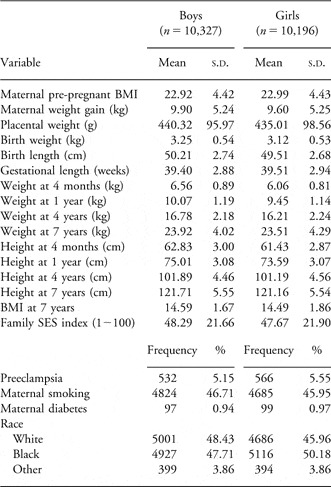
Descriptive characteristics for the overall eligible cohort (n = 20,523) are presented in Table 1 separately for boys (n = 10,327) and girls (n = 10,196). Approximately half of the cohort was black (48% boys; 50% girls). Maternal smoking during pregnancy was common (47% among mothers of boys; 46% among mothers of girls). Maternal preeclampsia was observed in 5–6% of all pregnancies. Maternal diabetes was recorded for <1% of the mothers. The average pre-pregnant BMI for mothers was 23 kg/m2. The prevalence of maternal overweight in the study population (pre-pregnant maternal BMI > 25 kg/m2) was 16.1%; and the prevalence of maternal obesity (BMI > 30 kg/m2) was 7.2%. The average BMI at age 7 years was 14.6 kg/m2 and 14.5 kg/m2 for boys and girls, respectively. Childhood BMI at age 7 years cut-off points for overweight (85th percentile) were 15.9 kg/m2 and 16.0 kg/m2 for boys and girls, respectively. Childhood BMI at age 7 years cut-off points for obesity (95th percentile) were 17.5 kg/m2 and 18.0 kg/m2 for boys and girls, respectively.
Descriptive characteristics of study sample, CPP, children born 1959–1966 and followed until 7 years of age

BMI, body mass index; CPP, Collaborative Perinatal Project; SES, socio-economic status.
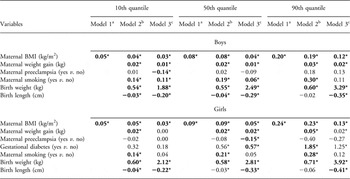
Table 2 summarizes the associations by three percentiles of childhood BMI at age 7 years (10th, 50th and 90th) for three progressive models (Models 1, 2, 3; see section ‘Methods’). For example, in boys, for each increment of 1 kg/m2 in maternal BMI, the childhood BMI at age 7 years was 0.05 kg/m2 higher at the 10th percentile, 0.08 higher at the 50th percentile and 0.20 higher at the 90th percentile. Within a given quantile, estimates for Models 1 and 2 were very similar suggesting that further adjusting for pregnancy-specific and birth variables did not affect the magnitude of the maternal BMI and child BMI association. Differences between Models 2 and 3 suggested that the presence of postnatal weight and height change variables influenced the magnitude of the estimates of the prenatal and birth variables. However pre-pregnancy maternal BMI, maternal weight gain and birth weight were still independently associated with BMI at age 7 years even after adjusting for the postnatal weight and height change variables. Maternal smoking, however, was no longer statistically significantly associated with the upper 90th percentile of BMI at age 7 years for boys and was no longer significant at any quantile for girls after adjusting for postnatal weight and height changes.
Maternal and birth factors and the association with BMI at 7 years; parameter estimates based on quantile regression methodsFootnote a ; CPP

BMI, body mass index; CPP, Collaborative Perinatal Project.
a Model 1 adjusts for geographic site, race and socio-economic status.
b Model 2 adjusts for geographic site, race, socio-economic status and gestational age.
c Model 3 adjusts for geographic site, race, socio-economic status, gestational age and postnatal changes in weight and height.
* P-value <0.01; estimates for maternal BMI and birth weight had P-values <0.001 across all models.
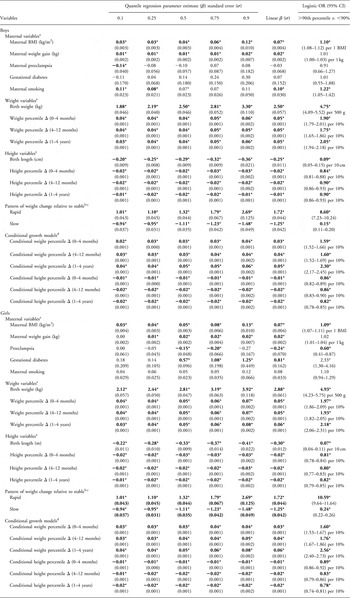
Table 3 presents the full multivariable regression models for the quantile regression model (Columns 2–6), linear regression model (Column 7) and logistic regression model (Column 8). Results from all three regression methods supported positive and independent associations between BMI at age 7 years and maternal BMI, maternal weight gain, birth weight and percentile change in weight for all three time periods (0–4 months, 4–12 months and 1–4 years) for both boys and girls. Point estimates for percentile change in postnatal weight for the three time periods were very similar. For example, a 10-percentile change in weight increased the probability of being overweight at age 7 years by approximately two-fold regardless of time period (OR = 1.8–2.1 for boys; OR = 1.9–2.2 for girls for the three time periods). There was a negative correlation between percentile weight changes during these three periods (r = −0.22, −0.11, −0.20 for boys and r = −0.18, −0.11, −0.19 for girls for period 1 compared to 2 and 3, and period 2 compared to 3, respectively). We tested for interaction among the three postnatal time periods of growth, but these were not statistically significant (data not shown). For both boys and girls, results from all three regression methods supported negative and independent associations with BMI at age 7 years and birth length and height changes for each time period. From the results in Table 3, we were able to evaluate what would happen if a child grew rapidly in only one time period but not the other two by setting the latter to zero (no change in percentile rank between two time periods). As Table 3 shows the parameter estimates within each quantile were very similar for each time period suggesting that rapid growth in any one period with no change in percentile in the other two had a similar effect on body size at age 7 years irrespective of the time period when the percentile change in weight gain occurred.
Comparison of the associations between maternal, birth and postnatal growth variables and BMI at age 7 years in the CPP with three regression models quantile, linear and logistic

BMI, body mass index; CPP, Collaborative Perinatal Project.
aControlling for geographic site, race, socio-economic status at birth, number of siblings, gestational age and simultaneously for the maternal, weight and height variables listed in the table.
bControlling for geographic site, race, socio-economic status at birth, number of siblings, gestational age, birth weight and simultaneously for the maternal and height variables listed in the table.
cWeight change pattern defined by decreasing two major percentiles from birth to age four – slow (n = 2121); staying within two major percentiles – stable (n = 6015), or increasing two major percentiles from birth to age 4 years – rapid (n = 2060).
dConditional weight and height change models adjusting for all maternal variables, birth weight, birth length, geographic site, race, socio-economic status at birth, number of siblings and gestational age.
*P-value <0.01; estimates for maternal BMI, birth weight, birth length and postnatal weight and height changes all had P-values <0.001 across all models.
As the percentile weight change estimates on BMI at age 7 years for each of the postnatal time periods were similar in magnitude, we further examined whether these estimates differed when stratified by major pattern of weight change from birth to 4 years (Table 3). Approximately 20% of boys and girls fell into each of the ‘rapid’ and ‘slow’ categories. All three regression models (quantile; linear; logistic) supported very large associations for rapid growers v. stable growers. For example, rapid weight change was associated with an eight- and ten-fold increase in the probability of being overweight at age 7 years for both boys and girls (OR = 8.6, 95% CI = 7.2–10.2 for boys; OR = 10.6, 95% CI = 9.6–11.6 for girls) relative to stable growth (staying within two major CDC percentiles from birth to 4 years). In addition to modeling percentile change in growth and pattern of growth, Table 3 also summarizes the results we observed from models using conditional weight gain and conditional height change. These results suggested that growth during the first two time periods had a similar association with BMI at age 7 years within a given quantile and for both linear and logistic regression models, and that associations with growth during the last time period were stronger.
Both maternal preeclampsia and gestational diabetes were associated with BMI at age 7 years in girls (OR = 0.6, 95% CI = 0.4–0.9 for preeclampsia, OR = 2.3, 95% CI = 1.3–4.2 for gestational diabetes), while preeclampsia was only associated with the lowest quantile and gestational diabetes was not associated with BMI at age 7 years for boys (OR = 0.9, 95% CI = 0.7–1.3 for preeclampsia OR = 1.0, 95% CI = 0.6–1.9 for gestational diabetes). Maternal smoking was associated with BMI at age 7 years in boys, particularly in the lower quantiles, but not in girls (OR = 1.2, 95% CI = 1.1–1.4 for boys OR = 1.1, 95% CI = 0.9–1.3 for girls). Maternal breastfeeding status at 1 week after birth did not independently predict childhood body size for girls or boys (data not shown). The inclusion of race-specific interaction terms did not materially improve the overall model fit, therefore, we only adjusted for the main effects of race in the final models. We performed supplemental analyses based on the final models in Table 3, separately restricting the analysis to preterm (<37 weeks) and low birth weight babies (<2500 g). Overall, 12.3% of boys and 11.7% of girls were born preterm and 7.8% of the boys and 10.9% of the girls were born low birth weight. When we restricted the models to preterm babies, all of the inferences were the same with the exception of maternal preeclampsia and maternal smoking; they were no longer significant for boys (data not shown). When we restricted the same models to low birth weight babies, we observed similar parameter estimates for weight and height changes as those reported for the overall sample in Table 3 (data not shown).
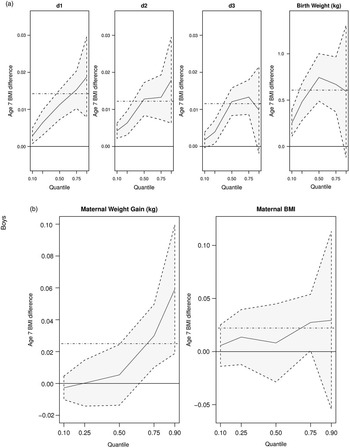
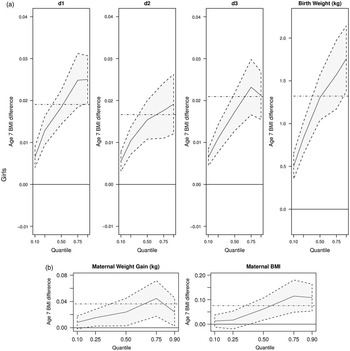
Results from the sibling analyses are presented in Figures 1 and 2 which are smoothed plots of each quantile-specific sibling model where the x axis represents the quantile of sibling difference in BMI at age 7 years and the y axis represents the predicted value of BMI at age 7 years based on the corresponding estimated coefficients from the regression model. The gray horizontal line represents the zero value, meaning that the covariate has no impact on explaining sibling differences in BMI at age 7 years. Almost all values with the exception of some of the lower quantiles for maternal weight gain were above the zero line suggesting that for both boys and girls the sibling with the higher BMI at age 7 years had higher values of postnatal weight change for the three periods, birth weight, maternal BMI and maternal weight gain. For comparison, the dotted horizontal lines represent the values for the same covariates if the sibling differences were estimated using ordinary least squares regression. Both Figures 1 and 2 suggest that linear regression would fail to describe the very large differences in covariate effects at the upper quantiles of sibling differences in BMI at age 7.
Differences between brothers in body mass index (BMI) at age 7 years based on differences in percentile weight change from birth to 4 months (d1), 4 months to 1 year (d2) and 1–4 years (d3) and birth weight estimated from quantile regression models. Notes: Smoothed plot based on quantile-specific estimates (x axis represents quantiles, y axis represents predicted values of BMI at age 7 years based on multivariate models adjusting for differences in maternal BMI, maternal weight gain, gestational age, birth weight, birth length, socio-economic status at birth and postnatal weight change: d1 = percentile weight change from 0 to 4 months, d2 = 4–12 months, d3 = 1–4 years). Solid horizontal line represents no difference, dotted horizontal line represents estimate from the ordinary least squares model.

Differences between sisters in body mass index (BMI) at age 7 years based on differences in percentile weight change from birth to 4 months (d1), 4 months to 1 year (d2) and 1 year to 4 years (d3) and birth weight estimated from quantile regression models. Notes: Smoothed plot based on quantile-specific estimates (x axis represents quantiles, y axis represents predicted values of BMI at age 7 years based on multivariate models adjusting for differences in maternal BMI, maternal weight gain, gestational age, birth weight, birth length, socio-economic status at birth and postnatal weight change: d1 = percentile weight change from 0 to 4 months, d2 = 4–12 months, d3 = 1–4 years). Solid horizontal line represents no difference, dotted horizontal line represents estimate from the ordinary least squares model.

Discussion
We found that maternal BMI, maternal weight gain, birth size and rapid childhood weight gain up to 4 years were all positively associated with body size at age 7 years. These findings were robust to statistical model type and held even within families suggesting that both prenatal and postnatal factors independently predicted body size at age 7 years in girls and boys.
Importance of prenatal factors
The importance of birth weight and length on childhood body size has been long recognized to exist across the continuum of birth size.Reference Binkin, Yip, Fleshood and Trowbridge 22 Birth size itself is influenced by a myriad of factors including parental body size, maternal weight gain, maternal nutrition, maternal smoking and placental function. In this study, we observed that maternal factors that are correlated with birth weight such as maternal weight gain and maternal BMI were independently associated with childhood body size even after considering their impact on birth weight and postnatal weight and height changes. Our findings were consistent with other studies suggesting that maternal BMI and pregnancy weight gain remain independently associated with childhood BMI even after accounting for their effects on early infant growth.Reference Li, Goran, Kaur, Nollen and Ahluwalia 23 , Reference Salsberry and Reagan 24 In girls, maternal preeclampsia was associated with a 40% reduction in the risk of being overweight at age 7 years, while maternal gestational diabetes was associated with an over two-fold increase in being overweight at age 7 years. These maternal conditions were unrelated to body size in boys. Maternal smoking and placental weight have also been observed to be associated with childhood growth in this cohort;Reference Chen, Pennell, Klebanoff, Rogan and Longnecker 51 , Reference Baptiste-Roberts, Salafia, Nicholson, Duggan, Wang and Brancati 52 we were able to consider the effects of these factors in our overall modeling approach by simultaneously adjusting for these factors and comparing estimates with and without their inclusion in the models.
Similarity in specific time period effects
Many studies (reviewed by Monteiro and VictoraReference Monteiro and Victora 8 and OngReference Ong 9 ) have reported associations between rapid weight change during the first few months, even weeks, of life with greater childhoodReference Eid 25 – Reference Dennison, Edmunds, Stratton and Pruzek 28 and adultReference Charney, Goodman, McBride, Lyon and Pratt 29 – Reference Stettler, Tershakovec and Zemel 32 body size. However, some of these studies either lack measures of, or do not adjust for, weight and height changes in later postnatal periods making it difficult to understand the full impact of early life growth changes.Reference Kuh and Ben-Sholmo 33 One of these studies by Stettler et al. used the same CPP study population that we used and reported on the importance of weight gain during the first 4 months of life in predicting childhood body size at age 7 years, independent of birth weight and weight at 1 year.Reference Stettler, Zemel, Kumanyika and Stallings 27 The main difference in our approach, however, is that we also adjusted for weight and height changes from 4 to 12 months, and 1 to 4 years. We further examined these associations with childhood growth using multiple statistical modeling approaches as well as a sibling design.
Percentile changes in each of these three time periods were negatively correlated, suggesting that individuals who grow rapidly in one period, are less likely to grow rapidly in other periods. We observed, like others,Reference Mei, Grummer-Strawn, Thompson and Dietz 34 that crossing growth percentiles is common in children – approximately 40% of children did not remain within two CDC growth percentiles from birth to 4 years. Thus, given the change that occurs over time, models that only investigate a single time period incompletely describe the heterogeneity in childhood growth.Reference Rolland-Cachera, Deheeger and Bellisle 35 Our findings also support those of Kinra, Baumer and Davey Smith who examined infant and childhood weight gain and BMI at age 7 years in 1335 children and also did not observe a critical window of susceptibility.Reference Kinra, Baumer and Davey Smith 36 The influence of rapid postnatal growth in multiple periods on health has been referred to by Singhal and Lucas as the growth acceleration hypothesis.Reference Singhal and Lucas 37 The growth acceleration hypothesis does not negate the importance of fetal development on growth and development but rather stresses multiple periods of influence rather than narrow windows of sensitivity.Reference Kuh and Ben-Sholmo 33 , Reference Gluckman 38 We observed that rapid weight gain in any of the three time periods was independently associated with body size at age 7 years in boys and girls; this result held even after stratifying by pattern of growth.
Within-family effects
We observed independent and significant differences in pre- and postnatal determinants of childhood body size even among same-sex siblings. Specifically, pregnancy-specific factors that differed between siblings such as maternal pregnancy weight gain and maternal pre-pregnancy BMI were associated with long-term differences in the body size of siblings. While studies of twins support a large degree of the similarity of body size,Reference Stunkard, Harris, Pedersen and McClearn 39 in birth weight differences between twins still predicts measures of body size later in life.Reference Allison, Paultre, Heymsfield and Pi-Sunyer 40 , Reference Loos, Beunen, Fagard, Derom and Vlietinck 41 Thus, even within families there may be multiple time periods and opportunities for intervention on factors that differ across pregnancies and individual siblings. The sibling design controls for fixed-family level effects including such factors as family-level socio-economic status. The consistency of our findings from both same-sex siblings and unrelated individuals offers valuable evidence that pregnancy-specific and postnatal growth variables are important independent predictors even within families.
Methodological considerations
We considered several important methodological issues when modeling these data including the use of percentile rank v. other methods (e.g. z-scores) and the use of progressive modeling v. other methods. Z-scores have been used in many applications of childhood growth studies,Reference Cole and Green 42 and there is a one-to-one mapping between percentile rank and z-scores (for a detailed discussion see Wei et al. Reference Wei, Pere, Koenker and He 43 ). For example, the 90th percentile is equivalent to a z-score of 1.28, the 95th percentile is equivalent to 1.64. However, the change in percentile rank measures the departure from the growth curve for each individual, and is, as a result, easier to interpret than a corresponding change in z-scores.
All three regression models (linear; logistic; quantile) led to the same general conclusion on whether or not the association with most pre- and postnatal factors and BMI at 7 age years was present. Robustness to specification of the model also meant that our findings held up under additive (linear and quantile regression) and multiplicative (logistic regression) assumptions. We tested for potential mediation of prenatal effects by postnatal weight and height change through progressive modeling. Although testing for mediation through progressive modeling may result in different findings across additive and multiplicative models,Reference Kaufman, Maclehose and Kaufman 44 our findings were robust to statistical model, suggesting that there were independent effects of weight gain during each time period. The percentile changes in weight during each time period were negatively correlated, they were not strongly correlated. The largest correlation coefficient among those changing scores was 0.21 based on our data; reducing model concerns about collinearity. However, to deal with these correlations, we also applied the conditional weight gain and height change methods in separate models.Reference Cole 18 The conditional weight gain and height change results revealed similar magnitude of associations for growth during the first two time periods and BMI at age 7 years with slightly stronger associations for growth during the third time period. However, both unconditional and conditional percentile change methods revealed independent associations with each time period even after considering the impact of growth in the other time periods.
Even though the overall associations between early life factors and childhood BMI at age 7 years were robust to statistical models, quantile regression revealed differences in the magnitude of the associations. In particular, the effect of maternal BMI on child BMI appeared stronger at the upper percentiles of BMI at age 7 years. This is most clearly observed in Figures 1 and 2, which illustrate the within-sibling differences by quantile relative to the horizontal line predicted from the linear model. Stronger associations between risk factors and the upper percentiles of BMI may mean that these risk factors are associated with differences in fat mass as opposed to lean body mass. We were limited to only measures of height and weight and were not able to assess the distribution of fat and lean mass. Rapid infant and early childhood weight gain has not only been associated with a higher BMI but also a higher total fat mass (measured by skinfolds), percent body fat (measured by bioelectrical impedance analysis) and waist circumference in children and young adults.Reference Ong, Ahmed, Emmett, Preece and Dunger 45 – Reference Blair, Thompson and Black 47
Only offspring who were followed until age 7 years were eligible for this study. As a result our population had a higher socio-economic status (SES) at birth (family SES index 48 followed v. 46 not followed), higher birth weight (3186 g compared to 3044 g), and were more likely to be white (47.2% v. 45.5%). However, we still had large variation of these factors in the population followed (see Table 1) and we were able to adjust for these factors in our analyses. All birth cohort studies have limited generalizability when considering exposures and outcomes subject to large secular changes. We defined overweight based on internal percentile rank rather than using cut-off points observed today. Overweight in childhood is usually defined as BMI above the 85% which was a BMI of 15.9 kg/m2 for boys and 16.0 kg/m2 for girls in our study population. Obesity in childhood is usually defined as BMI above the 95% which was a BMI of 17.5 kg/m2 for boys and 18.0 kg/m2 for girls in our population. The CDC percentile cut-points used now are higher reflecting the increase in childhood body weight over time. For comparison, using the CDC growth charts for a population of US children today, the 85% percentile at age 7 years is 17.4 for boys and 17.6 for girls and the 95% percentile at age 7 years is 19.2 for boys and 19.6 for girls.
Summary
Childhood obesity,Reference Eisenmann 48 birth weightReference Chike-Obi, David, Coutinho and Wu 49 and maternal pregnancy weight gainReference Martin, Hamilton and Sutton 50 are all increasing. The median pregnancy weight gain in the United States in 2003 was 30.5 pounds, 9.5 pounds more than the median in our cohort born 1959–1966. Our models suggested that this change alone would lead to a 5–9% increase in the risk of being overweight among 7-year-old boys and girls, respectively. Our models also suggested that a maternal BMI in the range of 25–30 kg/m2 compared to the median BMI in this cohort of 22 could lead to an additional 24–26% of boys and 16–21% of girls being overweight at age 7 years. Using current prospective cohorts, Gillman et al.Reference Gillman, Rifas-Shiman, Kleinman, Oken, Rich-Edwards and Taveras 53 have estimated that a large portion of childhood obesity may be potentially modifiable by such early factors as maternal smoking, pregnancy weight gain, breastfeeding and sleep duration. Increasing trends in maternal BMI, pregnancy weight gain and birth weight, all point to substantial long-term consequences on the prevalence of overweight children. However, our findings, which demonstrated that multiple, rather than specific time periods were important in shaping childhood body size, point to the possibility of multiple points of intervention, even within-families.
Acknowledgments
This study is funded in part by the National Cancer Institute's R01 CA 104842-03 and K07CA90685, the National Institute of Child Health and Development's P01 AG 023028-01 and the National Science Foundation's DMS-0504972.