Introduction
We must appeal to the good in human beings and expect response. Is it not conducive to the well-being of society that every member uses all his talents, only not for personal aggrandisement but for the good of all? Mahatma Gandhi
Sustainability is increasingly viewed not simply as ‘good to do,’ but ‘imperative to do’ (Lubin & Esty, Reference Lubin and Esty2010). Defined by the United Nations’ Brundtland Commission, development is sustainable when it meets the needs of the present without compromising the ability of future generations to meet their own needs. Once seen as little more than corporate window dressing (Kolk, Reference Kolk2003) and a challenge to managerial orthodoxy (Dunphy, Reference Dunphy2003), goals and strategies about sustainability are positioning firms for long-term success. The underlying logic recognizes that business cannot survive in a society that fails.
Scholars are building an important base of thinking about the role of sustainability in firm strategy. Success in creating sustainable organizations, as with other strategic initiatives, requires the utilization of key strategy process components (Baumgartner & Korhonen, Reference Baumgartner and Korhonen2010; Bonn & Fisher, Reference Bonn and Fisher2011; Galpin & Whittington, Reference Galpin and Whittington2012). Much of that research has focused on extending business models to integrate and implement sustainability into strategy and goal setting (McPhee, Reference McPhee2014; Perrott, Reference Perrott2014, Reference Perrott2015).
The focus of this paper is on goal setting. The importance of goal setting has long been regarded as a critical element in strategic planning. Effective goals that articulate organizational objectives should be clear and measurable and integrated into specific tactics (Armstrong, Reference Armstrong1982). As with other elements of strategy, being strategic about sustainability requires identification of the economic, environmental, and social issues that are important to the company, then choosing tactics that lead toward goal attainment (Baumgartner & Korhonen, Reference Baumgartner and Korhonen2010). Therefore, goals should be embodied in all approaches to sustainability management (Baumgartner & Rauter, Reference Baumgartner and Rauter2017). Clear communication about sustainability goals is required to mobilize the firm's resources and capabilities and garner the support of stakeholders.
Our research builds on a recent study by Palmer and Flanagan (Reference Palmer and Flanagan2016) that analyzed sustainability goals of leading U.S. firms. This qualitative study focuses on India; a growing economic powerhouse. By integrating country context into our design, the paper addresses a concern that context has been underappreciated in organizational research. Context contrasts are valuable because they provide a lens to detect phenomena that might otherwise be unobserved (Johns, Reference Johns2017). Our research addresses the claim that investigations using different country contexts to examine corporate responsibility are ‘thin at best’ (Jamali & Carroll, Reference Jamali and Carroll2017: 324). Scholars have concluded that key institutional differences in developing versus developed countries can explain company strategies associated with corporate responsibility (Forcadell & Aracil, Reference Forcadell and Aracil2017). Hence, early-stage exploratory research using qualitative techniques that integrate country context into research design is an important first step in detecting and describing patterns in sustainability strategies.
India is an especially suitable context to study because of its heavy load on natural resources, caused by high-population growth. Rapid development presents India with unique long-term threats, the mitigation of which business will be called on to play a vital role. Indian firms, therefore, must consider numerous social and environmental factors while preparing a strategic vision based on sustainability goals. The Indian context is also timely given regulatory changes addressing necessary contributions of business to society. India recently updated its Companies Act and has mandated sustainability-related investments for its largest firms. Revisions to the Companies Act are partly responsible for a spike in sustainability reporting because the Act requires that firms disclose certain sustainability information (Global Reporting Initiative, 2017). Taken together, these changes provide us with a unique opportunity to contrast sustainability goals of U.S. firms with Indian firms at an important juncture in corporate India's sustainability journey.
It is important to note that our research design is exploratory and qualitative. We do not develop theoretical arguments or test hypotheses. Rather, our aim, as is typical with qualitative research, is to describe a collection of qualitative materials (in our case, sustainability goal lists of large Indian firms) in a systematic, organized, way (see Schreier, Reference Schreier2012). We then examine our results and, to give heed to context, compare our results with those of a study that employed the same methodology using a sample of U.S. firms. Exploratory analysis of this kind is a crucial first step to inductive research (Jebb, Parrigon, & Woo, Reference Jebb, Parrigon and Woo2017). Additionally, by adding to what we know about a less studied phenomenon, studies of this type can increase knowledge and lead to future theory development and deductive studies (Woiceshyn & Daellenbach, Reference Woiceshyn and Daellenbach2018).
In summary, just as goal setting is critical in other strategic domains, the same is true for firms’ efforts at sustainability. Both sustainability practitioners and academics alike would benefit from a better understanding of the current landscape of sustainability goals adopted by leading firms and, further, whether national context flavors the composition of these goals. Contrasts of goals across national contexts can help shed light on whether firms’ sustainability strategies favor globalization as indicated by more standardized goals or whether strategies are best described as multi-domestic in which large firms set unique goals that fit a country or region's specific context.
Theoretical Background
‘Meeting the needs of the present without compromising the ability of future generations to meet their own needs’ (Brundtland, Reference Brundtland1987) is the most agreed-upon definition of sustainable development (Laasch & Conaway, Reference Laasch and Conaway2015) and forms the basis of the application of sustainability to business. Titled ‘Our Common Future,’ the Brundtland Report was authorized by the United Nations World Commission on Environment and Development. Scholars argue that sustainable development requires attention to needs associated with all forms of capital: human, natural, manufactured, and financial (Hawken, Lovins, & Lovins, Reference Hawken, Lovins and Lovins2008). This directs executive attention to concerns about natural environment, social welfare, and economic prosperity (Bansal, Reference Bansal2002) and is operationalized through the triple bottom line's people, planet, and profit approach to measuring firm performance (Elkington, Reference Elkington1997). The triple bottom line provides a useful framework for firms to develop their sustainability strategies as is evident in the following passage from the 2016 sustainability report of Toyota Kirloskar Motor Pvt. Ltd. (2016: 4):
A sustainable business must believe that it has to live on nature's income rather than on its capital. We believe in involving stakeholders at every level to achieve sustainable growth with a focus on protecting and nurturing our triple bottom line – People, Planet and Profit.
Sustainability reporting and goal setting
Sustainability is becoming integrated into firms’ strategies (Lloret, Reference Lloret2016). One study found that 43% of executives report aligning sustainability with their firms’ overall business goals, mission, or values, a 13% increase over the previous 2 years (Martin, Reference Martin2014). Firms are also increasingly reporting their outcomes. In total, 93% of the world's largest 250 companies report their sustainability performance (KPMG, 2013).
The triple bottom line lies at the heart of most sustainability reporting. This trend is largely motivated by the Global Reporting Initiative (GRI) co-developed by CERES (Coalition for Environmentally Responsible Economies) and the Tellus Institute, USA. Thousands of firms use the GRI standards for their sustainability reporting (Global Reporting Initiative, 2017), along with its triple bottom line framework. Whether a firm uses the GRI or other leading tools such as the Dow Jones Sustainability Index, the three dimensions of people, planet, and profit provide an approach for most sustainability reports (Milne & Gray, Reference Milne and Gray2013).
In addition to reporting, firms’ sustainability activities increasingly include setting and stating sustainability goals. For example, over 8,000 organizations, including over 300 from India, have become signatories of the United Nations’ Global Compact by pledging to support the Sustainable Development Goals (SDGs). Indian signatories span a wide range of industries from oil and gas producers to software and IT providers. Consider, for example, the prominence of the SDGs contained in introductory remarks of Infosys Ltd.’s (2015–2016) sustainability report (p. 6), ‘As a global corporation that is passionate about sustainable development, we take great pride that our own goals and commitments are in alignment with the SDGs. Our strategic objective is to build a sustainable organization.’
While sustainability professionals are becoming ever more strategic about setting goals, research has yet to comprehensively document this progress. Early research has explored characteristics of sustainability goals, but these efforts have been limited to single industries or countries. This paper builds on recent research conducted by Palmer and Flanagan (Reference Palmer and Flanagan2016) that provided an in-depth analysis of contemporary sustainability goals. They analyzed 389 goals identified by 22 of the largest 50 U.S. firms. They found that, on average, firms in their sample set 17.7 sustainability goals, most of which were planet goals. Fewer goals were associated with social issues and very few U.S. firms identified specific profit goals in their sustainability communications. The dearth of profit goals was surprising given the triple bottom line's equal emphasis on people, planet, and profits. Their research also identified subcategorizations within people (e.g., diversity, human rights) and planet (e.g., emissions, effluents, alternative energies) categorizations. One limitation of that study, however, was its focus solely on U.S. firms. Just as country-specific characteristics impact firm strategy (Franke, Hofstede, & Bond, Reference Franke, Hofstede and Bond1991), unique national characteristics should also impact the content of its top firms’ sustainability goals. Thus, studies describing the sustainability goals of leading firms in other important economic markets are warranted.
In sum, firms are increasingly using their sustainability reports to publicly identify their sustainability strategies and accomplishments. Further, goal setting is becoming a prominent component of sustainability strategies (Bonini & Swartz, Reference Bonini and Swartz2014) and research has examined why firms set the sustainability goals that they do (Ransom & Lober, Reference Ransom and Lober1999). Research is beginning to focus on the content of sustainability goals of individual firms (Galpin, Jouflas, & Gasta, Reference Galpin, Jouflas and Gasta2014; Palmer & Flanagan, Reference Palmer and Flanagan2016). However, research attention has not yet been devoted to systematically investigating how national context impacts firms’ stated sustainability goals. This paper attempts to fill that gap by analyzing goals of a sample of India's leading firms and comparing them with a previously published sample of U.S. firms. This comparison is conducted not to hold either country as the standard and to judge the other country's firms by differences from that standard. Thinking about sustainability as a global phenomenon with standards for firms to emulate ignores unique conditions executives find in their locations. Instead, by comparing sustainability goals with firms in other regions, professionals have the opportunity to build on the successes of their peers by creating goals that benefit their organizations as well as livelihoods in communities where they operate. In the following section, we overview elements of India's sustainability context that make investigations about sustainability goal setting in India especially timely.
Sustainability in India
India has a rich history of firms using their resources for the benefit of others. Indeed, decades before other companies integrated sustainability platforms into their strategic planning, industrial dynasties such as the Birlas and Tatas envisioned their resources as vehicles to build the nation and enhance society (Tripathi & Bains, Reference Tripathi and Bains2013). The philosophy of using the firm for the betterment of others by many of India's most storied companies predates Indian independence. As in other nations, these early efforts in sustainability, cloaked in corporate social responsibility (CSR), were motivated primarily by charity and philanthropy.
While considerable wealth has been created in India's rapidly developing economy, it has come at a cost. The Environmental Performance Index (2018) ranks India 177th out of 180 on a variety of performance indicators covering environmental health and ecosystem vitality. Similarly, the World Bank (2014) ranked India 155 among 178 countries they surveyed about environmental quality and almost last on air pollution exposure. Several studies have predicted that temperatures in the Indian subcontinent will vary 3–5 °C in the short term (temperature increases and decreases). This has implications for India's food and water security, biodiversity, and human health (Ravindranath et al., Reference Ravindranath, Rao, Sharma, Nair, Gopalakrishnan, Rao, Malviya, Tiwari, Sagadevan, Munsi and Bala2011). Simultaneously, rapid development has increased inequities between India's wealthiest and poorest citizens (Rueth, Reference Rueth, Mitra and Schmidpeter2017). One in five Indians, or 270 million of its citizens, lives in poverty (World Bank, 2017). It was against this backdrop that the government of India rewrote its Companies Act.
The CSR mandate
The landscape within India of firm involvement in, and reporting about, social and environmental initiatives changed significantly in the early 2000s. The impetus for these changes began with a number of legislative accomplishments. These include the Charter on Corporate Responsibility of Environmental Protection (2003), release of the Ministry of Corporate Affairs’ (2011) National Voluntary Guidelines on Social, Environmental and Economic Responsibility (NVGs), and new requirements that India's largest firms submit a Business Responsibility Report detailing their activities related to environment, the social sector, stakeholder relationships, and governance.
These actions provided much of the framework for Section 135 of the Companies Act of 2013. Under the direction of the Ministry of Corporate Affairs (2013), both Indian and foreign firms having a net worth of INR 5 billion, or sales of INR 10 billion, or a net profit of INR 50 million, must spend at least 2% of their average net profits made during the three immediately preceding financial years on social and environmental areas targeted for national development. Such targeted areas are outlined in Schedule VII of the Act and include poverty eradication, promoting gender equality, vocational skill development, and maintaining environmental sustainability and ecological balance. The Act came into effect for the fiscal year ending 31 March 2015. With passage of the Companies Act, India is among the first countries to require specified firms to spend a percentage of their profits on social and environmental activities, or explain why they do not.
While the Companies Act is specifically focused on corporate social responsibility, the Indian government's mandate is broader than CSR and dovetails into sustainability. For example, the country's NVGs, released in 2011, shaped the Companies Act and urges business to embrace the triple bottom line approach by blending strategies to enhance financial performance with society's expectations for social and environmental concerns. More directly, the formal document explaining the NVGs begins with a forward from the Ministry of Corporate Affairs summarizing the corporate sector's role in terms of the Brundtland Commission's definition of sustainability.
Indian sustainability reporting trends
Studies about Indian firm sustainability reporting suggest progression in the quality and quantity of reporting, in large part because of India's new regulations. There is an increasing tendency among Indian firms to improve transparency and openness in sustainability reporting (Jain & Winner, Reference Jain and Winner2016). One study found that high performing, visible, Indian firms are producing reports matching international benchmarks set by the GRI (Tewari & Dave, Reference Tewari and Dave2012; Godha & Jain, Reference Godha and Jain2015). Tewari and Dave (Reference Tewari and Dave2012) also note that a larger percentage of Indian companies now comply with GRI standards relative to multinational companies. This conclusion aligns with KPMG's (2013) finding that the highest growth rate in corporate responsibility reporting is among Indian firms. In particular, they found the reporting rate increased to 73% in 2013 from 20% in 2011.
In summary, regulatory changes within India have resulted in a dramatic increase in sustainability-related activities by Indian firms and their proclivity to report sustainability strategies and progress. This has given scholars the opportunity to explore the content of sustainability strategies. Indeed, much is being learned from such investigations. What remains unexamined, however, is exploration into sustainability goals being set by leading Indian firms.
Methodology
The purpose of this study is to describe the sustainability goals of large firms in India and then contrast them with those reported for large U.S. firms by Palmer and Flanagan (Reference Palmer and Flanagan2016). Our methodology replicates that of Palmer and Flanagan (Reference Palmer and Flanagan2016) which employed qualitative content analysis (QCA). ‘QCA is a method for systematically describing the meaning of qualitative material’ (Schreier, Reference Schreier2012: 8). The qualitative material employed in this context is firms’ sustainability goals.
Mirroring Palmer and Flanagan's (Reference Palmer and Flanagan2016) initial sample of the 50 largest firms on the U.S. Fortune list, our initial Indian sample was comprised of the 50 largest firms on the India Fortune 500 list. Large firms are important and suitable to research because they have significant economic impacts and have the financial and human resources needed to have well-developed sustainability programs.
In line with Palmer and Flanagan (Reference Palmer and Flanagan2016), our focus and unit of analysis was on goals presented in lists presented in company sustainability reports or goal lists reported in materials made publicly available by our sampled firms (e.g., websites, Business Responsibility Reports, GRI reports, etc.). While trying to infer a company's goals from various passages and language not in list form (such as discussions about aims, aspirations or ideals) might be illuminating, focusing on written material consciously organized by the company into list form is appropriate for this research. When firms publish a goal list, they take a formal position and provide the means for stakeholders to hold them accountable. Goal lists are easy for stakeholders and researchers to identify within corporate communications and lists signify a more formal commitment than other aspirational statements found in corporate materials. Formal goal lists were found for 21 of the 50 largest firms in the India Fortune 500. It is important to note that these 21 firms had combined revenues in 2016 in excess of US$333 billion. The lists contained a total of 290 sustainability goals. The Palmer and Flanagan (Reference Palmer and Flanagan2016) study found goal lists for 22 of the 50 largest U.S. firms (with a total of 389 goals).
We need to emphasize that our sample was not random. Rather, we used a purposeful sample as is typical in qualitative research in that our final collection of cases (i.e., firms in our study) is chosen because they ‘offer useful manifestations of the phenomenon of interest’ (Patton, Reference Patton2002: 40). Our sampling fits with the ‘intensity’ qualitative, purposeful, sample type listed in Miles and Huberman (Reference Miles and Huberman1994: 28). Intense cases are those that are ‘information-rich cases that manifest the phenomenon intensely’ (Miles & Huberman, Reference Miles and Huberman1994: 28). Limiting our cases to firms that have published goal lists allows us to look at intense cases because, as mentioned above, these are firms that have made formal sustainability goals that are easy to identify by stakeholders and thus be held accountable. Of course, adhering to Palmer and Flanagan's (Reference Palmer and Flanagan2016) methodology also helps us get perspectives on how our results for Indian cases may differ from those in the U.S. context and allows us to examine the replicability of Palmer and Flanagan's (Reference Palmer and Flanagan2016) QCA coding process with a new, non-U.S., sample of firms.
An important step in QCA is to develop coding frames. Coding frames are the categories and subcategories the observations are placed into and are developed using a combination of preexisting concepts and insights gleaned from the data analysis (Schreier, Reference Schreier2012). To facilitate comparison of our Indian firms’ results to the previously published U.S. analysis, we relied on the same coding frames as those used in the Palmer and Flanagan (Reference Palmer and Flanagan2016) study. They used the triple bottom line typology to sort goals into people, planet, and profit groups along with a fourth ‘overarching’ group for goals not fitting cleanly into one of these three. This latter category was used to code goals that were either about broad organizational initiatives associated with sustainability programs (e.g., training for sustainability, assessing sustainability, developing sustainability processes) or goals which fit into multiple pillars simultaneously. Goals in each of these four main categories were then sorted again into additional subcategories as identified in the sustainability literature.
For the current study, each of the 290 Indian firm sustainability goals was classified into the coding framework by four researchers (two from India, two from the United States). Prior to analyzing the sample, the raters reviewed the methods used by Palmer and Flanagan (Reference Palmer and Flanagan2016) and independently coded non-sampled firms’ goals and discussed results. This pilot test helped the raters gain experience with the coding framework and helped clarify understanding about the goal categories.
Once the pilot testing of the coding process was completed, the goals of firms in the Indian sample were analyzed using a modified Delphi procedure (Dalkey, Reference Dalkey1969). Judgments were made independently by the four researchers about which category a goal fit best. The researchers discussed and reconciled any conflicting goal categorizations. This process resulted in categorizing the 290 goals into 100 people goals, 115 planet goals, 42 profit goals, and 33 overarching goals.
Next, the researchers subcategorized goals of the Indian firms into the finer grained dimensions used in Palmer and Flanagan's (Reference Palmer and Flanagan2016) coding frame. People subcategories included diversity and human rights, economic/community development, education and training, and health, safety, and nutrition. An ‘other’ subcategory was used if a goal did not fit logically into any of these people subcategories. Planet goals were subsequently subcategorized into dimensions including emissions, effluents and waste, energy, sustainable sourcing, water, and ‘other.’ Finally, the overarching goals were subcategorized into dimensions comprised of sustainability processes, resources, training, general ethics, and multiple pillars (i.e., compound goals including more than one of the triple bottom line components).
Overall, the categorization process went smoothly with independent researcher categorizations being consistent between 70 and 90% of the time depending on the level of the framework. Any disagreements were easily reconciled based on discussion among the researchers.
Results
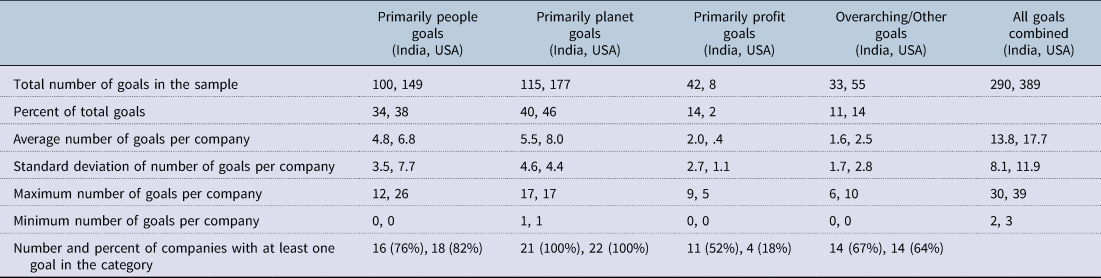
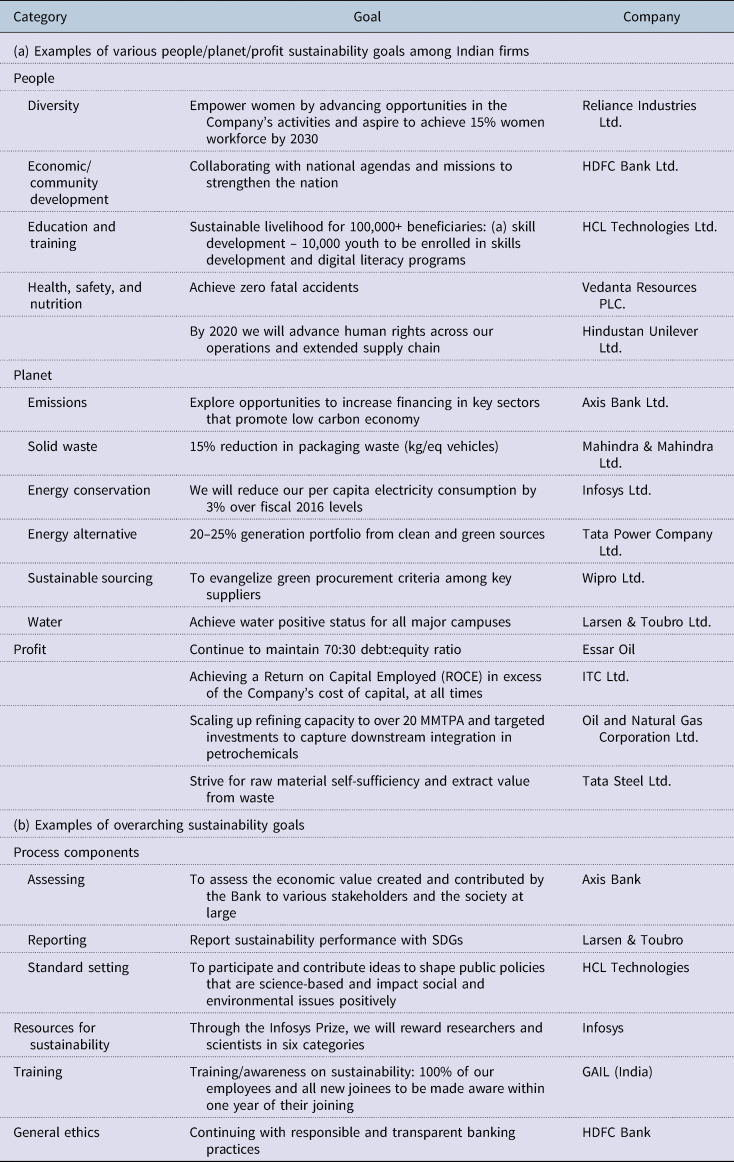
Tables 1 through 4 present detailed information on the 290 Indian goals and 389 U.S. goals (identified in Palmer & Flanagan, Reference Palmer and Flanagan2016) broken into four major goal areas. Tables 5a and b display exemplars of Indian sustainability goals. Selected results for each of the four goal area tables are presented below. Given our sample is not random but rather purposeful, it would be inappropriate to use inferential statistics to examine significance levels of our number counts, percentages, and averages. Rather, following the guidance of Miles, Huberman, and Saldana (Reference Miles, Huberman and Saldana2014) we look for and describe patterns, differences, and themes in the displayed data. Examples of published qualitative studies using this approach include Anteby (Reference Anteby2010) and Kellogg (Reference Kellogg2009).
Summary comparison of listed people, planet, and profit goals of sample companies: 21 Indian companies and 22 U.S. companies

As depicted in Table 1, on average, Indian firms listed 13.8 sustainability goals while the U.S. firms listed 17.7 goals. These ranged from a high of 30 goals (India) and 39 goals (USA) and a low of two (India) and three (USA). Across both the samples, planet goals were most common (India: 115 goals, 40%; USA: 177 goals, 46%). All firms in the India and the United States samples had at least one goal in the planet category. People goals were the next most common (India: 100 goals, 34%; USA: 149 goals, 38%). A majority of firms in both countries (India: 76%; USA: 82%) declared at least one people goal. Profit goals were very uncommon among U.S. firms. Only eight profit goals were detected in Palmer and Flanagan (Reference Palmer and Flanagan2016) (2% of the total). In contrast, we identified 42 profit goals among the Indian firms in our sample (14%) with companies, on average, identifying two profit goals. In total, 52% of Indian firms listed a profit goal while only 18% of U.S. firms did. Finally, our analysis revealed 88 overarching goals (India: 33 goals, 11% of their total goals; USA: 55 goals, 14%).
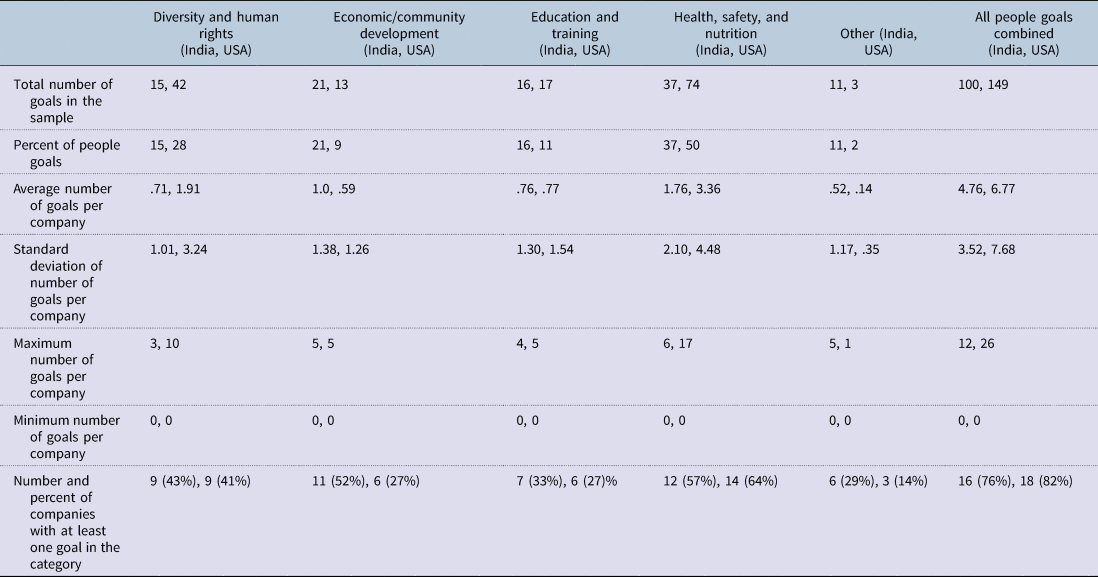
The most common subcategory of people goals was health, safety, and nutrition for both samples (see Table 2). In total, 57% of the Indian firms and 64% of the U.S. firms listed at least one of these goals. Among the Indian firms, a total 37 goals were identified (37% of the total Indian people goals). U.S. firms listed 74 health, safety, and nutrition goals (50% of U.S. firms’ people goals). A difference between goal content in the two samples was noticed with economic/community development goals. The Indian firms were more likely to integrate such goals into their goal lists than the U.S. firms. The Indian firms identified 21 economic/community development goals (21% of total people goals) while firms in the U.S. sample listed only 13 such goals (9% of U.S. people goals). Moreover, 52% of the Indian firms included at least one economic/community development goal while only 27% of the U.S. firms did the same.
Comparison of people goal subcategories: 21 Indian companies and 22 U.S. companies

Diversity and human rights goals were more common among U.S. firms than they were for Indian firms (42 U.S. goals, 28% of the total vs. 15 Indian goals, 15% of the total). Interestingly, while there were more U.S. diversity and human rights goals, Indian firms were more likely to identify at least one of them (43% of Indian firms listed at least one goal whereas 41% of U.S. firms listed at least one goal). Upon further examination of our cases, it appears that this finding is being driven by a large number of diversity and human rights goals at two U.S. companies in our sample (Microsoft and Walmart). Education and training goals appeared to be equally represented across both the Indian and U.S. firms. The Indian firms listed 16 such goals of their 100 total (16%) and the U.S. firms identified 17 goals (11% of the total 149 people goals). Last, Indian firms were much more likely to have ‘other’ goals that did not fit neatly into the people goal typology. In total, 29% of Indian firms had an ‘other’ people goal while only 14% of the U.S. firms listed an ‘other’ goal. The goals in the ‘other’ subcategory tended to be statements associated with employees such as growing talent, compensation, and investing in employees.
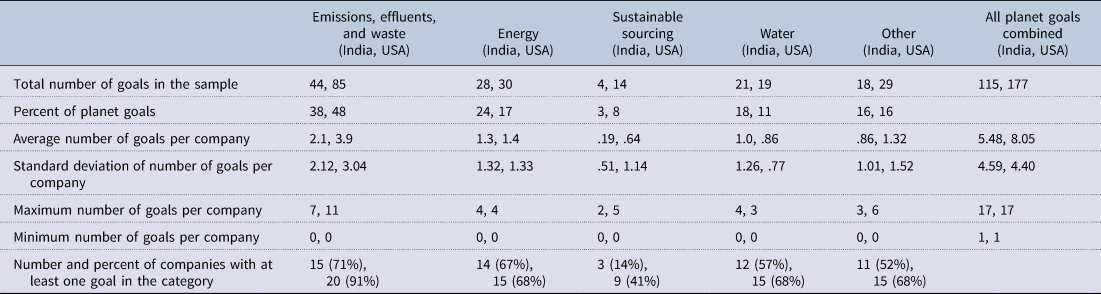
Regarding planet goals (Table 3), emissions, effluents, and waste was the most common subcategory among firms from both countries sampled. In total, 91% of U.S. firms had at least one goal in this subcategory (85 total goals, 48% of the total planet goals). U.S. firms, on average, identified 3.9 emissions, effluents, and waste goals. Indian firms were similarly inclined to list these goals. In total, 71% of Indian firms had at least one goal in the subcategory. Forty-four goals were identified among all firms (38% of the total). In total, 2.1 goals, on average, were listed.
Comparison of planet goal subcategories: 21 Indian companies and 22 U.S. companies

The second most common subcategory of planet goals for both Indian and U.S. firms was energy. In total, 67% of Indian firms and 68% of U.S. firms listed at least one of these goals. Among the Indian firms sampled, a total of 28 goals were identified (24% of the total Indian planet goals). Thirty energy goals were listed by U.S. firms (17% of U.S. firms’ planet goals). Majorities of firms in both samples (India: 57%; USA: 68%) set water reduction goals. Water goals represented a greater percentage of India's planet goals (18%) than they did among the U.S. firms sampled (11%).
Sustainable sourcing goals were uncommon. Only four such goals were detected among the Indian firms we sampled (3% of the total Indian environmental goals). U.S. firms listed 14 sustainable sourcing goals (8% of their total environmental goals). That said, 41% of the U.S. firms sampled had at least one sustainable sourcing goal whereas 14% of the 21 sampled Indian firms included one such goal.
Goals that fell in the other/multiple categories subcategory were equally common across both samples (India: 18 goals, 16% of their environmental goals; USA: 29 goals, 16% of their total). Goals subcategorized into the ‘other’ planet category tended to be broad statements about certifications (e.g., Leadership in Energy and Environmental Design, or LEED) and standards (e.g., ISO) which covered a variety of the planet subcategories.
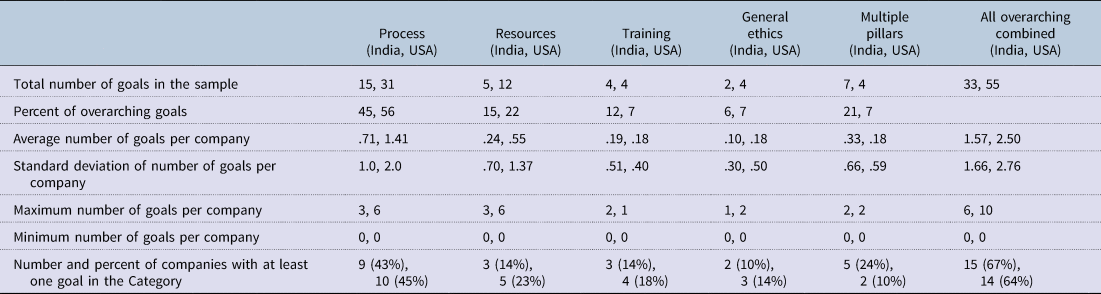
The final sustainability goal category we analyzed was goals that were ‘overarching.’ Thirty-three Indian goals and 55 U.S. goals (Table 4) were subcategorized into dimensions of process, resources, training, general ethics, and multiple pillars. The majority of overarching goals in both samples was about sustainability processes (India: 15 goals, 43% of firms had at least one process goal; USA: 31 goals; 45% with one goal in this category). Firms in our Indian sample were more likely than U.S. firms to have goals spanning multiple pillars. In total, 21% of India's overarching goals fit into this subcategory (seven goals) while only four U.S. goals (7%) were coded into multiple pillars. Other overarching subcategories included sustainability resources (e.g., goals for philanthropic donations or employee volunteerism) (5 Indian goals, 12 among U.S. firms), training goals (e.g., training employees on sustainability) (four goals apiece for firms in both samples), and general ethics goals (e.g., broad goals such as to ‘work ethically’) (two Indian goals and four U.S. goals).
Comparison of overarching goal subcategories: 21 Indian companies and 22 U.S. companies

Examples of sustainability goals

The above examples are taken from publicly available sources, such as corporate sustainability reports, GRI reports, business responsibility reports, and company websites.
Discussion and Implications
A key question of this exploratory, qualitative, research was the extent to which sustainability goals reflect globalization through standardization across national contexts versus goals that are stylized to reflect unique national contexts. The picture that emerges from our research is in part commonality but also considerable difference. We were initially struck by similarity in the number of leading firms in our samples that publish goal lists. Of the largest 50 firms in each country, 21 Indian firms and 22 U.S. firms publish lists of sustainability goals. This is especially noteworthy given the composition of industries represented. While both samples included IT firms, the leading Indian firms were represented by more basic industries such as mining, steel production, and petro-chemicals. In contrast, the U.S. sample was comprised of more retailers, automotive manufacturers, and pharmaceuticals. Hence, the proclivity of firms to publish sustainability goal lists appears to be independent of their national or industrial contexts.
Why is this important? As recently as a decade ago, many executives viewed sustainability as either an opportunity to cast their firms in environmentally-friendly ways or as a threat to strategic norms. Our results are aligned with previous reports that executives increasingly view sustainability in strategic terms and further suggest that such norms are common in multiple national contexts and industries. Our findings add support to the idea that regardless of region or industry, executives need to develop sustainability initiatives as part of their overall strategy. Not only is this important to a firm's own operations but this is an indication that suppliers or indeed customers’ strategies need to take into consideration the presence or absence of a potential partner's sustainability activities. This can help them maximize the benefits of a relationship or avoid costly negative associations.
The proportion of goals falling into the people and planet categories is a second key similarity we detected between the samples. Both Indian and U.S. firms set very similar proportions of people and planet goals. They were similarly inclined to list overarching goals. Further, firms in both samples, set more planet goals than people goals. Why might these commonalities exist? One possibility is that sustainability is global, not parochial. A host of international initiatives including the United Nations’ SDGs, Global Compact, the ‘We Mean Business’ coalition, among others, represent a unified business attempt to address key social and environmental challenges. A second explanation for the similarities we detected is that large firms’ operations commonly span national boundaries. Hence, some level of commonality among goals is to be expected. Executives could practically view this finding as an indication that planet goals are viewed as a necessary part of a sustainability program and that developing people oriented goals could be a significant source of competitive differentiation.
While one story that emerges from our analysis is about commonality, we also observed many differences. Our comparisons (Table 1) revealed that U.S. firms listed more goals than Indian firms. Closer examination, however, reveals a more complex story. We found a larger number of people and planet goals were listed by U.S. companies while the number of profit and overarching goals were higher for Indian firms. In the sections that follow, we identify notable distinctions between the goal lists we analyzed.
Subcategorizations of people goals
Our subcategory analysis of people goals (see Table 2) reveals interesting, and potentially provocative, results. U.S. companies identified, on average, approximately twice as many diversity goals and double the number of health, safety, and nutrition goals than Indian firms. These results may indicate two important goal areas that Indian firms need to develop to realize well-diversified goal lists.
We applaud the efforts of U.S. firms to set diversity goals, even though more work is needed. A study by the Center of American Progress (2012) found that the U.S. workforce is increasingly diverse regarding gender, ethnicity, and sexual identity. Yet, boardrooms remain predominantly male and white (Heilman, Reference Heilman2012). Inspection of the diversity goals among U.S. firms reveals that most are focused on promoting diversity in supply chains rather than among their own executive ranks.
The problem is more acute in India. The Indian government has initiated a number of programs to promote the economic empowerment of women. Despite these efforts, female workforce participation has actually fallen, from 34% in 1999 to 27% in 2017 (International Labor Organization, 2018). This decline, evident in both rural and urban India, has been attributed to a host of social explanations (International Labor Organization, 2014). Yet most agree that sustaining India's growth will require more women in the workforce. More dire, without increased female employment, India could encounter labor shortages in key sectors of the economy. Despite this need, of the 100 Indian people goals we analyzed, only 10 addressed diversity and most of those specified generic ambitions to increase diversity rather than set targets for increased female employment. Further, only three firms of the 21 in our sample (Reliance Industries, Tata Steel, and Vedanta) set specific goals for increasing the number of women employees.
Diversity is one area where national context plays an important role in understanding differences in sustainability goals. For example, while some U.S. firms actively recruit from the LGBTQ community, setting diversity goals associated with gender identity in India would be much more difficult because of an entrenched stigma against non-heterosexual orientations. It was not until September 2018 that the Indian Supreme Court repealed a colonial-era law against homosexuality. Article 377 of the Indian Penal Code criminalized all ‘sexual activities against the law of nature’ and was a key reason for driving the LGBTQ community underground. In the wake of the Supreme Court decision, Indian companies could lead social change that mainstreams the LGBTQ community into the economic building of the nation. A starting point would be the inclusion of LGBTQ diversity goals in sustainability platforms of Indian firms.
A diversity characteristic unique to India is the caste system. While many U.S. firms set goals to increase hiring from the poor, agendas to employ members of India's lowest caste, the ‘Dalits,’ would be especially challenging. Despite laws to protect them, Dalits face widespread discrimination resulting in employment that is overwhelmingly limited to the informal sector (World Bank, 2011). Correspondingly, none of the Indian goals we analyzed focused on populations marginalized by caste. This suggests an opportunity for India's largest corporations to set goals around poverty reduction, in part through hiring targets. While being cognizant of traditions and laws, firms operating or seeking to operate in India may benefit from actions to tactfully and legally find ways to develop a diverse workforce and take advantage of the talents of persons from traditionally marginalized groups.
Goal lists of Indian companies indicate less consideration for workplace health and safety than U.S. firms. Federal initiatives in the United States, such as Healthy People 2020, have set goals to increase the proportion of individuals who have access to employer-based wellness programs. Regarding safety, in the four decades since the inception of the Occupational Safety and Health Administration (OSHA), the U.S. workplace has seen vast improvements in both workplace injuries and fatalities. In contrast, health and safety regulations in India are lax and seldom enforced (Sardana, Reference Sardana2010; Ramachandran, Reference Ramachandran2014). Despite considerable legislative attention on health and safety issues through the Factories Act (1948, 1954, 1976, 1987, and 1990), industrial accidents continue to occur. On average, 48,000 Indians die each year due to work-related accidents and the number of industrial accidents causing death in India rose 41% in 2015 over 2014 levels (National Crime Records Bureau, 2016). Alarmingly, occupational deaths caused by cancers and other illnesses rather than accidents are grossly under-reported in India and analysis claims that most deaths in India are due to occupational illnesses rather than accidents or child-health-related diseases (Sardana, Reference Sardana2010). The challenge of occupational safety in India is compounded by the fact that 91% of the total Indian workforce is employed in the informal economy which is not under the purview of occupational health laws. One opportunity for Indian sustainability professionals therefore, is to lead by example. This could include increasing the presence of health and safety goals in their sustainability platforms. As the world moves more toward a knowledge-based work force, worker health and safety should not be regarded as ‘nice to do’ or simply a legal issue. Following laws and indeed going above and beyond laws with regard to health and safety can lead to a more stable, productive, and profitable work force.
The Indian companies we examined have almost twice the number of economic and community development goals as the U.S. firms. One explanation for this finding is the strong influence of the CSR Mandate. Over 900 affected firms must invest in designated targeted areas, one of which includes economic development. A recent study by KMGP (2017) found that nearly half of these firms are investing in rural development projects. Thus, it is to be expected that firms will be inclined to set goals regarding outcomes associated with their economic development investments. In addition, the media have been particularly vocal about India's lowly position in the Human Development Index, ranking 131st among 181 countries, a position shared by Pakistan, and other South Asian neighbors. This provides adequate incentive for companies to concentrate on the economic and other development of communities and to set specific sustainability goals in this area. A practical implication of this is that global firms working in India need to be cognizant that there may be a high expectation or need for them to undertake economic and community development initiatives.
Subcategorizations of planet goals
Our comparisons revealed that Indian firms were less likely than U.S. firms to set goals associated with emissions, effluents, and waste. Among planet goals set by U.S. firms, 85 (48%) were associated with this subcategory. In contrast, leading Indian firms set 44 goals (38%). Not only were more goals set, U.S. firms were more inclined to set goals in this subcategory (91% of U.S. firms set at least one emissions, effluents, and waste goal vs. 71% of Indian firms). As well, U.S. firms set, on average, a greater number of goals per company (3.9 vs. 2.1).
A considerable amount of press has depicted air and emission challenges in India. The World Health Organization database indicates that 10 of the world's most polluted cities are Indian. Fortunately, the Indian central government and business community are attuned to the challenges they face. We found the vast majority of Indian emissions, effluents, and waste goals to be associated with carbon reduction. We applaud India's commitment to the Paris Agreement and encourage Indian firms to integrate science-based targets into their emissions goals. While the American president removed the USA from the Agreement and disavowed the science of climate change, we are encouraged by the frequency of emission goals among American companies and encourage them to also devise goals based on the science of climate change.
Regarding water, the World Bank estimates that 21% of communicable diseases in India are linked to unsafe water and India's holiest river, the Ganges, is a public health risk. A significant concern is associated with untreated sewage, however contamination by industrial effluents include discharges of mercury, ammonia, phosphate, and a host of other chemicals and pesticides. Despite ongoing national and state regulatory work in this area, there is clearly a role to play by India's leading firms. Unfortunately, only three goals, set by two Indian firms (Essar Oil and Mahindra & Mahindra), pertained to effluents. We call on Indian sustainability professionals, especially in basic industries, to set challenging goals associated with water contamination. For example, firms could support the ‘Namami Gange’ campaign, the nation's flagship initiative to clean up the Ganges River.
Access to fresh water is the highest global concern, greater than climate change mitigation, food shortages, and profound social change, over the next 10 years (World Economic Forum, 2016). By 2030, demand for water will exceed current resources by 40% (2030 Water Resources Group, 2009). Access to water is pivotal to meeting the world's low carbon objectives and exposes firms to a host of physical, reputational, and regulatory risks. Essentially, disruption in the water supply often means ‘no water.’ Despite these considerable concerns, water reduction goals were not nearly as common as other types of planet goals for both the Indian and the U.S. firms. Water reduction goals accounted for 18% of Indian firms’ planet goals and only 11% of U.S. firms’. While Indian firms collectively set more water reduction goals, more U.S. firms set at least one water goal. Deeper analysis revealed that the Indian firms in our sample were more likely (76% vs. 68%) to set specific water reduction targets, however the average amount of those targets was nearly identical across both samples (India: 19% reduction, USA: 18%). Our data, therefore, would suggest that water concerns, viewed through the lens of sustainability goals, are comparable across national contexts and of relatively minor concern. This presents a significant gap between heightened global anxiety over the future of fresh water availability and firms’ sustainability agendas. Fresh water initiatives are clearly an area that firms in both India and the United States could positively impact while also using these efforts to differentiate themselves.
Biodiversity lies at the heart of ensuring biological resources such as food and shelter needed for survival. Despite its ecological importance, none of the U.S. firms in Palmer and Flanagan's (Reference Palmer and Flanagan2016) study listed any biodiversity planet goals. Because of that finding, our coding scheme for this study of Indian firms did not account for a biodiversity subcategory. Surprisingly, however, a number of Indian firms did, indeed, set biodiversity goals which were categorized as ‘other’ planet goals. Examples include Coal India and Infosys Ltd.’s goals for tree plantings, Vedanta's aim to implement biodiversity management plans, and Wipro's goal to convert campuses to biodiversity zones. The inclusion of biodiversity goals among Indian firms is impressive and sets a standard that U.S. firms should consider.
One explanation for the inclusion of biodiversity goals by Indian firms is the importance the Indian government has placed on biodiversity. India ratified, and is a signatory to, the Convention on Biological Diversity (CBD) whose objective is to develop national strategies for the conservation and sustainable use of biological diversity. The Indian government subsequently developed a National Biodiversity Action Plan that includes a roadmap for implementation. In contrast, while the USA is a signatory to the CBD, it was never ratified by the U.S. Congress. Absent the support of the federal government, U.S. firms appear unmotivated to set biodiversity goals. As with solving other environmental challenges that do not garner federal support, business may be called on to fill the void.
Our finding of biodiversity goals among Indian firms but not U.S. firms is another testament to the importance of considering national context in sustainability research. Firms looking to become more or better involved in the Indian economy are advised to consider adding biodiversity initiatives to their sustainability programs. Additionally, firms operating in the USA may consider following this trend in India by thoughtfully considering the importance and impact of their activities on biodiversity.
Subcategorizations of profit goals
One significant outcome of our analysis pertains to profit goals: the number of profit goals listed by Indian firms we sampled was considerably greater than profit goals set by U.S. firms. The higher number of profit goals in India, compared to USA (42 vs. 8) led us to undertake further investigation.
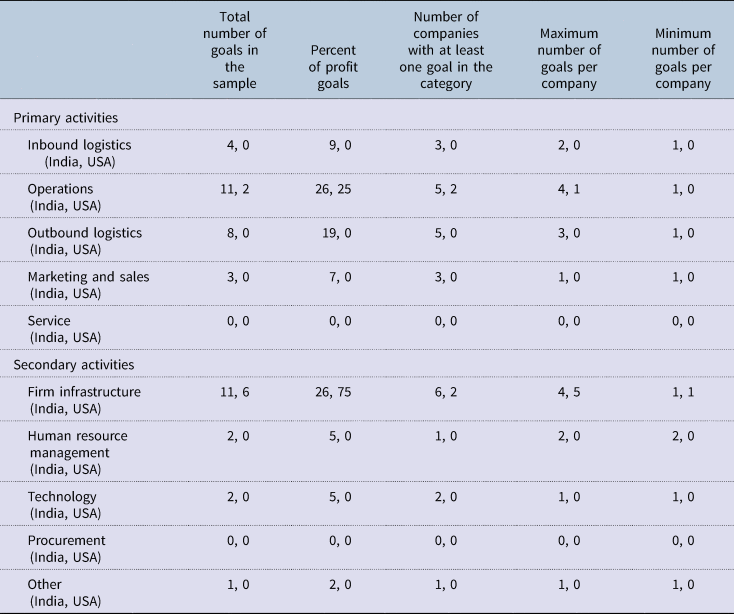
We relied on Michael Porter's (Reference Porter1985) influential value chain typology to seek greater insights into the types of profit goals Indian firms set. Porter's framework provided a good fit because it is explicitly about understanding how various organizational activities impact profits. We therefore content analyzed the profit goals by sorting them into primary activities (in-bound logistics, operations, outbound logistics, marketing and sales, and service) and secondary activities (firm infrastructure, human resource management, technology development, and procurement). Results of our review are shown in Table 6.
Comparison of primary and secondary profit goal subcategories (21 Indian companies and 22 US companies)

Of the 42 Indian profit goals we analyzed, 26 (62%) were classified into primary activities and most firms’ primary profit goals were concentrated on operations. For example, Axis Bank set a goal to ‘Increase the reach and usage of digital channels for enabling superior customer experience and simplified banking,’ and Tata Power Company has a goal to seek a 10-fold increase in value-added businesses, those with no or low capital investment needed.
Sixteen of the 42 profit goals (38%) we analyzed were coded as secondary activities. These included the activities of firm infrastructure, human resource management, and technology development. Infrastructure goals tended to include many profit targets such as Axis Bank's goal to ensure optimal utilization of capital through capital allocation driven by Vision 2020. Among the human resource management goals, several centered on culture such as Essar Oil's goal to create a performance driven culture by rewarding star employees. Finally, two Indian firms see technology as aligned with sustainability. For example, Bharti Airtel has set a goal to improve customer experience by deploying more compact and efficient technologies.
Some might wonder about the relevance of many of these profit goals to sustainability. However, the triple bottom line rests upon the three pillars of people, planet, and profits. Remove any pillar, and a firm's ability to sustain itself is compromised. For many years, sustainability has been equated with ‘green’ initiatives and only recently have social considerations become integrated into sustainability platforms. Many Indian firms we analyzed appear to hew even closer to the true spirit of Elkington's (Reference Elkington1997) triple bottom line by integrating goals associated with primary and secondary value chain activities that, if attained, may help those firms better attain their people and planet goals.
Limitations and Future Directions
Our research sought to increase understanding of sustainability goal setting by investigating a sample of India's leading firms and contrasting those firms’ goals with goals set by a sample of large firms in the USA. Additional research exploring sustainability goals in other contexts is encouraged. Many of the U.S. and Indian firms we analyzed are multinational. Analysis of the large firms we studied revealed efforts to solve global threats associated with ‘grand challenges’ such as climate change, diversity, and human rights. Other insights can be gained by investigating goals of small and medium-sized firms. Investigating sustainability goals of smaller firms might provide insights into local and regional issues that do not conform to international standards. Thus, future research should explore sustainability goals by examining firms of different sizes.
Our research relied on published sustainability goal lists of leading firms. We used lists because we believe the decision to include them in organizational documents indicates executives’ commitments to their goals. Lists also provide stakeholders with the opportunity to hold firms accountable. A published goal list, therefore, is highly likely to identify intentional commitments to specific targets. We acknowledge, however, that firms may commit to sustainability goals even when lists are not shared with the public. Other qualitative research designs such as fine-grained executive interviews are therefore warranted and would complement the results of our study. In addition, survey research tapping into larger sample sizes would provide the ability to identify statistically significant relations.
In a similar vein, results of our inductive study could be leveraged through future research employing different analytical techniques. Our intent was to describe the landscape of sustainability goal setting in the hope that patterns we detected might spur new research that builds and tests theory. Both finer-grained inductive research and deductive research using random sampling are necessary ‘next steps’ to build and test theory about sustainability goal setting.
Future research should continue investigating relations between philanthropy, CSR, and sustainability. While some see the two concepts as isomorphic, others continue to see stark differences. Are they the same? Similar? Different? Further, could Gandhi's model of trusteeship provide a useful perspective to reconcile the two? His idea was that those possessing excess resources should invest in society. Such a perspective could be at odds with a limited view that sustainability initiatives should be closely aligned with firm strategy. If so, whose responsibility is it to leverage resources for the sake of, for example, reducing water pollution? Is it only the polluters? Should non-polluting firms also leverage their resources to solve environmental and social challenges of tainted water? Should low energy-use firms be called on to help others find ways to limit carbon emissions? Future research could examine boundaries and overlaps between traditional philanthropy, CSR, and sustainability through the unique Indian perspective of trusteeship.
Our findings in areas such as LGBTQ initiatives, bio-diversity, and health and safety goals, highlight the interaction between firm sustainability goals and government regulations. Future research focusing on the impact of government policy on firms’ sustainability policies would benefit executives looking to better understand how their legal responsibilities may differ from country to country. Additionally, public policy researchers may be interested in learning more about how regulations are influencing firms’ goals. Learning where firms are concentrating their efforts, because of regulations or in spite of them, may give public policy makers indications of where gaps between private action and public good may exist which could subsequently enable thoughtful regulatory policy.
Finally, it must be acknowledged that our research focuses on goals. Setting a goal is not a certain indicator of action let alone a desired outcome. Future research detailing implementation issues such as how goals are put into actions and what factors influence whether these actions achieve a stated goal is certainly warranted.
In conclusion, the purpose of this study was to gain a better understanding of the strategic sustainability landscape by comparing sustainability goals of Indian firms with those of U.S. firms. The insights can help give direction and motivation to firms operating in the U.S. and India as well as give firms considering foreign direct investment in either country a better idea of the sustainability landscape of major firms in these countries. We have also highlighted how organizations in other parts of the value chain such as customers and suppliers and indeed government policy makers can benefit from a better understanding of the sustainability priorities of firms based in these countries. For researchers, we give credence to the idea that studying phenomena in varying contexts is important. While additional research is clearly warranted, we hope our sustainability research provides a frame of reference to help detect themes and patterns in this globally important, relatively novel, and quickly evolving business dimension.
Author ORCIDs
Timothy B. Palmer, 0000-0002-7907-9115