


Introduction
Worry is a common feature across many anxiety disorders, including separation anxiety disorder and social anxiety disorder. Although previously thought of primarily as a core feature of generalized anxiety disorder (GAD), worry is now often considered as a transdiagnostic construct (Kertz et al., Reference Kertz, Bigda-Peyton, Rosmarin and Björgvinsson2012). In fact, Olatunji and colleagues (Reference Olatunji, Cisler and Tolin2007) argue that worry is present to some extent in all individuals, with important associations with a multitude of anxiety and mood disorders. For example, an adolescent with social anxiety disorder may worry about a future social situation, or a child with separation anxiety disorder may worry about an upcoming time when she will be separated from her parents. Investigating worry as a construct that cuts across anxiety disorders provides a way to elucidate overlapping and distinct characteristics across symptom profiles. This approach may, at a minimum, inform treatment and aid in better diagnosis of emotional disorders. Further, through a better understanding of when and how worry manifests, it also may inform research on etiology and underlying neurological mechanisms or biomarkers associated with emotional disorders.
In adults, high levels of worry have been identified in patients with social anxiety disorder (Starcevic et al., Reference Starcevic, Berle, Milicevic, Hannan, Lamplugh and Eslick2007), panic disorder (Mohlman et al., Reference Mohlman, de Jesus, Gorenstein, Kleber, Gorman and Papp2004), and obsessive-compulsive disorder (Gladstone et al., Reference Gladstone, Parker, Mitchell, Malhi, Wilhelm and Austin2005). Worry also often presents in depressive disorders. In an older study, Starcevic (Reference Starcevic1995) found comparable levels of worry in depressed and anxious patients. There is also research suggesting that major depression and GAD share genetic risk (Eley and Stevenson, Reference Eley and Stevenson1999), providing further support for worry representing a construct with potential etiological significance. Gladstone et al. (Reference Gladstone, Parker, Mitchell, Malhi, Wilhelm and Austin2005) found higher levels of worry in patients with co-morbid depressive and anxiety disorders than those with just one of those disorders.
Such overlap calls the approach of using diagnostic categories to better understand the phenomenon of worry into question. Multiple models address this and suggest that worry is a transdiagnostic construct. An alternative interpretation of worry can be viewed through Weems’ (Reference Weems2008) theory of continuity and change in childhood anxiety. Weems suggests that there is a core set of primary features, which he refers to as ‘maladaptive anxious emotion’, which underlies all DSM anxiety disorders, and disorder-specific symptoms are secondary features. For example, in an adolescent with social anxiety disorder, the dysregulation is the intense emotional reaction experienced, and the secondary feature is the interpersonal concerns. Although the secondary features may change over time, the primary ‘maladaptive anxious emotion’ remains stable (Weems, Reference Weems2008). According to this theory, worry can be considered a primary feature of anxiety disorders, with separation anxiety and social anxiety symptoms remaining as the secondary characteristics. Given this theory, it would be necessary to examine the developmental relationship between these primary and secondary features. The present study applies Weems’ (Reference Weems2008) theory and assesses whether worry remains constant throughout a child and adolescent sample. Worry can also be viewed as a construct that cuts across diagnoses through the lens of the tripartite model for anxiety and depressive disorders in children (Chorpita, Reference Chorpita2002). This model, originally developed by Clark and Watson (Reference Clark and Watson1991), posits that anxiety and depressive disorders share three common factors: negative affect, physiological hyperarousal, and positive affect. However, it is possible to conceptualize worry in this model as another common factor that cuts across disorders. For anxiety disorders, worry tends to manifest as future-focused thought and for depressive disorders, worry manifests as a more ruminative, past-focused thought (McEvoy et al., Reference McEvoy, Watson, Watkins and Nathan2013). While the content of the thought may differ, worry still presents as a common factor of both disorders. In fact, worry has been found to significantly predict both anxiety and depression (McEvoy and Brans, Reference McEvoy and Brans2013). The present study views worry through the lens of this model and assesses the association between worry and anxiety symptoms.
This is important to study as there appears to be heterogeneity in the onset and trajectories of anxiety disorders (Beesdo et al., Reference Beesdo, Knappe and Pine2009). Anxiety disorders appear to emerge at varying times throughout development, with some disorders frequently appearing in preschool years (e.g. separation anxiety disorder; Franz et al., Reference Franz, Angold, Copeland, Costello, Towe-Goodman and Egger2013) and some disorders first emerging in adolescence (e.g. panic disorder or social anxiety disorder; Kessler et al., Reference Kessler, Berglund, Demler, Jin, Merikangas and Walters2005). For example, Beesdo et al. (Reference Beesdo, Knappe and Pine2009) showed that social anxiety disorder, generalized anxiety disorder, panic disorder and agoraphobia are significantly more prevalent in adolescents (ages 13–18 years) compared with younger children. However, the prevalence of separation anxiety and select specific phobias tends to decrease with age (Beesdo et al., Reference Beesdo, Knappe and Pine2009). Consistent with this, the median age of onset for social anxiety disorder is 13 years, whereas that of separation anxiety disorder is 7 years (Kessler et al., Reference Kessler, Berglund, Demler, Jin, Merikangas and Walters2005). Two of the most prevalent anxiety disorders affecting children and adolescents, and whose symptoms are the focus of the study, are separation anxiety disorder (4.1%; Shear et al., Reference Shear, Jin, Ruscio, Walters and Kessler2006) and social anxiety disorder (8.2%; Kessler et al., Reference Kessler, Avenevoli, Costello, Georgiades, Green, Gruber and Merikangas2012). Aside from their prevalence, these two disorder categories were investigated in the present study because there is evidence that a significant percentage of adults diagnosed with social anxiety had a diagnosis of separation anxiety during childhood (Otto et al., Reference Otto, Pollack, Maki, Gould, Worthington, Smoller and Rosenbaum2001). This evidence suggests that a close look at these two conditions could elucidate a pattern of changing relationships between these ‘secondary features’ over time (Weems, Reference Weems2008). It is possible that this relationship may be present even in adolescents with social anxiety.
Given the early onset of these disorders and the significant co-morbid presence of worry, it is important to assess the relationship between worry and these disorders. However, as noted previously, most of the existing studies that examine the relationship between worry and social anxiety disorder utilize an adult sample (e.g. Starcevic et al., Reference Starcevic, Berle, Milicevic, Hannan, Lamplugh and Eslick2007). Additionally, there is a dearth of studies that examine the relationship between worry and separation anxiety disorder in any age group. Given the prominence of worry in anxious individuals, it is imperative to study the relationship between worry and anxiety disorders, especially in children and adolescents, for whom there are considerably fewer empirical studies. To our knowledge, this study is the first to examine the relationship between worry and symptoms of both of these two disorders in a sample of children and adolescents.
The present study aims to assess the degree to which worry is present in children and adolescents with an anxiety diagnosis and the presence of separation anxiety and/or social anxiety symptoms. This study also aims to assess how relationships between worry and separation anxiety, and worry and social anxiety, may present differently at different ages. Following Weems’ (Reference Weems2008) model, we theorize that worry manifests as a stable feature of anxiety disorders, and separation anxiety and social anxiety symptoms present as variable characteristics. Hence, based on this theory, it would be expected that worry would be present in both the younger and the older groups. It was hypothesized that when viewing the sample as a whole, both separation anxiety and social anxiety symptoms will be significantly correlated with worry. It was also hypothesized that, due to the typical course and prevalence of separation anxiety primarily in younger children and social anxiety primarily in older children (Kessler et al., Reference Kessler, Berglund, Demler, Jin, Merikangas and Walters2005; Beesdo et al., Reference Beesdo, Knappe and Pine2009), worry will exhibit a stronger association with separation anxiety than with social anxiety in the younger group (ages 8–12 years), while worry will exhibit a stronger association with social anxiety than with separation anxiety in the older group (ages 13–18 years). Based on previous research on the relationship between depression and worry (Starcevic, Reference Starcevic1995; Eley and Stevenson, Reference Eley and Stevenson1999), a measure of negative mood was investigated as a covariate to control for the role of depressive symptoms in both age groups.
Method
Participants
Participants were 127 children and adolescents diagnosed with an anxiety disorder, presenting at a child anxiety out-patient clinic in New England. The mean age of the sample was 12.5 years (SD 2.8, range 8–18 years). The sample was 55% female (n = 70), and Caucasian was the primary ethnicity reported (85.6%, n = 77; ethnicity data was missing in 29.1% of cases). The sample was predominantly of middle to high socioeconomic status (SES), and 78.3% of participants were from a household with married parents (n = 72; family structure data missing in 27.6% of cases).
The sample was divided into two groups: a younger group, aged 8–12 years (n = 65, mean 10.2, SD 1.3), and an older group, aged 13–18 years (n = 62, mean 14.9, SD 1.6). The younger group was 53.8% female and the older group was 56.5% female. The older and younger groups did not differ with respect to gender, income or ethnicity (P>0.05). For certain supplemental analyses, these two groups were further subdivided into four age groups (see details below).
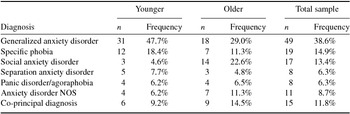
A principal anxiety diagnosis was required for inclusion in this study. Primary diagnoses were generalized anxiety disorder (38.6%), specific phobia (15%), social anxiety disorder (13.4%), separation anxiety disorder (6.3%), panic disorder/agoraphobia (6.3%), and anxiety disorder not otherwise specified (8.7%), as well as 11.8% with a co-principal diagnosis. Diagnostic information for the entire sample and for the two groups is reported in Table 1.
Frequencies of principal diagnoses for the entire sample and specific groups

NOS, not otherwise specified.
Measures
Child anxiety symptoms
The Multidimensional Anxiety Scale for Children (MASC) is a 39-item self-report questionnaire developed to measure anxiety symptoms in children and adolescents. The MASC is comprised of four main factors: (1) physical symptoms (12 items); (2) harm avoidance (9 items); (3) social anxiety (9 items); and (4) separation anxiety (9 items) (March et al., Reference March, Parker, Sullivan, Stallings and Connor1997). The present study utilized the social anxiety and separation anxiety subscales (Rynn et al., Reference Rynn, Barber, Khalid-Khan, Siqueland, Dembiski, McCarthy and Gallop2006). Items were scored on a 4-point Likert scale from 0 to 3, yielding subscale scores ranging from 0 to 27, with greater scores indicating greater anxiety symptoms. Sample items from the social anxiety subscale are ‘I worry about other people laughing at me’ and ‘I feel shy’; and from the separation anxiety subscale ‘I try to stay near my mom and dad’ and ‘I avoid going places without my family’. Although items on the social anxiety subscale utilize the word ‘worry’, the subscale's focus is the measurement of social anxiety and not worry in general. No items on the separation anxiety subscale utilized the word ‘worry’. Internal consistency was good for both scales (Cronbach's α = 0.845 and 0.715, for the social anxiety and separation anxiety subscales, respectively).
Child worry
The Penn State Worry Questionnaire for Children (PSWQ-C) is a 14-item self-report questionnaire intended to assess a child or adolescent's tendency to worry. Questions are designed to assess worry in general, not specific phobias. Adapted from the original PSWQ (Meyer et al., Reference Meyer, Miller, Metzger and Borkovec1990), the PSWQ-C was reworded to be appropriate for a second grade reading level (Chorpita et al., Reference Chorpita, Tracey, Brown, Collica and Barlow1997). Items are scored on a 4-point Likert scale from 0 to 3, yielding a total score ranging from 0 to 42, with greater scores indicating greater tendency to worry. Items 2, 7 and 9 are reverse scored as higher scores originally represented a lesser tendency to worry. Sample items include ‘Many things make me worry’; ‘I find it easy to stop worrying when I want’; and ‘I worry all the time’ (Pestle et al., Reference Pestle, Chorpita and Schiffman2008). Internal consistency was good (Cronbach's α = 0.926).
Child negative mood
The Children's Depression Inventory (CDI) is a 27-item self-report questionnaire designed to measure depressive symptoms in children and adolescents (Kovacs, Reference Kovacs1992). Each item consists of three self-report statements increasing in severity. Items are scored from 0 to 2, yielding a total score ranging from 0 to 54, with greater scores indicating a greater level of depression. For this study, the negative mood subscale of the CDI was included, yielding a total score for that subscale ranging from 0 to 12. The negative mood subscale includes items referring to both sadness and behaviors like crying and being bothered or upset by things. The negative mood subscale was used as a covariate to control for worry associated with negative mood states rather than anxiety. Sample items from the negative mood subscale are ‘I am sad once in a while/many times/all the time’ and ‘Things bother me once in a while/many times/all the time’. Internal consistency was good (Cronbach's α = 0.742 for the negative mood subscale).
Anxiety diagnosis
The Anxiety Disorders Interview Schedule for Children (ADIS-C; Silverman and Albano, Reference Silverman and Albano1996) is a structured interview utilized to diagnose anxiety disorders and select other, related disorders based on DSM (Diagnostic and Statistical Manual of Mental Disorders) criteria. The ADIS-C consists of both a parent interview and a child interview. A clinical severity rating (CSR) from 0 (none) to 8 (severely impaired) is assessed based on the presence of diagnostic symptoms and severity of associated impairment. The ADIS-C was used to determine eligibility for this study, which required a CSR of any anxiety disorder greater than or equal to 4. Diagnoses were made by masters- and doctoral-level clinicians with specific expertise and training in childhood anxiety disorders.
Procedure
The child and parents presented for an initial diagnostic evaluation. Prior to meeting with a clinician, parents signed a consent form acknowledging that their de-identified responses could be used for research purposes. The authors assert that all procedures contributing to this work comply with the ethical standards of Boston University's Institutional Review Board and with the Helsinki Declaration of 1975, and its most recent revision. Next, the child and parent(s) each separately filled out a pencil and paper packet consisting of assessment questionnaires, a selection of which were used in this study. Clinicians then conducted the ADIS-C. All diagnoses were presented and discussed at a weekly clinical meeting to establish consensus among expert clinicians.
Data analysis
All statistical tests were conducted using SPSS version 21. Descriptive statistics were first calculated for the entire sample as well as for both age groups. Independent sample t-tests were used to calculate any differences between younger and older participants. Correlations between variables for the younger group and for the older group were then calculated. Finally, hierarchical linear regression was modelled to assess the relationship between worry and anxiety symptoms in both the younger group and in the older group.
Results
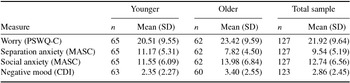
Descriptive statistics for the entire sample as well as for both age groups can be found in Table 2. Group differences were found for the separation and social anxiety subscales and for negative mood. Mean separation anxiety scores for the younger group were significantly higher (mean = 11.17) than for the older group (mean = 7.82) (t 125 = 3.82, P < 0.001; d (effect size) = 0.68). Mean social anxiety scores for the older group were significantly higher (mean = 13.98) than for the younger group (mean = 11.55) (t 125 = −2.12, P = 0.036; d = 0.38). Mean negative mood scores for the older group were significantly higher (mean = 3.40) than for the younger group (mean = 2.35) [t 121 = −2.42, P = 0.017; d = 0.43]. There were no significant differences in worry scores between the two age groups (t 125 = –1.71, P = 0.089; d = 0.30).
Means and standard deviations of variables in the entire sample and specific groups

For the sample as a whole, social and separation anxiety symptoms were significantly correlated with worry, r = 0.440 and r = 0.253, respectively. Subsequent correlations were calculated by age group. As expected, many correlations between measures were significant (see Table 3 for correlations for both age groups). The largest correlations were found between negative mood and worry in both the younger and older groups. Social anxiety was significantly correlated with worry in both the older group (r = 0.417) and the younger group (r = 0.432). Separation anxiety was significantly correlated with worry in younger participants (r = 0.516, P < 0.001), but not in older participants (r = 0.088, P = 0.498), and these correlations are significantly different from one another (z = 2.65, P = 0.008). (z is the symbol used to represent a z-statistic. It is the result of a comparison of the worry and separation anxiety correlation between the two groups.)
Correlations of variables for the younger and older groups

Correlations for the older group are presented above the diagonal and correlations for the younger group are presented below the diagonal. Due to patterns of missing data, correlations range from n = 60 to n = 65 for all comparisons. *P < 0.05; **P < 0.01; ***P < 0.001.
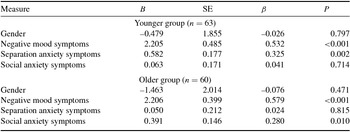
Two hierarchical regression models predicting worry were assessed: one consisted of a younger sample (age 8–12 years) and a second consisted of an older sample (age 13–18 years). Gender and negative mood were included as covariates in both regression models. Gender was entered into step 1, followed by negative mood in step 2, and finally, anxiety symptom subscales were entered in step 3. Final models from step 3 are presented in Table 4. As expected, negative mood was significantly associated with worry in both age groups. In the model with younger children, separation anxiety symptoms remained significant after the inclusion of covariates (B = 0.582, β = 0.325, P = 0.002), while social anxiety symptoms no longer remained significant. This model explained 51.7% of the variance (R 2 = 0.517). In the model with older children, social anxiety symptoms remained significant after the inclusion of covariates (B = 0.391, β = 0.280, P = 0.010), while separation anxiety symptoms remained non-significant. This model explained 48.2% of the variance (R 2 = 0.482). (B represents the unstandardized beta.)
Final step of hierarchical regressions predicting worry in younger and older groups

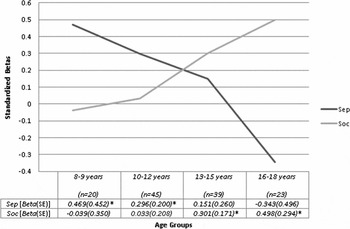
Supplemental analysis was conducted to further assess whether the findings held when more than two groups were used. Specifically, utilizing a one-way ANOVA as well as linear regressions, we assessed whether worry remained stable, with decreases in separation anxiety and increases in social anxiety with age. The stability of worry was confirmed with a one-way ANOVA finding no significant differences between the four age groups (8–9 years: mean = 20.55; 10–12 years: mean = 20.49; 13–15 years: mean = 21.67; 16–18 years: mean = 26.39) (F 3,123 = 2.18, P = 0.094). Hierarchical regression models predicting worry were then tested for each age group. The same model structure was used as in models shown in Table 4, where gender and negative mood were included as covariates in steps 1 and 2, respectively, followed by the anxiety symptom subscales in step 3. These regressions confirmed prior findings of a decrease in the effect of separation anxiety and an increase in the effect of social anxiety. Figure 1 details the standardized betas from the third step of these four regression models to illustrate the changing relationships between worry and anxiety symptoms across the four age groups. As can be seen from the graph, the effects for separation anxiety for the first two groups were significant, and the effects for the last two groups for social anxiety were significant.
Standardized results from four regression models comparing the relationship between worry and separation anxiety to worry and social anxiety across four age groups. *P<0.05. Standardized betas for separation anxiety and social anxiety were extracted from step 3 of a hierarchical regression model with worry as the dependent variable. Gender and negative mood symptoms were controlled for in steps 1 and 2, respectively.

Discussion
This study examined the degree to which worry is present in children and adolescents with separation anxiety and/or social anxiety symptoms, as well as the relationships between worry and separation anxiety, and worry and social anxiety in two age groups.
First, when viewing the sample as a whole, both separation anxiety and social anxiety scores were significantly correlated with worry, as hypothesized. Next, in the older group (ages 13–18 years), worry exhibited a stronger association with social anxiety than with separation anxiety. Finally, in the younger group (ages 8–12 years), worry was associated with both social anxiety and separation anxiety. However, after the inclusion of covariates, worry was no longer significantly associated with social anxiety for the younger children. These findings matched the typical course and prevalence of the two disorders, with separation anxiety symptoms initially presenting primarily in younger children, and social anxiety symptoms presenting primarily in older children (Kessler et al, Reference Kessler, Berglund, Demler, Jin, Merikangas and Walters2005; Beesdo et al., Reference Beesdo, Knappe and Pine2009).
Furthermore, although the correlation between worry and separation anxiety was only significant in the younger group, the correlation between worry and social anxiety was significant in both groups. Although it is possible that the unexpected correlation between worry and social anxiety in the younger group was caused by the use of the word ‘worry’ in both the PSWQ and the MASC social anxiety subscale, it is also possible that this was caused by early presenting social anxiety symptoms. Although a diagnosis of social anxiety disorder does not typically present until age 13 years (Kessler et al., Reference Kessler, Berglund, Demler, Jin, Merikangas and Walters2005), social anxiety symptoms as well as complete social anxiety disorder diagnoses may present earlier. In fact, three participants in the younger group were diagnosed with social anxiety disorder. It is possible that the presence of these participants may have positively swayed the correlation. Furthermore, a heritable and early emerging risk factor for social anxiety disorder is behavioral inhibition, which is typically characterized by shy, fearful and cautious actions in children (Clauss and Blackford, Reference Clauss and Blackford2012). It is possible that the participants in the younger group diagnosed with other anxiety disorders included some children presenting with behavioral inhibition, and, therefore, some symptoms of social anxiety disorder. This may be another cause of the correlation between worry and social anxiety in younger children. Additionally, it is important to note that many of the correlations were stronger in the younger group than in the older group. It is also possible that as children get older, their presentations branch out more (Weems, Reference Weems2008) and become more individualized, and, therefore, they are less likely to correlate well with other measures as there are more factors contributing to the variability of any one measure.
The finding that worry was comparable in both groups, with its association with anxiety symptoms changing with age, is also noteworthy. In fact, the worry scores found in this study were elevated compared with those found in another clinical sample (Pestle et al., Reference Pestle, Chorpita and Schiffman2008), when comparing both by the two age groups and by the entire sample. This may be due to the larger percentage of females in our sample compared with Pestle and colleagues’ sample, with women in general having been found to frequently report more worry than men (Robichaud et al., Reference Robichaud, Dugas and Conway2003). Additionally, Pestle and colleagues’ (Reference Pestle, Chorpita and Schiffman2008) sample consisted of patients with non-anxiety primary diagnoses, who, on average, reported lower worry scores than their patients with a primary anxiety diagnosis. Nonetheless, the consistent presence of worry in the sample lends further support for Weems’ (Reference Weems2008) theory of continuity and change in childhood anxiety. Consistent with this theory, worry manifested as the primary feature (stable over time), with disorder-specific symptoms of separation anxiety and social anxiety representing secondary characteristics (changing over time). However, the cross-sectional nature of this study does not allow for testing whether these presentations changed within the individual participants.
It is important to note the significant findings regarding the covariate, negative mood. Negative mood, an important aspect of depression, was found to be strongly associated with worry and social anxiety symptoms in both age groups, as well as with separation anxiety symptoms in the younger group. This is consistent with prior research that depressive symptoms commonly co-occur with anxiety symptoms in children (Garber and Weersing, Reference Garber and Weersing2010). This strong association also has implications on both the assessment and treatment of both of these anxiety disorders. Given these findings and the prior literature on co-morbidity, it is important to assess for the possibility of concurrent depressive mood symptoms that may also require treatment.
Strong associations between worry and depression are also not uncommon. Pestle and colleagues (Reference Pestle, Chorpita and Schiffman2008) found comparably high levels of worry in children and adolescents with a principal diagnosis of major depressive disorder to a sample with GAD, and slightly higher than those with a principal diagnosis of any other anxiety disorder. This was also consistent with prior studies that have found significant correlations between worry and depression in both clinical samples (i.e. Chorpita et al., Reference Chorpita, Tracey, Brown, Collica and Barlow1997) and non-clinical samples (i.e. Flett et al., Reference Flett, Coulter, Hewitt and Nepon2011).
Less consistent with prior literature was the finding that, in both age groups, the correlation between worry and negative mood was larger than the correlations with the two anxiety subscales. Similar to negative affect in the tripartite model (Chorpita, Reference Chorpita2002), negative mood can be viewed as a broader construct present across diagnoses. These broader constructs of worry and negative mood may be more closely associated with each other than either construct is with the specific symptoms that are focused on a target of worry (e.g. separation, social).
The findings of this study do have clinical implications. First, the significant presence of social anxiety symptoms in the younger group supports the need for clinicians to equally assess the possibility of social anxiety disorder presenting in a younger child when considering a diagnosis of an anxiety disorder. Additionally, the stability of worry across different diagnoses raises the question of whether initially treating the underlying worry may be more beneficial than solely treating the presenting anxiety symptoms. For children receiving treatment, for example, it is possible that targeting separation anxiety symptoms may result in fewer and less-impairing separation-focused concerns, yet leave untouched the underlying predisposition to worry, which could manifest itself later as social anxiety symptoms. One approach that targets transdiagnostic constructs, such as worry or negative affect, is the Unified Protocol (Barlow et al., Reference Barlow, Allen and Choate2004), which was recently adapted for adolescents (Ehrenreich et al., Reference Ehrenreich, Goldstein, Wright and Barlow2009). Ehrenreich and colleagues found a reduction in the clinical severity rating of each of their participants’ diagnoses to a non-clinical level. With the preliminary success of this approach and the continuity of worry present in both groups found in this study, continued development of these transdiagnostic approaches and further practical investigation into Weems’ (Reference Weems2008) theoretical model are warranted.
It is also important to note that worry may be a more difficult symptom to treat, compared with phobic or fearful reactions to stimuli that lend themselves well to exposure-based treatments (Barlow et al., Reference Barlow, Conklin, Bentley, Nathan and Gorman2015). Findings suggest that there is a significant need to develop worry-specific treatments for children. One such treatment that has shown efficacy in reducing levels of worry in adults is mindfulness-based therapies (e.g. Evans et al., Reference Evans, Ferrando, Findler, Stowell, Smart and Haglin2008; Vøllestad et al., Reference Vøllestad, Sivertsen and Nielsen2011). Mindfulness-based therapies attempt to shift the patient's focus from future worries to present awareness as a way to treat worry (Roemer and Orsillo, Reference Roemer and Orsillo2002). However, only recently have mindfulness-based therapies been extended to children (Burke, Reference Burke2010).
For example, Delgado and colleagues (Reference Delgado, Guerra, Perakakis, Vera, del Paso and Vila2010) assessed both a mindfulness intervention and relaxation therapy in a non-clinical sample with high worry scores. Results suggested that both interventions significantly reduced clinical symptoms of worry, and those in the mindfulness intervention exhibited greater emotional comprehension than those in the relaxation intervention (Delgado et al., Reference Delgado, Guerra, Perakakis, Vera, del Paso and Vila2010). The addition of components of Delgado and colleagues’ mindfulness intervention for worry to the traditional treatment of anxiety disorders with cognitive behavioral therapy (James et al., Reference James, James, Cowdrey, Soler and Choke2015) might aid in the patient's general recovery and growth. Future studies should assess this new proposed treatment.
The findings regarding worry have further implications for the treatment of pathological worry, often diagnosed as GAD. In adults, pathological worry has successfully been reduced through treatments such as metacognitive therapy and intolerance of uncertainty therapy (van der Heiden et al., Reference van der Heiden, Muris and van der Molen2012). Metacognitive therapy assumes that worry is actually not pathological and rather is a coping mechanism (Wells, Reference Wells1995). It focuses on cognitively restructuring the patient's beliefs about worry rather than focusing on the worry itself (Wells, Reference Wells2005). Intolerance of uncertainty therapy focuses on helping patients to accept uncertainty in their lives, which often compounds worry in patients with GAD (Dugas and Robichaud, Reference Dugas and Robichaud2007). Recently, Fialko and colleagues (Reference Fialko, Bolton and Perrin2012) assessed the model behind each of these theories in school-age children and adolescents. The authors concluded that with some modification, cognitive models of persistent worry in adults may have applicability to children (Fialko et al., Reference Fialko, Bolton and Perrin2012). It is possible that these treatments may benefit children and adolescents with GAD and other diagnoses where worry plays a prominent role, as seen in this study. Additional research is needed to confirm this.
The findings of this study must be viewed within the context of the following limitations. First, although this study assessed separation and social anxiety symptoms, actual diagnoses of separation anxiety disorder and social anxiety disorder were under-represented relative to other diagnoses, as the majority of this study's sample was diagnosed with GAD or a specific phobia, potentially reducing ability to test for subtle differences between patterns of social and separation anxiety symptoms. Although this study only used anxiety symptom subscales, it is possible that these findings may generalize to actual diagnoses.
Second, we do not know the actual content of the participants’ worries. While worry was consistently present in both age groups, worry's association with anxiety symptoms differed by age. It is possible that the content of the younger group's worries is separation-related and that the content of the older group's worries is social-related. Future studies should assess the content of each participant's worry, as well as the developmental course of those worries, to gain a further understanding of the different ways worry can manifest. Prior research has assessed the content of worry in children aged 7–12 years, finding that the three most common areas of worry involved school, health and personal harm (Silverman et al., Reference Silverman, Greca and Wasserstein1995). Muris and colleagues (Reference Muris, Merckelbach, Gadet and Moulaert2000) similarly examined the content of worry in children aged 4–12 years, finding the most frequently reported worries to be personal harm or harm to others, death, and test performance. Angelino and Shedd (Reference Angelino and Shedd2015) have begun to research the developmental course of worries, finding that while there was no gradual shift in the content of worry, specific worries did vary by age. For example, there is an increase in animal-related fears from ages 11–13 years and a spike in school-related worry at age 13 years; however, the authors noted that these findings were tentative due to a lack of studies for comparison. Future studies should build upon this research, including a broader range of children and adolescents.
Another limitation is this study's cross-sectional design, which limited the ability to determine the actual course of worry as it relates to anxiety disorders. Furthermore, as noted previously, there is heterogeneity in the onset and trajectories for anxiety disorders (Beesdo et al., Reference Beesdo, Knappe and Pine2009). While our statistical approach was appropriate for the type of data we have available, it is not able to fully reflect the complexity of child anxiety disorder trajectories. Future studies should use a longitudinal design to determine whether separation anxiety-related worry develops into social anxiety-related worry over time within individuals. Finally, there may have been issues of multicollinearity as separation anxiety, social anxiety and negative mood were all significantly correlated with each other, suggesting that results should be interpreted with some caution. Furthermore, while the MASC assesses specific anxiety domains and the PSWQ measures worry in general, it must be acknowledged that some overlap (e.g. the MASC using the word ‘worry’) is likely, and may have accounted for some of these high correlations.
In summary, this study assessed the extent to which worry is present in children and adolescents with anxiety symptomology, as well as the relationships between worry and anxiety symptomology as it pertains to age. While future studies should address certain limitations of this study to confirm its findings, the results of this study lend support for worry as a stable construct associated with anxiety disorders throughout late childhood and early adolescence.
Acknowledgements
Financial support: This research received no specific grant from any funding agency, commercial or not-for-profit sectors.
Conflicts of interest: The authors have no conflict of interest with respect to this publication.




Comments
No Comments have been published for this article.