Introduction
Developmental psychotic experiences are mostly transitory and generally disappear over time, but there is evidence that a proportion becomes persistent, depending on the degree of environmental risk that someone is exposed to (Van Os et al. Reference Van Os, Linscott, Myin-Germeys, Delespaul and Krabbendam2009). Recent work suggests that childhood trauma and daily life stress may represent important factors causing persistence and clinically relevant psychotic outcomes. First, the association between childhood trauma and the occurrence of clinical and subclinical psychotic experiences has been shown in many studies (Escher et al. Reference Escher, Romme, Buiks, Delespaul and Van Os2002a; Morrison et al. Reference Morrison, Frame and Larkin2003; Read et al. Reference Read, Van Os, Morrison and Ross2005; Whitfield et al. Reference Whitfield, Dube, Felitti and Anda2005; Lataster et al. Reference Lataster, Van Os, Drukker, Henquet, Feron, Gunther and Myin-Germeys2006; Spauwen et al. Reference Spauwen, Krabbendam, Lieb, Wittchen and Van Os2006; Bendall et al. Reference Bendall, Jackson, Hulbert and McGorry2008; Bentall & Fernyhough, Reference Bentall and Fernyhough2008; Kelleher et al. Reference Kelleher, Harley, Lynch, Arseneault, Fitzpatrick and Cannon2008; Shevlin et al. Reference Shevlin, Houston, Dorahy and Adamson2008; Freeman & Fowler, Reference Freeman and Fowler2009; McAloney et al. Reference McAloney, McCrystal, Percy and McCarton2009; Schreier et al. Reference Schreier, Wolke, Thomas, Horwood, Hollis, Gunnell, Lewis, Thompson, Zammit, Duffy, Salvi and Harrison2009; Elklit & Shevlin, Reference Elklit and Shevlin2010; Mackie et al. Reference Mackie, Castellanos-Ryan and Conrod2011). Similarly, there is evidence that not only childhood trauma, but also other indicators of social adversity, such as stressful life events, elicit psychotic experiences (Bebbington et al. Reference Bebbington, Wilkins, Sham, Jones, Van Os, Murray, Toone and Lewis1996; Myin-Germeys et al. Reference Myin-Germeys, Delespaul and Van Os2005; Glaser et al. Reference Glaser, Van Os, Thewissen and Myin-Germeys2010). Second, recent studies suggest that the mechanism underlying the associations between clinical psychotic symptoms and childhood trauma may represent: (i) persistence of initially subclinical psychotic experiences (Spauwen et al. Reference Spauwen, Krabbendam, Lieb, Wittchen and Van Os2006; Cougnard et al. Reference Cougnard, Marcelis, Myin-Germeys, De Graaf, Vollebergh, Krabbendam, Lieb, Wittchen, Henquet, Spauwen and Van Os2007; Mackie et al. Reference Mackie, Castellanos-Ryan and Conrod2011); and (ii) complication of initial hallucinatory experiences by (secondary) delusional ideation, resulting in need for care (Dominguez et al. Reference Dominguez, Wichers, Lieb, Wittchen and Van Os2009; Smeets et al. Reference Smeets, Lataster, Dominguez, Hommes, Lieb, Wittchen and Van Os2010). Persistence of psychotic experiences and complication by (secondary) delusional ideation may be mediated by trauma-related intrusiveness and impact of hallucinatory experiences, under the influence of emotional factors (Escher et al. Reference Escher, Romme, Buiks, Delespaul and Van Os2002a; Krabbendam et al. Reference Krabbendam, Myin-Germeys, Hanssen, Bijl, De Graaf, Vollebergh, Bak and Van Os2004, Reference Krabbendam, Myin-Germeys, Bak and Van Os2005; Hanssen et al. Reference Hanssen, Krabbendam, De Graaf, Vollebergh and Van Os2005; Myin-Germeys & Van Os, Reference Myin-Germeys and Van Os2007; Mackie et al. Reference Mackie, Castellanos-Ryan and Conrod2011), resulting in poorer prognosis over time (Escher et al. Reference Escher, Romme, Buiks, Delespaul and Van Os2002b). On the other hand, there may be a degree of reverse causality too, in the sense that children with subtle alterations in behaviour or unusual ideas may be more susceptible to experience social adversity, e.g. being bullied by peers (Jones et al. Reference Jones, Rodgers, Murray and Marmot1994), possibly resulting in a progressive vicious circle of symptoms and adversity.
In a 5-year follow-up study of a case-control sample of 7- and 8-year-old children with and without auditory vocal hallucinations (AVH) (Bartels-Velthuis et al. Reference Bartels-Velthuis, Jenner, Van de Willige, Van Os and Wiersma2010), the onset, persistence and severity of hallucinatory experiences were examined in relation to (i) the occurrence of traumatic experiences (TE) and stressful events (SE) and (ii) delusional ideation.
Method
Participants
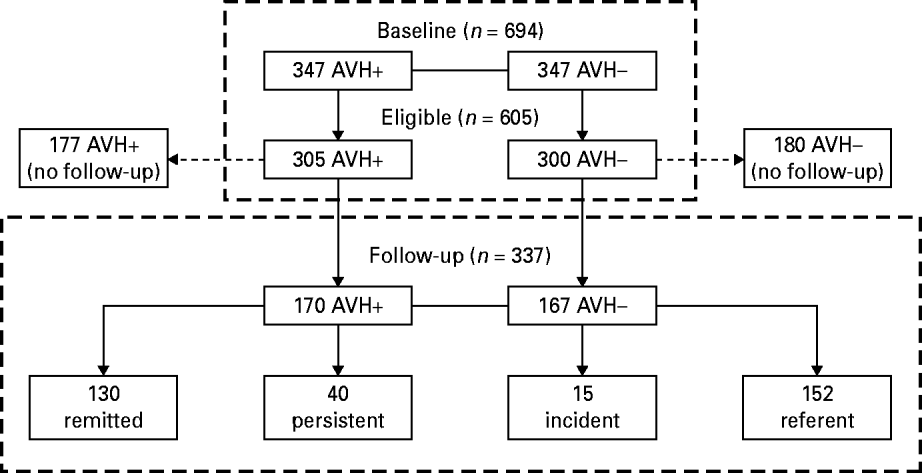
Participants in this follow-up study were 337 children, aged 12–13 years, included from a case-control sample of children with and without AVH (Fig. 1). This case-control sample had been composed 5 years earlier as a result of a population-based survey on auditory hallucinations in almost all 7- to 8-year-old children (n=3870) in the province of Groningen, the Netherlands (Bartels-Velthuis et al. Reference Bartels-Velthuis, Jenner, Van de Willige, Van Os and Wiersma2010). Main outcomes of the baseline study were that AVH were less prevalent though more serious in urban children, that AVH showed very weak associations with pre- and perinatal complications, and that AVH severity was positively associated with more somatic complaints. The participating children at follow-up (n=337) represented 56% of eligible baseline participants (n=605); follow-up participation rate was similar regardless of baseline AVH status (AVH-positive, 50.4%; AVH-negative, 49.6%). Mean age of the children at follow-up was 13.1 years (s.d.=0.5, range 12.0–14.6) and 46% were boys.
Flow chart of baseline and follow-up participants. AVH+, Auditory vocal hallucinations; AVH−, no auditory vocal hallucinations.

Procedure
From the original case-control sample of the first wave (n=694), parents of 605 children (87%) gave informed consent for the follow-up study. These parents were sent a notification letter by mail. Non-responders were sent a reminder followed by a second letter, if necessary. In case of persistent non-response, parents were contacted by telephone if their numbers could be traced.
Seven female interviewers (six orthopedagogy students of the University of Groningen and one psychology graduate) conducted the interviews at the children's home, separately from their parents. During training, the interviewers were first introduced to the topic of (auditory) hallucinations and delusions, and then, with consent, observed several therapeutic sessions of adult patients at the Voices Outpatient Department (VOPD) of the University Medical Center Groningen. Next, interviewers were informed in detail about the structure and results of the baseline study and received training in the administration of follow-up instruments and in conducting interviews with children. Finally, they practised patient interviews at the VOPD, under supervision of G.v.d.W. and J.A.J. In addition to the formal interview training, booster sessions were arranged to discuss interview and scoring procedures and to prevent interviewer ‘drift’. The interviewers used a detailed protocol on how to approach the families and conduct the interviews. To prevent bias, interviewers were unaware of children's AVH status at baseline.
Children were screened about the experience of hearing voices in the past 5 years; AVH-positive children were interviewed with the Auditory Vocal Hallucination Rating Scale (AVHRS; Jenner & Van de Willige, Reference Jenner and Van de Willige2002). All children were successively interviewed about experiences of delusional ideation, hallucinations in other modalities (visual, olfactory, taste and tactile) and TE and SE. Parents were instructed on how to contact the research team in case they or their children had questions or worries resulting from the interview.
Children and parents provided written informed consent.
Measures
At baseline and at follow-up, auditory hallucinations were assessed with the 16-item AVHRS (Jenner & Van de Willige, Reference Jenner and Van de Willige2002), a structured interview which rates, on a five-point scale, severity of voices in terms of frequency, duration, loudness, negative content, distress, anxiety, control, interference with thinking and daily life. Scores range from ‘0’=not applicable to ‘4’=most applicable. Psychometric properties of the AVHRS are good (Bartels-Velthuis et al. Reference Bartels-Velthuis, Van de Willige, Jenner and Wiersma2008). During booster sessions, DVD-recorded AVHRS interviews (of consenting patients attending the VOPD) were rated by the seven interviewers and A.A.B.-V. Total inter-rater agreement score (weighted Cohen's κ) was 0.88 (Bartels-Velthuis et al. Reference Bartels-Velthuis, Van de Willige, Jenner and Wiersma2008).
At follow-up, delusional ideation was assessed with three items, developed in the Dunedin study (Poulton et al. Reference Poulton, Caspi, Moffitt, Cannon, Murray and Harrington2000) and validated by Kelleher et al. (Reference Kelleher, Harley, Murtagh and Cannon2011): (i) ‘Some people believe in mind reading or being psychic. Have other people ever read your mind?’; (ii) ‘Have you ever had messages sent just to you through television or radio?’; and (iii) ‘Have you ever thought that people are following you or spying on you?’. The items could be rated as: ‘0’ (no), ‘1’ (yes, likely) or ‘2’ (yes, definitely).
TE were assessed at follow-up using an interview questionnaire developed at the VOPD (by J.A.J. and colleagues). The questionnaire consists of six items: sexual approach/abuse, Internet blackmailing/threatening, undeserved punishment, being an eye witness to: (i) serious accidents, (ii) robberies or (iii) threats. The frequency of lifetime occurrence was rated on a six-point scale, ranging from ‘0’ (never) to ‘5’ (very often).
SE were assessed at follow-up by questionnaire, designed for the TRAILS study (TRacking Adolescents' Individual Life Survey; Bouma et al. Reference Bouma, Ormel, Verhulst and Oldehinkel2008; Bosch et al. Reference Bosch, Riese, Ormel, Verhulst and Oldehinkel2009). This questionnaire is composed of 36 life events, of which 22 negative, seven positive, five negative or positive, and two open questions. For the purpose of the current study, a priori only the negative events were used, resulting in a total number of 25 negative events. Items included were, for example, parental divorce or death, severe illness/death of family members, (romantic) relationship break-up and victimization. Items had a yes/no format to indicate whether or not the event had occurred in the past 2 years. The severity of an event was rated on a four-point scale, ranging from ‘0’ (not unpleasant) to ‘3’ (very unpleasant).
At follow-up, children were also asked about the experience of hallucinations in other modalities in the past 5 years: visual (seeing things that other people do not see), olfactory (smelling things that other people do not smell), taste (having taste sensations without plausible explanation) and tactile (sensation of being physically touched without anyone nearby). The items were scored as ‘0’ (absent) and ‘1’ (present).
Data analysis
Based on baseline and follow-up data, four AVH groups were defined: (i) children hearing voices at baseline and still hearing voices at follow-up: the persistent group (i.e. children hearing voices in the year before the baseline interview and at least [occasionally] during one other year over the follow-up period); (ii) children hearing voices in the year before the baseline interview but no longer hearing voices during the follow-up period: the remitted group; (iii) children not hearing voices at baseline but positive for AVH at follow-up: the incident group (i.e. children who heard voices for the first time after baseline assessment, with a minimum duration of 3 months); (iv) children hearing voices at neither baseline nor follow-up interview: the referent group. Differential non-response due to differences in help-seeking and psychiatric service use was tested by tracing the children anonymously at group level through the Psychiatric Case Register North-Netherlands. Socio-economic status was derived from parental averaged educational levels and family income, resulting in a tripartition of low, middle and high.
In order to model severity of AVH, a severity index was composed, by recoding AVHRS items to ‘0’ (none or mild consequences) and ‘1’ (considerable to severe consequences) and calculating their sum score (ranging from 0 to 14). Conforming with previous work (Bartels-Velthuis et al. Reference Bartels-Velthuis, Jenner, Van de Willige, Van Os and Wiersma2010), two groups were created: the ‘severe AVH’ children (children scoring in the highest quartile of the severity index, score ⩾5) and ‘mild AVH’ children (scores 0–4). These severity groups (including both persistent and incident AVH-positive children) were compared with control children (without AVH). Occurrence of hallucinations in other modalities was indexed in two ways: (i) a sum score of the four dichotomous items of visual, olfactory, taste and tactile hallucinations, and (ii) a dichotomous variable indicating absence (‘0’) or presence (‘1’) of any visual, olfactory, taste or tactile hallucination.
Guided by Poulton et al. (Reference Poulton, Caspi, Moffitt, Cannon, Murray and Harrington2000), responses on the delusional items were added to create a sum score of delusional ideation. In addition, a dichotomous variable was created to define children who had experienced at least one definite delusion.
In order to examine associations between TE and SE on the one hand, and AVH at follow-up (i.e. persistent or incident AVH) with and without delusional ideation on the other hand, four groups of psychotic experiences (PE) were defined, conforming with previous work (Smeets et al. Reference Smeets, Lataster, Dominguez, Hommes, Lieb, Wittchen and Van Os2010): (i) children with (persistent or incident) AVH only; (ii) children with delusional ideation only; (iii) children with both (persistent or incident) AVH and delusional ideation; and (iv) children without symptoms at follow-up (the PE reference group).
A TE sum score was computed by summing the six frequency scores; in addition, a dichotomous TE variable was constructed by distinguishing children with and without TE (‘0’=no TE, ‘1’=at least one TE).
In order to create an SE index, item severity scores were summed. Because this sum score was highly skewed, an a priori dichotomization around the median value was effectuated (‘0’=less than three stressful experiences, ‘1’=three or more stressful experiences).
All continuous and dichotomous measures were used in the analyses.
Analyses were carried out using SPSS for Windows (version 16.0; SPSS Inc., USA) and Stata 10.1 (StataCorp LP, USA). Significance tests were two-tailed with α set at 0.05. Standard multinomial logistic regression (MLR) analyses, yielding odds ratios (ORs) and 95% confidence intervals (CIs), were used to compare the four AVH groups (incident, persistent, remitted and referent) and the four PE groups (AVH only, delusions only, AVH and delusions, referent group without symptoms), with their respective referent groups as reference category.
Results
Mean interval between baseline and follow-up assessment was 5.1 years (s.d.=0.4). Attrition analyses (based on the baseline sample of n=694) showed that participation of baseline AVH-positive and control children was evenly divided (49% v. 48%). The participation rate for girls was higher than for boys (53% v. 44%; χ2=5.50, p=0.02). There was no evidence for significant or suggestive differential attrition as a function of age, urbanicity at baseline or psychiatric service use (data not shown). Most children in the follow-up sample (90%) lived in a rural environment. Socio-economic status was evenly distributed (31% low, 39% middle and 30% high), 53% of the children were attending higher-level secondary education.
(i) Associations between AVH and delusional ideation, TE/SE and hallucinations in other modalities
The AVH persistence rate was 24% and the 5-year cumulative incidence rate in the baseline control sample was 9%. Mean duration of hearing voices in the persistent group was 5.7 years (s.d.=1.9); in the incident group this was 3.5 years (s.d.=1.7).
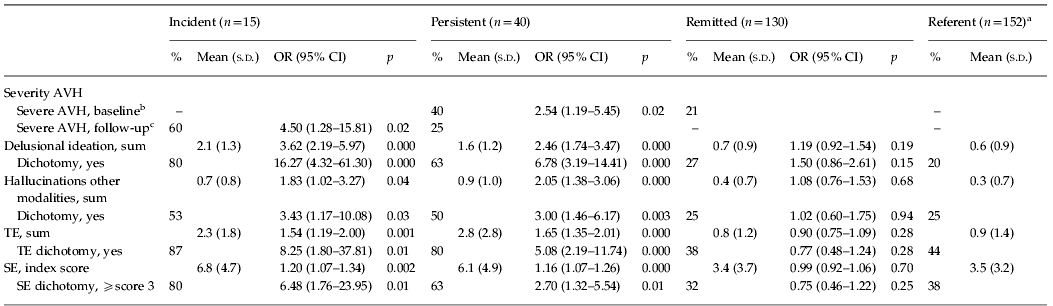
Of the children, 30% reported at least one ‘definite’ delusion (Table 1) and 43% one ‘likely’ delusion. Paranoid ideas were the most frequent definite delusional symptom in the total sample (29%). Mind reading and receiving media messages were rare (3%). Children with AVH at follow-up more often reported delusions than children without AVH (incident AVH 80%, persistent AVH 63%, compared with remitted 27% and referent 20%, respectively) (χ2=45.9, df=3, p=0.000). Delusional ideation sum scores also were significantly higher in both the incident (mean 2.1, s.d.=1.3) and persistent (mean 1.6, s.d.=1.2) than in the remitted (mean 0.4, s.d.=0.7) and referent (mean 0.3, s.d.=0.7) AVH groups (F=21.2, df=3, p=0.000; Table 1).
Associations between AVH status and AVH severity, delusional ideation, hallucinations in other modalities, TE and SE (n=337)

AVH, Auditory vocal hallucinations; TE, traumatic experiences; SE, stressful events; s.d, standard deviation; OR, odds ratio; CI, confidence interval.
a The reference comparison group in the multinomial logistic regression.
b The reference category is ‘Remitted’.
c The reference category is ‘Persistent’.
The TE sum score ranged from 0 to 11 (mean 1.1, s.d.=1.7); 48% reported a single TE, 28% two or more. The rate of having experienced at least one TE was higher in the group with AVH than in the group without AVH (incident and persistent AVH: 87% and 80% v. remitted and referent AVH: 38% and 44%, respectively; χ2=31.9, df=3, p=0.000).
The SE sum score ranged from 0 to 23 (mean 3.9, median 3.0, s.d.=3.9). At least one SE was experienced by 81% of all children and 40% scored above the median. Children with AVH more often scored above the median on the SE index than children without AVH (incident and persistent 80% and 63% v. remitted and referent 32% and 38%, respectively; χ2=22.5, df=3, p=0.000).
Of the children at follow-up, 29% reported at least one hallucination in another modality. In the AVH groups this was around 50% (incident: 53%, persistent: 50%). In children without AVH this was 25% both for the remitted and referent groups (χ2=14.8, df=3, p=0.002). Both incident (mean 0.7, s.d.=0.8) and persistent AVH children (mean 0.9, s.d.=1.0) also displayed higher sum scores of hallucinations in other modalities compared with remitted (mean 0.4, s.d.=1.0) and referent (mean 0.3, s.d.=1.0) children (F=6.2, df=3, p=0.000).
In Table 1, results from MLR analyses are summarized.
(ii) Associations between AVH severity and TE/SE, delusional ideation and hallucinations in other modalities
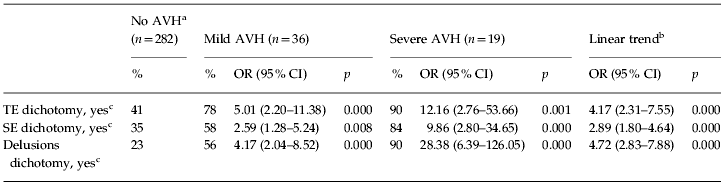
Severe AVH were reported by 35% of the children with auditory hallucinations at follow-up. The proportion of children with severe AVH at follow-up was higher in the incident group (60%) than in the persistent group (25%) (χ2=5.91, p=0.02). Greater level of AVH severity was associated with stronger exposure to social adversity, indexed by TE and SE. Level of AVH severity also displayed progressively stronger associations with delusions (summary OR linear trend 4.72, 95% CI 2.83–7.88, p=0.000; Table 2).
Associations of AVH severity with TE, SE and delusions (n=337)

AVH, Auditory vocal hallucinations; TE, traumatic experiences; SE, stressful events; OR, odds ratio; CI, confidence interval.
a Reference group (OR=1).
b The summary OR linear trend is the summary increase in risk with one unit increase in AVH severity.
c Variables entered separately into the equation.
(iii) Associations between PE groups and TE/SE and hallucinations in other modalities
The four predefined PE groups (AVH only, delusions only, AVH and delusions, PE reference group without symptoms) were compared on TE/SE and hallucinations in other modalities.
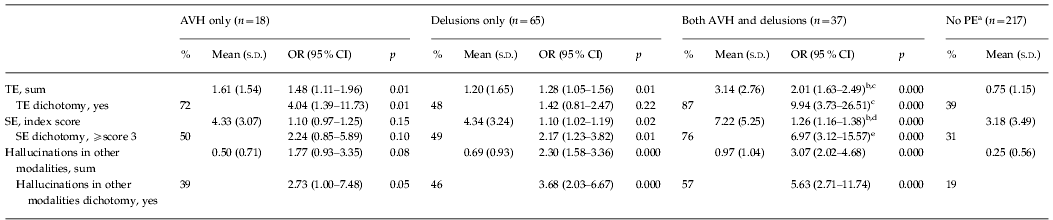
The mean number of TE differed significantly across the four PE groups (F=26.5, df=3, p=0.000) and was highest in the ‘AVH+delusions’ group; Tukey post-hoc tests showed that TE occurred significantly more often in the ‘AVH+delusions’ group compared with both the ‘AVH only’ (p=0.003) and the ‘delusions only’ groups (p=0.000). Both the ‘AVH only’ and the ‘delusions only’ groups did not differ from the reference group. MLR analyses confirmed this pattern of results, the association between the dichotomous TE score and the ‘AVH+delusions’ group (OR 9.94, 95% CI 3.73–26.51, p=0.000) being numerically highest and significantly stronger than the association with the ‘AVH only’ group (OR 4.04, 95% CI 1.39–11.73, p=0.01; Table 3).
Associations of PE status and TE, SE and hallucinations in other modalities (n=337)

PE, Psychotic experiences; TE, traumatic experiences; SE, stressful events; AVH, auditory vocal hallucinations; s.d., standard deviation; OR, odds ratio; CI, confidence interval.
a The reference comparison group in the multinomial logistic regression.
b OR for both AVH and delusions >OR for AVH only, p<0.05.
c OR for both AVH and delusions >OR for delusions only, p<0.001.
d OR for both AVH and delusions >OR for delusions only, p<0.01.
e OR for both AVH and delusions >OR for delusions only, p<0.05.
Similarly, the mean number of SE differed significantly across the four PE groups (F=13.4, df=3, p=0.000), Tukey post-hoc tests indicating that SE scores were significantly higher in the ‘AVH+delusions’ group compared with both the ‘AVH only’ (p=0.03) and the ‘delusions only’ groups (p=0.001). Both the ‘AVH only’ and the ‘delusions only’ groups did not differ from the reference group. MLR analyses confirmed these differences, the association between the dichotomous SE score and the ‘AVH+delusions’ group (OR 6.97, 95% CI 3.12–15.57, p=0.000) being numerically highest and significantly greater compared with the ‘delusions only’ group (OR 2.17, 95% CI 1.23–3.82, p=0.01; Table 3).
The mean number of hallucinations in other modalities differed significantly across the four PE groups (F=14.6, df=3, p=0.000), Tukey post-hoc tests indicating that the sum scores were significantly higher in both the ‘AVH+delusions’ and ‘delusions only’ group compared with the reference group (for both comparisons p=0.000). MLR analyses confirmed the differences, with the strongest effect size for the ‘AVH+delusions’ group (Table 3).
Discussion
While many studies focusing on trauma and psychosis examined severe TE such as sexual abuse (Read et al. Reference Read, Van Os, Morrison and Ross2005; Bendall et al. Reference Bendall, Jackson, Hulbert and McGorry2008; Elklit & Shevlin, Reference Elklit and Shevlin2010), in the current study, sexual approach or abuse was reported by only 1% of the children. Thus, even though the exposure rate of these severe events was low, strong associations between TE and SE and both incidence and persistence of AVH were found, as well as with AVH severity and delusional ideation. In addition, children who reported both AVH and delusions experienced more TE and SE than children with either AVH or delusions alone, suggesting that social adversity may specifically have an impact on ‘co-morbid’ delusional ideation in children with AVH.
The mechanism underlying these associations may be that exposure to TE/SE induces greater persistence of AVH or higher AVH severity (Escher et al. Reference Escher, Romme, Buiks, Delespaul and Van Os2002a; Hanssen et al. Reference Hanssen, Krabbendam, De Graaf, Vollebergh and Van Os2005; Dominguez et al. Reference Dominguez, Wichers, Lieb, Wittchen and Van Os2009; Smeets et al. Reference Smeets, Lataster, Dominguez, Hommes, Lieb, Wittchen and Van Os2010), which in turn could facilitate onset of delusional ideation, by faulty attempts to explain the anomalous experiences (Kapur, Reference Kapur2003; Morrison et al. Reference Morrison, Frame and Larkin2003; Maher, Reference Maher2006; Van der Gaag, Reference Van der Gaag2006).
Reviews suggest that life stress is associated with psychotic experiences (Escher et al. Reference Escher, Romme, Buiks, Delespaul and Van Os2002b; Van Winkel et al. Reference Van Winkel, Stefanis and Myin-Germeys2008). Although systematic reviews on the association between trauma and psychosis or psychotic experiences are not consistent (Read et al. Reference Read, Van Os, Morrison and Ross2005; Morgan & Fisher, Reference Morgan and Fisher2007; Bendall et al. Reference Bendall, Jackson, Hulbert and McGorry2008), a large number of studies (Whitfield et al. Reference Whitfield, Dube, Felitti and Anda2005; Lataster et al. Reference Lataster, Van Os, Drukker, Henquet, Feron, Gunther and Myin-Germeys2006; Scott et al. Reference Scott, Chant, Andrews, Martin and McGrath2007; Shevlin et al. Reference Shevlin, Dorahy and Adamson2007, Reference Shevlin, Houston, Dorahy and Adamson2008; Kelleher et al. Reference Kelleher, Harley, Lynch, Arseneault, Fitzpatrick and Cannon2008; Fisher et al. Reference Fisher, Morgan, Dazzan, Craig, Morgan, Hutchinson, Jones, Doody, Pariante, McGuffin, Murray, Leff and Fearon2009; Freeman & Fowler, Reference Freeman and Fowler2009) have consistently demonstrated a relationship across a range of designs, natural experiments and endpoints, including a number of strong prospective studies establishing temporal order and ruling out reverse causality (Schreier et al. Reference Schreier, Wolke, Thomas, Horwood, Hollis, Gunnell, Lewis, Thompson, Zammit, Duffy, Salvi and Harrison2009; Arseneault et al. Reference Arseneault, Cannon, Fisher, Polanczyk, Moffitt and Caspi2010; Elklit & Shevlin, Reference Elklit and Shevlin2010). Studies have addressed genetic confounding by controlling, directly or indirectly, for genetic risk (Janssen et al. Reference Janssen, Krabbendam, Bak, Hanssen, Vollebergh, de Graaf and Van Os2004; Schreier et al. Reference Schreier, Wolke, Thomas, Horwood, Hollis, Gunnell, Lewis, Thompson, Zammit, Duffy, Salvi and Harrison2009; Arseneault et al. Reference Arseneault, Cannon, Fisher, Polanczyk, Moffitt and Caspi2010). The current study adds to this body of work by showing associations between TE, SE and both incidence and persistence of AVH. Because of the time frame for the assessment of SE (per definition after the onset of AVH), the link between AVH and SE cannot be considered prospective; although the association between TE and AVH may be prospective, many TE also would have occurred after AVH onset. As strong associations were nevertheless found between AVH and the experience of adversity, one interpretation, conforming to previous literature (Dominguez et al. Reference Dominguez, Wichers, Lieb, Wittchen and Van Os2009), is that if hallucinations are apparent, experience of subsequent SE/TE may predict a higher probability of persistence.
The current study suggests that exposure to childhood adversity increases the intrusiveness of the hallucinatory experience, which in turn may increase the risk of secondary delusional ideation. These findings concur with previous work, showing that exposure to adversity affects distress and locus of control associated with psychotic experiences (Bak et al. Reference Bak, Krabbendam, Janssen, De Graaf, Vollebergh and Van Os2005), and work indicating that greater level of adversity and intrusiveness of hallucinatory experiences predicts delusion formation (Escher et al. Reference Escher, Romme, Buiks, Delespaul and Van Os2002a; Hanssen et al. Reference Hanssen, Krabbendam, De Graaf, Vollebergh and Van Os2005). The issue of secondary delusion formation is of clinical relevance, as this can be regarded as a significant deepening of early psychotic experiences that increases the risk of transition to clinical disorder (Krabbendam et al. Reference Krabbendam, Myin-Germeys, Hanssen, Bijl, De Graaf, Vollebergh, Bak and Van Os2004; Smeets et al. Reference Smeets, Lataster, Dominguez, Hommes, Lieb, Wittchen and Van Os2010).
Methodological issues
One limitation of the study is that the temporal order of exposures (TE/SE) and outcomes (AVH, delusions) is uncertain: the window of assessment of TE was lifetime (‘did you ever experience …’), whereas for SE the period was the last 2 years. For AVH the total assessment period was 6 years (measured at two assessment points) and for delusions this was again lifetime. Therefore, although the interpretation was in the direction of social adversity resulting in persistence and in higher level of AVH severity, in turn leading to ‘co-morbid’ delusional ideation, alternative explanations cannot be excluded, for example baseline AVH leading to both TE/SE and delusional ideation. To answer this question, future studies with more precise temporal assessments are required.
TE were only assessed at follow-up, at the same time of assessment of psychotic experiences, thus possibly introducing bias, as reports of childhood trauma in individuals with psychotic experiences may be different compared with controls, e.g. because individuals are searching for reasons for their experiences. However, previous work suggests that this may not explain the reported association given positive findings in studies introducing (semi-) prospective designs (Schreier et al. Reference Schreier, Wolke, Thomas, Horwood, Hollis, Gunnell, Lewis, Thompson, Zammit, Duffy, Salvi and Harrison2009; Elklit & Shevlin, Reference Elklit and Shevlin2010), assessment of trauma through independent sources (Arseneault et al. Reference Arseneault, Cannon, Fisher, Polanczyk, Moffitt and Caspi2010; Elklit & Shevlin, Reference Elklit and Shevlin2010) and validation procedures for reporting of trauma by patients (Fisher et al. Reference Fisher, Craig, Fearon, Morgan, Dazzan, Lappin, Hutchinson, Doody, Jones, McGuffin, Murray, Leff and Morgan2011). In addition, the children in the current study were not diagnosed with psychotic disorder – they reported subclinical psychotic experiences that probably do not induce a ‘search for meaning’ as would be expected in the case of diagnosed psychotic illness.
Another limitation, however, beyond our sphere of influence, is that the number of children with auditory hallucinations at follow-up was rather small, particularly the group with incident AVH (n=15), thus hampering robust statistical inference.
In addition, a strength of the study is the inclusion of multiple control groups (remitted children and children without AVH over a lengthy period).
The course of auditory hallucinations in the 5-year follow-up period was not always regular. However, the children in the persistent group all heard voices in the past year and about half of them heard voices on a more or less regular basis. However, in other children, the course seemed intermittent during the 5-year follow-up period, thus complicating a clear-cut definition of the outcome groups.
In the PE groups, only children with definite delusional symptoms were included, indicating that children with probable delusional symptoms were included in the no-delusions groups (n=5 in the ‘AVH only’ group and n=37 in the referent group). This represents a conservative approach. Post-hoc analyses, examining the distribution of covariates across PE groups based on ‘pure’ no-delusions-groups, however, showed similar results.
The AVH groups were not subdivided with regard to hallucinations in other modalities, because the starting point for analysis was the presence of AVH. In addition, subsuming hallucinations in other modalities in the analyses of PE groups might outweigh the importance of these symptoms. Post-hoc analyses showed that occurrence of hallucinations in other modalities (mainly visual and tactile) was similarly positively associated with TE (χ2=18.0, df=1, p=0.000), SE (χ2=10.1, df=1, p=0.001) and delusional ideation (χ2=30.0, df=1, p=0.000).
The traumatic events questionnaire has not yet been validated. However, the clear format with high face validity, the clinical interview format by trained interviewers (rather than self-report) and continuing training during interviewer booster sessions would support validity and reliability of the data.
Clinical implications
Despite the fact that a causal relationship between AVH and/or delusional ideation and the experience of TE and/or SE could not be established, their associations are evident. These findings therefore may serve to raise awareness of the possible development of psychotic ideation in children with history of psychosocial adversity (Larkin & Read, Reference Larkin and Read2008). Paying attention to (and treatment of) hallucinatory and delusional experiences in the earliest stages may be helpful in preventing possible transition to overt mental illness (Krabbendam et al. Reference Krabbendam, Myin-Germeys, Bak and Van Os2005; Phillips et al. Reference Phillips, McGorry, Yuen, Ward, Donovan, Kelly, Francey and Yung2007, Reference Phillips, Nelson, Yuen, Francey, Simmons, Stanford, Ross, Kelly, Baker, Conus, Amminger, Trumpler, Yun, Lim, Mcnab, Yung and McGorry2009). In addition, the effects of TE/SE on AVH persistence may be important, as previous work suggests that particularly persistence of psychotic experiences may result in need for care and formal diagnosis of psychotic disorder (Cougnard et al. Reference Cougnard, Marcelis, Myin-Germeys, De Graaf, Vollebergh, Krabbendam, Lieb, Wittchen, Henquet, Spauwen and Van Os2007; Dominguez et al. Reference Dominguez, Wichers, Lieb, Wittchen and Van Os2009; Smeets et al. Reference Smeets, Lataster, Dominguez, Hommes, Lieb, Wittchen and Van Os2010; Mackie et al. Reference Mackie, Castellanos-Ryan and Conrod2011).
Nevertheless, the results of this study also indicate that hearing voices at age 7–8 years represents a transient experience for the majority of the children. However, transition to diagnosed mental disorder was not the outcome studied. A further follow-up is planned at age 18/19 years in order to study mental health outcomes.
Acknowledgements
Funding for this study was provided by the ‘Stichting tot Steun VCVGZ’ (Foundation for Support, Christian Union for Care of Mentally Ill), the ‘Stichting Open Ankh’, the ‘Bensdorp Fund’, Maastricht University and the Rob Giel Research centre of the University of Groningen. The ‘Stichting tot Steun VCVGZ’, ‘Stichting Open Ankh’ and ‘Bensdorp Fund’ had no role in the study design, in the collection, analysis and interpretation of data, in the writing of the report, nor in the decision to submit the paper for publication.
The authors are most grateful to all children and parents who were willing to take part in this follow-up study. We thank the interviewers for all their efforts and our colleagues from the Psychiatric Case Register North-Netherlands for providing data at group level.
Declaration of Interest
J.v.O. is an unrestricted grant holder with or has received financial compensation as an independent symposium speaker from Eli Lilly, BMS, Lundbeck, Organon, Janssen-Cilag, GSK, AstraZeneca, Pfizer and Servier.