



1 Introduction
Within the framework of line bundles equipped with positive metrics, there are numerous well-known vanishing theorems, such as Kodaira’s vanishing theorem and Nadel’s vanishing theorem. When the metric is merely semi-positive, a natural progression leads to injectivity theorems, which have numerous applications such as demonstrating the torsion freeness of higher direct image sheaves and yielding further vanishing results. These topics are discussed in detail in references such as [Reference Cao, Demailly and Matsumura2], [Reference Enoki9]–[Reference Fujino and Matsumura13], [Reference Kollár23], [Reference Matsumura27], [Reference Ohsawa28], [Reference Zhou and Zhu32]. Moveover, these theorems are connected to the dlt extension conjecture, highlighted in works by Demailly–Hacon–Păun [Reference Demailly, Hacon and Păun7] and Gongyo–Matsumura [Reference Gongyo and Matsumura14], underscoring the significance and value of studying injectivity theorems.
Kollár established an injectivity theorem for semi-ample line bundles on projective manifolds using algebraic methods in [Reference Kollár23], and Enoki obtained an injectivity result for semi-positive line bundles on compact Kähler manifold by analytic methods in [Reference Enoki9]. Within the analytic framework, Takegoshi extended these results in [Reference Takegoshi30] (see also [Reference Ohsawa28]) to holomorphically convex Kähler manifolds under certain curvature conditions. For pseudo-effective line bundles, the scope of injectivity theorems has been expanded due to contributions from Fujino, Matsumura, Cao, Demailly and others. Zhou–Zhu ultimately established their injective theorem in [Reference Zhou and Zhu32], which unifies several of the previously mentioned theorems.
It is worth noting that Cao–Demailly–Matsumura initially derived an injectivity theorem through an extension theorem in [Reference Cao, Demailly and Matsumura2], which was extended by Zhou–Zhu via approximating two weight functions simultaneously. Specifically, Cao–Demailly–Matsumura obtained their extension theorem under the assumption that one of the weight functions is a quasi-plurisubharmonic function with neat analytic singularities, and Zhou–Zhu removed this assumption by their approximation lemma. These methods and conclusions should also be valid for vector bundles with smooth Nakano semi-positive metrics, however, there are still relatively few results concerning singular Hermitian metrics.
In this paper, we present an injectivity theorem for vector bundles endowed with singular Hermitian metrics. Let E be a holomorphic vector bundle of rank r over a complex manifold X. Recall that a singular Hermitian metric h on E is a measurable map from X to the space of non-negative Hermitian forms on the fibers satisfying
 $0<\det h<+\infty $
almost everywhere. The metric h is called Griffiths semi-positive if
 $|u|^2_{h^*}$
is plurisubharmonic for any local holomorphic section u of
 $E^*$
. One can define the multiplier submodule sheaf associated with
 $(E,h)$
by
 $$ \begin{align*}\mathcal{E}(h)_x:=\{u\in E_x:\ |u|_h^2\ \text{is}\ L^1_{\text{loc}}\ \text{near} \ x\}.\end{align*} $$
When considering the case that E is a holomorphic line bundle, it follows that
 $\mathcal E(h)=\mathcal {O}(E)\otimes \mathcal I(h)$
, where
 $\mathcal I(h)$
is the multiplier ideal sheaf associated with h.
It is well-known that the multiplier ideal sheaf associated with a pseudo-effective line bundle possesses several fundamental properties, including coherence and integral closedness, among others. Nevertheless, it remains uncertain whether Griffiths semi-positivity implies the coherence of multiplier submodule sheaves [Reference Inayama21]. To derive further insights into multiplier submodule sheaves, we could investigate positivity stronger than Griffiths positivity. Recently, inspired by [Reference de Cataldo3], [Reference Lempert24] and Demailly’s approximation theorem, Guan–Mi–Yuan introduced a new notion of Nakano semi-positivity for singular Hermitian metrics in [Reference Guan, Mi and Yuan17] and obtained an optimal
 $L^2$
extension theorem in [Reference Guan, Mi and Yuan16].
Definition 1.1 (See [Reference Guan, Mi and Yuan16]).
Let E be a holomorphic vector bundle of rank r over a Hermitian manifold
 $(X,\omega )$
equipped with a singular Herimitian metric h. Let
 $\theta $
be a continuous real
 $(1,1)$
-form on X. We say that h is approximately
 $\theta $
-Nakano semi-positive, if the following conditions hold:
-
(1) There is a sequence
 $\{X_j\}^{+\infty }_{j=1}$
of relative compact subsets of X such that
$X_1\Subset X_2\Subset \cdots \Subset X_j\ldots $
, and
$\bigcup ^{+\infty }_{j=1} X_j=X$
.
-
(2) For any
$X_j$
, there is a sequence of
$C^2$
Hermitian metrics
$\{h_{j,s}\}^{+\infty }_{s=1}$
on
$X_j$
, such that
$\lim _{s\to +\infty }h_{j,s}=h$
on
$X_j\setminus \Sigma $
, where
$\Sigma $
is a closed subset of measure zero in X. -
(3) For any
$X_j$
, there are continuous functions
$\lambda _j$
and
$\lambda _{j,s}$
on
$\overline {X_j}$
, the closure of
$X_j$
, such that-
(a) for any
$x\in X_j$
, any
$e_x\in E_x$
and any s, we have
$|e_x|_{h_{j,s}}\leqslant |e_x|_{h_{j,s+1}}$
, -
(b)
$i\Theta _{E,h_{j,s}}\geqslant _{{\text {Nak}}}(\theta -\lambda _{j,s}\omega )\otimes \operatorname {Id}_E$
on
$X_j$
, -
(c)
$\lambda _{j,s}$
converges to
$0$
almost everywhere on
$X_j$
, -
(d) for any s,
$0\leqslant \lambda _{j,s}\leqslant \lambda _j$
on
$X_j$
.
-


In particular, we say that h is approximately Nakano semi-positive when
 $\theta =0$
and approximately Nakano positive when
 $\theta $
is positive.
Remark 1.2.
-
(1) Demailly’s smooth approximation theorem (Lemma 2.1) implies that any
$\theta $
-plurisubharmonic function
$\psi $
, that is,
$\theta +i\partial \overline {\partial }\psi \ge 0$
in the sense of currents, induces an approximately
$(-\theta )$
-Nakano semi-positive singular metric
$e^{-\psi }$
on the trivial line bundle. -
(2) Recently, Deng–Ning–Wang–Zhou established the converse of
$L^2$
theory and provided a characterization of smooth Nakano semi-positive metrics by the optimal
$L^2$
-estimate condition in [Reference Deng, Ning, Wang and Zhou8]. This work essentially leads to an alternative definition of Nakano positivity, as introduced in [Reference Inayama20], [Reference Inayama and Matsumura22]. One can show that an approximately
$\theta $
-Nakano semi-positive singular Hermitian metric h is also
$\theta $
-Nakano semi-positive in the sense of the optimal
$L^2$
-estimate (Lemma 2.6).


Therefore, we can obtain the following extension (injectivity) theorem by the procedure and techniques in [Reference Guan, Mi and Yuan16], [Reference Zhou and Zhu32].
Theorem 1.3. Let
 $(X,\omega )$
be a holomorphically convex Kähler manifold and
 $\theta $
be a real continuous
 $(1,1)$
-form on X. Let
 $\psi $
be a
 $\theta $
-plurisubharmonic function on X, E be holomorphic vector bundle over X, and h be an approximately
 $\theta $
-Nakano semi-positive singular Hermitian metric on E. Assume that
 $(1+\alpha )\psi $
is also
 $\theta $
-plurisubharmonic for some
 $\alpha>0$
, then the following homomorphism induced by the natural inclusion
 $\mathcal {E}(he^{-\psi })\to \mathcal {E}(h)$
is injective for any q,
 $$ \begin{align*}H^q(X,K_X\otimes\mathcal{E}(he^{-\psi}))\to H^q(X,K_X\otimes\mathcal{E}(h)).\end{align*} $$
Equivalently, the following homomorphism induced by the quotient map
 $\mathcal {E}(h)\to \mathcal {E}(h)/\mathcal {E}(he^{-\psi })$
is surjective for any q,
 $$ \begin{align*}H^q(X,K_X\otimes\mathcal{E}(h))\to H^q(X,K_X\otimes\mathcal{E}(h)/\mathcal{E}(he^{-\psi})).\end{align*} $$
As applications, we have the following injectivity theorem and vanishing theorem for vector bundles [Reference Matsumura25], [Reference Zhou and Zhu32].
Corollary 1.4 (=Corollary 4.1).
Let X be a holomorphically convex Kähler manifold, F be a holomorphic vector bundle and M be a holomorphic line bundle over X. Let
 $\theta $
be a real continuous semi-positive
 $(1,1)$
-form on X. Assume that
 $h_F$
is an approximately
 $\theta $
-Nakano semi-positive singular Hermitian metric on F and
 $h_M$
is a smooth metric on M such that
 $b\theta \ge i\Theta _{h_M}$
for some constant
 $b\in (0,+\infty )$
. Then for a non-zero holomorphic section s of M, the following homomorphism induced by the tensor product with s
 $$ \begin{align*}\otimes s: H^q(X,K_X\otimes\mathcal{F}(h_F))\to H^q(X,K_X\otimes M\otimes\mathcal{F}(h_F))\end{align*} $$
is injective for any
 $q\geqslant 0$
.
Corollary 1.5 (=Corollary 4.2).
Let X be a projective manifold of dimension n, F be a holomorphic vector bundle and M be a holomorphic line bundle over X. Let
 $\theta $
be a real continuous semi-positive
 $(1,1)$
-form on X. Assume that
 $h_F$
is an approximately
 $\theta $
-Nakano semi-positive singular Hermitian metric on F and
 $h_M$
is a smooth metric on M such that
 $0\le i\Theta _{h_M}\le b\theta $
for some constant
 $b\in (0,+\infty )$
. Then we have
 $$ \begin{align*}H^q(X,K_X\otimes\mathcal{F}(h_F))=0\quad \text{for} \quad q>n-\kappa(M).\end{align*} $$
The remaining parts of this paper are organized as follows. In Section 2, we recall some basic preparatory results. In Section 3, we prove Theorem 1.3 by the basic facts proved in [Reference Guan, Mi and Yuan16], [Reference Zhou and Zhu32], along with standard approximation techniques and limit arguments. In Section 4, we prove Corollaries 1.4 and 1.5 by Theorem 1.3.
2 Preliminaries.
Let us first recall the following smooth approximation theorem for
 $\theta $
-plurisubharmonic functions obtained by Demailly, which implies that approximate Nakano semi-positivity coincides with Griffiths semi-positivity on holomorphic line bundles.
Lemma 2.1 (See [Reference Demailly4, Theorem 1.1], see also [Reference Zhou and Zhu31, Theorem 3.1]).
Let
 $(X,\omega )$
be a compact Hermitian manifold and
 $\theta $
be a continuous real
 $(1,1)$
-form on X. Assume that
 $\psi $
is a
 $\theta $
-plurisubharmonic function on X and the Chern curvature tensor of
 $T_X$
satisfies
 $$ \begin{align*}(\frac{\sqrt{-1}}{2\pi}\Theta_{T_X}+\varpi\otimes\operatorname{Id}_{T_X})(\kappa_1\otimes\kappa_2,\kappa_1\otimes\kappa_2)\geqslant 0,\ \forall\kappa_1,\kappa_2\in T_X\ \text{with}\ \langle\kappa_1,\kappa_2\rangle=0\end{align*} $$
for some continuous non-negative
 $(1,1)$
-form
 $\varpi $
on X. Then there is a family of smooth functions
 $\{\psi _\rho \}$
on
 $X,\ (\rho \in (0,\rho _1)$
for some positive number
 $\rho _1)$
independent of
 $\theta $
, such that
-
(i)
$\psi _\rho $
is increasing with respect to
$\rho $
on X, and converges to
$\psi $
on X as
$\rho \to 0$
, -
(ii)
$i\partial \overline {\partial }\psi _\rho \geqslant -\theta -\pi \varsigma _\rho \varpi -\delta _\rho \omega $
on X,


where
 $\varsigma _\rho (x)$
is an increasing family of continuous functions on X such that
 $$ \begin{align*}\lim_{\rho\to 0}\varsigma_\rho(x)=\nu(\psi,x)\ (\text{Lelong number of }\psi\ \text{at}\ x)\ \text{at every point } x\in X,\end{align*} $$
and
 $\{\delta _\rho \}$
is an increasing family of positive numbers such that
 $\lim _{\rho \to 0}\delta _\rho =0$
.
According to [Reference Zhou and Zhu32, Remark 3.1], this approximation theorem is also true for the relatively compact open subsets of noncompact Hermitian manifolds. Notice that
 $\nu (\psi ,x)=0$
almost everywhere, then for any
 $\theta $
-plurisubharmonic function
 $\psi $
,
 $e^{-\psi }$
is
 $(-\theta )$
-Nakano semi-positive.
Now let us recall the
 $L^2$
estimate with error term given in [Reference Guan, Mi and Yuan16]. There are many contributions to this result by Donnelly, Ohsawa, Takegoshi, Demailly and others. In this paper, we adopt the following formulation.
Lemma 2.2 (See [Reference Guan, Mi and Yuan16, Lemma 2.20]).
Let X be a complete Kähler manifold,
 $\omega $
be a Kähler metric (not necessarily complete) on X and Q be a holomorphic vector bundle over X equipped with a smooth Hermitian metric h. Let
 $\tau $
and
 $A^{-1}$
be smooth bounded positive functions on X such that
 $\tau +A$
is also a smooth bounded positive function, and define
 $$ \begin{align*}B:=[\tau i\Theta_{Q,h}-i\partial\overline{\partial}\tau-iA^{-1}\partial\tau\wedge\overline{\partial}\tau,\Lambda].\end{align*} $$
Assume that
 $\delta \geqslant 0$
is a bounded continuous function such that
 $B+\delta I$
is positive definite everywhere on
 $\Lambda ^{n,q}T_X^*\otimes Q$
for some
 $q\geqslant 1$
. Then for every form
 $g\in L^{n,q}_{(2)}(X,Q)_{h,\omega }$
such that
 $\overline {\partial } g=0$
and
 $$ \begin{align*}\int_X\langle (B+\delta I)^{-1}g,g \rangle_{h,\omega}dV_\omega<+\infty,\end{align*} $$
there exists an approximate solution u and an error term v such that
 $\overline {\partial } u+P_h(\sqrt {\delta }v)=g$
and
 $$ \begin{align*} \int_X\frac{|u|^2_{h,\omega}}{\tau+A}dV_{\omega}+\int_X|v|^2_{h,\omega}dV_{\omega}\leqslant\int_X\langle (B+\delta I)^{-1}g,g \rangle_{h,\omega}dV_\omega, \end{align*} $$
where
 $P_h: L^{n,q}_{(2)}(X,Q)_{h,\omega }\to \ker \overline {\partial }$
is the orthogonal projection.
Lemma 2.3 (See [Reference Guan, Mi and Yuan16, Lemma 2.21]).
Let
 $\{u_n\}_{n=1}^{+\infty }$
be a sequence of
 $L^2$
integrable
 $(p,q)$
-forms which is weakly converges to u, and let
 $\{v_n\}_{n=1}^{+\infty }$
be a sequence of measurable real functions on X which converges to v almost everywhere. Assume that
 $\{v_n\}_{n=1}^{+\infty }$
is uniformly bounded, then
 $\{v_nu_n\}_{n=1}^{+\infty }$
weakly converges to
 $vu$
in
 $L^2$
space.
Lemma 2.4 (See [Reference Guan, Mi and Yuan16, Lemma 2.22]).
Let X be an n-dimensional complex manifold and
 $\omega $
be a hermitian metric on X. Let E be a holomorphic vector bundle on X. Let
 $\{h_i\}$
be a sequence of
 $C^2$
smooth Hermitian metrics on E, and h be a singular Hermitian metric on E such that
 $\lim _{i\to +\infty }h_i=h$
almost everywhere. We assume that
 $h_i$
is increasingly convergent to h. Denote
 $\mathcal {H}_i=L^{p,q}_{(2)}(X,E)_{h_i,\omega }$
and
 $\mathcal {H}=L^{p,q}_{(2)}(X,E)_{h,\omega }$
. Then we have
 $\mathcal {H}\subset \mathcal {H}_i\subset \mathcal {H}_1$
. Let
 $P_i:\mathcal {H}_i\to \ker \overline {\partial }$
and
 $P:\mathcal {H}\to \ker \overline {\partial }$
be the orthogonal projections. Let
 $\{f_i\}$
be a sequence of E-valued
 $(n,q)$
-forms such that
 $f_i\in \mathcal {H}_i$
and
 $\|f_i\|_{h_i}<C$
for some constant
 $C>0$
. Then there exists a subsequence
 $\{f_i\}$
(also denoted by
 $\{f_i\}$
) and an E-valued
 $(n,q)$
-form
 $f_0\in \mathcal {H}$
such that
 $\{f_i\}$
weakly converges to
 $f_0$
in
 $\mathcal {H}_1$
and
 $\{P_i(f_i)\}$
weakly converges to
 $P(f_0)$
in
 $\mathcal {H}_1$
.
Definition 2.5. Let X be an n-dimensional complex manifold,
 $\theta $
a continuous real
 $(1,1)$
-form on X and E a holomorphic vector bundle over X endowed with a singular Hermitian metric h. We say that h is
 $\theta $
-Nakano semi-positive in the sense of the optimal
 $L^2$
-estimate if for any Stein coordinate open subset S, any Kähler form
 $\omega _S$
on S and any smooth
 $\theta $
-plurisubharmonic function
 $\psi $
such that for any
 $f\in L^{n,q}_{(2)}(S, E)_{h,\omega _S}$
,
 $1\le q\le n$
, with
 $\overline {\partial } f=0$
, there is
 $u\in L^{n,q-1}_{(2)}(S, E)_{h,\omega _S}$
satisfying
 $\overline {\partial } u=f$
and
 $$ \begin{align*}\int_S|u|^2_{he^{-\psi},\omega_S}dV_{\omega_S}\leqslant\int_S \langle B^{-1}_{\psi,\theta}f,f \rangle_{he^{-\psi},\omega_S}dV_{\omega_S}\end{align*} $$
provided that the right hand side is finite, where
 $B_{\psi ,\theta }=[(\theta +i\partial \overline {\partial }\psi )\otimes \operatorname {Id}_E,\Lambda _{\omega _S}]$
.
Moreover, Inayama–Matsumura in [Reference Inayama and Matsumura22] showed that any approximately
 $\theta $
-Nakano semi-positive singular Hermitian metric h is indeed
 $\theta $
-Nakano semi-positive in the sense of the optimal
 $L^2$
-estimate.
Lemma 2.6 (See [Reference Inayama and Matsumura22, Theorem 1.2]).
Let
 $(X,\omega )$
be a weakly pseudoconvex Kähler manifold,
 $\theta $
a continuous real
 $(1,1)$
-form on X and E a holomorphic vector bundle over X endowed with an approximately
 $\theta $
-Nakano semi-positive singular Hermitian metric h. Then for any smooth
 $\theta $
-plurisubharmonic function
 $\psi $
, we have that for any
 $f\in L^{n,q}_{(2)}(X, E)_{h,\omega }$
,
 $1\le q\le n$
, with
 $\overline {\partial } f=0$
, there is
 $u\in L^{n,q-1}_{(2)}(X, E)_{h,\omega }$
satisfying
 $\overline {\partial } u=f$
and
 $$ \begin{align*}\int_X|u|^2_{he^{-\psi},\omega}dV_{\omega}\leqslant\int_X \langle B^{-1}_{\psi,\theta}f,f \rangle_{he^{-\psi},\omega}dV_{\omega}\end{align*} $$
provided that the right hand side is finite, where
 $B_{\psi ,\theta }=[(\theta +i\partial \overline {\partial }\psi )\otimes \operatorname {Id}_E,\Lambda _{\omega }]$
. In particular, h is
 $\theta $
-Nakano semi-positive in the sense of the optimal
 $L^2$
-estimate.
Using Lemma 2.6, and following a similar approach to the proof of [Reference Demailly5, (5.11) Nadel Vanishing theorem], we can obtain the following vanishing theorem for approximately Nakano positive holomorhic vector bundles.
Lemma 2.7. Let
 $(X,\omega )$
be a weakly pseudoconvex Kähler manifold and E a holomorphic vector bundle over X endowed with an approximately
 $\varepsilon \omega $
-Nakano positive singular Hermitian metric h, where
 $\varepsilon $
is a continuous positive function on X. Then for any
 $q\ge 1$
,
 $$ \begin{align*}H^q(X,K_X\otimes \mathcal E(h) )=0.\end{align*} $$
Proof. Let
 $\mathcal {L}^{n,q}_{(2),h}$
be the sheaf over X of germs of measurable E-valued
 $(n,q)$
-forms u such that both
 $|u|_{h,\omega }^2$
and
 $|\overline {\partial } u|_{h,\omega }$
are locally integrable. It follows from Lemma 2.6 that the complex of sheaves
 $(\mathcal {L}^{n,\bullet }_{(2),h},\overline {\partial })$
is an acyclic resolution of the sheaf
 $\mathcal O( K_X)\otimes \mathcal E(h)$
. Let
 $\psi $
be a smooth plurisubharmonic exhaustion function on X. Since h is approximately
 $\varepsilon \omega $
-Nakano positive, we can apply Lemma 2.6 globally on X, with the original metric h of F multiplied with the factor
 $e^{\chi (\psi )}$
, where
 $\chi $
is a convex increasing function of arbitrary fast growth at infinity. This factor can be used to ensure the convergence of integrals at infinity. Therefore, we conclude that
 $H^q(\Gamma (X,\mathcal {L}^{n,\bullet }_{(2),h}))=0$
for
 $q\ge 1$
. We complete the proof.
Lemma 2.8 (See [Reference Prill29, Lemma II.1]).
Let X and Y be complex spaces, and let
 $f:X\to Y$
be a proper holomorphic map. Let
 $\mathcal {F}$
be a coherent analytic sheaf on X, and suppose Y is a Stein space. Then the direct limit map
 $f^*:H^q(X,\mathcal {F})\to H^0(Y,R^qf_*\mathcal {F})$
is an isomorphism of topological vector spaces for every
 $q\geqslant 0.$
In particular, each
 $H^q(X,\mathcal {F})$
is Hausdorff.
Lemma 2.9 (See [Reference Gunning and Rossi19, Lemma 12 of Section A in Chapter VIII]).
Let X be a complex analytic space and
 $\mathcal {F}$
be a coherent analytic sheaf ovex X. Let
 $x\in X$
, and
 $\mathcal {M}$
be a submodule of
 $\mathcal {F}_x$
. Then for any open neighborhood U of x,
 $$ \begin{align*}\mathcal{M}_U:=\{F\in H^0(U,\mathcal{F}):\text{the germ of }F\text{ at }x\text{ belongs to } \mathcal{M}\}\end{align*} $$
is a closed subset of
 $H^0(U,\mathcal {F})$
.
Lemma 2.10 (Remmert’s reduction theorem [Reference Grauert and Remmert15]).
Let X be a holomorphically convex complex space, then there exists a Stein space Y and a proper holomorphic surjective map with connected fibres
 $\rho :X\to Y$
. The space Y and the map
 $\rho $
are uniquely determined up to an isomorphism.
Lemma 2.11 (The open mapping theorem).
Let
 $T:F_1\to F_2$
be a linear map between Fréchet spaces. If T is continuous and surjective, then T is open.
Lemma 2.12 (See [Reference Gunning and Rossi19, Theorem 2 of Section D in Chapter II]).
Let U be an open neighborhood of the origin
 $0$
in
 $\mathbb {C}^n$
,
 $G_1,\ldots ,G_q\in \mathcal {O}_U^p$
be holomorphic functions on U, whose germs at the origin generate a submodule
 $\mathcal {M}\subset \mathcal {O}^p$
. Then there exists a closed polycylinder
 $\overline {\Delta }(0;r)\subset U$
and a constant
 $K>0$
, such that every
 $F\in \mathcal {M}_{\overline {\Delta }(0;r)}$
can be written in the form
 $$ \begin{align*}F=\sum_{j=1}^{q}h_jG_j\end{align*} $$
where
 $h_j\in \mathcal {O}_{\overline {\Delta }(0;r)}$
and
 $\sup _{\overline {\Delta }(0;r)}|h_j|\leqslant K\sup _{\overline {\Delta }(0;r)}|F|$
. Moreover, given any finite number of such submodules and generators, there is a polycylinder
 $\overline {\Delta }(0;r)$
such that the above conclusions hold simultaneously for all the modules in that one polycylinder.
Let
 $(X,\omega )$
be an n-dimensional complex manifold,
 $\theta $
a real continuous
 $(1,1)$
-form on X,
 $\psi $
a
 $\theta $
-plurisubharmonic function and E a holomorphic vector bundle endowed with an approximately
 $\theta $
-Nakano semi-positive singular Hermitian metric. Now we introduce topologies on the
 $L^2_{\text {loc}}$
Dolbeault cohomology groups (see [Reference Zhou and Zhu32]).
Let
 $\mathcal {L}^{n,q}_{(2),h}$
be the sheaf over X whose stalk at x consists of germs of measurable E-valued
 $(n,q)$
-forms u such that
 $$ \begin{align*}\int_U|u|_{h,\omega}^2dV_\omega+\int_U|\overline{\partial} u|_{h,\omega}^2dV_\omega<+\infty.\end{align*} $$
for some open neighborhood U of x. Then Lemma 2.6 implies that
 $$ \begin{align*}0\to K_X\otimes\mathcal{E}(h)\to\mathcal{L}^{n,0}_{(2),h}\to\mathcal{L}^{n,1}_{(2),h}\to\mathcal{L}^{n,2}_{(2),h}\to\cdots\end{align*} $$
is an acyclic resolution of
 $K_X\otimes \mathcal {E}(h)$
. Let U be a Stein coordinate subset, for any compact subset
 $K\subset U$
, we define the semi-norm
 $\|\bullet \|_{h,K}$
on
 $\Gamma (U,\mathcal {L}^{n,q}_{(2),h})$
by
 $$ \begin{align*}\|u\|^2_{h,K}:=\int_K|u|_{h,\omega}^2dV_\omega+\int_K|\overline{\partial} u|_{h,\omega}^2dV_\omega.\end{align*} $$
Then
 $\Gamma (U,\mathcal {L}^{n,q}_{(2),h})$
becomes a Fréchet space. We know that the induced sequence
 $$ \begin{align*}0\to\Gamma(U,K_X\otimes\mathcal{E}(h))\xrightarrow{\tilde{\iota}}\Gamma(U,\mathcal{L}^{n,0}_{(2),h})\xrightarrow{\overline{\partial}_0}\Gamma(U,\mathcal{L}^{n,1}_{(2),h})\xrightarrow{\overline{\partial}_1}\cdots\end{align*} $$
is exact. According to the definition and Lemma 2.12, every homomorphism is continuous, where the topology on
 $\Gamma (U,K_X\otimes \mathcal {E}(h))$
is the topology of locally uniformly convergence of holomorphic sections.
Consider the Dolbeault complex
 $$ \begin{align*}0\xrightarrow{\overline{\partial}_{-1}}\Gamma(X,\mathcal{L}^{n,0}_{(2),h})\xrightarrow{\overline{\partial}_0}\Gamma(X,\mathcal{L}^{n,1}_{(2),h}) \xrightarrow{\overline{\partial}_1}\Gamma(X,\mathcal{L}^{n,2}_{(2),h})\xrightarrow{\overline{\partial}_2}\cdots.\end{align*} $$
Then we can define the
 $L^2_{\text {loc}}$
Dolbeault cohomology group
 $$ \begin{align*}H^{n,q}_{(2),\text{loc}}(X,E,h)=\frac{\operatorname{Ker}\overline{\partial}_q}{\operatorname{Im}\overline{\partial}_{q-1}}\ (0\leqslant q\leqslant n),\end{align*} $$
and the topology on it is the quotient topology. The following topological isomorphism can be proved in the same way as in [Reference Andreotti and Kas1, Proposition 12], and we use the similar arguments for singular version given in [Reference Matsumura26], [Reference Matsumura27], [Reference Zhou and Zhu32].
Lemma 2.13 (See [Reference Matsumura27, Proposition 2.16], [Reference Zhou and Zhu32, Lemma 3.12]).
 $H^q(X,K_X\otimes \mathcal {E}(h))\simeq H^{n,q}_{(2),\text {loc}}(X,E,h)$
is a topological isomorphism.
Similarly, we can define the topology on the
 $L^2_{\text {loc}}$
Dolbeault cohomology group with respect to
 $\mathcal {E}(h)/\mathcal {E}(he^{-\psi })$
. We have an acyclic resolution
 $$ \begin{align*}0\to K_X\otimes\mathcal{E}(h)/\mathcal{E}(he^{-\psi})\to\mathcal{L}^{n,0}_{(2),h}/\mathcal{L}^{n,0}_{(2),he^{-\psi}}\to\mathcal{L}^{n,1}_{(2),h}/\mathcal{L}^{n,1}_{(2),he^{-\psi}}\to\cdots.\end{align*} $$
For any Stein coordinate open subset U, any compact subset
 $K\subset U$
, we can define the semi-norm
 $\|\bullet \|^{\prime }_{h,K}$
on
 $\Gamma (U,\mathcal {L}^{n,q}_{(2),h}/\mathcal {L}^{n,q}_{(2),he^{-\psi }})$
by the quotient topology induced by the isomorphism
 $$ \begin{align*}\Gamma(U,\mathcal{L}^{n,q}_{(2),h}/\mathcal{L}^{n,q}_{(2),he^{-\psi}})\simeq\Gamma(U,\mathcal{L}^{n,q}_{(2),h})/\Gamma(U,\mathcal{L}^{n,q}_{(2),he^{-\psi}}),\end{align*} $$
that is, we can define
 $$ \begin{align*}\|u'\|^{\prime}_{h,K}:=\inf\{\|u\|_{h,K}:\ u\in\Gamma(U,\mathcal{L}^{n,q}_{(2),h})\text{ and }u\text{ is in the equivalent class }u' \}.\end{align*} $$
Then
 $\Gamma (U,\mathcal {L}^{n,q}_{(2),h}/\mathcal {L}^{n,q}_{(2),he^{-\psi }})$
becomes a Fréchet space. We know that the induced sequence
 $$ \begin{align*}0\to\Gamma(U,K_X\otimes\mathcal{E}(h)/\mathcal{E}(he^{-\psi}))\xrightarrow{\tilde{\iota}}\Gamma(U,\mathcal{L}^{n,0}_{(2),h}/\mathcal{L}^{n,0}_{(2),he^{-\psi}})\xrightarrow{\overline{\partial}_0}\cdots\end{align*} $$
is exact. Thanks to the definition and Lemma 2.12, every homomorphism is continuous, where the topology on
 $$ \begin{align*}\Gamma(U,K_X\otimes\mathcal{E}(h)/\mathcal{E}(he^{-\psi}))\simeq\frac{\Gamma(U,K_X\otimes\mathcal{E}(h))}{\Gamma(U,K_X\otimes\mathcal{E}(he^{-\psi}))}\end{align*} $$
is the quotient topology induced by locally uniformly convergence of holomorphic sections.
Consider the Dolbeault complex
 $$ \begin{align*}0\xrightarrow{\overline{\partial}_{-1}}\Gamma(X,\mathcal{L}^{n,0}_{(2),h}/\mathcal{L}^{n,0}_{(2),he^{-\psi}})\xrightarrow{\overline{\partial}_0} \Gamma(X,\mathcal{L}^{n,1}_{(2),h}/\mathcal{L}^{n,1}_{(2),he^{-\psi}})\xrightarrow{\overline{\partial}_1}\cdots.\end{align*} $$
Then we can define the
 $L^2_{\text {loc}}$
Dolbeault cohomology group
 $$ \begin{align*}H^{n,q}_{(2),\text{loc}}(X,E,h/{he^{-\psi}})=\frac{\operatorname{Ker}\overline{\partial}_q}{\operatorname{Im}\overline{\partial}_{q-1}}\ (0\leqslant q\leqslant n),\end{align*} $$
and the topology on it is the quotient topology. By the same argument as in [Reference Zhou and Zhu32], we have the following topological isomorphism.
Lemma 2.14 (See [Reference Zhou and Zhu32, Lemma 3.13]).
The group isomorphism
 $$ \begin{align*}H^q(X,K_X\otimes\mathcal{E}(h)/\mathcal{E}(he^{-\psi}))\simeq H^{n,q}_{(2),\text{loc}}(X,E,h/{he^{-\psi}})\end{align*} $$
is also a topological isomorphism.
Remark 2.15 (See [Reference Zhou and Zhu32, Remark 3.2]).
We have the following commutative diagram

where
 $i_X$
and
 $j_X$
are isomorphisms, and
 $p_X$
and
 $P_X$
are the natural homomorphisms.
3 Proof of Theorem 1.3
In this section, we will show the extension theorem of cohomology classes for vector bundles by the techniques and arguments in [Reference Zhou and Zhu32].
Proof of Theorem 1.3
Since X is holomorphically convex, there is a proper holomorphic surjection
 $\pi :X\to S$
from X to a Stein space S by Remmert’s reduction theorem (see Lemma 2.10). We know that
 $R^q\pi _*(K_X\otimes \mathcal {E}(h))$
and
 $R^q\pi _*(K_X\otimes \mathcal {E}(h)/\mathcal {E}(he^{-\psi }))$
are coherent sheaves by Grauert’s direct image theorem. Therefore, it is sufficient to show that the sheaf homomorphism
 $$ \begin{align*}\mathcal{P}:R^q\pi_*(K_X\otimes\mathcal{E}(h))\to R^q\pi_*(K_X\otimes\mathcal{E}(h)/\mathcal{E}(he^{-\psi}))\end{align*} $$
is surjective by Lemma 2.8.
For any fixed
 $y_0\in S$
, we can take
 $f\in R^q\pi _*(K_X\otimes \mathcal {E}(h)/\mathcal {E}(he^{-\psi }))_{y_0}$
, then there exists a Stein neighborhood
 $S_0\Subset S$
of
 $y_0$
such that f has a representation in
 $H^0(S_0,R^q\pi _*(K_X\otimes \mathcal {E}(h)/\mathcal {E}(he^{-\psi })))$
. We may assume that
 $$ \begin{align*}f\in H^q(X_0,K_X\otimes\mathcal{E}(h)/\mathcal{E}(he^{-\psi})),\end{align*} $$
where
 $X_0=f^{-1}(S_0)$
.
Step one: Construction of a smooth representation
 $\mathbf {\tilde {f}}$
.
Let
 $\mathcal {U}=\{U_i\}_{i\in I}$
be a locally finite Stein open covering of
 $X_0$
. Then f can be represented by a Čech q-cocycle
 $\{c_{i_0\cdots i_q}\}$
by Leray’s theorem, that is, for
 $U_{i_0\cdots i_q}=U_{i_0}\cap \cdots \cap U_{i_q}$
, we have
 $$ \begin{align*}c_{i_0\cdots i_q}\in\Gamma(U_{i_0\cdots i_q},K_X\otimes\mathcal{E}(h)/\mathcal{E}(he^{-\psi})).\end{align*} $$
Since the natural homomorphism
 $$ \begin{align*}\Gamma(U_{i_0\cdots i_q},K_X\otimes\mathcal{E}(h))\to\Gamma(U_{i_0\cdots i_q},K_X\otimes\mathcal{E}(h)/\mathcal{E}(he^{-\psi}))\end{align*} $$
is surjective by the Stein property of
 $U_{i_0\cdots i_q}$
, we may assume that
 $c_{i_0\cdots i_q}\in \Gamma (U_{i_0\cdots i_q},K_X\otimes \mathcal {E}(h))$
. Then for a partition of unity
 $\{\xi _i\}_{i\in I}$
associated with
 $\mathcal {U}$
, f can be represented by a smooth
 $(n,q)$
-form
 $$ \begin{align*}\tilde{f}:=\sum_{i_0,\ldots,i_q} c_{i_0\cdots i_q}\xi_{i_q}\overline{\partial}\xi_{i_0}\wedge\cdots\wedge\overline{\partial}\xi_{i_{q-1}}.\end{align*} $$
Then
 $\tilde {f}\in \Gamma (X_0,\mathcal {L}^{n,q}_{(2),h})$
and
 $\overline {\partial }_q\tilde {f}=0\in \Gamma (X_0,\mathcal {L}^{n,q+1}_{(2),h}/\mathcal {L}^{n,q+1}_{(2),he^{-\psi }})$
. Then we have
 $\overline {\partial }\tilde {f}\in \Gamma (X_0,\mathcal {L}^{n,q+1}_{(2),he^{-\psi }}).$
This means that
 $\overline {\partial }\tilde {f}$
is locally
 $L^2$
integrable. Let
 $S_1\Subset S_0$
be a Stein neighborhood of
 $y_0$
and let
 $X_1:=\pi ^{-1}(S_1)$
. Then we have
 $$ \begin{align*}\int_{X_1}|\overline{\partial}\tilde{f}|^2_{h,\omega}e^{-\psi}dV_\omega<+\infty.\end{align*} $$
Step two: Construction of twist factors and weighted functions.
Since h is approximately
 $\theta $
-Nakano semi-positive and
 $\psi $
and
 $(1+\alpha )\psi $
are both
 $\theta $
-plurisubharmonic, by the definition and Lemma 2.1, there exists a sequence of
 $C^2$
metrics
 $\{h_k\}$
on
 $\overline {X}_1$
, a sequence of smooth functions
 $\{\psi _k\}$
, a sequence of continuous functions
 $\{\lambda _k\}$
and a continuous function
 $\lambda $
such that
 $h_k$
increasingly converges to h almost everywhere on
 $X_1$
and
 $\psi _k$
decreasingly converges to
 $\psi $
. Moreover, we have
-
(1) for any
$x\in X_1$
, any
$e_x\in E_x$
and any k,
$|e_x|_{h_ke^{-\psi _k}}\leqslant |e_x|_{h_{k+1}e^{-\psi _{k+1}}}$
, -
(2)
$i\Theta _{E,h_{k}e^{-\psi _k}}\geqslant _{{\text {Nak}}}-\lambda _k\omega \otimes \operatorname {Id}_E$
,
$i\Theta _{E,h_ke^{-(1+\alpha )\psi _k}}\geqslant _{{\text {Nak}}}-\lambda _k\omega \otimes \operatorname {Id}_E$
-
(3)
$\lambda _k$
converges to
$0$
almost everywhere, -
(4) for any k,
$0\leqslant \lambda _k\leqslant \lambda .$


For any
 $t\in (-\infty ,0)$
, we define a smooth function on
 $\mathbb {R}$
by
 $$ \begin{align*}\sigma_t(s):=\log(e^s+e^t),\end{align*} $$
and we define a new metric
 $h_{t,k}:=h_ke^{-\psi _k}e^{-\zeta (\sigma _t(\psi _k))}$
on E, where
 $\zeta $
is an undetermined smooth function on
 $(-\infty ,0)$
. We may assume that
 $\sup _{X_0}\psi <0$
, then there is a real number
 $t_0<0$
, such that
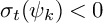 $\sigma _t(\psi _k)<0$
for any
 $t<t_0$
on
 $X_1$
. Define twist factor
 $\tau _{t,k}:=\chi (\sigma _t(\psi _k))$
, where
 $\chi $
is also an undetermined smooth functions on
 $(-\infty ,0)$
. Define operators
 $$ \begin{align*}\Theta_{t,k}:=\tau_{t,k}i\Theta_{h_{t,k}}-i\partial\overline{\partial}\tau_{t,k}-\frac{i\partial\tau_{t,k}\wedge\overline{\partial}\tau_{t,k}}{A_{t,k}}\end{align*} $$
and
 $B_{t,k}:=[\Theta _{t,k},\Lambda ]$
, where
 $A_{t,k}$
will be given later. By direct computation, we have
 $$ \begin{align*} i\partial\overline{\partial}\tau_{t,k}=\chi"(\sigma_t(\psi_k))i\partial\sigma_t(\psi_k)\wedge\overline{\partial}\sigma_t(\psi_k)+\chi'(\sigma_t(\psi_k))i\partial\overline{\partial}\sigma_t(\psi_k), \end{align*} $$
hence we can obtain
 $$ \begin{align*} \Theta_{t,k}&=\chi(\sigma_t(\psi_k))\cdot[i\Theta_{h_k}+i\partial\overline{\partial}\psi_k+i\partial\overline{\partial}(\zeta(\sigma_t(\psi_k)))] -i\partial\overline{\partial}(\chi(\sigma_t(\psi_k))) -A_{t,k}^{-1}i\partial\tau_{t,k}\wedge\overline{\partial} \tau_{t,k} \\ &=\chi\cdot(i\Theta_{h_k}+i\partial\overline{\partial}\psi_k+\zeta'i\partial\overline{\partial}\sigma_t(\psi_k)+\zeta" i\partial\sigma_t (\psi_k)\wedge\overline{\partial}\sigma_t(\psi_k)) \\ & \quad -\chi'i\partial\overline{\partial}\sigma_t(\psi_k)-\chi"i\partial\sigma_t(\psi_k)\wedge\overline{\partial}\sigma_t(\psi_k) -A_{t,k}^{-1}{\chi'}^2i\partial\sigma_t(\psi_k)\wedge\overline{\partial}\sigma_t(\psi_k) \\ &=\chi\cdot(i\Theta_{h_k}+i\partial\overline{\partial}\psi_k)+(\chi\zeta'-\chi') \cdot i\partial\overline{\partial}\sigma_t(\psi_k) +(\chi\zeta"-\chi"-{\chi'}^2A_{t,k}^{-1})\cdot i\partial\sigma_t(\psi_k)\wedge\overline{\partial}\sigma_t(\psi_k). \end{align*} $$
Let
 $A_{t,k}=\frac {{\chi '}^2(\sigma _t(\psi _k))}{(\chi \zeta "-\chi ")(\sigma _t(\psi _k))}$
, we assume that
 $\chi $
and
 $\zeta $
satisfy
 $\chi \zeta '-\chi '=1$
, then
 $$ \begin{align*} \Theta_{t,k}&=\chi(i\Theta_{h_k}+i\partial\overline{\partial}\psi_k)+i\partial\overline{\partial}\sigma_t(\psi_k) \\ &=\chi(\sigma_t(\psi_k))(i\Theta_{h_k}+i\partial\overline{\partial}\psi_k)+\sigma_t'(\psi_k)i\partial\overline{\partial}\psi_k+\sigma_t" (\psi_k)i\partial\psi_k\wedge\overline{\partial}\psi_k \\ &=\chi(\sigma_t(\psi_k))(i\Theta_{h_k}+i\partial\overline{\partial}\psi_k)+\frac{e^{\psi_k}}{e^{\psi_k}+e^t} i\partial\overline{\partial}\psi_k+\frac{e^{\psi_k+t}}{(e^{\psi_k}+e^t)^2}i\partial\psi_k\wedge\overline{\partial}\psi_k \\ &=\chi(\sigma_t(\psi_k))(i\Theta_{h_k}+i\partial\overline{\partial}\psi_k+\lambda_k\omega)-\lambda_k\chi (\sigma_t(\psi_k))\omega +\frac{e^{\psi_k}}{\alpha(e^{\psi_k}+e^t)}\alpha i\partial\overline{\partial}\psi_k \\ &\quad +\frac{e^{\psi_k+t}}{(e^{\psi_k}+e^t)^2}i\partial\psi_k\wedge\overline{\partial}\psi_k. \end{align*} $$
Now we assume that
 $\chi \geqslant \frac {1}{\alpha }$
. Since
 $\frac {e^{\psi _k}}{\alpha (e^{\psi _k}+e^t)}\le \frac {1}{\alpha }$
and
 $i\Theta _{h_ke^{-\psi _k}}\ge _{{\text {Nak}}}-\lambda _k\omega \otimes \operatorname {Id}_E$
, we get
 $$ \begin{align*} \Theta_{t,k}&\geqslant \frac{e^{\psi_k}}{\alpha(e^{\psi_k}+e^t)} (i\Theta_{h_k}+(1+\alpha)i\partial\overline{\partial}\psi_k+\lambda_k\omega)- \lambda_k\chi(\sigma_t(\psi_k))\omega +\frac{e^{\psi_k+t}}{(e^{\psi_k}+e^t)^2}i\partial\psi_k\wedge\overline{\partial}\psi_k \\ &\geqslant -\lambda_k\chi(\sigma_t(\psi_k))\omega+\frac{e^{\psi_k+t}}{(e^{\psi_k}+e^t)^2}i\partial\psi_k \wedge\overline{\partial}\psi_k, \end{align*} $$
where the second inequality is owing to
 $i\Theta _{h_ke^{-(1+\alpha )\psi _k}}\ge _{{\text {Nak}}}-\lambda _k\omega \otimes \operatorname {Id}_E$
.
Furthermore, if
 $\chi $
is decreasing, we have
 $\chi (\sigma _t(\psi _k))\leqslant \chi (t)$
. Then we obtain
 $$ \begin{align*} \Theta_{t,k}\geqslant-\lambda_k\chi(t)\omega+\frac{e^{\psi_k+t}}{(e^{\psi_k}+e^t)^2}i\partial \psi_k\wedge\overline{\partial}\psi_k. \end{align*} $$
Hence
 $$ \begin{align*} B_{t,k}+\lambda_k\chi(t)I \geqslant[\frac{e^{\psi_k+t}}{(e^{\psi_k}+e^t)^2}i\partial\psi_k\wedge\overline{\partial}\psi_k,\Lambda] =\frac{e^{\psi_k+t}}{(e^{\psi_k}+e^t)^2} T_{\overline{\partial}\psi_k} T_{\overline{\partial}\psi_k}^*\geqslant 0 \end{align*} $$
holds on
 $X_1$
as an operator on
 $(n, q + 1)$
-forms, where
 $T_{\overline {\partial }\psi _k}\bullet =\overline {\partial }\psi _k\wedge \bullet $
and
 $T_{\overline {\partial }\psi _k}^*$
is the adjoint map of
 $T_{\overline {\partial }\psi _k}$
.
Note that in the preceding argument, we assume that
 $\chi $
satisfies
 $$ \begin{align*} \chi\zeta'-\chi'=1,\ \chi'<0\ \text{and}\ \inf_{t<0}\chi(t)=\frac{1}{\alpha}. \end{align*} $$
Step three: Construction of truncated forms and solving
 $\mathbf {\overline {\partial }}$
equations.
Let
 $\theta :\mathbb {R}\to [0,1]$
be a smooth function satisfying
 $\theta =1$
on
 $(-\infty ,0]$
,
 $\theta =0$
on
 $[1,+\infty )$
and
 $|\theta '|\leqslant 2$
on
 $\mathbb {R}$
. Set
 $g_{t,k}:=\overline {\partial }(\theta (\psi _k-t)\tilde {f})$
, we have
 $\overline {\partial } g_{t,k}=0$
, and
 $$ \begin{align*}g_{t,k}=\theta'(\psi_k-t)\overline{\partial}\psi_k\wedge\tilde{f}+\theta(\psi_k-t)\overline{\partial}\tilde{f}=:g_{1,t,k}+g_{2,t,k}.\end{align*} $$
The Cauchy-Schwarz inequality shows that
 $$ \begin{align*} &\langle (B_{t,k}+(\lambda_k\chi(t)+e^{2t})I)^{-1}g_{t,k},g_{t,k} \rangle_{h_{t,k},\omega} \\ \leqslant\ &2\langle (B_{t,k}+(\lambda_k\chi(t)+e^{2t})I)^{-1}g_{1,t,k},g_{1,t,k} \rangle_{h_{t,k},\omega} \\ &+\langle (B_{t,k}+(\lambda_k\chi(t)+e^{2t})I)^{-1}g_{2,t,k},g_{2,t,k} \rangle_{h_{t,k},\omega} \\ \leqslant\ &2\langle (B_{t,k}+\lambda_k\chi(t)I)^{-1}g_{1,t,k},g_{1,t,k} \rangle_{h_{t,k},\omega}+2\langle \frac{1}{e^{2t}}g_{2,t,k}, g_{2,t,k} \rangle_{h_{t,k},\omega} \\ =:&2A_1+2A_2. \end{align*} $$
By direct computation, we have
 $$ \begin{align*} \int_{X_1}A_1dV_\omega&\leqslant\int_{X_1}\frac{(e^{\psi_k}+e^t)^2}{e^{\psi_k+t}}\langle (T_{\overline{\partial}\psi_k}^*)^{-1}(T_{\overline{\partial}\psi_k})^{-1}g_{1,t,k}, g_{1,t,k}\rangle_{h_{t,k},\omega}dV_\omega \\ &\leqslant\int_{X_1}\frac{(e^{\psi_k}+e^t)^2}{e^{\psi_k+t}}\cdot 4|\tilde{f}|^2_{h_k,\omega}e^{-\psi_k}e^{-\zeta(\sigma_t(\psi_k))}\cdot \mathbb{I}_{\{t<\psi_k<t+1\}} dV_\omega, \end{align*} $$
where
 $\mathbb {I}_{\{t<\psi _k<t+1\}}$
is the characteristic function associated with
 $\{t<\psi _k<t+1\}$
. If we assume that
 $\zeta \geqslant 0$
, then we have
 $$ \begin{align*} \int_{X_1}A_1dV_\omega&\leqslant\int_{X_1}\frac{4(e^{\psi_k}+e^t)^2}{e^{2\psi_k+t}}|\tilde{f}|^2_{h,\omega}\mathbb{I}_{\{t<\psi_k<t+1\}} dV_\omega \\ &\leqslant\frac{4(e+1)^2}{e^t}\int_{X_1}|\tilde{f}|^2_{h,\omega}\mathbb{I}_{\{t<\psi_k<t+1\}} dV_\omega. \end{align*} $$
Since
 $\theta =0$
on
 $[1,+\infty )$
, we have
 $$ \begin{align*} \int_{X_1}A_2dV_\omega&=\int_{X_1}\langle\frac{1}{e^{2t}}g_{2,t,k}, g_{2,t,k} \rangle_{h_{t,k},\omega}dV_\omega \\ &\leqslant e^{-2t}\int_{X_1}|\overline{\partial}\tilde{f}|^2_{h,\omega}e^{-\psi}\cdot \mathbb{I}_{\{\psi_k<t+1\}}dV_\omega. \end{align*} $$
In summary, we obtain
 $$ \begin{align*} C_k(t):=&\int_{X_1}\langle (B_{t,k}+(\chi(t)\lambda_k+e^{2t})I)^{-1}g_{t,k},g_{t,k} \rangle_{h_{t,k},\omega} dV_\omega \\ \leqslant&\frac{8(e+1)^2}{e^t}\int_{X_1}|\tilde{f}|^2_{h,\omega}\mathbb{I}_{\{t<\psi_k<t+1\}} dV_\omega \\ &+2e^{-2t}\int_{X_1}|\overline{\partial}\tilde{f}|^2_{h,\omega}e^{-\psi}\cdot \mathbb{I}_{\{\psi_k<t+1\}}dV_\omega. \end{align*} $$
By the facts that
 $$ \begin{align*}\int_{X_1}|\tilde{f}|^2_{h,\omega}dV_\omega<+\infty \ \text{ and }\ \int_{X_1}|\overline{\partial}\tilde{f}|^2_{h,\omega}e^{-\psi}dV_\omega<+\infty,\end{align*} $$
it follows from Fatou’s lemma that
 $$ \begin{align*} C(t):=\varlimsup_{k\to+\infty}C_k(t)\leqslant&\frac{8(e+1)^2}{e^t}\int_{X_1}|\tilde{f}|^2_{h,\omega}\mathbb{I}_{\{t\leqslant\psi\leqslant t+1\}} dV_\omega \\ &+2e^{-2t}\int_{X_1}|\overline{\partial}\tilde{f}|^2_{h,\omega}e^{-\psi}\cdot \mathbb{I}_{\{\psi\leqslant t+1\}}dV_\omega \end{align*} $$
and
 $$ \begin{align*} \lim_{t\to-\infty}e^{2t}C(t)=0. \end{align*} $$
By Lemma 2.2, there exists an E-valued
 $(n,q)$
-form
 $u_{t,k}$
and an E-valued
 $(n,q+1)$
-form
 $v_{t,k}$
such that
 $$ \begin{align*} \overline{\partial}u_{t,k}+P_{h_k}(\sqrt{\lambda_k\chi(t)+e^{2t}}v_{t,k})=g_{t,k} \end{align*} $$
and
 $$ \begin{align*} \int_{X_1}\frac{|u_{t,k}|^2_{h_k,\omega}e^{-\psi_k}e^{-\zeta(\sigma_t(\psi_k))}}{\tau_{t,k}+A_{t,k}}dV_\omega+\int_{X_1}|v_{t,k}|^2_{h_k,\omega}e^{-\psi_k}e^{-\zeta(\sigma_t(\psi_k))}\leqslant C_k(t), \end{align*} $$
where
 $P_{h_k}$
is the orthogonal projection from
 $L^2$
space to
 $\operatorname {Ker}\overline {\partial }$
. To simplify the computation, we define
 $\zeta $
so that
 $$ \begin{align*} \frac{e^{-\zeta(\sigma_t(\psi_k))}}{\tau_{t,k}+A_{t,k}}=\frac{\alpha e^{\sigma_t(\psi_k)}}{1+\alpha}\geqslant\frac{\alpha e^t}{1+\alpha} \text{ and }\ e^{-\zeta(\sigma_t(\psi_k))}\geqslant e^{-\zeta(0)}, \end{align*} $$
that is,
 $\zeta $
satisfies
 $$ \begin{align*} (\chi+\frac{{\chi'}^2}{\chi\zeta"-\chi"})e^{\zeta(t)+t}=\frac{1+\alpha}{\alpha} \text{ and }\ \zeta'>0. \end{align*} $$
In summary, we assume that
 $\chi $
and
 $\zeta $
are the solutions of the following system of ODEs:
 $$ \begin{align*} \left\{ \begin{aligned} &\chi(t)\zeta'(t)-\chi'(t)=1, \\ &(\chi+\frac{{\chi'}^2}{\chi\zeta"-\chi"})e^{\zeta(t)+t}=\frac{1+\alpha}{\alpha}, \\ &\inf_{t<0}\chi(t)=\frac{1}{\alpha},\ \chi'<0, \\ &\inf_{t<0}\zeta(t)=0,\ \zeta'>0. \end{aligned}\right. \end{align*} $$
Take (see also [Reference Guan and Zhou18])
 $$ \begin{align*} \left\{ \begin{aligned} &\zeta(t)=\log\frac{\frac{1}{\alpha}+1}{\frac{1}{\alpha}+1-e^t}, \\ &\chi(t)=\frac{\frac{1}{\alpha^2}-1+e^t-(\frac{1}{\alpha}+1)t}{\frac{1}{\alpha}+1-e^t}, \end{aligned}\right. \end{align*} $$
then
 $\zeta (t)$
and
 $\chi (t)$
satisfy the desired conditions. Therefore, we have
 $$ \begin{align*} \int_{X_1}\frac{\alpha e^t}{1+\alpha}|u_{t,k}|^2_{h_k,\omega}e^{-\psi_k}dV_{\omega}+\int_{X_1}\frac{1}{1+\alpha}|v_{t,k}|^2_{h_k,\omega}e^{-\psi_k}dV_{\omega}\leqslant C_k(t). \end{align*} $$
For any fixed t, there is a subsequence
 $\{u_{t,k_j}\}_{j=1}^{+\infty }$
of
 $\{u_{t,k}\}_{k=1}^{+\infty }$
and an E-valued
 $(n,q)$
-form
 $u_t$
such that
 $u_{t,k_j}$
weakly converges to a limit
 $u_t$
in
 $L^{n,q}_{(2)}(X_1,E)_{h_ie^{-\psi _i},\omega }$
for any integer i by the increasing convergence of
 $h_k$
and the diagonal argument.
Hence the Banach–Steinhaus theorem shows that, for any i,
 $$ \begin{align*} \int_{X_1}\frac{\alpha e^t}{1+\alpha}|u_t|^2_{h_i,\omega}e^{-\psi_i}dV_{\omega} &\leqslant \varliminf_{j\to+\infty}\int_{X_1}\frac{\alpha e^t}{1+\alpha}|u_{t,k_j}|^2_{h_i,\omega}e^{-\psi_i}dV_{\omega}\\ &\leqslant\varliminf_{j\to+\infty}\int_{X_1}\frac{\alpha e^t}{1+\alpha}|u_{t,k_j}|^2_{h_{k_j},\omega}e^{-\psi_{k_j}}dV_{\omega}. \end{align*} $$
Then it follows from Fatou’s lemma that
 $$ \begin{align*} \int_{X_1}\frac{\alpha e^t}{1+\alpha}|u_t|^2_{h,\omega}e^{-\psi}dV_{\omega} &\leqslant\varliminf_{i\to+\infty}\int_{X_1}\frac{\alpha e^t}{1+\alpha}|u_t|^2_{h_i,\omega}e^{-\psi_i}dV_{\omega} \\ &\leqslant\varliminf_{j\to+\infty}\int_{X_1}\frac{\alpha e^t}{1+\alpha}|u_{t,k_j}|^2_{h_{k_j},\omega}e^{-\psi_{k_j}}dV_{\omega}. \end{align*} $$
A similar argument is also true for
 $\{v_{t,k}\}_{k=1}^{+\infty }$
. Hence we can find forms
 $u_t$
and
 $v_t$
such that
 $$ \begin{align*} \int_{X_1}\frac{\alpha e^t}{1+\alpha}|u_t|^2_{h,\omega}e^{-\psi}dV_{\omega}+\int_{X_1}\frac{1}{1+\alpha}|v_t|^2_{h,\omega}e^{-\psi}dV_{\omega}\leqslant C(t) \end{align*} $$
and
 $$ \begin{align*} \lim_{t\to-\infty}\int_{X_1}|e^tv_t|^2_{h,\omega}e^{-\psi}dV_\omega\leqslant\lim_{t\to-\infty}(1+\alpha)e^{2t}C(t)=0. \end{align*} $$
Note that
 $0\leqslant \lambda _k\leqslant \lambda \in C^0(X_0)$
, then
 $$ \begin{align*} \sup_{k}\int_{X_1}(\lambda_k\chi(t)+e^{2t})|v_{t,k}|^2_{h_k,\omega}e^{-\psi_k}dV_\omega <+\infty. \end{align*} $$
Thus by Lemma 2.4, there is a subsequence of
 $\{\sqrt {\lambda _k\chi (t)+e^{2t}}v_{t,k}\}$
(we may use the same notation) that converges to a limit
 $\tilde {v}_t$
weakly in
 $L^{n,q+1}_{(2)}(X_1,E)_{h_{i}e^{-\psi _i},\omega }$
for any i, and
 $P_{h_k}(\sqrt {\lambda _k\chi (t)+e^{2t}}v_{t,k})$
converges to
 $P(\tilde {v}_t)$
weakly, where P is the orthogonal projection from the
 $L^2$
space with respect to
 $he^{-\psi }$
to
 $\operatorname {Ker}\overline {\partial }$
. Since
 $0\leqslant \lambda _k\chi (t)+e^{2t}$
is uniformly bounded for
 $t\in (-\infty ,0)$
, we know that
 $\sqrt {\lambda _k\chi (t)+e^{2t}}v_{t,k}$
converges to
 $e^tv_t$
weakly in any
 $L^{n,q+1}_{(2)}(X_1,E)_{h_{i}e^{-\psi _i},\omega }$
by Lemma 2.3. Hence
 $\tilde {v}_t=e^tv_t$
due to the uniqueness of the weak limit. Then
 $P_{h_k}(\sqrt {\chi (t)\lambda _k+e^{2t}}v_{t,k})$
converges to
 $P(e^tv_t)$
weakly. This implies that
 $$ \begin{align*}\overline{\partial} u_t+P(e^tv_t)=\overline{\partial}(\theta(\psi-t)\tilde{f})\end{align*} $$
and
 $$ \begin{align*}\lim_{t\to-\infty}\int_{X_1}|P(e^tv_t)|^2_{h,\omega}e^{-\psi}dV_\omega=0.\end{align*} $$
Step four: showing the surjectivity.
We know that
 $H^{q+1}(X_1,K_X\otimes \mathcal {E}(h))$
is Hausdorff by Lemma 2.8, this means that the image of the map
 $$ \begin{align*}\overline{\partial}_q:\Gamma(X_1,\mathcal{L}^{n,q}_{(2),h})\to\Gamma(X_1,\mathcal{L}^{n,q+1}_{(2),h})\end{align*} $$
is closed. Then the following map is a continuous linear surjective between two Fréchet spaces
 $$ \begin{align*}\overline{\partial}_q:\Gamma(X_1,\mathcal{L}^{n,q}_{(2),h})\to\operatorname{Im}\overline{\partial}_q.\end{align*} $$
Then it follows from Lemma 2.11 that
 $\overline {\partial }_q$
induces a topological isomorphism
 $$ \begin{align} \frac{\Gamma(X_1,\mathcal{L}^{n,q}_{(2),h})}{\operatorname{Ker} \overline{\partial}_q}\simeq\operatorname{Im} \overline{\partial}_q \end{align} $$
where the topology is induced by the semi-norm
 $$ \begin{align*}\|u\|^2_{h,K}:=\int_K|u|_{h,\omega}^2dV_\omega+\int_K|\overline{\partial} u|_{h,\omega}^2dV_\omega\end{align*} $$
and the quotient topology mentioned before Lemma 2.13. Let
 $z_t:=P(e^tv_t)$
, then we have
 $z_t=\overline {\partial }(\theta (\psi -t)\tilde {f}-u_t)\in \operatorname {Im}\overline {\partial }_q$
and
 $$ \begin{align*}\lim_{t\to-\infty}\int_{X_1}|z_t|^2_{h,\omega}e^{-\psi}dV_\omega=0.\end{align*} $$
In particular, we have
 $$ \begin{align*}\lim_{t\to-\infty}\int_{X_1}|z_t|^2_{h,\omega}dV_\omega=0\end{align*} $$
since
 $\psi $
is a quasi-plurisubharmonic function. It follows from (3.1) that we can find a sequence of E-valued
 $(n,q)$
-forms
 $s_t\in \Gamma (X_1,\mathcal {L}^{n,q}_{(2),h})$
such that
 $\overline {\partial } s_t=z_t$
and
 $\lim _{t\to -\infty }\|s_t\|_{h,K}=0$
for any compact subset K in coordinate charts of
 $X_1$
.
Let
 $\tilde {f}_t:=\theta (\psi -t)\tilde {f}-u_t-s_t$
, then we have
 $\overline {\partial }\tilde {f}_t=0$
. Hence
 $$ \begin{align*}\tilde{f}_t\in\operatorname{Ker}\overline{\partial}_q\subset\Gamma(X_1,\mathcal{L}^{n,q}_{(2),h}).\end{align*} $$
Note that
 $$ \begin{align*}(\theta(\psi-t)-1)\tilde{f}-u_t\in L^{n,q}_{(2)}(X_1,E)_{he^{-\psi},\omega}\end{align*} $$
and
 $$ \begin{align*}\overline{\partial}(\theta(\psi-t)\tilde{f}-u_t-\tilde{f})=z_t-\overline{\partial}\tilde{f}\in L^{n,q+1}_{(2)}(X_1,E)_{he^{-\psi},\omega},\end{align*} $$
we can obtain
 $$ \begin{align*}\theta(\psi-t)\tilde{f}-u_t-\tilde{f}\in\Gamma(X_1,\mathcal{L}^{n,q}_{(2),he^{-\psi}}).\end{align*} $$
Therefore
 $$ \begin{align*}\tilde{f}_t-\tilde{f}=-s_t\ \mod\ \Gamma(X_1,\mathcal{L}^{n,q}_{(2),he^{-\psi}}).\end{align*} $$
Hence for the semi-norm
 $\|\bullet \|^{\prime \prime }_{h,K}$
on
 $H^{n,q}_{(2),\text {loc}}(X,E,h/{he^{-\psi }})$
induced by the quotient map, we have
 $$ \begin{align*}\lim_{t\to-\infty}\|\tilde{f}_t-\tilde{f}\|^{\prime\prime}_{h,K}\leqslant\lim_{t\to-\infty}\|\tilde{f}_t-\tilde{f}\|^{\prime}_{h,K}\leqslant\lim_{t\to-\infty}\|s_t\|_{h,K}=0.\end{align*} $$
Therefore, f is in the closure of
 $H^0(S_1,\operatorname {Im}\mathcal {P})$
in
 $H^0(S_1,R^q\pi _*(K_X\otimes \mathcal {E}(h)/\mathcal {E}(he^{-\psi })))$
by Lemma 2.8. Since
 $$ \begin{align*}H^0(S_1,\operatorname{Im}\mathcal{P})=\bigcap_{y\in S_1}\{F\in H^0(S_1,R^q\pi_*(K_X\otimes\mathcal{E}(h)/\mathcal{E}(he^{-\psi}))): F_y\in(\operatorname{Im}\mathcal{P})_y \},\end{align*} $$
it follows from Lemma 2.9 that
 $H^0(S_1,\operatorname {Im}\mathcal {P})$
is a closed subset. This means that
 $f\in H^0(S_1,\operatorname {Im}\mathcal {P})$
. Hence
 $\mathcal {P}$
is surjective. This completes the proof of Theorem 1.3.
Remark 3.1. Since analytic subsets are usually not essential obstacles when we use
 $L^2$
method and solve
 $\overline {\partial }$
-equations due to [Reference Demailly6, Chapter VIII-(7.2) and (7.3)], it is reasonable to expect that the same conclusion is also true for the Nakano positivity in the sense of approximations defined in [Reference Inayama and Matsumura22] by the similar arguments in [Reference Inayama and Matsumura22], [Reference Zhou and Zhu32].
4 Applications of Theorem 1.3
We first show the following injectivity theorem for vector bundles, using the approach in [Reference Zhou and Zhu32, Theorem 2.1], as an application of Theorem 1.3.
Corollary 4.1 (=Corollary 1.4).
Let X be a holomorphically convex Kähler manifold, F be a holomorphic vector bundle and M be a holomorphic line bundle over X. Let
 $\theta $
be a real continuous semi-positive
 $(1,1)$
-form on X. Assume that
 $h_F$
is an approximately
 $\theta $
-Nakano semi-positive singular Hermitian metric on F and
 $h_M$
is a smooth metric on M such that
 $b\theta \ge i\Theta _{h_M}$
for some constant
 $b\in (0,+\infty )$
. Then for a non-zero holomorphic section s of M, the following homomorphism induced by the tensor product with s
 $$ \begin{align*}\otimes s: H^q(X,K_X\otimes\mathcal{F}(h_F))\to H^q(X,K_X\otimes M\otimes\mathcal{F}(h_F))\end{align*} $$
is injective for any
 $q\geqslant 0$
.
Proof. Define
 $\psi :=2\log |s|_{h_M}$
, then
 $\psi $
is
 $i\Theta _{h_M}$
-plurisubharmonic. Let
 $\mathcal {U}=\{U_i\}_{i\in I}$
be a Stein open covering of X. Then the following maps induced by the tensor product with s
 $$ \begin{align*}H^0(U_i,K_X\otimes\mathcal{F}(h_F))\to H^0(U_i,K_X\otimes\mathcal{F}\otimes\mathcal{M}(h_F\otimes h_Me^{-\psi}))\end{align*} $$
are isomorphisms. Hence, by Leray’s theorem, we have the following isomorphism between cohomology groups:
 $$ \begin{align*}H^q(X, K_X\otimes\mathcal{F}(h_F))\to H^q(X, K_X\otimes\mathcal{F}\otimes\mathcal{M}(h_F\otimes h_Me^{-\psi})).\end{align*} $$
Consider the following homomorphism induced by the inclusion
 $$ \begin{align*}\iota:H^q(X, K_X\otimes\mathcal{F}\otimes\mathcal{M}(h_F\otimes h_Me^{-\psi}))\to H^q(X, K_X\otimes\mathcal{F}\otimes\mathcal{M}(h_F\otimes h_M)).\end{align*} $$
Taking
 $E=F\otimes M$
,
 $h=h_F\otimes h_M$
,
 $\alpha =\frac {1}{b}$
in Theorem 1.3, we get that
 $\iota $
is injective. Note that
 $h_M$
is smooth, together with the above isomorphism, we obtain the following injective morphism:
 $$ \begin{align*}H^q(X,K_X\otimes\mathcal{F}(h_F))\overset{\otimes s}{\hookrightarrow} H^q(X,K_X\otimes M\otimes\mathcal{F}(h_F)).\end{align*} $$
According to this injectivity theorem, we can obtain the following vanishing theorem (see [Reference Matsumura25]).
Corollary 4.2 (=Corollary 1.5).
Let X be a projective manifold of dimension n, F be a holomorphic vector bundle and M be a holomorphic line bundle over X. Let
 $\theta $
be a real continuous semi-positive
 $(1,1)$
-form on X. Assume that
 $h_F$
is an approximately
 $\theta $
-Nakano semi-positive singular Hermitian metric on F and
 $h_M$
is a smooth metric on M such that
 $b\theta \ge i\Theta _{h_M}\geqslant 0$
for some constant
 $b\in (0,+\infty )$
. Then we have
 $$ \begin{align*}H^q(X,K_X\otimes\mathcal{F}(h_F))=0\quad \text{for} \quad q>n-\kappa(M).\end{align*} $$
Proof. Corollary 4.2 holds trivially if
 $\kappa (L)\le 0$
. We only need to consider the case where
 $\kappa (L)> 0$
. For a contradiction, we suppose that there is a nonzero cohomology class
 $\xi \in H^q(X,K_X\otimes \mathcal {F}(h_F))$
for some
 $q>n-\kappa (L)$
. Consider the linear map induced by the tensor product with
 $\xi $
 $$ \begin{align*}\otimes \xi:H^0(X,M^k)\to H^q(X,K_X\otimes{M}^k\otimes\mathcal{F}(h_F)).\end{align*} $$
We claim that
 $\otimes \xi $
is injective. For a contradiction, we suppose that there is a non-zero holomorphic section s of
 $M^k$
such that
 $s\otimes \xi =0$
in
 $H^q(X,K_X\otimes {M}^k\otimes \mathcal {F}(h_F))$
. Then by Theorem 4.1, the homomorphism induced by the tensor product with s
 $$ \begin{align*}\otimes s: H^q(X,K_X\otimes\mathcal{F}(h_F))\to H^q(X,K_X\otimes M^k\otimes\mathcal{F}(h_F))\end{align*} $$
is injective. Then
 $s\otimes \xi =0$
implies that
 $\xi =0$
in
 $ H^q(X,K_X\otimes \mathcal {F}(h_F))$
, which is a contradiction. Therefore, the homomorphism
 $\otimes \xi $
is injective and hence
 $$ \begin{align*}\dim H^0(X,M^k)\leqslant\dim H^q(X,K_X\otimes{M}^k\otimes\mathcal{F}(h_F)).\end{align*} $$
By the following Lemma 4.3,
 $\dim H^0(X,M^k)=\mathrm {O}(k^{n-q})$
as
 $k\to +\infty $
. Thus
 $\kappa (M)\le n-q$
by the definition of the Kodaira dimension, which contradicts to the inequality
 $q>n-\kappa (M)$
. Hence we complete the proof.
Lemma 4.3 (See [Reference Matsumura25, Lemma 4.3]).
In the same situation as above, we have
 $$ \begin{align*}\dim H^q(X,K_X\otimes M^k\otimes\mathcal{F}(h_F))=\mathrm{O}(k^{n-q}).\end{align*} $$
Proof. We follow the approach in [Reference Matsumura25]. We prove the lemma by induction on the dimension of X. For simplicity, we put
 $\mathcal {G}_k:=K_X\otimes M^k\otimes \mathcal {F}(h_F)$
. Take a very ample line bundle A on X such that
 $H^q(X,\mathcal {G}_k\otimes A^m)=0$
for any
 $q,k,m>0$
. This is possible by Lemma 2.7. First we consider the case of
 $n=1$
. If we take points
 $\{p_j\}^m_{j=1}$
on X in a “very” general position, these points satisfy the following conditions:
-
(1)
$A=\mathcal {O}_X(\sum ^m_{j=1}p_j)$
. -
(2) The length of the stalk of
$\mathcal {G}_k$
at
$p_j$
is equal to the rank of
$K_X\otimes \mathcal {F}(h_F)$
. -
(3) For every
$k>0$
, the following sequence is exact:
$$ \begin{align*}0\rightarrow\mathcal{G}_k\rightarrow\mathcal{G}_k\otimes A\rightarrow\bigoplus^m_{j=1}(\mathcal{G}_k\otimes A)_{p_j}\rightarrow 0.\end{align*} $$


Indeed, for a given
 $k>0$
, points in a general position of the complete linear system
 $|A|$
of A satisfy conditions
 $(1)$
,
 $(3)$
. Therefore points in a very general position of
 $|A|$
satisfy conditions
 $(1)$
,
 $(3)$
. The rank of coherent sheaves is defined by the length of the stalk of the sheaves at a general point. Thus condition
 $(2)$
is also satisfied.
The induced long exact sequence and
 $H^q(X,\mathcal {G}_k\otimes A^m)=0$
yield
 $$ \begin{align*}h^1(X,\mathcal{G}_k)\leqslant \sum_{j=1}^m h^0(p_j,(\mathcal{F}_k\otimes A)_{p_j}).\end{align*} $$
By condition
 $(2)$
, the right hand side depends only on the number of points
 $\{p_j\}_{j=1}^m$
and the rank of
 $K_X\otimes \mathcal {F}(h_F)$
. The number of points
 $\{p_j\}_{j=1}^m$
does not depend on k. Therefore we have
 $h^1(X,\mathcal {G}_k)=O(1)=O(k^{1-1})$
. On the other hand, we have
 $h^0(X,\mathcal {G}_k)\leqslant h^0(X,K_X\otimes M^k\otimes F)$
since
 $\mathcal {F}(h_F)$
is a submodule sheaf of F.
We may assume that Lemma 4.3 holds for
 $(n-1)$
-dimensional projective manifolds. We can take a smooth hypersurface H (independent of k) in the complete linear system
 $|A|$
with the following exact sequence:
 $$ \begin{align*}0\rightarrow\mathcal{G}_k\otimes A^{m-1}\rightarrow\mathcal{G}_k\otimes A^m\rightarrow\mathcal{G}_k\otimes A^m|_H\rightarrow 0\end{align*} $$
where
 $\mathcal {G}_k\otimes A^m|_H$
denotes the restriction of
 $\mathcal {G}_k\otimes A^m$
to H. Indeed, for a given
 $k>0$
, a general member in
 $|A|$
(which does not contain any components of subvarieties defined by the associated primes of
 $\mathcal {G}_k$
) satisfies the above exact sequence. Therefore it is sufficient to take a very general member in
 $|A|$
.
Now we consider exact sequence of the case of
 $m=1$
. By the induced long exact sequence and the fact that
 $H^q(X,\mathcal {G}_k\otimes A^m)=0$
, we obtain
 $$ \begin{align*}h^q(X,\mathcal{G}_k)\leqslant h^{q-1}(H,\mathcal{G}_k\otimes A|_H)\end{align*} $$
for every
 $q>0$
. For the proof, we need to estimate the right hand side by the induction hypothesis. For this purpose, we consider the exact sequence of the case of
 $m>1$
. By the induced long exact sequence, we obtain
 $$ \begin{align*}h^q(H,\mathcal{G}_k\otimes A^m|_H)=0\end{align*} $$
for
 $q>0$
and
 $m>1$
. This asserts that the restrictions of
 $K_X\otimes \mathcal {F}(h_F)\otimes A$
and M to H also satisfy the vanishing condition at the beginning of the proof of Lemma 4.3. Therefore we obtain
 $h^{q-1}(H,\mathcal {G}_k\otimes A|_H)=O(k^{(n-1)-(q-1)})=O(k^{n-q})$
for
 $q>0$
by the induction hypothesis. It remains to see the case of
 $q=0$
. Indeed, we have
 $h^0(X,\mathcal {G}_k)\leqslant h^0(X,K_X\otimes M^k\otimes F)=O(k^n)$
.
Acknowledgements
The authors would like to thank Prof. Xiangyu Zhou and Prof. Zhitong Mi for useful discussions. They wish to express their gratitude to the anonymous referee for carefully reading the manuscript and for giving useful suggestions.



