Introduction
The consequences of a rapidly ageing and healthier population are well documented (Care Quality Commission 2012; Centre for Workforce Intelligence 2011; Department of Health 2007, 2009; HelpAge International 2013). Amongst other things, this is increasing the size, as well as the economic and social importance, of the adult social care workforce in the United Kingdom (UK) and in other industrialised countries. In response to this, in the UK over the past decade there has been an increasing emphasis on the professionalisation of the workforce with the aim of ensuring a consistently high quality of care. Moreover, following on from the increasing number of investigations and reports into incidents of abuse and neglect in hospitals and residential care and nursing homes (Equality and Human Rights Commission 2012; Francis Reference Francis2013; Health Service Ombudsman 2011; Flynn, 2012), emphasis is being placed on the challenges of creating and maintaining a compassionate care culture (Department of Health 2012; Hesselink et al. Reference Hesselink, Kuis, Pijnenburg and Wollersheim2013). With this in mind, understanding what it is that motivates care-workers to do their work would seem critical to the process of helping organisations adopt and sustain professional and compassionate working practices.
Although there has been an increase in research undertaken with people who work in social care (Atkinson and Lucas Reference Atkinson and Lucas2013; Hussein, Manthorpe and Stevens Reference Hussein, Manthorpe and Stevens2010; Lepore Reference Lepore2008; Lucas, Atkinson and Godden Reference Lucas, Atkinson and Godden2008; Skills for Care 2007; Weicht Reference Weicht2010), this research is still in its infancy, and falls short of providing a detailed exploration of care-workers' experience and motivation. We therefore draw on the plethora of research undertaken on nursing, which has both contributed to and resulted from the recent professionalisation of this occupation (Adams and Nelson Reference Adams and Nelson2009; Ousey and Johnson Reference Ousey and Johnson2007; Rytterström, Cedersund and Arman Reference Rytterström, Cedersund and Arman2009; Woodward Reference Woodward1997), as a basis for understanding workers' experiences in social care in the context of the current professionalisation of this sector. Here too, however, available research is also seen to lack a robust theoretical analysis of what activates and sustains nurses' motivation to work in a professional and compassionate manner (Folbre Reference Folbre2012).
To address the widely acknowledged ‘data desert’ of the adult social care workforce, the National Survey of Care Workers (Skills for Care 2007) aimed to find out more about members of this workforce, including their motivations for working in care. The overall findings (which reveal, among other things, high levels of satisfaction), suggest that economic motives tend to be secondary for workers in this sector. This accords with other research into care-worker attitudes and responses to human resource practices (Atkinson and Lucas Reference Atkinson and Lucas2013), which has found that overall care-workers have clearly defined altruistic values, but ambivalent feelings about pay. This is also in line with other research on the impact of rewards and incentives on recruitment and retention in the workforce (Lucas, Atkinson and Godden Reference Lucas, Atkinson and Godden2008, Reference Lucas, Atkinson and Godden2009) which has found that ‘pay is rarely the major influencing factor in taking up and remaining in care jobs' (Lucas, Atkinson and Godden Reference Lucas, Atkinson and Godden2009: 4). Indeed, previous research has found that over three-quarters of staff planned to stay in their current organisation as a result of their liking the nature of the job, their relationship with clients, the team atmosphere, and opportunities for training and development (Lucas, Atkinson and Godden Reference Lucas, Atkinson and Godden2009). Relationships at work, in particular with clients, as well as with other care staff and supervisors or managers, have also consistently been found to be key contributors to job satisfaction and wellbeing (Moyle Reference Moyle2003; Wilson, Davies and Nolan Reference Wilson, Davies and Nolan2009).
These findings are widely recognised to conflict with traditional economic theories of work motivation that are predicated on financial incentives and (personal) self-interest and which struggle to account for the more altruistic and ‘selfless’ behaviours which care work demands (Lucas, Atkinson & Godden, Reference Lucas, Atkinson and Godden2009). However, where more contemporary models of work motivation – that emphasise intrinsic versus extrinsic motivation such as self-determination theory (Deci and Ryan Reference Deci and Ryan2008; Gagné and Deci Reference Gagné and Deci2005) – have been applied to social care and nursing, they have resulted in controversial interpretations of motivation, which have been damaging to, and misrepresentative of, the workforce (Himmelweit Reference Himmelweit2007; Lepore Reference Lepore2008; Nelson and Folbre Reference Nelson and Folbre2006). Simplistically put, the intrinsic versus extrinsic perspective of motivation argues that people who are motivated by inner rewards of fulfilment and worthiness exhibit a better quality of motivation which is more sustainable than those who are motivated primarily by external rewards such as money and prestige. Moreover, research within this realm has demonstrated that extrinsic rewards can undermine peoples' intrinsic motives (Ryan and Deci Reference Ryan and Deci2000). Drawing on this evidence, some economists have argued that ‘A badly paid nurse is a good nurse’ and justified giving care-workers and nurses poor pay in light of the gratification they receive from caring and healing (Heyes Reference Heyes2005). Moreover, care organisations tap into and utilise the social and moralistic discourse surrounding caring to validate keeping wages low (Lepore Reference Lepore2008; Palmer and Eveline Reference Palmer and Eveline2012; Weicht Reference Weicht2010). This has been recognised to inhibit a more holistic and thorough understanding of care-workers and nurses' motivations (Folbre Reference Folbre2012; Nelson and Folbre Reference Nelson and Folbre2006; Palmer and Eveline Reference Palmer and Eveline2012).
In line with other popular models of motivation, such as those based on personality and individual differences, these dominant motivation theories emphasise the individualistic nature of motivation and pay limited attention to the interactions between personal and social dynamics (Ellemers, De Gilder and Haslam Reference Ellemers, De Gilder and Haslam2004). Nevertheless, the pivotal importance of relationships and group identification in determining wellbeing and quality of aged care is increasingly being recognised by researchers, policy makers and practitioners (Jetten, Haslam and Haslam Reference Jetten, Haslam and Haslam2012; Moyle Reference Moyle2003; Nolan, Davies and Brown Reference Nolan, Davies and Brown2006; Wilson and Davies Reference Wilson and Davies2009). Indeed, a relationship-centred approach to care underpins the national agenda in the UK (and elsewhere; e.g. the United States of America, Australia) to instil compassionate working cultures in health and social care (Department of Health 2012). In light of these various points, it would appear that a holistic understanding of the motivations of care-workers needs to take account of the collective, relational and personal contexts in which care work is performed and of the way in which these contexts relate to the psychology and self-concepts of care-workers.
Identification, motivation and helping behaviour
In trying to address some of the shortcomings that are evident in individualistic models of motivation, our understanding of work motivation is guided by theorising in the social identity tradition (Ellemers, De Gilder and Haslam Reference Ellemers, De Gilder and Haslam2004; Haslam Reference Haslam2004). This combines principles of social identity theory (Tajfel and Turner Reference Tajfel and Turner1979) and self-categorisation theory (Turner Reference Turner1985; Turner et al. Reference Turner, Hogg, Oakes, Reicher and Wetherell1987), and argues that motivation in the workplace derives from employees' desire to enhance the self, but that the self can be defined in different ways and at different levels of abstraction (Turner Reference Turner1985). According to self-categorisation theory, a person's self-concept is fluid, dynamic and context-dependent; and it incorporates multiple identities which can be defined at a personal, relational and collective level (for more detail, see Ashforth, Harrison and Corley Reference Ashforth, Harrison and Corley2008; Haslam Reference Haslam2004).
A large body of prior research informed by the social identity approach has shown that the more a person identifies with a particular group or relationship at work (such that they internalise it into their sense of self), the more the person's perceptions and behaviour will be informed by the norms and values associated with the group or relationship in question (e.g. as a care-worker, an organisational representative, a supervisee or a carer; Ashforth and Mael Reference Ashforth and Mael1989; Haslam Reference Haslam2004; Van Knippenberg Reference Van Knippenberg2000). Moreover, greater identification with the organisation as a whole and greater congruence between other work-based identities (e.g. the team, the profession, and with individual supervisors and colleagues) has been shown to underpin more positive work experiences. It has also been shown to result in greater motivation to act on behalf of the relational or collective entity and to advance its goals (Ellemers, De Gilder and Haslam Reference Ellemers, De Gilder and Haslam2004; Haslam, Postmes and Ellemers Reference Haslam, Postmes and Ellemers2003; Hogg and Terry Reference Hogg and Terry2000).
Self-categorisation theory argues that, at any particular moment, the salience of a particular identity – and hence its impact on behaviour and motivation – will be determined by the accessibility of the identity as well as its perceived fit (Oakes, Haslam and Turner Reference Oakes, Haslam and Turner1994; Turner et al. Reference Turner, Hogg, Oakes, Reicher and Wetherell1987). In this way the theory also explains how people's sense of themselves, their self-esteem, motivation and wellbeing, is bound up with the various relationships and group memberships that they develop in the workplace (Haslam et al. Reference Haslam, Powell and Turner2000). Accordingly, care-workers' motivation can be understood to be driven as much (if not more) by an individual's need to enhance a collective and relational sense of self (‘us’) as it is by his or her need to enhance a personal sense of self (‘I’). Supporting this point, previous research on helping and pro-social behaviour has found that where a helper and the person they help perceive themselves to share social identity, this serves not only to increase the likelihood of helping (Levine et al. Reference Levine, Prosser, Evans and Reicher2005) but also to increase the (perceived) quality of any help that is provided (Van Leeuwen and Tauber Reference Van Leeuwen, Tauber, Stürmer and Snyder2010; Stürmer and Snyder Reference Stürmer, Snyder, Stürmer and Snyder2010).
Aims of the present study
In line with the above arguments we suggest that care-workers' explanations of (or narratives about) their work motivation will (a) be tied to enduring identity narratives that connect the contents of relevant personal, relational and social identities; and (b) be influenced by the context in which they are interviewed (specifically, the extent to which this makes salient particular personal, relational and social identities). In order to explore these hypotheses, the present research sought to gain an in-depth, holistic and dynamic understanding of care-workers' motivations, which takes into account the social context of their work. More specifically, the study sought to answer two key research questions. First, what features of their work motivate care-workers? Second, why does care work matter for care-workers?
Method
In order to address the above questions, the study had two stages. First, a thematic analysis of interviews with care-workers and, second, an analysis of the findings from the thematic analysis informed by a social identity perspective. As noted above, a key premise of the social identity approach is that the psychological impact of groups derives not from demographic features (e.g. a person's sex, age, social class) but rather from the extent to which particular group memberships are psychologically meaningful and form the basis of shared self-definition (a sense of ‘we-ness’; Turner et al. Reference Turner, Hogg, Oakes, Reicher and Wetherell1987).
As a first stage in a more extensive programme (Bjerregaard Reference Bjerregaard2015; Bjerregaard, Haslam and Morton forthcoming; Bjerregaard et al. forthcoming), we chose to initiate research through a qualitative approach that allowed for an open inquiry into the question of how care-workers' identities were made meaningful and which did not impose particular definitions of identity upon them. Accordingly, we chose to avoid closed questions about a given identity as well as quantitative measure of identity that might have been constraining or reactive in this respect. This involved using a thematic analysis approach (Braun and Clarke Reference Braun and Clarke2006; see also Haslam and McGarty Reference Haslam and McGarty2014) to ascertain the themes and sub-themes underlying participants' narratives about their work-related selves. This started by examining the content of care-workers' identities (as revealed in narratives about work behaviour and the associated norms and values) and then went on to focus on the nature of those identities which were found to be meaningful in the context of performing care work.
Participants
Participants were care staff drawn from a large care organisation responsible for delivering care services across the south of England. This was a care organisation that had recently been formed by an amalgamation of four different care organisations and a training organisation, and so incorporated a variety of working cultures. To reflect working contexts that varied on a range of dimensions (e.g. location, size, type of care), participants were recruited to the study from three different community care bases and from three different care and nursing homes. A stratified random sampling approach involved the principal researcher selecting participants from staff pay lists on the basis of job role and availability to invite to interviews. In liaison with care home and care base managers, participants received a letter from the researcher inviting them to take part in the study. They were informed that interviews would be conducted in work time but that it was their choice as to whether they participated or not.
In each setting interviews were conducted until data saturation was achieved (i.e. such that new interviews were generating no new themes; Pidgeon and Henwood Reference Pidgeon, Henwood and Hayes1997). Of the 19 participants included in the final sample, nine worked in domiciliary care and ten in care and nursing homes.
Interviews
The first author conducted semi-structured, tape-recorded interviews with 20 care and senior care staff. One interview with a domiciliary care-worker was omitted from the study because the recording was inaudible. Interviews were conducted in a quiet place (office or rest room) at the care home and community base. They took around 40 minutes to conduct. In the care and nursing homes, interviews took place during participants' work shifts. At the community bases, participants came into the base, before or after their shift, and were paid by the care organisation for their time.
The interview script was piloted on three care-workers, and phrases and words were reviewed to ensure a shared understanding. Following a phenomenological approach (Smith and Osborn Reference Smith, Osborne and Smith2008), interviews were guided by, but not restricted to, this script. Where appropriate, the interviewer asked exploratory questions in response to issues brought up by the participants, and thus tried to allow the participants to shape the dialogue as much as possible. After an opening question, in which interviewees were asked to introduce themselves and describe their job, the interview included open-ended questions such as: ‘If you have had a good/bad day what has made it a good/bad day?’ ‘What made you decide to work in care?’ ‘Who do you feel you relate to most at work?’
Ethical approval for the study was granted by the relevant university ethics committee, and participants were informed that their responses would remain anonymous and that they were able to withdrawal from the research at any stage in the process. After the interviews, a letter was sent to all participants providing an anonymised summary of the findings and offering them the chance to withdraw from the study if they wished – none did. The second stage of analysis was undertaken using the qualitative analysis software Atlas/ti.
Data analysis
The analysis of the data followed a thematic analysis approach as outlined by Braun and Clarke (Reference Braun and Clarke2006). This provides a ‘recipe for people to undertake thematic analysis in a way which is theoretically and methodologically sound’ (Braun and Clarke Reference Braun and Clarke2006: 78). Thematic analysis was considered the best approach for this research as it accommodates the interplay between a ‘top-down’ theoretical perspective and the ‘bottom-up’ knowledge and experience of participants. It is acknowledged to be ‘compatible with an inductive, data-driven approach whilst, at the same time, allowing for integration of prior theory and research’ (Allen et al. Reference Allen, Bromley, Kuyken and Sonnenberg2009: 417; Haslam and McGarty Reference Haslam and McGarty2014).
The research process was led by the first author who played an active role in identifying and interpreting the themes (Taylor and Ussher Reference Taylor and Ussher2001). She was sensitive to the way in which the interaction between researcher and participant played an active role in shaping the latter's accounts of their experiences (Smith and Osborn Reference Smith, Osborne and Smith2008), and kept reflective notes. More specifically, it appears that interaction was likely to have been affected by both (a) the context in which the interviews were conducted (i.e. care homes – where the pressure of limited time and the need to return to work was particularly apparent) and (b) the nature of the interviews (i.e. as conducted by an external researcher from a university and involving care-workers who had varying experiences of research). In this regard, it is worth noting that in self-categorisation terms, the relationship between the participant and interviewer was predominantly experienced as not entailing shared social identity. This was evident in the way participants primarily talked about their work and occupation in the third person.
In keeping with Braun and Clarke's (Reference Braun and Clarke2006) guidelines for conducting thematic analysis and in line with suggestions that research involves ‘a constant interplay between data and the researcher's developing conceptualisations' (Pidgeon and Henwood 1998: 252), in addition to the two key research questions (What motivates care-workers? Why does care work matter to them?), two further questions were driven by the interview process: ‘Why care?’ and ‘What is important about care work?’
The interview recordings were listened to in full and then transcribed. The resulting transcripts were re-read several times. Specific thoughts, feelings and observations were identified in the verbatim data and coded in terms of representing ‘some level of patterned response or meaning within the data set’ (Braun and Clarke Reference Braun and Clarke2006: 82). These meanings were then translated into themes, which were compared and, where warranted, differentiated further to capture different nuances of meaning or grouped according to their commonalities. This differentiation and merging of themes ‘allowed for the development of an analytic hierarchy in which abstract, overarching themes were composed of sub-themes that, in turn, were descriptively close to the verbatim data’ (Allen et al. Reference Allen, Bromley, Kuyken and Sonnenberg2009: 417). The inter-relatedness and juxtaposition of different themes was explored and refined through spider diagram models. Two independent parties (both experienced qualitative researchers) then reviewed the credibility and coherence of the coding and themes. Any discrepancies were discussed and agreement was reached before the coding was amended accordingly. The quotations selected for presentation below were those seen to best represent the data that contributed to a particular sub-theme.
Results
Thematic analysis
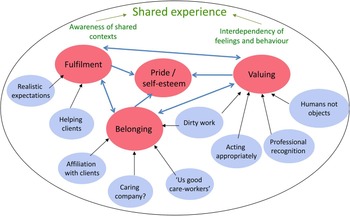
Three core themes were identified as reflecting what care-workers' find meaningful about their work. These themes of ‘fulfilment’, ‘valuing’ and ‘belonging’ contributed to the fourth theme, of ‘pride’, which was identified as reflecting why care work mattered to them. As Figure 1 illustrates, the overarching theme of ‘shared experience’ was also identified as integral to the way in which interviewees made sense of and understood their work-related behaviour and motivation.
A schematic representation of the key themes identified as contributing to care-workers’ motivation.

A number of themes and sub-themes relating to norms and values were identified as contributing to these core themes, reflecting interviewees' thoughts and feelings about working in adult social care. In an attempt to mirror the bottom-up approach through which we analysed the data, we first report the data as it related to our exploratory questions, in terms of the sub-themes and broader themes, before moving on to discuss the way in which ‘shared experience’ appears to actualise and embed participants' motivations and wellbeing.
Fulfilment: why care? Fulfilment was identified as a key underlying theme that reflected and explained what interviewees sought from their work. This was identified from participants' narratives in the themes and sub-themes outlined below.
Helping clients: All participants talked in some detail about the satisfaction of helping clients. They referred to helping them in a number of ways: by providing physical care, supporting independence, socialising with them, identifying illnesses, ‘being there’ and providing domestic support. In her explanation about why she works in care, a domiciliary care-worker summarises a ‘feel-good factor’ which was evident in many participants' accounts:
I think it's just because the people are so nice, you're just popping in, giving them a chat, and obviously the aspects of the fact that you feel you're doing a worthy thing, you're giving something to somebody and they are appreciative of it. So I think that's the biggest thing with the job, you just feel you're helping people. Whatever small little thing you're doing, you're helping them.
Interviewees also expressed conviction about the work being ‘rewarding’ and ‘worthy’. As a senior domiciliary care-worker put it, ‘I don't know what questions you want to ask me but it's a good job, it's a very, very rewarding job’. Several participants contrasted their positive experience of care work with negative public perceptions: according to one of the younger residential care-workers, ‘people think it's a horrible, horrible job but it's not it's really enjoyable and you really get something rewarding out of doing it’. All of the participants emphasised feeling satisfaction in relation to helping clients live a fulfilling life as possible, whether it be to support their independence at home ‘not to get shipped off as [a domiciliary care-worker's] nan puts it’ or in the words of a senior residential care-worker, making them ‘feel like this is their home’. Notably too there was an association between what care-worker valued about the working conditions, such as expressed by a senior domiciliary care-worker, ‘being your own boss’ and what he felt he was contributing to peoples' lives, ‘keeping them independent’.
The feedback participants received from clients, clients' appreciation, also contributed to whether they had a good or bad day and whether they found their work enjoyable. A senior residential care-worker explained, ‘that's the only thing when you've done your best and they still turn around and say you don't do nothing for us'. Appreciation of their work, or lack of it, was a prevalent issue not only in relation to clients but also in relation to the organisation and the general public. Indeed, this was seen to validate interviewees' sense of the worthiness of a care-worker role and identity.
Realistic expectations: ‘Realistic expectations’ was a factor that was seen to determine whether or not care-worker experienced the work as fulfilling. A domiciliary care-worker observed, ‘I think sometimes people come into this job very blind. And when they do start they're thinking god what have I let myself in for?’ Recruitment strategies that involved ‘rose-tinted advertising’ were one of the explanations given for people having unrealistic expectations. Others were inadequate inductions, as well as the public perception that anyone can care.
Belonging: what is special about us? Another core theme that was identified as representing and explaining why participants were motivated to care was ‘belonging’. This again had several sub-themes.
Affiliation with clients: It was noticeable that all respondents experienced a sense of ‘affiliation with clients’. This relates to an aspect of the way in which care-workers identify with their clients, as a result of empathising with and relating their circumstances to their own contexts and situations. One of the youngest residential care-workers explained, ‘when I work here it's like how would I like to be treated when I am older, I want to be treated with respect and nice and that's what I try and do’. Another senior residential care-worker explained how she felt about the residents, ‘It is, my grandparents … I think of them being in here and what they would need’. This sense of affinity was also referred to by a young domiciliary care-worker as what distinguished care-workers from others who did not value it, ‘you're going to get old someday. You want to make sure someone's out there to help you’. Personal connections with clients also contributed to this sense of affiliation and participants regarded bonding, at least with some clients, as an inevitable part of their work.
‘Family’: Families and family relations were referred to in terms of their influence on care-workers' decision to work in care. As well as being spoken about in terms of their mutual belonging in a group at work, this also involved seeing oneself as being part of a family (in care homes) or being a friend of the family (in domiciliary care). A senior residential care-worker examined her attachment to her work:
I don't know what's keeping me here, ‘cause I felt I am in a family … a family … people say ‘well that's not very professional, you shouldn't think it's a family’, but if you go into a home, a residential home, you have people like families.
‘Us good care-workers’: References to belonging to an occupational group of care-workers or a profession were largely implicit rather than explicit. They were generally apparent in references to what ‘we do’ in contrast to ‘others who don't’. Participants made reference to their in-group of care-workers as ‘those who can’ in contrast to ‘those who can't’. They distinguished between them according to personality traits and attributes as well as values, such as doing it for ‘more than the money’, having ‘a strong head, strong stomach’ and not being ‘a grumpy, a bagpuss’. For example, an experienced domiciliary care-worker contrasted the motivation of good and bad care-workers in these terms as ‘there are some people that just do this job for money but there are other people that do it because they are professional people and they enjoy doing everything correctly’. Notably, participants felt themselves to be part of a group that displayed a unique aptitude for the work, as another domiciliary care-worker put it: ‘And I think if you speak to anybody it's the same with anyone. They either can't’ do it or they love it’.
Participants talked about their colleagues in relation to the support they received from them and expectations surrounding collaborative working, ‘peer support and expectations’.
The different working environments of domiciliary care and residential care were reflected in participants' discussion of their experiences of collaborative working in pairs as double-ups or in teams (shifts). They discussed the support they received from their colleagues and their expectations of support. One of the younger domiciliary care-workers observed that ‘I think you've got to have that communication. There's got to be a lot more respect for each other’.
Caring company: Participants primarily talked about belonging to the organisation in terms of how much it cared about the clients and the staff; that is, was it a ‘caring company’? For example, a supervisor in residential care explained that ‘they [the organisation] are taking more care in the people they pick as carers’. Moreover, there were mixed opinions about whether the organisation cared enough. According to a senior domiciliary care-worker, ‘we are a caring company and as the years go on I suppose … because the company is good … it just needs a few changes to make us a caring company not just a money company’. Overall, participants spoke more inclusively (and often implicitly through references to shared experience), about their relationship with clients. Participants' references to the organisation differed in terms of whether they were seen to be part of an inclusive ‘we’ or more abstract ‘they’ and an authoritative ‘other’. Care-workers' sense of loyalty was also sometimes split between clients and the organisation; a domiciliary care-worker explained:
I work for [name of organisation], so you do what you got to do with them, your loyalties are with them in a certain respect but I suppose your client comes first because you have a bigger bond with them.
Valuing: validation of role and work. Valuing people, be they the clients or the care-workers, valuing living and valuing the provision of quality of care to ensure quality of life was an integral theme in participants' discussions about the importance of their work. The themes and sub-themes which reflected the different aspects of valuing are outlined below.
Humans not robots: Participants spoke about their dissatisfaction at not having enough time to spend with clients and the negative consequences this had on the provision of care and their health. The pressure placed on care-workers' time was frequently referred to by most of the participants, some of the references included, that ‘it can be frustrating [being] pushed pillar to post’, ‘it can feel like you're chasing your tail’. Moreover, participants were critical of the priority being placed on completing the task rather than looking after people. As a senior residential care-worker explained, ‘you can't do it in ten minutes … you can do the washing and the dressing but you can't do the caring’. A range of references were made to clients being treated ‘more like in a factory’, and the ‘domino effects’, caused by visiting slots being too short.
Acting appropriately: Part of the unique set of skills and attributes that care-workers perceived themselves to have were related to the need to ‘act appropriately’ even when this was hard work. This construct could also be understood in terms of the exertion of ‘emotional labour’ (James Reference James1989, Reference James1992). In this regard, there were explicit expectations, such as articulated by a residential care-worker, ‘to put on a face regardless of what you feel’, and to express kindness and warmth ‘because [in the eyes of an older domiciliary care-worker] you have to talk to this person and not treat them like a machine’. As a young residential care-worker made clear, ‘you don't turn around and go “oh my god look at that big toe!” Even if you want to’. Although highlighted by participants, this compassionate behaviour appeared to be a ‘taken-for-granted’ aspect of care. However, acting appropriately received more mixed responses when it came to boundaries between personal and professional spheres, and the extent to which it was inevitable and even desirable. Another domiciliary care-worker explained, ‘I'm not the type of person that can switch off … I'm not that type of person but on the other hand I think that's what makes me good at what I do because I do genuinely care about the people’. Here too, the potential for blurred boundaries to contribute to stress and burnout were acknowledged. In the view of a senior domiciliary care-worker, ‘if you put them [personal and professional lives] together you're in the wrong job because it could get you down, make you feel sick, make you poorly’.
Dirty work: Participants' narratives about their work were framed by social and cultural attitudes towards care work and the recognition and values attached to it. In particular, they were conscious of how their work was perceived to be ‘dirty’, and viewed as undesirable work because of its taintedness. A young care-worker explained, ‘I mean I've had friends I've explained the job to and it's like “no way I couldn't do that. I couldn't wipe somebody's bum”’. Social stigma surrounding care was evident in several participants' accounts of care-workers just doing domestic work as ‘dog's bodies’, taboos associated with working with those who ‘are waiting to die’, and the physical intimacy required to ‘wash them and whatever’. However, the very aspects of work that were seen to be stigmatising were also the aspects of work to which care-workers referred positively, and which were seen to capture their unique capabilities. A male domiciliary described one of the aspects of the work he particularly valued: ‘the one thing I would say is the most rewarding gift is the last rites’.
Professional recognition, or lack of it: This was a theme that reflected the way in which participants perceived how their work was valued. ‘Recognition or lack of it’ was evident not only in terms of pay and status but also in what the work entailed and the knowledge and skills required to do the job well. In the view of a senior domiciliary care-worker, ‘It's no longer “you're just a home help”. Now it's a career, because everybody's realising that it isn't just an easy job to do. It's not a cop out from school, just go into care or whatever’. A young residential care-worker acknowledged the professional nature of the job: ‘I do think it's seen as a profession’. Nevertheless, at the same time that respondents indicated that they liked being defined as professionals, they also downplayed their work. One of the experienced domiciliary care-workers explained:
When people say oh god you've got to be so great to do a job like that. But well it's nothing really, because you're just helping … and getting paid for it … not a great deal. But it's good to be on that professional scale, you know, to have a nice title instead of just carer.
Participants spoke enthusiastically about working practices they perceived to enable them to provide a good quality of care. In particular, they emphasised the importance of continuity of care and key worker roles to provide, in the words of one of the domiciliary care-workers ‘something constant for the elderly … so they don't get confused’. Participants also referred to the comfort and security it gave their clients and the knowledge they gained about their clients. Furthermore, numerous examples were given of the way in which physical intimacy with clients provided respondents with in-depth knowledge of those clients and enabled them to provide quality care, although they rarely acknowledged it as learned knowledge. Such an example was outlined by one of the middle-aged residential care-workers:
You know, they might not have been feeling well last night but they didn't want to bother you. But while you're doing them they might turn round and say to you, ‘I felt a bit funny last night, what do you think?’, but if you're in and out like a conveyor belt system they might be seriously ill and you haven't been able to pick it up.
Pride
Pride was identified as a central theme; both as a motivator of participants' work and as a factor that makes care work matter. It related not only to ‘helping clients’ but also to being prepared to undertake ‘dirty work’ and belonging to a ‘unique’ group of people who are able to enjoy such work. It related to all three overarching themes: first, to participants' sense of fulfilment, as a male supervisor in domiciliary care explained, ‘if it wasn't for people like ourselves and that, then these people wouldn't be staying in their own homes, wouldn't have their own independence’; second, to participants' sense of belonging to a unique group of people; and third, to the pride respondents associated with (the neglected) valuing of care work, as evidenced by a senior residential care-worker's observation that ‘I do think they work very hard and the wages are very low and I think you have to be a special person to do this job, you do honestly’.
Pride was also evident in participants' suggestions that care-workers' motivations were driven by ‘love before money’. All of the participants either explicitly stated or implied that ‘the money is rubbish’, and did not truly reflect the value of the work undertaken, as explained by a residential care-worker, ‘why should somebody want to come and do care, when you can sit at a computer for double the money?’ Yet, much of the talk about money was juxtaposed to caring. In the view of an experienced domiciliary care-worker, ‘you've got to be compassionate I think, and passionate as well about care, because you certainly don't do it for the money. That's for sure’.
Shared experience
Participants' articulation of the core themes that motivated them at work also went some way to explaining why that work mattered to them (i.e. a sense of fulfilment, belonging, validation and pride), and this was actualised through the shared experience of the role and work. This shared experience of caring was primarily spoken about as taking place with clients, but participants' narratives also reflected the shared norms and values of a strong occupational group. The importance of shared experience for participants' narratives about their motivation was evident throughout the data in three distinct ways. The first of these was interdependency of feelings between care-workers and clients, and between care-workers and care-workers, as a young senior care-worker explained, ‘it was just I feel that the clients didn't get the satisfaction, so I didn't get the satisfaction at the end of the day’. This was also evident in respondents' sense of being a care-worker and being a member of the organisation: a senior residential care-worker felt that working for this organisation married her professional self and her organisational self: ‘I'm a professional. And that's why I've come here and I haven't looked anywhere else’. The second element was awareness of shared contexts especially between an in-group of care-worker and client versus an out-group of other care-workers or the organisation. As one of the younger domiciliary care-workers observed, ‘but when you're going in … it can be very daunting to be with a stranger [another care-worker]. And I do find as well I think it's quite daunting for the client’. This awareness of shared context was also evident when participants spoke of the risk that care-workers as well as clients could be dehumanised by change that prioritised the task before the person. According to an older senior domiciliary care-worker, ‘because that's what it used to be, we were numbers as a carer and as a client … everyone felt we were just numbers and now we're not’. The third element was interdependency of behaviour between care-worker and clients; in the view of a supervisor in domiciliary care, ‘they have got to have confidence in you before you can get confidence with them and you have got to have confidence in yourself so it's got to work both ways so to speak’. These examples can also be seen to highlight the ways in which care-workers integrated the social context (their shared experience) into their self-concept at both a relational and collective level.
Social identity analysis
The foregoing analysis sought to provide in-depth insights into the motivations of care-workers by examining narratives about work experience and looking at the motives, norms and values that were attributed to working in care as aspects of people's identities as employees in this sector. It did this by conducting a thematic analysis of interviews with care-workers with a view to identifying the core themes that captured (a) what it is about care work that motivates people and (b) why this work matters to them. This analysis showed that care-workers' motivation was related to their need for fulfilment, belonging and validation, which contributed to their strong sense of pride, and was shaped by their shared experience of the social context in which they operate.
Subsequent analysis of these findings through a social identity perspective speaks further to the way in which these core themes capture the essence of care-worker motivation. As indicated in Figure 1, and reflected in the discussion below, these core themes were inter-related and together contribute to care-workers' self-esteem and work identification.
Fulfilment of collective self-esteem
Participants' sense of fulfilment appeared to be primarily related to helping clients and the feelings that this generates. In this the ‘individual is striving to systematically promote the perception that they are worthwhile persons' (Swann Reference Swann, R.M. and E.T.1990: 410). Feeling needed by, and indispensable to, others not only meets one of the more basic human needs, for love and belonging (Maslow Reference Maslow1943), but also fulfils higher-order needs for enhancement of self-esteem (Ellemers, de Gilder and Haslam Reference Ellemers, De Gilder and Haslam2004). It is evident in the foregoing analysis that self-esteem enhancement is achieved through feelings of worthiness that were associated with a need for belonging. This collective self-esteem was derived from (a) care-workers' relational identity with their clients and (b) their collective identity, as a member of a care team, an occupation or an organisation which cares about the needs of the client. In a similar vein, the strong feelings of pride expressed by participants, that are interpreted as an outcome of fulfilment, belonging and valuing, were both related to the ‘helping’ nature of the work (invoked in the relational identity), and to a sense of belonging to the group which provides the help (i.e. a sense of collective identity; Stürmer and Snyder Reference Stürmer, Snyder, Stürmer and Snyder2010; see also Baumeister and Leary Reference Baumeister and Leary1995).
In spite of it being acknowledged as essential, care work is not held in high regard, as it is socially and culturally perceived as tainted work, both physically (intimate, personal care) and socially (supporting those who are less able and close to death; Douglas Reference Douglas1966), and this is reflected in the low wages and low status of care-workers (Himmelweit Reference Himmelweit2007). It might therefore be expected that occupational esteem in this group would be low, and that individual care-workers would not derive much ‘pride’ from their social identification with it (Dukerich, Golden and Shortell Reference Dukerich, Golden and Shortell2002; Tyler Reference Tyler1999). However, it is apparent from this study and from other research, that this expectation is incorrect as care-workers derive high levels of pride from their work (Lucas, Atkinson and Godden 2008, 2009; Skills for Care 2007). Indeed, this is consistent with Ashforth and Kreiner's (Reference Ashforth and Kreiner1999: 413) observation that ‘the stigma of “dirty work” fosters development of a strong occupational or workgroup culture’. This is seen to occur in part through a process of redefining ‘dirty work’ as something that is positive, and which requires special sorts of people to do it. Accordingly, a strong occupational culture can be seen in participants’ accounts of their work through (a) the pride they express towards the unique attributes and work of fellow care-workers; (b) the recognition of an in-group of care-workers, ‘those who can’, contrasted to an out-group of ‘those who cannot’; and (c) strong group norms about what it means to be a care-worker. This strong occupational identity helps explain how, in spite of being publicly perceived as a low-status group which receives low remuneration, care-workers have a strong sense of pride in themselves as care-workers.
Yet, in addition to the positive consequences of strong identification at work (such as high satisfaction, wellbeing, pride and commitment; Ellemers and Haslam Reference Ellemers, De Gilder and Haslam2004; Van Knippenberg Reference Van Knippenberg2000), there was also evidence that this has negative consequences (such as an increased likelihood of exhaustion and burnout; Haslam Reference Haslam2004).. This was particularly evident in participants' accounts of the emotional labour they perform (Hochschild Reference Hochschild1983), specifically in their dedication to clients, and in their normative references that ‘taking it home with you’ is ‘appropriate behaviour’ and an inevitable and even desirable feature of the job.
Valuation of the caring role
Participants' motivation at work also appeared to be shaped by the values they attributed to their caring role and their experience of valuing and being valued. This was particularly evident in their dislike of regulations and organisational activities that were perceived to restrict helping clients and dehumanise care. Along the lines of findings from research with nurses (Nelson Reference Nelson2000), participants did not overtly valorise the knowledge, skills and attributes entailed in their work. Indeed, they were sometimes dismissive of their own effort and skills. Nevertheless, although there was little use of a professionalised or technical language to describe their work, an implicit awareness of the knowledge and attributes required to be a care-worker was evident in narratives about the value attached to aspects of care work, and preferences for certain care practices (e.g. continuity of care). In addition, their descriptions of the knowledge they acquired and utilised through working closely with clients is characteristic of forms of ‘body-knowledge’ (Adams and Nelson Reference Adams and Nelson2009).
Yet probably the most notable norm that was inherent in narratives about valuing care work was the assertion that the lack of material recognition was compensated by the rewarding and virtuous nature of the work (Folbre and Nelson 2000). Beyond acknowledging pay as a necessary requirement of working, in the main participants were scornful and dismissive of money. This norm reflects the powerful dichotomy of material versus moral reward that permeates socio-cultural discourse surrounding care work. This is a norm which is recognised as embedded in care-workers' discourse and which, care scholars argue, explains their ambiguity about seeking better pay and working conditions (Folbre Reference Folbre2012; Himmelweit Reference Himmelweit2007; Lepore Reference Lepore2008; Palmer and Eveline Reference Palmer and Eveline2012). Tellingly too, it is also a norm that has been invoked by care organisations to keep wages low (Palmer and Eveline Reference Palmer and Eveline2012).
Discussion
Overall, the above findings illustrate how care-workers' work experience and motivation, the degree to which their work provides a sense of fulfilment, belonging, validity and pride, contributes to and is shaped by their identification as care-workers. In this regard care-workers' work-related identities appear to be primarily defined in terms of their identification with their clients. More specifically, participants' multiple references of ‘shared experiences’ with clients, their evidently strong ‘affiliation to clients’ and the value they attached to ‘helping’ them, conveyed a strong impression of attachment to clients and of belonging with them. In line with the bottom-up perspective on identity formation (e.g. Baumeister and Newman Reference Baumeister and Newman1994; Ibarra and Barbulescu Reference Ibarra and Barbulescu2010; Postmes, Haslam and Swaab Reference Postmes, Haslam and Swaab2005; Scott, Corman and Cheney Reference Scott, Corman and Cheney1998), it thus appears that much of the way in which care-workers make sense of their work-based identity is at a relational level through identification with clients. This deep-rooted identification is reflective of the way in which ‘individuals often identify by following their hearts – by seeking to experience a sense of pride, warmth or affirmation and that these thoughts and emotions can drive behaviour’ (Harquail Reference Harquail, Whetten and Godfrey1998: 11). The intimate nature of the personal support care-workers give to clients also means that the enactment of this relational identity is intense and engages care-workers' bodies and emotions, as well as their minds. It follows that as physical and emotional labour is such a core component in care work, embodied cognition not only has an important role in care-workers' knowledge and expertise base but also plays a powerful role in their organisational (and other work-based) identification (Harquail and King Reference Harquail and King2010).
Participants' narratives also illustrate how the relational identity between care-worker and client in turn feeds into and thereby acts as a conduit for all three levels of identification (collective, relational and personal; Ashforth, Harrison and Corley Reference Ashforth, Harrison and Corley2008). The roles of care-worker and client are defined at the collective level by social and work-based (occupational and organisational) expectations and norms. The personal level is implicated in the nature of the individuals who occupy the roles of care-worker and client and this affects the way they enact prototypical role expectations: ‘the relationship level is implicated in the juxtaposition of the two roles as enacted by the two individuals' (Sluss and Ashforth Reference Sluss and Ashforth2008: 810). For example, at the collective level, expectations of appropriate behaviour between care-worker and client are both formalised (e.g. in terms of professional regulations, staff conduct) and implied (e.g. in terms of social norms of being kind and considerate, and occupational norms, ‘to put on a face regardless of how you feel’). Expectations of appropriate behaviour at the personal level are grounded in each individual's attitudes and beliefs and in their previous experiences. In addition, expectations reside and are generated at the relational level in the behaviour and exchange between each individual care-worker and client. As Wilson & Davies, Reference Wilson, Davies and Nolan2009: 1752 found in their study on the contribution staff made to improving the quality of care in residential homes through their approach to the development of relationships during care routines: ‘Staff brought something of themselves to the relationship that enabled them to work more effectively with each other, the resident and the family’.
Our findings indicate that this central caring relationship between care-worker and client is integral to the content of care-workers' identities, and to their accounts of what motivates and matters to them. For instance, participants' identification with the organisation was largely articulated in terms of the extent to which the organisation was perceived to be a caring organisation, both for care-workers as well as clients. Thus care-workers' organisational identification can be viewed as a ‘mutually reinforcing’ conceptual extension of the caring relationship between care-worker and client. This observation aligns with Sluss and colleagues' previous work on the congruence between relational and organisational identification (Sluss and Ashforth Reference Sluss and Ashforth2008; Sluss et al. Reference Sluss, Ployhart, Cobb and Ashforth2012).
Practical implications
Previous findings from social identity research into work behaviour suggest that tapping into and strengthening work-based identities that are meaningful to care-workers will enhance their motivation and improve the quality of their work (e.g. Ellemers, De Gilder and Haslam Reference Ellemers, De Gilder and Haslam2004; Haslam, Postmes and Ellemers Reference Haslam, Postmes and Ellemers2003). On the basis of the patterns we have already discussed, it seems likely that the more a care-worker feels that the organisation they work for values their identification and affiliation with the client (i.e. by facilitating continuity of care, increasing the amount of time available to spend with each client), the more the care-worker is likely to identify with the organisation and exhibit positive behaviours and outcomes associated with high organisational identification (i.e. greater motivation, commitment, wellbeing). Along these lines, care-workers' motivation to provide compassionate care is likely to be enhanced to the extent they perceive the organisation to reflect compassionate ethos and value (Adamson et al. Reference Adamson, Dewar, Donaldson, Gentleman, Gray, Horsburgh, King, Kalorkoti, Maclean, McCrossan, McIntash, Ross, Pullin, Sloan, Smith, Smith, Toucher and Waugh2012). An additional benefit of supporting care-workers' identification with clients is that in line with social identity research on helping behaviour, it appears that the more the care-worker identifies with the client the more likely she or he is to provide high-quality empathy-based compassionate care which ‘values the other's welfare as an end in its own right’ (Stürmer and Snyder Reference Stürmer, Snyder, Stürmer and Snyder2010: 44). It follows too, that in order to maximise this ‘identity capital’ (Akerlof and Kranton 2011: 1), organisations need to ensure that care-workers' identification with clients and the organisation are aligned and congruent, by tapping into and instilling shared values and norms. It follows too that where identification with clients (or, for that matter, supervisors, co-workers or teams) conflicts with, or is misaligned with, organisational identification, it is likely to be detrimental to care-workers' wellbeing and work motivation, as well as to the quality of care they deliver.
Limitations and directions for future research
The limitations of this study are primarily related to its qualitative nature – in particular, the fact that the size and profile of the sample might affect the extent to which the findings can be generalised to the wider aged-care workforce (Crouch and McKenzie Reference Crouch and McKenzie2006). Nevertheless, the sample size was within the lower end of acceptable numbers for a qualitative study (Mason Reference Mason2010), and the decision not to add more participants to this sample was made once there was clear saturation in the responses that interviews elicited (Mason Reference Mason2010). Although the same overarching care body employed the participants, there was nevertheless considerable diversity in age, job title, nationality, gender and geographical location. It should also be noted that the care group had recently been formed by an amalgamation of four different care organisations and a training organisation, and so incorporated a variety of working cultures (albeit all not-for-profit). Moreover, many of our core observations accord with those of other research undertaken with care-workers (in particular, Lepore Reference Lepore2008; Lucas Atkinson & Godden, 2009; Skills for Care 2007) and in this respect there are no grounds for thinking that our findings are peculiar to the particular sample we studied.
This qualitative analysis also provides a rich evidence base which can be used to inform further research into the dynamics of care-workers' motivation (Bjerregaard Reference Bjerregaard2015; Bjerregaard, Haslam, Morton & Ryan, in press). Indeed, research that builds upon the present analysis consolidates and builds upon the above findings by quantifying patterns of care-workers' identification and motivation, and assessing how they influence one another. In particular, it does this (a) by examining differences in patterns of client and organisational identification between domiciliary and residential care-workers and showing how these feed into distinct patterns of work motivation and (b) by showing how professionalisation impacts on work motivation through its impact on different forms of identification (Bjerregaard Reference Bjerregaard2015; Bjerregaard et al., in press).
Conclusion
It is not original to suggest that care-workers are primarily motivated by the desire to care (for their clients) and be cared for (by the organisation and society at large). Yet the present findings demonstrate not only that ‘caring’ is a central component of care-workers' motivation, but also that this manifests itself in the content and dynamics of their work-related identities – identities that inform all aspects of the work they perform. In this it can be seen that the social identity perspective offers a theoretically coherent psychological account of the importance and influence of a relationship-centred approach to the motivation and wellbeing of care-workers. This in turn leads us to suggest that it is by recognising and supporting this ‘caring’ identity that organisations and policy makers will develop, strengthen and maintain a compassionate caring workforce.
Acknowledgements
We thank the care staff who contributed to this work. We also thank Blake Ashforth for his comments on early draft of this article. The first author received a PhD CASE scholarship funded by the European Social Research Council and the industry partner, Somerset Care Ltd. Ethical approval for this research was granted by the University of Exeter, and data collection followed the University's guidelines for collecting data, this included asking permission from participants and informing them of the right to withdrawal from the research at any given time. All of the authors named made a significant contribution to this article. The authors declare no potential conflicts of interest with respect to the research, authorship and/or publication of this article.