





1. Introduction
Stalagmites are among the most widely used continental palaeoclimate archives: their internal lamination and geochemical composition record variations in drip hydrology, cave microclimate and soil processes over time scales from seasons to glacial cycles (Genty & Quinif Reference Genty and Quinif1996; Tan et al. Reference Tan, Baker, Genty, Smith, Esper and Cai2006; Baker et al. Reference Baker, Smith, Jex, Fairchild, Genty and Fuller2008; Labuhn et al. Reference Labuhn2015). Interpreting these records requires a quantitative understanding of stalagmite growth, including how calcium carbonate is transported by thin water films and incorporated into the solid. To date, most theoretical work has focused on vertical growth rates and on the large-scale shape of mature stalagmites (Romanov et al. Reference Romanov, Kaufmann and Dreybrodt2008), while the existence of a minimal stalagmite radius has received comparatively little attention.
Early attempts to describe stalagmite morphology date back to Allison (Reference Allison1923), but the first quantitative theory was established by Franke (Reference Franke1965). A key conceptual ingredient introduced there is the idea of invariant (translating) growth: for fixed external conditions the stalagmite profile approaches a time-independent shape in a co-moving frame and subsequently advances upward without changing form. Franke derived a steady-state model for growth under a continuous water flux, predicting an equilibrium stalagmite radius set by the drip rate and chemical kinetics. In the limit of vanishing flux, however, the continuum description implies that the radius tends to zero. Yet field observations indicate that stalagmites are at least centimetre-scale structures; examples of such slender forms are shown in figure 1.
Examples of stalagmites with basal diameters of a few centimetres. (a) Teufelshöhle (Devil’s Cave), Germany. (b) Grotte de Dargilan, France. (c) Grotte du Père Noël (Santa Claus Cave), Belgium. (d) Ana Mou’o Cave, Rurutu, French Polynesia. (e) Vairoa Cave, Makatea, French Polynesia. Photo credits: (a) Magnus Gertkemper (CC BY-SA 2.0 DE); (b,c) Philippe Crochet (reproduced with permission); (d,e) Piotr Szymczak.

Recognising that real stalagmites are fed by discrete drops, Curl (Reference Curl1973) postulated a finite minimum radius
 $R_{\textit{min}}$
in the low-flow limit, where impacts are sufficiently rare for each drop to relax to equilibrium and precipitate essentially all of its excess
 $\textrm {CaCO}_3$
. In Curl’s treatment, however, the post-impact water layer is modelled as a static ‘pancake’ of constant thickness and uniform supersaturation. This approximation neglects two essential couplings: gravitational spreading, which thins the film in time, and precipitation-driven solute depletion, which is inherently spatially non-uniform. As a result, while Curl identified the droplet volume as the relevant control parameter, his model cannot provide a predictive theory for
 $R_{\textit{min}}$
and yields a scaling inconsistent with the coupled dynamics.
A more systematic description of stalagmite growth was developed by Dreybrodt and co-workers, who coupled calcite precipitation kinetics to thin-film transport models under a continuous supply of dripwater (Dreybrodt Reference Dreybrodt1988; Romanov et al. Reference Romanov, Kaufmann and Dreybrodt2008). In most implementations the film thickness and flow are treated in a quasi-steady manner or via steady-flux closures, rather than by explicitly resolving the transient post-impact drainage of an individual finite-volume drop. Numerical implementations of this framework have been used to model time-averaged stalagmite growth and to interpret palaeoclimate signals in terms of external forcing (Kaufmann Reference Kaufmann2003; Romanov et al. Reference Romanov, Kaufmann and Dreybrodt2008; Baker et al. Reference Baker, Mattey and Baldini2014).
Building on the same framework, Szymczak et al. (Reference Szymczak, Ladd, Lipar and Pekarovič2025) developed an analytic theory of ‘ideal’ stalagmites. In that work, the lubrication dynamics coupled to linear precipitation kinetics was shown to admit closed-form similarity solutions for steadily growing stalagmites. The theory predicts three families of ideal shapes (flat-top, columnar and conical), organised by a single dimensionless control parameter involving the drip flux and reaction kinetics. Together with earlier numerical studies (Kaufmann Reference Kaufmann2003; Romanov et al. Reference Romanov, Kaufmann and Dreybrodt2008), this provides a consistent continuum picture of stalagmite morphodynamics under a continuous supply of supersaturated water.
However, a common feature of these continuous theories is that they contain no intrinsic lateral length scale. Choosing the apex as the vertical origin, if
 $z(r)$
is a solution for flux
 $Q$
, then
 $\lambda ^{-1}z(\lambda r)$
is a geometrically similar solution for flux
 $Q/\lambda ^2$
. Consequently, as the imposed flux tends to zero, the predicted width can shrink without bound, and the theory cannot by itself select a non-zero minimal radius. What is missing in this description is the intrinsically discrete nature of stalagmite feeding by individual drops.
A complementary approach to stalagmite width selection considers the discrete nature of drop impacts and the resulting transient dynamics. Mühlinghaus et al. (Reference Mühlinghaus, Scholz and Mangini2007) pioneered the modelling of stalagmite growth as a function of drip interval, highlighting how the residence time of individual drops affects geochemical signals. More recently, Parmentier et al. (Reference Parmentier, Lejeune, Maréchal, Bourges, Genty, Terrapon, Maréchal and Gilet2019, Reference Parmentier, Terrapon and Gilet2023) have addressed the transient coupling between discrete drop inflow, impact-induced mixing and redistribution of the post-impact film. These studies demonstrate that stalagmite width is strongly influenced by the statistics of drop trajectories and the maximum spreading radius of the impact-generated lamella. In the limit of negligible dispersal this mechanism reduces to a footprint scale set by the lamella radius, but it does not address how much
 $\textrm {CaCO}_3$
is deposited during the subsequent drainage and reaction of the thin film.
Taken together, existing approaches range from steady-supply thin-film growth models that emphasise reactive transport and geochemical controls, to drop-based descriptions that constrain the wetted footprint and the post-impact film state through renewal, mixing, redistribution and drainage on curved tips. A missing ingredient for minimal-radius selection is an explicit treatment of precipitation kinetics coupled to the transient thinning of a finite-volume post-impact film, so that the deposition produced by one drainage event can be computed from first principles.
Drop impacts can generate a range of initial wetted footprints and film profiles. Here, we do not attempt to resolve the initial inertial impact stage. Instead, we isolate the low-flow limit most relevant to the minimal radius: a single supersaturated drop deposited on a locally flat stalagmite tip and spreading as a thin viscous gravity current. This corresponds to the entire drop being initially concentrated at the apex – the most compact possible release for a given volume – and thus provides a lower bound on the stalagmite radius.
In this limit the spreading film thins algebraically in time, while its supersaturation decays due to precipitation. By calculating the total amount of calcite deposited during this transient spreading event, and requiring that this deposition be sufficient to sustain the vertical growth of a stalagmite of radius
 $R$
, we derive a lower bound,
 $R_{\textit{min}}$
. This scale emerges from the competition between viscous thinning and reaction-driven solute depletion, and provides the compact-footprint baseline against which broader wetting or chemical disequilibrium mechanisms can be compared.
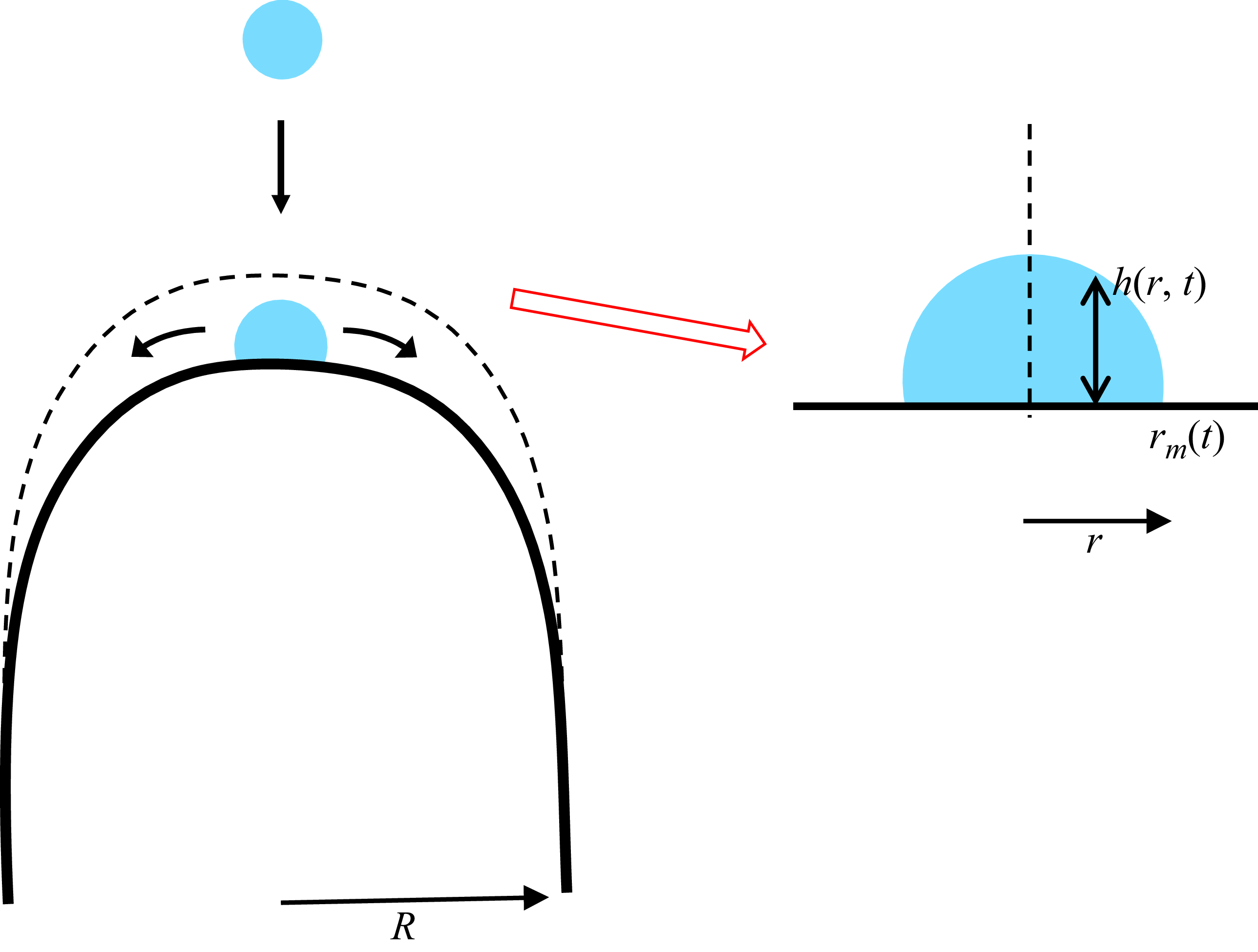
Schematic of a drop spreading on a stalagmite tip. After impact, a drop of volume
 $V$
spreads into an axisymmetric thin film; the film thickness is
 $h(r,t)$
and the instantaneous wetted radius is
 $r_m(t)$
(contact line). The radial coordinate
 $r$
is measured from the apex. The draining film leaves behind a thin layer of precipitated material; in the long-time invariant-growth regime the stalagmite profile (solid) translates upward while maintaining its shape (dashed outline).

2. Single-drop dynamics and scale selection
We focus on stalagmites fed by a single drip point, so that successive drops strike close to the same location on the tip. We assume that the interval between drops is long compared with the characteristic time of drainage and precipitation, so that the film generated by one impact largely drains and reaches near-equilibrium before the next drop arrives (Curl Reference Curl1973). Under these conditions each impact can be treated as an independent event; we analyse one representative drop and later relate the resulting per-drop deposition to the invariant-growth regime of a stalagmite of radius
 $R$
.
2.1. Hydrodynamics of a spreading drop
We consider a single water drop of volume
 $V$
deposited at the stalagmite tip and spreading over a nearly horizontal surface as a thin viscous film (figure 2). The drop is assumed to be axisymmetric and sufficiently thin that lubrication theory applies, i.e.
 $h \ll R$
and slopes
 $\partial h/\partial r \ll 1$
, where
 $h(r,t)$
is the local film thickness and
 $r$
the radial coordinate measured from the impact point. We furthermore assume that inertia is negligible compared with viscous stresses, which is appropriate for the low Reynolds numbers characteristic of the post-impact thin-film drainage flow considered here.
Our strategy is to relate the microscopic deposition of a single drop to the macroscopic geometry of the stalagmite. We assume the system is in the long-time invariant-growth regime, in which the stalagmite profile translates upward at a constant mean rate while the body radius remains approximately constant at
 $R$
(Franke Reference Franke1965; Dreybrodt Reference Dreybrodt1988; Szymczak et al. Reference Szymczak, Ladd, Lipar and Pekarovič2025). Each drop of volume
 $V$
arrives with a calcium concentration above saturation by an amount
 $c_0$
. We assume that, in the isolated-drop limit considered here, the entire excess carried by the drop is ultimately precipitated and incorporated into the stalagmite. The total volume of calcite available to precipitate from this drop is therefore
 $\varOmega c_0 V$
, where
 $\varOmega$
is the molar volume of calcite. Because the shape is invariant, deposition from one drop translates the stalagmite profile upward by a fixed vertical increment
 $w_0$
, corresponding to a precipitated volume per drop
 $\pi R^2 w_0$
. Equating these volumes gives
 \begin{equation} \pi R^2 w_0 = \varOmega c_0 V. \end{equation}
Thus, determining the stalagmite radius
 $R$
reduces to calculating the deposition increment per drop,
 $w_0$
. It is easiest to evaluate it at the apex (
 $r=0$
), where the symmetry simplifies the dynamics.
However, the calculation of
 $w_0$
at
 $r=0$
is not a fully local problem: the rate at which fluid drains away from the apex depends on the global flow profile down the sides of the stalagmite. To render the problem tractable while ensuring a robust bound, we approximate the substrate by the tangent plane at the apex and use the similarity solution for a gravity current on a flat plate. This approximation is exact to leading order at
 $r=0$
, but neglects the substrate slope which grows with distance from the axis. On a curved tip, the substrate slope
 $\partial z / \partial r$
introduces a tangential gravity component that enhances drainage. This effect becomes significant when the substrate slope becomes comparable to the film thickness gradient,
 $\partial z / \partial r \sim \partial h / \partial r$
. By neglecting this curvature-induced drainage, we minimise the thinning rate and maximise the deposition
 $w_0$
; consequently, the radius
 $R$
obtained via (2.1) represents a lower-bound estimate of the stalagmite radius (see § 3).
In the lubrication approximation the depth-integrated radial flux
 $q(r,t)$
driven by the hydrostatic pressure gradient is
 \begin{equation} q(r,t) \;=\; -\,\frac {g}{3\nu }\,h^3(r,t)\,\frac {\partial h}{\partial r}, \end{equation}
where
 $g$
is the gravitational acceleration and
 $\nu$
the kinematic viscosity of water. Mass conservation of the incompressible liquid film gives
 \begin{equation} \frac {\partial h}{\partial t} + \frac {1}{r}\,\frac {\partial }{\partial r}\!\left ( r q \right ) = 0, \end{equation}
together with the volume constraint
 \begin{equation} 2\pi \int _0^{r_m(t)} r\,h(r,t)\,{\rm d}r = V, \end{equation}
where
 $r_m(t)$
is the position of the contact line (the edge of the spreading drop). Equations (2.2)–(2.4) constitute the classical problem of a fixed-volume axisymmetric viscous gravity current spreading over a horizontal surface, whose similarity solution was obtained by Huppert (Reference Huppert1982).
Following Huppert, we seek a self-similar solution in which the drop radius and thickness evolve as power laws in time. Introducing the similarity variable
 \begin{equation} \xi = \left (\frac {g V^3}{3\nu }\right )^{-1/8} r\,t^{-1/8}, \end{equation}
and writing the film thickness in the form
 \begin{equation} h(r,t) = \left (\frac {3\nu V}{g}\right )^{1/4} t^{-1/4}\,\varPsi (\xi ), \end{equation}
reduces (2.2)–(2.3) to an ordinary differential equation for the dimensionless profile
 $\varPsi (\xi )$
. Axisymmetry implies
 $\varPsi '(0)=0$
, while the contact line is located at a finite similarity coordinate
 $\xi =\xi _m$
where the film thickness vanishes,
 $\varPsi (\xi _m)=0$
. The similarity profile then satisfies
 \begin{equation} \big ( \xi \,\varPsi ^3 \varPsi ' \big )' + \frac {1}{8} \xi ^2 \varPsi ' + \frac {1}{4} \xi \varPsi = 0, \quad 0\lt \xi \lt \xi _m, \end{equation}
with boundary conditions
 \begin{equation} \varPsi '(0)=0, \quad \varPsi (\xi _m)=0, \end{equation}
the solution of which is simply
 \begin{equation} \varPsi (\xi ) = \left (\frac {3}{16}\right )^{1/3} \big ( \xi _m^2 - \xi ^2 \big )^{1/3}. \end{equation}
This satisfies (2.7)–(2.8) for any value of
 $\xi _m$
, reflecting the scaling symmetry
 $\xi \to \mu \xi$
,
 $\varPsi \to \mu ^{2/3}\varPsi$
of the governing equation;
 $\xi _m$
itself is fixed only once the volume constraint (2.4) is imposed. In similarity variables, (2.4) reads
 $2\pi \int _0^{\xi _m}\xi \,\varPsi (\xi )\,\mathrm{d}\xi =1$
, which gives
 \begin{equation} \xi _m = \left (\frac {2^{10}}{3^4\pi ^3}\right )^{1/8} \simeq 0.894. \end{equation}
The apex value of the profile entering § 2.2 is therefore
 \begin{equation} \varPsi (0) = \left (\frac {3}{16}\right )^{1/3}\xi _m^{2/3} = (4\pi )^{-1/4} \simeq 0.531. \end{equation}
2.2. Reactive depletion and precipitation
Having established the time-dependent film thickness
 $h(r,t)$
for a spreading drop, we now couple this hydrodynamic thinning to precipitation-driven depletion of supersaturation and compute the net calcite deposited during a single impact event.
We denote by
 $c(r,t)$
the excess concentration of calcium ions in the film, i.e. the difference between the actual concentration and its saturation value with respect to calcite. Throughout we take the saturation concentration to be effectively constant during one spreading event, i.e. the drop is assumed to be already equilibrated with cave
 $\textrm {CO}_2$
; ongoing degassing would make the saturation level time-dependent (Dreybrodt et al. Reference Dreybrodt, Buhmann, Michaelis and Usdowski1992).
We assume that the film is vertically well mixed, so that
 $c$
is uniform across the thickness
 $h$
, and that along-film diffusion is negligible compared with advection and reaction over the time scales of interest.
At the solid surface the concentration decays because of precipitation. For a stalagmite formation, a good model of this process is first-order reaction (Buhmann & Dreybrodt Reference Buhmann and Dreybrodt1985)
 \begin{equation} J = k c, \end{equation}
where
 $J$
is the molar precipitation flux per unit area and
 $k$
is the reaction rate constant. At the centre of the stalagmite, where advection vanishes by symmetry, the concentration dynamics is then governed by a local balance between storage and reaction:
 \begin{equation} h(0,t)\,\frac {\partial c(0,t)}{\partial t} = - k\,c(0,t). \end{equation}
 \begin{equation} \frac {\partial c(0,t)}{\partial t} = - A\,t^{1/4}\,c(0,t), \quad A = \frac {k}{\varPsi (0)}\left (\frac {g}{3\nu V}\right )^{1/4}. \end{equation}
Solving (2.14) with the initial condition
 $c(0,0)=c_0$
gives
 \begin{equation} c(0,t) = c_0 \exp \big [-\alpha t^{5/4}\big ], \quad \alpha = \frac {4}{5}A = \frac {4k}{5\varPsi (0)} \left (\frac {g}{3\nu V}\right )^{1/4}. \end{equation}
Thus the concentration at the stalagmite axis decays faster than exponentially in time because the film at the origin thins as it drains away under gravity. The total deposition at the origin induced by one drop is proportional to the time integral of
 $c(0,t)$
:
 \begin{equation} w_0 = \varOmega k \int _0^\infty c(0,t)\,\mathrm{d}t = \frac {4}{5} \varOmega k \, c_0 \, \alpha ^{-4/5}\,\varGamma \!\left (\frac {4}{5}\right )\!, \end{equation}
where
 $\varGamma (\boldsymbol{\cdot })$
denotes Euler’s Gamma function.
We now relate the deposition generated by one impact to the macroscopic stalagmite radius. Substituting the expression for
 $w_0$
into the mass balance equation (2.1) yields
 \begin{equation} R^2 = \frac {V}{\frac {4}{5} k\, \pi \alpha ^{-4/5}\,\varGamma \!\left (\frac {4}{5}\right )}. \end{equation}
Substituting
 $\alpha$
from (2.15), we obtain the final scaling:
 \begin{equation} R_{\textit{min}} = C_{\textit{min}}\, V^{2/5}\left (\frac {g}{\nu k}\right )^{1/10}, \end{equation}
with the dimensionless prefactor
 \begin{equation} C_{\textit{min}} = \frac {1}{\sqrt {\pi \,\varGamma (4/5)}} \left ( \frac {5}{12} \right )^{1/10} \varPsi (0)^{-2/5}. \end{equation}
Following Curl (Reference Curl1973), we take the characteristic drop volume relevant to the smallest stalagmites to be that produced by the smallest feeder stalactites. To estimate the characteristic drop volume
 $V$
, we consider the physics of drop detachment. The volume of a drop falling from a stalactite is primarily determined by the radius of the feeder tip, with a weaker dependence on drip rate. The smallest feeder stalactites are soda straws, whose diameter is constrained by the meniscus curvature of the calcite-saturated solution. Curl (Reference Curl1972) estimated the minimum diameter of a soda straw to be
 $d_s \approx 0.51\,\mathrm{cm}$
. Using the correlation between tip radius and drop volume for tubular stalactites, this minimum diameter corresponds to a drop volume of approximately
 $V \approx 0.07\,\mathrm{ml}$
(Curl Reference Curl1972). We adopt this value as the characteristic volume for the smallest possible drops.
We now evaluate (2.18) for representative cave conditions. We take the temperature
 $T\simeq 10\,^\circ \mathrm{C}$
, so that the kinematic viscosity of water is
 $\nu \simeq 1.3\times 10^{-6}\,\mathrm{m}^2\mathrm{\,s}^{-1}$
. The precipitation rate constant is taken as
 $k=1.3\times 10^{-7}\,\mathrm{m\,s^{-1}}$
(Romanov et al. Reference Romanov, Kaufmann and Dreybrodt2008). Using
 $\varPsi (0) = (4\pi )^{-1/4} \simeq 0.531$
from (2.11), we find
 $C_{\textit{min}} \simeq 0.617$
from (2.19). Inserting these numbers into (2.18) yields
 $R_{\textit{min}} \approx 2.0\,\mathrm{cm}$
.
The drop volume
 $V$
is physically constrained by the balance between gravity and surface tension at the sourcing stalactite tip (Tate Reference Tate1864; Curl Reference Curl1973). Although
 $V$
can exhibit some variability with the tip geometry, its influence on
 $R_{\textit{min}}$
is strongly attenuated by the
 $V^{2/5}$
scaling: a factor-of-two variation in
 $V$
changes the predicted radius by only about
 $30\,\%$
. Environmental factors may likewise lead to variability in the kinetic rate
 $k$
, but the weak dependence
 $R_{\textit{min}}\propto k^{-1/10}$
ensures the robustness of the centimetric scale. For instance, a factor-of-ten variation in the precipitation rate changes the predicted radius by only about
 $20\,\%$
–
 $25\,\%$
, confirming that
 $R_{\textit{min}}$
is a stable, emergent hydrochemical limit rather than an artefact of a specific parameter choice.
Temperature affects both the kinematic viscosity and the precipitation rate. Over the cave-relevant temperature range, the IAPWS viscosity formulation of Huber et al. (Reference Huber, Perkins, Laesecke, Friend, Sengers, Assael, Metaxa, Vogel, Mareš and Miyagawa2009) gives
 $\nu (30\,^\circ \mathrm{C})/\nu (0\,^\circ \mathrm{C})\approx 0.447$
, while the rate law of Romanov et al. (Reference Romanov, Kaufmann and Dreybrodt2008),
 \begin{equation} k(T)= \big (0.52+0.04T+0.004T^2\big ) \times 10^{-5}\,\mathrm{cm\,s^{-1}}, \end{equation}
where
 $T$
is measured in
 $^\circ \mathrm{C}$
, gives
 $k(30\,^\circ \mathrm{C})/k(0\,^\circ \mathrm{C})\approx 10.2$
. The decrease in viscosity and the increase in reaction rate have opposing effects on
 $R_{\textit{min}}$
, but the latter dominates. Since both parameters enter through the combination
 $(\nu k)^{-1/10}$
,
 \begin{equation} \frac {R_{\textit{min}}(30\,^\circ \mathrm{C})} {R_{\textit{min}}(0\,^\circ \mathrm{C})} \approx (0.447\times 10.2)^{-1/10} \approx 0.86. \end{equation}
Thus
 $R_{\textit{min}}$
decreases by approximately
 $14\,\%$
across the full
 $0$
–
 $30\,^\circ \mathrm{C}$
range, further confirming the robustness of the centimetre-scale prediction.
2.3. Validity of the assumptions
The use of a gravity-driven lubrication model is justified by a scaling analysis of the relevant forces and time scales. We first demonstrate that the macroscopic spreading of the drop is governed by gravity and cannot be arrested by surface tension. For a characteristic drop volume
 $V = 0.07\,\mathrm{ml}$
, the equivalent spherical radius is
 $a = (3V/4\pi )^{1/3} \approx 2.6\,\mathrm{mm}$
. Comparing this with the capillary length of water,
 $\ell _c=(\sigma /\rho g)^{1/2}\approx 2.7\,\mathrm{mm}$
, yields an initial drop-scale Bond number,
 ${Bo}_d=(a/\ell _c)^2$
, of order unity. This indicates that the drop is already at the crossover of gravitational dominance. Furthermore, active stalagmites are typically covered by a residual water film, ensuring a complete wetting condition and eliminating contact-line pinning. Consequently, even with negligible impact momentum, the drop spreads under its own weight. As the wetted radius
 $r_m(t)$
increases, the macroscopic Bond number scales as
 $(r_m/\ell _c)^2$
; at the predicted minimal radius
 $R_{\textit{min}} \approx 2.0\,\mathrm{cm}$
,
 ${Bo} \approx 55$
, confirming that the flow is governed by the balance of viscosity and gravity during the bulk of the drainage phase.
We also decouple the inertial dynamics of the initial drop impact from the subsequent long-time drainage and reaction. The reaction–drainage phase is characterised by the time scale
 $\tau _{\textit{react}}=\alpha ^{-4/5}\approx 7.5\,\mathrm{min}$
. The inertial time scale,
 $\tau _{\textit{impact}}\sim d/U\sim 5\times 10^{-3}\,\mathrm{s}$
, with the drop diameter
 $d=2a\approx 5\,\mathrm{mm}$
and
 $U\sim 1\,\mathrm{m\,s^{-1}}$
, is orders of magnitude shorter, so the kinetic energy associated with the high-Weber-number impact phase
 $ (\textit{We}=\rho U^2d/\sigma \gg 1 )$
is dissipated long before significant deposition occurs. In the present model, the detailed post-impact footprint and film profile are not resolved. Instead, the subsequent drainage is represented by the source-type similarity solution, in which the initial condition is retained only through the drop volume. Once this regime is reached, the effect of any inertial pre-spreading is equivalent to starting the drainage calculation at a later stage of the same similarity evolution. The film is therefore thinner throughout the subsequent reaction, deposits less calcite at the apex and yields a larger predicted radius.
Finally, we justify the depth-averaged transport approximation by comparing the vertical diffusion time
 $\tau _{\textit{diff}}=h^2/D$
with the characteristic depletion time
 $\tau _{\textit{react}}$
. Using the similarity solution evaluated at the apex, the film thins as
 $h(0,t)\approx 217\,(t/1\,\mathrm{s})^{-1/4}$
μm, so that
 $\tau _{\textit{diff}}\propto t^{-1/2}$
. For typical parameters (
 $D\approx 10^{-9}\,\mathrm{m^2\,s^{-1}}$
),
 $\tau _{\textit{diff}}$
falls below
 $\tau _{\textit{react}}\approx 7.5\,\mathrm{min}$
after approximately
 $0.011\,\mathrm{s}$
and decreases rapidly thereafter. Thus, except during this very short initial transient, vertical diffusion is much faster than precipitation, justifying the use of a depth-averaged concentration.
3. Discussion
The minimal radius (2.18) arises from an intrinsic coupling between the finite volume of individual drops, viscous gravitational spreading and precipitation kinetics. Unlike continuous-flow models, where the film thickness is set by a prescribed flux, a single spreading drop thins algebraically in time; this accelerates the decay of supersaturation and fixes the deposition efficiency of one impact event. Combining this transient deposition with solute conservation then selects a characteristic cross-sectional area and hence a non-zero minimal radius.
Our result places Curl’s (Reference Curl1973) low-flow postulate on a dynamical footing. Curl correctly identified drop volume as the relevant control parameter, but his static-film ‘pancake’ closure bypasses the coupled thinning–reaction dynamics. In particular, assuming a static film of constant thickness implies a purely geometric scaling
 $R \sim V^{1/2}$
. In contrast, evaluating the dynamic order-of-magnitude balance between the viscous drainage time scale (
 $\tau _{\textit{drain}} \sim \nu R^8 / g V^3$
) and the chemical depletion time scale (
 $\tau _{\textit{react}} \sim V/k R^2$
) recovers our scaling
 $R \propto V^{2/5}$
; the full similarity solution fixes the numerical prefactor.
The model relies on a single-drop approximation: the water film generated by one impact should largely drain and react before the next drop arrives. Since the chemical depletion is characterised by the time scale
 $\tau _{\textit{react}} \approx 7.5\,\mathrm{min}$
, the isolated-drop limit is most appropriate for drip intervals
 $\tau _{\textit{drip}} \gtrsim \tau _{\textit{react}}$
. For substantially shorter intervals, interactions between successive drops are expected to drive a crossover towards the continuous-film regime captured by previous authors (Dreybrodt Reference Dreybrodt1988; Romanov et al. Reference Romanov, Kaufmann and Dreybrodt2008; Szymczak et al. Reference Szymczak, Ladd, Lipar and Pekarovič2025).
It is also important to interpret (2.18) as a lower bound. We assumed a locally flat tip, which minimises gravitational drainage. On a convex surface, the tangential component of gravity enhances outflow, reduces the residence time of supersaturated solution near the stagnation point and therefore decreases the local deposition per drop. For fixed solute supply this requires a larger radius to sustain steady growth, so any curvature shifts the system upward from the bound derived here.
To demonstrate this mathematically, we consider a regime where drainage is dominated solely by the substrate slope on a hemispherical tip of radius
 $R_c$
. In this limit, the film thins more rapidly as
 $h(t) = (3\nu R_c/4gt)^{1/2}$
(Takagi & Huppert Reference Takagi and Huppert2010), leading to a reduced central deposition height
 $w_0 =\varOmega c_0 \varGamma(2/3) (k \nu R_c/2g)^{1/3}$
. Applying the mass conservation principle
 $\pi R^2 w_0 = \varOmega c_0 V$
and seeking a self-consistent solution where
 $R = R_c$
yields a curvature-driven radius:
 \begin{equation} R_c = \left [ \frac {2^{1/3}}{\pi \varGamma (2/3)} \right ]^{3/7} V^{3/7} \left ( \frac {g}{\nu k} \right )^{1/7}. \end{equation}
For typical parameters (
 $V = 0.07$
ml), this predicts
 $R_c \approx 4.7$
cm. The fact that this purely curvature-driven radius is more than twice as large as our flat-plate result (
 $2.0$
cm) confirms that tangential drainage significantly broadens the wetted footprint.
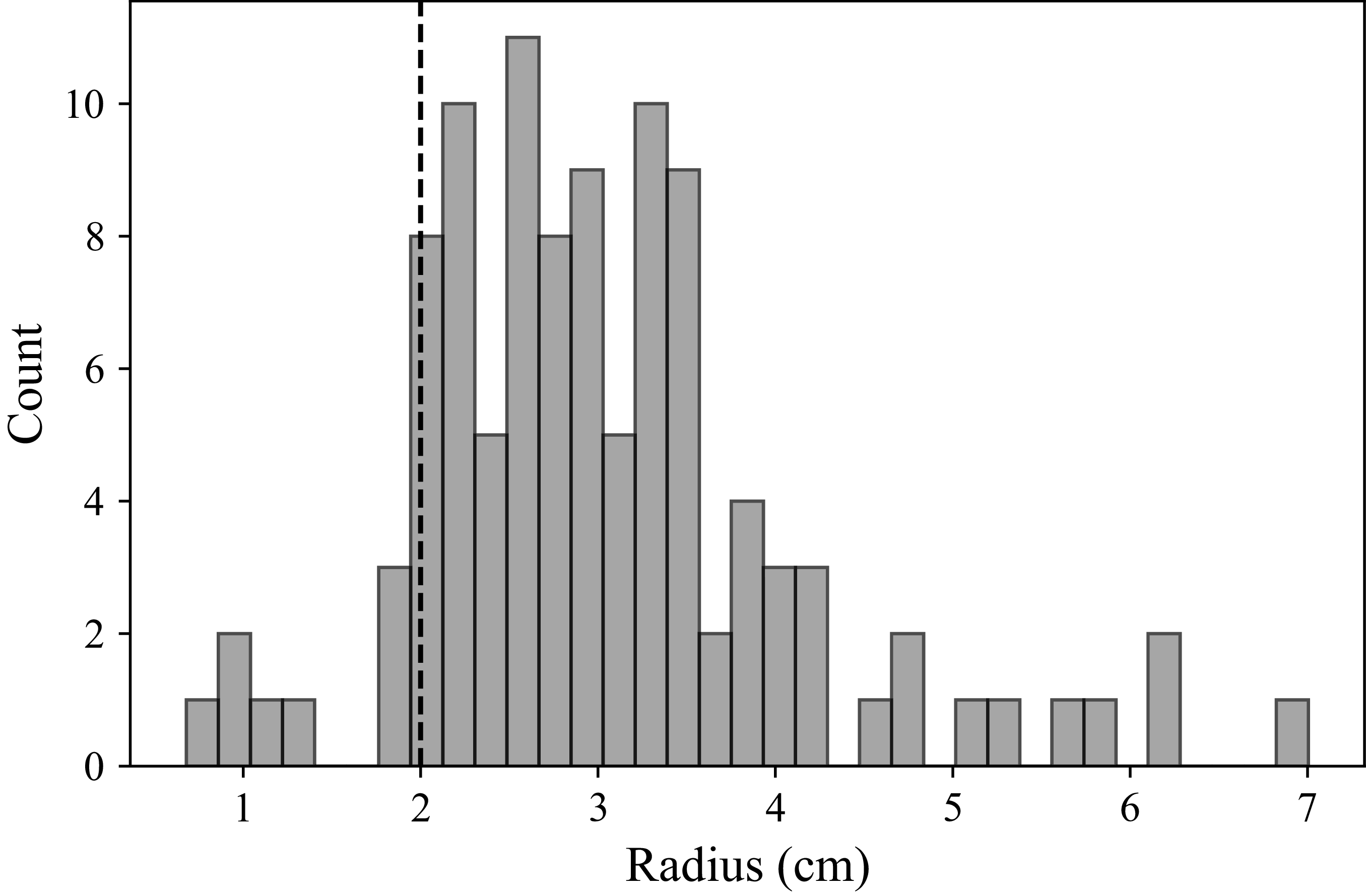
To test the existence of this hydrochemical floor, we examined the size distribution of stalagmites from Browns Folly Mine in Wiltshire, England, reported by Baldini (Reference Baldini2001). This anthropogenic site provides a unique chronological constraint: the mine was opened in 1836 and abandoned in 1886. This places a strict upper bound of approximately 160 years on the age of the speleothems at the time of sampling. This relatively short interval limits the influence of major climatic shifts that typically complicate the interpretation of natural cave populations.
Histogram of basal stalagmite radii measured in Browns Folly Mine, Wiltshire, England (Baldini Reference Baldini2001). The dashed line marks the theoretical lower bound
 $R_{\textit{min}}\approx 2.0\,\mathrm{cm}$
predicted by (2.18).

Figure 3 displays the histogram of basal radii alongside the theoretical bound
 $R_{\textit{min}}$
predicted here. The bulk of the population lies above
 $R_{\textit{min}}$
, consistent with the interpretation of (2.18) as a baseline: additional processes, such as higher drip rates approaching a continuous-film regime (Romanov et al. Reference Romanov, Kaufmann and Dreybrodt2008; Szymczak et al. Reference Szymczak, Ladd, Lipar and Pekarovič2025) or impact broadening, can only increase the effective footprint and shift radii upward.
A small number of specimens fall below the bound. These outliers likely reflect cases where the assumptions underlying the isolated-drop, invariant-growth estimate are not yet satisfied. Since the equilibrium radius
 $R_{\textit{min}}$
corresponds to an asymptotic state reached only after the deposition of many layers, and the growth window in the mine is limited to roughly 160 years, these smallest specimens have likely not yet converged to the hydrochemical attractor. Nevertheless, radii substantially smaller than
 $R_{\textit{min}}$
are rare in this dataset, supporting the existence of a characteristic centimetric floor.
One important broadening mechanism is associated with drop impact and trajectory dispersion (Parmentier et al. Reference Parmentier, Lejeune, Maréchal, Bourges, Genty, Terrapon, Maréchal and Gilet2019, Reference Parmentier, Terrapon and Gilet2023). Specifically, drops falling from a significant height acquire kinetic energy that drives the formation of a splash lamella, and their trajectories may be scattered by aerodynamic forces. Both effects – the inertial spreading of the lamella and the statistical dispersal of impact points – act to increase the effective wetted area. It is instructive to compare our hydrochemical bound with the inertial spreading scales of this lamella. For a 5 mm drop, close to the characteristic drop size adopted here, falling from a height of about 1 m, Parmentier et al. (Reference Parmentier, Terrapon and Gilet2023) found a spreading diameter of order 1.5 cm on a pre-existing thin water film, corresponding to a radius of approximately 0.75 cm. For a comparable impact on a dry surface, the spreading diameter is of order 3 cm, corresponding to a radius of approximately 1.5 cm (Laan et al. Reference Laan, de Bruin, Bartolo, Josserand and Bonn2014; Josserand & Thoroddsen Reference Josserand and Thoroddsen2016). The pre-wetted case is particularly relevant to active stalagmites, which are often coated by a thin layer of moisture and exist in highly humid environments (95 %–100 %) (Fairchild et al. Reference Fairchild, Smith, Baker, Fuller, Spötl, Mattey and McDermott2006; Lachniet Reference Lachniet2009). Crucially, this wet-impact spreading radius (
 $0.75$
cm) falls well below our derived hydrochemical baseline of
 $R_{\textit{min}} \approx 2.0$
cm. While drops falling from much greater heights may generate wider inertial lamellae that exceed this baseline, this demonstrates that inertial spreading alone is often geometrically insufficient to establish the final width of the formation. Even after the kinetic energy of the impact is entirely dissipated, the fluid must still spread outward as a viscous gravity current to
 $R \approx 2.0$
cm in order to precipitate its solute load. Consequently, the centimetric scale of stalagmites is underpinned by the intrinsic drainage–reaction coupling, and our hydrochemical result serves as a conservative lower bound.
The present result can also be placed in relation to the broader stalagmite shape families (Szymczak et al. Reference Szymczak, Ladd, Lipar and Pekarovič2025). The calculation addresses the columnar limit, in which inertial impact spreading is negligible and the arriving solution is equilibrated with cave
 $\textrm {CO}_2$
. We further assume that an isolated post-impact film drains and precipitates before the next drop arrives. Other morphodynamic regimes are expected to increase the relevant lateral scale. Flat-top growth involves a broader effective wetted region at the tip, which may arise through inertial impact spreading and splashing, or through scatter in the impact point between successive drops. Conical growth corresponds to a distinct regime in which the incoming solution is not yet equilibrated with the cave atmosphere with respect to
 $\textrm {CO}_2$
exchange. In that case ongoing degassing during spreading lowers the
 $\textrm {CO}_2$
-controlled equilibrium level and can replenish the supersaturation, effectively prolonging precipitation beyond the relaxation time of an equilibrated drop.
4. Conclusions
We have shown that the coupled hydrodynamics and precipitation kinetics of a single drop spreading as a thin viscous film on a stalagmite tip select a minimal stalagmite radius. Using the similarity solution for an axisymmetric gravity current of fixed volume and a first-order reaction law, we derived an explicit expression:
 \begin{equation} R_{\textit{min}} = C_{\textit{min}}\,V^{2/5}\left (\frac {g}{\nu k}\right )^{1/10}, \end{equation}
with
 $C_{\textit{min}}$
a dimensionless constant of order unity. For typical cave parameters this yields a minimal radius of order
 $2$
cm, consistent with field observations of the smallest stalagmites. The dependence on drop size and temperature follows directly from (4.1):
 $R_{\textit{min}}\propto V^{2/5}$
, with
 $\nu (T)$
and
 $k(T)$
entering only through the weak factor
 $(g/\nu k)^{1/10}$
. Our calculation offers a simple constraint for models of stalagmite growth and illustrates how finite reaction kinetics in a draining gravity current can generate a characteristic length scale.
Funding
This work was supported by the National Science Centre (NCN, Poland) under research grant 2022/47/B/ST3/03395.
Declaration of interests
The authors report no conflict of interest.


 V
 h(r,t)
 rm(t)
 r
 Rmin≈2.0cm

 Open access

