- AFH
Archivum Franciscanum Historicum
- CF
Collectanea Franciscana
- PDBFCNA
Pubblicazioni della Bibliotheca Francescana Chiesa Nuova-Assisi
- SB
Spicilegium Bonaventurianum
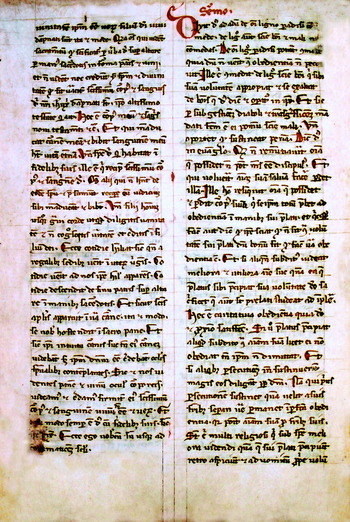
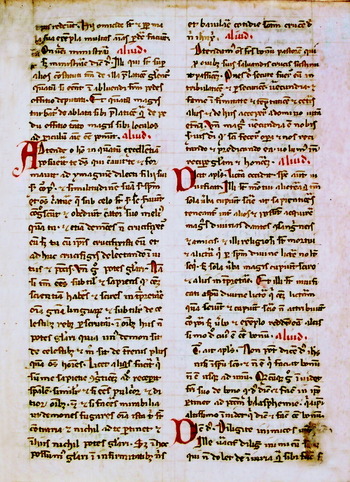
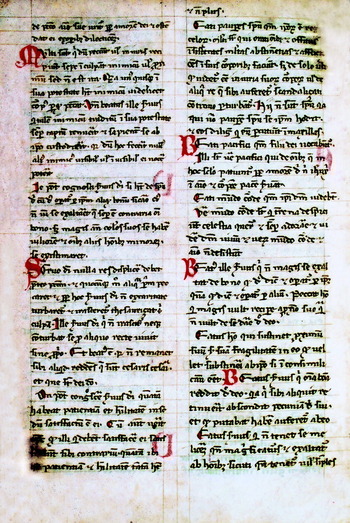
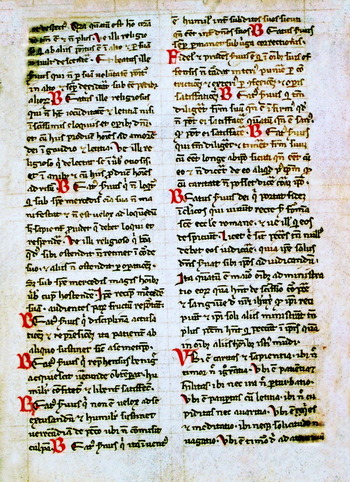
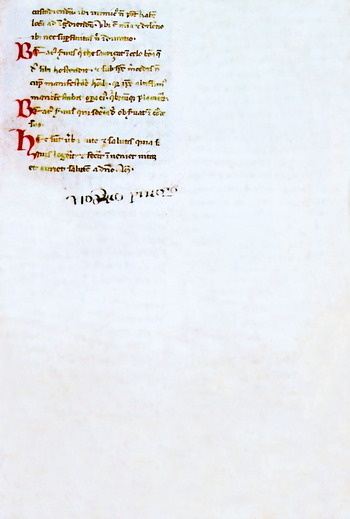
The purpose of this article is to discuss and print an addition to the family of manuscripts containing the text of the Admonitions of St Francis of Assisi. The manuscript was not included in the most detailed list of manuscripts containing Francis's Opuscula published by Kajetan Esser and R. Oliger in 1972, nor was it available for Esser's critical edition of the writings of St Francis, published in 1976, for the editio minor of this work published in 1978, or for the second edition of the editio maior prepared by Engelbert Grau and published in 1989.Footnote 1 Similarly it was not known to Antonio Ciceri, who has compiled a valuable list of manuscripts which have come to light in the quarter of a century following the publication of Esser's edition,Footnote 2 nor to Carlo Paolazzi, who has recently published a new edition of the Admonitions.Footnote 3 This study focuses on the early transmission of St Francis's writings, describes the newly recovered text of the Admonitions, comparing it to the other manuscripts, especially to those from the thirteenth century. It provides a transcription of the text along with facsimiles of the manuscript (see Figs 1–6).
The Admonitions of St Francis of Assisi: private manuscript, fo. 4r.

The Admonitions of St Francis of Assisi: private manuscript, fo. 4v.

The Admonitions of St Francis of Assisi: private manuscript, fo. 5r.

The Admonitions of St Francis of Assisi: private manuscript, fo. 5v.

The Admonitions of St Francis of Assisi: private manuscript, fo. 6r.

The Admonitions of St Francis of Assisi: private manuscript, fo. 6v.

St Francis's writings
Francis's sanctity, the miracles attributed to his intercession and the diffusion of his cult in the western Church ensured that his words were treasured and carefully conserved, above all by members of his own order. Despite his protestations of simplicity and his self-effacing comments about the limitations of his formal education,Footnote 4 he left a substantial body of writings. The small quantity of extant autographs, consisting of two folios containing three short works, shows that Francis himself was capable of writing in Latin.Footnote 5 Apart from these autographs, Francis is known to have written at the chapter of 1221 to the minister general and friars of France an autograph letter no longer extant, and there are references to his requesting writing implements to be brought to him.Footnote 6 Recent scholarship has cast doubt on the earlier view that Francis's education was rudimentary.Footnote 7 There is also some evidence that he dictated his thoughts to his companions, notably to Leo.Footnote 8 In most of his letters Francis requested that his words should be preserved and disseminated, and he sometimes imparted his blessing to those who fulfilled his wishes in this respect.Footnote 9 Francis enjoined that the texts of certain of his writings, notably the Testament and the Regula non bullata, should be preserved by the ministers and other officials of the order without addition or subtraction.Footnote 10 Angelo Clareno no doubt records a view widespread among the fraticelli when he states that the saint's writings served to preserve his wishes against friars intent on thwarting his will.Footnote 11 He further attributes all that Francis said in the Rule, the Testament and his letters to a divine source.Footnote 12
A corpus of Francis's major writings was established at an early stage. None the less, debate about the authenticity of certain minor texts continues.Footnote 13 The collection of undisputed texts was sufficiently well-established and authoritative to be of use to Thomas of Celano, Francis's first biographer, whose Vita prima of Francis dates from 1228–9. Indeed, recourse to Francis's writings was one effective means for the hagiographer to authenticate the portrait of his subject.Footnote 14
The Vita prima by Thomas of Celano cites the Testament on the subject of Francis's perception of lepers prior to his conversion and the prayer to be recited in all churches.Footnote 15 Quotations and borrowings from the Testament,Footnote 16 the Rule,Footnote 17 some of the letters Footnote 18 and the Canticle of Brother Sun were identified by the Quaracchi editors in their critical apparatus to the Vita prima.Footnote 19 Francis's writings are likely to have circulated among the ministers provincial and the friaries at a very early stage. The Rule (Regula vitae) was read in common by the friars each Friday,Footnote 20 probably during the meeting of the domestic chapter (while the general constitutions were to be read each monthFootnote 21 and the provincial constitutions every two months).Footnote 22 The copying and citation of Francis's writings served to stimulate friars to imbibe the spiritual lessons of their founder. These writings were also regarded as a vital supplement to the Regula bullata, the version of the Rule which was approved by Pope Honorius iii on 29 December 1223, and as a guide to Francis's thoughts regarding a range of topics which were not explicitly addressed therein.Footnote 23 The Vita prima cited the Admonitions as well as other works by Francis,Footnote 24 while a Liber exemplorum alludes to Admonition 19.Footnote 25
Copies of St Francis's writings, even those which concerned the domestic affairs of the Franciscans, were owned and read outside the order. Members of other religious orders and some secular clergy took a keen interest in the counsel proffered by the man whose body had been marked in a hitherto unprecedented manner by the stigmata, the five wounds borne by the Crucified Christ. One of the earliest quotations from the Admonitions comes from an anonymous Dominican preacher at Paris on 13 July 1231.Footnote 26 It will be apparent that admiration for and interest in St Francis was not confined to the order which bore his name. Two of the earliest representations of the saint were painted in the Benedictine monasteries of Mont Saint-Michel and the Sacro Speco, Subiaco.Footnote 27 The latter is a wall painting datable by an inscription in the chapel in which it appears to the second pontifical year of Gregory ix (21 March 1228–20 March 1229). The subject is described not as a saint but as Frater Franciscus and lacks a nimbus. These features suggest that the painting was completed prior to Francis's canonisation on 16 July 1228.Footnote 28 In other words it may be dated between 21 March and 16 July 1228. Matthew Paris, the chronicler at the Benedictine monastery of St Albans, reproduced the complete text of Francis's Rule in his Chronica maiora, which he illustrated with images of the saint and one of his early companions, William, a barefooted English friar.Footnote 29
The extensive research of Esser and Oliger reveals something of the circulation of Francis's writings outside the order. Copies came into the possession of Benedictines (Staatsbibliothek, Bamberg, ms B.V.35), Dominicans (Universitätsbibliothek, Basle, ms C.V.19), Cistercians (Bibliothèque nationale, Paris, ms lat. 2477), Augustinian canons (Stadtbibliothek, Trier, ms 476) and Carthusians (Universiteitsbibliotheek, Utrecht, ms 167).Footnote 30 A late fourteenth-century catalogue of the library of the Benedictine abbey of Peterborough listed two copies of the Rule and one of the Testament.Footnote 31
The biographers who followed Thomas of Celano enjoyed access to fuller collections of Francis's writings, as the vitae from the 1230s attest. John of Perugia, the author of the Anonymus Perusinus, quoted the Testament Footnote 32 and alluded to the Rule and other texts. The Compilatio Assisiensis likewise cited the Testament.Footnote 33 The last two sentences of the portrait in Thomas of Celano's Vita secunda of the ideal preacher quote from the Testament and the Letter to St Anthony of Padua. The conduct of Elias of Cortona, minister general, who was deposed by the general chapter of Rome in 1239, concentrated reflection on the Rule.Footnote 34 The friars and their opponents cited the Rule during the polemical exchanges of the 1250s and later 1260s.Footnote 35 One of the first extant commentaries on the Rule in 1241–2 cited the Testament.Footnote 36 Along with the Testament, it continued to circulate in the first half of the fourteenth century. It was natural that the controversies involving the fraticelli should have focussed attention on Francis's writings, above all the Rule and the Testament.Footnote 37
Borrowings from the Admonitions have been located in the Anonymus Perusinus,Footnote 38 and in Thomas of Celano's Vita secunda.Footnote 39 The Admonitions, like the Testament and the Rule itself, were quoted in debates regarding the fitting observance of the Rule, although the extracts or summaries tend to be too brief to check against the manuscript tradition. The Compilatio Assisiensis is an early exception to this pattern in its quotation of the last sentence of the sixth Admonition: ‘sancti fecerunt opera, et nos, recitando et predicando ea, volumus inde recipere honorem et gloriam’.Footnote 40 It is noteworthy that the Compilatio Assisiensis, in including the words ‘et predicando’, is identical to the text of the manuscript published below and most other manuscripts.Footnote 41 The edition by Esser and Grau prefers the reading ‘recitando’ alone, but Paolazzi restores ‘et predicando’.Footnote 42 Bonaventure of Bagnoregio's Legenda maior reproduces a brief passage from the twentieth Admonition.Footnote 43 Similarly, the third,Footnote 44 eleventhFootnote 45 and fourteenth Admonitions were cited in Angelo Clareno's Commentary on the Rule.Footnote 46
The Admonitions
While some of Francis's letters were addressed to groups outside the order, such as the clergy, all the faithful, and lay rulers, many of his writings, including the Admonitions, were intended specifically for friars. However, there is no direct evidence concerning the circumstances in which the Admonitions were composed nor concerning their date of composition. The Anonymous Perusinus reports that Francis delivered admonitiones to the friars concerning the observance of the Rule during the order's chapters.Footnote 47 The Legenda trium sociorum refers in similar terms to Francis's admonitiones in the context of a chapter held at S. Maria della Porziuncula.Footnote 48 Although it cannot be claimed that these texts are referring specifically to the work by Francis known as the Admonitiones,Footnote 49 it is reasonable to suppose that this work derives in whole or in part from addresses that St Francis gave at meetings of the general chapter of the order. This circumstance is perhaps reflected in the title of the Admonitions in an important manuscript of the works of St Francis: ‘verba sacre admonitionis … ad omnes fratres’.Footnote 50 Jacques de Vitry, in a letter of October 1216, refers to the Franciscans' practice of congregating together once a year.Footnote 51 The Regula non bullata of 1221 ordered that a triennial general chapter was to be held at La Porziuncula and an annual chapter of the Italian friars was to be held in the same place.Footnote 52 Esser regards the Admonitions as a single composition;Footnote 53 but if it is correct to associate the Admonitions with the general chapters, this suggests that they represent not so much a single work as a series of texts compiled over a period of years.
It has been claimed that the Admonitions are reportationes, in other words that members of Francis's audience wrote down his words when he addressed the chapters or on other occasions.Footnote 54 However, there is more than one problem with this view. As we shall see in the context of a discussion of the headings in manuscripts of the Admonitions,Footnote 55 the works of St Francis, including the Admonitions, show a remarkable fidelity to the views of Francis on the appropriate use of vocabulary, a fidelity which suggests that the texts of his works accurately reflect not only his thoughts but also the manner in which he wished them to be expressed. A further problem is that the manuscripts of the Admonitions do not contain sufficient differences in the text to suggest that they derive from different reportationes. We are left, then, with a single rapporteur, who was intimately acquainted with Francis's ideas and his preferred means of expression, and it seems reasonable to substitute for that hypothetical figure Francis himself. The argument appears to be reinforced by the conclusions of Giovanni Pozzi's study of the prose style of Francis. He stresses the homogeneity of Francis's writings, with reference in particular to the autograph works and the Admonitions. Footnote 56
The teaching of the Admonitions is grounded in the New Testament, and the work contains numerous quotations from the New Testament.Footnote 57 André Vauchez has plausibly suggested that an implicit theme of the work is the repudiation of contemporary heretical beliefs.Footnote 58 Francis tends to begin each Admonition with a scriptural quotation, an allusion or image, which is followed by a practical application.Footnote 59 The text also contains echoes of the Beatitudes articulated in the Sermon on the Mount (Matthew v. 1–16 and Luke vi. 20–6). The Admonitions often start with ‘Beatus ille qui’, matched by the lament for those who transgressed this norm of conduct, ‘Ve illi religioso’. This negative element implies a note of disillusionment with those friars who failed to act according to the founder's ideals. This may suggest composition in the years following Francis's decision to return from the east and to stand down from leadership of the order (1220). The majority of commentators do indeed place the Admonitions late in Francis's life, that is, in the 1220s. Robert J. Karris, for instance, dates them to the last three years of his life.Footnote 60 On the other hand, Giovanni Miccoli, following Damien Vorreux, suggests a date as early as c. 1209–21.Footnote 61
Vices and virtues were central themes in the friars' programme of preaching, as ordained by chapter nine of the Regula bullata.Footnote 62 This preoccupation informs the Admonitions,Footnote 63 which also reflect the involvement of members of the order in the implementation of the decrees of the Fourth Lateran Council of November 1215.
Although numerous manuscripts survive containing the writings of St Francis, only six of them are believed to date from the thirteenth century. Five out of the six include the Admonitions; in two manuscripts, the Admonitions are the only work by Francis, as is the case with the manuscript discussed in this article.Footnote 64
Among the manuscripts of the writings of St Francis, Sacro Convento di S. Francesco (formerly Biblioteca Comunale), Assisi, ms 338, holds pride of place. Although the date of this manuscript is disputed, recent scholarship has tended to reinforce F. C. Burkitt's view that the section of the manuscript (quires 2–4) containing works by Francis dates from the mid-thirteenth century.Footnote 65 Esser and Pellegrini in their detailed studies of the manuscript arrive at conclusions very similar to those of Burkitt regarding the date, Pellegrini arguing for a date of 1244–53.Footnote 66 This manuscript and Biblioteca Medicea Laurenziana, Florence, cod. X, Plut. XIX dextr. contain two of the earliest known copies of the Admonitions. The latter, from the library of the convent of Santa Croce, Florence, is a miscellany of texts associated with the order and a variety of other items. This manuscript shows some independence in its use of headings in the Admonitions, and it divides the text in a slightly different manner. The Admonitions are also contained in Bibliotheca Apostolica Vaticana, ms Rossin. lat. 23 and in Bibliotheca Guarnacci, Volterra, ms 225, manuscripts which have been assigned to the later thirteenth century. The final manuscript to be mentioned is Grays Inn Library, London, ms 2, which has been dated to the late thirteenth or early fourteenth century. These early manuscripts do not present a uniform text of the Admonitions. Thus the Gray's Inn manuscript omits the first Admonition, as do some later manuscripts, perhaps reflecting a perception that it was a separate work on the inculcation of eucharistic piety. In the manuscript published below, on the other hand, it appears under the Admonitions' main heading, ‘Hec sunt verba sacre admonitionis …’, with the subheading ‘De corpore domini nostri Iesu Christi’.Footnote 67 Doubts have been expressed in the past about Francis's authorship of the first Admonition, but the consensus is now that it is a genuine work of the saint.Footnote 68
A newly recovered text of the Admonitions
A manuscript containing the Admonitions was sold at Sotheby's in London on 22 June 2004 (lot 54) and passed into private hands.Footnote 69 Nothing is known about the provenance of the manuscript prior to the sale. The number ‘15561’ written in modern pencil at the end of the text (fo. 6v) may be a bookseller's stock number. The manuscript numbers only six folios, measuring 189 mm by 131 mm. The text is in two columns and is written in the same hand throughout. The scribe was not a masterly calligrapher: his hand is fairly rough, and the lines end unevenly. What survives probably once formed part of a larger manuscript, but the two sections of the manuscript in its present state appear to be complete. The first section (fos 1–4) contains extracts from the Liber scintillarum, a very popular collection of quotations from the Bible and the Fathers. It was compiled c. 700 by Defensor, a monk of Ligugé near Poitiers. This section closes with excerpts from chapter sixteen, De silentio,Footnote 70 and chapter eighteen, De sapientia.Footnote 71
The Franciscans took some interest in Defensor's collection which was to be found in their libraries at San Fortunato, Todi;Footnote 72 the Sacro Convento, Assisi;Footnote 73 Il Santo, Padua;Footnote 74 and Santa Croce, Florence.Footnote 75 Franciscans from the custody of Newcastle gathering information for the Registrum Anglie, a union catalogue of libraries, noted that the Liber scintillarum was available at the Augustinian Priory of Guisborough, North Yorkshire, and the Cistercian abbey at Newminster, Northumberland.Footnote 76 The catalogue of the library of San Francesco Grande in Padua contains two copies of Defensor's collection.Footnote 77
The second section of the manuscript (fos 4r–6v) contains the Admonitions. It is in the same hand as the first section and runs straight on from it without any vacant space. It is noteworthy that in the heading Francis of Assisi is not referred to as sanctus or beatus. It reads: ‘Hec sunt verba sacre admonitionis venerabilis patris nostri Francisci ad omnes fratres. In nomine Patris et Filii et Spiritus Sancti. Amen. De corpore Domini nostri Iesu Christi.’ The failure to describe Francis as a saint strongly suggests that the manuscript antedates his canonisation, which took place less than two years after his death (he died on 3 October 1226 and was canonised on 16 July 1228).Footnote 78 News of this event must have spread rapidly within the order and elsewhere, and it is difficult to imagine that a scribe would fail to describe Francis as sanctus or beatus once he was aware that he had been canonised. In theory, a scribe writing after the canonisation, might have slavishly copied an earlier manuscript which did not describe Francis as a saint, but this seems unlikely.
The handwriting of the manuscript can be studied in the facsimiles which accompany this article. It is quite different from that of the celebrated collection of writings of St Francis and other Franciscan texts, Assisi ms 338.Footnote 79 Among the distinctive features of the hand are the two elongated bars in the capital E, the form of the er abbreviation after s, which makes s(er)- at first sight look like sy, and the rather prominent horizontal stroke which precedes s. The final s is invariably long. In order to attempt to date the handwriting, it is advisable to compare it with the various published facsimiles of dated and datable manuscripts. We have not found illustrated in these catalogues any examples that strikingly resemble this hand. One of the closest that we have noticed is Bodleian Library, Oxford, ms Lat. liturg. f. 1, although the hand of the Oxford manuscript is rather more cursive in character. It is a Cistercian breviary of French origin of c. 1219.Footnote 80 Two manuscripts in the Bibliothèque nationale, Paris, display similar script, lat. 469 and lat. 6901. The first contains the Postillae of Hugh of Saint Cher, is datable to the years 1230–48, and belonged to Clarinus, bishop of Carcassone 1226–48.Footnote 81 The other, which is closer to the privately owned manuscript, contains works by Rasis in the translation by Gerard of Cremona, is dated 5 June 1230, but has not been localised.Footnote 82 In another Cistercian breviary, now Bibliothèque municipale, Troyes, ms 1907, from Clairvaux and datable to after 1228, the name Francisci is similar in appearance to the same word in our manuscript.Footnote 83 The script may also be compared to that of the Epistola ad clericos published with a facsimile by L. Oliger from a manuscript in the Biblioteca Vallecelliana, Rome (Cod.B.24).Footnote 84 That manuscript is from the Benedictine abbey of the Sacro Speco, Subiaco, and Oliger argued that the text of the Epistola ad clericos was copied there from Francis's autograph or the original exemplar.Footnote 85 This section of the manuscript is datable to the years 1219–38,Footnote 86 and it is therefore close to the likely date of the manuscript of the Admonitions. One may note, for instance, the similarity of the words ‘sanctissimum corpus et sanguis domini nostri Iesu Christi’ in the manuscript of the Admonitions to the words ‘sanctissimum corpus et sanguinem domini nostri Iesu Christi’ in the Subiaco manuscript.Footnote 87 Although it would be difficult to date our manuscript of the Admonitions on the basis of its handwriting alone, comparison of the latter with dated and datable manuscripts does not contradict the evidence of the title; in other words, the handwriting is compatible with a date prior to Francis's canonisation.
The first line of text is written below the top ruled line, with the exception of one page, where the words ‘et non plus’ are above the top line.Footnote 88 N. R. Ker, in discussing English manuscripts, noted that in around 1230 scribal practice changed from writing above the top line to writing below it. He associated the new procedure down to the middle of the thirteenth century with the work of professional scribes. It must be emphasised that we are not here concerned with a sudden change and that the timing of the change may have varied in different parts of Europe.Footnote 89 In the case of the present manuscript, all that can be said is that writing below the top line neither contradicts nor supports a date before Francis's canonisation.
A possible objection to the argument advanced here is that, to judge from the first edition of Esser, there are several manuscripts of the Admonitions which are undoubtedly of later date and which do not describe Francis as a saint in the heading: ‘Haec sunt verba sacrae admonitionis venerabilis patris nostri Francisci ad omnes fratres’.Footnote 90 However, Esser omitted the word ‘sancti’ or ‘beati’ before ‘Francisci’, a point corrected in Grau's revised edition.Footnote 91 It seems, then, that the original argument can be maintained, namely that our manuscript dates from before Francis's canonisation in 1228. It should be dated within his lifetime or between his death and canonisation. If this is correct, it is the earliest extant manuscript of Francis's works with the possible exception of two celebrated autograph manuscripts, the original Regula bullata of 1223, and the manuscript of the Epistola ad clericos. All these, except the Regula bullata, contain very short works, in the case of the autographs the Laudes dei altissimi with the Benedictio fratris Leonis, and the letter to Leo.Footnote 92 They are considerably earlier than the next earliest manuscript, Assisi ms 338.
It is less easy to localise the manuscript than to date it. The script does not appear to give any clear pointers to where the manuscript was written. The five manuscripts drawn upon for comparison are probably all French or Italian, and it is likely that the new manuscript is French or Italian. The manuscript contains some distinctive spellings. It is worth considering these more fully, although insufficient work has been done on medieval Latin orthography to localise the manuscript on the basis of evidence of this type.Footnote 93 The words ‘cognoscere’ and ‘cognitio’ appear as ‘congnoscere’ and ‘congnitio’, in the forms ‘congnovissetis’, ‘congnovistis’, ‘congnoscunt’ and ‘congnitionem’.Footnote 94 The identical spellings occur in the text of the Admonitions as copied in Bodleian Library, Oxford, ms lat. theol.d.23 (beginning on fo. 139). This manuscript is known as the Little manuscript, after its former owner, the great Franciscan scholar A. G. Little.Footnote 95 It is likely to date from the early fifteenth century and was written for Fr Lawrence of Rieti, minister of the province of St Anthony (i.e. Venice). Although the scribe was German,Footnote 96 the manuscript was presumably written in northern Italy. The same spelling is adopted in Vatican Library, ms Rossin. lat. 23, dated by Esser and Oliger to the late thirteenth century but not localised by them.Footnote 97 Another noteworthy spelling which occurs in this manuscript is x in place of s or ss: thus, ‘confexionem’ instead of ‘confessionem’ and ‘dexiderat’ instead of ‘desiderat’.Footnote 98 This use of x has its parallel in another Italian manuscript, written in Verona in 1294. It has ‘Tomaxinus’ in place of the more usual spelling ‘Tomassinus’.Footnote 99
The heading of the Admonitions, referring to Francis as ‘venerabilis patris nostri Francisci’, indicates that the manuscript was produced for members of the Franciscan order. While it is possible that a scribe, writing outside the order, or for the use of non-Franciscans, could have simply copied ‘nostri’ from an earlier exemplar, it is more likely that the manuscript was written in or for a Franciscan convent.
The very inconclusive palaeographical and orthographic evidence discussed above points to production in or for a Franciscan convent in France or Italy.
In the present manuscript, some of the Admonitions commence with a capital in red ink. In other cases, a space has been left for a capital but it has not been filled in. Thus, folio 5v displays five red capitals; there are five spaces where a capital has not been added, and in two of these there is an indication in the left margin of which letter was to be inserted. The explanation for this circumstance must be that the unexecuted capitals were to be in a colour other than red, most likely blue. The text scribe or another scribe added the red capitals but never got round to completing the others. Admonition 2 begins with the heading ‘Sermo’ and Admonitions 4 to 8 with the heading ‘Aliud’, all in red. These headings look like later additions, but there is no reason to suppose that they are in a different hand from that of the main scribe. The heading ‘Sermo’ doubtless reflects the origin of the second Admonition in a sermon or address by St Francis, perhaps delivered at a general chapter of the order.Footnote 100
The newly recovered manuscript has the explicit ‘Hec sunt verba vite et salutis, quia si quis legerit et fecerit inveniet vitam et auriet salutem a Domino. Amen’, and two other thirteenth-century witnesses have a similar explicit.Footnote 101 It is worth noting that the first recension of the Epistola ad fideles, as it occurs in the Volterra manuscript, uses the identical words in its rubricated heading.Footnote 102
The new manuscript has no marginal emendations or additions. In contrast, Assisi ms 338 was corrected thrice within the space of two lines, where the words ‘sanctis’, ‘ostendit’ and ‘in’ were inserted in the right and left margins towards the end of the first Admonition. Moreover, Assisi ms 338 has a marginal addition to the thirteenth Admonition in the form of a quotation from Matt. v. 9, which occurs in a minority of manuscripts but is absent from the manuscript on which this study is based. Here this Admonition begins with the words ‘[N]on potest congnoscere servus Dei quantam habeat patientiam’.Footnote 103 This divergence may call to mind the statement in Jordan's Chronicle that Francis entrusted Caesarius of Speyer with ‘adorning’ the Rule with passages from the Gospels.Footnote 104 Perhaps, then, the new manuscript transmits an earlier, ‘unadorned’ version of the thirteenth Admonition, although it must be admitted that there are numerous scriptural quotations elsewhere in the manuscript's text. The quotation is included in the edition by Esser and Grau but rejected by Paolazzi.Footnote 105
The sequence of Admonitions in the newly available text differs from that of Assisi ms 338: the order of the eleventh and twelfth Admonitions is reversed. The other early manuscripts have the same sequence as the Assisi manuscript, and this sequence is followed in the critical editions by Esser and Grau and by Paolazzi.
Unlike the other manuscripts which may be dated to the thirteenth century, the present manuscript does not contain any headings for the Admonitions. It is likely that these were added to the text at some stage between the composition or compilation of the Admonitions and the copying of the Assisi manuscript. In this context, it is necessary to consider an important article by Carlo Paolazzi concerning the role of St Francis in the composition of the works ascribed to him.Footnote 106 Paolazzi draws attention to the account in the Speculum perfectionis and the Compilatio Assisiensis of a visit by a doctor called Bonus Iohannes to Francis, who did not wish to call him by his name: ‘Non enim voluit eum vocare proprio nomine, quia nunquam volebat aliquem nominare qui vocaretur “bonus” propter reverentiam Domini qui dixit: “Nemo bonus nisi solus Deus”. Similiter nec “patrem” nec “magistrum” volebat aliquem vocare vel in litteris suis scribere, propter reverentiam Domini qui dixit: “Et patrem nolite vocare vobis super terram, nec vocemini magistri”, etc.’Footnote 107 Examining the appearences of the words ‘bonus’, ‘magister’ and ‘pater’ in Francis's work, Paolazzi finds them used only to describe God or Christ. The one exception is the heading of Admonition 20, ‘De bono et vano religioso’. It is, however, generally recognised that the headings in the Admonitions do not derive from Francis himself.Footnote 108 Paolazzi concludes that the wording of the Opuscula precisely reflects Francis's preoccupations; he convincingly rejects the view of Esser, among others, that Francis tended to dictate his works in the vernacular, which the scribe then translated into Latin. According to this view, even if the thoughts were those of Francis, the phraseology was not his.Footnote 109 In the present context, it is worth reiterating that the headings do not occur in what appears to be the earliest manuscript of the Admonitions. In this respect, and in the omission of the word ‘beatus’ or ‘sanctus’ to describe the author, the manuscript undoubtedly represents an earlier stage in the transmission of the text than the other thirteenth-century manuscripts.
Since the headings are not part of Francis's original work, we should not be surprised to find variations in them from one manuscript to another.Footnote 110 This is apparent in the thirteenth-century manuscripts. The fourth Admonition, for instance, appears as ‘Ut nemo appropriet sibi prelationem’ in the Assisi manuscript, ‘Ut nullus sibi appropriet prelationem’ in the Florentine manuscript and as ‘Ut nullus sibi appropriat prelationem’ in the Volterra manuscript.Footnote 111
The present manuscript and the early manuscripts at Assisi, Florence, London, Rome and Volterra all include the twenty-seventh Admonition, the authenticity of which has recently been the subject of debate between Carlo Paolazzi and Jan Hoeberichts.Footnote 112 All the early manuscripts present this Admonition in continuous prose rather than the ‘verse’ form employed in the editions by Esser and Paolazzi,Footnote 113 a form reproduced in the latest translation of Francis's writings into English.Footnote 114 In this particular, Grau's revised edition of Esser is faithful to the early manuscripts.Footnote 115
The edition by Esser and Grau divides the manuscripts of the Admonitions into several groups and also distinguishes two individual manuscripts which do not fall into any of these groups.Footnote 116 The groups are as follows:
Group a. This consists of eleven manuscripts. None of the distinctive readings of this group of manuscripts correspond to the text of the new manuscript.
Group c. This group consist of a further eleven manuscripts. It represents an earlier stage in the transmission of the text than does Group a. None of the distinctive readings of Group c are found in the manuscript.
Group d. Eleven manuscripts belong to this group, which is associated with Assisi ms 338 and the manuscripts closest to it, although these manuscripts form a separate group (see Group k below). None of the readings peculiar to Group d occur in the new manuscript.
Group f. This group consists of sixteenth-century manuscripts and printed editions. As with Group d, there are affinities with Assisi ms 338. Only a very few of the distinctive readings of Group f occur in the manuscript.
Group i. This consists of only two fourteenth-century manuscripts, which contain some major divergences from the other groups. None of these divergences are found in the new manuscript.
Group k. This is the largest group, with at least fourteen witnesses, including Assisi ms 338 and all the earlier manuscripts of the Admonitions. The readings of the newly recovered manuscript tend to correspond to those of the manuscripts in this group.
While Esser's edition is generally regarded as a distinct advance on all previous editions, and the vast range of manuscripts consulted and evaluated is remarkable, it must also be admitted that it has been subjected to a considerable amount of criticism, especially in recent years. Stanislao da Campagnola, in the introduction to Fontes Franciscani, which reprints the edition by Esser and Grau, among other observations, criticises Esser for having selected the manuscripts which form the basis of the edition in an arbitrary manner and for giving only a selection of the variants in the apparatus criticus.Footnote 117 Ernesto Menestò argued that Esser failed securely to establish the interrelationship between the various manuscripts of Francis's Opuscula and thus to justify the readings adopted in the edition. He pointed out that the only stemma codicum in Esser's edition is the one for the Admonitions and that this is difficult to understand.Footnote 118 The shortcomings of Esser's edition are apparent in more concrete terms from a doctoral thesis by Laurent Gallant which provides an edition of the Officium passionis on the basis of a new study of the manuscripts.Footnote 119 They are also apparent in the criticisms of Esser's edition contained in three long articles by Carlo Paolazzi.Footnote 120 He applies to the manuscripts of the Regula non bullata, of the Epistole and of the Admonitions the classical technique of textual criticism known as the Lachmann method in order to establish a stemma codicum and to prepare new editions of these works. Esser believed that Francis's Italianisms and errors or inelegancies in Latin were improved by the scribes to whom he dictated his works and by subsequent copyists. Esser for this reason tended to prefer readings which in his opinion were closer to Francis's original words, irrespective of which manuscript or manuscripts contained them. Paolazzi convincingly rejects such an approach.Footnote 121
Paolazzi's edition of the Admonitions is based on a new classification of the manuscripts. He argues that all the extant manuscripts derive from an archetype which contained two lacunae and one error.Footnote 122 Since the newly recovered manuscript displays the same defects, it doubtless also derives from the archetype. Paolazzi further distinguishes two branches, which diverged already in the thirteenth century, α and β.Footnote 123
Branch α consists of the following groups:
Group α1. This is in turn is divided into two subgroups, that is, Esser's groups a and c.
Group f (in Esser's classification).
Group i (in Esser's classification).
Group k2. This contains ten manuscripts from Esser's group k, including the following thirteenth-century witnesses: Biblioteca Medicea Laurenziana, cod. X. Plut. XIX dextr.; Gray's Inn Library ms 2; Vatican Library, ms Ross. lat. 23; and Volterra, ms 225.
Branch β consists of two groups:
Group d (in Esser's classification).
Group k1. This contains five manuscripts from Esser's group k, including Assisi ms 338 from the mid-thirteenth century.
The main differences introduced by Paolazzi in the classification of manuscripts of the Admonitions are the division of the manuscripts into two branches, and the separation into two of Esser's all-important Group k, some manuscripts being assigned to branch α (k2), others to branch β (k1); k2 and k1 represent the earliest stage of α and β respectively.Footnote 124 Paolazzi provides a detailed discussion of the variant readings of the different branches and groups of manuscripts. It is worth considering how the text of the new manuscript relates to these.
Branch α. Paolazzi draws attention to fourteen passages in which α differs from the putative archetype.Footnote 125 In nine of these, the readings of the new manuscript correspond to those of α; in the remaining five, they correspond to those of the archetype. Paolazzi then considers thirty-two passages in which the manuscripts of Group α1 display variants from the archetype.Footnote 126 In all but three cases, the newly recovered manuscript follows the archetype or at least is close to it; in those three cases, it differs from both the archetype and α1. Next Paolazzi considers thirty-six passages in which the manuscripts of subgroup a differ from the archetype.Footnote 127 In almost every case, the new manuscript is identical or close to the archetype. In one case it differs from both, and it never accords with the distinctive readings of Group a. There are twenty passages in which the manuscripts of subgroup c differ notably from the archetype.Footnote 128 Here too our manuscript almost invariably coincides with the archetype. On just one occasion is its reading that of subgroup c. Similarly with the thirty-four divergent readings of Group f and the forty-two divergent readings of Group i, the new manuscript is identical or close to the archetype, except once when it differs from both the archetype and Group f and once when it has the same reading as Group i.Footnote 129 However, the result of the comparison is different in the case of Group k2. Our manuscript contains seven of the ten distinctive readings of this group that Paolazzi lists.Footnote 130
Branch β. Paolazzi considers seven divergent readings found in this branch, none of which are shared by the privately owned manuscript;Footnote 131 the latter in every instance coincides with the text as reconstructed by Paolazzi. Next Paolazzi turns to the distinctive readings of Group d.Footnote 132 In only two of the twenty-six passages that he discusses does the new manuscript give the reading of Group d; in the remaining cases it is identical to the edited text. Similarly, it shares the divergent readings of Group k1 only once (out of nine passages).Footnote 133
One may conclude, on the basis of this comparison of our manuscript with the branches and groups of manuscripts according to Paolazzi's classification, that its readings coincide most closely with those of Group k1, to which all the other thirteenth-century manuscripts of the Admonitions, except Assisi ms 338, belong.
In the course of the discussion, we have mentioned various distinctive or notable readings in the newly recovered manuscript. We now wish to draw attention to some more of these readings, especially in comparison with Assisi ms 338 and the other thirteenth-century manuscripts, without, however, seeking to provide a comprehensive treatment of the variants.Footnote 134
The title in the present manuscript reads: ‘Hec sunt verba sacre admonitionis venerabilis patris nostri Francisci ad omnes fratres. In nomine patris et filii et spiritus sancti. Amen. De corpore Domini nostri Iesu Christi.’Footnote 135 The Assisi manuscript has a different order, commencing ‘In nomine patris et filii et spiritus sancti. Amen. Hec sunt verba sacre admonitionis venerabilis patris nostri sancti Francisci ad omnes fratres. De corpore Christi.’Footnote 136 The Florentine manuscript differs from that of Assisi and reads: ‘In nomine domini. Amen. Hec sunt verba admonitionis venerabilis patris nostri beati Francisci.’Footnote 137 The Volterra codex uses ‘sancti’, but like the Florentine, it omits ‘ad omnes fratres’.Footnote 138 Gray's Inn Library ms 2 lacks the opening formula and the first Admonition, beginning with the words ‘Hec sunt verba Sancti Francisci ad fratres de ordine domini primo de malo proprie voluntatis’.Footnote 139
Admonition 1. The present manuscript opens with the words ‘Dixit Dominus Iesus discipulis suis’. Biblioteca Medicea Laurenziana, cod. X. Plut. XIX dextr. and four other manuscripts have ‘Dicit’ in place of ‘Dixit’. The same divergence occurs twice again in this Admonition. Esser and Grau prefer the present tense as ‘die ungewöhnlichere, aber dem Sprachgebrauch des hl. Franziskus entsprechendere Form’, but Paolazzi offers persuasive reasons for preferring ‘Dixit’.Footnote 140 The sentence ‘Pater lucem h(abe)t inaccessibilem, et spiritus Deus’ (1.5) displays two divergent readings, neither of them acceptable. All other manuscripts have ‘habitat’ or ‘inhabitat’ in place of ‘habet’ and add ‘est’ before ‘Deus’. In the case of the clause ‘Ideo non eum spiritu videri potest’ (1.6), Esser and Grau prefer the reading ‘in spiritu’ as more ‘Italianate’, but Paolazzi argues for ‘spiritu’ alone.Footnote 141 The new manuscript is the only one to have ‘eum’ in this sentence, evidently an error for ‘nisi’, which occurs in the other manuscripts. This manuscript and a number of others, including those in the Biblioteca Medicea Laurenziana and Volterra, have ‘vivi’ before ‘dampnati sunt’ (1.8).Footnote 142 As in most other manuscripts, we find the reading ‘sanguis novi testamenti’ (1.10), although ‘sanguis meus novi testamenti’ seems preferable. Assisi ms 338 has the unsatisfactory ‘sanguis mei novi testamenti’.Footnote 143 Like a small number of other manuscripts, our manuscript has a more extensive version of the question, ‘Ut quid non cognoscitis veritatem et creditis in Filium Dei’ (1.15), namely ‘Ut quod diligitis vanitatem et non cognoscitis veritatem et creditis in Filium Dei?’Footnote 144 In the penultimate sentence of this Admonition, the manuscript gives ‘debet’ as a superscript addition before ‘esse’, although the word is in fact redundant at this point.
Admonition 2. Here the manuscript has ‘dicit et operatur in ipso’ (2.3). Many manuscripts have ‘dedit’ instead of ‘dicit’, but the latter is the preferred reading in the editions by Esser and Grau and by Paolazzi. The following sentence has the unusual (although perfectly correct) spelling ‘subgestionem’ instead of ‘suggestionem’.
Admonition 3. Our manuscript begins with the present tense (‘Dicit’), which is the preferred reading of Esser and Grau and of Paolazzi. The reading ‘perdet illam’ (at 3.2) is found in all but one of the thirteenth-century manuscripts and is adopted in the critical editions.Footnote 145 The manuscript appears to be the only one which reads ‘Qui non renuntiaverit omnia’ rather than ‘omnibus’ (3.1). The text of Luke (xiv. 33) from which this is taken has ‘omnibus’. Paolazzi argues plausibly that the phrase ‘perdit corpus suum’ at 3.3, found in our manuscript and in all other manuscripts except those of Group a, should read ‘perdit [animam suam et] corpus suum’.Footnote 146 Assisi ms 338, Volterra ms 225 and four other manuscripts have what Esser and Grau, followed by Paolazzi, regard as the earliest phrasing ‘sua voluntarie Deo sacrificet’ (3.5).Footnote 147 Our manuscript, on the other hand, is among those which read ‘sua voluntate Deo sacrificet’. At 3.8, the manuscript, in a unique reading, gives the verbs ‘sustinuerint’ and ‘diligant’ in the plural rather than the singular. The singular would have been grammatically more correct, since the verbs' subject is ‘subditus’ in the previous sentence.
Admonition 4. There is a wide variety of readings in the third and fourth sentences of this Admonition. Five thirteenth-century manuscripts (including the privately owned manuscript) and four later ones give ‘in abluendi fratrum pedes offitio deputati’. This is preferred by Esser and Grau as the lectio difficilior,Footnote 148 and by Paolazzi. Our manuscript appears to be the only one to add a superfluous ‘esse’ at the end of the Admonition: ‘ad periculum anime esse ponunt’.
Admonition 5. Here too the manuscript at one point provides an unsatisfactory text, not recorded elsewhere: ‘quia unus demon sit de celestibus et modo sit de terrenis’ (5.6). The critical editions read: ‘quia unus demon scivit de celestibus et modo scit de terrenis’.
Admonition 6. At 6.2, the new manuscript reads ‘de hiis acceperunt a Domino vitam eternam’ against ‘de hi(i)s receperunt a Domino vitam sempiternam’ of the critical editions. No other manuscript displays the reading ‘acceperunt’, and ‘receperunt’ seems preferable.
Admonition 7. At two points in this Admonition, the readings of branches α and β (in Paolazzi's classification) diverge; the newly recovered manuscript invariably coincides with α, confirming its association with Group k1 of branch α.Footnote 149
Admonition 8. A wide range of readings is evident at the beginning of this Admonition: ‘Ait apostolus’, ‘Ut ait apostolus’, ‘Sicut ait apostolus’, ‘Et ait apostolus’. Footnote 150 The privately owned manuscript does not offer a clear solution here, for the first letter has been left blank for the insertion of a coloured initial. The second letter is t, which implies that the first word is ‘Ut’ or ‘Et’. The manuscript suggests that the variety of readings is the result of the use of an exemplar or exemplars in which the opening initial had not been filled in.
Admonitions11 and 12. The order of these two Admonitions is reversed in the privately owned manuscript. The occurrence of ‘aliquam personam’ in place of ‘aliqua persona’ seems to be a simple grammatical mistake (11.2). Paolazzi argues for the reading ‘quia non remanet’ rather than ‘qui non retinet’ at 11.4.Footnote 151 This is supported by the present manuscript. The thirteenth-century manuscripts are divided over the words ‘ante oculos (suos)’ (12.3). The present manuscript includes ‘suos’, which is Paolazzi's preferred reading.Footnote 152
Admonition13. The phrase in the new manuscript ‘quantam ibi hinc(?) patientiam et humilitatem tantam habet et non plus’ (13.1) appears in the identical form in the critical edition by Esser and Grau, except that ‘hinc’ is omitted, while Paolazzi's text reads: ‘quantam ibi patientiam et humilitatem habet, tantam habet et non plus’. This phrase displays a large number of variations in the manuscripts.
Admonition14. The last sentence of this Admonition begins ‘Hii non sunt spiritu’ in the new manuscript. It seems clear that ‘pauperes’ has been omitted in error before ‘spiritu’.
Admonition 17. The new manuscript reads ‘quam non vult de se dare’ (17.2). The words are identical in Assisi ms 338 and certain other manuscripts, although the word order is different. An alternative is ‘quam vult’, but Esser and Grau prefer ‘quam non vult’ as the lectio difficilior, which is also Paolazzi's reading.Footnote 153
Admonition 18. In the second sentence of this Admonition, ‘Beatus servus, qui omnia bona reddit Domino Deo’, three thirteenth-century manuscripts, including the privately owned one, omit ‘sua’ after ‘bona’. This is undoubtedly the better reading, for as Esser and Grau and subsequently Paolazzi have pointed out, the use of ‘sua’ here would not accord with Francis's ideas concerning evangelical poverty.Footnote 154
Admonition 19. In the first sentence, the new manuscript has ‘quando magnificatus et exaltatus’ rather than ‘quando magnificatur et exaltatur’, which apparently occurs in all other manuscripts. The sense is identical in both readings. Later in the same sentence there is a spelling mistake, ‘simples’ instead of ‘simplex’. At 19.4, the manuscript has ‘subesse pedibus aliorum’, a reading preferred by Paolazzi to ‘esse sub pedibus aliorum’ adopted in the edition of Esser and Grau.Footnote 155
Admonition 20. In the last two sentences (‘et cum hiis producit homines ad amorem Dei in gaudio et letitia. Ve illi religioso qui delectat se in verbis otiosis et inanibus et cum hiis producit homines ad risum’), the new manuscript provides a series of readings favoured in the editions by Esser and Grau and by Paolazzi, with the exception of ‘inanibus’, to which Esser and Grau prefer ‘vanis’ as closer to the Italian.Footnote 156
Admonition 21. The first sentence of this Admonition appears with many variants in the manuscripts.Footnote 157 The new manuscript has the unsatisfactory wording, ‘Beatus servus qui non loquitur que sub specie mercedis’, ‘que’ here being redundant. It may be that the scribe should have written, ‘Beatus servus qui, quando loquitur, sub specie mercedis’, this being the wording of Assisi ms 338. The manuscript shares the reading ‘parum fructum’ with most of the earlier manuscripts, in contrast to the alternative ‘parvum fructum’.Footnote 158
Admonition 23. Esser and Grau regard the word order ‘Fidelis et prudens servus’ as earlier than ‘Fidelis servus et prudens’ (23.3),Footnote 159 but Paolazzi takes the opposite view, in which he is supported by the biblical text (Matt. xxiv. 46). The new manuscript has the former order, while Assisi ms 338 has the latter. Later in the same sentence, the new manuscript reads ‘interius punire per contritionem’ in common with Assisi ms 338, Biblioteca Medicea Laurenziana, cod. X. Plut. XIX dextr., and Volterra ms 225. Paolazzi regards ‘punire’ as a ‘diffrazione testuale’ from the original ‘penitere’ of Francis's text by the archetype (from which all the extant manuscripts derive).Footnote 160
Admonition 24. In the new manuscript one finds at the beginning: ‘Beatus servus qui tantum diligeret fratrem suum quando est infirmus quod non potest ei satisfacere quantum quando est sanus quod potest ei satisfecere’. Assisi ms 338 gives qui in place of the second quod and this is adopted in the critical editions of Esser and Grau and of Paolazzi. The reading of the new manuscript, which is shared by a large number of witnesses, echoes ‘quod non potest’ earlier in the sentence.
Admonition 25. The new manuscript, in common with all but one of the thirteenth-century witnesses, reads: ‘non diceret de eo aliquid post ipsum’, while many other manuscripts omit ‘de eo’, followed by Esser and Grau. Paolazzi argues for the retention of ‘de eo’. Footnote 161
Admonition 26. The new manuscript and most others begin ‘Beatus servus Dei’. Esser and Grau regard ‘Dei' as `eine spätere Angleichung an den Titel des Kapitels’,Footnote 162 the title in question being ‘Ut servi Dei honorent clericos’. The new manuscript contradicts this view, since it includes ‘Dei’ but has no chapter title. Paolazzi restores ‘Dei’, which is found in all the thirteenth-century manuscripts.Footnote 163 The new manuscript appears to be unique in beginning the third sentence with ‘Ita’ rather than ‘Nam’.
Admonition 28. The manuscripts offer three possibilities in the last sentence: ‘secreta Dei’, ‘secreta Domini’, or ‘secreta Domini Dei’. Esser and Grau regard ‘secreta Domini’ as the original reading,Footnote 164 as does Paolazzi. The new manuscript is ambiguous, with ‘secreta D(omin)i’ or ‘secreta D(e)i’, while Assisi ms 338 has ‘secreta Domini Dei’.
The manuscript is relatively free from glaring errors. This is not to say that its readings should be automatically accepted as superior to those of other manuscripts. Indeed, some of these readings, as we have seen, are unsatisfactory. However, the new manuscript will undoubtedly play a prominent part in any further work on the text of the Admonitions. Some of its characteristics are already evident. It offers a virtually complete text of the Admonitions; no chapter is omitted. Nor does the text differ dramatically from that transmitted by the other thirteenth-century manuscripts. This shows that the Admonitions are likely to have attained their complete form at a relatively early date, that is, before Francis's canonisation (1228).
It is remarkable and fortunate that a number of objects survive which can be directly associated with the person of St Francis, not so much on the basis of pious tradition or wishful thinking as on the basis of reliable evidence: his autograph writings discussed above; the original letter of grace of Honorius iii of 1223 confirming the Franciscan Rule (the Regula bullata); the autograph writings of Francis' companion Leo, the earliest of which are thought to date from c. 1244;Footnote 165 the breviary that Francis used;Footnote 166 and the crucifix of S. Damiano that, according to the account in the Vita prima, spoke to Francis.Footnote 167 There is a further group of objects where the connection to Francis is less close but which are notable for their early date, within Francis' lifetime or not long after his death. These include the manuscript of the Epistola ad clericos from Subiaco and, it seems, the fresco of Francis at Subiaco, both already mentioned. If the arguments advanced in this article are valid, to this second group should now be added the privately owned manuscript of Francis's Admonitions.
APPENDIX
The Text of the Admonitions Transcribed from the Privately Owned Manuscript
In providing a transcript of the new manuscript, we have preserved the spelling of the original. This seemed especially necessary given its potential value for localising the manuscript.Footnote 168 We have silently extended abbreviations, unless there is some doubt about what the scribe intended, in which case we give the letters supplied in round brackets. This is a particular problem with the abbreviation ds., which can stand for either deus or dominus. Rubrics and coloured initials are printed in bold. The division of the Admonitions is on occasion different in the present manuscript from that given in the printed editions. We have sought to preserve the arrangement of the manuscript, while retaining the standard numbering of chapters for ease of reference. Where the text differs from that of Paolazzi, this is noted in the footnotes (where P=Paolazzi), but differences of spelling (e.g., hostendit instead of ostendit) are not usually recorded here.
[fo. 4rb] Hec sunt verba sacre admonitionis venerabilis patris nostri Francisci ad omnes fratres.
In nomine Patris et Filii et Spiritus Sancti Amen. De corpore Domini nostri Iesu Christi.
[I] Dixit Dominus Iesus discipulis suis: Ego sum via, veritas et vita. Nemo venit ad Patrem nisi per me. Si congnovissetis me, et Patrem meum utique congnovissetis; et amodo congnovistisFootnote 169 eum et vidistis eum. DixitFootnote 170 ei Phylippus: Domine, hostende nobis Patrem, et sufficit nobis. Dicit ei Iesus: Tanto tempore vobiscum sum et non congnovistis me, Phylippe? Qui videt me videtFootnote 171 et Patrem meum. Pater lucem habet inaccessibilem, et spiritus Deus,Footnote 172 et Deum nemo vidit umquam. Ideo non eumFootnote 173 spiritu videri potest, quia spiritus est qui vivificat; caro non prodest quicquam.Footnote 174 Set nec Filius in eo quod equalis est Patri, videtur ab aliquo aliter quam Pater, aliter quam Spiritus Sanctus. Unde omnes qui viderunt Dominum Iesum secundum humanitatem et non viderunt et crediderunt secundum spiritum et di-[fo. 4va]-vinitatem ipsum esse verum Filium Dei viviFootnote 175 dampnati sunt, ita et modo, quiaFootnote 176 omnes qui vident sacramentum quod sanctificatur per verba Domini super altare per manusFootnote 177 sacerdotis in forma panis et vini, et non vident necFootnote 178 credunt secundum spiritum et divinitatem quod sit veraciter sanctissimum corpus et sanguis Domini nostri Iesu Christi dampnati sunt ipso altissimo testante,Footnote 179 qui ait: Hoc est corpus meum et sanguisFootnote 180 novi testamenti, etc.Footnote 181 Et qui manducat carnem meam et bibit sanguinem meum habet vitam eternam. Unde spiritus Domini qui habitat in fidelibus suis ille est qui recipit sanctissimum corpus et sanguinem Domini. Omnes alii qui non habent de eodem spiritu et presumunt recipere eum iudicium sibi manducant et bibunt. Unde filii hominum usquequo gravi corde? Ut quodFootnote 182 diligitis vanitatem et non cognoscitis [corrected from cognoscetis] veritatem et creditis in Filium Dei?Footnote 183 Ecce cotidie humiliatFootnote 184 sicut quando a regalibus sedibus venit in uterum virginis. Cotidie venit ad nos ipse humilis apparens. Cotidie descendit de sinu Patris super altare in manibus sacerdotis. Et sicut sanctis apostolis apparuitFootnote 185 in vera carne, ita et modo se nobis hostendit in sacro pane. Et sicut ipsi intuitu carnis sue tantum eius carnem videbant sed ipsum dominumFootnote 186 esse credebant oculis spiritualibus contemplantes. Sic et nos videntes panem et vinum oculis corporeis videamus et credamus firmiter eius sanctissimum corpus et sanguinem vivum debetFootnote 187 esse et verum. Et tali modo semper est Dominus cum fidelibus suis, sicut ipse dixit: Ecce ego vobiscum sum usque ad consumationem seculi.
[fo. 4vb] [II] Sermo
Dixit Dominus ad Adam: De omni ligno paradisi commede, de ligno autem scientie boni et mali non(?)Footnote 188 commedas. De omni ligno paradisi poterat commedere, quia dum non venit contra obedientiam non peccavit. Ille enim commedit de ligno scientie boni qui sibi suam voluntatem appropiat et se exaltat de bonis que Dominus dicit et operatur in ipso. Et sic per subgestionem diaboli et transgressionem mandati factum est ei pomum scientie mali. Unde oportet quod sustineat penam. [III] Dicit dominus in Evangelio: Qui non renuntiaverit omniaFootnote 189 que possidet non potest meus esse discipulus. Et qui voluerit animam suam salvam facere perdet illam. Ille homo relinquit omnia que possidet et perditFootnote 190 corpus suum qui se ipsum totum prebet ad obedientiam in manibus sui prelati, et quicquid facit aut dicit, quod ipse sciat quod non sit contra voluntatem sui prelati,Footnote 191 dum bonum sit quod facit, vera obedientia est. Et si aliquandoFootnote 192 subditus videat meliora et utiliora anime sue quam ea que prelatus sibiFootnote 193 precipiat sua voluntateFootnote 194 Deo sacrificet, que autem sunt prelati studeat adimplere.Footnote 195 HecFootnote 196 est caritativa obedientia quia Deo et proximo satisfecit.Footnote 197 Si vero prelatus precipiat aliquid subdito contra animam suam, licet ei non obediat, tamen ipsum non dimittat. Et si aliquibus persecutionem inde sustinuerintFootnote 198 magis eos diligant propter Deum. Nam qui prius persecutionem sustinet, quam velit a suis fratribus separari, vere permanet in perfecta obedientia, quia ponit animam suam pro fratribus suis. Sunt enim multi religiosi qui sub specie meliora videndi quam que sui prelati precipiunt, retro aspiciunt et ad vomitum proprie volun-[fo. 5ra]-tatis redeunt. Hii omicide sunt et propter mala sua exempla multas animas perdere faciunt.
[IV] Aliud
[N]on veni ministrari sed ministrare, dicit Dominus. Illi qui sunt super alios constituti tantum de illa prelatione glorientur quantum si essent in abluendi fratrum pedes offitio deputati. Et quantumFootnote 199 magis turbantur de ablata sibi prelatione quam de pedu[m] offitio, tanto magis sibi loculos ad periculum anime esseFootnote 200 [sic] ponunt.Footnote 201
[V] Aliud
Adtende o homo in quantum excellentiamFootnote 202 posuerit te D(ominu)sFootnote 203 quiFootnote 204 creavit te et formavitFootnote 205 ad ymaginem dilecti Flii sui secundum corpus et similitudinem suam secundum spiritum. Et omnes creature que sub celo sunt secundum se serviunt, congnoscunt et obediunt Creatori suo melius quam tu. Et etiam demones non crucifixerunt eum sed tu cum ipsis crucifixisti eum et adhuc crucifigis delectando in vitiis et peccatis. Unde ergo potes gloriari? Nam si tantum esses subtilis et sapiens quod omnem scientiam haberes et scires interpretareFootnote 206 omnia genera linguarum et subtiliter de celestibus rebus perscrutare(?),Footnote 207 in omnibus hiis non potes gloriari quia unus demon sitFootnote 208 de celestibus et modo sitFootnote 209 de terrenis plus quam omnes homines. Licet aliquis fuerit qui summe sapientie congnitionem a D(omin)o receperit specialem. Similiter et si esses pulcrior et ditior omnibus,Footnote 210 etiam etFootnote 211 si faceres mirabilia ut demones fugares omnia ista tibi sunt contraria et nichil ad te pertinet et in hiis nichil potes gloriari. Sed in hoc possumus gloriari in infirmitatibus nostris [fo. 5rb] et baiulare cotidie sanctam crucem Domini nostri Iesu Christi.
[VI] Aliud
[A]dtendamus omnes fratres bonum pastorem qui pro ovibus suis salvandis crucis sustinuit passionem. Oves Domini secute fuerunt eum in tribulatione et persecutione, verecundia et fame, infirmitateFootnote 212 et temptatione et ceteris aliis et de hiis acceperuntFootnote 213 a Domino vitam eternam.Footnote 214 Unde magna verecundia est nobis servis Dei quod sancti fecerunt opera et nos recitando et predicando ea volumus inde recipere gloriam et honorem.
[VII] Aliud
Dicit apostolus, Lictera occidit, spiritus autem vivificat. Illi sunt mortui a lictera qui tantum sola verba cupiunt scire ut sapientiores teneantur inter alios et possint acquirereFootnote 215 magnas divitias dantes consanguineis et amicis. Et illi religiosi sunt mortui et a lictera qui perFootnote 216 spiritum divine lictere nolunt sequi, sed sola verba magis cupiunt scire et aliis interpretare. Et illi sunt vivificati a spiritu divine lictere qui omnem licteram quam sciunt et cupiunt scire non attribuunt corpori, sed verbo et exemplo reddunt eam altissimoFootnote 217 Deo cuius est omne bonum.
[VIII] Aliud
[U]tFootnote 218 ait apostolus, Nemo potest dicere Dominus Iesus nisi in Spiritu Sancto; et non est qui faciat bonum, non est usque ad unum. Quicumque ergo invidet fratri suo de bono quod Dominus dicit et facit in ipso pertinet ad peccatum blasphemie, quia ipsi altissimo invidet qui dicit et facit omne bonum.
[IX] Dicit Dominus, Diligite inimicos vestros, etc.Footnote 219 IlleFootnote 220 veraciter diligit inimicum suum qui non dolet de iniuria quam sibi facit, sed [fo. 5va] de peccato anime sue uritur propter amorem Dei, et ostendat ei ex operibus dilectionem.
[X] Multi sunt qui dum peccant vel iniuriam recipiunt, sepe inculpant inimicum vel proximum, sed non est ita, quia unusquisque in sua potestate habet inimicum, videlicet corpus per quod peccat. Unde beatus ille servus qui talem inimicum traditum in sua potestate semper captum tenuerit et sapienter se ab ipso custodierit; quia dum hoc fecerit nullus alius inimicus visibilis vel invisibilis ei nocere poterit.
[XII] [S]ic potest cognosci servus Dei, si habet de spiritu Domini: cum Dominus operaretur per ipsum aliquod bonum, si caro eius non inde se exaltaret queFootnote 221 semper est contraria omni bono, sedFootnote 222 magis ante oculos suos se haberet viliorem, et omnibus aliis hominibus minorem se existimaret.
[XI] Servo Dei nulla res displicere debet preter peccatum. Et quocumque modo aliquam personam [sic]Footnote 223 peccaret et propter hoc servus Dei non ex caritate turbaretur et irasceretur, thesaurizat sibi culpam. Ille servus Dei qui non irascitur neque conturbat se pro aliquo recte vivit sine proprio. Et beatus est quia non remanet sibi aliquid reddens que sunt cesaris cesari, et que sunt Dei Deo.
[XIII] [N]on potest congnoscere servus Dei quantam habeat patientiam et humilitatem in se dum satisfactum est ei. Cum autem venerit tempus quod illi qui debentFootnote 224 satisfacere ei satisfaciuntFootnote 225 sibi contrarium, quantam ibi hinc(?)Footnote 226 patientiam et humilitatem tantam habet [fo. 5vb] et non plus.
[XIV] [B]eati pauperes spiritu quoniam ipsorum est regnum celorum. Multi sunt qui orationibus et offitiis insistentes multas abstinentias et afflictiones in suis corporibus faciunt, sed de solo verbo quod videtur esse iniuria suorum corporum vel de aliqua re que sibi auferetur scandalizati continuo perturbantur. Hii non suntFootnote 227 spiritu; quia qui veroFootnote 228 pauperem [sic]Footnote 229 spiritu se ipsum hodit et eos diligit qui eum percutiunt in maxillas.Footnote 230
[XV] Beati pacifici quoniam filii Dei vocabuntur. Illi sunt vere pacifici qui de omnibus que in hoc seculo patiuntur, propter amorem Domini nostri Iesu Christi in animo et corpore pacem servant.
[XVI] [B]eati mundo corde quoniam ipsi Deum videbunt. Vere mundo corde sunt qui terrena despiciunt, celestia querunt et semper adorare et videre Dominum Deum vivum et verum mundo corde et animo non desistunt.
[XVII] Beatus ille servus qui non magis se exaltat de bono quod Dominus dicit et operatur per ipsum quam quod dicit et operatur per alium. Peccat homo qui magis vult recipere a proximo suo quam non vult de se dare Domino Deo.
[XVIII] [B]eatus homo qui sustinet proximum suum secundum suam fragilitatem in eo quod vellet substineri ab ipso si in consimili casu esset. Beatus servus qui omnia bona reddit Domino Deo, quia qui sibi aliquitFootnote 231 retinuerit absconditFootnote 232 pecuniam dominiFootnote 233 sui et quod putabat habere, auferetur ab eo.
[XIX] [B]eatus servus qui non tenet se meliorem quando magnificatusFootnote 234 et exaltatusFootnote 235 ab hominibus, sicuti quando tenetur vilis, simples [sic] [fo. 6ra] et despectus. Quia quantum est homo coram Deo tantum est et non plus. Ve illi religioso qui ab aliis positus est in alto et per suamFootnote 236 non vult descendere. Et beatus ille servus qui non per suam voluntatem ponitur in alto et semper dexideratFootnote 237 subesse pedibus aliorum. [XX] Beatus ille religiosus qui non habet iocunditatem et letitiam nisi in sanctissimis eloquiis et operibus Domini, et cum hiis producit homines ad amorem Dei in gaudio et letitia. Ve illi religioso qui delectat se in verbis otiosis et inanibus et cum hiis producit homines ad risum.
[XXI] Beatus servus qui nonFootnote 238 loquitur que [sic]Footnote 239 sub specie mercedis omnia sua non manifestat et non est velox ad loquendum sed sapienter providet que debet loqui et respondere. Ve illi religioso qui bona que Dominus sibi ostendit non retinet in corde suo, et aliis non ostendit per operationem, sed sub specie mercedis magis hominibus verbis cupit hostendere. Ipse recipit mercedem suam;Footnote 240 audientes parum fructum reportant.
[XXII] Beatus servus qui disciplinam, accusationem et reprehensionem ita patienter ab aliquo sustinetFootnote 241 sicut a semetipso.
Beatus servus qui reprehensus benigne acquiescit, verecunde obtemperat, humiliter confitetur et libentur satisfecit.Footnote 242Beatus servus qui non est velox ad se excusandum et humiliter sustinet verecundiamFootnote 243 de peccato ubi non commisit culpam. [XXIII] Beatus servus qui ita inventus [fo. 6rb] est humilis inter subditos suos, sicuti quando esset inter dominos suos. Beatus servusFootnote 244 semper permanet sub virga correctionis.
Fidelis et prudens servus est qui in omnibus suis offensis non tardat interius punireFootnote 245 per contritionem et exterius per confexionem et operis satisfationem [sic]. [XXIV] Beatus servus qui tantum diligeret fratrem suum quando est infirmus quod non potest ei satisfacere quantum quando est sanus qui potest ei satisfacere. [XXV] Beatus servus qui tantum diligeret et timeret fratrem suum cum esset longe ab ipso, sicuti quando esset cum eo et non diceret de eo aliquid post ipsum, quod cum caritate non posset dicere coram ipso. [XXVI] Beatus servus Dei qui portat fidem in clericosFootnote 246 qui vivunt recte secundum formam sancte ecclesie romane, et ve illis qui eosFootnote 247 despiciunt. Licet enim sint pecatores tamen nullus debet eos iudicare, quia ipse solus Dominus servatFootnote 248 sibi ipsos ad iudicandum. ItaFootnote 249 quantum est maior omnibus administratio eorum quam habent de sanctissimo corpore et sanguine Domini nostri Iesu Christi quod ipsi recipiunt et ipsi soli aliis ministrant t(a)n(tum) plus peccatum habent qui peccant in ipsis quam in omnibus aliis hominibus istius mundi.
[XXVII] Ubi est caritasFootnote 250 et sapientia, ibi nec timor nec ignorantia. Ubi est patientia et humilitas, ibi nec ira nec perturbatio. Ubi est paupertas cum letitia, ibi nec cupiditas nec avaritia. Ubi est quiesFootnote 251 et meditatio, ibi neque solicitudo neque vagatio. Ubi est timor Domini ad atrium suum [fo. 6va] custodiendum, ibi inimicus non potest habere locum ad ingrediendum. Ubi est misericordia et discretio, ibi nec superfluitas nec induratio.
[XXVIII] Beatus servus, qui thesaurizat in caelo bona que Dominus sibi hostendit et sub specie mercedis non cupit manifestare hominibus, quia ipse altissimus manifestabit opera eius quibuscumque placuerit.
Beatus servus qui secreta D(omin)iFootnote 252 observat in corde suo.
Hec sunt verba vite et salutis, quia si quis legerit et fecerit inveniet vitam et auriet salutem a Domino. Amen.