On 5 July 1801 Samuel Harrison Smith wrote to his sister Mary Ann from Washington, DC. Smith had arrived in the capital just a year earlier, shortly after the federal government relocated from Philadelphia. As his father had been a member of the Continental Congress, Smith moved easily among the capital's social elite, and as a dedicated Republican he frequently attended dinners and receptions at the President's House.Footnote 1 It was one of these receptions that prompted Smith to write a letter he hoped would give his sister's ‘patriotic heart delight’. In it, Smith explained that he had arrived to find President Jefferson, some twenty citizens of Washington and Georgetown, and five visiting Cherokee chiefs engaged in conversation. The guests were then invited into the dining room, where their ‘company soon increased to near a hundred’. As they enjoyed cakes, wine and punch, martial music ‘announced the approach of the marine corps of Capt. Burrows, who in due military form saluted the President, accompanied by the President's March played by an excellent band attached to the corps’. After this military demonstration ‘the company returned to the dining room, and the band from an adjacent room played a succession of fine patriotic airs’.Footnote 2
Smith's letter is the first known description of the United States Marine Band in performance at the White House, and it also marks the first time the band can be definitively placed in front of a sitting US president. Such details may seem trivial, but Jefferson's inauguration – and the seating of a new Republican majority in Congress – ushered in sweeping political changes and focused new attention on the recently formed United States Marine Corps. Over the next few years, a group of hostile Congressmen would investigate the service and seek to dismiss many of its officers. Jefferson, however, was also a devoted lover of music, and he found friendship with the Marine Corps’ Commandant – and staunch Federalist – William Ward Burrows.Footnote 3 Indeed, in the months surrounding Jefferson's rise to power, Burrows worked quickly to transform the modest field music authorized for the Corps into a more flexible ensemble that could provide badly needed entertainment for the new capital. It would be too bold to claim that Jefferson's musical interests and Burrows's Marine musicians single-handedly saved the Corps, but the social value of this ensemble no doubt helped to moderate Republican sentiment. This study traces the earliest history of the Marine Band, demonstrates its development from eighteenth-century signalling traditions and suggests the ways in which its presence in the capital helped to stem growing political hostility.
A WORD ON SOURCES
Serious studies of military music in the United States are few and far between, and much of the literature that does exist consists of theses and dissertations that explore individual ensembles, players, sections and leaders. While valuable, the problems common to these sources are compounded by the Marine Band's particular historiography.Footnote 4 In the 1920s and 1930s, the head of the Marine Corps’ Historical Division, Edwin North McClellan, set out to write a multi-volume history of the service as a whole. In the process, he consulted a great many primary sources and drafted – but never published – a history of the band. While McClellan's quotations from military documents are generally accurate, he rarely provides citations and frequently embellishes newspaper accounts to place the band at events where he was certain they performed. While we might simply write off McClellan's more casual assertions, in the 1940s another Marine Corps historian, Joel D. Thacker, used his work to create an additional unpublished history of the band.Footnote 5 These two related sources were then used to compile a series of chronologies now housed at the United States Marine Band Library and Archives in Washington, DC. These sources, taken together, have been used to create information pamphlets as well as official military reports destined for the Commandant of the Marine Corps, Secretary of the Navy and Congress. They have also been heavily cited in mainstream scholarship.Footnote 6 Any project seeking to document this ensemble thus swims against a stream of received wisdom that includes unconfirmed references to the band's presence at John Adams's White House, Thomas Jefferson's two inaugurations, the city's earliest balls and a host of other political and social events. In navigating this stream, it is useful to return to three types of sources: government documents, newspaper accounts, and personal letters and diaries.
The most useful government documents are the Records of the United States Marine Corps now housed at the National Archives and Records Administration in Washington, DC. As the Marine Corps is part of the Department of the Navy, its most senior officer is a commandant who reports to the Secretary of the Navy. The National Archives holds collections of letters to and from the commandant's office, as well as orders issued and received and the compiled service records of enlisted men. These collections are both massive and incomplete, and it is clear that McClellan had access to only a portion of what is now available and that some of the materials once at his disposal are now missing.Footnote 7
Newspapers, personal letters and diaries also present challenges. Washington, DC is one of few capital cities worldwide that was created specifically to serve as the seat of government. The social life of the city was therefore quite limited when federal employees arrived in the summer of 1800. Henry Adams – the great-grandson of the second United States president – described the situation in typically colourful language:
Never did hermit or saint condemn himself to solitude more consciously than Congress and the Executive in removing the government from Philadelphia to Washington: the discontented men clustered together in eight or ten boarding-houses as near as possible to the Capitol, and there lived, like a convent of monks, with no other amusement or occupation than that of going from their lodgings to the Chambers and back again.Footnote 8
As the city grew, newspapers, letters and diaries began to document such comings and goings; but while the city's early press and inhabitants often mentioned music, it was rare for a particular ensemble to be named. Many historians – including McClellan and Thacker – have forgotten the pre-existing port communities of Alexandria and Georgetown, and have imagined early Washington as a cultural wasteland in which any reference to music must be evidence of the Marine musicians who arrived in the summer of 1800. While it is not unreasonable to think that marines supplied much of the city's early musical life, any survey of the capital's press reveals that local militias and touring ensembles also provided music for the new capital.Footnote 9 References to music or bands must thus be treated with some care and not automatically assumed to refer to marines.
One might wonder why ‘The President's Own’ United States Marine Band deserves such detailed attention. As the oldest musical ensemble in the United States, the most senior service band in the nation and the principal source of musical entertainment for the White House, the Marine Band continues to receive considerable press attention, especially during events of national importance.Footnote 10 The ensemble's received history, therefore, is told and retold annually in newspapers, on national television and through a wealth of published and online sources. On each occasion, myths and half-truths are repeated and embellished. Furthermore, military bands – despite their social importance – have received relatively little scholarly attention. This study is a first attempt to untangle the complex past of the ensemble and to show how it played an important and surprising role in the nation's early cultural and political life.
DRUMS, FIFES AND MARINES IN THE LONG EIGHTEENTH CENTURY
In the simplest sense a marine is a soldier at sea: someone qualified with small arms whose duties include keeping order on ship, guarding prisoners and boarding enemy vessels. Beginning in the seventeenth century, European militaries experimented with several different models for the organization of such forces, but the first example of a formalized British marine regiment came in October of 1664 when Charles II directed that twelve hundred land soldiers be raised, ‘prepared for Sea Service’ and distributed to the fleet.Footnote 11 It was then customary for regiments to be named after their commanding officer and as these men would fall under the jurisdiction of the king's brother they became known collectively as the Duke of York and Albany's Maritime Regiment of Foot, or more simply, the Lord Admiral's Regiment. A brief examination of this early marine unit provides an opportunity to consider the role and station of official music in military life.
The monarch's order directed that these marines be organized as six companies, each consisting of two hundred soldiers, one captain, one lieutenant, one ensign, four sergeants, four corporals and a single drummer. Just as the regiment's twelve hundred men might be thought of as Britain's first authorized marines, the six drummers – one per company – were the first of Britain's authorized marine musicians. Their placement alongside the officers and other men gives some sense of their vital military function, and indeed it appears that drummers hold the distinction of being the British Royal Marines’ first explicitly authorized specialization.
For modern listeners a band is a large ensemble of mixed winds that plays for the entertainment of a seated audience. Such ensembles, however common they may be now, are largely decorative; when they did appear in Britain and elsewhere, they were almost always funded through the private donations of officers rather than officially authorized by the government.Footnote 12 As their position alongside the officers and other men suggests, the marine drummers of the Admiral's Regiment were anything but decorative. Their loud volume could set pace on the march, issue commands over large distances and sound the beats that regulated life in camp and on ship. Given their importance, it is no surprise that all ‘Arms, Drums and Colours’ were to be ‘prepared and furnished out of his Majesty's stores’.Footnote 13 Like weapons and pendants, drums were necessary instruments of military life and so were furnished by the crown.
Such drums – which in other circumstances might be joined by fifes, bugles, trumpets or bagpipes – are often referred to as the ‘field music’, ‘instruments of signal’ or ‘instruments of command’, and virtually every form of military organization has relied on them. Their primary purpose was not to make music per se; rather, they acted as communication devices, sounding advance and retreat, calling the colours and regulating drill. A small group of musicians could, of course, also arouse the curiosity of a crowd, inspire a desire for adventure and entice men to enlist. One should not, therefore, assume these signal players to have been unmusical; indeed, instruction books and manuals make clear that the traditions of field music valued skill and aesthetics, that their beats and tunes carried a cherished history and that they cared about the more nuanced aspects of musical performance.Footnote 14 It is better, therefore, to consider the roles played by musicians rather than the players themselves. On board ship or at camp, the primary role of a drummer or fifer was to provide signal and communication. The same player might be tapped for recruitment duty and join with other musicians to play patriotic and popular airs to drum up interest in the service. It was the bending of this nebulous divide between communication and entertainment that allowed the United States Marine Band to coalesce from the authorized field music at the start of the nineteenth century.
There is one other aspect of English military music that would prove important to the United States Marine Corps. Writing in 1768, Bennett Cuthbertson noted that ‘the finest children that can be had should always be chosen for fifers; and as their duty is not very laborious, it matters not how young they are taken’. Given the size and weight of their instruments, boy drummers were often a bit older (and sometimes graduated from the fife), but, as Cuthbertson notes, ‘few, when past fourteen years of age, attain to any great perfection on the Drum’, and therefore ‘active, ingenious lads, with supple joints, and under that age, should be only chosen’. In any case, a family relation could help build unit cohesion ‘because such boys, from being bred in the regiment from their infancy, have a natural affection and attachment to it, and are seldom induced to desert, having no other place to take shelter at’.Footnote 15 The most skilled of these boys might, when old enough, become drum and fife majors, the non-commissioned staff responsible for the instruction and good discipline of the signal players. Military music in the early United States would adopt this tradition of training boy musicians for the signal service.
RECRUITING A CORPS
Marines played an important role in the American Revolution, and the modern Corps traces its history back to November of 1775, when Congress authorized the raising of two marine battalions from the army of George Washington.Footnote 16 The musicians in this Continental force played the roles one might expect of signal music: on ship a paired drummer and fifer sounded the daily signal, while the same instruments were used to entice recruits. No less a source than Benjamin Franklin recalled decorated drums patrolling the streets of Philadelphia. One of these instruments was painted with a design created by Christopher Gadsden and used in the Continental Fleet: ‘I observed on one of the drums belonging to the marines now raising, there was painted a Rattle-Snake, with this modest motto under it, “Don't tread on me”.’Footnote 17
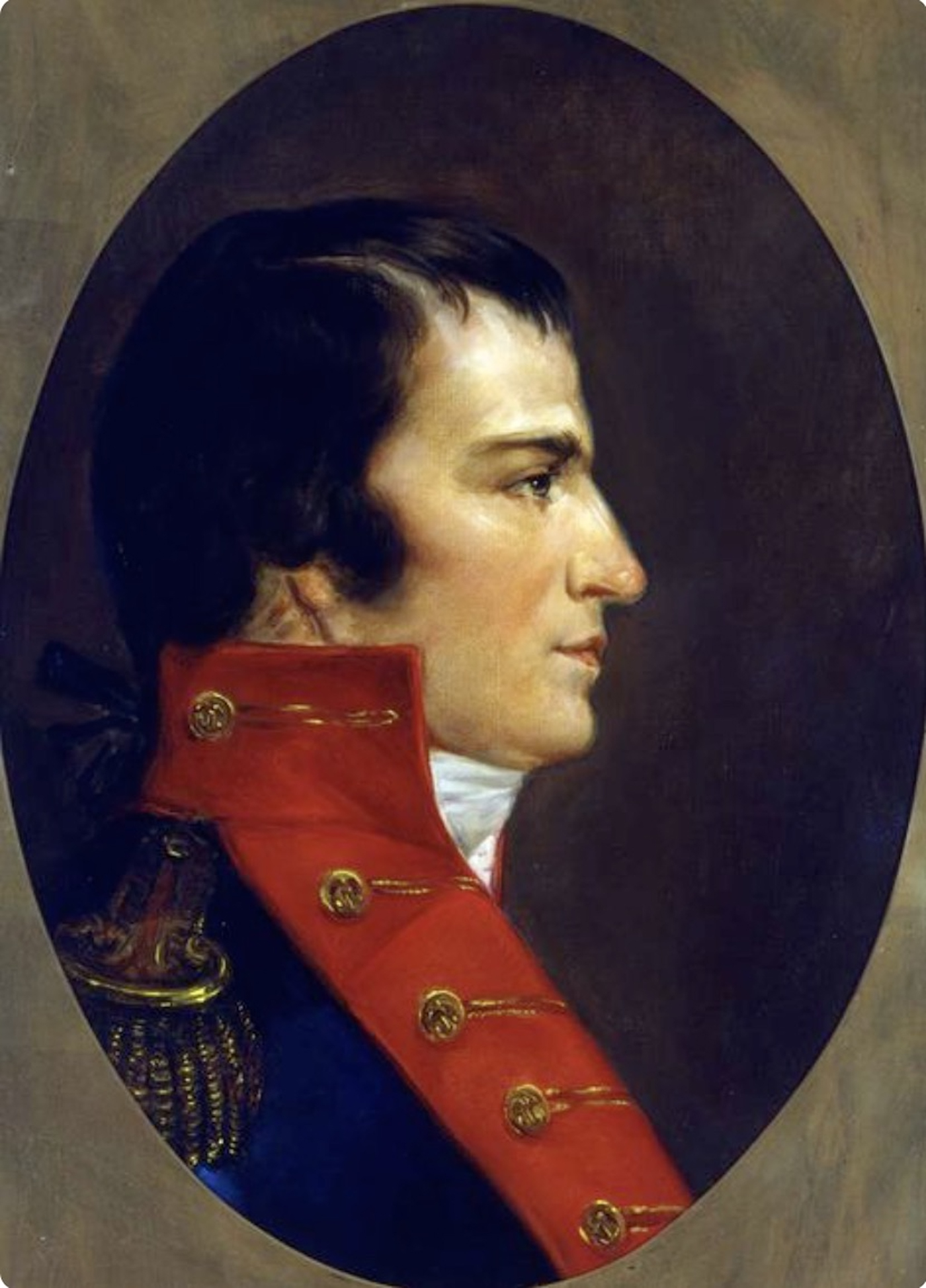
The cessation of war saw the end of the Continental Navy and its accompanying Marine force. When the last marine officer catalogued the government stores remaining aboard the Alliance he noted among the muskets, pistols and cutlasses a single drum, a drumhead, a set of sticks and a fife.Footnote 18 With peace now at hand, a cash-strapped Congress was in no mood to see the military resurrected, but the wars in Europe, coupled with the Barbary pirates sailing out of North Africa, placed American trade at risk. Federalists had long argued in favour of a strong navy to protect international trade, and in 1797 the Adams administration backed a series of bills that established a Department of the Navy and allowed for ships to be built, rented and purchased. On 11 July 1798 Congress passed an act establishing and organizing a new Marine Corps, and the next day President Adams appointed its first commandant, Maj. William Ward Burrows (see Figure 1).
Commandant William Ward Burrows, oil painting by John Joseph Capolino after a pastel by Edith McCartney, 1944. National Museum of the Marine Corps. Used by permission

Much like the authorization for the Admiral's Regiment, the 1798 bill spelled out the new service's personnel: ‘there shall be raised and organized a corps of marines, which shall consist of one major, four captains, sixteen first lieutenants, twelve second lieutenants, forty-eight sergeants, forty-eight corporals, thirty-two drums and fifes, and seven hundred and twenty privates’.Footnote 19 Burrows's first task was to raise these men, and letters to his recruiting officers make clear that the sounds of drums and fifes would be an important asset. On 6 September 1798 he wrote to Henry Caldwell informing him of his appointment as a second lieutenant and telling him that he should seek out men immediately. Caldwell was advised to find a recruiting sergeant and secure ‘as many drummers and fifers as you can’. Similar letters abound and make clear that Burrows placed a high priority on finding musicians: Lieut. Reuben Lilly was reminded to ‘enlist as many drummers and fifers as you can’ and Lieut. Jonathan Church was told that he ‘must endeavor to obtain music, I mean drummers and fifers’. Letters from the field indicate that the officers agreed on the importance of music. Lieut. John Johnson – writing from Frederick, Maryland – noted that ‘it is a difficult thing to enlist men in this place and more so without music’.Footnote 20
Given the challenges faced by his recruiting officers, in October 1798 Burrows petitioned the secretary of the navy to authorize an additional bounty for musicians. ‘It appears impossible to procure music without a bounty’, he wrote; ‘I wish you would give me liberty to expend such sum as I shall think fit for the Corps’.Footnote 21 Burrows had, in fact, already established a fund for music by mandating contributions from his officers. As he told the secretary, ‘we, at present, have agreed to raise $300 amongst ourselves, until your pleasure is known. Other troops give a bounty and volunteer corps expend large sums in this way, which makes it difficult to procure music of any kind.’Footnote 22 In other contexts, it would be reasonable to assume the men raised with this bounty were destined to form a band of music that would provide entertainment for the officers, but Burrows makes clear that his intention was to acquire the drummers and fifers necessary to the recruiting of ordinary fighting men. Lieut. David Stickney was informed that ‘the meaning of the officers advancing 10 dollars each for to procure drummers and fifers, is to raise a fund to enable them to give a bounty, which Congress will not give’. A month later, the same officer was reminded that if he could not enlist drummers easily, he was ‘authorized to advance a bounty out of the fund appropriated by the officers’.Footnote 23
Burrows's letters also indicate that he regularly bent regulations to enlist drummers and fifers. The War Department had placed limits on the number of foreign-born recruits the marines could accept, and Burrows reminded Lieut. John Hall that ‘you must be careful not to enlist more foreigners than as one to three natives’. He did, however, urge Hall to find ‘as many drummers and fifers as possible’, adding ‘I do not care what country they are of’. On another occasion he told Lieut. Newton Keene that ‘no foreigners or vagrants’ were to be recruited, but added that ‘drummers or fifers may be enlisted of any country’. Similarly, the Corps had established a height requirement, which Burrows had already lowered. Given their importance to recruiting efforts, drummers were exempted from this restriction: ‘they are to be enlisted of any size or age if found’.Footnote 24
APPRENTICE MUSICIANS AND THEIR MASTERS
Burrows's instruction that drummers could be enlisted of any size or age is early evidence that the US Marine Corps looked to its European models and enlisted young boys for use as signal musicians. An apprentice programme would become formalized at the Marine Headquarters in Washington, DC over the course of the nineteenth century, but in these earliest years the system seems to have been much more localized and informal: boys were taken in by enlistment and, when possible, educated in the field. In January 1799 Burrows told Capt. Lemuel Clark that if he could ‘procure any fine boys with their parents’ or friends’ consent’, he could ‘enlist them as fifers’, provided he could ‘have them taught’. Other letters suggest a similar arrangement in which young recruits were instructed by older musicians. In writing to Lieut. Edward Hall in New York, for example, Burrows gave permission to pay a bounty for a particularly skilled fifer, but he would be expected to teach: ‘I hope you will enlist the fifer you speak of, who you say plays music at first sight. If he is really fit to teach you may give him his price, if you cannot get him for less, but you must make him instruct your boys.’Footnote 25
The same 1798 act that established the Marine Corps allowed for the appointment of additional non-commissioned staff as needed, including drum and fife majors. On 23 January 1799 Burrows enlisted an Irish-born musician named William Farr and on 24 April appointed him as the first drum major in the United States Marine Corps.Footnote 26 The position of bandleader was not established until the Marine Band was formally authorized in 1861, but a variety of sources make clear that by the second decade of the nineteenth century the drum major was acting as de facto leader.Footnote 27 Extending this tradition further back, the modern Marine Band now considers William Farr its first leader. His duties probably included the instruction of boy drummers, the assessment of when they were ready to begin service aboard ship and some level of administrative oversight over both boy and adult musicians. A similar position of fife major carried parallel duties.
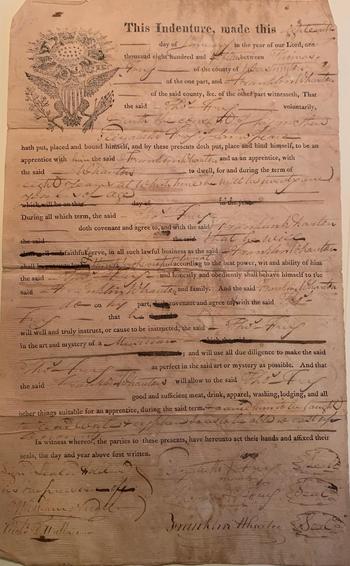
The Marine Corps’ musical apprentice programme has often sparked curiosity, in part because its most famous member was none other than John Philip Sousa, who enlisted in 1868 at the age of thirteen. It was not, however, a particularly unusual system. Boys of the eighteenth and nineteenth centuries often served apprenticeships, and similar programmes could be found in other US service branches and indeed attached to militaries throughout Europe. In this sense, it is simply another reminder that the drummers and fifers authorized by Congress in 1798 drew heavily on their Revolutionary and British models: they played an important role in recruitment, sounded the necessary signals in camp and aboard ship and were supplemented by boy musicians. The sheer number of boys learning music also suggests that the duties of the drum and fife majors were probably consumed by instruction and discipline, rather than anything approaching the work of a modern band conductor (see Figure 2).Footnote 28
An early Marine Corps apprenticeship agreement (1815). In this case the boy was bound to the second commandant, Franklin Wharton, to learn ‘the art and mystery of a musician’. Record Group 127, Entry 98 (Certificates of Indenture), NARA

MARINE MUSICIANS IN PHILADELPHIA
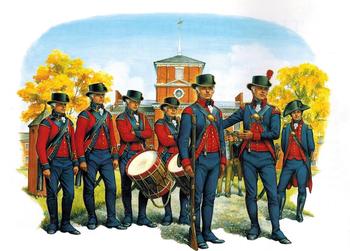
Most of the drummers and fifers enlisted by Burrows's officers were destined for dispersal to the fleet. A few, however, were retained in the temporary capital, and there is even some indication that Burrows – a cultured man who by all accounts enjoyed the trappings of his office – sought to gather his most skilled players in Philadelphia (see Figure 3). In April of 1799, for example, he bragged to Lieut. Weaver: ‘I have some of the best music at Head Quarters.’Footnote 29 The players he collected there were almost certainly used for recruiting purposes similar to those carried out by the Continental drummer observed by Benjamin Franklin. There are, however, a few hints that Burrows sought to place his musicians – drummers and fifers all – before a larger audience. On 27 November 1799 Burrows ordered two sergeants, sixteen men ‘and the music attend at the Frigate’. The occasion was the next day's launch of the Philadelphia, a subscription vessel whose construction was ‘evidence of the patriotism of the merchants of the city’.Footnote 30 This launch, then, was both a military and a civic event, one that inspired a crowd of several hundred to gather on the banks of the Delaware River. It is also the first time Marine musicians can be placed at a specific public occasion.
Marine musicians taking part in a recruitment drive outside Philadelphia's Independence Hall. In order to aid in their identification, military musicians have often worn distinctive or reversed uniforms as depicted in this painting by Donna J. Neary. United States Marine Band Library and Archives. Used by permission

Burrows soon found other opportunities to show off his players. The death of George Washington, on 14 December 1799, plunged the nation into a period of mourning, and a national funeral service was held in Philadelphia on 26 December. The two emerging political parties viewed Washington's legacy in somewhat different lights and, hoping to keep the nation fixated on America's first president, Federalist politicians devised several ways of extending the public mourning. President Adams issued a proclamation suggesting that his countrymen wear black armbands, and Washington's next birthday, 22 February 1800, was declared a national day of remembrance. Philadelphia's Society of the Cincinnati – a Revolutionary veterans’ association whose inherited membership gave it strong ties to the Federalist Party – arranged for a memorial service that began with a procession from City Hall to the German Reformed Church. The press does not detail the accompanying bands, but just two days earlier Burrows ordered ‘that the music parade at the State House on Saturday’ and ‘that they practice in the meantime General Washington's March’.Footnote 31 The Cincinnati again made use of Marine musicians on Independence Day when they hosted an ‘elegant entertainment’ at City Tavern, where the toasts were accompanied by ‘animating notes of martial music’ performed ‘by the band belonging to Colonel Burrows's corps of Marines’.Footnote 32
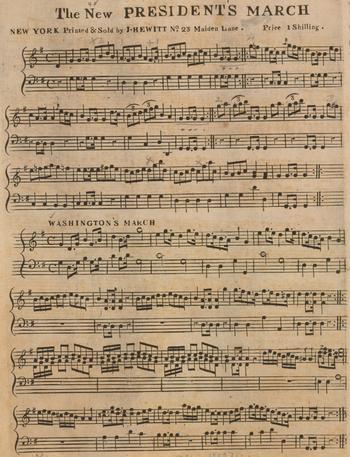
These three appearances – the November 1799 launch of the Philadelphia, the February 1800 procession in honour of George Washington and the 4 July entertainment at City Tavern – are the only performances by a massed group of Marine musicians that can be positively documented in the temporary capital. Several points are worth making about them. First, with the exception of the 4 July toasts, the press paid no attention whatsoever to these musicians. As music played a regular but unremarkable role in all sorts of military and civic occasions, such an oversight is hardly surprising. Furthermore, as Burrows's players were just one of several military-style ensembles present in the city, there was little point in drawing special attention to them. Second, there is no indication of what instruments these Marine musicians played, and indeed only one reference to a specific piece of music: Burrows's instruction that the band practise ‘General Washington's March’. Several tunes with this and similar titles were published in the late eighteenth century, but the most likely candidates for the February 1800 performance are those now known as ‘Washington's March’ and ‘Washington's March at the Battle of Trenton’, both of which were regularly performed by drums and fifes (see Figure 4).
Two possible candidates for the piece Burrows calls ‘Gen. Washington's March’: ‘The New President's March’ and ‘Washington's March’. Both of these works were printed in New York by J. Hewitt c1800, but can be found in other sources with variants in their titles. Library of Congress

Finally, coverage of the City Tavern entertainment provides one additional hint as to why Burrows may have sought to place his musicians before the public eye. In the debate leading to the Marine Corps’ original formation, Republicans made their desire for a temporary military quite clear. Speaking for the minority, Rep. Albert Gallatin (Republican, Pennsylvania) hoped that ‘this corps of marines will not be made a permanent part of the Military Establishment; but only have the same duration with the laws for equipping and keeping in employment the armed vessels’.Footnote 33 One way of ensuring this impermanence was to deny the Corps any strong leadership, and the 1798 authorization called for the ranking officer to be only a major. On 1 May 1800, however, Federalists were successful in promoting Burrows to the rank of lieutenant colonel, giving him field-officer status. In its reporting on the City Tavern event, the Gazette of the United States used Burrows's new rank, which provided Republicans with a very large target. Making matters worse, the commandant made no secret of his political ties. He was a well-known Federalist, he had packed his officer corps with like-minded men and his music had now been performed in events elevating the Cincinnati and celebrating the nation's first president: both were Federalist objectives that drew significant Republican criticism. Taken together, it seems that Burrows was using his musicians to draw attention to the young Marine Corps, something that would become increasingly valuable as the national capital moved to Washington and a new administration came to power.
A BAND FOR THE CORPS
When the federal government relocated to Washington in the summer of 1800, not everyone was eager to make the move. Burrows himself was so hesitant that at the end of June, Secretary of the Navy Benjamin Stoddert ordered him to Washington without further delay. On the day after the performance at City Tavern, Burrows wrote to one of his officers that he expected to be in the capital on 15 July, but ‘I shall bring nothing but music with me’.Footnote 34 The music Burrows brought would, in fact, come to play an important role in the city's small, but growing, cultural life. In the process, it helped to buttress the Marine Corps itself against a growing political storm.
When the Marines finally arrived in July of 1800, they set camp on a hill overlooking the Potomac in what is now Foggy Bottom. One of the commandant's friends in the city was William Thornton, the architect who had designed the US Capitol. On 21 August, Thornton's wife, the former Anna Maria Brodeau, noted in her diary that she and her companions ‘went on the Hill to hear the Band which was playing at the tents’.Footnote 35 In a letter from three months later, the commandant himself noted that he had given a ball on the hill and that ‘the evening was mild, the moon divine, and the music the best I ever heard; made up of Wilkinson's and my Band’.Footnote 36
Burrows had good reason to show off his musicians in the summer of 1800. The election of that year – a rematch between John Adams and Thomas Jefferson – again inserted the military establishment into the political debate, and Burrows knew that if Republicans came to power they might well move against the Corps. The very week of the hilltop performance, Burrows prophesied Jefferson's victory and also ordered Lieut. Edward Hall to ‘procure and send with all convenient dispatch’ two French horns, two C clarinets, one bassoon and one bass drum, as well as some clarinet and bassoon reeds.Footnote 37 If forming a European-style Harmonie was part of a plan to protect the Corps, Burrows was right to be worried. Within a year of taking office Jefferson dismissed several hundred marine privates, in March 1802 the House moved to reconsider the rank and pay of marine officers, and in February 1803 they pushed a bill to abolish the office of commandant altogether.
Burrows's instruments arrived by winter, and he quickly set out to place his musicians before Washington society.Footnote 38 The band's first documented appearance after the hilltop performances was the 1801 celebration of Independence described in Samuel Smith's letter to his sister. In addition to being a personal friend of the president, Smith also founded the nation's leading Republican daily, the National Intelligencer, which explained that during the White House reception, the band played ‘with great precision and with inspiring animation the President's march’. Later that day, at the boarding house of McMunn and Conrad, ‘a full band of music, detached from col. Burrows's Corps, played patriotic and festive airs’ alongside the usual round of toasts.Footnote 39 This occasion – in addition to being the band's first documented performance at the White House – marks the first time the ensemble can be placed front and centre in a patriotic celebration that included many of the capital's social and political elite. The White House reception was attended by department heads, civil and military officers, foreign diplomats and ‘most of the respectable citizens of Washington and George-Town’. The dinner hosted figures such as the secretaries of state, treasury and war, the postmaster general ‘and most if not all of the civil officers attached to the general government, the officers of the Marine Corps, and those of the frigates’. In their performance, the band was even praised by an openly Republican newspaper.
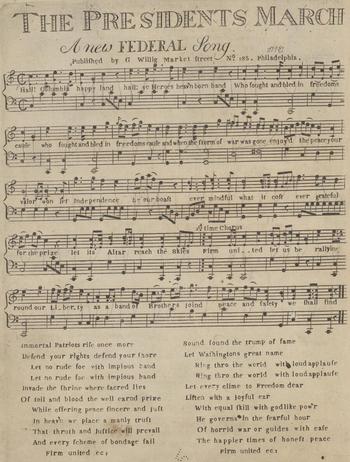
This 1801 event also offers a rare glimpse of the ensemble's repertory, and it is possible that they used the celebration as part of an even more subtle effort to ingratiate the Marine Corps with the new Republican administration. According to both Smith and his newspaper, on entering the reception the band struck up ‘The President's March’, a tune by Philip Phile composed for George Washington's 1798 inauguration. It had, since that time, become well associated with a text that Myron Gray has shown carried strong Federalist sentiments: Francis Hopkinson's ‘Hail, Columbia’ (see Figure 5).Footnote 40 When the band played at the White House, this instrumental performance was presumably rendered non-partisan. When it was sung at McMunn and Conrad's, however, the vocalist was Thomas Tingey, an officer who had been charged with overseeing the Navy Yard's construction. He did not perform the Hopkinson text, however. Instead Tingey used a new, avowedly non-partisan, variation by one of the dinner's organizers, Thomas Law, which included verses such as:
Press reports fail to indicate whether Marine musicians joined in on Tingey's song, but one cannot help but note that everything about this event – from the audience to the press to the music itself – could help shed the Corps’ partisan reputation in front of the very Republicans who would soon decide its future.
‘The President's March’, with the text ‘Hail! Columbia’, as published in Philadelphia by G. Willig, c1798. Library of Congress

President Jefferson and his guests would have many other opportunities to hear the Marine Band during his first term. A widower at the time of his inauguration, Jefferson avoided lavish parties, but the White House celebrations of Independence Day and the New Year became annual social events for the city. In addition to their 1801 appearance, the band can be placed at July celebrations in 1802 and 1803.Footnote 42 The toasts that accompanied the evening dinners on Independence Day were often reported in the press and in 1803 the National Intelligencer even noted some of the accompanying tunes. A salute to the president was followed by ‘Jefferson's March’ and one to the founding executive by ‘Washington's March’. The Revolutionary dead received ‘Roslyn Castle’ and the well-regulated militia was applauded with ‘Yankee Doodle’. On each New Year's Day, the mansion's doors were thrown open to visitors of all social classes and the president personally provided entertainment and refreshments. Marine musicians probably appeared every year during Jefferson's first term, and they can be positively placed at the event in 1802, 1804 and 1805.Footnote 43
It was not just at the White House, however, that Washington could hear this small band of Marines. A lack of churches in the young city prompted the House of Representatives to open its doors for religious services. Samuel Smith's wife – the former Margaret Bayard – provided a description of these unusual social events:
This sabbath-day-resort became so fashionable, that the floor of the house offered insufficient space, the platform behind the Speaker's chair, and every spot where a chair could be wedged in was crowded with ladies in their gayest costume and their attendant beaux and who led them to their seats with the same gallantry as is exhibited in a ball room.Footnote 44
While Smith does not provide a date for her memory, she did go on to note: ‘The marine-band, were the performers. Their scarlet uniform, their various instruments, made quite a dazzling appearance in the gallery.’ Rep. Manasseh Cutler (Federalist, Massachusetts) attended the services twice in February of 1805 and recalled that the band performed ‘Denmark’.Footnote 45 This state of affairs did not, apparently, last for long, and Smith noted that ‘the marches they played were good and inspiring, but in their attempts to accompany the psalm-singing of the congregation, they completely failed and after a while, the practice was discontinued, – it was too ridiculous’.Footnote 46
It is unclear for just how long the Marine Band continued to supply music for religious services, but in late 1806 a new commandant wrote to Capt. Anthony Gale asking that he acquire appropriate music: ‘As we have a scarcity of sacred music, and as we attend church on each Sunday, you will oblige me by purchasing a collection of pieces.’ Gale's response suggests that string instruments were used in these situations, and he wrote that he had ‘purchased the best collection of sacred music that could be found’ and shipped it along with ‘strings, etc. for the violincello’.Footnote 47 In any case, it seems that Washington's elite could have heard the ensemble on Sundays in the House chamber early in Jefferson's presidency, and that they continued to play at local churches for some years.
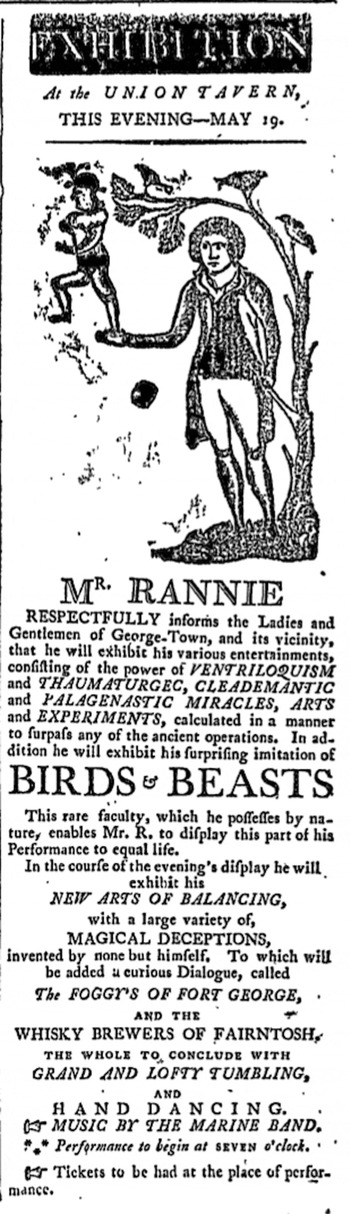
The band also appeared at social and theatrical events. The British diplomat Augustus Foster recalled attending dancing assemblies at the Navy Yard, where he may have heard Marine musicians.Footnote 48 In September 1802 the Alexandria Theatre presented a benefit performance of a play entitled The Mountaineers, along with a tumbling act and a farce under the title Jew & Doctor (probably Thomas Dibdin's two-act The Jew and the Doctor). Notices announce that ‘by permission of Col. Burrows, the Marine Band will join the music of the Theatre’.Footnote 49 A similar event took place in May of 1803, when the ensemble provided music at Union Tavern for what must have been an extraordinary entertainment of ventriloquism, magic, tumbling and hand dancing (see Figure 6).Footnote 50 These events are simply those documented by newspaper reports, and the Marine musicians were probably heard on many other occasions.
Advertisement from the Olio, 19 May 1803, showing the Marine Band participating in an evening of mixed entertainment

Throughout this period, the musicians authorized by Congress remained the drums and fifes of the signal music. It is clear, however, that Burrows was working to acquire other instruments and adapt his players to other purposes. In doing so, the fledgling Marine Band quickly became one of the better documented musical ensembles in the city. While it is possible that Burrows was simply hoping to provide entertainment for the young capital, the ensemble's palpable presence would have been a useful way to remind Republicans of the Corps’ social importance. There is even some evidence that Jefferson himself took an interest in the ensemble. On 31 March 1801 – just weeks after the inauguration – Burrows told one of his officers that he had ‘been all this morning engaged riding with the president looking out for a proper place to fix the Marine Barracks’.Footnote 51 According to tradition, it was during this ride that the president inspired an effort toward the band's expansion. Jefferson is well known to have been interested in Italian art, and he once sought out Italian musicians for Monticello. On several occasions in 1803 and 1804, he had the opportunity to hear a now mysterious ensemble that the press referred to simply as the ‘Italian band of music’.Footnote 52 It is possible that Jefferson was inspired by these players and that during one of their rides suggested to Burrows that he seek out musicians in the Mediterranean. Whatever happened, Burrows did direct Lieut. John Hall to recruit players while on service with Commodore Edward Preble during the war with Tripoli. These musicians arrived in Washington during the autumn of 1805 and would come to play an important role in the Marine Band's expansion during the early nineteenth century.Footnote 53
If Burrows hoped that a military band would derail attacks against his command, he was only partially successful. In 1803 Rep. Michael Leib (Republican, Pennsylvania) demanded a detailed accounting of the Corps’ books, and in early 1804 Rep. John W. Eppes (Republican, Virginia) introduced an amendment that would decapitate the service almost literally by removing most of its officers. Eppes's goals were clear, as ‘he was fully convinced the corps might be dispensed with, without any injury to the United States’.Footnote 54
In the end, Burrows was not a strong bookkeeper, and Leib's committee was able to uncover some $9,000 worth of irregularities. In the spring of 1804 an amendment to abolish the office of Lieutenant Colonel Commandant was attached to the Naval Peace Establishment Bill and cleared the House. Just a week before the critical vote in the Senate, Burrows – now in ill health and recently a widower – submitted his resignation. While the commandant would later be exonerated, Jeffersonian Republicans had cost him his command. Luckily for the Corps, however, the Senate neglected to approve the bill. There are many ways to explain this setback for isolationists in Congress, the simplest of which is mere overreach by the most radical Republicans amid military success abroad. Had Jefferson thrown his full weight behind the effort or had Washington's social elite turned on Burrows, however, the whole affair might have ended quite differently. There is no smoking gun to demonstrate that its fledgling band saved the Marine Corps, but its frequent appearance at all matter of occasions surely served as a positive reminder of the Corps’ contributions to social life in the city.
The United States Marine Corps would face other political threats, but never again would they be existential. Indeed, the scrutiny it faced under the Seventh and Eighth Congresses, if anything, spurred a move toward institutional maturity. Burrows's successor, Commandant Franklin Wharton, strove to appear less partisan than his predecessor (and to keep his account books in better order). One method of protecting his service was to entrench the band ever more firmly within the capital's social life, and by the mid-nineteenth century this collection of military musicians was widely regarded as the most important musical ensemble in Washington, DC. It would, indeed, go on to build a rather impressive résumé: its members fought in the War of 1812; it was present when the Washington Monument's cornerstone was laid in 1848; it accompanied Abraham Lincoln to Gettysburg in 1863; and it assisted in the dedication of the Statue of Liberty in 1886. In later years the band would make some of the first commercially released musical recordings, appear regularly at presidential inaugurations and in 1963 lead the funeral parade of a slain Commander-in-Chief. In short, this ensemble's history is interesting in its own right, but at the very start of the nineteenth century, it may well have played a central role in the survival of the Marine Corps itself. It was, it seems, semper fidelis – always faithful – from the very beginning.