Introduction
Mumbai, the commercial heart of modern India and one of the world's largest cities with a population of almost 20 million, derives its name from Mumbādevī, the patron Goddess of Mumbai. The worship of Mumbādevī long predates European settlement in western India, and it is widely believed that in the beginning she was the favoured Mother Goddess of the indigenous inhabitants of Mumbai, the Koḷī fisher community. Despite this pedigree, much touted in the tourist brochures of Mumbai, the city has only a single temple to Mumbādevī. Moreover, an extensive search of the literature has revealed that there are only three books that include an account of the Mumbādevī temple: a book in Gujarati by Dave (Reference Dave1985, pp. 238–265), Raghunathji's 1900 inventory of the Hindu temples of Mumbai (1900, pp. 29–32), and a modern inventory of the houses of worship in Mumbai by Ranade (Reference Ranade2004, 2 vols.). Various histories of the city of Mumbai mention the temple of Mumbādevī, but no major archaeological, historical or ethnographic account has yet been written of this temple to the Mother Goddess who protects Mumbai. To write about Mumbādevī, therefore, would seem to be a thankless task, given the lack of written records and the impossibility of undertaking an archaeological excavation of the current site in order to unravel some of the hidden history of the Goddess and the temple devoted to her. This paper therefore seeks to piece together what is known about Mumbādevī and places that are within the broader context of the beliefs and lives of Mumbai's contemporary residents, including their worship of other Mother Goddesses. In particular, we were keen to investigate the extent to which the preoccupations which Hindu fundamentalists have with the Hindu God Rāma have undermined the Devī in this throbbing city.
Myths About the Origins of Mumbādevī
Dave (Reference Dave1985, pp. 245–246) provides a useful summary of the various myths of origin associated with the temple of Mumbādevī. He notes that Mumbādevī belongs to the long tradition of ‘Earth Mothers’ that date back to the times of the Indus civilisation in about 3,000-1,500 B.C.E. He goes on to report that British residents of Mumbai in the nineteenth century described Mumbādevī as ‘Pārvatī’, the consort of Shiva. No doubt these reports were based on local information, suggesting that by the time of European settlement, Mumbādevī had started to become ‘Hinduised’, a process, which is well documented for other Mother Goddesses such as the river Goddess Pampā at Hampi (see below). Maria Graham's journal describes the Temple of Mumbādevī in the following manner:
The largest pagoda in Bombay is in the Black Town, about a mile and a half from the fort. It is dedicated to Momba Devee, or the Bombay goddess who, by her images and attributes, seems to be Parvati, the wife of Siva. (Graham,1812, p. 14)
A very different myth related by Dave associates Mumbādevī with a ‘Muslim tyrant’ called Mumbāraka (Dave, Reference Dave1985, p. 246) who ruled western India in the early fourteenth century. This tyrant was subdued by the Goddess who then assumed the name of Mumbādevī, the first half of that name being derived from Mumbāraka. At least one popular tourist website repeats the myth of the ‘sadistic giant’ although he is not described as being a Muslim probably because his name identifies him as such.Footnote 2 Like many other sources, this website claims that the Mumbādevī temple is very old (600 years) when in fact no authoritative source is available to substantiate any particular claims about its origins. Indeed, the existing temple by the name of Mumbādevī dates from 1737, although earlier versions probably existed in Bombay before then.
The myth of the Muslim tyrant or giant is also reported by Raghunathji in his 1900 inventory. According to him, the myth is based on a Sanskrit Purana of unknown date and authorshipFootnote 3 (Raghunathji, 1900, p. 31 footnote). According to this version, Brahmā initially favoured Mumbāraka and granted him the benefit of eternal life. When, however, the Gods saw that Mumbāraka had betrayed their trust and was harassing the inhabitants of Mumbai, they implored Viṣṇu and Śiva to intervene. Together they created a Devī or Goddess with the explicit purpose of destroying Mumbāraka. In the ensuring fight, Mumbāraka was defeated, and in defeat the Goddess invited him to make a wish. He wished that his name and hers be joined together to make ‘Mumbādevī’ and that the Goddess assume that name. Ever since then the people of Mumbai have worshipped the Goddess Mumbādevī. Raghunathji adds that the Mumbāraka to whom the myth refers is probably the Muslim king Mumbāraka the First, the head of an Islamic dynasty that ruled Mumbai in the early fourteenth century. Raghunathji adds that perhaps the name Mumbai had been given to the city by that Muslim ruler but that after his death, his unpopularity gave rise to a myth that was subsequently legitimised by the Brahmins in a Sanskritic Purāṇa:
It can also be supposed that the Emperor Mumbarak may have given this island his own name and called it Mumbapur or Mumbarak. That Emperor was a hater of the Hindu religion. For this reason the Hindus gave him the appellation of giant, and after his death composed the above account of his, which is now read and venerated as Puran. (Raghunathji, 1900, p. 31 footnote, para 4).
S. M. Edwardes also refers to this myth of Mumbādevī but, in his case, we also discover that the person who first wrote about the myth and claimed that it was based on a Sanskrit Purāṇa was Govind Narayan. He wrote an article about this in Bombay Past and Present (pp. 30–34 cited in Edwardes, Reference Edwardes1909, vol. 1, p. 24 footnote 1). Edwardes himself raises questions about whether Mumbāraka or rather Mubarak Shah 1 of Gujarat ever ruled Bombay, as his centre of power along the western Indian coast was Thane, on the mainland opposite the islands that constituted Bombay in the period of his reign from 1317–1320 (Edwardes, Reference Edwardes1909, vol. 2, p. 17). Muslim rule of this part of western India was shaky and alternated with Hindu overlordship until 1347. Thereafter, Bombay was fought over by the Muslim monarchs of the Deccan and the Gujarat for numerous centuries, although few Muslims settled on the islands of Mumbai.Footnote 4
The myths surrounding Mumbādevī clearly reflect historical interpretations that were almost certainly created by the high castes, most probably the Brahmins. Indeed, it could signify the beginning of the appropriation of Mumbādevī by the high castes. One notes that the legend that links Mumbādevī to Mumbāraka also parallels the legends surrounding the origins of Durgā, one of the most powerful manifestations of the Mother Goddess in India. In both cases, the power of the Devī is demonstrated through the slaying of the demon.Footnote 5
A third myth related by Dave (Reference Dave1985, p. 245) states that the stone image of Mumbādevī in the temple by that name was brought by a merchant from its original location in Saurashtra where it had been worshipped by the maternal uncle (māmā) of Rāvaṇa. It is said that the word Mumbādevī evolved from the term māmā. In this instance, the legend of Mumbādevī links the worship of the Mother Goddess to the Gujarati community that has settled in Mumbai during the last four hundred years. In none of the other records we have consulted is there any evidence to verify this legend or explain it in greater detail.
The fourth, most widespread and enduring myth about Mumbādevī states that Mumbādevī was first recognised and worshipped by the Koḷī tribal people, the original inhabitants of Bombay. This legend is also repeated on at least one internet site.Footnote 6 Raghunathji also links the worship of Mumbādevī to the Koḷī fisherfolk. In 1900 he wrote that although nobody could remember who had ‘consecrated’ the Mumbādevī temple, local informants said that the consecration had happened some 400 or 500 years before at ‘the expense of a certain fisherman.’ Raghunathji found this myth of origins to be plausible, given the long history of Koḷī settlement in Mumbai. He also cited linguistic evidence suggesting that because a popular female name amongst the Koḷī is ‘Munga’, the Goddess was probably originally called ‘Mungā Devī’ which later became corrupted as ‘Mumbādevī’. His alternative hypothesis was that the Brahmins of Mumbai might have changed the ‘gā’ in Mungā Devī to a ‘b’ as in Mumbādevī as it is usual with the Hindus to make changes and substitutions. (Raghunathji, 1900, p. 31, para. 1).
However, not all Koḷī communities around Mumbai subscribe to the above myth. A recent interview with Kiran KoliFootnote 7 (president of the Madh Island Fishermen's Co-operative Society near the western suburb of Andheri) revealed that Mumbādevī had no place in the mythology of these communities. Their myth did involve the seven āsarās discussed later in this chapter, but Mumbādevī was not one of them. Somewhat surprisingly, the site of the Virgin Mary of Bandra was included in his list of the seven āsarās.
The association between the Koḷīs and Mumbādevī is also not universally acknowledged in literature. For example, in his account of the Koḷīs in 1922, Enthoven makes not a single reference to Mumbādevī or the Koḷī's connection to any Devī. Rather, his account of the religious beliefs of the Son Koḷīs,Footnote 8 focused on their ‘hinduisation’ and in particular the manner in which they followed the teachings of Kalu Bhagat, a Koḷī guru who began to convert them to Hinduism during the times of the Peshwas (Enthoven, Reference Enthoven1922, vol. 2, p. 259).Footnote 9 According to Enthoven, the Koḷīs in the early part of the twentieth century worshipped Malhāri-Mārtaṇḍa (Khaṇḍobā) at the Temple in Jejuri, which ‘remains the chief shrine or centre of Koḷī worship’. (Enthoven, Reference Enthoven1922, vol. 2, p. 259)
The one thing on which British and Indian historians of Bombay agree is that the name Mumbādevī is a local, indigenous appellation rather than a Portuguese one. The Portuguese called Mumbai ‘Bombaim’. Malabari noted in 1910 that in the middle of the sixteenth century, the village and island of Bombaim was not known for anything other than the location of ‘the shrine of the old Hindu Goddess Mumbādevī (Malabari, Reference Malabari1910, p. 22). Malabari is adamant that the word Bombay itself is based on Mumbādevī (Malabari, Reference Malabari1910, p. 22, footnote +). Malabari also cites the view of Sir George Birdwood who also rejected, as many others have, the argument that the name ‘Bombaim’ derived from the Portuguese description of the natural harbour of Bombay as a ‘good bay’ or ‘Boon-bay’. S. M. Edwardes, in his Gazetteer of 1909, provides a long list of European and Muslim travellers who referred to Bombay and the manner in which they spelt the name Bombay or Mumbai (Edwardes, Reference Edwardes1909, vol. 1, pp. 19–20). The earliest of these references is to the Mirat-i-Ahmadi in 1507. After weighing up all the evidence, Edwardes also opted for the origins of the name Mumbai in the Koḷī Goddess Mumbādevī. (Edwardes, 1910, vol. 1, p. 21)
To varying degrees, all these myths survive in the culture of modern Mumbai. The relationship between the myths and particular Bombay communities including the Koḷī, is, however, poorly documented. The rest of this chapter describes the physical manifestations of Mumbādevī in Mumbai today and the place of Mumbādevī in the context of other Devī worship and more general worship.
The Mumbadevi Temple
The temple of Mumbādevī today is located behind Marine Lines, near the Gujarati cloth market. It was moved to this site in the nineteenth century from its prior location near the Victoria Terminus, Bombay's central railway station. According to Maria Graham who wrote her account in 1812, the temple was based in the ‘Black Town’ (Graham, Reference Graham1812, p. 14). Other reports say that the original Mumbādevī temple was to be found in the Fort area of Mumbai until the British decided to rebuild that part of the town in 1737 (Edwardes, Reference Edwardes1909, vol. 3, p. 357). Confusion about the history and location of the temple does not end here: some sources speak of the Mumbādevī temple on the Esplanade.
The temple was rebuilt on its current site by a wealthy Marathi merchant from Bombay, one Pandusheth Sonar, of the goldsmith caste. His descendants were still managing the temple in 1909 (Raghunathji, 1909, p. 31). However, Edwardes agrees with this history but goes on to insist that tank in front of the temple and all the surrounding properties were the property of a Kapol Bania, Nagardas Navlakhya and his descendants (Edwardes, Reference Edwardes1909, vol. 3, p. 359). The management of the temple, however, remained in the family of Pandusheth Sonar until 1888 when the advocate general of the Bombay Presidency filed a case against Vasudev Laxman, the husband of Pandusheth's granddaughter, for misappropriating temple funds. (Dave, 1987, pp. 248–249). On the 4th of October 1899 the court passed the temple administration to a committee of trustees. Because of the concentration of Gujarati merchants in the vicinity of the temple, the trustees would have been mainly Gujaratis and this has remained so to this date. This change in temple management may have at least partly contributed to the changing concentration of the worshippers who at first were predominantly the Marathi speaking Koḷīs and then increasingly Gujaratis. In the late nineteenth century, the guardian of the Mumbādevī shrine was a Gujarati Brahmin belonging to the Audich sub-caste (Raghunathji, 1900, p. 30). In 1900, the Marathi connection with Mumbādevī was revealed both in the clothing of the Devī (she wore Marathi drapes on ordinary days which were switched to silk for festive occasions) and in young married Koḷī couples visiting the temple to receive the Devī's blessings (Raghunathji, 1900, p. 30; Edwardes, Reference Edwardes1909, vol. 3, p. 358). But already in 1900, the Koḷī were not the only community to have a special relationship with Mumbādevī.
From 1900 till today, the Mumbādevī temple has formed part of a complex of nine temples dedicated to particular Gods and Goddesses. In the words of Raghunathji this group of adjacent temples constitute the ‘Mumbādevī range’. Today all nine temples take it in turns to celebrate the nine nights of Navarātra. Edwardes, writing in 1909, noted that the other temples in addition to Mumbādevī were dedicated to Ganeśa, Mārutī, Mahādeva, Indrāyaṇī, Murlidhara, Jagannātha, Narsobā and Bālājī (Edwardes, Reference Edwardes1909, vol. 3, p. 359). Raghunathji provides a detailed account of most of these but lists a number of additional temples that belonged to the same complex of shrines and adjacent rooms, namely, a second shrine to Narsobā, another room to Gaṇapati, a second Mahādeva shrine and two more shrines to Mārutī. In Raghunathji's account, the most authoritative that is available, the Mumbādevī complex included no fewer than 14 shrines or temples. (Raghunathji, 1909, pp. 25–34)
Temple pujaris or priests are chosen from all over India and at present there are two Marathis and four north Indian Brahmins providing this service. All the prayers and rituals are essentially brahamanical and the āratīs (ritual songs) are often in the Gujarati language.Footnote 10 The temple properties are controlled by a trust, which has a majority of Gujarati members.
We obtained conflicting information about the current involvement of the Koḷī community as devotees at the Mumbādevī temple. According to the Gujarati manager of the temple, these days the Koḷīs come to the Mumbādevī temple only once a year on Ekādaśī Day when a Brahmin priest is employed to ‘perform a Yagna at a specially built altar at the front of the temple.’ This statement, however, was not substantiated by two pujaris at the temple who informed us that to their knowledge, no such ritual had taken place in the recent past. These pujaris had been there for eight years. Asked if Koḷīs attended the shrine regularly, the pujaris answered, ‘we have no way of knowing if they do. These days people all wear the same gear and look the same. But there is certainly no special function for the Koḷī community as far as we know.’ It is likely that there was a special day for the Koḷīs in days gone by and a Yagna for the Koḷī community was indeed performed.
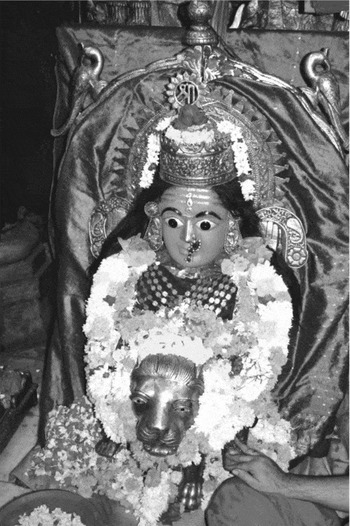
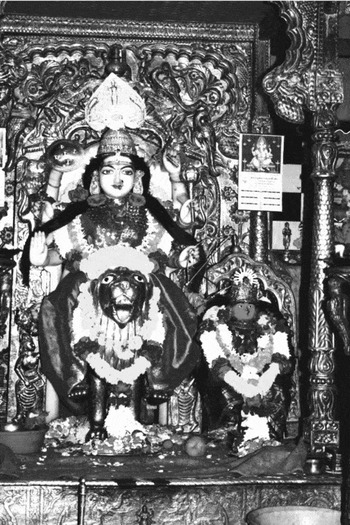
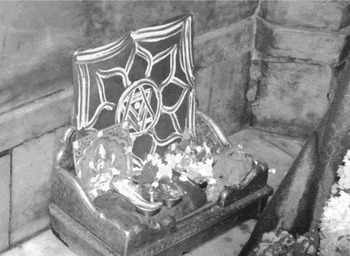
When Raghunathji wrote his description of the Mumbādevī temple, the sanctum sanctorum consisted of two stone images: that of the five feet Mumbādevī and to her left, the much smaller one foot image of Annapūrṇā. As it stands today, the shrine is divided into two alcoves and consists of three images. As the worshipper enters the inner sanctum, he finds that to the far left of the images is a silver Śri Yantra, the Maṇḍala of creation, an ancient Indian geometrical image that captures the cosmic power associated with the goddess. The Yantra acts as a cosmic conductor of energy, an antenna of nature, and a symbol of creation, preservation and dissolution (Mookerji and Khanna, Reference Mookerji and Khanna1977, pp. 56–58). Next to the Śri Yantra is the image of Mumbādevī, which takes the form of an elaborately painted face covering the original stone, which is said to have arisen by itself (swayambhū) from the seas surrounding Mumbai. Placed below this stone image is a brass tiger.Footnote 11 To the right of Mumbādevī in a separate alcove are first the images of Durgā and next to her, the much smaller image of Annapūrṇā. Durgā appears to be riding a large brass tiger (Figures 1, 2 and 3). When one of the authors of this chapter visited the temple in January 2004, Durgā carried a sword, but on a second visit in December 2004 the sword was absent. As it often happens with Indian gods and goddesses, the temple priests may add or remove the sword or other symbols at various times. During the second visit to the temple, a fourth image, that of the ubiquitous Gaṇeśa, in the form of a calendar that had been hung just above the image of Annapūrṇā, was also present. The relative size of the goddesses gives some indication of their potency and importance for the temple: Mumbādevī is five feet high, Durgā is about four feet and Annapūrṇā is about a foot.
Mumbadevi image
(Photograph by Jayant Bapat)

Durgā and Annapūrṇa Images

The Śri Yantra at the temple
(Photographs by Jayant Bapat)

The Śri Yantra is worshipped daily accompanied by chanting of the ‘Śrī Sūkta’. Installation of the Durgā image and especially the Śrī Yantra were obviously important steps in the Brahminization of the shrine. However, we were unable to ascertain when these changes were made.
The most interesting thing about Raghunathji's description of the Mumbādevī temple in 1900 is that there is no reference to the image of Durgā. Given his detailed description of this centrepiece of the Mumbādevī complex, we must assume that there was no image of Durgā in the Mumbādevī temple at this time. Rather, Raghunathji notes the five-foot high image of Mumbādevī was accompanied by the one-foot high Annapūrṇā image to the left of the Goddess. Annapūrṇā was ‘seated on a stone peacock’ on festival days. If this description is correct, then sometime during the twentieth century the image of Durgā was added to these two and interposed between Mumbādevī and Annapūrṇā. In other words, Raghunathji's description helps us to understand the process of Sanskritisation that has been taking place in the Mumbādevī temple over the last hundred years. Evidence of Sanskritisation was already obvious in Raghunathji's inventory. For example, on the verandah at the entrance to the Mumbādevī shrine stood a ‘four-foot high brass tiger’ that Raghunathji describes as the ‘Goddess carrier (Raghunathji, 1909, p. 29). It is more than likely that this same tiger now seats the new image of Durgā that has been added since then to the Mumbādevī temple. However, the association of Mumbādevī with Durgā was even older than this new tiger image that was installed in 1890, for Raghunathji notes that an ‘old — rough stone’ tiger image was lying in a ‘corner of the compound’. (Raghunathji, 1909, p. 29)
Further evidence of Sanskritization occurs in Raghunathji's description of the festival of Ashwin (October–November) when the keeper ‘arranged Mumbādevī in her richest silks and costliest ornaments, and lays besides her a drawn sword and a shield’ (Raghunathji, 1900, p. 30). In this sentence, the association of Mumbādevī with Durgā is firmly established with the coming together of the images of the tiger, sword and shield. In 1900, however, Sanskritisation had not yet totally obliterated the pre-Hindu forms of worship at the Mumbādevī shrine. For example, at the start of Ashwin a reserved area before the entrance to the temple was planted with rice and millet. The fledgling crop was sown at the end of Ashwin (October–November); the ‘pale seedlings’ were pulled out and presented to the Goddess (Raghunathji, 1909, p. 30). This ancient fertility rite no longer survives at the temple. In 1900 the links between the Koḷī and Mumbādevī were also stronger than they are now — on their wedding day Koḷī couples used to come to Mumbādevī for the blessings of the Goddess. (Raghunathji 1909, p. 30)
Clearly, during the last one hundred years, Mumbādevī has become more thoroughly Hinduised and made to blend more closely with the familiar representation of the Hindu Goddess Durgā. During the ten-day Durgā festival in March each year, Durgā's slaying of the buffalo-headed demon Mahiśāsura is commemorated and all the temples at Mumbādevī are honoured. The devotees do not distinguish between Durgā and Mumbādevī, although they prefer to call the main temple and the images ‘Mumbādevī’. The Devī, in other words, incorporates in her essence Durgā, the protector and Annapūrṇā, the provider. Both belong to the brahmanic pantheon and the much older Mumbādevī, the tribal Goddess of the original Koḷī inhabitants of Mumbai. Such confluences are common in India, and have been noted by amongst others, Fritz and Michell in their study of Vijayanagara. Here the river Pampā is associated with the original devi of Hampi, the local Goddess Pampā. Pampā became absorbed into the greater Hindu tradition by marrying the God Virūpakṣa (an aspect of Shiva). Despite this, ‘both god and site are defined in terms of the goddess’. (Fritz and Michell, Reference Fritz and Michell1991, pp. 49–50)
The melding of Mumbādevī and Durgā was probably facilitated by the importance of tiger worship amongst the Koḷīs. According to Dalmia, the Koḷīs share with other western Indian tribal people ‘a common religious awe of the Tiger God, roughly carved wooden statues of him can be seen installed in all parts of the district’ [of Thane] (Dalmia, Reference Dalmia1988, p. 13). The Tiger God made Durgā, whose vehicle is the Tiger, totally acceptable to the Koḷīs while for the Hindus the representation of the Tiger God made Mumbādevī totally compatible with the Hindu pantheon and Durgā.Footnote 12 Earlier on in her study of the Warli, Dalmia notes that ‘the Warlis seize the Hindu festivals and make them their own with true poetic justice’ (Dalmia, Reference Dalmia1988, p. 58). Similar judgements can be applied to the relationship between Hindu and Koḷī beliefs in Mumbai and, more specifically, between the enthusiasm with which Mumbādevī and Durgā have been worshipped by both the Koḷī and other Hindu communities.
The confluence of Durgā, Annapūrṇā and Mumbādevī also reflects the compatible characteristics of the Hindu Devī and the tribal Devī, both of them extremely powerful and both of them tracing their ancestry to the original Mother Goddess of India. The blending of the two Devī traditions was obviously facilitated by the unique characteristics of Durgā. Of all the Hindu Goddesses, Durgā stands alone; she is a virgin, unmarried and unaccompanied by any male partner. Durgā is nobody's consort. Mahiśāsura the demon desired her and tried to seduce her, but she cut off his head. In destroying the demon she demonstrated her supreme power even over the Gods, as none of the Gods, individually or collectively, had been able to kill the demon (Wangu, Reference Wangu2003, p. 176). The pedigree of Durgā is no less impressive than that of the original Koḷī tribal Goddess. It has been said that Durgā's status as an Indian Goddess can be traced to the Indus Valley civilisation. Numerous seals depict images of the proto-Durgā: some show a Devī-like image accompanied by a tiger; others show the Devī emerging from a tree and hypnotising a tiger or in dialogue with it; and a third group show the Devī as having a human torso and a tiger's body (Hiltebeitel cited in Wangu, Reference Wangu2003, pp. 25–26; Jayakar, Reference Jayakar1989, pp. 67, 72–76). The ferocious independence of Durgā is an apt reflection of the equally independent, and equally important Mumbādevī. It is not that one is superior to the other; rather the two have co-mingled. This was recognised by scholars such as Pupul Jayakar and Wendell Beane, who have described the beliefs and rituals surrounding the Earth Mother throughout India. According to Jayakar,
When she entered the Puranic pantheon, the virgin Earth Mother became Durgā, and, changing with provenance and tribe, her names and anthropomorphic forms are legion. (Jayakar, Reference Jayakar1989, p. 156)
In his analysis of the Devībhāgavata Purāṇa, Beane has shown that while the work describes Devī in her various forms, the primary intention of the work is the worship of the mother earth. (Beane, Reference Beane1977, p. 64)
The legends and beliefs surrounding Durgā also have political potency. After the composition of Valmiki's Rāmāyaṇa, many other Rāma stories incorporated Durgā coming to the assistance of Rāma in establishing a stable polity (Kinsley, Reference Kinsley1998. pp. 108–109). The reputation and popularity of Durgā was further strengthened in western India through the heroic exploits of Shivaji, the Maratha leader who challenged and won out over the Mughal armies. Popular accounts of the victories of Shivaji over Afzal Khan, the Mughal General, say that Shivaji's sword was victorious because Durgā-Bhavānī had entered it (Kinsley, Reference Kinsley1998, pp. 109–110). The sword is one of the symbols of Durgā's power and Shivaji named his sword Bhavānī. Popular cloth posters of Durgā sold on the streets of Mumbai show her with eight arms and wielding a sword in the right hand of the lower-most arm. A South Indian Chola bronze from c. 1,000 AD shows that in earlier times Durgā also had eight arms (Kinsley, Reference Kinsley1998, p. 103, photograph of Durgā with eight arms). Mumbādevī, in her own right and as a manifestation as Durgā, is clearly the protector of the city of Mumbai as all the legends associated with her are stories of protection.
On the other hand, the image of Annapūrṇā, who sits next to the image of Durgā as part of the temple triad, brings in the benign aspect of the Devī as the mother goddess and completes the picture. She is the provider, nourisher and sustainer. She is Pārvatī, the mother of the world. She is the great Mother Goddess manifested as the Goddess of the harvest, food and of cooking. She represents the other side of the Devī, namely the nurturer. The rites of planting seeds and offering the sprouting seedlings to the Goddess, which were observed at the Mumbādevī Temple at least up to the late nineteenth century (Raghunathji, 1900, p. 30), explicitly celebrated that characteristic of Annapūrṇā. The rituals of nourishment are not merely linked to pre-historic or animistic beliefs but also express the highest forms of spiritual nourishment.
The three images together thus represent a synthesis of brahmanic and folk Hinduism to represent the Devī in all her aspects. Not surprisingly, the most important festival that involved Mumbādevī was and remains Dussera, a ten-day celebration in the month of Ashwin of the Hindu calendar. Throughout India, Dussera celebrates the Mother Goddess, who in the case of Mumbai, is simultaneously Mumbādevī. In his description of Dussera in the early twentieth century, Edwardes writes:
The largest gatherings take place at Mumbādevī, Bhuleshwar and Madhav Baug. Here the people worship the shami or apta tree, and after offering leaves to the Goddess distribute them among their friends and relatives. (Edwardes, Reference Edwardes1909, vol. 1, p. 173)
Again, the inclusive nature of Devī worship should be noted here—not only were the largest gatherings outside the largest temple complexes but again throughout India, Dussera has involved honouring all the Goddesses and Gods even though Durgā is the centre of attention during this festival.
Mumbadevi in the Context of the Mother Goddesses of Mumbai
Mumbādevī is not the only Mother Goddess worshipped in Mumbai. Raghunathji's 1900 inventory lists a total of 403 temples of which 70 (17%) were Devī temples (Appendix 1). Appendix 2 provides a list of these Devī temples. An analysis of this material showed that the most numerous temples were to Kālī (22), followed by 17 to Jari-Mari, the Goddess of Life and Death (sometimes described as the Cholera Goddess), eight to Śitalā Devī, the Smallpox Goddess, nine to Rakhmāī, five to Lakṣmī and four to Rādhā (Appendix 2).
The Koḷīs of Mumbai also worshipped a surprisingly large number of Devīs and Devas in 1900, despite the myth that they were mainly followers of Mumbādevī. Appendix 2 shows that at the end of the nineteenth century, the Koḷīs also revered Lakṣmī, Kalkā Devī, Chaṇḍikā Devī, Chedā Devī, Golbā Devī, Mhasobā, Jari Mari, Śitalāmātā, a sand lingam, and many others. Appendix 2 also shows that many devi temples in Mumbai were founded by Koḷīs.
Recent visits to Mumbai and a study of the various works on the Koḷī tribes have confirmed that the religious beliefs of the Koḷīs have remained far more inclusive than the mythology of the temple of Mumbādevī would suggest (Ghurye, Reference Ghurye1963, p. 190; Punekar, Ch. 7).Footnote 13 According to the head of one of the Koḷī Samāj (Association) of Mumbai,Footnote 14 the Koḷīs today worship no less than nine Goddesses. There are about 23 Koḷī villages remaining in modern Mumbai. The seven that we have visited are dedicated to different Devīs including Khāḍadevī, Harbādevī, Hinglādevī, Khāmgādevī, Mahālakṣmī and the Virgin Mary. In addition to these Devīs, the Koḷī also revere minor goddesses, the āsarās or water spirits.Footnote 15 It is said that these seven spirits are sisters, and they are accompanied by their seven brothers. In many of the Koḷī temples that we have seen, each of the brothers has a shrine at the entrance to the main goddess temple. It is traditional to pay one's respects to the brothers first before proceeding to the main Devī shrine.
In Mumbai today, as in the rest of the state of Maharashtra, the supreme Goddess of the Koḷīs is Ekavīrā Devī. Her principal shrine is located opposite the Karla caves near Karjat. This contradicts the old myth that the main Goddess of the Koḷīs is Mumbādevī.Footnote 16 The nature of worship around the Ekavīrā Devī temple is the subject of a forthcoming paper. Ekavīrā Devī has a considerable retinue of other Goddesses. We have visited seven Koli temples in Mumbai and discovered that each of them has a particular Goddess manifestation unique to that temple. The first of these studied by us is a temple built around the swayambhū (self arising) stone image said to be that of Khāḍādevī. Khāḍādevī is the Goddess of the Cuff Parade Koḷī Village, but her shrine is located within the compound of the Colaba Police Station, about a kilometre away from the village. A separate paper about this temple and the rituals around it will soon be published by us. Our fieldwork has shown that even if a Koḷī temple is dedicated to a special, favourite local Goddess this does not happen to the exclusion of other Devis and Devas. The other objects of worship in the Colaba Koḷī temple include Ganeśa, Lakṣmī, Marutī and even Buddha. In this manner, the Colaba shrine is a microcosm of the complex beliefs and worship of Mumbai's citizens. Raghunathji's report of 1900 already noted a similar cosmopolitan mixture. His inventory establishes for us the basic principle of a Hindu temple in Mumbai: in addition to the main deity many smaller shrines appear inside temples in order to accommodate a range of personal and family favourites. Hence Raghunathji reports that a shrine to Śitalādevī was to be found on the steps to the Siddheshwara Temple (Raghunathji, 1900, p. 217) and also at the entrance to the Mahādeva temple (Raghunathji, 1900, p. 256). Thus, the name by which a particular temple or temple complex is known is insufficient to determine which Goddesses and Gods were actually worshipped at these shrines by the devotees. Indeed, the conclusion that springs from Raghunathji's account is that it would be futile to attempt to develop a hierarchy of Goddesses and Gods as an index to what was more popular and what was less popular. It would be more sensible to simply note the complexity of the Hindu pantheon and the diversity of worship that continued to ensure an important place to the Devī, the Mother Goddess and protectress of India and the protectress of Mumbai in the form of Mumbādevī. These observations are as pertinent today as they were in 1900.
We can apply an interesting test to this argument. Modern scholarship has noted that at the time that Raghunathji was compiling his inventory, the Indian nationalist leader Tilak was vigorously campaigning to establish the Gaṇapatī festival and veneration of Ganeśa as a major expressions of the nationalist sentiment of the Indian masses. As Kaur has noted, during the 1890s the images of Ganeśa assumed an increasingly ferocious and warlike demeanour (Kaur, Reference Kaur2002, pp. 69–75). Despite this only thirteen or a mere three percent of the temples listed by Raghunathji were specifically dedicated to Ganeśa. Of course, Ganeśa was worshipped in many of Bombay's temples and smaller shrines and at home, and remained a very popular god throughout the city. But in no way was this different from the worship of other Devas and Devīs. Thus we learn from Raghunathji that even at the height of Tilak's campaigns during the 1890s Ganeśa did not achieve the kind of privileged position that modern historians sometimes have assumed. We believe that similar assumptions can be made today about Rāma. Hindu fundamentalists have tried to elevate Rāma into the supreme Hindu God, but there is little evidence to show that this has succeeded with the Hindu masses of India, including those living in Mumbai.
Another temple, that of Lakṣmī-Nārāyaṇa at old Nagpada road, was described by Raghunathji as of recent origin in 1900. Interestingly, this shrine had been originally built by a Koḷī fisherwoman only 12 years before (Raghunathji, 1900, pp. 161–162). At the centre of the shrine were two white marble images of Lakṣmī and Nārāyaṇa, but other images such as those of Gaṇapatī, Viṭhobā and Rakhmāi and Hindu religious symbols were also scattered throughout the premisesFootnote 17.
Raghunathji's description of the proliferation of Devī worship is something of which we have a better understanding today, thanks to the work of Hawley and McKean. The key realisation is that the Devis and Devas of India are not static entities. Rather, they are constantly evolving and indeed giving birth to new incarnations. Hawley has described the emergence of a new Devī, Santośī Mā, through the medium of Bollywood (Hawley, Reference Hawley, Hawley and Wulff1996, pp. 3–9) and McKean has analysed the complex interplay between nationalism, culture and religious belief in her description of the emergence of Bhārat-Mātā or Mother India (McKean, Reference McKean, Hawley and Wulff1996, pp. 250–280). More recently Madhu Kishwar has reported the birth of yet another Devi in Delhi, the Cleanliness Goddess who is newly venerated by the street vendors. (Kishwar, Reference Kishwar2005, pp. 1–13)
Despite its unique qualities, Raghunathji's inventory is by no means a complete account of the Hindu temples of Mumbai in 1900. For example, Ranade's list of houses of worship, published in 2004 for western Mumbai names many temples which should have appeared on Raghunathji's account. One of these is the Harbādevī-Haradādevī temple at Madh Island near the Fort of Mumbai. According to Ranade, this shrine was rebuilt in 1954 but its origin dates to the early thirteenth century (Ranade, Reference Ranade2004, p. 42). Ranade has judged the existing site to be worthy of excavation and conservation for beneath the modern renovations lies the original temple dating to the Yadava era. The present temple is a very plain structure that remains intimately linked with the local Koḷī community who sheltered in the temple during the freakish weather conditions created off the coast of Mumbai by the Indonesian tsunami on Boxing Day 2004 (Thakurdesai, Reference Thakurdesai2005). As noted earlier, Harbādevi-Hardādevi is one of the Goddesses worshipped by the Koḷīs. The Madh Island temple is devoted to her but also to Hanuman. (Ranade, Reference Ranade2004, p. 42)Footnote 18
Mother Goddesses Within the Context of Hindu Worship in Mumbai Today
As in 1900 and before, many of Mumbai's Hindu temples today are dedicated to the Devī in her various incarnations. It is unlikely that modernity has had any impact on reducing the number of worshippers who follow even those manifestations of the Devī that may appear to outsiders to be increasingly irrelevant. For example, it would be easy but foolish to conclude that the eradication of smallpox has reduced the followers of Śītalāmātā or that the social reform movement to stamp out the devadasi system of offering young girls to the Goddess Yellamā has caused the Goddess Yellamā to be neglected.Footnote 19 For the vast majority of Mumbai's citizens, worship is not driven only or primarily by practical needs but rather by faith and belief, or by practical needs to which the most comforting response is belief and faith. This has not changed since Raghunathji published his study in 1900.
There is another shrine of great popularity and durability in Mumbai. One large marble post on the corner of an elaborate cast iron fence that surrounds a former merchant's mansion of Mumbai has evolved into a holy Christian site. There is a cross at the top of the pillar and beneath it a grilled enclosure that houses figures representing the Virgin Mary and the baby Jesus. Day and night, candles at the bottom of the pillar burn brightly and every Wednesday evening hundreds of people from all religious persuasions come to offer their respects in return for the hope that their wishes will be granted. Throughout Mumbai, Wednesday evening is an occasion of popular worship that brings non-Christians into the company of Christians to celebrate Novena. In the large Christian churches of Mumbai, a special prayer meeting is held after the evening mass, to help the needy and people of non-Christian faith are welcomed. In observing the popularity of the Mother Mary at this shrine it is hard not to imagine that many of the Hindu worshippers are in effect placing their hopes and fears before yet another incarnation of the Devī. As mentioned earlier, the Virgin Mary actually assumes the form of one of the seven sisters or āsarās revered by the Koḷī community of Madh island. They have a special Koḷī name for her, ‘Maut Mauli’. Connections between the Koḷī devis and the Virgin Mary appear in many other stories about the beliefs of the original tribal inhabitants of Mumbai. For example, the well-known Church of the Virgin Mary at Bandra is said to have originally been a sacred site on which there once sat a Koḷī shrine.
The potency of the Devī affects all aspects of life in contemporary Mumbai, depending on the beliefs and wishes of the individual worshipper. The majority of taxi drivers have images of Hindu Goddesses and Gods and burn incense while driving their clients. Many small shrines exist in shops; for example in 2005 the camera shop opposite the Regal Cinema displayed a tiny Ganeśa with red jewelled eyes sitting on top of a glass display case. It is the benign form of Ganeśa that is now popular, rather than the warrior form of the nationalist movement (Kaur, 2003, p. 3). Interstate and international calling booths also have their favourite deities depicted on postcards and posters hung with marigolds amongst the most popular shrines are those to Durgā. Street vendors and handicraft shops sell cloth and paper posters of all Goddesses and Gods in many sizes, colours and decorative styles. The most expensive posters are covered in glass beads and sequins stitched to the painted surfaces, giving them a shimmering quality. Again, Durgā, Kālī, Lakṣmī, Pārvatī and Sitā are great favourites. The Shiv Sena has not campaigned against these representations of the Hindu pantheon, in contrast to its other campaigns to ban the use of the images of Goddesses and Gods on wrapping paper and shopping bags. Even Internet cafes have small shrines devoted to the proprietor's favourite deity. In one of the largest Internet cafes in Colaba, it is not uncommon to come across tourists coughing uncontrollably because of the copious volumes of incense that the manager burns in front of his six-inch high brass Durgā.
The most dramatic recent example of the importance of the Devī to modern Mumbai occurred when Govinda, one of India's best known Bollywood actors, won the seat for North Mumbai in the national elections of May 2004. Prior to contesting the election as a member of the Indian National Congress Party (headed up by Sonia Gandhi), Govinda returned to his home-town of Virar and prayed to the Devī housed in the temple of Jivdani (Kumar, Reference Kumar2004; Lokhande, Reference Lokhande2004b; Lokhande, Reference Lokhande2004c). Virar is the final station at the end of Mumbai's suburban railway line. After a landslide victory which gave him a margin of over 4%against the incumbent minister for petroleum Ram Naik (Parliamentary Constituency: North Mumbai, 2004),Footnote 20 Govinda returned to Virar to thank the Goddess by climbing the 1,200 steps to her shrine to pray before the image (puja) (Lokhande, Reference Lokhande2004a). Govinda apparently had had no intention of entering politics but was invited to do so by Sonia Gandhi (Jha, Reference Jha2004). Sonia herself comes from a dynastic family, which reached the pinnacle of its power under Indira Gandhi, widely described throughout India as Mahāśaktī—a term which translates as ‘Great Female Power’ and is usually reserved to describe the potency of the Great Mother Goddess, the Devī. The sensational result of the May 2004 national elections, in which five out of six Mumbai seats fell into the hands of the Congress Party after the dominance of the BJP for some ten years, has no doubt further increased the popularity of the temple at Jivdani. Jivdani has been growing in importance during the last two decades with some 25,000 devotees attending there every Sunday (Manju, Reference Manju2004). Temple practices today include not only the usual blessings and offerings but also animal sacrifices. In response to the increasing pressure of pilgrims, temple renovations began in 1996 under the guidance of the renowned Mumbai temple architect Hariprasad H. Sompura (‘Temple on hill gets a facelift’, 1996).
Conclusion
Although very little is known about the history, culture and archaeology of the Devīs of Mumbai, every so often the international press reminds everyone about the importance of the Goddesses of India. One such event occurred on 25 January 2005 when some 265 pilgrims were killed and more than 200 injured during a fire and stampede at the western Indian temple of Kaḷubāī or Manḍhardevī. Kaḷubāī is one of the manifestations of Durgā who is in turn one of the manifestations of the Mother Goddess of India. Like many other popular Devīs in rural India, Kaḷubāī originally belonged to the smaller tradition of village India and was worshipped as a matṛkā or guardian goddess who ensured that the village was kept safe from harm. Today, the worship of Kaḷubāī at Māndhardevī near Wai, about 250 kilometers south of Mumbai, has become a grander affair attracting some 300,000 pilgrims a year to the full moon festival (AP, 2005).
The popularity of the Māndhardevī Temple near Wai is a microcosm of the high regard that remains for the Devī in cosmopolitan Bombay. Although the BJP attempted to elevate Rāma to unprecedented heights of cultural and political importance, the Devī, in all her various manifestations, retains a vigorous presence in the physical structure of Mumbai and in the hearts of her citizens.
The temple of Mumbādevī is only one of the thousands of temples that are scattered throughout the city, and the temples are only one manifestation of the religious life of Mumbai's citizens. Both the temples and the religious life of Mumbai are poorly researched and understood, with myths taking the place of established fact and scholarship. In that mythology, the Koḷīs have a special relationship with Mumbādevī.
As this paper has argued, since the early twentieth century, the hinduisation of the Koḷīs has resulted in their worshipping many Hindu Gods and Goddesses. First noted by Enthoven, hinduisation has continued without undermining the potency of Mumbādevī or other earlier Devis in Mumbai. Hinduisation has been accompanied by a parallel process amongst the Marathi and Gujarati communities in particular—these have appropriated Mumbādevī and incorporated her into their own Sanskritised traditions. The Mukteshwar Mandir in modern day Juhu represents yet another example of this infinitely complex interaction between the Koḷī and the Hindu communities of ancient and modern Bombay. Built in 1668 on a site long worshipped by the Koḷīs, the temple was rebuilt in the nineteenth century and again during the 1980s and today is the property of the Mukteshwar Devālaya Trust (Ranade, Reference Ranade2004, p. 26). But perhaps the most important conclusion we have reached about the potency of the Devis of Mumbai today is that they have not been overthrown by Rāma despite the efforts to harness religious belief to the agenda of narrow minded, Hindu fundamentalist political parties. Thus, the Shiv Sena of contemporary Mumbai have failed, as did Tilak in the nineteenth century, to codify Hindu religious thought into a simplistic straight jacket of political narrative. Instead, contemporary Mumbai preserves the eclectic and syncretic traditions of western India in a celebration of religious diversity that provides the observer with an exuberant culture of complex religious practice and thought.
Appendix 1
Hindu Temples of Bombay in 1900
(The Popularity of certain temples in Mumbai 1900.
(A content analysis of a 1900 list of 403 temples in Mumbai)

Definition: All temples with the word Devi, plus known Devi temples such as Jari Mari, Lakshmi etc. have been included in this analysis.
Source: Raghunathji (1900).
Appendix 2
The Devi Temples of Mumbai in 1900
(The spelling of the names in this table reflects the original used in Raghunathji's 1900 text. We have not used diacritics here as this might confuse the reader wanting to check our summary against the original source. Neither have we changed the names which were incorrectly spelled e.g. Mahalakshumi)

Notes: Col. 1 the temple No. given by Raghunathji.
Col 2 the name of the temple.
Col. 3 the images of the Goddesses and Gods found in the temples.
Col. 4 the relationship of the temple to the Koli.
The last three temples in Table 2 are not Devi temples but they have been included here because they all had a special relationship with the Koli community of Mumbai.