Introduction
Cutaneous squamous cell carcinoma (cSCC) represents a growing public health concern, particularly given the increasing incidence linked to population ageing and cumulative ultraviolet (UV) exposure. As the second most common keratinocyte carcinoma after basal cell carcinoma, cSCC represents a growing public health concern due to its rising incidence and metastatic potential. Despite a generally favourable prognosis for early-stage disease, cSCC carries a significant burden of morbidity and mortality when associated with aggressive histologic features, perineural or lymphovascular invasion, deep tissue involvement or regional and distant metastases. In fact, cSCC is responsible for the majority of deaths attributed to non-melanoma skin cancers.Reference Rogers, Weinstock, Harris, Hinkley, Feldman and Fleischer1
The majority of cSCC lesions are managed effectively with surgical resection alone, particularly when diagnosed early and lacking high-risk features. However, approximately 3 per cent to 5 per cent of cases are considered high-risk, defined by a constellation of clinical, histopathologic and patient-specific factors that confer a higher likelihood of recurrence, nodal involvement or metastasis. Cutaneous SCC arising in the head and neck region are classified as high-risk according to the United States National Comprehensive Cancer Network guidelines.2 Furthermore, surgical margins in this anatomical area tend to be narrower due to functional and structural constraints, which may contribute to an increased risk of local recurrence. These high-risk tumours require a more nuanced and often multidisciplinary approach that includes consideration of adjuvant radiotherapy and, increasingly, systemic therapy.
Historically, the management of high-risk resected cSCC has been limited to surgery followed by radiotherapy in selected cases. Systemic therapy options were primarily reserved for unresectable or metastatic disease. However, recent advancements in immunotherapy, particularly the development and approval of anti–programmed cell-death protein 1 (PD-1) checkpoint inhibitors such as cemiplimab and pembrolizumab, have reshaped the treatment paradigm. These agents have demonstrated durable responses in patients with advanced cSCC and are now being evaluated in earlier disease settings, including as adjuvant or neoadjuvant therapies.
The 2025 American Society of Clinical Oncology (ASCO) annual meeting presented landmark data from randomised phase 3 trials—KEYNOTE-630 and C-POST—that evaluated the efficacy of adjuvant immunotherapy in patients with resected high-risk cSCC. These trials have begun to define the role of systemic therapy in this patient population, with cemiplimab emerging as the first agent to significantly reduce disease recurrence risk when administered post-operatively.Reference Rogers, Weinstock, Harris, Hinkley, Feldman and Fleischer1–Reference Karia, Jambusaria-Pahlajani, Harrington, Murphy, Qureshi and Schmults4
This review aims to provide a comprehensive update on the current management strategies for high-risk cSCC, with a particular emphasis on the implications of these recent clinical trials. We outline the evolving standards in diagnosis, staging and treatment, while also examining emerging data on biomarkers, circulating tumour DNA (ctDNA) and future directions in precision oncology. The goal is to equip clinicians with the latest evidence-based tools to guide personalised, effective care for patients facing this increasingly complex disease.
Material and methods
This narrative review was conducted in accordance with the Scale for the Assessment of Narrative Review Articles (SANRA) and the recommendations of the International Committee of Medical Journal Editors for transparent reporting.Reference Baethge, Goldbeck-Wood and Mertens5 Preferred Reporting Items for Systematic reviews and Meta-Analyses (PRISMA) 2020 Checklist for Narrative Review has been included as Supplementary Material.
Because the work synthesises previously published data and material in the public domain, neither institutional-review-board approval nor informed consent was required. Before any literature searches were run, the review team (F. P., E. D. C. and V. C.) drafted and unanimously approved a protocol that prespecified the objective, search strategy, eligibility criteria, data-extraction fields and evidence-grading approach. The protocol is archived in the first author’s institutional repository and can be accessed on request (F.P.).
A comprehensive search of PubMed, Embase, Web of Science and the Cochrane Central Register of Controlled Trials identified articles published between 1 January 2015 and 31 May 2025. The following combination of keywords and Medical Subject Headings (MeSH) was used: (“cutaneous squamous cell carcinoma” OR cSCC) AND (“high risk” OR “perineural invasion” OR “extracapsular extension” OR “nodal”) AND (“immunotherapy” OR cemiplimab OR pembrolizumab OR “PD-1” OR “neoadjuvant” OR “adjuvant”) AND (trial OR cohort OR “clinical study”). Searches were limited to human studies published in English; no study-design filters were applied at this stage to maximise sensitivity. To capture emerging evidence, we hand-searched abstracts presented at major conferences—ASCO, European Association of Dermato-Oncology (EADO), American Academy of Dermatology (AAD) and Society for Investigative Dermatology (SID)—for the years 2020 through 2025. In addition, relevant information was retrieved from the websites of the US Food and Drug Administration, the European Medicines Agency and the National Comprehensive Cancer Network. These steps are fully aligned with the supplementary methods paragraph in the original manuscript. The search strategy is included as Supplementary Material.
Eligibility criteria
Eligible studies enrolled adults (≥ 18 years) with histologically confirmed high-risk cSCC as defined by the American Joint Committee on Cancer (AJCC), 8th edition, or the Brigham and Women’s Hospital (BWH) classification. Interventions of interest included surgery, radiotherapy, systemic therapy (programmed cell-death 1 inhibition, targeted agents or chemotherapy) and neoadjuvant approaches. Studies had to report at least one oncological outcome such as recurrence-free survival (RFS), disease-free survival (DFS), overall survival, pathologic complete response or objective response rate (ORR). Acceptable designs comprised randomised controlled trials, prospective or retrospective cohort studies, case–control studies and systematic reviews or meta-analyses. Exclusions were applied to non-English publications without reliable translation, single-case reports or opinion pieces when higher-level evidence on the same question existed, preclinical investigations and studies that focused exclusively on non-high-risk disease.
Screening and study selection
Two reviewers (F.P. and E.D.C.) independently screened titles and abstracts in duplicate by means of Covidence software (Covidence systematic review software, Veritas Health Innovation, Melbourne, Australia). Full texts were retrieved for all records deemed potentially relevant. Disagreements were resolved by consensus, and a third reviewer (V.C.) adjudicated unresolved conflicts.
Quality of studies and risk of bias
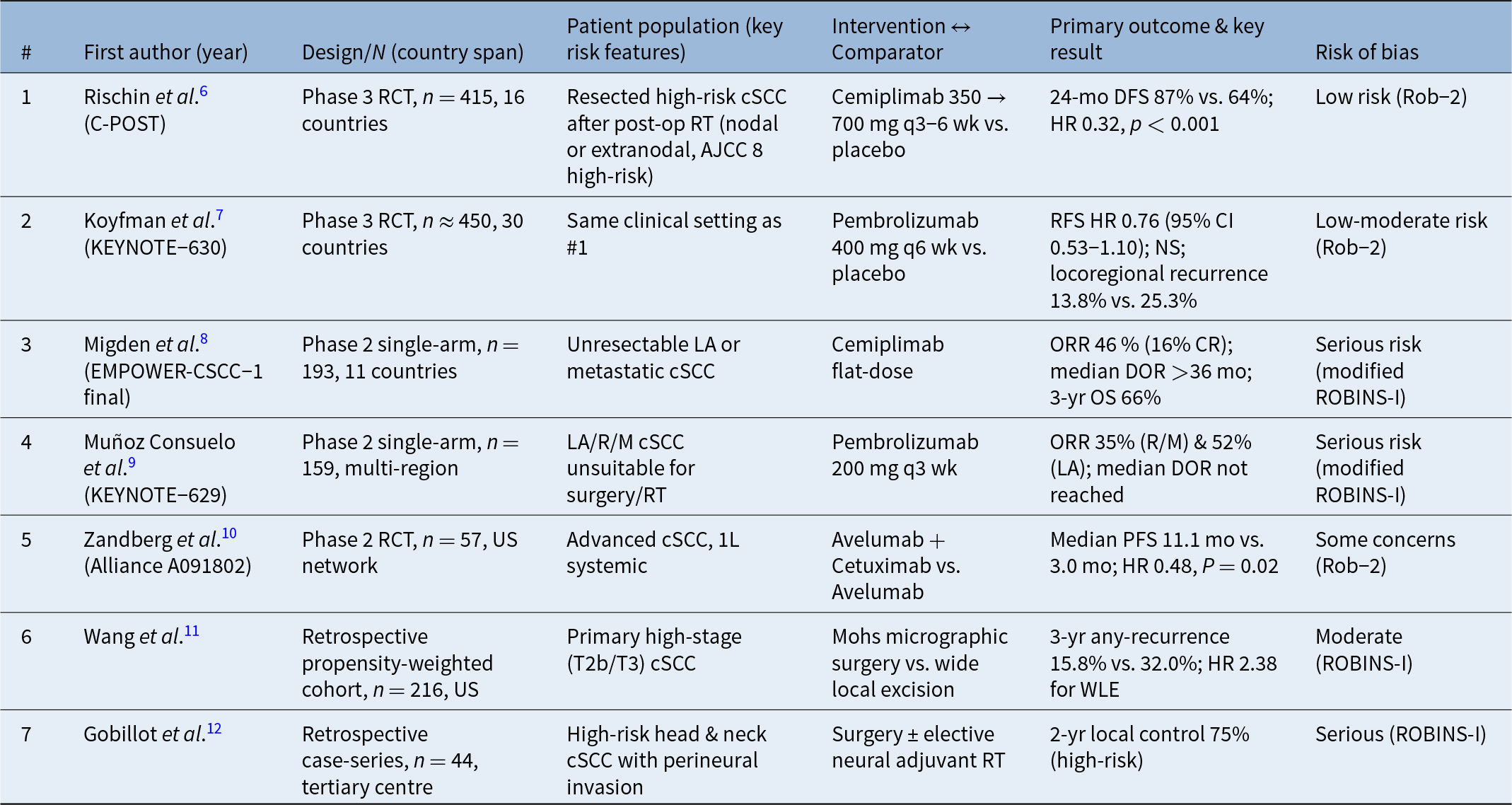
Risk of bias was systematically evaluated for all seven studies included in Table 1 using validated assessment tools appropriate to each study design. The assessment was conducted independently and followed established methodological guidelines.
Summary of the principal studies that met the review’s inclusion criteria and anchor today’s management of high-risk cSCC

AJCC = American Joint Committee on Cancer; cSCC = cutaneous squamous cell carcinoma; DOR = duration of response; LA = locally advanced; ORR = objective response rate; OS = overall survival; PFS = progression-free survival; RCT = randomised controlled trial; R/M = recurrent/metastatic; RT = radiation therapy; US = United States.
For randomised controlled trials, we employed the Cochrane Risk of Bias 2 (RoB 2) tool, which represents the current gold standard for assessing bias in randomised trials. The RoB 2 tool evaluates five key domains: Firstly, Bias arising from the randomisation process: Assessment of random sequence generation, allocation concealment and baseline balance between intervention groups. Secondly, Bias due to deviations from intended interventions: Evaluation of blinding procedures, protocol adherence and whether deviations from intended interventions occurred that could affect the outcome. Thirdly, Bias due to missing outcome data: Analysis of completeness of outcome data, reasons for missing data and whether missingness could depend on the true value of the outcome. Fourthly, Bias in measurement of the outcome: Assessment of outcome measurement methods, blinding of outcome assessors and whether measurement could have differed between intervention groups. Fifthly, Bias in selection of the reported result: Evaluation of whether reported results were selected from multiple eligible outcome measurements or analyses.
Each domain was judged as “Low risk,” “Some concerns,” or “High risk” based on signaling questions and algorithms specified in the RoB 2 guidance. An overall risk of bias judgment was derived from the domain-level assessments.
For single-arm phase 2 trials (Studies 3 and 4), we adapted the Risk Of Bias In Non-randomised Studies - of Interventions (ROBINS-I) framework, recognising that these studies lack a control group and therefore have inherent limitations in establishing causality. For observational studies, we applied the full ROBINS-I tool, which is specifically designed for non-randomised studies of interventions.
For each domain within each assessment tool, we assigned one of the following judgments: Firstly, Low risk of bias: The study is comparable to a well-performed randomised trial (for RCTs) or the study is at low risk of bias for the domain (for non-randomised studies). Secondly, Some concerns (RoB 2 only): The study raises some concerns in the domain but is not at high risk of bias. Thirdly, Moderate risk of bias (ROBINS-I only): The study is sound for a non-randomised study but cannot be considered comparable to a well-performed randomised trial. Fourthly, Serious risk of bias: The study has some important problems in the domain that could substantially affect the reliability of results. Fifthly, Critical risk of bias (ROBINS-I only): The study is too problematic to provide any useful evidence on the effects of intervention.
An overall risk of bias judgement was derived for each study based on the domain-level assessments. For RCTs assessed with RoB 2, the overall judgment reflected the highest risk level across all domains, with particular attention to domains most critical to the study’s validity. For studies assessed with ROBINS-I, the overall judgment considered the pattern of risk across domains and the potential impact on effect estimates.
Evidence synthesis
Given the marked heterogeneity in study designs, interventions and outcome definitions, quantitative pooling was deemed inappropriate. Findings are therefore summarised narratively, prioritising high-quality randomised trials and large prospective cohorts, discussing clinical relevance in terms of recurrence, metastasis and survival and highlighting concordance or divergence among key trials such as KEYNOTE-630 and C-POST. Safety, tolerability and quality-of-life data are considered throughout.
In addition to risk of bias assessment, we considered the overall quality of evidence provided by each study in the context of the GRADE (Grading of Recommendations Assessment, Development and Evaluation) framework. This integrated assessment considered: (1) Study design (RCT vs. observational study), (2) Risk of bias, (3) Consistency of results, (4) Directness of evidence, (5) Precision of effect estimates and (6) Publication bias considerations.
Studies were categorised as providing: Firstly, High-quality evidence (Level 1): Further research is very unlikely to change confidence in the estimate of effect. Secondly, Moderate-quality evidence (Level 2): Further research is likely to have an important impact on confidence in the estimate of effect. Thridly, Low-quality evidence (Level 3-4): Further research is very likely to have an important impact on confidence in the estimate of effect. Fourthly, Very low-quality evidence (Level 5): Any estimate of effect is very uncertain
Ethical and funding disclosures
All included studies documented ethics approval in their source publications. The present review received no external funding, and the authors declare no competing interests.
Results and analysis
Study selection and characteristics
The systematic search identified 1,247 database records and 87 additional sources. After removing 245 duplicates, 1,089 records were screened, and 197 full-text articles were assessed for eligibility. Seven studies met inclusion criteria and were included in the qualitative synthesis (Figure 1; Table 1): two phase 3 RCTs (Rischin et al.Reference Rischin, Porceddu, Day, Brungs, Christie and Jackson6, Koyfman et al.Reference Koyfman, Lee, Mortier, Bratland, Luna-Romero and Chipman7), one phase 2 RCT (Zandberg et al.Reference Zandberg, Allred, Rosenberg, Kaczmar, Swiecicki and Julian8), two phase 2 single-arm trials (Migden et al.Reference Migden, Rischin, Schmults, Guminski, Hauschild and Lewis9, Muñoz Consuelo et al.Reference Muñoz Couselo, Maxwell Hughes, Mortier, Grob, Gutzmer and Roshdy10), one retrospective cohort (Wang et al.Reference Wang, Vestita, Murad, Morgan, Rowley and Rettig11) and one retrospective case-series (Gobillot et al.Reference Gobillot, Greer, Parvathaneni, Liao, Laramore and Goff12). Studies enrolled 1,534 patients across diverse clinical settings, from resected high-risk disease to unresectable/metastatic disease. Given marked heterogeneity in designs, populations and outcomes, narrative synthesis was employed rather than meta-analysis.
Study selection for qualitative synthesis.

Risk of Bias Assessment (Table 2)
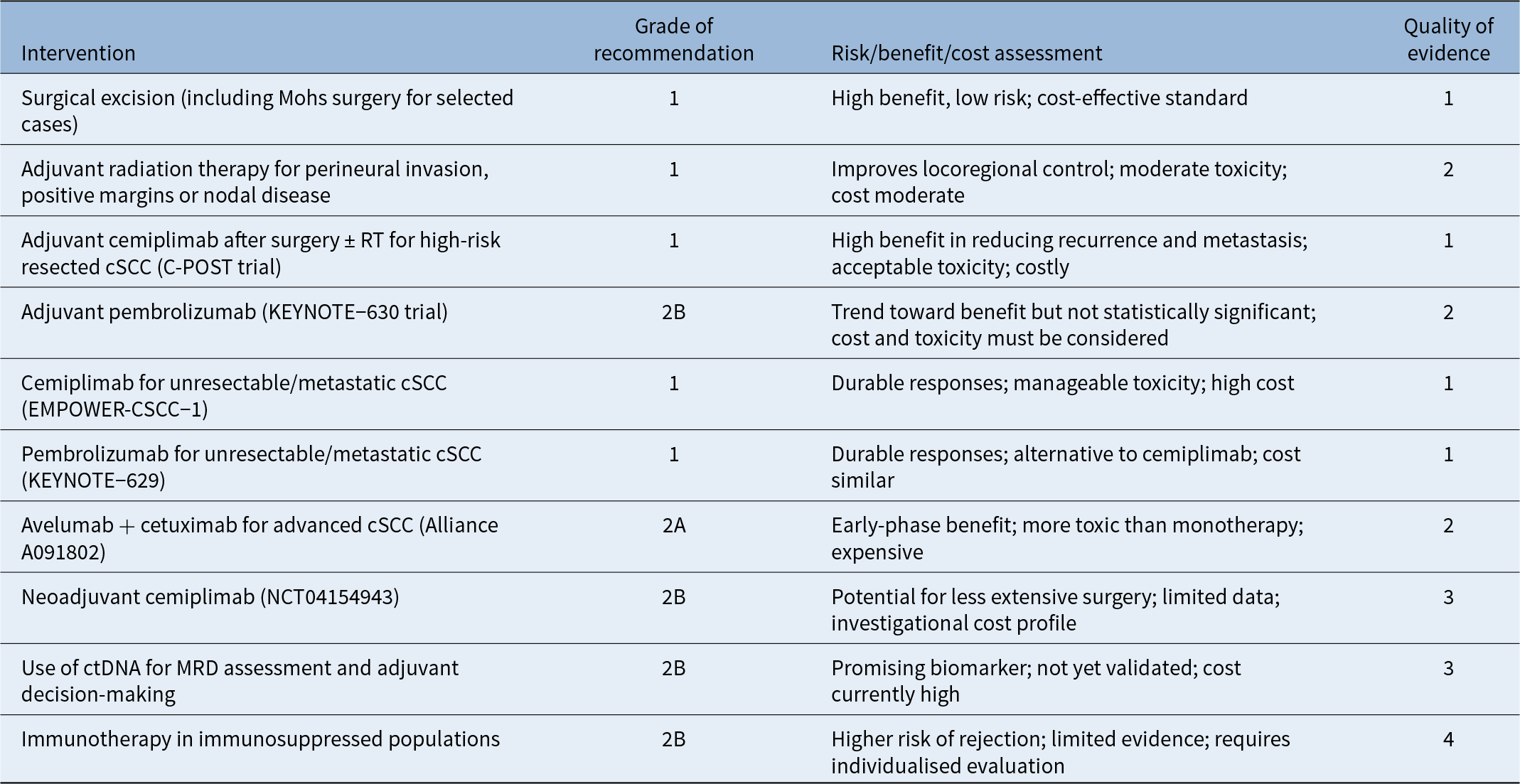
GRADE evidence of available evidences

cSCC = cutaneous squamous cell carcinoma; ctDNA = circulating tumour DNA; GRADE = Grading of Recommendations Assessment, Development and Evaluation; MRD = minimum residual disease
Note: Quality of Evidence Legend: 1, Randomised controlled trial or meta-analysis; 2, Prospective cohort or well-designed non-randomised trial; 3, Retrospective cohort, case–control study; 4, Case series, cross-sectional study; 5, Expert opinion or case report. Grades of Recommendation: Grade 1: Strong recommendation based on high-quality evidence; Grade 2A: Conditional recommendation based on moderate-quality evidence; Grade 2B: Weak recommendation based on low or limited-quality evidence.
Risk of bias was systematically assessed using Cochrane RoB 2 for RCTs and ROBINS-I for non-randomised studies. Only Rischin et al. (C-POST)Reference Rischin, Porceddu, Day, Brungs, Christie and Jackson6 demonstrated low risk of bias across all domains, providing Level 1 evidence. Koyfman et al. (KEYNOTE-630)Reference Koyfman, Lee, Mortier, Bratland, Luna-Romero and Chipman7 showed low–moderate risk with some concerns regarding the non-significant primary outcome. Zandberg et al.Reference Zandberg, Allred, Rosenberg, Kaczmar, Swiecicki and Julian8 and Wang et al.Reference Wang, Vestita, Murad, Morgan, Rowley and Rettig11 exhibited moderate risk due to small sample size/open-label design and retrospective design/unmeasured confounding, respectively. The three single-arm or case-series studies (Migden et al.Reference Migden, Rischin, Schmults, Guminski, Hauschild and Lewis9, Muñoz Consuelo et al.Reference Muñoz Couselo, Maxwell Hughes, Mortier, Grob, Gutzmer and Roshdy10, Gobillot et al.Reference Gobillot, Greer, Parvathaneni, Liao, Laramore and Goff12) had serious risk of bias due to lack of control groups, limiting causal inference. Detailed assessments are provided in supplementary materials.
Definition of high-risk cSCC
High-risk cSCC is defined based on clinicopathologic features associated with increased risk of local recurrence, regional nodal metastasi and disease-specific mortality. Both the AJCC, 8th edition, and the BWH staging systems provide stratification criteria. Commonly recognised high-risk features include: (1) Tumour diameter greater than 2 cm (especially on the head, neck or ear), (2) Depth of invasion greater than 6 mm or extension beyond subcutaneous fat, (3) Moderate-to-poor histologic differentiation, (4) Perineural invasion (notably involving nerves >0.1 mm), (5) Lymphovascular invasion, (6) Anatomic location on high-risk sites (e.g., ear, lip, temple), (7) Recurrent tumours or tumours arising in scars or areas of chronic inflammation, (8) Nodal metastases (particularly >2 involved nodes or nodes >2 cm), (9) Extracapsular extension (ECE), (10) Host immunosuppression (e.g., solid organ transplant recipients, hematologic malignancy), (11) In-transit metastases, (12) Rapid growth or multiple prior recurrences and (13) Advanced age or poor performance status.
These features are used to stratify risk and inform treatment planning, often within a multidisciplinary tumour board setting.Reference Brantsch, Meisner, Schönfisch, Trilling, Wehner-Caroli and Röcken13
Standard-of-care management
Surgical excision
Surgical excision, performed either by wide local resection or Mohs micrographic surgery, remains the therapeutic foundation for localised high-risk cSCC. Complete margin clearance is paramount; consequently, Mohs surgery is favoured in anatomically complex regions where tissue conservation is desirable.
Adjuvant radiation therapy
Where adverse histopathologic factors such as perineural invasion or close margins persist after surgery, adjuvant radiotherapy offers improved locoregional control, even though its impact on overall survival has not been definitively demonstrated. Adjuvant radiation therapy (RT) is recommended for patients with adverse features such as perineural invasion, close or positive margins and nodal involvement. RT improves locoregional control, although evidence of a survival benefit remains inconclusive. Fractionation schedules and delivery techniques are adapted based on tumour location and individual risk factors.Reference Stratigos, Garbe, Dessinioti, Lebbe, Bataille and Bastholt14–Reference Burton, Ashack and Khachemoune21
Adjuvant Systemic Therapy: 2025 Evidence Update
KEYNOTE-630 was a phase 3, double-blind, placebo-controlled trial evaluating adjuvant pembrolizumab in patients with high-risk cSCC following complete resection and post-operative RT. Eligible patients had at least one predefined high-risk feature (e.g., nodal metastasis, ECE or multiple adverse pathological factors).Reference Koyfman, Lee, Mortier, Bratland, Luna-Romero and Chipman7
With a median follow-up of 28.6 months, the 24-month RFS was 78.3 per cent with pembrolizumab vs. 68.6 per cent with placebo (HR 0.76; p = 0.072). Although the trend favored pembrolizumab, the trial did not meet its predefined threshold for statistical significance. Subgroup analyses suggested potential benefit in patients with ECE, older age (≥65 years) and nonsmokers. Given the failure to meet the primary endpoint, pembrolizumab is not currently considered standard adjuvant therapy for resected high-risk cSCC.
In contrast, the phase 3 C-POST trial demonstrated the efficacy of adjuvant cemiplimab in patients with high-risk resected cSCC who had completed curative-intent surgery and RT. Eligibility included patients with nodal involvement or non-nodal high-risk features (e.g., poor differentiation, perineural invasion or large tumour size).Reference Rischin, Porceddu, Day, Brungs, Christie and Jackson6
Cemiplimab significantly improved DFS with a HR of 0.32 (p < 0.0001). The 24-month DFS rate was 87 per cent in the cemiplimab group versus 64 per cent in the placebo group. Notably, cemiplimab also significantly reduced the risk of local recurrence (HR 0.20) and distant metastasis (HR 0.35). These results position cemiplimab as the new standard for adjuvant systemic therapy in this population.
Advanced and unresectable disease
Cemiplimab is an FDA-approved anti–PD-1 monoclonal antibody indicated for the treatment of patients with locally advanced or metastatic cSCC who are not candidates for curative surgery or definitive radiation. The approval is based on the phase 2 EMPOWER-CSCC-1 trial, which enrolled patients with unresectable or advanced disease. The ORR was 44 per cent, including 13 per cent complete responses. Median duration of response (DOR) was not reached at the 12-month analysis, indicating prolonged disease control. The safety profile was favourable and consistent with other PD-1 inhibitors, with the majority of treatment-related adverse events being grade 1–2 in severity.Reference Migden, Rischin, Schmults, Guminski, Hauschild and Lewis9
Pembrolizumab, another PD-1 inhibitor, is also approved for the treatment of advanced cSCC in patients who are not candidates for curative surgery or radiation. Clinical efficacy has been demonstrated in both clinical trials and real-world settings, with reported ORRs ranging from 34 per cent to 50 per cent. Responses are often durable, with many patients achieving sustained disease control. Pembrolizumab is frequently utilised in clinical practice for patients who are either ineligible for cemiplimab or where access is limited due to formulary or geographic considerations. The safety profile is consistent with the known class effects of checkpoint inhibitors.Reference Koyfman, Lee, Mortier, Bratland, Luna-Romero and Chipman7, Reference Muñoz Couselo, Maxwell Hughes, Mortier, Grob, Gutzmer and Roshdy10, Reference Grob, Gonzalez, Basset-Seguin, Vornicova, Schachter and Joshi22
Several investigational strategies are being explored to enhance outcomes in advanced cSCC. The phase 2 Alliance A091802 trial evaluated avelumab in combination with cetuximab in patients with metastatic cSCC. The combination demonstrated an improvement in progression-free survival (PFS) compared to avelumab monotherapy (HR 0.53; p = 0.041), suggesting potential synergistic benefit and supporting further investigation.Reference Wang, Vestita, Murad, Morgan, Rowley and Rettig11
In the neoadjuvant setting, cemiplimab is under evaluation in ongoing trials (e.g., NCT04154943). Preliminary findings suggest promising rates of pathological complete response and nodal downstaging, potentially allowing for less extensive surgery or reduced need for adjuvant treatment. These results highlight the potential role of immunotherapy earlier in the treatment continuum for high-risk cSCC.Reference Gross, Miller, Khushalani, Divi, Ruiz and Lipson23
Special considerations
Immunosuppressed patients
These patients are underrepresented in trials and often exhibit lower response rates to immunotherapy. Management must balance oncologic efficacy with risks of graft rejection or infection. For organ transplant recipients, the use of checkpoint inhibitors remains controversial and mandates multidisciplinary decision-making.Reference Kawashima, Joachim, Abdelrahim, Abudayyeh, Jhaveri and Murakami24
Biomarkers
PD-L1 expression is not routinely used to select patients for immunotherapy in cSCC due to variable expression and lack of predictive consistency. Tumour mutational burden (TMB) and IFN-γ signatures are under investigation as potential predictive markers.
Circulating tumour DNA and minimal residual disease
Emerging data suggest circulating tumour DNA (ctDNA) may serve as a predictive and prognostic tool for recurrence and adjuvant therapy benefit, though validation is ongoing. ctDNA clearance post-resection could identify patients most likely to benefit from adjuvant systemic therapy.
Discussion
Recent advances in the management of high-risk cSCC have significantly reshaped therapeutic strategies, particularly with the integration of immunotherapy as a viable adjuvant and definitive treatment option. The rising incidence of cSCC, coupled with its considerable morbidity and mortality in high-risk populations, emphasises the need for continually evolving, evidence-based management approaches.
A major evolution in cSCC care has been the refinement of risk stratification. High-risk disease is defined by a constellation of clinicopathologic and host factors, including tumour diameter, depth of invasion, perineural or lymphovascular involvement, nodal metastasis and immunosuppression. Tumours located in the head and neck region are classified as high risk, particularly when arising in subsites such as the face, ear and pre- or post-auricular skin.Reference Rogers, Weinstock, Harris, Hinkley, Feldman and Fleischer1, Reference Karia, Jambusaria-Pahlajani, Harrington, Murphy, Qureshi and Schmults4, Reference Brantsch, Meisner, Schönfisch, Trilling, Wehner-Caroli and Röcken13 Lesions involving the ear and lower vermilion lip are recognised as high risk due to their proximity to lymphovascular structures and the thinness of the dermis, which may facilitate early invasion and dissemination. Periocular and eyelid tumours exhibit similarly aggressive behavior, with an increased incidence of lymphatic spread and perineural invasion. These anatomical locations also pose significant surgical and reconstructive challenges, and the necessity to preserve function and cosmesis may result in narrower excision margins, thereby potentially compromising oncologic clearance.Reference Burton, Ashack and Khachemoune21 These features, codified in staging systems such as the AJCC 8th edition and BWH criteria, are essential for guiding treatment decisions. Multidisciplinary collaboration involving dermatologic surgery, radiation oncology, medical oncology and pathology is critical to tailoring care for this complex patient population.
Surgical excision remains the cornerstone of localised disease management, with Mohs micrographic surgery offering high cure rates and tissue preservation in functionally or cosmetically sensitive areas. However, surgery alone is often insufficient in the presence of high-risk features. Adjuvant RT improves locoregional control, particularly in cases with perineural invasion or positive margins. Still, its limitations—especially in terms of toxicity and unclear survival benefit—highlight the need for systemic strategies that can improve long-term outcomes.
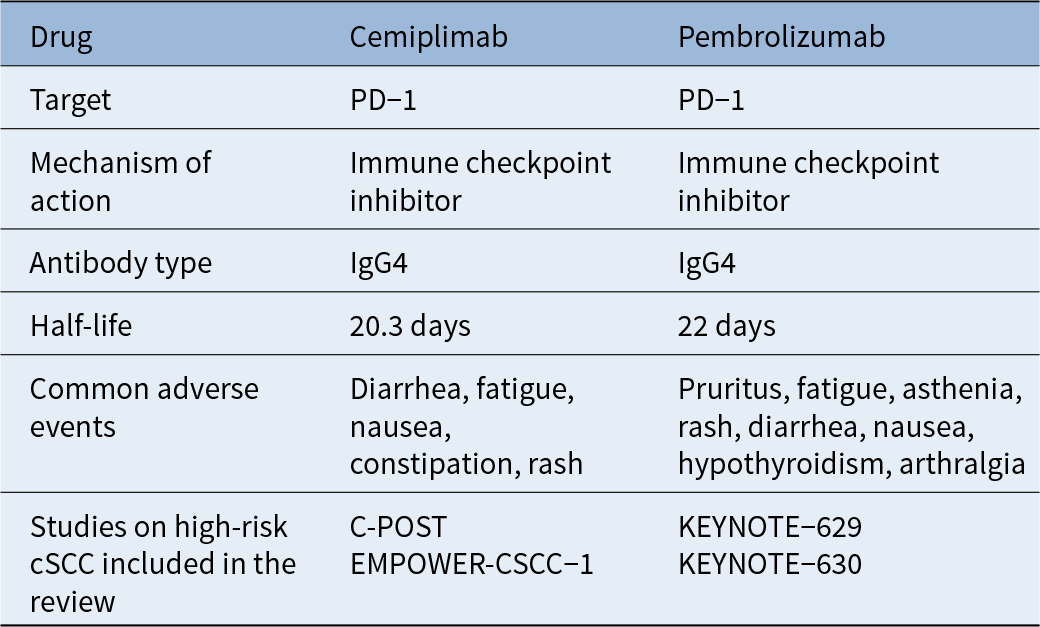
Checkpoint inhibitors have revolutionised the treatment of advanced cSCC (Table 3). Cemiplimab, the first PD-1 inhibitor approved for this indication, demonstrated durable responses in the EMPOWER-CSCC-1 trial. Pembrolizumab has shown comparable activity, providing additional therapeutic flexibility. These agents—initially used for unresectable or metastatic disease—are now being investigated in curative-intent settings, including as adjuvant or neoadjuvant therapies.
Overview on cemiplimab and pembrolizumab

cSCC = cutaneous squamous cell carcinoma; IgG4 = immunoglobulin G4; PD-1 = programmed cell-death protein 1.
Two pivotal phase 3 trials—KEYNOTE-630 and C-POST—have defined the role of adjuvant immunotherapy in resected high-risk cSCC. While KEYNOTE-630 did not meet its primary endpoint for RFS, subgroup analyses suggested benefit in specific populations, such as older adults and those with ECE. In contrast, the C-POST trial demonstrated a substantial improvement in DFS with adjuvant cemiplimab, firmly establishing it as the new standard of care in patients with resected high-risk cSCC post-radiation. These findings mark a paradigm shift in the post-operative management of this disease.
Despite these advances, several clinical questions remain. Optimal treatment duration, timing in relation to radiation and appropriate sequencing of therapies are not yet clearly defined. The management of immunosuppressed patients poses particular challenges: these individuals experience higher recurrence rates, yet often have limited eligibility for immunotherapy due to the risk of allograft rejection or immune-related toxicity. Multidisciplinary input is essential, and prospective data specific to this population are urgently needed.
Biomarkers may play a key role in refining risk stratification and treatment personalization. While PD-L1 expression and tumour mutational burden have shown promise in other tumour types, their utility in cSCC is unproven. ctDNA is a promising biomarker for minimal residual disease assessment and recurrence prediction, but its clinical application requires further validation.
Neoadjuvant immunotherapy is another area of active investigation. Early-phase studies, including trial NCT04154943, suggest that pre-operative cemiplimab may lead to meaningful pathologic responses and nodal downstaging, potentially allowing for less extensive surgery.Reference Gross, Miller, Khushalani, Divi, Ruiz and Lipson23 This approach not only facilitates tumour resectability but also enables real-time immune profiling and translational research opportunities. If validated, neoadjuvant strategies could become integral to the curative-intent treatment of high-risk patients, particularly those with contraindications to extensive surgery.
Health system factors also merit consideration. The expanded use of immunotherapy raises issues related to cost, accessibility and equity. Ensuring broad access—particularly in community and rural settings—will require infrastructure support, such as tele-oncology platforms, patient navigation services and clinician education. The translation of scientific progress into equitable outcomes demands coordinated efforts across regulatory, institutional and societal levels.
The path forward includes several key priorities. First, trials are needed to evaluate abbreviated or intermittent dosing schedules for adjuvant immunotherapy, especially in older or frail patients. Second, biomarker-driven approaches using ctDNA and immune gene signatures could inform dynamic treatment adaptation. Third, strategies tailored to immunosuppressed populations—such as low-dose checkpoint inhibition or novel immunomodulatory combinations—must be prospectively evaluated. Finally, policies that promote equitable access to immunotherapy, including reimbursement reform and geographic decentralisation, are essential to ensure that innovation benefits all patients.
In conclusion, high-risk cSCC is at a critical juncture. Cemiplimab has redefined the adjuvant standard of care, while ongoing research continues to explore immunotherapy earlier in the treatment continuum. Biomarker development, neoadjuvant approaches and inclusivity of immunocompromised populations will be central to the next phase of progress. The integration of clinical innovation, health equity and personalised oncology will shape the future of care for patients with high-risk cSCC.
• Cutaneous squamous cell carcinoma (cSCC) of the head and neck frequently show high-risk features
• Surgery represents the mainstay of treatment but often poses functional and reconstructive challenges
• Adjuvant cemiplimab significantly prolongs disease-free survival in resected high-risk cSCC
• Pembrolizumab shows nonsignificant recurrence-free survival improvement in KEYNOTE-630 trial
• Neoadjuvant programmed cell-death protein 1 (PD-1) blockade demonstrates early promise in ongoing studies
• ctDNA investigated as biomarker for recurrence and treatment guidance
Conclusions
High-risk cSCC requires a nuanced, risk-adapted and often multidisciplinary approach. The emergence of adjuvant immunotherapy, particularly cemiplimab as supported by the C-POST trial, represents a transformative shift in post-operative management. Pembrolizumab, though showing benefit in select subgroups, did not achieve statistical significance in the KEYNOTE-630 trial and is not considered a standard adjuvant therapy.
For patients with unresectable or metastatic disease, anti-PD-1 agents remain the cornerstone of treatment, with ongoing trials investigating combinations and earlier use in the treatment continuum. Neoadjuvant strategies and ctDNA-based minimal residual disease monitoring are areas of active research that promise further refinement of therapeutic strategies.
Continued efforts in biomarker development, inclusion of immunosuppressed patients in trials and international collaboration on rare tumour registries will be essential to optimise outcomes. Clinicians should incorporate emerging evidence into personalised care plans that reflect both oncologic efficacy and patient quality of life.
Supplementary material
The supplementary material for this article can be found at https://doi.org/10.1017/S0022215126104332.
Data availability
No new data were created or analysed in this study. Data sharing is not applicable.
Funding
This review received no external funding.
Competing interests
The authors declare no competing interests.
Ethical approval/ethics statement
Not applicable. This narrative review synthesises previously published literature; no new data from human participants or animals were collected, therefore, institutional review board approval and informed consent were not required.
Author contributions
Conceptualisation and study design: F.P.; Literature search and data extraction: F.P., E.D.C., V.C.; Data analysis and interpretation: D.C., A.G., C.B.; Manuscript drafting: F.P., E.D.C.; Critical revision: D.S., M.N. and V.C. All authors approved the final manuscript.