Democracy is about the management of conflict, and political parties help in reaching compromises on important issues that divide a country. One function of political parties and election campaigns is therefore to inform voters about the political offer on key issues in order to help them in reaching electoral decisions. At the very least, informed electoral decision-making requires parties to talk about the same issues so that citizens have the possibility to gain knowledge of party proposals (Sigelman and Buell Reference Sigelman and Buell2004; Kaplan, Park and Ridout Reference Kaplan, Park and Ridout2006). In the literature, this is known as “issue engagement” (Sigelman and Buell Reference Sigelman and Buell2004) or “dialogue” (Simon Reference Simon2002). Ideally, issue engagement enables citizens to make informed choices and select that party whose program is closest to their preferences (Downs Reference Downs1957; Nadeau et al. Reference Nadeau, Pétry and Belanger2008).
Although it is thus normatively desirable that parties address the same topics, the decision to talk about an issue or not lies with individual political parties. The overall level of issue engagement therefore depends on the strategic decisions taken by individual parties. Indeed, the system-wide level of issue engagement is best seen as the aggregate consequence of the extent to which there is issue engagement between sets of political parties, who may vary in the extent they talk about the same issues (Green-Pedersen and Mortensen Reference Green-Pedersen and Mortensen2010). This important point has been obscured by the fact that most research into issue engagement has been on the US two-party system, where pair-wise and systemic issue engagement are identical. By understanding when and why the level of issue engagement varies between sets of parties in multiparty systems, we can gain important insight into when and how party systems in general are characterized by issue engagement.
Our analysis of issue engagement is based on an extensive content analysis of party press releases in a multiparty system. Specifically, our sample consists of 2453 press releases published by the five parliamentary parties in the Austrian 2008 election campaign. These data enable us to examine issues at a much lower level of aggregation than in previous analyses. We thus consider 189 specific issues such as youth unemployment, value-added taxes or the price of petrol. By studying issues in this way, we can be sure that two parties really are both talking about the same specific issues rather than addressing the same broad policy areas in their campaigns (see also Lipsitz Reference Lipsitz2013). For each issue, we analyze whether two parties address the issue or not, providing us with a measure of issue engagement between each possible party pairing.
In this article, we suggest that patterns of issue engagement emerge because parties have varying electoral incentives to engage rivals but also face organizational constraints in their ability to do so. First, parties will want to talk about those issues where the political benefits of issue engagement with rivals are greatest. Here, we highlight the incentive for parties to talk about the same issues as those parties that represent the most important electoral threat (Bale Reference Bakker, de Vries, Edwards, Hooghe, Jolly, Marks, Polk, Rovny, Steenbergen and Vachudova2003; Spoon, Hobolt and de Vries Reference Spoon, Hobolt and de Vries2014). Thus, issue engagement should be more likely when parties share similar policy goals and address similar voter groups. Second, parties will face organizational constraints in the extent they can address different issues. Hence, issue engagement is most likely between party pairs where both parties have the human resources and financial means necessary to be able to address a broad range of issues.
We test this incentives-constraints framework using data from Austria, which provides a suitable case for examining issue engagement in a multiparty context as it is a moderately diverse system with both long-standing mainstream parties and newer, niche competitors. It therefore contains parties that vary significantly in their policy positions and their organizational resources. Our detailed data also allow us to control for potential confounding effects, in particular the media issue agenda.
In the election we study, issue engagement was partial and incomplete: some parties talked about the same issues as their rivals, but there were few issues where the campaign involved all parties. More importantly, we find empirical support for our claims that issue proximity and party resources matter in explaining why parties choose to engage rivals on issues. These findings help us to understand patterns in party issue competition, as the propensity for sets of parties to engage over issues depends on the incentives and constraints those parties face.
These results also have important implications for the quality of party democracy. We show that parties fail to engage with each other in particular when this is needed most. Citizens arguably need information most when policy choices differ widely and when parties are smaller and newer. Yet, our findings suggest that issue engagement is less likely (1) particularly on those issues where there are large positional differences and (2) among parties that are smaller, newer and have fewer personnel and financial resources. Thus, we cannot rely on parties to provide high levels of issue engagement as their decision to raise particular topics depends on their individual incentives and constraints.
This paper is structured as follows. We first describe issue engagement and how and why it may differ between parties and issue areas. Then we describe our data and its advantages over other information sources for party issue emphasis. Next, we present our results before considering the implications of our findings for the broader study of campaign communication and salience strategies.
Issue Engagement in a Multiparty Context
The definition of issue engagement is quite minimalist (Sigelman and Buell Reference Sigelman and Buell2004; Kaplan, Park and Ridout Reference Kaplan, Park and Ridout2006): it is enough for two parties to talk about the same issue during a certain period of time, for instance, in the campaign preceding an election. The term thus refers to whether two parties talk about the same topic (see also Lipsitz Reference Lipsitz2013). Issue engagement between two parties exists when they address the same issue during an election campaign. It does not exist when just one or neither of the two parties addresses the issue. The term “issue engagement” therefore captures patterns of issue coverage at the level of party dyads.
We prefer the term “engagement” to “dialogue” (Simon Reference Simon2002) and “convergence” (Damore Reference Damore2005; Kaplan, Park and Ridout Reference Kaplan, Park and Ridout2006; Lipsitz Reference Lipsitz2013), although these terms are sometimes used interchangeably. “Dialogue” implies a substantive conversation, but all that we consider is whether two parties talk about the same issue within a certain time frame (see also Lipsitz Reference Lipsitz2013). “Convergence” has positional connotations, but our measure of engagement does not capture the views espoused by the parties. Yet, we note that one disadvantage of the term “engagement” is that it implies that one party “engages” another party on an issue when all the term means is that two parties address the same issue during a given period, for example, a campaign. It is therefore not relevant which party mentioned the issue first or whether it was the intention of the second party to respond to its competitor. Instead, issue engagement simply captures whether or not both parties mentioned an issue, regardless of the content or intention of that action.
There are various reasons why party competition should be characterized by issue engagement. First, parties do not want to be seen as ignoring issues that are of public concern and the subject of extensive media coverage (Ansolabehere and Iyengar Reference Ansolabehere and Iyengar1994). Second, parties have incentives to take up or “copy” issues raised by rival parties if these issues are promising vote-winners (Bale Reference Bakker, de Vries, Edwards, Hooghe, Jolly, Marks, Polk, Rovny, Steenbergen and Vachudova2003; Sulkin Reference Sulkin2005; Green-Pedersen Reference Green-Pedersen2007; Meguid Reference Meguid2008; Spoon, Hobolt and de Vries Reference Spoon, Hobolt and de Vries2014). Third, addressing an issue gives parties some influence over how an issue is framed in the public debate (Jerit Reference Jerit2008; Nadeau, Pétry and Belanger Reference Nadeau, Nevitte, Gidengil and Blais2010). Issues such as immigration can be discussed in different ways, for example, in economic or cultural terms, and parties will talk about issues in order to frame them in a favorable way (Odmalm Reference Odmalm2011).
However, there are also reasons why parties should avoid issue engagement. The classic issue ownership perspective argues that parties do not address all salient issues with similar intensity and instead focus on their strongest issues (Budge and Farlie Reference Budge1983; Petrocik Reference Petrocik1996; Petrocik, Benoit and Hansen Reference Petrocik, Benoit and Hansen2003), which are those on which they have a clear positional (Budge and Farlie Reference Budge1983) or competence (Petrocik Reference Petrocik1996) advantage over their rivals. Budge (Reference Budge1987, 24) thus argues that party competition is less a “classical ‘great debate,’ or direct argument over a common range of problems” and characterized more by “parties talk[ing] past each other, glossing over areas which might favour their rivals while emphasizing those where they feel they have an advantage.”
The empirical evidence regarding the occurrence of issue engagement is mixed. Although some research shows that parties indeed fail to address the same topics in campaigns (Budge and Farlie Reference Budge1983; Spiliotes and Vavreck Reference Spiliotes and Vavreck2002), other studies have found that parties in fact do engage with each other (Sigelman and Buell Reference Sigelman and Buell2004; Damore Reference Damore2005; Green-Pedersen Reference Green-Pedersen2007; Dolezal et al. Reference Dolezal, Ennser-Jedenastik, Müller and Winkler2014). In any case, it is not possible to say that party competition in general is driven either by engagement or avoidance as issue engagement will vary across parties and by issue area (Kaplan, Park and Ridout Reference Kaplan, Park and Ridout2006; Wagner and Meyer Reference Wagner and Meyer2014; Green-Pedersen and Mortensen Reference Green-Pedersen and Mortensenforthcoming). It is the main aim of this paper to understand and to explain this variation.
Explaining Issue Engagement: Electoral Incentives and Organizational Constraints
We argue that the variation in issue engagement between parties and across policy issues can be understood by looking at the electoral incentives and organizational constraints parties face.
Electoral Incentives
Strategically, parties will want to engage with rivals on those issues where they believe they can win over additional voters—or at least prevent their supporters from defecting. There are many reasons why some topics may be electorally attractive, for example, on an issue a party may have a position that is particularly close to the median voter (Downs Reference Downs1957) or distinct within the party system (Wagner Reference Wagner2012), or it may have a long-standing ownership reputation (Petrocik Reference Petrocik1996). A party may also want to emphasize wedge issues, so those topics where a rival party or its supporters are internally divided (Hillygus and Shields Reference Hillygus and Shields2009; van de Wardt, Hobolt and de Vries Reference van de Wardt, Hobolt and de Vries2014).
When thinking about why sets of parties talk about the same issue, a key incentive may be whether these parties have similar policy positions and thus aim to address similar voter groups. Adams and Somer-Topcu (Reference Adams and Somer-Topcu2009, 828) suggest that, in spatial models where parties have full information, the vote share of a party depends largely on the positions that its most proximate competitors take. Similarly, Budge (Reference Budge and Farlie1994) and Laver (Reference Laver2005) suggest that parties develop their issue-based strategies mainly by looking at their close rivals, which Budge (Reference Budge and Farlie1994, 454) terms “marker parties.”
Proximate rivals may thus be more likely to talk about the same issues as they aim to attract the same potential voters or to prevent existing supporters from changing their party preference. This means that raising the salience of an issue can be an offensive or a defensive strategy: offensive, if the rival parties engage over an issue in the hopes of stealing their respective voters; defensive, if the parties do so in order to prevent their own voters from defecting (Bale Reference Bakker, de Vries, Edwards, Hooghe, Jolly, Marks, Polk, Rovny, Steenbergen and Vachudova2003; Green-Pedersen Reference Green-Pedersen2007; Spoon, Hobolt and de Vries Reference Spoon, Hobolt and de Vries2014). In either case, parties should talk about the same issues most if they are close to each other in terms of issue positions. In sum, we hypothesize that:
Hypothesis 1 The probability of issue engagement between parties increases as the proximity of their issue positions increases.
Organizational Constraints
Parties also face constraints that affect their ability to engage over issues. Some of these constraints will be electoral, for instance, if a party or its supporters are divided on what position to take or if it has a reputation for incompetence. Here, we focus on the organizational constraints parties face. In other words, the level of issue engagement is also likely to vary with the resources parties have at their disposal. To run successful election campaigns, parties need sufficient personnel and financial means to get their messages heard. Although party communication may involve “cheap talk,” it certainly also requires parties to acquire a minimum amount of factual information on key issues, to keep track with rivals’ campaign activities, and to draft and publish campaign material—often under time pressure. This requires a well-staffed party machinery with sufficient resources. For instance, party personnel is vital for spreading campaign messages by writing speeches and press releases and by printing and distributing leaflets and election posters. Parties with sufficient resources in terms of personnel and finances also have more freedom in choosing the issues on which to center their election campaigns (Kaplan, Park and Ridout Reference Kaplan, Park and Ridout2006). The more activists and money a party has, the more it can focus on multiple topics. For instance, (organized) subgroups within the party (e.g., pensioners and youth organizations) can target specific subconstituencies. In contrast, parties with fewer resources in terms of personnel and money will have fewer means to communicate multiple campaign messages to voters. Such parties are more likely to focus on a small number of “core” campaign messages.
A party’s resources are often correlated with its electoral size, not least because public party funding (e.g., of campaign expenditures) has become more important and is often tied to electoral success (Nassmacher Reference Nassmacher2001). Their electoral success also means that larger parties will want to address a broader, and potentially more heterogeneous, electorate than smaller parties. Their “catch-all” (Kirchheimer Reference Kirchheimer1966) character makes larger parties more likely to campaign on a wider range of issues. In contrast, smaller parties will receive support from a very low number of “issue publics” (Converse Reference Converse1964; Krosnick Reference Krosnick1990).
For issue engagement between party pairs, this means that parties are most likely to talk about the same issues if both parties are large and have sufficient personnel and financial resources. In turn, the probability of issue engagement is lowest between pairs of small parties that both lack the resources necessary to campaign on a broader range of issues. We therefore expect party resources to be associated with the extent of issue engagement. Thus, we hypothesize that:
Hypothesis 2 Issue engagement is most likely among parties with a high level of resources and least likely among parties with a low level of resources.
Measuring Issue Engagement in Party Press Releases
Our empirical analysis is based on campaign communication in party press releases. These documents have been used in previous analyses of European (Hopmann et al. Reference Hopmann, Elmelund-Praestekaer, Vliegenthart, de Vreese and Albaek2012; Klüver and Sagarzazu Reference Klüver and Sagarzazu2014) but mostly US campaigns (see, e.g., Tedesco Reference Tedesco2005a; Tedesco Reference Tedesco2005b). Party press releases are short texts, typically a few paragraphs long, where parliamentary candidates, speakers, and regional and national party elites express opinions on policy issues, react to rival parties and announce campaign appearances. Examples of three press releases are included in the supporting material (online Appendix A).
Party press releases are particularly suitable for analyzing issue engagement in election campaigns. In contrast to party manifestos, which are drafted weeks or months in advance of the election campaign, party press releases are published on a daily basis over the course of the election campaign. Their dynamic nature allows parties to react to each other and thus to pursue issue engagement. Compared with manifestos, which also serve in part as signals to party activists (Dolezal et al. Reference Dolezal, Ennser-Jedenastik, Müller and Winkler2012), the target readership of party press releases is clear, as they are written for the main purpose of influencing the public debate via the news media (Hopmann et al. Reference Hopmann, Elmelund-Praestekaer, Vliegenthart, de Vreese and Albaek2012). Party press releases also have advantages over other sources of salience measures. For example, expert surveys (e.g., Benoit and Laver Reference Benoit and Laver2006; Bakker et al. Reference Bale2015) measure issues at a much higher level of aggregation, whereas media coding (e.g., Kriesi et al. Reference Kriesi, Grande, Lachat, Dolezal, Bornschier and Frey2008) only provides evidence of party strategies as mediated by journalists and news organizations. Finally, in contrast to party interaction in parliaments (e.g., Green-Pedersen and Mortensen Reference Green-Pedersen and Mortensen2010), the ability to send out press releases is less strongly characterized by the different institutional powers of the government and the opposition.
We analyze the press releases that were published by all parliamentary parties in the 2008 Austrian general election campaign. In Austria, all party press releases are archived and accessible online at the Austrian Press Agency with clear identifiers for parties and party actors. This data access ensures that we have all party press releases at our disposal. We focus on press releases by the five parties in parliament as follows: the Greens, the Social Democrats (SPÖ), the conservative People’s Party (ÖVP), the radical-right Freedom Party (FPÖ) and its splinter party, then led by Jörg Haider, the Alliance for the Future of Austria (BZÖ). In the last six weeks of the 2008 campaign, these parties published 2453 press releases.
Our focus on one campaign allows us to measure issue focus at a very detailed level, below that of broader policy areas. For example, a policy area such as “environmental protection” encompasses various policy issues such as “animal protection,” “nuclear power,” “road tolls in city centers” and “emissions trading.” Although most comparable studies of press releases are based on policy areas (e.g., Brandenburg Reference Brandenburg2002; Spiliotes and Vavreck Reference Spiliotes and Vavreck2002; Sigelman and Buell Reference Sigelman and Buell2004; Tedesco Reference Tedesco2005a; Tedesco Reference Tedesco2005b; Hopmann et al. Reference Hopmann, Elmelund-Praestekaer, Vliegenthart, de Vreese and Albaek2012), we measure engagement at the level of individual issues.Footnote 1 Measures based on policy areas may identify high levels of issue engagement even when parties address issues that are completely unrelated to each other (see also Lipsitz Reference Lipsitz2013). For example, two parties who talk about the environment may be referring to very different things (e.g., nuclear power and animal protection). This problem becomes even more severe for broad issue areas covering many individual issues (e.g., economic policy). Our fine-grained measure is less likely to overestimate the level of issue engagement.
To capture the issues parties address in their press releases, we developed a coding scheme that contains 189 policy issues clustered in 16 policy areas as follows: pensions, economy, families, multiculturalism, EU, taxes and budget, environment, security and crime, health care, education, infrastructure, reforms, services and social security, values and traditionalism, foreign affairs and defense, and urban/rural matters. A list of all 189 policy issues and the policy areas is presented in the supporting material (online Appendix B). The number of issues is high but not uncommon. For example, Page (Reference Page1978) uses a comparable number of issues (122) in his analysis of the 1968 presidential election, whereas the US policy agendas project uses 220 subtopics (Policy Agendas Project 2014).Footnote 2 For descriptive details on the press releases and issue engagement between party pairs, see online Appendix C.
In the following analyses, we aim to explain for which party pairs and which issues issue engagement is most likely. Our variable of interest is issue engagement, which is coded for each party pair (dyad) and each issue. As there are five parties, there are ten combinations of party pairs. For each party pair, there are 189 issues where issue engagement could occur. The dependent variable indicates whether both parties in a dyad addressed an issue (1) or not (0).Footnote 3 The final data set consists of 1890 observations (10 dyads×189 issues) with 556 instances of issue engagement (29 percent).
A challenge using dyadic data is that observations are not independent events: if parties A and B address an issue and party B responds to party C on the same issue, then there is also issue engagement between parties A and C. We address this problem in two ways. First, we use party pair-policy area clustered standard errors. However, as Erikson, Pinto and Rader (Reference Erikson, Pinto and Rader2014) note, clustered standard errors do not sufficiently account for the overconfidence in standard errors. Following their advice, we therefore use randomization testing, a non-parametric technique comparing the observed test statistics (z-scores) with a distribution of false test statistics obtained based on the data structure alone. For that purpose, we randomly reshuffle party names, exchange the observed issue engagement scores with the reshuffled scores and re-run the regression models in 1000 simulations. The random reshuffle breaks the systematic relationship between our dependent variable, issue engagement and the covariates, so that we can compare the false 1000 test statistics (z-scores) with the one based on real data (for more details on the approach, see Erikson, Pinto and Rader Reference Erikson, Pinto and Rader2014). The randomization test p-values thus indicate the probability that the observed test statistics in our model are the result of the interdependencies in the dyad data structure.
Predictor Variables
In our analysis, we make use of several predictors such as policy proximity, party resources and, as control variables, similarity in the parties’ overall campaign strategies, systemic issue salience, ministerial responsibility and media attention.
Policy Proximity
Data on party positions are taken from the 2008 election manifestos coded by the Austrian National Election Study (AUTNES Manifesto Coding 2008 2012; see also Dolezal et al. Reference Dolezal, Ennser-Jedenastik, Müller and Winkler2014). Human coders identified individual statements in the party manifestos (unitizing). Next, statements were allocated to issue areasFootnote 4 along with the (binary) party position on that issue (coding). Within each issue area, we distinguish between “left” (coded: −1) and “right” (coded: +1) statements. A party’s policy position is then measured as the average of left and right statements in a given policy area with policy positions ranging from −1 (only left statements) to 1 (only right statements). For each party pair, we then calculate the absolute policy distance in the respective policy area to indicate ideological proximity; the raw policy scales range from −1 to 1 so that the highest possible absolute distance is 2 and the smallest is 0. Finally, we match the data on party distances on policy areas from the manifestos with the policy areas in our analysis of press releases. This provides us with data on policy distances in 13 policy areas.Footnote 5 The largest policy difference is that between the Greens and the FPÖ on security and crime (1.86). Note that policy proximity is therefore calculated not for individual issues but for policy areas, so one level of aggregation higher up.
Party Resources
We make use of a variety of indicators to assess the resources Austrian parties have at their disposal: financial means (income and campaign expenditure), the size of their party membership and the number of parliamentary candidates. First, Austrian parties differ in their financial means. According to their financial accounts in 2008,Footnote 6 the two largest parties, SPÖ and ÖVP, each had a gross income of about 20 million Euros (20.8 and 19.7 million Euros, respectively). This is substantially higher than that of the FPÖ (6.3 million), BZÖ (4.5 million) and the Greens (5.1 million). Similarly, campaign spending in 2008 varied between 12.4 (ÖVP) and 10.0 million Euros (SPÖ) for the two largest parties and 4.2 (FPÖ), 3.3 (BZÖ) and 3.0 million Euros (Greens) for the three smaller ones.
Second, we find similar differences when we turn to the parties’ personnel. Traditionally, party membership in Austria is high (Mair and van Biezen Reference Mair and van Biezen2001). Figures from 2007 (van Biezen, Mair and Poguntke Reference van Biezen, Mair and Poguntke2011) show that the People’s Party (700,000) and the Social Democrats (300,000) have the largest membership, followed by the Freedom Party with 40,000 party members. Party membership is much lower among the younger parties (BZÖ: 10,000; Greens: 4,600).
Third, the number of candidates running in the 2008 election provides another indicator for the parties’ resources. This is because Austrian parties tend to nominate more candidates than there are seats in parliament; these technically superfluous candidates are mostly party activists who are running the campaigns but have no chance of winning a seat. The number of candidates provides a good indicator of how many party members are active in the election campaign. Here, the SPÖ (710) and ÖVP (687) nominate more candidates than the FPÖ (640), the Greens (591) and the BZÖ (490).
Based on these indicators, we classify the five Austrian parties into three groups. Two parties, the ÖVP and the SPÖ, have a high level of resources. Two further parties, the Greens and the BZÖ, have comparatively few resources, whereas the FPÖ takes an intermediate position. We term these levels of resources large (L), medium (M) and small (S), so there are five types of party dyads (L–L; L–M; L–S; M–S; S–S).Footnote 7
Additional Covariates
In the analyses below, we also employ four additional covariates that may explain issue engagement. First, we consider the overlap in the parties’ overall campaign strategies. What parties emphasize in the campaign is partly determined by decisions and strategies chosen before the start of the election campaign. In the first days of the campaign, often during a party convention, parties usually announce the “core issues” on which they aim to concentrate in the campaign. They often choose issues where they have a competitive advantage or that they “own.” Issue engagement should be more likely if two parties’ campaign strategies are tailored toward similar policy issues. We identify core issues using party manifestos and take the product of the two parties’ salience values as our cases are party pairs. In other words, this variable measures the overlap of core issues in the parties’ manifestos. Large values mean that both parties see a policy area as important, whereas the variable approaches 0 if at least one party is not interested in the policy area.
Second, issue engagement between two parties may also result from the fact that they are both reacting to issues raised by rival parties. Thus, we control for the extent to which other parties address an issue. We capture this systemic salience (Steenbergen and Scott Reference Steenbergen and Scott2004) using the number of other parties that address an issue. For each issue and party pair, this indicator varies between 0 (i.e., no other party addresses the issue) and 3 (i.e., all other parties address the issue).
Third, the level of issue engagement may be higher if one of the parties has ministerial responsibility for that issue area. Opposition parties may focus on issues on which the government has a poor track record, and governing parties may feel forced to respond to these attacks (Green-Pedersen and Mortensen Reference Green-Pedersen and Mortensen2010, 264). This should be the case in particular if the party has ministerial responsibility over the policy issue. To measure ministerial responsibility, we first allocate the 16 policy areas to the ministry that is responsible for each policy issue. For ten policy areas, we are able to identify a single ministry that is primarily responsible for the respective policy issues.Footnote 8 In four issue areas two ministries were identified as jointly responsible.Footnote 9 We decided to code no party as responsible for two further issue areas, “reform” and “values and traditionalism,” as these issues can be assigned to various ministries. We then identified which of the two government parties between 2006 and 2008 (SPÖ or ÖVP) had ministerial responsibility for each policy area. For each party pair and each policy area, the resulting variable is 1 if one of the two parties in the dyad is responsible for the respective issue area, 0 otherwise.
Finally, we control for the media issue agenda in the election campaign. Media reporting captures the effect of events, for example, surprising economic news (such as the collapse of Lehman Brothers) or a natural disaster (such as Hurricane Sandy). Usefully, the key concerns of the public are also likely to be reflected in media coverage, which can complement polling as an indicator of the public agenda (Walgrave and van Aelst Reference Walgrave and van Aelst2006, 100). Moreover, the media may have its own role in setting the agenda of political parties (van Noije, Kleinnijenhuis and Oegema Reference van Noije, Kleinnijenhuis and Oegema2008; Green-Pedersen and Stubager Reference Green-Pedersen and Stubager2010, though see Norris et al. Reference Norris, Curtice, Sanders, Scammell and Semetko1999; Brandenburg Reference Brandenburg2002; Brandenburg Reference Brandenburg2006; Walgrave and van Aelst Reference Walgrave and van Aelst2006, 96). We use data from a content analysis of national media coverage to measure media issue emphasis (AUTNES Media Coding 2008 2012). Human coders analyzed six national newspapers, including broadsheets and tabloids.Footnote 10 All newspaper articles relating to the national election were included in the analysis. For each article or segment, the coders identified the major issue addressed; this provides us with information on media coverage of each of the 16 issue areas. We count the number of articles and reports for each policy area and use these estimates to indicate the media issue agenda.Footnote 11
Explaining Varying Levels of Issue Engagement
We begin our analysis with bivariate patterns of how issue engagement during the campaign varies across party pairs and issue areas. To illustrate the empirical patterns in the data, we plot the share of issues where party pairs pursue issue engagement dependent on their electoral incentives (Figure 1) and organizational constraints (Figure 2).
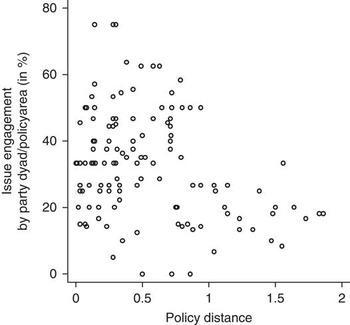
Issue engagement and ideological proximity Note: each dot represents issue engagement between two parties in one policy area. For the list of policy areas, see online Appendix B. The y-axis shows the percentage of issues within each policy area that both parties addressed during the campaign period in press releases (i.e., the share of issues within a policy area with issue engagement). The x-axis shows the distance between the two parties as measured using the data provided for each policy area in AUTNES Manifesto Coding 2008 (2012).

Issue engagement and party resources Note: this graph shows the percentage of issues that both parties addressed during the campaign period in press releases (i.e., the share of issues with issue engagement) (y-axis) dependent on the level of party resources (x-axis). Party dyads are clustered in five groups (separated by vertical lines) distinguishing party pairs for parties with a large (L), medium (M) and small (S) amount of resources (Spearman’s rank-order correlation: −0.91).

Figure 1 shows the bivariate pattern for the relationship between issue engagement and ideological distance. For this descriptive analysis we consider the share of issues with issue engagement within each policy area. Each marker thus represents a party pair within one policy area, so there is a total of 130 markers, ten for each policy area and 13 for each party dyad.Footnote 12 The x-axis shows the absolute policy distance between the two parties on that policy area based on party manifestos. The y-axis displays the percentage of issues with issue engagement for each party dyad and policy area. Each dot therefore indicates the extent to which, within one policy area, parties mentioned the same issues in their press releases. For example, the dot at the top-left is the SPÖ–Greens party dyad on family affairs, and the Social Democrats and the Greens pursue issue engagement on about 75 percent of issues within that policy area.
Figure 1 provides some support that ideological proximity matters: issue engagement is lower among parties with very different policy positions. The correlation is significant but rather weak (r=0.30; N=130), suggesting that ideological proximity, while important, is likely to be only part of the story.
Figure 2 shows the proportion of issues shared between two parties (y-axis; in percent) conditional on parties’ resources (x-axis). Each dot thus indicates what proportion of issues (across all policy areas) both parties talked about. The horizontal lines separate the party pairs, ranging from pairs of parties where both have many resources on the left to party pairs with low resources on the right. There is a clear trend that issue engagement is more common among parties with sufficient resources and less likely among parties that lack the resources to address a broader range of issues. Parties with high or moderate resources (SPÖ, ÖVP and FPÖ) pursue engagement on about 40 percent of all issues. In contrast, issue engagement is less common for pairs where one party has low resources (BZÖ and Greens). In this case, the share of issues addressed by both parties is lower than 30 percent.
Although the patterns in Figure 2 support the hypothesis that financial means and personnel play a role, they also reveal variation that cannot be explained by party resources. For example, the Greens are more likely to pursue issue engagement with the Social Democrats (29 percent) than with the People’s Party (23 percent), although both SPÖ and ÖVP have comparably high resources at their disposal. This difference indicates that other, perhaps policy-related factors may also account for the varying levels of issue engagement.
Multivariate Results
For a more comprehensive test of our hypotheses, we apply a multivariate regression model with all covariates from Hypotheses 1 and 2 as well as our control variables. The units of analysis are party dyads on each individual issue. Our dependent variable is issue engagement on individual issues: whether both parties in a dyad talk about an issue (1) or not (0).Footnote 13 We employ a logistic regression and clustered standard errors and randomization testing to account for our data structure (issues nested in party dyads and policy areas). The number of observations differs across model specifications because we have no data on policy differences for three of our issue areas. In the full model with all covariates, we have 1670 cases as we have 167 issues areas and ten party dyads.
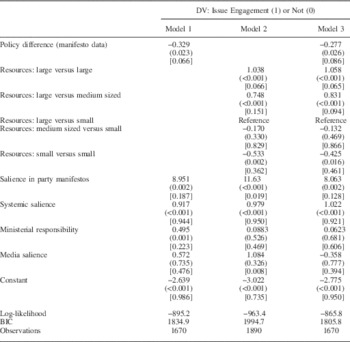
Table 1 shows the regression results of logistic regressions explaining issue engagement. Models 1 and 2 show the results testing Hypotheses 1 and 2 separately. In Model 3, we add all covariates in a full regression model. Note that we show p-values using clustered standard errors (in parentheses) and randomization tests (in brackets) rather than standard errors.Footnote 14
Explaining Issue Engagement Between Party Pairs (Logistic Regression Models)

Note: p-values based on clustered standard errors in parentheses; randomization test p-values in brackets.
BIC=Bayesian information criterion.
We find support for Hypothesis 1: ideological proximity affects the likelihood of issue engagement. The negative regression coefficients in Models 1 and 3 indicate that issue engagement becomes less likely as the ideological distance between two parties increases. The average probability of issue engagement decreases by about 1.5 percent (from 14.5 to 13.1 percent) if ideological distance increases by one standard deviation. To illustrate this, take the example of the two parties that share very similar views on a policy issue (policy distance: 0.1 points). Ceteris paribus, their likelihood of issue engagement is relatively high (16.0 percent). For two parties that have quite conflicting views (policy distance: 1.00), the likelihood of issue engagement is somewhat lower (13.0 percent).
To test Hypothesis 2, we use the party dyads where we expect medium levels of issue engagement (high versus low resources) as our reference category. Compared with these dyads, party pairs where both parties have high levels of resources should also exhibit more frequent issue engagement, whereas the effects should be negative for party dyads where both parties have few resources. There is strong empirical support for our hypothesis that party pairs with greater financial and human resources are more likely to pursue issue engagement. This effect is in the expected direction and significant in Model 2 as well as in the full model (Model 3). Ceteris paribus,Footnote 15 issue engagement is much more likely (32.8 percent) for parties with many resources (high versus high) than for those party dyads where both parties lack resources (low versus low; 10.0 percent). The regression results also show that the effect is not equally large across the different categories. The main distinction to be made is that between dyads involving only parties with high or medium resources (SPÖ, ÖVP and FPÖ) and dyads containing at least one of the two smaller parties with the least resources (BZÖ and Greens). This pattern resembles the bivariate pattern in Figure 2.
Turning to the control variables, the positive and significant effect of the parties’ manifesto issue emphasis indicates that ex ante strategies affect campaign communication. Thus, parties are more likely to pursue issue engagement if both parties emphasized the respective issue area in their manifestos, although the effect does not reach conventional levels of statistical significance in all models for the randomization test p-values. Ceteris paribus, increasing the parties’ combined issue salience in their manifestos from the mean value by one standard deviation increases the probability of issue engagement by about 2 percentage points (from 14.5 to 16.4 percent).
The results show that issue engagement is also related to the issues raised by the other parties in the party system. Increasing the number of rival parties addressing an issue from 1 (the mode) to 2 increases the probability of issue engagement by about 17 percentage points (from 14.5 to 31.9 percent). However, note the vast difference between the “ordinary” p-values (highly significant) and those of the randomized testing (not significant). The non-finding for randomized testing makes sense because in contrast to all other covariates, systemic salience is a system-wide feature, which is not linked to a particular party. When we randomize party labels and re-run the analysis in these simulations, effects of systemic salience are common because exchanging party labels has only a limited effect for measures built on several parties. Thus, if systemic salience affects issue emphasis in the party dyads, its effect is also present in the simulations, and hence the randomized p-value does not meet conventional levels of statistical significance.
The evidence in Table 1 provides no empirical support that ministerial accountability matters. Although the effect is positive in all regression models, it is not statistically significant once we account for all covariates in Model 3. The effect is also very small: the likelihood of issue engagement increases by about 1 percentage point (from 14.5 to 15.3 percent). Finally, there is no empirical support for the media influence effect, although some p-values reach conventional levels of statistical significance. A closer analysis reveals that while there is a close correspondence between media issue emphasis and party issue engagement on most issue areas, there are a few issue areas where the party and the media issue agenda diverge. For example, almost all policy issues dealing with pensions are of central importance for most parties but are rarely mentioned in the news media. In contrast, issues dealing with political reforms and corruption are stressed heavily in media reports but only rarely mentioned by political parties. Thus, the media issue agenda and the parties’ issue priorities did not match on all issues. We conclude that there was no general media effect on issue engagement in the 2008 Austrian election.
Conclusion
Our extensive content analysis of party press releases shows that the extent to which parties pursue issue engagement depends on the electoral incentives they are presented with, but also on the organizational constraints they face. Specifically, we find that a key electoral incentive that characterizes the relationship between two parties—their issue proximity—affects their propensity to pursue issue engagement. Thus, parties engage more with each other if their positions on that issue area are close to each other, so when they are direct rivals for policy-based support from voters. Organizational resources also affect whether a party is likely to talk about the same issues as its rivals. We argue that this is because larger parties with more resources have the money and personnel to cover a broad range of topics. Overall, we need to consider both incentives and constraints when trying to understand why issue engagement varies.
These patterns in issue engagement have consequences for the quality of party democracy. Issue engagement is a minimal requirement if voters are to evaluate party positions on different issues and to make the well-informed choices. Yet, we have shown that issue engagement in a multiparty context is partial at best: while many issues are addressed by two or three parties, few issues are addressed by all parties. Moreover, issue engagement is lower where it is much needed. Engagement becomes less likely when parties defend very different policies, so when there are clear choices to be made. This is arguably the opposite of what democracy should provide. Issue engagement is also lower when parties are small and new. This may reduce the ability for voters to gain a full picture of party positions. Finally, we note that issue engagement may be particularly desirable when one of the parties is in government or when issues are at the top of the media agenda, yet multivariate models indicate that there is no consistent evidence that issue engagement is higher in these cases.
Overall, our findings are therefore cause for concern about the extent to which parties provide information to voters when it is needed. Successful electoral competition between parties would benefit from a high level of issue engagement between all parties, yet democracy relies on individual parties to provide this. However, because the strategies and resources of parties differ, parties fail to pursue issue engagement on all salient issues. In this way, parties’ strategic decisions regarding issue salience may run counter to the public interest.
Our study also demonstrates the need for comparative research on issue engagement. For example, we find support that issue competition in party press releases is related to that in party manifestos: parties are more likely to engage over issues during the campaign that they both also addressed in their manifestos. This finding illustrates the wider impact of manifestos on other campaign activities. Yet, for two reasons we should be careful in generalizing this finding. First, the effect does not withstand all tests of statistical significance, in particular when using the randomization test p-values. Second, we would generally expect party strategies in manifestos and press releases to differ quite substantially. The two types of party communication differ in their length, audience and authorship, and these differences should also affect the content of these texts.
In general, the results presented here demonstrate that issue engagement is likely to work differently in two-party and multiparty systems. We have shown that party resources and ideological polarization affect the level of issue engagement. This suggests that issue engagement is less likely in fragmented, polarized party systems where parties’ resources are minimal. Further single-country or comparative analyses would add to our knowledge of issue engagement in election campaigns.
Acknowledgments
We would like to thank Laurenz Ennser-Jedenastik for comments on an earlier version of this paper and Roman Senninger for research assistance. The authors gratefully acknowledge the support of the Austrian National Election Study (AUTNES), a National Research Network (NFN) sponsored by the Austrian Research Fund (FWF) (S10902-G11 & S10903-G11).
Supplementary Material
To view supplementary material for this article, please visit http://dx.doi.org/10.1017/psrm.2015.40