Introduction
The goals of successful tympanoplasty are the removal of pathology and the achievement of a mucosa-lined middle-ear cleft with an intact tympanic membrane.Reference Albu, Babighian and Trabalzini1 The reported incidence of surgical success of tympanoplasty ranges from 60 to 99 per cent in adults.Reference Inwood, Wallace and Clarke2
There are various reported prognostic factors which may influence tympanoplasty success.Reference Lin and Messner3 These comprise age, perforation location and size, eustachian tube condition, middle-ear mucosa status, graft type and surgeon experience.Reference Bhat and De4
Gastroesophageal reflux disease causes several symptoms and affects many people; hence, otolaryngologists will encounter patients with gastroesophageal reflux disease. Gastroesophageal reflux disease causing supraoesophageal lesions can have manifestations in the larynx, pharynx, nasal cavity and middle ear.Reference Weaver5 Animal studies have revealed that an acidic pH and the presence of pepsin can cause laryngeal complications and eustachian tube dysfunction as a result of gastroesophageal reflux disease.Reference Gaynor6–Reference Yazici, Sari, Uneri, Midi and Tugtepe8 Gastroesophageal reflux disease may manifest as nasopharyngitis, leading to ear disease, and may also cause chronic, therapy-resistant middle-ear disease.Reference Poelmans, Tack and Feenstra9
However, we were unable to find any previous studies specifically assessing the association between gastroesophageal reflux disease and tympanoplasty success. Therefore, we investigated the possible clinical relationship between gastroesophageal reflux disease and the surgical outcomes of type one tympanoplasty in adults with chronic otitis media, by using a simple, cost-effective, reliable questionnaire together with assessment of physical findings.
Materials and methods
Our study group comprised patients who presented to the ENT department of Istanbul Haydarpasa Numune Education and Research Hospital and were treated with type one tympanoplasty between January 2009 and January 2010.
This study was approved by Haydarpasa Numune Education and Research Hospital ethics committee, and a completed informed consent form was obtained from each patient prior to study commencement.
The medical charts of 147 patients were reviewed by the first two data collectors. Variables such as age, sex, presence of systemic disease, perforation location and size, and dry period duration were evaluated. Patients who had a central tympanic membrane perforation of less than 50 per cent, and a dry period of more than three months, were included in the study.
Patients with systemic disease, marginal perforation, previous ear surgery on the same side or graft material other than temporalis fascia, and those who died during follow up, were excluded from the study. Any patients who had been treated with histamine antagonists or proton pump inhibitors in the six months prior to the study were also excluded. In this way, we excluded most known prognostic factors affecting tympanoplasty surgical outcomes, in order to focus only the effect of gastroesophageal reflux disease.
The underlay tympanoplasty technique, in which temporalis fascia is harvested as the graft material, was used in all patients, under general anaesthesia. The surgical approach was retroauricular. All surgical procedures were performed by three senior surgeons.
Patients were followed up six months post-operatively. An intact graft in the correct position was considered a success.
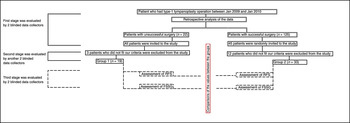
The second stage of the study was conducted by two different data collectors. Twenty-two patients had unsuccessful tympanic membrane closure. Of these, 19 patients met our selection criteria; these patients were classified as group one. One hundred and twenty-five patients had successful surgery. These patients were arranged in order of patient hospital protocol number, and 45 consecutive patients were invited to take part in the study. Thirty-three of these patients agreed and met our selection criteria; these patients were classified as group two (Figure 1).
Flow diagram showing progress of patients through the study procedure. Jan = January; RFS = Reflux Finding Score; FSSG = Frequency Scale for the Symptoms of Gastroesophageal Reflux Disease

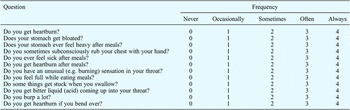
In the third stage of the study, the selected patients underwent evaluation of gastroesophageal reflux disease symptoms using the Frequency Scale for the Symptoms of Gastroesophageal Reflux Disease questionnaire, administered by two blinded otolaryngologists who were unaware of the previous stages of data collection (Appendix 1). The Frequency Scale for the Symptoms of Gastroesophageal Reflux Disease is a new method of assessing gastroesophageal reflux disease, and addresses the most common symptoms of the disease.Reference Kusano, Shimoyama, Sugimoto, Kawamura, Maeda and Minashi10 This questionnaire comprises seven questions on acid reflux and five questions on dysmotility.Reference Kusano, Shimoyama, Kawamura, Maeda, Kuribayashi and Nagoshi11 Subjects answered questions about the frequency of their symptoms, scoring them as follows: never = 0, occasionally = 1, sometimes = 2, often = 3 and always = 4. We calculated the acid reflux, dysmotility and total scores. A total score of 8 or more was considered to indicate probable gastroesophageal reflux disease.Reference Sugimoto, Nishino, Kodaira, Yamade, Uotani and Ikuma12
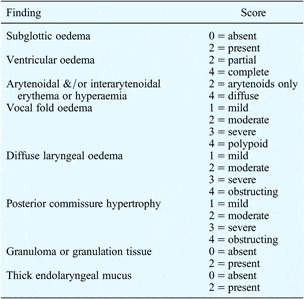
Since there is no pathognomonic laryngopharyngeal reflux finding, Belafsky et al. have developed an eight-item clinical severity scale with which to rate the laryngoscopic findings of laryngopharyngeal reflux. This Reflux Finding Score appears to be useful for assessment and follow up of laryngopharyngeal reflux patients.Reference Belafsky, Postma and Koufman13 Belafsky et al. rated, on a variably weighted scale from 0 to 4, the following eight findings associated with laryngopharyngeal reflux: subglottic oedema, ventricular obliteration, erythema or hyperaemia, vocal fold oedema, diffuse laryngeal oedema, posterior commissure hypertrophy, granuloma, and thick endolaryngeal oedema. Possible results ranged from 0 (normal) to 26 (worst possible score). Based on this analysis, one could be 95 per cent certain that a patient with a Reflux Finding Score of 7 or more had laryngopharyngeal reflux.Reference Ford14
Our study evaluated the physical findings of laryngopharyngeal reflux seen during fibre-optic laryngoscopy, using this Reflux Finding Score, administered by the same two blinded otolaryngologists (Appendix 2).Reference Belafsky, Postma and Koufman13
Subsequently, we calculated the correlations between the Frequency Scale for the Symptoms of Gastroesophageal Reflux Disease score, the Reflux Finding Score and the patient's tympanoplasty surgical success.
Statistical analysis
The NCSS 2007 and PASS 2008 Statistical Software packages (Kaysville, Utah, USA) was used for all analyses, and a biostatistician reviewed the results. The Mann–Whitney U test was used to compare the values obtained in the two groups. Spearman's rho coefficient was used to assess the correlation between the Frequency Scale for the Symptoms of Gastroesophageal Reflux Disease score and the Reflux Finding Score. Statistical significance was defined as a p value of less than 0.05. A confidence interval of 95 per cent was used.
Results
There were 25 male and 27 female patients in this study. The age range of the patients was 18 to 48 years. Nineteen patients had unsuccessful tympanic membrane closure. Thirty-three patients with successful surgery were evaluated as a control group.
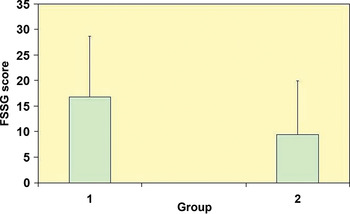
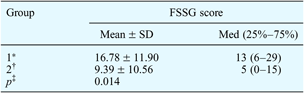
The Frequency Scale for the Symptoms of Gastroesophageal Reflux Disease had a mean score ± standard deviation and a median score of 16.8 ± 12.0 and 13, respectively, in group one, and 9.4 ± 10.6 and 5, respectively, in group two. Group one had a significantly higher mean score than group two (p < 0.05) (Table I, Figure 2).
Mean Frequency Scale for the Symptoms of Gastroesophageal Reflux Disease (FSSG) scores in group one (n = 19) and group two (n = 33).

Comparison of FSSG scores
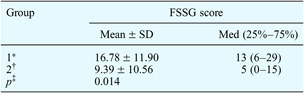
* n=19; †n = 33. ‡Mann–Whitney U test. FSSG = Frequency Scale for the Symptoms of Gastroesophageal Reflux Disease; SD = standard deviation; Med = median
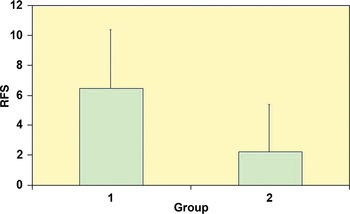
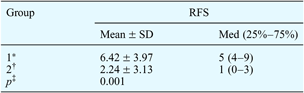
The Reflux Finding Score had a mean ± standard deviation and a median of 6.4 ± 4.0 and 5, respectively, in group one, and 2.2 ± 3.1 and 1, respectively, in group two (Table II, Figure 3).
Mean Reflux Finding Score (RFS) in group one (n = 19) and group two (n = 33).

Comparison of RFS
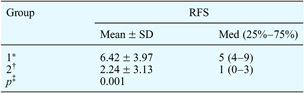
* n=19; †n = 33. ‡Mann–Whitney U test. RFS = Reflux Finding Score; SD = standard deviation; Med = median
Both the Reflux Finding Score and the Frequency Scale for the Symptoms of Gastroesophageal Reflux Disease generated significantly higher scores for group one than for group two (p = 0.014 and p = 0.001, respectively). For all cases, there was a significant positive relationship between the Frequency Scale for the Symptoms of Gastroesophageal Reflux Disease score and the Reflux Finding Score, at the level of 36 per cent, with an r value of 0.360 (Spearman's rho coefficient) and a p value of 0.009.
Discussion
Gastroesophageal reflux disease is the most frequent disease of the oesophagus, and is present in about 20 to 40 per cent of the Western population.Reference Poelmans, Tack and Feenstra9 Pathophysiologically, two mechanisms are responsible for the mucosal injury caused by gastroesophageal reflux disease. One is the action of acid and the proteolytic enzyme pepsin. The other may be the reflexes mediated by the vagal nerve.Reference Shaker, Milbrath, Ren, Toohill, Hogan and Li15
The relationship between reflux oesophagitis and otorhinolaryngological problems has been described before.Reference Weaver5–Reference Poelmans, Tack and Feenstra9 Patients with laryngeal problems have acid reflux reaching higher levels of the proximal oesophagus, compared with normal individuals.Reference Shaker, Milbrath, Ren, Toohill, Hogan and Li15 Oedema of the mucosa around the eustachian tube, as a direct effect of gastroesophageal reflux disease, might cause a difference in pressure between the middle-ear cavity and the nasopharynx which could result in the ingress of a bolus of reflux material from the pharynx into the middle ear.Reference Velepic, Velepic, Starcevic, Manestar and Rozmanic16 Transient reflux of acid and resultant conversion of pepsinogen to pepsin could cause further eustachian tube dysfunction, as suggested by studies on animal models.Reference White, Heavner, Hardy and Prazma7
The discovery of pepsin and pepsinogen in the middle-ear effusions of children provides strong evidence of a causal relationship between gastroesophageal reflux disease and otitis media.Reference Tasker, Dettmar, Panetti, Koufman, Birchall and Pearson17 Most investigations of the relationship between otitis media and gastroesophageal reflux disease have been conducted in children, with only limited research in adults.Reference Poelmans, Tack and Feenstra9, Reference Velepic, Velepic, Starcevic, Manestar and Rozmanic16, Reference Lieu, Muthappan and Uppaluri18–Reference Poelmans, Tack and Feenstra20
One of the common sequelae of chronic otitis media is tympanic membrane perforation, which can cause hearing loss and otorrhoea. The major goals of tympanoplasty are to reduce the number of infections and improve hearing. Reported factors that may influence the success of such surgery are age, perforation location and size, eustachian tube condition, middle-ear mucosa status, graft type, and surgeon experience.Reference Bhat and De4
Abnormal eustachian tube function appears to be the most important factor in the pathogenesis of middle-ear disease in all age groups.Reference Bluestone21 Firstly, direct contact between reflux and eustachian tube mucosa may occur, based on the eustachian tube's proximity to the upper airway. Secondly, occlusion of the eustachian tube by inflammation may cause secondary changes. Finally, reflux exposure may generate inflammatory mediators, stimulating a cascade of inflammation which leads to middle-ear disease. A previously conducted literature review of modifiable risk factors for otitis media identified gastroesophageal reflux disease as a risk factor.Reference Lubianca Neto, Hemb and Silva22 Although gastroesophageal reflux disease has been demonstrated to be related to eustachian tube dysfunction and middle-ear disease, we have not encountered any previously published literature concerning gastroesophageal reflux disease as a possible prognostic factor for tympanoplasty success.Reference White, Heavner, Hardy and Prazma7, Reference Yazici, Sari, Uneri, Midi and Tugtepe8, Reference Sone, Yamamuro, Hayashi, Niwa and Nakashima19
The goal of the present study was to investigate the relationship between gastroesophageal reflux disease and tympanoplasty success. In our patients, scores for both the Frequency Scale for the Symptoms of Gastroesophageal Reflux Disease and the Reflux Finding Score were significantly higher in group one than group two. These higher scores in group one can be explained by eustachian tube dysfunction caused by reflux. Therefore, we hypothesise that gastroesophageal reflux disease may be a significant prognostic factor for tympanoplasty success.
Although scores for both research tools were significantly higher in group one, the limitation of our study was the lack of exact diagnosis of gastroesophageal reflux disease, due to the fact that endoscopic examinations are invasive and stressful for patients, especially for those who have only ear symptoms. Moreover, studies have shown that 24-hour pH monitoring may not be the ‘gold standard’ for diagnosing gastroesophageal reflux disease.Reference DiBaise, Olusola, Huerter and Quigley23 Thus, we used a questionnaire (the Frequency Scale for the Symptoms of Gastroesophageal Reflux Disease) together with assessment of physical findings of laryngopharyngeal reflux on laryngoscopy (rated using the Reflux Finding Score), and found this approach to be simple, reliable, cost-effective and well tolerated by patients.
• Gastroesophageal reflux disease is associated with eustachian tube dysfunction and middle-ear disease
• This study assessed the relationship between gastroesophageal reflux disease and adult tympanoplasty success, via a questionnaire and physical findings
• Pre-existing gastroesophageal reflux disease may affect tympanoplasty outcomes
• Reflux treatment should be considered for patients with ear complaints and gastroesophageal reflux symptoms
The results of this study demonstrate that the presence of gastroesophageal reflux disease in patients with chronic otitis media who have undergone type one tympanoplasty may affect their surgical outcome. Thus, treatment for gastroesophageal reflux disease should be considered for patients with ear complaints, especially those who have gastroesophageal reflux disease related symptoms.
Conclusion
There are various prognostic factors reported in the literature which may influence the surgical success of tympanoplasty. In this study, we excluded most of these factors in order to assess only the effect of gastroesophageal reflux disease on tympanoplasty success. To our best knowledge, this is the first study to describe the relationship between gastroesophageal reflux disease and tympanoplasty success. In the future, further studies should be conducted assessing a wider range of relevant prognostic factors (e.g. nasal and eustachian tube pathology, perforation location and size, and graft type), compared using multivariate analysis in a larger patient group.
Gastroesophageal reflux disease has been demonstrated to be related to eustachian tube dysfunction and middle-ear disease. It may also be a significant prognostic factor for tympanoplasty success. Therefore, reflux investigation may be important in patients receiving treatment for chronic otitis media, and in positive cases reflux treatment may be necessary in addition to treatment of the primary disease. The next step should be to detect the existence of pepsin (or pepsinogen) in the middle ear of patients whose tympanoplasty has failed.
Frequency scale for the symptoms of gastroesophageal reflux disease

Patients were asked to score each question as never = 0; occasionally = 1; sometimes = 2; often = 3; or always = 4. In the frequency scale for the symptoms of gastroesophageal reflux disease (FSSG) , there are seven acid-reflux-related symptoms (questions 1, 4, 6, 7, 9, 10 and 12), and five dysmotility-like symptoms (questions 2, 3, 5, 8 and 11). The acid reflux, dysmotility and total scores (acid reflux and dysmotility scores) were calculated, and a total score of = 8 was considered to indicate probable GERD
Reflux finding score