The influence of semantics on cross-linguistic activation
In the psycholinguistic research field dealing with bilingual lexical access, the dispute between selective and non-selective views seems to have been settled in favour of the latter. Despite early studies (Gerard & Scarborough, Reference Gerard and Scarborough1989; Macnamara & Kushnir, Reference Macnamara and Kushnir1971) suggesting that access to the mental lexicon in bilingual word recognition is restricted to only one language, and that bilinguals are to a certain extent able to control their access to lexical information, other and more recent studies have shown that bilingual word recognition basically occurs automatically and in a non-selective way. This means that bilinguals, upon viewing a word, do not access the lexicon of each language separately but actually run a parallel search through their entire lexicon, irrespective of the language. The most conclusive results stem from studies using cognates. In general, these studies unambiguously report that bilingual participants respond more quickly to L2 cognates than they do to L2 control words (e.g. Dijkstra, Grainger & van Heuven, Reference Dijkstra, Grainger and van Heuven1999; Duyck, Van Assche, Drieghe & Hartsuiker, Reference Duyck, Van Assche, Drieghe, and Hartsuiker2007; Lemhöfer & Dijkstra, Reference Lemhöfer and Dijkstra2004). In contrast to the constant cognate facilitation effect, homograph studies yield a complicated pattern of results ranging from inhibition to no effects and to facilitation (Beauvillain & Grainger, Reference Beauvillain and Grainger1987; Caramazza & Brones, Reference Caramazza and Brones1979; Christoffanini, Kirsner & Milech, Reference Christoffanini, Kirsner and Milech1986; De Groot, Delmaar & Lupker, Reference De Groot, Delmaar and Lupker2000; Dijkstra, De Bruijn, Schriefers & Ten Brinke, Reference Dijkstra, De Bruijn, Schriefers and Ten Brinke2000; Dijkstra et al., Reference Dijkstra, Grainger and van Heuven1999; Dijkstra, Timmermans & Schriefers, Reference Dijkstra, Timmermans and Schriefers2000; Dijkstra, van Jaarsveld & Ten Brinke, Reference Dijkstra, van Jaarsveld and Ten Brinke1998; Jared & Szucs, Reference Jared and Szucs2002; Lemhöfer & Dijkstra, Reference Lemhöfer and Dijkstra2004; Von Studnitz & Green, Reference Von Studnitz and Green2002).
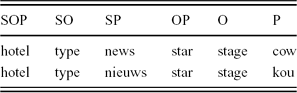
It is believed that the mixed and seemingly inconsistent results obtained in the homograph studies are due to experimental factors such as task demands and list composition. Yet, it is also argued that the inherent characteristics of the homographic items used could be responsible for the differential results. Dijkstra et al. (Reference Dijkstra, Grainger and van Heuven1999), for instance, investigate the degree of cross-linguistic overlap on the basis of semantics (S), orthography (O) and phonology (P), yielding six types: SOP, SO, SP, OP, O and P (see Table 1).
Examples of word types used in Dijkstra, Grainger and van Heuven (Reference Dijkstra, Grainger and van Heuven1999).

The results show facilitation effects in the case of semantic and orthographic overlap (O and SO), while phonological overlap induces inhibition (P). For present purposes, only the homographic items O and OP are relevant. The researchers argue that the interplay of these two items might explain the previously observed null effects for homographs. The line of reasoning here is that the facilitatory effect due to the orthographic overlap is neutralised by the inhibitory effect due to the phonological overlap. Although a later study by Lemhöfer and Dijkstra (Reference Lemhöfer and Dijkstra2004) does not report this phonology-ascribed inhibition, the findings in Dijkstra et al. (Reference Dijkstra, Grainger and van Heuven1999) suggest that null effects, and even inhibition effects, obtained in previous studies could be explained by the degree of cross-linguistic phonological overlap.
Thus, previous studies provide different findings for cognates presented in isolation compared to homographs presented in isolation. But how are these words recognised in context? Does the presence of a sentence context, of the same language as the target word, restrict the activation of the non-target word, in the case of both cognates and homographs? Schwartz and Kroll (Reference Schwartz and Kroll2006), for example, investigate the influence of a semantic context provided by a sentence on the recognition of cognates and homographs. To determine the influence of a semantic constraint on lexical activation, highly proficient and intermediate Spanish–English bilinguals had to name target and control words that were inserted in low-constraint and high-constraint sentences as quickly as possible (e.g. “We felt a bit nervous when we saw the fin of the shark in the distance” and “From the beach we could see the shark's fin pass through the water”, respectively). In low-constraint sentences, the results clearly demonstrate a cognate facilitation effect (replicated by Duyck et al., Reference Duyck, Van Assche, Drieghe, and Hartsuiker2007 and van Hell & De Groot, Reference van Hell and De Groot2008). However, in the high-constraint sentences, recognition of homographs and cognates did not produce a significant effect, nor did homographs in low-constraint sentences. Next to the fact that the results for homographs deviate again, the findings of Schwartz and Kroll (Reference Schwartz and Kroll2006) establish two things: First, the cognate facilitation effect in low-constraint sentences shows that the presence of a unilingual sentence does not restrict lexical search to a particular language. Second, the null-effects obtained in the other conditions demonstrate that the presence of a rich semantic context can eliminate lexical activation of the non-target language.
These findings are also established in studies using homophones. Li and Yip (Reference Li and Yip1998), for example, examine cross-linguistic homophones in the lexical processing of Chinese–English bilinguals. The homophones were either inserted in a predictive sentence context or in a neutral one. The results of their cross-modal naming experiment show that the predictive sentence context significantly facilitates Chinese–English bilinguals' recognition of homophones, which in turn facilitates their naming of the phonologically related words. Similarly, in a recent eye-tracking study using English–French homophones (e.g. pool – poule), Chambers and Crooke (Reference Chambers and Cooke2009) demonstrate that a semantically compatible sentence context eliminates the activation of the English lexicon when interpreting French sentences. Once again, these studies provide evidence that the degree of non-selective activation is influenced by the semantic characteristics of the sentence context.
Comparable findings were also uncovered in a semantic priming paradigm. In a single-word semantic priming study, De Bruijn, Dijkstra, Chwilla and Schriefers (Reference De Bruijn, Dijkstra, Chwilla and Schriefers2001) report that regardless of the language, prime target words were responded to faster in a semantically related condition than in a semantically unrelated condition. This means that the language of context items in itself is not sufficient to suppress lexical candidates from the other language; only a semantic constraint is. Elston-Güttler (Reference Elston-Güttler2000) adds that priming effects, found in single-word lists, disappeared when homographs were presented at the end of full sentences, such as “The woman gave her friend an expensive GIFT”. This indicates that the semantic information provided by the preceding high-constraint sentence was sufficient to rule out the irrelevant meaning of the non-target language, German (Gift means “poison”). Later, Elston-Güttler, Gunter and Kotz (Reference Elston-Güttler, Gunter and Kotz2005) qualify this finding, arguing that bilinguals have to zoom into the all-L2 task. In their study, the results show a homograph priming effect in a sentence context, but only in the first half of the experiment. This is evidence that the participants gradually learn to deactivate the irrelevant meaning of the L1 reading of the homograph, based on the sentence context.
In sum, the studies on lexical access in a sentence context indicate that, in recognising interlingual homographs (or homophones for that matter), the presence of a sentence context could guide lexical access towards the target language. This especially applies to highly proficient bilinguals, whose results reveal an elimination of cross-linguistic effects in a semantically high-constraint context (see also Elston-Güttler, Paulmann & Kotz, Reference Elston-Güttler, Paulmann and Kotz2005). Semantic context here is to be defined on a general level. A recent lexical decision and translation study by van Hell and De Groot (Reference van Hell and De Groot2008), however, examined the influence of semantics on cross-linguistic activation at a more fine-grained level, by differentiating between concrete and abstract nouns. In this study, Dutch–English bilinguals had to perform a lexical decision task as well as translate target words (concrete and abstract cognates and non-cognates) from L1 to L2 and vice versa. Targets were embedded in a high- or low-constraint context, or presented in isolation. The results reveal the same pattern as in Duyck et al. (Reference Duyck, Van Assche, Drieghe, and Hartsuiker2007) and Schwartz and Kroll (Reference Schwartz and Kroll2006), which is that the cognate facilitation effect only disappears in high-constraint sentences. It confirms that non-selectivity can be constrained by embedding words in a semantically constraining sentence context. In addition, the results show that this effect is sensitive to the more fine-grained variation of semantic overlap in backward and forward translation. Indeed, in the translation tasks, differences in concreteness modulate the interaction between cognate status and semantic constraint. This finding indicates that it is worthwhile to go beyond the absolute all-or-none semantic overlap manipulations.
We believe that the degree of cross-linguistic overlap should be specified with respect to semantics, resulting in a clear differentiation between lexical semantics on the one hand, and word class semantics (or categorial meaning) on the other. Whereas van Hell and De Groot's (Reference van Hell and De Groot2008) study focuses on the former, the present manuscript will focus on the latter. We argue that the various results obtained in the homographs studies may be driven by the fact that part of the homograph stimuli share the same word class whereas others do not. The English words ANGEL and BREED, for example, are spelled identically to Dutch words meaning “sting” and “wide”, respectively. However, ANGEL is in the same word class in English and Dutch (noun), whereas BREED belongs to different word classes (verb/noun and adjective, respectively). We assume that expectations regarding the word class will influence the degree of cross-linguistic activation. This topic has so far received little empirical attention. A number of researchers acknowledge that little is known about the effects of semantic and syntactic information on cross-linguistic activation (e.g. Dijkstra & van Heuven, Reference Dijkstra and van Heuven2002; French & Jacquet, Reference French and Jacquet2004; Kroll & Tokowicz, Reference Kroll, Tokowicz, Kroll and De Groot2005; van Hell, Reference van Hell2002).Footnote 1 Meuter (Reference Meuter and Pavlenko2009) actually mentions the lack of explicit claims concerning the influence of different word classes. In addition, van Hell (Reference van Hell2002) states that the effects of word class may constrain existing models of bilingual word recognition.Footnote 2 Recently, Sunderman and Kroll (Reference Sunderman and Kroll2006) prove that it is relevant to control for word class. In a translation recognition study of words presented out of context, they show that bilinguals are sensitive to cues of word class, as form-related interference effects are reduced or eliminated when the word pairs are drawn from different categorial classes. The influence of word class meaning, however, becomes particularly relevant in a sentence context, as it is only in interaction with other words that meaning is fully deployed.
One may, for example, attribute a lexical-class meaning to the word fire, yet the categorial meaning of this word depends on actual speech and whether fire is used as a verb (for example, in the sentence They fired rubber bullets) or as a noun (for example, in There was a fire on the ground floor) depends on the sentence as a whole. (Willems, Reference Willems2000, p. 96)
Previous homograph recognition studies, presenting their items in a sentence context, did not control their stimuli for word class semantics, but only for semantics on a general level. Therefore, we systematically control for categorial semantics in this study. As far as we know, no other study has made this distinction with regard to the recognition of interlingual homographs in a sentence context.Footnote 3
Method
Participants
We constructed a single experiment that was carried out by high-proficient Dutch–English bilinguals – seven male and 26 female university students ranging from 19 to 23 years old. The group received monetary compensation for participation. All participants were native speakers of Dutch living in an L1-dominant environment, speaking Dutch daily in their community. They had learnt English in a formal school setting from the age of 14 onwards and were, from an even younger age, more than regularly exposed to English (e.g. through the Internet, music, films, television and so forth). In addition to this daily exposure, participants were more exposed to English than is usual for the average speaker of Dutch, as they were all reading English language and literature at university. Of the 33 participants, one was excluded because of poor performance in the lexical decision task (his mean error rate was more than 2.5 standard deviations above the overall mean error rate).
Stimulus materials
The critical target stimuli consisted of 32 English–Dutch homographs, of which 16 belong to the same word class in both languages and 16 do not. Furthermore, the homographs were subdivided into a high-frequency and low-frequency group, based on their use in English (HFE and LFE, respectively). The homographs were extracted from the CELEX database (Baayen, Piepenbrock & van Rijn, Reference Baayen, Piepenbrock and van Rijn1993). Using the WordGen stimulus generation program (Duyck, Desmet, Verbeke & Brysbaert, Reference Duyck, Desmet, Verbeke and Brysbaert2004), the control condition was created through an item-by-item match with respect to word frequency in English, neighbourhood size, comparable syllable structure (bigram) and word length (see Table 2). Table 2 shows that the homographs and their control words did not differ from each other with regard to these variables. These tests prove that the English readings of the homographs and the controls differ only in terms of their interlingual homographic status.
Mean lexical characteristics of stimuli used.

Standard deviations are indicated between brackets. Reported p-values indicate significance levels of dependent samples comparisons between homographs and controls (matched item by item).
aLogarithm of word frequency per million words according to the CELEX lexical database (Baayen et al., Reference Baayen, Piepenbrock and van Rijn1993).
bNeighbourhood size calculated using the WordGen program (Duyck et al., Reference Duyck, Desmet, Verbeke and Brysbaert2004).
cBigram frequency calculated using the WordGen program (Duyck et al., Reference Duyck, Desmet, Verbeke and Brysbaert2004).
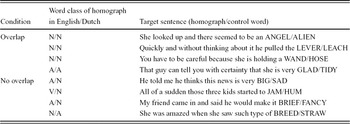
An important criterion for the selection of critical words was that both the homograph and its control word had to be usable in the same low-constraint sentence as a final word (see Table 3). Low constraint should be understood here on a lexical–semantic level. Nonetheless, the sentences do create expectation regarding the word class semantics of the targets. This is comparable to Schwartz and Kroll's (Reference Schwartz and Kroll2006) study in which the high-constraint environments create a certain expectation regarding the target's lexical semantic field. In our study, expectancy is not based on “what a word means” (lexical semantics) but on “what word class a word belongs to” (categorial semantics).
Examples of sentence stimuli used.

As non-critical stimuli, we composed 16 low-constraint filler sentences with English filler target words and also 48 filler sentences with non-words as final words. These latter filler sentences were comparable to the sentences used for homographs and their respective controls. All 64 filler targets were again generated by using the WordGen stimulus generation program (Duyck et al., Reference Duyck, Desmet, Verbeke and Brysbaert2004), which produces non-words that are orthographically and phonologically conformable to English. In all, the stimulus list consisted of 96 experimental trails: 16 homographs, 16 controls, 16 fillers and 48 non-words. This way, participants were distracted from the presence of homographs. Furthermore, critical and non-critical sentences were presented in random order so that the sequence of the sentences was completely unpredictable.
After conducting the experiments, three critical pairs out of 32 were excluded from the group's RT-analyses. POMP (overlap), REIN and ROMP (both no overlap) and their controls were discarded from further analysis because the mean error rate was more than 2.5 standard deviations above the overall mean error rate.
Procedure
Participants were tested in small groups. They were placed in such a way that it was impossible to see each other's computer screens. Oral as well as written instructions were given in English on how to perform an L2 lexical decision task to word targets appearing as final words (serial visual presentation, SVP; see Duyck et al., Reference Duyck, Van Assche, Drieghe, and Hartsuiker2007, and Schwartz & Kroll, Reference Schwartz and Kroll2006). Participants were asked to respond by pressing one button if the word belonged to the English language and another button if it did not. They were instructed to react as soon as they identified the target as being an English word. It was ensured that participants were not aware of the fact that L1 was crucial for the experiment; they were told that the experiment was about L2 processing.
Our English sentences were presented in the middle of the computer screen, one word at a time. Each word was presented in black print and centred for 700 ms on a flat-screen monitor showing a white background.Footnote 4 The upcoming appearance of the targets was indicated by a preceding word highlighted in red, which also lingered on the middle of the screen (1200 ms). The red highlight was important in order to ensure word class disambiguation. One could argue, for instance, that sentences with a noun target like “He trembled for a moment when he saw the LOVER” cause a problem with regard to the expected word class because the target's preceding article in this sample sentence could be followed by an adjective. However, the red print of the article makes such an expectation impossible. Targets were then presented in capital letters as a cue to respond with a maximum response time of 2500 ms. The interval between the successive presentations of sentences measured 1200 ms.
The presentation order of the 96 sentences was random and presented in six blocks of ten sentences and four blocks of nine sentences (preceded by one practice block of ten sentences). The participants saw each sentence only once, either with the homograph or its respective control word as the target. To ensure that the participants actually read the sentences, we used a recognition task (similar to Duyck et al., Reference Duyck, Van Assche, Drieghe, and Hartsuiker2007, and Elston-Güttler, Gunter & Kotz, Reference Elston-Güttler, Gunter and Kotz2005). After each block of nine or ten sentences, four sentences were presented, two of which were shown in the preceding block. Participants had to indicate for each of these four sentences whether it appeared in the preceding block. Mean accuracy on this verification task was very high (M = 85.59%, SD = 3.7).
Results
Statistical methodology
A linear mixed model with fixed-effect terms for homograph (yes, no), categorial overlap (yes, no), frequency (LFE, HFE), time (in which quarter of the experiment) and crossed random effects for subject and item (Baayen, Davidson & Bates, Reference Baayen, Davidson and Bates2008) was fitted to assess the cross-linguistic activation of homographs. To explore the effect of word class overlap, the same mixed models were used but with an additional interaction term for overlap-by-homograph. Statistical analyses of the proportion of incorrect responses were carried out using a mixed-effects logistic regression (Jaeger, Reference Jaeger2008) with the same terms as those used above. Analyses were carried out using R, an open-source programming language and environment for statistical computing (R Development Core Team, 2007) and in particular the lme4 package for linear mixed-effects models (Bates, Reference Bates2005).
Reaction time analysis
The single experiment involved 32 participants and 29 items. The proportion of incorrect responses was 12.9%. These trials were excluded from all reaction time (RT) analyses. RTs that were more than 2.5 standard deviations below or above the participant's RT were excluded from the RT analysis (1.3% of the data).
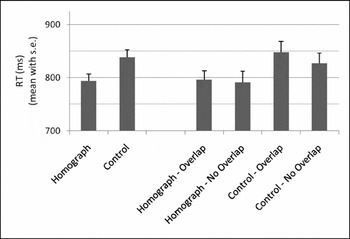
The bar plot in Figure 1 shows the mean RT in each condition of interest, averaged over individual trials, with the error bar representing the standard error of the mean. From these simple presentations, ignoring the dependency within subjects and words, trends in the data are quite clear but need to be confirmed by the statistical models accounting for these dependencies.
Mean reaction times (RT, in ms) by experimental condition. Error bars represent the standard error of the mean.

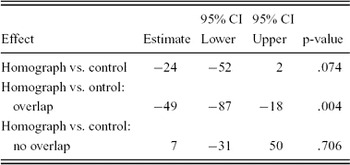
Table 4 shows the results of the linear mixed-effect analyses. A marginally significant effect of homographs vs. control on reaction time is observed (p = .074). This difference is driven by words with categorial overlap (p = .004). Reaction times for homographs with categorial overlap were 49 ms smaller compared to their controls, while no significant effect (p = .706) was observed for homographs with no categorial overlap. These findings clearly demonstrate that the degree of cross-linguistic overlap in terms of word classes modulates cross-linguistic activation effects.
Estimated differences from mixed linear model for RT, in ms, and associated 95% confidence intervals (CIs) and p-values obtained by MCMC sampling (Baayen, Davidson & Bates, Reference Baayen, Davidson and Bates2008).

Following Elston-Güttler, Gunter and Kotz (Reference Elston-Güttler, Gunter and Kotz2005), additional statistical analyses were carried out on the experimental data divided by half. The results show that the facilitation effect obtained for homographs with word class overlap was less pronounced in the second half (−35ms, p = .109) compared to the first half (−55ms, p = .037). This might suggest that bilinguals zoom into the L2 task in that expectations regarding categorial meaning fade away. Nevertheless, the halving of the data makes statistical analyses less precise and reliable. Therefore, rather than interpreting the decreasing trend in RT as indicative of a process of zooming into L2, it merely shows that participants learn how to perform on the specific experimental task.
Error rate analysis
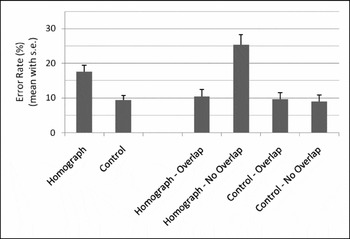
The error rate (i.e., the number of incorrect responses divided by the total number of trial times), averaged over individual trials, is shown in Figure 2. The error rate for homographs is higher than is the error rate for controls, and it is driven by words with no categorial overlap.
Mean error rate by experimental condition. Error bars represent the standard error of the mean.

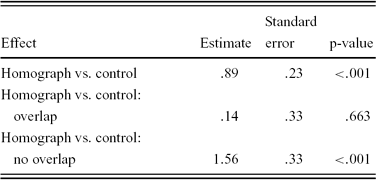
The results from the mixed-effects logistic model corroborate these findings. Effects in Table 5 have to be interpreted on the log-odds ratio scale: for example, the significant positive estimate of homograph versus the control effect indicates that this condition corresponds to a greater probability of an incorrect response. While the odds of an incorrect response (defined as the probability of an incorrect response divided by one minus this probability) is similar for the homographs and controls with categorial overlap, the odds are almost five times as high for the homographs with no overlap relative to their controls.
Estimates of fixed effects from mixed logistic regression model (in log odds).

Discussion
Earlier research has shown that lexical access in bilingual homograph recognition, generally accepted as non-selective with respect to language, can be influenced by several factors, such as external experimental factors and stimuli-inherent differences in the degree of cross-linguistic overlap (i.e. SOP representations). Seeing that these findings are based on isolated word recognition studies, Schwartz and Kroll (Reference Schwartz and Kroll2006), among others, have examined the nature of bilingual lexical activation in a sentence context. They find that language membership of a sentence per se is not sufficient to constrain cross-linguistic activity. Only a strong semantic context can suppress the activation of the non-target language. With semantics, Schwartz and Kroll (Reference Schwartz and Kroll2006, p. 209) refer to lexical-level and message-level semantic information. However, no distinction is made between lexical semantics and categorial semantics. Conceptually similar to the experiments conducted by Schwartz and Kroll, our study additionally examined whether the degree and direction of cross-linguistic interactions might be affected by categorial semantics as well.
Overall, our findings demonstrate that a unilingual linguistic context is insufficient to constrain lexical activation to that specific language, as cross-linguistic activation effects were obtained. The effects of non-selectivity in this experiment only decreased when the non-target could not tie in with the sentence – more specifically, with its expected categorial meaning – in the target language. Indeed, homograph facilitation effects were found in the case of word class overlap but were eliminated when there was no such overlap. As in Schwartz and Kroll's study, “this suggests that the top–down processes of sentence comprehension can interact directly with the bottom–up process of lexical access and reduce the number of lexical entries that compete for selection” (Schwartz & Kroll, Reference Schwartz and Kroll2006, p. 208).
Our finding that categorial meaning modulates the extent of cross-linguistic activations is compatible with the word recognition study by Dijkstra et al. (Reference Dijkstra, Grainger and van Heuven1999), which investigates the degree of cross-linguistic overlap on the basis of lexical semantics (S), orthography (O) and phonology (P). Dijkstra et al. (Reference Dijkstra, Grainger and van Heuven1999) demonstrate that the usual facilitatory effect due to orthographic overlap is neutralised by the inhibitory effect due to phonological overlap. Analogously, we found that the lack of word class overlap has similar inhibitory effects on homographic items. As in Sunderman and Kroll (Reference Sunderman and Kroll2006), it shows that form-related effects are eliminated when the word class of the homographs is different.
Furthermore, our homograph facilitation effect is comparable to the cognate facilitation effect in low-constraint sentences (Duyck et al., Reference Duyck, Van Assche, Drieghe, and Hartsuiker2007; Schwartz & Kroll, Reference Schwartz and Kroll2006; van Hell & De Groot, Reference van Hell and De Groot2008). Analogous to the convergence of orthography and lexical semantics, yielding facilitation effects in the cognate studies, we assume that the convergence of orthography and categorial semantics produced the facilitation effect in our study. In addition, it should be noted that Duyck et al. (Reference Duyck, Van Assche, Drieghe, and Hartsuiker2007) observe a stronger cognate facilitation effect with identical cognates compared to non-identical cognates. In other words, they show that the degree of cross-linguistic overlap indeed affects the strength of cross-linguistic activations. In an unpublished doctoral thesis, Font (Reference Font2001) demonstrates something similar using cognates with orthographic difference at the end of the word (Fr. texte; Sp. texto) or in the middle (Fr. usuel; Sp. usual), the first group revealing a larger degree of facilitation than the latter. In these studies the degree of cross-linguistic overlap was defined in terms of orthography, while in ours, different categorial L1–L2 relationships were taken into account.
As for the accuracy data, our highly proficient participants made more errors on homograph items than on control items. Again, this effect is modulated by the degree of cross-linguistic overlap – in exactly the opposite way of the RT analyses. Homographs with no overlap induced significantly more errors (typically on items associated with slower RTFootnote 5) compared to controls, while this was not the case with homographs with word class overlap. This shows that the activation of the non-targets occurs especially when the lexical competitors are only form-related.
Finally, it is important to discuss some implications of the present study for the future development of models of bilingual language processing. The most explicit model of visual word recognition in bilinguals is currently the BIA+ model of Dijkstra and van Heuven (Dijkstra et al., Reference Dijkstra, Grainger and van Heuven1999; Dijkstra & van Heuven, Reference Dijkstra and van Heuven2002). Following its predecessor (the BIA model, Dijkstra & van Heuven, Reference Dijkstra, van Heuven, Grainger and Jacobs1998), BIA+ assumes an integrated L1/L2 lexicon with parallel bottom–up activation; only a minimal role is attributed to top–down influence. This means that non-linguistic context factors such as task demands and participant expectations can only indirectly affect the word identification system. Conversely, it is assumed that the presence of linguistic factors such as lexical, semantic and syntactic information offered by a sentence context can directly influence the word recognition system, thus limiting non-selectivity. In other words, the modellers leave open the possibility that language membership of a target word is pre-activated by the presence of a sentence context and as a result will prevent the non-target from being activated. Schwartz and Kroll (Reference Schwartz and Kroll2006), on the contrary, show that language membership exerts only minimal influence, as cross-linguistic activation continues to occur. The present study replicated this finding and likewise provided support for the notion that language membership tags do not constrain non-selectivity when a sentence context is present. The available language nodes in BIA+ are therefore considered to be merely passive.
The major new finding of this study is that the effects of cross-linguistic activation are influenced by whether or not language-ambiguous words share categorial meaning. Homographs belonging to the same word class in both languages are more rapidly responded to than those that do not. This finding is in harmony with the BIA+ model, as it assumes that the increased activation of semantics (through the presence of a sentence context which also indicates the categorial meaning) could potentially have a direct impact on cross-linguistic activation. However, the BIA+ model does not fully specify which type of semantics is intended. Schwartz and Kroll (Reference Schwartz and Kroll2006) already indicate this and propose a distinction between lexical-level and message-level semantics; van Hell and De Groot (Reference van Hell and De Groot2008), for their part, offer a more fine-grained analysis at the lexical level. The present study provides evidence that categorial semantics also plays a role. In line with van Hell and De Groot (Reference van Hell and De Groot2008), our study has established that a broad notion such as semantics needs to be defined in greater detail in order to fully capture the effect it has on (the degree of) cross-linguistic activations.