It is well documented that cardiovascular complications, such as hypertension, coronary arterial disease, and cardiac failure, may all develop in the mid- and long-term follow-up of patients who experienced successful repair of native aortic coarctationReference O’Sullivan, Derrick and Darnell1, Reference Cohen, Fuster and Steele2. The underlying mechanisms of hypertension, however, remain unknown. One retrospective study documented that age at the time of repair is one of the key factors associated with an increased risk of hypertensionReference Cohen, Fuster and Steele2. Because of this, early intervention is usually preferred. Endothelin-1 is an endothelial derived potent vasoconstrictor peptideReference Yanagisawa, Kurihara and Kimura3. The agent has been suggested to have play a possible physiological role in maintaining vascular tone in infancyReference Ekblad, Arjamaa, Vuolteenaho, Kapa and Kero4. A possible mechanism for production of hypertension in patients with aortic coarctation, therefore, may be impaired endothelial function resulting from physical factors such as mechanical pressure and stretchReference Yanagisawa, Kurihara and Kimura3–Reference Horigome, Miyauchi and Takahashi- Igari5. It has been demonstratedReference Horigome, Miyauchi and Takahashi- Igari5 that balloon angioplasty for coarctation of the aorta is accompanied by increased levels of endothelin-1 in the plasma, with peak levels observed a few hours after the angioplasty. Increased levels of endothelin-1 have also been documents patients with systolic dysfunction.Reference Yousufuddin, Henein, Flather and Wang6
Children with aortic coarctation of the aorta have left ventricular muscle hypertrophy, enhanced ejection fractions, and diminished mural stressReference Donner, Black, Spann and Carabello7. Echocardiography is a reliable non-invasive method for detecting such changes. Together with echocardiography, measurement of atrial natriuretic peptide and the B-type natriuretic peptide are also useful to detect changes in the ventriclesReference Iso, Arai, Wada, Kogure, Suzuli and Nagai8. The B-type natriuretic peptide is a hormone of predominantly ventricular origin, produced and released in response to increased ventricular mural stress.Reference Hunt, Richards and Nicholls9, Reference Sutovsky, Katoh and Ohno10 Levels of the peptide are known to parallel levels of endothelin-1 in the plasma.Reference O’Sullivan, Derrick and Darnell1 With all these issues in mind, we evaluated left ventricular performance by means of echocardiography and biochemical markers in normotensive children with native aortic coarctation who had undergone successful surgical or catheter intervention, residual gradient being less than 20 mmHg at rest.
Methods
We designed our randomized prospective study using a cohort of 14 normotensive patients who had undergone successful surgical or catheter relief of aortic coarctation. We included equal number of male and female patients, the patients having a mean age at the time of study of 8.5 plus or minus 4 year, with a range from 1 to 14 years. All were normotensive at rest according to the values published by the Task Force on Blood Pressure Control in Children,11 and none had any significant associated cardiac lesions or evidence of recoarctation. The mean time of follow up was 58 plus or minus 13 months, with a range from 33 to 78 months. We compared data from the 14 patients with data obtained from age and gender-matched normal subjects undergoing the same protocol.
Measurement of blood pressure
Measurements were taken in the right arm after 5 minutes resting. We used appropriately sized cuffs having a width greater than 2/3 of the thickness of the arm. We took an average of at least 5 measurements using a manual mercury sphygmomanometer to determine the blood pressure at rest.
Echocardiographic assessment
Echocardiograms were obtained with General Electrics Vivid 3 Ultrasound system utilizing 3- and 5-megahertz phased array transducers. Successful imaging of the aortic arch was possible from the suprasternal approach in all cases, A peak instantaneous pressure gradient was determined from the maximal velocity of flow using the modified Bernoulli equation.
Left ventricular mass
This was calculated from M-mode echocardiographic measurement according to the recommendations of the American Society of Echocardiography, using the formula: 0.8 [ 1.04 (ventricular septal thickness + posterior wall thickness + left ventricular end-diastolic dimension)Reference Yanagisawa, Kurihara and Kimura3] + 0.6,Reference Devereux, Alonso and Lutas12 indexing the values for body surface area.Reference Daniels, Meyer, Liaug and Bove13
Parameters of diastolic function
Using the apical four chamber view, we carried out a pulsed Doppler examination of the left ventricular inflow tract at the level of the mitral valve annulus, recording the maximal velocities. From the digitized Doppler spectral tracings, we measured the peak E wave, indicative of the passive filling phase of the mitral inflow velocity, and the A wave, indicative of the active filling phase of the mitral inflow velocity. We then measured the areas under the Doppler tracings.Reference Bahler, Vrobel and Martin14
Myocardial performance index
The so-called Tei indexReference Tei, Ling and Hodge15 is accepted as the sum of the times of isovolumic contraction and relaxation divided by the time of ejection time. We defined the isovolumic contraction time as the interval between the end of the mitral inflow and the onset of left ventricular outflow, measuring the isovolumic relaxation time as the interval between left ventricular outflow velocity and the onset of mitral flow. All echocardiographic measurements were made from three consecutive cardiac cycles and averaged for each subject.
Measurement of B type natriuretic peptide and endothelin-1
Blood was collected from both the patients and their controls in tubes containing EDTA. B-type natriuretic peptide was measured with a chemiluminescent immunoassay kit (Roche Diagnostics) on an Elecsys 2010 analyzer, while Endothelin-1 was studied with the ELISA method (Biosource, Belgium).
Statistical Analysis
Since patients and normal subjects were matched for gender and body surface area, we made statistical comparisons using a paired Student’s t test. A probability value less than 0.05 was considered indicative of a significant difference. We carried out receiver operating characteristic curves to assess the efficacy of echocardiographic parameters in discriminating between the 2 groups. Intra-observer and inter-observer variabilities for the echocardiographic measurements were 5.3% and 4.8%, respectively.
Results
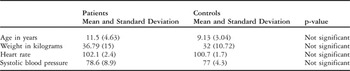
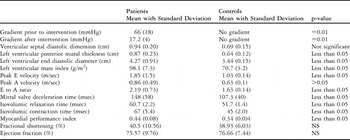
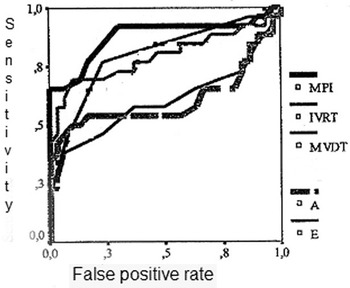
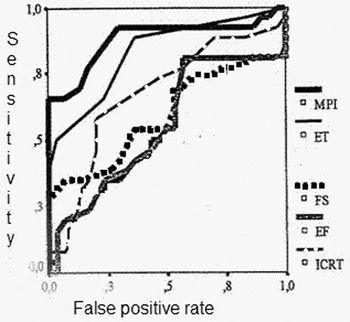
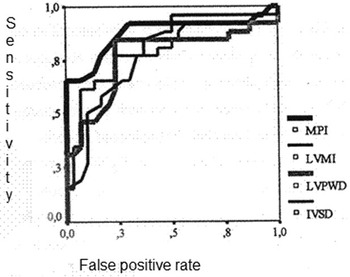
There was no significant difference in the levels of systolic blood pressure and heart rate between the patients and their controls (Table 1). The peak gradient at the site of coarctation prior to intervention, which was 66 plus or minus 18 mmHg, was reduced to 17.2 plus or minus 4 mmHg following intervention (p value equal 0.01). The ventricular septum and the posterior wall of the left ventricle were significantly thicker in the patients compared to their controls, at 0.94 plus or minus 0.20 cm and 0.87 plus or minus 0.23 cm in the patients, compared with 0.69 plus or minus 0.15 and 0.64 plus or minus 0.12 cm in the control group (p value less than 0.05). In the patients, the index of left ventricular mass was also significantly greater than in the normal subjects, at 98.1 plus or minus 7.3 in the patients and 70.7 plus or minus 3.2 in the controls (p value less than 0.05). Comparisons between the patients and the normal subjects for peak velocities of flow across the mitral valve showed that peak velocities of the E wave, the E to A ratio, and the deceleration time were all significantly higher in the patients (Table 2). Times of isovolumic relaxation and contraction were significantly longer, and the myocardial performance index was significantly higher, in the patients (Table 2). Analysis of the receiver operating characteristic curves showed that the myocardial performance index had higher sensitivity and specificity when compared to the other echocardiography parameters (Figs 1–3). There was no significant difference in fractional shortening and ejection fraction between the groups, but levels of both endothelin-1 and B-type natriuretic peptide were significantly higher in the patients than in their controls (Table 3).
Demographic data and values of blood pressure for patients and their controls.

Echocardiographic data of the patients and their controls.

Analysis of receiver operating characteristic curves of myocardial performance index and parameters of diastolic function. Abbreviations: A: Active filling phase of the mitral inflow velocity, E: Passive filling phase of the mitral inflow velocity, IVRT: Isovolumic relaxation time, MPI: Myocardial performance index, MVDT: Mitral valve deceleration time.

Analysis of receiver operating characteristic curves of myocardial performance index and parameters of systolic function. Abbreviations: EF: Ejection fraction, ET: Ejection time, FS: Fractional shortening, ICRT: Isovolumic contraction time, MPI: Myocardial performance index.

Analysis of receiver operating characteristic curves of myocardial performance index and parameters of left ventricular hypertrophy. Abbreviations: IVSD: ventricular septal thickness, LVMI: Left ventricular mass index, LVPWD: Left ventricular posterior mural thickness, MPI: Myocardial performance index.

Levels of Endothelin-1 and B-type natriuretic peptide in the patient and controls.

Discussion
Coarctation of the aorta is known to be associated with an essentially shortened life expectancy due to the complications of cardiac failure, ruptured of the aorta or cerebral arteries, or infective endocarditis.Reference Cohen, Fuster and Steele2 After the middle of the last century, rates of survival for children with aortic coarctation improved markedly as a result of early intervention and improved surgical techniques. Several long-term studies, nonetheless, have indicated that the increased incidence of ischaemic heart disease, stroke, and sudden death remain important causes of late cardiovascular morbidity and mortality subsequent to correction, possibly associated with persistent hypertension. The risk for late hypertension may be as high as 10% to 20%, even when the coarctation is repaired in infancy.Reference O’Sullivan, Derrick and Darnell1, Reference Brouwer, Erasmus and Ebels16 Several arguments have been suggested to explore the mechanisms underlying the occurrence of the late hypertension after surgical repair. The age at initial repair, persistent obstruction, residual limitation of the capacity and distensibility of the proximal aorta, disturbances of the renin-angiotensin system, and concomitant essential hypertension have been some of the postulated mechanismsReference Cohen, Fuster and Steele2, Reference Maron, O’Neal, Rowe and Mellitis17. A study of infants who had undergone repair showed that one-quarter had blood pressures whilst supine slightly above the 90th centile for age when measured 49 months following surgical repair.Reference Pfammater, Ziemer and Kaulitz18 These investigators found no significant difference in systolic blood pressures between their patients and a group of control subjects. Others have also shown that, despite successful repair, alterations in systolic and diastolic function remain after long-term follow-up.Reference Moskowitz, Schieken and Mosteller Mi Bossano19
Our own findings of increased left ventricular mass index are consistent with previous findings.Reference Moskowitz, Schieken and Mosteller Mi Bossano19 Studies of adults with hypertension suggest that increased left ventricular mass, developing as an adaptive mechanism in the setting of increased afterload, may be responsible for the pathologic manifestations of hypertensive cardiovascular disease. As a measure of diastolic functions by Doppler-derived, the velocity of transmitral flow is affected early in adults with diastolic hypertension. Frequently, altered diastolic function precedes the occurrence of overt left ventricular hypertrophy.Reference Inoue, Massie and Loge20, Reference Phillips, Coplan and Krakoff21 The velocity of transmitral flow is dependent on variables including relaxation, preload, afterload, heart rate, atrial pressure and atrial function.Reference Stoddard, Pearson, Kern and Ratcliff22 The increased peak early filling velocity noted in our study is consistent with increased left atrial pressure, or perhaps decreased left ventricular relaxation. We also found the mitral valve deceleration time, along with times of isovolumic relaxation and contraction, to be increased. This can be explained by decreased ventricular compliance, likely resulting from ventricular hypertrophy. It is arguedReference Leandro, Smallhorn and Benson23 that successfully treated children with aortic coarctation who are normotensive at rest after operation are still at risk for developing damage to their end organs, probably explained by the onset of mild hypertension documented by ambulatory monitoring. In the same study,Reference Leandro, Smallhorn and Benson23 the mitral peak E wave was shown to be higher in males, and left ventricular mass index was higher in patients, these findings being matched by our own. We also found a significantly higher ration of E to A. The myocardial performance index, also known as the Tei indexReference Tei, Ling and Hodge15, has been the subject of interest since its inception in 1995. One study of 40 normotensive children who had undergone repair of aortic coarctation revealed an abnormal myocardial performance index in almost half the patients,Reference Balderraibano-Saucedo, Vizcaíno-Alarcon and Reyes-de la Cruz24 a finding again endorsed by our experience. The index is a valid echocardiographic parameter owing to its ability to assess overall left ventricular performance. It is less dependent on ventricular geometry and preload, and is much more sensitive, than endocardial measurements and Doppler imaging of transmitral flow, methods that are conventionally used to evaluate left ventricular function.
Chronic pressure overload is known to increase cardiac mass and levels of expression of both atrial natriuretic peptide and brain natriuretic peptide mRNAs.Reference Iso, Arai, Wada, Kogure, Suzuli and Nagai8 The relation between plasma b-type natriuretic peptide and diastolic dysfunction is well documented,Reference Lubien, DeMaria and Krishnaswamy25 the B-type natriuretic peptide having 85% sensitivity and 83% specificity in detecting isolated diastolic cardiac failureReference Berger, Huelsman and Strecker26. Our findings of increased levels of b-type natriuretic peptide in our patients may be the reflection of decreased compliance of left ventricle. Another explanation may be a vascular response to aortic coarctation, or to vascular injury, despite the success of the intervention. A study performed on rats with aortic coarctation demonstrated that production of endothelin-1 decreased, and endothelin receptors were down-regulated, in hypertrophied ventricles 8 weeks after the production of coarctation as a compensatory response to pressure overloadReference Sirvio, Uhlenius, Stewen, Metsarinne and Fyhrquist27. Another study involving patients with cardiac failure showed that levels of atrial natriuretic peptide and endothelin-1 in the plasma after peak exercise are potentially more reliable and important than their resting levels as markers of left ventricular systolic dysfunctionsReference Yousufuddin, Henein, Flather and Wang28. In our study, we found significantly increased endothelin-1 levels in our patients. As the role of endothelin-1 in controlling systemic blood pressure is well established, the high levels of endothelin may well contribute to the pathogenesis of late hypertension in patients with coarctation. But, although the levels of endothelin-1 in our patients were higher than in our normal subjects, the levels we measured remained within the normal range.Reference Ekblad, Arjamaa, Vuolteenaho, Kapa and Kero4
The major limitation of our study relates to the small number of patients we studied, with only 14 patients agreeing to participate. It is not likely, however, that the patients were sicker that those who chose not to participate, and all those studied were asymptomatic according to their last outpatient record.
In conclusion, we have shown that normotensive patients with successfully relieved aortic coarctation continue to have impaired diastolic function, a higher left ventricular mass, and increased endothelial reactivity. Further studies are needed to assess whether levels of B-type natriuretic peptide and endothelin-1 may predict occurrence of late hypertension in the long term follow-up of such patients. As we know that arterial hypertension can contribute to long-term cardiovascular morbidity and mortality, monitoring the concentrations of the B-type natriuretic peptide and endothelin-1 may prove useful, along with echocardiography, when stratification of risk is required.