The general maxims of morality are formed, like all other general maxims, from experience and induction. We observe in a great variety of particular cases what pleases or displeases our moral faculties, what these approve or disapprove of, and, by induction from this experience, we establish those general rules . . . In treating of the rules of morality, in this manner, consists the science which is properly called Ethics. (Adam Smith, Reference Smith, Raphael and Macfie1976 [1759] The Theory of Moral Sentiments, VII.iii.2.6, VII.iv.6)
One of the most dramatic developments in economics over the past few decades has been the rapidly increasing willingness of economists to extend their models of human motivation beyond the traditional assumption of narrow self-interest and to incorporate moral and other social preferences. This has been prompted mostly by results from experiments, originally conducted to test predictions of the canonical model but subsequently also designed to inform new or modified theories. Most of this empirical work has involved stakeholders, or parties whose personal stakes are affected by their decisions. A fairly recent addition to the toolkit of these researchers, however, is the use of spectators, or third parties who make decisions affecting others but not themselves. Spectators of a kind were also at the centre of the moral theory Adam Smith explicated more than 250 years ago in his The Theory of Moral Sentiments, or TMS (1759). Smith's characterization of ethics as a science and his placement of spectators at the centre of that science differ radically from most mainstream moral philosophy, both in his time and ours. Nevertheless, despite centuries of relative neglect, his moral theory has recently experienced a renaissance with a flurry of high-quality scholarship across many disciplines.Footnote 1
This paper undertakes a comparative analysis of these two concepts of spectatorship stimulated by possibilities for enriching both economic and philosophical research into ethics. Although the two approaches will be fleshed out in greater detail below, brief and simple descriptions at this point should help motivate and clarify the purpose here. Smith's so-called impartial spectator is not a literal third party, indeed not a real person at all, but rather what real people, or agents, imagine to be the moral judgements of an impartial and well-informed third party. According to Smith, the repeated social interactions of agents, including as real spectators, produce this internalized moral guide.
The empirical spectator studies on which I will focus, on the other hand, involve real people, specifically ones who reveal the moral judgements of their own presumed impartial spectators concerning matters affecting others. I call these quasi-spectators, since their judgements typically only approximate those of the ideal impartial spectator. Their views might be elicited in a variety of ways, but the clearest examples involve treatments in which third parties make decisions affecting the material allocations of other subjects but not of themselves, e.g. Konow (Reference Konow2000), Charness and Rabin (Reference Charness and Rabin2002), Engelmann and Strobel (Reference Engelmann and Strobel2004) and Coffman (Reference Coffman2011). Of interest here are also hybrid quasi-spectator/stakeholder experiments in which third parties incur a fixed cost to influence the earnings of others, e.g. Kahneman et al. (Reference Kahneman, Knetsch and Thaler1986), Fehr and Fischbacher (Reference Fehr and Fischbacher2004b) and Charness et al. (Reference Charness, Cobo-Reyes and Jiménez2008). Finally, there are studies that encourage participants to reveal their moral views about real or hypothetical situations, but their views do not materially impact themselves or others. These include many survey studies in the social sciences, especially moral psychology, empirical social choice, and in the emerging field of experimental philosophy. They do not, however, include results from the majority of survey studies (e.g. most public opinion research), which do not explicitly address moral questions or consciously promote impartial reasoning. One concern with surveys is that respondents might be insufficiently incentivized to provide thoughtful judgements given the lack of material consequences. Thus, the discussion here of such studies focuses on some recent investigations that purposely target spectator views and provide evidence strongly suggesting sufficient participant motivation.
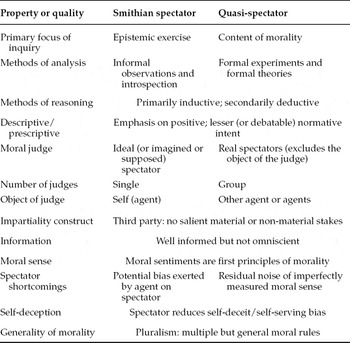
To be clear, the intent of this study is not to demonstrate an equivalency between Adam Smith's moral theory and a research programme in behavioural economics. Nor is the title of this paper meant to imply an exhaustive treatment of either, which would be beyond the scope of this paper. Rather, I examine issues at their intersection that appear promising for addressing open questions in both research agendas. I argue that both Smith's analysis and modern quasi-spectator investigations explore moral knowledge and its contents, adopt a kind of scientific method, point to a conflict between self and others in which self-deception is often involved, conceive of impartiality in terms of three properties (absence of stakes, information and a common moral sense), and conclude that the moral sense is often characterized by rules. The following section presents Table 1, to which the reader may refer at various stages in the paper as a rough guide to similarities and differences between the two types of spectators.Footnote 2
Comparison of Smithian spectator and quasi-spectator

The discussion is organized around what I claim is a remarkable but tractable area of overlap in the two approaches in terms of their goals and methodologies (section 1), assumptions about human nature (section 2) and spectator attributes and emphasis on moral rules (section 3). I conclude with a discussion of how insights from Smith's impartial spectator can inspire and help improve empirical spectator studies and economic theory, and how, in turn, empirical spectator findings might inform philosophical ethics and normative economics (section 4).
1. GOALS AND METHODOLOGIES IN SPECTATOR ANALYSES
1.1 Goals
Smith lays out two questions for ethical inquiry: ‘First, wherein does virtue consist? Or what is the tone of temper, and tenor of conduct, which constitutes the excellent and praise-worthy character . . .? And, secondly, by what power or faculty in the mind is it, that this character, whatever it be, is recommended to us?’ (TMS VII.i.2). That is, the second question inquires into the nature of moral judgement, i.e. it is the epistemic exercise, which asks how we recognize what is right. The first question examines the results of that inquiry, i.e. it concerns the contents of moral knowledge, including its general properties.
The quote at the start of this paper gives direction as to Smith's answers to both questions. We discern virtue using our ‘moral faculties’ and guided by our moral sentiments. This grows out of the tradition of moral sense theory that includes Smith's mentor, Francis Hutcheson, and his friend, David Hume – an approach that proceeds from our sense of approval and disapproval of our actions or those of others. Whereas Hutcheson viewed the moral sense as endowed and likened it to the physical senses, Smith argued that it evolves through a process of repeated interactions with others that are initially motivated by our natural desire for their approval. Indeed, Smith eschewed the term ‘moral sense’ and referred instead to ‘moral sentiments’, underscoring both the plurality of such sentiments and their putative evolutionary origins. The development of moral sentiments occupies a prominent place in TMS (see, especially, TMS III. 2 and VI.1), as it does in much of the secondary literature (e.g. Young Reference Young1992; Broadie Reference Broadie and Haakonssen2006; Weinstein Reference Weinstein2007), and it will resurface later in this paper. Nevertheless, my concern is with the realized impartial spectator, rather than its genesis, for a variety of reasons, including reasons of brevity and the lack of empirical quasi-spectator studies on the formation of moral judgement. Thus, I will employ the term ‘moral sense’ in this paper as a collective noun that encompasses the moral sentiments while refraining from commitment to other aspects of the positions of Hutcheson and Smith on this subject.
Raphael (Reference Raphael2007: 9–10) argues that TMS focuses mostly on the epistemic exercise and dedicates much less attention to the content of morality. Others, including Fleischacker (Reference Fleischacker1999), provide extensive commentaries on and analysis of Smith's views on morality itself. The most significant fact about Smith's treatment of the content of morality for the current discussion, though, is his claims about moral rules. That moral judgement can be characterized by rules is both his assumption going into the epistemic exercise as well as his conclusion coming out of it. As the opening quote to this paper conveys, we can infer the general rules of morality when our moral sense encounters a variety of different circumstances, and, although this might not be the deliberate exercise of the agent, it is, in Smith's view, the office of the ethicist.
Modern spectator studiesFootnote 3 have similarly addressed these two questions, although the greater emphasis has clearly been on investigating the content of moral preferences, including altruism (Harbaugh et al. Reference Harbaugh, Mayr and Burghart2007), distributive justice (Dickinson and Tiefenthaler Reference Dickinson and Tiefenthaler2002; Chavanne et al. Reference Chavanne, McCabe and Paganelli2010a; Becchetti et al. Reference Becchetti, Degli Antoni, Ottone and Solferino2012), fair rewards from risk-taking (Huesch and Brady Reference Huesch and Brady2010; Cappelen et al. forthcoming), fair distribution of losses from risk-taking (Cappelen et al. Reference Cappelen, Luttens, Sørensen and Tungodden2011), reciprocity (Charness et al. Reference Charness, Cobo-Reyes and Jiménez2008; Croson and Konow Reference Croson and Konow2009; Utikal and Fischbacher Reference Utikal and Fischbacher2010), and the effects of moral bias (Traub et al. Reference Traub, Seidl, Schmidt and Levati2005; Croson and Konow Reference Croson and Konow2009; Chavanne et al. Reference Chavanne, McCabe and Paganelli2010b). As with the larger empirical literature on social preferences that includes stakeholder studies, this research has usually been conducted under the presumption that general forces are at work and with the goal of contributing to models of those forces (Konow Reference Konow2000; Charness and Rabin Reference Charness and Rabin2002). Thus, this parallels Smith's assumptions and conclusions about moral rules. Although empirical spectator studies have maintained their distance from epistemic and metaethical inquiry, they have also addressed the role of information on spectator judgements (Konow Reference Konow2009a, Reference Konow2009b), possible spectator bias (e.g. Aguiar et al. Reference Aguiar, Becker and Miller2010; Chavanne et al. Reference Chavanne, McCabe and Paganelli2010b), and differences between spectatorship and other concepts of impartiality such as Rawls's (Reference Rawls1971) veil of ignorance (Herne and Mård Reference Herne and Mård2008; Aguiar et al. Reference Aguiar, Becker and Miller2010). Many of these studies explicitly refer to Smith.
These quasi-spectator studies are social science projects aimed at describing behaviour and its underlying social preferences. Smith, on the other hand, places his objective with TMS squarely in the domain of philosophy, a point that Part VII underscores. These differences would usually result in two quite distinct research agendas, viz. with respect to whether the analysis is descriptive or prescriptive, and whether the reasoning is mostly inductive or deductive. Nevertheless, given how they conceptualize and investigate their subject matters, the two approaches are both more distant from much of the mainstream in their respective disciplines and more proximate to one another than one might expect, as discussed in the following sub-section.
1.2 Methods
To understand Smith's take on these questions, we must realize that he adopts an empiricist, rather than rationalist, epistemology. That is, he traces the source of moral knowledge to our moral sentiments rather than reason: ‘But though reason is undoubtedly the source of the general rules of morality . . . it is altogether unintelligible to suppose that the first perceptions of right and wrong can be derived from reason . . . These first perceptions, as well as all other experiments upon which any general rules are founded, cannot be the object of reason, but of immediate sense and feeling . . . It is by finding in a vast variety of instances that one tenor of conduct constantly pleases in a certain manner, and that another as constantly displeases the mind, that we form the general rules of morality’ (VII.iii.2.7). The inductive approach Smith advocates, and even the terminology (‘experiments’) he employs, could characterize the modern social science research that seeks to identify social preferences empirically and to infer their rules. Smith's impartial spectator embodies that moral sense and represents the preferences targeted by quasi-spectator studies.
Although these two approaches proceed from similar assumptions and share a common disposition to scientific reasoning and language, there remain important differences in methods. Redman (Reference Redman1993) writes that Smith borrowed from the Newtonian parlance of the day but that the terms ‘experiment’ and ‘observation’ were given different meanings by Smith and his Scottish contemporaries in philosophy. Whereas modern science and quasi-spectator research both involve formal methods of observation and analysis, Smith's method was based on introspection and informal psychology, viz. personal and written observations of others. Whereas Smith stresses the grounding of the general moral sense on individual experience, the quasi-spectator agenda is focused on collecting individual experiences of the general moral sense. Smith engages in thought experiments, whereas quasi-spectator researchers employ formal experiments.
As scientific endeavours, both approaches lean heavily on induction but not to the exclusion of deduction. Smith refers to the need both to use reason to infer the general rules of morality but also to apply those lessons in particular cases: ‘From reason, therefore, we are very properly said to derive all those general maxims and ideas. It is by these, however, that we regulate the greater part of our moral judgements, which would be extremely uncertain and precarious if they depended altogether upon what is liable to so many variations as immediate sentiment and feeling, which the different states of health and humour are capable of altering so essentially’ (VII.iii.2.6). Modern spectator studies have been utilized to infer theories of moral preferences, as in Charness and Rabin (Reference Charness and Rabin2002) and Konow (Reference Konow2000). With respect to deduction, Smith describes in the passage above the use of general rules to regulate behaviour in specific instances, whereas spectator studies often proceed from general to specific for the purpose of testing existing theories in particular contexts, as in Gaertner et al. (Reference Gaertner, Jungeilges and Neck2001).
The distinction between induction and deduction in these research agendas is also closely connected to the descriptive and prescriptive intentions of their analyses. Among Smith scholars, the more controversial question of the two concerns whether TMS should be understood in prescriptive terms. On the one hand, TMS reads like a psychological and sociological treatise on the evolution and practice of social norms. On the other hand, normative words like ‘should’ and ‘ought’ occur with great frequency, and the agent's efforts to comply with his moral sentiments and the demands of the spectator are often laid out in the first-person plural, as Smith exhorts the reader to right conduct and character.Footnote 4 Raphael (Reference Raphael2007: 133–135) sees Smith's usage in psychological, rather than philosophical, terms. Haakonssen (Reference Haakonssen2006) states that ‘morality was, in Smith's eyes, to be approached as a matter of fact’, although he points to an indirect normative significance in Smith. Most commentators see some of both purposes in Smith, and a common view is that TMS has normative purpose grounded in a descriptive construct, viz. the impartial spectator. Firth argues that Smith presents the impartial spectator not only as a device to explain behaviour but also as an ideal to which people should aspire – indeed, one that is practically attainable for a segment of the population (Reference Firth, Cockfield, Firth and Laurent2007: 118). Fleischacker (Reference Fleischacker1991) writes that ‘moral philosophers, he believes, should contribute to moral practice’ (p. 255). Griswold (Reference Griswold1999) points to the tension between agent and spectator perspectives in contrasting everyday behaviour with moral excellence. He suggests that Smith sees moral theory as a means we ought to pursue in order to promote moral practice, pointing, among other things, to Smith's protreptic writing style. Along similar lines, Weinstein (Reference Weinstein2007) contends that Smith views education chiefly as serving moral growth. Campbell (Reference Campbell1971) concludes that the main emphasis in TMS is on explanation but that Smith's work should be viewed in the context of his day, when the contrast between science and philosophy was considerably less sharp.
Such close association of descriptive and prescriptive analysis raises the spectre of the ‘is–ought fallacy,’ which can be traced to Hume's is–ought problem and Moore's naturalistic fallacy. This is often encapsulated in the saying ‘ought cannot be derived from is’. That is, one cannot argue from premises that contain only descriptive statements, e.g. most people support capital punishment, to normative conclusions, e.g. capital punishment should be legal. There is some controversy in the philosophical literature about whether this is a fallacy, but the treatment of descriptive and prescriptive statements as equivalent, at a minimum, marks a tautology.
Although quasi-spectator research, by definition, examines the actual values of real people, much of it is motivated by the belief that empirical evidence on impartial moral views is germane to reflection on prescriptive theories. Many authors suggest their results are relevant to reflection on philosophical ethics (Schokkaert et al. Reference Schokkaert, Capeau and Devooght2003; Herne and Mård Reference Herne and Mård2008; Amiel et al. Reference Amiel, Cowell and Gaertner2009), normative economics (Konow Reference Konow2003, Reference Konow2009a, Reference Konow2009b; Gächter and Riedl Reference Gächter and Riedl2006), and policy (Traub et al. Reference Traub, Seidl, Schmidt and Levati2005; Chavanne et al. Reference Chavanne, McCabe and Paganelli2010a). The putative normative relevance of these empirical findings is not based on observation of just any actions or views, indeed not even on specifically ‘moral’ views, but rather on moral views elicited in a particular way. The implicit claim behind this professed relevance might be stated as follows: ‘Although ought cannot be derived from is, ought can be derived from a subset of what is’. Such a statement is bound to stir controversy, and I have not seen it formulated in this way in the quasi-spectator literature. But the view that the validity of normative claims depends in some (as yet incompletely specified) manner on their ability to be reconciled with actual impartial moral judgements has parallels to Smith's approach. The spectator serves as the moral measuring rod in passages with value-laden terminology (e.g. see the use of ‘ought’ in VI.ii.I.22) but is also described as a creation of the agent, who imagines the moral judgements of a well-informed third party. Thus, one interpretation of both agendas is that normatively valid claims are based on a subset of actual views, viz. the moral judgements of informed and impartial third parties, literal ones in the case of quasi-spectators and an imagined one in the case of Smith.
2. HUMAN NATURE: AGENT AND SPECTATOR
This section explores parallels between Smith's vision of human nature and recent approaches in behavioural economics and expands discussions of the two spectator models.Footnote 5
2.1 Split personality
Smith added the following sub-title to TMS beginning with edition 4: ‘An essay towards an analysis of the principles by which men naturally judge concerning the conduct and character, first of their neighbors, and afterwards of themselves’. This sub-title both underscores the importance of the epistemic exercise to his enterprise and portends the dual nature of people as observers and participants that he develops. In Smith's view, there are two parts to a person, viz., the agent and the spectator, who judges the agent as if from a distance: ‘When I endeavour to examine my own conduct . . . it is evident that . . . I divide myself, as it were, into two persons; and that I, the examiner and the judge, represent a different character from that other I, the person whose conduct is examined into and judged of. The first is the spectator . . . The second is the agent’ (III.1.6). This is one of many cases of Smith anticipating much later work in the social sciences. In psychology, this resembles the impulsive System 1 and deliberate System 2 accounts of dual process theory (e.g. Evans 2008). In economics, dual-self theories employ far-sighted planners and myopic agents (Thaler and Shefrin Reference Thaler and Shefrin1981; Fudenberg and Levine Reference Fudenberg and Levine2006).
Dual-self models have addressed mostly problems of intertemporal choice and self-control rather than specifically moral questions. In contrast, most efforts to formalize moral conflict, in both quasi-spectator studies and the more general behavioural economics literature, have been reductionist and included separate terms representing material self-interest and moral preferences within a single utility function, e.g. Levine (Reference Levine1998), Fehr and Schmidt (Reference Fehr and Schmidt1999), Bolton and Ockenfels (Reference Bolton and Ockenfels2000), Konow (Reference Konow2000), Charness and Rabin (Reference Charness and Rabin2002), Dufwenberg and Kirchsteiger (Reference Dufwenberg and Kirchsteiger2004), Engelmann and Strobel (Reference Engelmann and Strobel2004) and Falk and Fischbacher (Reference Falk and Fischbacher2006). Although moral preferences are variously specified in these models as altruism, reciprocal altruism, equality, equity, maximin, efficiency, or some subset thereof, they incorporate tension between material utility and an internalized motive that includes the interests of others.
However formally modelled in recent work, these internalized and opposing goals, i.e. between one's own interests and those of others, are central in TMS; indeed, Smith places them in the opening sentence: ‘How selfish soever man may be supposed, there are evidently some principles in his nature, which interest him in the fortune of others, and render their happiness necessary to him, though he derives nothing from it except the pleasure of seeing it’ (I.1.I.1). On the one hand, individuals are referred to the sympathetic impartial spectator, to the ‘tribunal of their own consciences’ and the ‘great judge and arbiter of their conduct’ (III.2.32). On the other hand, self-interest, or self-love as Smith expresses it, plays a famously central role in his thinking. Self-love is not to be confused with prudence, or the proper care of one's own well-being, including one's health and reputation, which Smith considers a virtue (VI.1). Rather, self-love represents a failure to sympathize appropriately and is associated with the pursuit of ‘wealth and greatness (which) are mere trinkets of frivolous utility’ (IV.I.8).
2.2 Three properties of spectators
Smith's impartial spectator is not a real person or persons but rather a model conjured in the imagination of the agent, and he frequently refers to the ‘imagined’ or ‘supposed’ spectator. This spectator takes neither the position of the agent nor that of a real bystander, but rather the view the agent imagines an impartial observer possesses. Quasi-spectators, by contrast, are real third parties, i.e. individuals lacking material stakes in the matter at hand, who are prompted to volunteer the moral judgements of their own impartial spectators.
Smith fleshes out in some detail the origin of the imagined spectator: he is the product of society (e.g. TMS VI.1). People participate in social interactions and, as real spectators (i.e. third parties), judge the behaviour of others. This leads to a moral sense, eventually manifested as an imagined third party and experienced chiefly in affective terms, which, when turned on the agent himself, becomes conscience. Social approval provides the motivation for, but not the ultimate goal of, moral learning: ‘But this desire of the approbation, and the aversion to the disapprobation of his brethren, would not alone have rendered him fit for that society for which he was made. Nature, accordingly, has endowed him, not only with a desire of being approved of, but with a desire of being what ought to be approved of; or of being what he himself approves of in other men. The first desire could only have made him wish to appear to be fit for society. The second was necessary in order to render him anxious to be really fit’ (III.2.6). Indeed, he describes in eds. 2–5 the process of moral learning in considerable detail, by which we eventually learn to balance or stand above the sometimes conflicting desires of those with whom we deal (III.2). The resulting impartial spectator, as Sugden (Reference Sugden2002) writes, ‘represents, in idealized form, the correspondence of sentiments that is induced by social interaction’.
I will focus on three properties that the impartial spectator and the quasi-spectator have in common: impartiality, information and the moral sense. This is not meant as an exhaustive list of the properties of either, but I believe these categories are the most useful and important ones for this particular comparison. In this section, I describe these properties in the ideal Smithian impartial spectator and then proceed, in following sections, to discuss various practical limitations, both those raised by Smith and those emerging from quasi-spectator research.
First, the spectator is impartial, a modifier that also represents a Smithian addition to the language of spectator theory. That is, as an ideal, the impartial spectator is a disinterested (or detached) third party, who has no stakes in the situation or parties being evaluated. This, of course, serves to avoid moral judgements being tainted by self-interest. But there is a potential problem, as Griswold (Reference Griswold and Haakonssen2006) points out, severing the spectator from self-interest. The spectator is a creation of sympathetic imagination, but individuals are motivated to respond to sympathy, which itself seems self-centred. Quasi-spectator studies and modern behavioural models address this question by drawing the line between self-interest and social preference based on whether the motive or action is directed toward one's own material interests or reflects more general considerations that potentially incorporate the interests of others, respectively. I believe this a productive distinction, in general, for both empirical research and reading Smith: let self-interest refer to motives based on extrinsic reasons, including but not limited to material rewards, e.g. also seeking the approbation, or avoiding the disapprobation, of others, whereas any intrinsic reward or punishment that is derived from or motivated by acting in the interests of others, such as sympathy, is not characterized as self-interested. As sympathy motivates agents toward right conduct in Smith, casting sympathy as self-interest risks making the latter term tautological. This proposed distinction, by contrast, seems consistent with Smith's treatment of sympathy as praiseworthy and of self-interest as being a different and potentially opposed motive.Footnote 6
Second, impartiality must be coupled with the necessary information conditions. Smith states on several occasions that the morally relevant judgements are those of the ‘impartial and well-informed spectator’. Although, at various points, he acknowledges the challenges to this goal, these conditions are not an unattainable abstraction but rather a state that real people can sometimes achieve (III.3.35–37). Importantly, the spectator accesses his own life experiences: ‘The man who is conscious to himself that he has exactly observed those measures of conduct which experience informs him are generally agreeable, reflects with satisfaction on the propriety of his own behavior’. Nevertheless, his conduct is not motivated by a desire for social approbation or by false consciousness, since ‘he views it in the light in which the impartial spectator would view it . . . and though mankind should never be acquainted with what he has done, he regards himself, not so much according to the light in which they actually regard him, as according to that in which they would regard him if they were better informed’ (III.2.5). Moreover, the spectator who reasons with these facts is ‘cool’ and ‘intelligent’ (e.g. I.ii.3.8 and VI.3.27). These passages help underscore the importance of these properties of the imagined spectator, which are themes in TMS: the spectator is a third party, well informed of the relevant particulars, who processes this information rationally with respect to internalized values.
Third, an informed third party is of no relevance to either Smith's or the modern spectator programme unless, of course, the respective spectator possesses a moral sense. This is related, but not identical, to sympathy in Smith, an often controversial topic among his commentators. Various interpretations distinguish the affective versus cognitive qualities of sympathy and the associated relationship between agent and spectator. Sugden avoids the term sympathy, which he associates with the economic model of altruism, and, instead, refers to ‘fellow-feeling’, which is a consciousness of another's feelings, where that consciousness itself brings pleasant or unpleasant feelings (2002, 71). Similarly, for Griswold sympathy is a fellow-feeling (of the affective kind) that is not necessarily limited to morals (Reference Griswold and Haakonssen2006: 25). Raphael (Reference Raphael2007) interprets sympathy as the feeling that results from the convergence of spectator and agent sentiments. Weinstein describes it as fellow-feeling with any passion of others and as a cognitive process, which subsequently arouses emotion in the spectator (Reference Weinstein2006: 83; Reference Weinstein2007: 132). Others see it in less affective terms. Göçmen (Reference Göçmen2007) considers sympathy the ability to imagine ourselves in situations of others and distinguishes first-order sympathy, whereby we imagine ourselves in the situation of another, and second-order sympathy, where we imagine ourselves as someone observing us. Forman-Barzilai (Reference Forman-Barzalai2005) makes an even more dramatic break from common interpretations of sympathy as an emotion or a virtue and argues Smithian sympathy is a social practice, i.e. an activity that produces morality in shared physical, affective and historical spaces.
There is merit in each of these readings, I think, but my concern in relating Smith to quasi-spectator research is with the moral sense itself, or, more specifically, with the set of moral judgements and rules implied by the spectator's moral sentiments, and the supportive role of sympathy. To that end, various versions of sympathy will do. I will focus on two functions of sympathy, similar to the distinction Rawls (Reference Rawls2000) makes in reference to Hume's spectator. First, sympathy has an epistemic role that is of relevance to the spectator: it enlarges his awareness of relevant facts by enabling him to factor in the experiences and feelings of others in coming to moral judgements. In addition, sympathy has a motivational function that pertains to the agent and helps him to put aside, or at least to moderate, his own interests relative to those of others and to align his conduct more closely with the judgement of the spectator.
A theme that runs throughout much of TMS is the role of sympathy in enabling the moral sense of the spectator and motivating moral action by the agent (e.g. III.3.3). The agent secures the sympathy he desires from others ‘by lowering his passion to that pitch, in which spectators are capable of going along with him’ (I.i.4.7). And, ‘as nature teaches the spectators to assume the circumstances of the person principally concerned, so she teaches this last in some measure to assume those of the spectators’ (I.i.4.8). Perhaps the clearest indication of Smith's belief in the virtues of his model for epistemic purposes emerges in his comparative analysis of moral theories in Part VII. For instance, in a passage added to the 7th edition, he writes of alternative theories that ‘None of these systems either give, or even pretend to give, any precise or distinct measure by which this fitness or propriety of affection can be ascertained or judged of. That precise and distinct measure can be found nowhere but in the sympathetic feelings of the impartial and well-informed spectator’ (VII.ii.1.49). This assertion not only reinforces his many statements elsewhere about the critical roles of impartiality, information and sympathy but also elevates his claims to a higher level: his theory, unlike others, provides the means to identify right and to distinguish it from wrong.
3. IDEAL VS. REAL SPECTATORS
This section explores Smith's view of human nature in greater detail, examining moral flaws of both agents and spectators. I argue that this exercise produces lessons for empirical research and leads to conclusions about the content of morality.
3.1 Nobody is perfect, not even spectators
Smith frequently refers to the impartial spectator as the ‘ideal man within the breast’ (e.g. III.3.29), but there are indications of a fallible judge, indicating he uses the modifier ideal in the sense of imagined rather than perfect.Footnote 7 Although the spectator encapsulates the moral sense, Smith treats in some detail the ‘irregularities of sentiments’, and these can cause ‘even the impartial spectator (to) feel some indulgence for what may be regarded as the unjust’ feelings of agents (II.iii). Smith explicitly notes variability and partiality in the spectator's judgements, such as in the spectator's interpretation of the motives of another person: ‘the imagination of the spectator throws upon it either the one colour or the other, according either to his habits of thinking, or to the favour or dislike which he may bear to the person whose conduct he is considering’ (III.2.26). Moreover, as evolving moral agents, we initially seek the approbation of all and try to incorporate the sometimes conflicting interests of stakeholders. But ‘we find that by pleasing one man, we almost certainly disoblige another’ and, therefore, ‘soon learn to set up in our own minds a judge between ourselves and those we live with’ (III.1, eds. 3–5). Although this is not stated in so many words in TMS, the vagaries of spectator impartiality might emerge, therefore, not only from the ‘self-love’ and shortcomings of the agent who creates him, but rather be inherent to the spectator's balancing act.
Most quasi-spectator studies employ various measures to implement impartiality, e.g. stakeholders and spectators are anonymous, and spectators receive fixed fees unrelated to those of stakeholders. The first such study was the ‘dictator game’ of Konow (Reference Konow2000). In the standard version of this game, which I call here the ‘stakeholder treatment’, subjects are anonymously paired, and one subject (the so-called ‘dictator’) is given a sum of real money to divide between himself and his counterpart (the ‘recipient’). In another new ‘spectator treatment’, a third party (or spectator), divided a sum of money between two anonymous subjects. The dictators in the standard stakeholder treatment demonstrated a bias, taking for themselves, on average, more than third parties in the spectator treatment gave similarly situated subjects in their treatment.Footnote 8
Most other spectator experiments have adopted a similar method, although I am aware of two studies that deliberately implement potentially partial, as opposed to impartial, spectators with mixed results. In a three-player dictator game, Chavanne et al. (Reference Chavanne, McCabe and Paganelli2010b) vary whether initial stakes are earned or endowed, after which one subject, the spectator, can redistribute earnings between the other two. They find that the spectator's redistribution is unaffected by whether or not he shares with one of the recipients the same experience with respect to the initial stakes, i.e. whether or not initial stakes were earned or endowed. Aguiar et al. (Reference Aguiar, Becker and Miller2010) come to different conclusions. They report a two-stage dictator game: initial stakes are endowed unequally between three subjects, after which one subject in each triple is paid a fixed fee to allocate as spectator a second sum of money between the other two. They find that spectators whose initial endowments equal those of one of the two stakeholders favour such stakeholders compared with spectators whose initial endowments did not equal those of any stakeholders. Thus, introduction of partial considerations might disturb spectator impartiality, although impartiality does not, thereby, seem to be systematically affected or especially labile.
Smith also identifies shortcomings of spectator sympathy, although in his case not that of sympathizing unequally with two parties but rather of sympathizing insufficiently with one: ‘the emotions of the spectator will still be very apt to fall short of the violence of what is felt by the sufferer’, since that ‘imaginary change of situation, upon which their sympathy is founded, is but momentary’ (I.i.4.7). There is an asymmetry in this respect, since, observing a companion, the spectator ‘must find it much more difficult to sympathize entirely, and keep perfect time, with his sorrow, than thoroughly to enter into his joy’ (I.iii.1.8).Footnote 9
There are relatively few experimental studies of feelings and morality, still fewer involving quasi-spectators. The closest, to my knowledge, is an experiment by Harbaugh et al. (Reference Harbaugh, Mayr and Burghart2007) using dictators who can allocate money to a charity that serves the poor. Dictators face a series of payoff combinations between themselves and the charities, e.g. respectively (100,0), (100,45), (55,0), (55,45), etc. Both fMRI measures of neural activity and self-reported subjective satisfaction scores indicate that, holding dictator earnings constant (similar to spectators), they subsequently feel better, when the charity receives more. Using self-reported measures of feelings, the dictator study of Konow (Reference Konow2010) finds a similar, and even stronger, result: dictators feel better, when they transfer more to charities serving the needy, even when dictator earnings are not held constant but rather decrease dollar for dollar with transfers.Footnote 10 Greene et al. (Reference Greene, Sommerville, Nystrom, Darley and Cohen2001) examine whether feelings affect moral judgement using hypothetical scenarios, including emotionally charged moral dilemmas as well as other non-emotional scenarios. Their fMRI scans confirm that the moral dilemmas cause greater emotional activation in subjects and further that this activation predicts choices in the dilemmas. Thus, these studies find evidence consistent with a relationship between feelings and moral judgements or actions.
Regarding the spectator property of information, as previously noted, sympathy serves a complementary epistemic role: ‘the spectator must, first of all, endeavour, as much as he can, to put himself in the situation of the other, and to bring home to himself every little circumstance . . . and strive to render as perfect as possible, that imaginary change of situation upon which his sympathy is founded’ (I.i.4.6). Smith repeatedly makes clear that morally relevant judgement proceeds not from the incomplete and faulty knowledge we often possess but rather from an advantaged informational position that provides access to relevant particulars (e.g. III.2.5–9). Although complete information is the ideal, Smith refers to the ‘well-informed’, never the ‘perfectly’ or ‘completely’ informed, spectator and marks the limits of this goal with comments like ‘as much as he can’ and ‘as perfect as possible’. On several occasions, he stresses the importance of being informed of the causes of passions with which we might sympathize while noting the state of imperfect information in which we often find ourselves (e.g. I.i.1.9, I.ii.3.5).
Contrary to these claims about the benefits of acquiring more information, there are both theoretical arguments and empirical evidence for its deleterious effects. Additional information might conceivably complicate moral reasoning and encourage divergent views, undermining attempts for consensus. Moreover, some research on stakeholders, such as that reported by Babcock and Loewenstein (Reference Babcock and Loewenstein1997), finds that information feeds biases and increases disputes. Two questionnaire studies explore the effects of varying information in quasi-spectator research. A hypothesis in Konow (Reference Konow2009a) is that relevant information permits third parties to reason more accurately and, therefore, reach consensus. In fact, the moral judgements of better-informed respondents regarding eight different scenarios exhibit lower variance that cannot be attributed to alternative explanations, such as focal points. This analysis is expanded in Konow (Reference Konow2009b) to include different combinations of both relevant and irrelevant information and different types of stakeholders as well as spectators in six different scenarios. Irrelevant information does not contribute to moral consensus, but relevant information creates consensus among both spectators and stakeholders and even significantly reduces stakeholder bias. Thus, quasi-spectator research corroborates the benefits of relevant information for spectators and clarifies the need to distinguish different types of information and the different roles of spectators and stakeholders.
In light of variable impartiality, incomplete sympathy and imperfections of information, one seems justified in speaking of spectators rather than the spectator. More often, though, Smith employs the singular, perhaps, in part, because of his focus on the reflexive and personal use of spectator perspective by the agent. Nevertheless, the real conditions Smith frequently illuminates are characterized by various imperfections that colour individual moral judgement. Campbell refers to ‘the averaging out of differences between the reactions of spectators’, which produces a ‘sort of moral consensus’ (Reference Campbell1971: 138). This characterization of spectatorship is implicit in the approach of quasi-spectator research and is consistent with the findings of the quasi-spectator studies that shed light on such claims, which I will now summarize.
First, minimal evidence of impartiality is that quasi-spectators’ judgements often differ from those of stakeholders given the bias of the latter. This has been confirmed in distribution experiments, e.g. Engelmann and Strobel (Reference Engelmann and Strobel2004), and dictator games, e.g. the aforementioned Konow (Reference Konow2000) study that identified bias in stakeholders relative to spectators. Stronger evidence of the impartiality of quasi-spectators comes from a vignette study (Konow, Reference Konow2009b) in which stakeholders have opposing interests. Since each is biased in his own (opposite) direction and away from the supposed impartial choice, the mean spectator choices should be intermediate to the mean choices of opposing stakeholders. That further prediction is confirmed in this study.
The above results are about average behaviour. Another type of evidence comes from the dispersion in views. A potential concern with quasi-spectators is that they are insufficiently motivated to acquire or process relevant information about others and instead choose randomly or capriciously. On the other hand, stakeholders might exhibit higher variance in their judgements than spectators for at least two reasons: first, their interests are often opposed and, second, individual agents differ in the weight they attach to self-interest versus moral norms. Moreover, quasi-spectators should place greater value on the morally right choice; although their views might not align perfectly for various reasons, including those discussed above, there should be a much higher level of consensus in their choices. This latter conjecture is confirmed in studies of distributive preferences (Konow et al. Reference Konow, Saijo and Akai2009) and reciprocal preferences (Croson and Konow Reference Croson and Konow2009), which find significantly lower variance in spectator than stakeholder decisions.
Several other findings bolster confidence in the utility of quasi-spectator research. Stakeholders have been shown to act on the same moral values as quasi-spectators, even when the rules are more complicated, such as proportional rules of equity in Konow (Reference Konow2000), and even when multiple rules compete, as in Engelmann and Strobel (Reference Engelmann and Strobel2004) and Cappelen et al. (forthcoming). The latter study also reveals that, controlling for individual differences in the weight attached by stakeholders to self-interest, the decisions of stakeholders and spectators contain very similar levels of unexplained variance or ‘noise’. The moral preferences of third parties are sufficiently strong that they are willing to incur material costs to enforce them on others, e.g. Fehr and Fischbacher (Reference Fehr and Fischbacher2004a, Reference Fehr and Fischbacher2004b), Kahneman et al. (Reference Kahneman, Knetsch and Thaler1986) and Turillo et al. (Reference Turillo, Folger, Lavelle, Umphress and Gee2002), and to incur psychic costs to contemplate them in complex but hypothetical scenarios, e.g. Huesch and Brady (Reference Huesch and Brady2010) and Konow (Reference Konow2009a, Reference Konow2009b).
3.2 The tangled web of self-deception
In the 2009 film ‘The Invention of Lying’, a world is depicted in which people never lie to themselves or others. Were such honesty combined with unfettered access to morally relevant information, it is unclear what need there would be for impartial spectators, at least for their epistemic function. People sometimes behave in self-interested ways (indeed, often brutally so, in the aforementioned film), but this is not due to a failure to understand what is right, but rather to an unwillingness to act on those morals because of unadulterated self-interest. An explanation for the need for an epistemic spectator role is the possibility of self-deception, specifically, the ability to alter one's beliefs about what is right in the direction of one's own selfish interests, which Smith termed self-deceit and is, in modern scholarship, often called a self-serving bias. Indeed, Fleischacker (Reference Fleischacker2011) sees self-deception as critical to understanding not only the impartial spectator's role but Smith's moral philosophy as a whole. Self-deception has been an important topic in philosophy but it has also been prominent in modern social science research beginning with cognitive dissonance theory (Festinger Reference Festinger1957).
Smith writes that ‘self-deceit, this fatal weakness of mankind, is the source of half the disorders of human life’ (III.4.6). Modern research suggests Smith's estimate might be conservative: even under sterile laboratory conditions, which are least conducive to self-deception, almost two-thirds of unfairness has been traced to such a bias (Konow Reference Konow2000). The experiment of Di Tella and Pérez-Truglia (Reference Di Tella and Pérez-Truglia2010) also finds a large self-serving bias, specifically, subjects in that study act selfishly towards counterparts by distorting their beliefs about how selfishly the counterparts will behave towards them. Babcock and Loewenstein (Reference Babcock and Loewenstein1997) describe experimental and field studies showing that the self-serving bias significantly impacts bargaining behaviour, impeding agreements and promoting impasse, such as with contract negotiations and in civil litigation. They also report that this bias is very tenacious, as demonstrated by various experimental attempts to dislodge it.
Is Smith's imagined spectator free of such self-deception? There are both philosophical and empirical grounds for hesitating to answer in the affirmative. This model, as we have discussed, involves looking inward not to one's sentiments but to one's sentiments if one were an imagined other person. Note that this is a kind of second-order introspection, but introspection, just the same. Schwitzgebel (Reference Schwitzgebel2008) makes an important and compelling argument, in my view, that introspection is generally highly unreliable in at least two ways: it sometimes yields no result and at other times the wrong result. In fact, there is evidence from social science experiments on moral decision-making of the latter: people have systematically biased beliefs about what is right. Since the impartial spectator is conjured by real agents, these considerations should leave us less than sanguine about the objectivity of the derived moral judgements.
Smith claims the impartial spectator is better informed than the agent, since the former considers the interests and perspectives of others. In forming the image, however, the spectator accesses the life experiences of the agent. This seems an improvement over theories of impartiality that rely on constraints on information, such as the Rawlsian veil of ignorance, that require withholding information that could create bias but that might, nonetheless, be necessary to render accurate moral judgements. Nevertheless, the experiences of the agent also limit the imagination of the spectator, as Weinstein (Reference Weinstein2006) points out. Recondite information might, at a minimum, be a source of error in the spectator's reasoning. Of particular concern, research on self-deception indicates that self-serving biases arise chiefly through the biased collection and recollection of information, e.g. Dunning et al. (Reference Dunning, Meyerowitz and Holzberg1989) and Thompson and Loewenstein (Reference Thompson and Loewenstein1992). Thus, agents, the progenitors of the spectator, might filter the information provided to the latter and affect the imagined correspondence in a biased manner.
Indeed, in ed. 1 of TMS, Smith expresses precisely these kinds of doubts and impugns even the spectator for self-deceit: after likening the spectator to a looking glass, he continues ‘unfortunately this moral looking-glass is not always a very good one. Common looking-glasses, it is said, are extremely deceitful, and . . . conceal from the partial eyes of the person many deformities which are obvious to every body besides. But there is not in the world such a smoother of wrinkles as is every man's imagination, with regard to the blemishes of his own character’ (III.1.5n). This passage was dropped, however, from later editions, which, combined with his treatment of the spectator and of self-deceit as a whole, suggests to me that he viewed the impartial spectator, on balance, as a positive force against self-deception.
In addition to the impartial spectator, Smith mentions the real spectator, i.e. a genuine third party who observes and judges the conduct of others.Footnote 11 To be sure, the real spectator is not as prominent a feature in TMS as the imagined spectator, and Smith uses this exact term only three times in that book, all in Part III. Nevertheless, he often refers to real spectators in other words (e.g. III.2.15–24 and III.3.22–24), sometimes relating them to the impartial spectator. For example, when writing on gratitude and resentment, he states that feelings ‘seem proper and are approved of, when the heart of every impartial spectator entirely sympathizes with them, when every indifferent by-stander entirely enters into, and goes along with them’ (II.i.1.7).
Real spectators are explicitly mentioned jointly with the imagined spectator as the voices that are unwisely ignored by a person who lacks self-command (III.3.26). The most detailed discussion of the real spectator, however, is a passage in which Smith acknowledges the kinds of limitations of the imagined spectator discussed above: ‘In solitude, we are apt to feel too strongly whatever relates to ourselves: we are apt to over-rate the good offices we may have done, and the injuries we may have suffered: we are apt to be too much elated by our own good, and too much dejected by our own bad fortune. The conversation of a friend brings us to a better, that of a stranger to a still better temper. The man within the breast, the abstract and ideal spectator of our sentiments and conduct, requires often to be awakened and put in mind of his duty, by the presence of the real spectator: and it is always from that spectator . . . that we are likely to learn the most complete lesson of self-command’ (III.3.38). Here Smith addresses the effects of the self-serving bias, including the biased processing of information, and the role of the real spectator in correcting that bias and prompting the agent to greater objectivity and purer motives. Moreover, Smith writes that the less personal the relationship between agent and real spectator, the more effective the intervention of the latter. Indeed, Schram and Charness (Reference Schram and Charness2011) show experimentally that even the advice of anonymous spectators can influence agent behaviour.
Some commentary on Smith has cast the real spectator in a negative light (e.g. Raphael, Reference Raphael2007). This can be traced to a narrow reading of the first explicit mention of the real spectator in TMS, where Smith was attempting in later editions to address a criticism of his theory as presented in the first edition. Specifically, a potential problem of his impartial spectator is this: if the conscience that guides the imagined spectator is a product of society, how is it that the conscience sometimes opposes the judgement of society, as we can observe it sometimes does? Smith's response involves distinguishing the imagined spectator from the morally superior ‘all-seeing Judge of the world, whose eye can never be deceived, and whose judgments can never be perverted’ (III.2.33).Footnote 12 Smith writes at great length in TMS on the natural harmony between Nature and the moral values fostered through socialization. In countering this challenge to his theory, however, he devotes two paragraphs to introducing the possibility of occasional tension between these forces. In such cases, the imagined spectator seems to be torn between the real spectators, whose views normally concur with his own, and a higher authority: ‘The supposed impartial spectator of our conduct seems to give his opinion in our favour with fear and hesitation; when that of all the real spectators, when that of all those with whose eyes and from whose station he endeavours to consider it, is unanimously and violently against us’ (III.2.32). Thus, this problem arises not because of some deficiency specific to real spectators, but rather because of Smith's attempt to explain how both real and even imagined spectators might at times be at odds with the higher moral authority. Indeed, all three passages explicitly mentioning the real spectator imply that the views of imagined and real spectators are typically aligned.
Both real and imagined spectators sometimes err, but Smith views both types of spectators as usually accurate and mutually consistent resources whose moral judgements dominate those of the agent. The largest share of TMS treats individual judgement and behaviour, and, therefore, the frequent reflexive use of the imagined spectator might be viewed, at least in part, as a practical matter: that individuals would constantly consult literal third parties regarding every action with potential moral implications is blatantly infeasible. The impartial spectator, on the other hand, is a guide that not only can be summoned at almost any moment but also one that does not always require conscious deliberation, when it influences the agent through conscience.
Consider, though, a different purpose for spectators, viz. that of distilling empirically the moral sense and its rules. This is the epistemic exercise in moral philosophy to which Smith refers and is of interest to many modern social scientists as an aid to both descriptive analysis and policy design. What kind of spectator might we want in light of the limitations raised above? I will argue that an answer to this question, which builds on materials Smith provides, is the quasi-spectator approach. The impartial spectator, which the agent imagines for application to his own behaviour, is, as discussed, subject to self-serving biases. Consider, instead, a real spectator modelled on the three aforementioned properties of the imagined spectator but who affects the circumstances of others but not himself. This person has no salient personal (e.g. material or reputational) stake, so that any tendency for self-interest to insinuate itself into his judgement (e.g. through projection of his interests on others) and to cause a self-serving bias is sharply attenuated. In addition, this person has liberal access to information that might be relevant to judging conduct and character. In the absence of personal stakes, the process of sorting relevant information from irrelevant information should not be sullied. Sympathy motivates this spectator's desire to commit resources to the acquisition of information, including about the interests and feelings of affected parties, and to expend mental effort processing the facts with respect to the imagined spectator embedded in him. This person is neither omniscient, due to cognitive limitations and the practical impossibility of acquiring of all relevant information, nor infallible, given potential residual effects of individual interests and insufficient sympathy. Nevertheless, the judgement of this spectator should be superior to that of the imagined one the agent applies to himself: in both cases, the spectator's judgement actually impacts someone, so both are morally motivated, but the difference in personal stakes implies a difference in potential bias. This real spectator is an agent, but one lacking personal stakes in the decision, whereas the imagined spectator is tied to a stakeholding agent, such that, even if we can get past the direct expression of the agent's interests and access his impartial spectator, applying the spectator to oneself creates openings for the aforementioned self-serving biases.
Is there something even better than this type of real spectator? I would say, yes: lots of them. Although the quasi-spectator should dominate the (reflexively applied) imagined spectator in terms of self-serving bias, the former is not perfect, and his judgement is subject to noise. Thus, there is the straightforward statistical property that increasing the sample size bolsters one's confidence in conclusions based on such observations. There is also considerable empirical research on decisions involving groups that indicates the possibility of more balanced processes and outcomes than with individuals alone, based partly on informational grounds.Footnote 13 Of course, a well-known criticism of ideal observer theories is that their informational conditions can never realistically be satisfied, as Zagzebski (Reference Zagzebski2004) points out. But I am not faulting any version of spectators discussed here for failing to be omniscient: neither Smith's impartial spectator nor the quasi-spectator approach, in contrast to ideal observer theory, aspires to perfection. Rather, the claim is that, for the purpose of empirical analysis of moral preferences, the quasi-spectator approach builds and improves on alternative spectator models.
3.3 Moral rules
Recall that one of Smith's two tasks for ethical inquiry concerns the contents of morality, that is, the particular conclusions or general rules that might emerge from the application of the other task, viz. his epistemic exercise. It is striking, though, how brief and even vague the treatment of this topic is in TMS, at least relative to other major contributions to moral philosophy. This is likely related to the fact that his theory is grounded in moral sentiments, rather than grand moral principles. As argued in previous sections of this paper, the existence of and search for moral rules are important both in Smith's moral philosophy and in quasi-spectator research. But as Fricke (Reference Fricke2011) points out, even concerning the most important moral rules (the rules of justice), ‘Smith does not make the exact content of these rules very explicit’.
Although descriptive detail is often sparse, Smith is quite clear about other aspects of these rules. Not only are they grounded in moral sentiments, as discussed thus far, but they are plural and not reducible to a single principle.Footnote 14 Smith frequently refers in so many words to virtues, rules, principles and measures of conduct. These include prudence, courage, industry and benevolence (VI) and prohibit killing, stealing and violating the rights of others (II.ii.2.2). Economics experiments using spectators corroborate the pluralism of the moral sentiments, e.g. the studies of Cappelen et al. (forthcoming) and Engelmann and Strobel (Reference Engelmann and Strobel2004) point to multiple principles of distributive justice. Psychology studies, including those eliciting third-party judgements, also support the descriptive accuracy of such sentimentalist pluralism in a variety of contexts, according to Gill and Nichols (Reference Gill and Nichols2008).
According to Smith, there is an additional benefit of and justification for moral rules: they provide a means to cope with self-deception. Smith recognizes that applying moral rules requires complex interpretative decisions, as they ‘require so many modifications, that it is scarce possible to regulate our conduct entirely by regard to them’ (III.6.9), a fact that widens the opening for self-serving application of them. Fleischacker (Reference Fleischacker2011) argues that ‘rule-following is central to Smith's solution to self-deceit’. Moral rules serve to help overcome this weakness by sanctioning such deviations: ‘Those general rules of conduct, when they have been fixed in our mind by habitual reflection, are of great use in correcting the misrepresentations of self-love’ (III.4.12). Indeed, the most important rules, viz. the rules of justice, have absolute authority, according to Fricke (Reference Fricke2011). Violation of these rules can be so harmful that Smith stresses the importance of habitual compliance with these, even when deviations might cause no harm, in order to avoid a slippery slope (III.6.10).
4. CONCLUSIONS
This paper has examined and contrasted the impartial spectator in Adam Smith's The Theory of Moral Sentiments and empirical methods that elicit third-party moral judgements in recent social science research. I have argued that these two approaches have a number of attributes in common. These include the goal of deriving morality from a moral sense, predominant use of inductive methods for description but not to the exclusion of deduction and prescriptive analysis, a tension between self-interest and moral preferences in which self-deception is often involved, grounding the epistemic exercise in the three properties of impartiality, information and a moral sense, a basis in the real and fallible moral judges embedded in real people rather than in views from hypothetical and idealized states, and an interest in deriving moral rules that are assumed to influence the behaviour of agents in many situations. On the other hand, important differences between the two methods were discussed. These include differences in the relative importance of each of the aforementioned attributes in the methods. More fundamentally, though, Smith's impartial spectator is imagined and primarily employed reflexively to guide and motivate individual action, whereas the quasi-spectator method is based on multiple observations of the judgements or actions of real spectators toward other persons. I conclude with some thoughts about how research in economics and philosophy might benefit from further analysis of Smithian spectatorship and empirical spectator studies.
First, mounting evidence of the importance and complexity of moral motivation for economic activity has made it increasingly difficult for economists to justify their traditional position that economics should be a value-free science (Robbins Reference Robbins1932) or to sequester themselves behind a single normative criterion such as Pareto efficiency. The spectator-based theory of TMS offers valuable lessons for descriptive analysis of morals in economics and the other social sciences. For example, we have considered in this paper how Smith's impartial spectator bears similarities to, and sometimes has even exerted explicit influences on, recent empirical spectator methods, analysis of self-deception and theories of dual-selves. I believe there are many other unexploited insights in TMS that can inspire and guide empirical spectator studies and descriptive theoretical work in economics. For instance, Smith provides a rich description of the extension of affections to, respectively, other individuals, one's society and the universe of persons (VI.2) that can inform empirical research on moral views about the appropriate reference group, e.g. should fairness apply only to one's own countrymen or also to foreigners? Here quasi-spectators could provide insights into more objective views of how these questions should be resolved. As another example, Smith's treatment of the relationship between moral sentiments and custom and culture (V.2) seems to support a view of universal moral sentiments that permit some variability in their implications for conduct due to a dependence on context, including culture. Despite the recent growth of research into moral preferences and culture (e.g. Henrich et al. Reference Henrich, Boyd, Bowles, Camerer, Fehr and Gintis2004), there has been almost no quasi-spectator analysis in this area. An exception is the experimental study of Konow et al. (Reference Konow, Saijo and Akai2009), which finds the same fairness preferences among US and Japanese quasi-spectators but different behaviour between stakeholders in the two groups due to differences in the willingness to act on fairness. There are many other similar opportunities, including for quasi-spectator studies inspired by Smith's analysis of the relationship between morals and happiness (VI.1) and of the role of moral rules in overcoming pitfalls created by self-deception (III.4).
Second, many claim that descriptive analysis of morality is relevant to philosophical ethics and normative economics (see section 1.2 of this paper). In philosophy, the connection between descriptive and prescriptive ethics is a contentious matter. For instance, deontologists, who include Kantians, oppose judging choices based on their consequences, and most (although not all) are hostile to grounding normative ethics on actual states, including the state of moral values. Other schools of thought, however, are open to, or even embrace, such a link. This claim is least controversial for empiricist schools such as Smith's (on this, see Campbell Reference Campbell1971; Griswold Reference Griswold1999; Sen Reference Sen2009). In addition, most of normative economics derives from consequentialism, the philosophical tradition that evaluates the morality of choices based on their consequences. A straightforward consequentialist argument for the study of descriptive ethics is based on the ‘ought implies can’ claim: actual moral values often constrain choices or mediate their effects on the ultimate good, whatever one holds that to be.Footnote 15 For example, suppose a social planner is utilitarian, but workers are egalitarian and willing to strike if pay is sufficiently unequal: the latter fact both alters and potentially constrains the compensation scheme that maximizes the planner's social welfare. Understanding manifested morality, therefore, is not only relevant for normative economics but also for economic policy (see Hausman and McPherson Reference Hausman and McPherson1993).
Note, however, that any arguments in favour of the relevance of descriptive ethics for prescriptive ethics in principle surely depend on the quality of the former in practice. In this regard, I have sought to demonstrate that recent empirical research on moral preferences, in particular, that involving quasi-spectators, represents a constructive advance. Evidence has been presented that this method reduces the effects of self-interest and self-deception and facilitates the inference of moral rules. There are multiple paths to establishing a descriptive/prescriptive link, but let me conclude with some thoughts on one strategy that shares many elements with Smith's approach. Gill and Nichols (Reference Gill and Nichols2008) advocate for what they call sentimentalist pluralism, which holds that commonsense moral judgements are based on moral sentiments and guided by a plurality of moral rules, consistent with the interpretation of Smith presented in this paper. Further, they argue for normative sentimentalism, i.e. the view that the emotions are a proper ground for morality, which they trace to classical sentimentalism. Pointing to recent empirical work on moral judgement, they conclude that alternate approaches leave us ‘saddled with normative consequences virtually no one is willing to accept,’ whereas sentimentalist pluralism is ‘the most initially promising response to these findings.’ Nevertheless, they do not work out the meta-ethical foundations for normative sentimentalism or address many of the arguments against it. Thus, future work for philosophers sympathetic to this approach could be to take on these challenges, in part by reference to empirical findings of quasi-spectator studies and the strength of that method in identifying impartial moral judgements.