

Introduction
The lobate lac scale, Paratachardina pseudolobata Kondo & Gullan (Hemiptera: Kerriidae), is considered native in tropical Asia, although the exact native range is unclear (Howard et al., Reference Howard, Pemberton, Hodges, Steinberg, McLean and Liu2006; Reference Howard, Pemberton, Shroer and Hodges2010). Lobate lac scale was first discovered in the United States in 1999 in Southern Florida (Hamon and Hodges, Reference Hamon and Hodges2001). In Hawaii, it was first found on weeping banyan, Ficus benjamina, on Oahu in October 2012 (State of Hawaii, Department of Agriculture, 2013), which is the largest urban and population centre in Hawaii. It has now become a severe pest attacking many native and non-native plant species on Oahu, especially in the urban landscapes where infestation is heaviest. The pest was not reported on any other Hawaiian islands other than Oahu until May 2016, when it was confirmed on Big Island in our state-wide survey, and then on Maui (Fukada, Hawaii Department of Agriculture, pers. commun., May 2016). However, given the frequency of inter-island, Hawaii–US mainland, and international transport of travellers and goods, and the fact that its population appears to be high around Honolulu International Airport, lobate lac scale is likely to spread and disperse to other neighbouring islands in Hawaii, subtropical areas in the United States, and other subtropical and tropical areas in the Pacific region.
Lobate lac scale was initially mistakenly identified as Paratachardina lobata Chamberlin in the previous literature, but was then corrected to Paratachardina pseudolobata after the taxonomic revision of the genus Paratachardina (Kondo and Gullan, Reference Kondo and Gullan2007). The mature female lobate lac scale is about 2 mm long and 2 mm wide, with an x-shaped appearance and a deep maroon colour. Paratachardina pseudolobata have a hard, resinous protective armour covering their soft body underneath. The first instar measures approximately 0.4 mm in length and has a deep red colour. The second instar moults to the adult stage. Development from instar to adult requires 15–19 weeks. The first instar stage lasts 8–11 weeks and the second instar lasts 7–8 weeks (Howard et al., Reference Howard, Pemberton, Shroer and Hodges2010). The crawler exits the mother's shellec through the dorsal opening (Howard et al., Reference Howard, Pemberton, Shroer and Hodges2010). The adults are wingless, immobile and attach tightly to twigs. Males have not been observed and thus lobate lac scale is considered parthenogenetic, as are many other scale insects (Kondo and Gullan, Reference Kondo and Gullan2007; Howard et al., Reference Howard, Pemberton, Shroer and Hodges2010).
The lobate lac scale disperses at its crawler stage (either first or second instar) via air currents, birds, and other animals. Humans can unknowingly spread them, by moving infested plants. The lobate lac scale infests the woody tissues of small, young twigs, and branches of around pencil-size thickness, but less frequently the older branches. Major effects on hosts include the formation of sooty moulds (with unhealthy appearance), the dieback of twigs and branches, thinning of foliage, and eventually, the death of the entire plant of some species. No lobate lac scale has been found infesting leaves, petioles, flowers, and roots of plants.
Lobate lac scale has a wide range of hosts, consisting of more than 300 mainly woody dicotyledonous plant species in Florida (Howard et al., Reference Howard, Pemberton, Shroer and Hodges2010). In Hawaii, our previous host survey indicated that it had over 80 native and non-native host plant species on Oahu (Cheng and Bhandari, Reference Cheng and Bhandari2015).
Among the wide range of plant hosts, Ficus species are observed to be the primary hosts in the urban landscape of Hawaii. Therefore, we conducted this study to identify effective management strategies to control lobate lac scale on two Ficus species – weeping banyan, Ficus benjamina, and Chinese banyan, Ficus microcarpa. Lobate lac scale is not reported to be a major pest in its native range, so there is little or no information on its biological, chemical, or other control methods. One study conducted at the University of Florida showed that imidacloprid was effective to some extent in controlling lobate lac scale when applied via soil drench (Howard and Steinberg, Reference Howard and Steinberg2005). Therefore, we included imidacloprid and another low-risk systemic insecticide, emamectin benzoate, in the present study. However, we used a different approach, i.e. trunk injection, to deliver the insecticides rather than soil drench. Trunk injection is a cost-effective method of treating trees to combat problems related to insects, diseases, and nutrient deficiencies. This method typically requires less active ingredients compared to conventional methods (such as foliar spray and soil drench). The dose of pesticides required to control certain tree pests applied via trunk could be 1/10 to 1/5th of that required when applied to the soil (Norris, Reference Norris1965). Unlike conventional methods, trunk injection system directly injects chemicals into the vascular system of the tree, without exposing the chemicals to the environment. We hypothesized that imidacloprid and/or emamectin benzoate delivered through trunk injection would be effective in controlling lobate lac scale on weeping banyan and Chinese banyan over a long period.
Materials and methods
Survey of lobate lac scale hosts in Hawaii's urban landscape
The survey sought to document additional plant species as host of the lobate lac scale in January 2015 on Oahu, Hawaii. We covered University of Hawaii at Manoa campus and its nearby urban landscapes, Bishop Museum area, and some natural areas (Moanalua Valley, Kulanaahane trail, Diamond Head) in the Honolulu Metropolitan area. In the survey, a plant species was considered as a host of lobate lac scale if at least one mature female was found on the plant (Howard et al., Reference Howard, Pemberton, Hodges, Steinberg, McLean and Liu2006). Host plants were mostly identified to species level.
Preventive and curative efficacy of systemic insecticides against lobate lac scale
This experiment was conducted on the campus of University of Hawaii at Manoa (21.2970° N, 157.8170° W), Honolulu, Hawaii, USA. Two Ficus species, Chinese banyan, Ficus microcarpa, and weeping banyan, Ficus benjamina, which are primary hosts of lobate lac scale in Hawaii, were included in this study.
For the preventive study, we included 45 Chinese banyan trees with similar characteristics (size, canopy health, etc.). These trees had no lobate lac scale infestation at the time of the application of the treatments. The average diameter at breast height (DBH) of trees was 120.65 cm. Eighteen trees were injected in July 2013 with imidacloprid (5%) at 8 ml per 2.54 cm DBH and 18 with emamectin benzoate (4%) at 10 ml per 2.54 cm DBH. Nine trees were included as untreated control. Arborjet QUIK-jet micro infusion system and pressurized Tree IV system (Arborjet, Inc. Woburn, MA, USA) were used for trunk injection. Three new terminal shoots (approximately 45 cm long) from each tree were randomly collected from the middle canopy of a tree monthly till one year after treatment and every other month afterwards. The lobate lac scale infestation level (1–5, 1= no infestation, 5= severe infestation) was measured at each sampling time.
Ten weeping banyan trees of similar characteristics (such as lobate lac scale infestation, size, and canopy health) were included, to study the efficacy and persistence of efficacy of imidacloprid as curative treatment. In this study, five trees were treated with systemic insecticide imidacloprid with Tree IV system (Arborjet, Inc. Woburn, MA, USA) in December 2013. The dose of imidacloprid (5%) was at 8 ml per 2.54 cm DBH. Five trees were included as untreated control. Five new terminal shoots (approximately 45 cm long) from each tree were randomly collected prior to treatment and monthly up to one year after treatment, and every other month after one year. The lobate lac scale infestation level (1–5, 1= no infestation, 5= severe infestation) was measured at each sampling time.
Statistical analysis
Statistical analysis was conducted using MINITAB (Version 15, Minitab, Inc. State College, PA, US), and differences were considered significant at P<0.05. For the preventive study on Chinese banyan trees, treatment effect in each month was analysed using one way analysis of variance (ANOVA). For the weeping banyan study, treatment effect in each month was analysed using t-test.
Results
Survey of lobate lac scale hosts in Hawaii's urban landscape
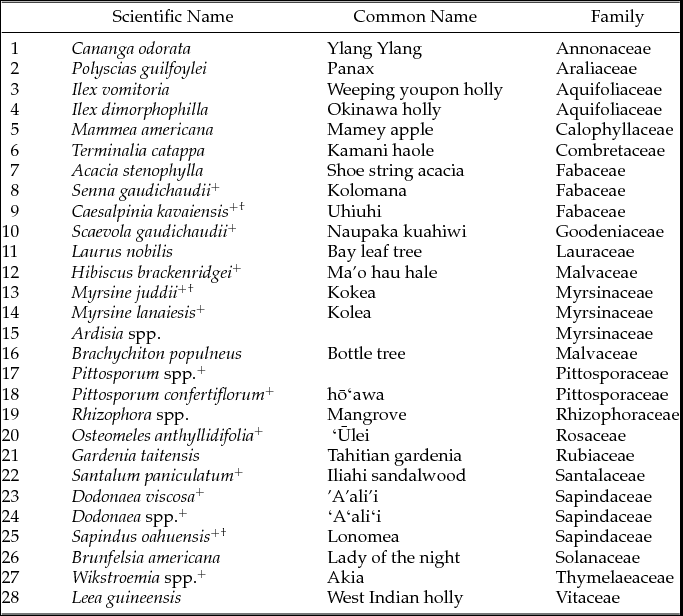
A plant species was considered a host of lobate lac scale if at least one mature female was observed, but in reality, we always observed multiple adults and crawlers on the host plants identified in our survey. In this survey, we recorded 28 new host plant species belonging to 20 families, including 14 plant species native to Hawaii and three endangered plant species (Table 1). Considering our previous survey results, we have now documented 111 plant species belonging to 44 families (including 29 plant species native to Hawaii and seven endangered plant species) that are hosts of lobate lac scale in the urban landscape of Oahu, Hawaii. Some of the plant families (such as Moraceae, Fabaceae, Malvaceae, Rubiaceae, and Myrtaceae) were more susceptible, as indicated by the high number of infested species in these families.
New hosts of lobate lac scale identified in the urban landscape of Hawaii

+ Plant species native to Hawaii.
† Endangered plant species.
Preventive and curative efficacy of systemic insecticides against lobate lac scale
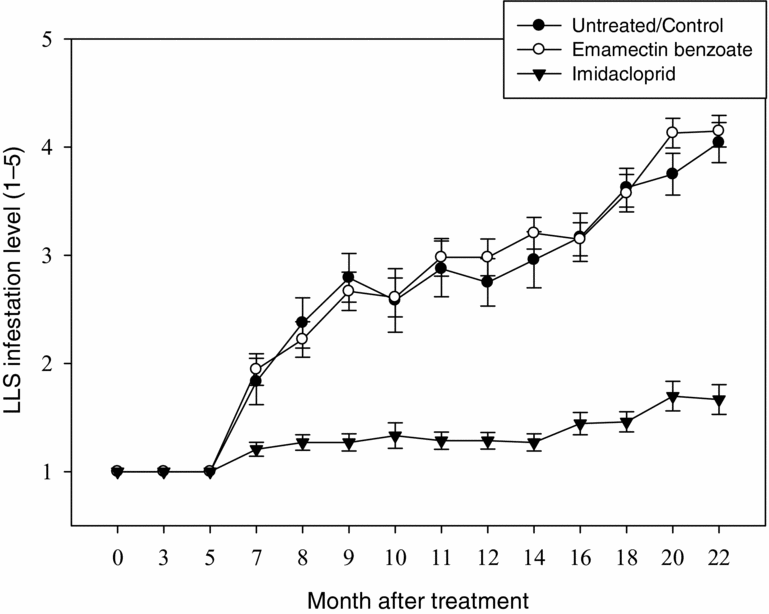
We evaluated the efficacy and persistence of preventive treatment using imidacloprid and emamectin benzoate against lobate lac scale on Chinese banyan trees, one of lobate lac scale's major hosts in Hawaii, up to 22 months post-treatment. Starting from the seventh month after preventive injection, lobate lac scale infestation appeared on trees under control and those treated with emamectin benzoate (Fig. 1). Lobate lac scale infestation on imidacloprid injected trees was very low or absent. Lobate lac scale infestation increased over time in emamectin benzoate treated trees and untreated/control trees (Fig. 1). Our results showed imidacloprid was effective (P<0.05 within each sampling time starting from the seventh month post treatment) in preventing lobate lac scale infestation up to 22 months after preventive treatment.
Lobate lac scale infestation level on Chinese banyans up to 22 months after preventive treatment (infestation level: 1= no infestation and 5= severe infestation). Error bars indicate standard error from the mean. LLS: lobate lac scale.

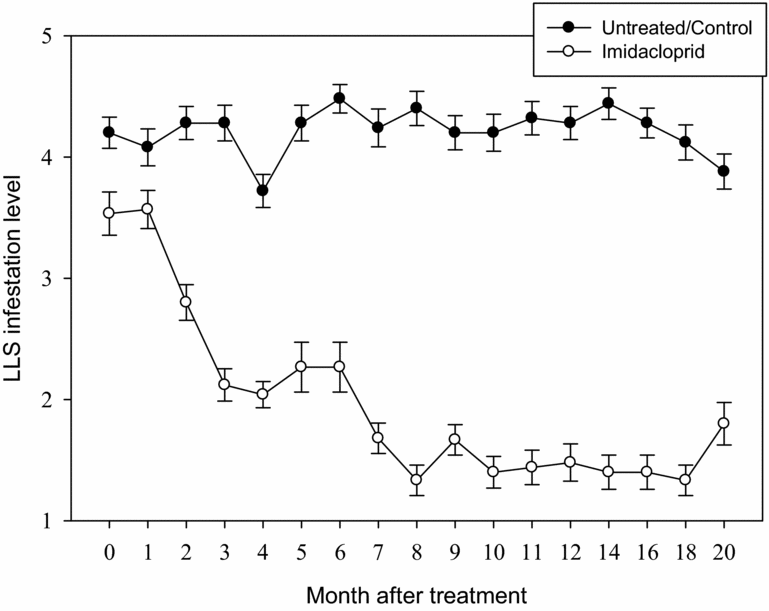
In the curative study on 10 weeping banyan trees, the effect of imidacloprid treatment started to appear from the 2nd month after treatment with significant decline in lobate lac scale infestation (P<0.05 within each sampling time starting from the 2nd month post-treatment) (Fig. 2). There was low survival of instars and adults on imidacloprid treated trees. Figure 2 shows the results up to 20 months after treatment, where imidacloprid significantly reduced the infestation of lobate lac scale on weeping banyans. Lobate lac scale was almost eliminated on imidacloprid injected trees and no new infestation was observed.
Lobate lac infestation level on weeping banyans up to 20 months after curative treatment (infestation level: 1= no infestation and 5= severe infestation). Error bars indicate standard error from the mean. LLS: lobate lac scale.

Discussion
In Florida, lobate lac scale population was not consistent throughout the year, with some increase in population observed during summer season (Howard et al., Reference Howard, Pemberton, Shroer and Hodges2010). In contrast, our study showed no significant seasonal fluctuation on the infestation level of lobate lac scale after they had established on weeping banyans in Hawaii. This could be due to relatively consistent temperature in Hawaii throughout the year. The lobate lac scale has higher chances of invading and becoming established in those areas where temperatures do not drop below freezing point (Chong et al., Reference Chong, Roda and Mannion2008). This could be the main reason for the widespread distribution of lobate lac scale on Oahu in a short period of time since its discovery in October 2012. Our previous survey recorded over 80 host plant species belonging to 34 families, including 15 plant species native to Hawaii and four endangered plant species (Cheng and Bhandari, Reference Cheng and Bhandari2015). Considering the 28 new host plant species reported here, we have now recorded 111 host plant species in Oahu's urban landscape. The wide host range of lobate lac scale (including many native and endangered plant species) underscores the severe threat of this pest to Hawaii's ecosystem, even though the infestation is heaviest in the urban landscapes at present. In another study, the first instar crawlers survived up to 14–18 days without host plants, which shows their higher chance of spreading in tropical regions on national and international levels (Howard et al., Reference Howard, Pemberton, Shroer and Hodges2010).
Preventive control using trunk injection into Chinese banyan trees showed that imidacloprid was effective in preventing lobate lac scale infestation for at least 22 months after treatment. In previous studies, imidacloprid and emamectin benzoate showed considerable variation in their effectiveness and persistence against different insect pests on different plants. A study on trunk injection of imidacloprid on eastern hemlock, Tsuga canadensis, to determine its effectiveness on hemlock woolly adelgid, Adelges tsugae, found reduced A. tsugae populations under imidacloprid treatment and the treatment prevented further damage up to four years post-treatment, resulting in new shoot growth and better tree health (Eisenback et al., Reference Eisenback, Salom, Kok and Lagalante2014). The trunk-injected imidacloprid was significantly effective against erythrina gall wasp, Quadrastichus erythrinae Kim, on wiliwili trees, Erythrina sandwicensis, and prevented re-infestation of this pest beyond 13 months after treatment (Doccola et al., Reference Doccola, Smith, Strom, Medeiros and von Allmen2009). A single trunk injection with emamectin benzoate resulted in significant control of emerald ash borer, Agrilus planipennis Fairmaire for 2–3 years in ash trees, Fraxinus pennsylvanica Marsh (Smitley et al., Reference Smitley, Doccola and Cox2010; McCullough et al., Reference McCullough, Poland, Anulewicz, Lewis and Cappaert2011). Similarly, a study conducted at University of Hawaii at Manoa showed that emamectin benzoate was more effective than imidacloprid in managing leaf gall wasp, Josephiella microcarpae and stem gall wasp, Josephiella spp., on Chinese banyan trees (Bhandari and Cheng, Reference Bhandari and Cheng2016). In contrast, trunk-injected emamectin benzoate was ineffective against lobate lac scale on Chinese banyan trees.
Our study on weeping banyan trees showed imidacloprid delivered via trunk injection was curatively highly effective against lobate lac scale. Similarly, a study on Chinese banyan, Ficus microcarpa, in Florida to observe the effectiveness of root drenching of imidacloprid, organocide (containing fish and sesame seed oils and lecithin) and malathion combined with horticultural oil, showed imidacloprid was effective, almost eliminating lobate lac scales within 103 days after treatment (Howard and Steinberg, Reference Howard and Steinberg2005). A study using trunk injection to manage red gum lerp psyllid (RGLP), Glycaspis brimblecombei, on red gum eucalyptus trees, Eucalyptus camaldulensis, found significantly reduced population of RGLP within a week following imidacloprid treatment with significantly reduced psyllid nymphs for eight months in treated trees (Young, Reference Young2002). Our finding is consistent with these studies, as it shows that imidacloprid is effective against lobate lac scale for at least 20 months after treatment on weeping banyan trees when delivered through trunk injection. Only a small number of live instars was observed on the samples from trees treated with imidacloprid in certain months, but not the live adults. The small number of live instars may have been relocated (by air currents, birds, or other animals) from untreated control trees in the surrounding area. Since the weeping banyan and Chinese banyan trees have their own host-specific pollinators (agaonidae wasp species), possible negative impact of imidacloprid and emamectin benzoate usage in these plant–insect systems on common pollinators, such as honey bees, is extremely low.
Since the native range of lobate lac scale insect is still unclear, no potential biocontrol programme has been developed. The imidacloprid treatment using trunk injection system appears to be an effective approach for the prevention and control of lobate lac scale on ficus trees in Hawaii's urban landscapes.
Acknowledgements
We thank University of Hawaii at Manoa Landscape Services and East West Center for support to this project. This research was funded by Z. Cheng's start-up funding and Hatch project at the College of Tropical Agriculture and Human Resources, University of Hawaii at Manoa. We also thank Dr Richard A. Criley (TPSS, University of Hawaii at Manoa) for assistance in identifying some plants, and Arborjet for assistance with treatments.