INTRODUCTION
Over the course of the last two decades, spiritual care has gradually received more recognition as an important aspect of healthcare. The growing acceptance of spiritual care as an integral part of healthcare can be perceived in the surge in the number of publications and conferences on the topic, the establishment of taskforces and centers devoted to spirituality and health (e.g., the GW Institute for Spirituality and Health at George Washington University and the EAPC Taskforce on Spiritual Care in Palliative Care), and the establishment of global networks (e.g., the Global Network for Spirituality and Health). Palliative care (PC) providers and researchers have also demonstrated a keen interest in spirituality (Walter, Reference Walter2002). This is not so surprising given the fact that the founders of the modern hospice movement were drawn toward care for the terminally ill driven by strong spiritual inspiration. They also realized that these patients had specific spiritual needs that required particular attention (Clark, Reference Clark2001). From there, spiritual care has become an essential part of good PC.
Since its modest beginnings in the first decades after World War II, PC has gradually turned into a global movement (Wright et al., Reference Wright, Wood and Lynch.2008). The principles of holistic PC have thus spread throughout the world, as has the concept and practice of spiritual care. Indian PC providers have realized that they should care for the spiritual problems and concerns of their patients. Palliative care was introduced into India during the second half of the 1980s. Programs have been developed in different parts of the nation since then, though the coverage of PC in India still remains a huge problem. Most of these programs focus on cancer patients (Rajagopal & Palat, Reference Rajagopal and Palat2002; McDermott et al., Reference McDermott, Selman and Wright2008; Shanmugasundaram et al., Reference Shanmugasundaram, Chapman and O'Connor2006), but recent research and the presentations at the annual conference of the Indian Association of Palliative Care indicate that there is a willingness to include other patients with PC needs (e.g., those with HIV/AIDS).
There is an awareness of the necessity to care for the spiritual needs and concerns of patients among Indian providers of PC. A 2004 study showed that 91% of PC doctors, nurses, social workers, spiritual counselors, and volunteers in India considered it important or very important to attend to their patients' spiritual concerns (Wright et al., Reference Wright, George and Mingins2004). This awareness may have been stimulated by the particular social, cultural, religious and economic circumstances that make spirituality specifically significant to PC in India. For example, Jagannathan and Juvva (Reference Jagannathan and Juvva2009) observed that prayer and meditation were more often used as a coping strategy in lower-income patients with head and neck cancers. They suggested that this difference may have been due to inaccessibility of the required medicine for this group. This observation illustrates how the particularities of the Indian context can influence the nature of spirituality in PC. Observations regarding the prevalence and characteristics of spiritual distress in Western patients may thus not always be relevant to the Indian context (Chaturvedi, Reference Chaturvedi2007). India is not just a country—it has the size of a subcontinent, with its own distinct cultures, societies, economic conditions, worldviews, and religions. This situation justifies undertaking separate studies on spirituality in Indian PC, and it served as a motivation for us to conduct the present systematic review.
We wanted to determine which aspects or dimensions of spirituality are important for patients in Indian PC. We also realized that spirituality may have ethical implications for PC that have largely been overlooked in the present literature, and so we also decided to analyze these ethical consequences. In order to be able to assess and interpret the issues in these two areas, we decided to study how spirituality has been interpreted in research on Indian PC patients and how it has been operationalized in empirical studies involving this population.
METHODS
The review was performed following the recommendations of the PRISMA Statement (Moher et al., Reference Moher, Liberati and Tetzlaff2009; Liberati et al., Reference Liberati, Altman and Tetzlaff2009), with some adaptations in order to suit the particular aims of our research. Data collection, extraction, and analysis were performed in three stages, which were determined and described before the study began.
Stage 1: Retrieval and Screening of Studies
In January of 2015, the following five databases were searched: ATLA, CINAHL, EMBASE, PsycINFO, and PubMed. Studies published before that date were included. In order to maximize the possibility of retrieving relevant publications from our search, we used a combination of controlled and noncontrolled vocabulary. Because initial searches had demonstrated that the number of publications on spirituality in Indian PC patients may be limited, we decided to use very broad search terms and select relevant studies from the retrieved records.
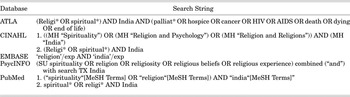
The search strings that were employed to search the databases can be found in Table 1. They comprised two main components: the first referring to spirituality or religion and the second to India. We included search terms directly derived from the concepts “religion” and “spirituality” for two reasons. First, although there is disagreement in the PC literature regarding the meaning of the concept of spirituality, the word “spirituality” is widely used therein. Therefore, it was deemed better not to impose a predetermined interpretation of spirituality on the studies but to search for publications about Indian PC patients in which the terms “spirituality” or “religion” or their derivatives are mentioned. “Religion” was added as an alternative because it is generally accepted that aspects of religion are a part of spirituality. In the Indian context, religion may be of particular importance. Second, this broad approach would enable us to assess how spirituality has been interpreted and operationalized in PC research involving Indian patients. This, in turn, would allow us to evaluate the risk of bias within studies.
Searched databases and search strings

We had to include a third component related to PC patients in the ATLA (American Theological Library Association) search string. This database indexes publications that specifically study religion. Without the third component, the number of retrieved records would be unmanageable, as a huge number of records dealing with all kinds of religious and spiritual phenomena in India were included, most of which had no direct bearing on illness or patients, let alone PC. The terms that were chosen for the third component referred to hospice or PC, the dying process, or HIV/AIDS or cancer—two illnesses that often trigger the need for PC. Most PC programs in India focus on cancer patients (Shanmugasundaram et al., Reference Shanmugasundaram, Chapman and O'Connor2006; Rajagopal & Palat, Reference Rajagopal and Palat2002; International Observatory, 2014), though HIV/AIDS patients also have particular PC needs (Selman et al., Reference Selman, Simms and Penfold2013; Huang, Reference Huang2013; Merlins et al., Reference Merlins, Tucker and Saag2013) (see Table 1).
Reports were included if they met the following criteria. They had to be in English and published in a peer-reviewed journal before January 1, 2015. Conference abstracts and dissertations were excluded. The terms “spirituality” and “religion” or their respective adjectives (“spiritual” and “religious”) had to be mentioned explicitly. Studied samples had to include patients who were receiving palliative treatment or who were likely to have PC needs, particularly patients suffering from advanced cancer or HIV/AIDS. The studies had to deal with PC patients in India or of Indian origin living abroad. The particular migratory background of these latter patients notwithstanding, they were included, as findings among them could contribute to our understanding of spirituality among Indian PC patients.
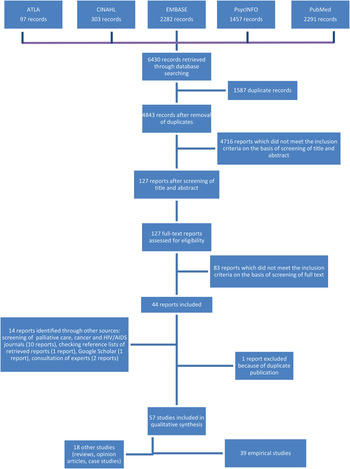
Relevant reports were first selected on the basis of a thorough reading of titles and abstracts. The full texts of these reports were then read, and a further selection was made. We then undertook the following steps to identify missing reports. We hand-searched the following relevant journals from the earliest issue available online (year in parentheses) until January 1, 2015: Psycho-Oncology (1992), Palliative & Supportive Care (2003), Supportive Care in Cancer (1993), AIDS Care (1989), the Indian Journal of Palliative Care (2003), the Indian Journal of Cancer (2003), and the Indian Journal of Sexually Transmitted Diseases and AIDS (2007). We also checked the reference lists of the reports and searched Google Scholar. Finally, we contacted authors who had published in the field of spirituality in Indian PC. We presented our list of retrieved publications to them and asked that they check whether the list was exhaustive enough and to identify any other relevant literature. Figure 1 is a flowchart that represents the results of our search.
Flowchart of search results.

Stage 2: Content Analysis of Spirituality
In order to understand how spirituality has been understood in studies of Indian PC patients and which aspects or dimensions are seen as constituents of spirituality in this context, we undertook a content analysis of all the selected reports. To this end, electronic versions of the reports were uploaded with MAXQDA 11, a software package for qualitative data analysis, which was employed throughout the coding process. We opted for a conventional content analysis (Hsieh & Shannon, Reference Hsieh and Shannon2005). This meant that codes emerged from the data and were not determined beforehand. We identified sentences that contained information about authors' interpretation of spirituality and its possible dimensions. If a questionnaire had been utilized, those questionnaire items that had been specifically identified by the report's authors as spiritual were included in the analysis as well. The identified parts were repeatedly read carefully. These parts were then read sentence by sentence and interpreted within the context of the report in which they had appeared. This interpretation led to assignment of codes. As the analysis progressed, the codes for the various reports were continuously compared and adjusted when necessary. Comparison of the codes gradually led to insights into various relationships between the codes. This enabled us to group codes together into overarching categories. A coding tree emerged that showed how spirituality was understood in studies on Indian PC patients.
Stage 3: Data Extraction from Empirical Studies
We divided the studies into two groups: empirical and other (review, opinion, case study). The data were extracted from the empirical studies using a data-extraction sheet, where we indicated the research design (qualitative, quantitative, or mixed-methods). If qualitative interviews had been undertaken, we noted whether these were structured or semistructured. In the case of questionnaire studies, we indicated who administered the questionnaire (self or interviewer) and whether there were open-ended questions, closed-ended questions, or both. In addition, we documented the operationalization or measurement of spirituality and the study sample. We then entered whether and how spirituality had been found to play a role in the treatment of Indian PC patients.
RESULTS
Some 39 empirical and 18 other-type studies were retrieved. Among the empirical studies, 12 were qualitative (Bottorff et al., Reference Bottorff, Grewal and Balneaves2007; David et al., Reference David, Roul and Kuruvilla1988; Elsner et al., Reference Elsner, Schmidt and Rajagopal2012; Francis, Reference Francis1986; Gurm et al., Reference Gurm, Stephen and MacKenzie2008; Howard et al., Reference Howard, Bottorff and Balneaves2007; Majumdar, Reference Majumdar2004; Selman & Higginson, Reference Selman and Higginson2010; Shanmugasundaram & O'Connor, Reference Shanmugasundaram and O'Connor2009; Simha et al., Reference Simha, Noble and Chaturvedi2013; Singh-Carlson et al., Reference Singh-Carlson, Wong and Martin2013; Patel et al., Reference Patel, Harcourt and Naqvi2014), 21 quantitative (Banerjee et al., Reference Banerjee, Vadiraj and Ram2007; Bele et al., Reference Bele, Bodhare and Mudgalkar2012; Chandra et al., Reference Chandra, Chaturvedi and Channabasavanna1998; Reference Chandra, Gandhi and Satishchandra2006; Reference Chandra, Satyanarayana and Satishchandra2009; Chaturvedi, Reference Chaturvedi1991; Reference Chaturvedi2003; Kandasamy et al., Reference Kandasamy, Chaturvedi and Desai2011; Lewis et al., Reference Lewis, Salins and Kadam2013; Mahalakshmy et al., Reference Mahalakshmy, Premarajan and Hamide2011; Marashi et al., Reference Marashi, Garg and Gupta2009; Pakseresht et al., Reference Pakseresht, Ingle and Garg2011; Pandey et al., Reference Pandey, Latha and Mathew2003; Reference Pandey, Thomas and Sreerekha2005; Skevington, Reference Skevington2012; Talukdar et al., Reference Talukdar, Ghosal and Sanyal2013; Thomas et al., Reference Thomas, Mohan and Thomas2002; Vidhubala et al., Reference Vidhubala, Kannan and Mani2005; WHOQoL HIV Group, 2004; Lewis et al., Reference Lewis, Salins and Rao2014; Peter et al., Reference Peter, Kamath and Andrews2014; Arora & Shukla, Reference Arora and Shukla2014), and 6 mixed-methods studies (Jagannathan & Juvva, Reference Jagannathan and Juvva2009; Mishra et al., Reference Mishra, Bhatnagar and Philip2010; Pahwa et al., Reference Pahwa, Babu and Bhatnagar2005; Ramanakumar et al., Reference Ramanakumar, Balakrishna and Ramarao2005; Wright et al., Reference Wright, George and Mingins2004; Chacko et al., Reference Chacko, Anand and Rajan2014). There was a duplicate publication of one of the quantitative studies (Chaturvedi, Reference Chaturvedi1991; Reference Chaturvedi2003). The 18 other studies can be categorized in the following three broad categories: 10 reviews (Bauer-Wu et al., Reference Bauer-Wu, Barrett and Yeager2007; Bhattacharya, Reference Bhattacharya2004; Chaturvedi, Reference Chaturvedi2007; Reference Chaturvedi2008; Deshpande et al., Reference Deshpande, Reid and Rao2005; Reference Deshpande, Sheriff and Nazir2013; Jagannathan & Juvva, Reference Jagannathan, Juvva, Altilio and Otis-Green2011; Singh-Carlson & Kaur, Reference Singh-Carlson, Kaur and Fowler2012; Vasudevan, Reference Vasudevan2003; Chaturvedi et al., Reference Chaturvedi, Strohschein and Saraf2014), 4 opinion articles (Bainbridge, Reference Bainbridge1991; Lunn, Reference Lunn2007; Panikulam, Reference Panikulam2011; Rajagopal & Lipman, Reference Rajagopal and Lipman2003), and 4 case studies (Braun, Reference Braun2008; Goswami, Reference Goswami2012; Mehta, Reference Mehta2011; Satija et al., Reference Satija, Singh and Kashyap2014). No systematic reviews were found. The authors of the retrieved review articles reflected upon particular aspects of spirituality, using a selection of the relevant literature.
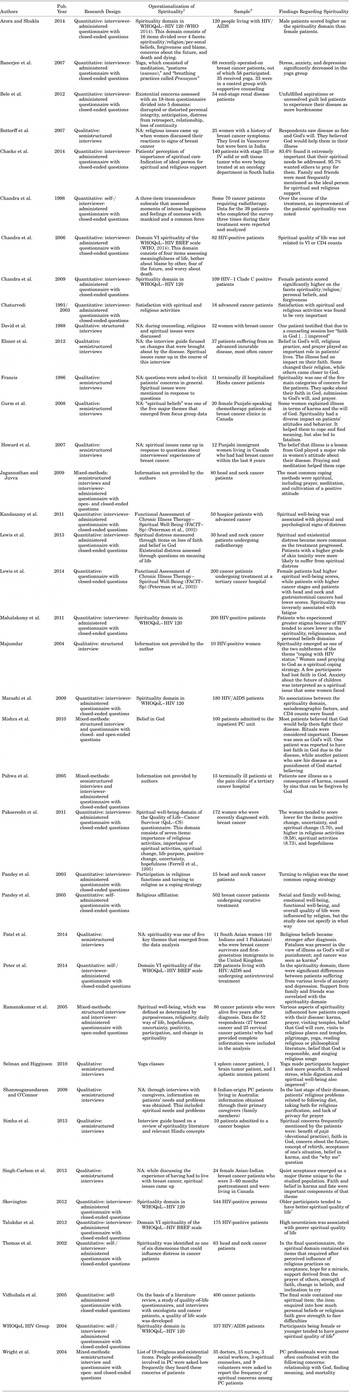
Assessment of the quality of the empirical studies and the risk of bias often turned out to be difficult or even impossible because the information regarding the methods in several publications was unclear or incomplete (David et al., Reference David, Roul and Kuruvilla1988; Jagannathan & Juvva, Reference Jagannathan and Juvva2009; Lewis et al., Reference Lewis, Salins and Kadam2013; Ramanakumar et al., Reference Ramanakumar, Balakrishna and Ramarao2005; Chacko et al., Reference Chacko, Anand and Rajan2014). Some of the studies clearly suffered from poor research design or small sample size. As can be seen from Table 2, with less than 100 patients studied in 10 surveys (Pandey et al., Reference Pandey, Latha and Mathew2003; Bele et al., Reference Bele, Bodhare and Mudgalkar2012; Lewis et al., Reference Lewis, Salins and Kadam2013; Banerjee et al., Reference Banerjee, Vadiraj and Ram2007; Chandra et al., Reference Chandra, Chaturvedi and Channabasavanna1998; Reference Chandra, Gandhi and Satishchandra2006; Chaturvedi Reference Chaturvedi1991; Reference Chaturvedi2003; Kandasamy et al., Reference Kandasamy, Chaturvedi and Desai2011; Thomas et al., Reference Thomas, Mohan and Thomas2002), sample sizes in the quantitative studies tended to be too small for statistical tests and descriptive statistics. Some researchers tested various associations without correcting for multiple comparisons, and some reported statistically significant associations without any attempt to explain or understand the associations (Bele et al., Reference Bele, Bodhare and Mudgalkar2012; Pandey et al., Reference Pandey, Thomas and Sreerekha2005).
Methodology of empirical studies

NA = not applicable because the investigators did not purposively operationalize spirituality.
‡ Religious affiliation is only mentioned in the table when the study linked it to other aspects of patient well-being and not when it was only used to describe a sample's demographic composition.
* All studied patients lived in India, unless specified otherwise.
× The study did not distinguish between the experiences of patients and caregivers.
† The study made no distinction between participants from India and those from seven other countries.
$ In the analysis of the data, no distinction was made between the views of black and South-Asian women.
# The study made no distinction between participants from India and those from five other countries.
When we look at the operationalization of spirituality in the empirical studies, it becomes clear that spirituality has not been treated as a major point of interest. It has most often been studied as an aspect or domain of quality of life (Chandra et al., Reference Chandra, Chaturvedi and Channabasavanna1998; Reference Chandra, Gandhi and Satishchandra2006; Reference Chandra, Satyanarayana and Satishchandra2009; Chaturvedi, Reference Chaturvedi1991; Reference Chaturvedi2003; WHOQoL HIV Group, 2004; Mahalakshmy et al., Reference Mahalakshmy, Premarajan and Hamide2011; Marashi et al., Reference Marashi, Garg and Gupta2009; Kandasamy et al., Reference Kandasamy, Chaturvedi and Desai2011; Bele et al., Reference Bele, Bodhare and Mudgalkar2012; Pakseresht et al., Reference Pakseresht, Ingle and Garg2011; Pandey et al., Reference Pandey, Thomas and Sreerekha2005; Skevington, Reference Skevington2012; Talukdar et al., Reference Talukdar, Ghosal and Sanyal2013; Vidhubala et al., Reference Vidhubala, Kannan and Mani2005; Peter et al., Reference Peter, Kamath and Andrews2014; Arora & Shukla, Reference Arora and Shukla2014), as one of the coping mechanisms used by patients (Jagannathan & Juvva, Reference Jagannathan and Juvva2009; Ramanakumar et al., Reference Ramanakumar, Balakrishna and Ramarao2005), or as part of the set of psychosocial problems faced by patients (Mishra et al., Reference Mishra, Bhatnagar and Philip2010; Pahwa et al., Reference Pahwa, Babu and Bhatnagar2005; Thomas et al., Reference Thomas, Mohan and Thomas2002; Lewis et al., Reference Lewis, Salins and Kadam2013). In 10 qualitative studies, spirituality was not even purposively operationalized but came up in response to certain probes by the interviewer (Bottorff et al., Reference Bottorff, Grewal and Balneaves2007; David et al., Reference David, Roul and Kuruvilla1988; Elsner et al., Reference Elsner, Schmidt and Rajagopal2012; Francis, Reference Francis1986; Gurm et al., Reference Gurm, Stephen and MacKenzie2008; Howard et al., Reference Howard, Bottorff and Balneaves2007; Majumdar, Reference Majumdar2004; Shanmugasundaram & O'Connor, Reference Shanmugasundaram and O'Connor2009; Singh-Carlson et al., Reference Singh-Carlson, Wong and Martin2013; Patel et al., Reference Patel, Harcourt and Naqvi2014).
Spirituality was the central topic in only six empirical studies (Banerjee et al., Reference Banerjee, Vadiraj and Ram2007; Kandasamy et al., Reference Kandasamy, Chaturvedi and Desai2011; Selman & Higginson, Reference Selman and Higginson2010; Simha et al., Reference Simha, Noble and Chaturvedi2013; Wright et al., Reference Wright, George and Mingins2004; Lewis et al., Reference Lewis, Salins and Rao2014), two of which (Selman & Higginson, Reference Selman and Higginson2010; Banerjee et al., Reference Banerjee, Vadiraj and Ram2007) focused on yoga, which can be seen as a religious practice, though Banerjee and colleagues emphasized its relaxation effects. As a consequence, we have very little information on the nature and frequency of the spiritual needs, problems, and concerns faced by PC patients in India.
Nevertheless, the retrieved empirical and other studies do provide interesting information on how spirituality is perceived and experienced in Indian PC. Through the content analysis, three dimensions of spirituality emerged: (1) the relational dimension, (2) the existential dimension, and (3) the values dimension. Religion is not seen as a separate dimension. As will be shown, religious beliefs, practices, and emotions play an important role in all three spiritual dimensions. Indeed, we can argue that religion is central to the experience of spirituality among Indian PC patients. This is illustrated by Simha et al.'s (2013) observation that a majority of the PC patients that they studied did not perceive a difference between religion and spirituality.
Relational Dimension
Regarding the relational dimension, the content analysis led to a distinction between the aspects of connectedness and disconnectedness. Connectedness involves actions and feelings that make human beings bond and, in this sense, transcend their limited selves. Through this process of bonding, patients can relate to family members, friends, and caregivers. The bonding process includes an aspect of trust through which patients can have confidence in the people who surround them, including the medical staff—and even themselves (Jagannathan & Juvva, Reference Jagannathan and Juvva2009). From a social perspective, the feeling of connectedness has been argued to be of particular importance for Indian patients, who are said to value communitarianism over individualism (Singh-Carlson & Kaur, Reference Singh-Carlson, Kaur and Fowler2012). In the empirical studies, this aligns with Bottorff et al.'s (2007) observation that Punjabi women with symptoms of breast cancer derived strength from their extended family. Chaturvedi (Reference Chaturvedi1991; Reference Chaturvedi2003) found that 90% of studied advanced cancer patients considered happiness with family and relatives moderately to very important and attributed this fact to their Hindu background. Peter et al. (Reference Peter, Kamath and Andrews2014) observed that the spiritual domain and social support from family and friends were correlated in Indian HIV/AIDS patients. This shows the importance of social connectedness to spirituality in Indian PC, something that is also reflected in the qualitative study conducted by Simha et al. (Reference Simha, Noble and Chaturvedi2013), who observed that forgiveness is one of the active behaviors undertaken by PC patients in an attempt to get their lives back on the right track. Forgiveness can be seen as a very relevant way to reestablish connectedness.
However, connectedness is not only experienced in relationships with other human beings but also with a higher transcendent Reality, such as God (Chaturvedi et al., Reference Chaturvedi, Strohschein and Saraf2014). From the numerous times in which this latter aspect has been discussed in the retrieved studies, we can conclude that researchers of spirituality in Indian PC consider it a very important aspect. Indian patients have been observed to be actively searching for connectedness with what transcends humanity and the physical world (Lunn, Reference Lunn2007). The search for transcendence is so pervasive in the Indian PC context that Vasudevan (Reference Vasudevan2003) made it central in his interpretation of spirituality. Although transcendence is not restricted to connectedness with God, several studies confirm that most Indian PC patients strive to connect with a personal God. A very visible expression of this striving is the habit of Hindu patients to have pictures of gods close by. Many of the Hindu patients interviewed by Simha and colleagues reported having framed pictures of gods in their rooms (Simha et al., Reference Simha, Noble and Chaturvedi2013). The belief in God in Indian PC is pervasive. In a study by Mishra and colleagues (Reference Mishra, Bhatnagar and Philip2010), 98% of PC patients testified to believing in God.
When confronted with advanced disease, belief in God becomes very important to many Indian PC patients because they are convinced that God can and will cure their illness (Howard et al., Reference Howard, Bottorff and Balneaves2007; Jagannathan & Juvva, Reference Jagannathan and Juvva2009). Indians generally consider God to be in control of everything, as argued by Gurm et al. (Reference Gurm, Stephen and MacKenzie2008). Ramanakumar et al. (Reference Ramanakumar, Balakrishna and Ramarao2005) observed that four fifths of studied cancer patients believed that God would save them from their illness. Other studies attest to the frequent occurrence of the belief in a curing God among Indian PC patients (Bottorff et al., Reference Bottorff, Grewal and Balneaves2007; Wright et al., Reference Wright, George and Mingins2004). If God has the power to cure, patients may be inclined to believe that they will benefit from close godly ties. Such a connection can be achieved through such religious practices as prayer, singing religious songs (e.g. bhajans), worship, pilgrimage, meditation, and yoga. This is illustrated by the PC patients attending yoga classes studied by Selman and Higginson (Reference Selman and Higginson2010) who asserted that yoga helped them to “feel closer to the divine.” That seems to be the reason why yoga and other spiritual practices have been found to be very important to Indian PC patients. A study of 18 Indian advanced cancer patients showed that they tended to consider satisfaction with these spiritual and religious activities very important (Chaturvedi, Reference Chaturvedi1991; Reference Chaturvedi2003). The PC patients studied by Selman and Higginson (Reference Selman and Higginson2010) reported that yoga had become an important part of their lives. Mehta (Reference Mehta2011) described a patient who even refused pain medications because he believed this would make him less alert and thus less capable of meditating. In a study conducted by Simha et al. (Reference Simha, Noble and Chaturvedi2013), belief in the benefit of pūjā (devotional practice) was the most frequently observed expression of spirituality. A diagnosis of breast cancer made other patients more strict in their religious observance (Howard et al., Reference Howard, Bottorff and Balneaves2007). Ramanakumar et al. (Reference Ramanakumar, Balakrishna and Ramarao2005) reported that cancer patients became more regular in their religious practice after the diagnosis. Moreover, patients who were no longer able to participate in rituals continued stressing their importance (Mishra et al., Reference Mishra, Bhatnagar and Philip2010).
This connection with the divine, which is brought about by spiritual practices, generates a sense of trust in the future. This, in turn, influences the ways in which patients experience their disease and helps them to cope. Indeed, the patients suffering from an advanced incurable disease studied by Elsner et al. (Reference Elsner, Schmidt and Rajagopal2012) believed that personal prayer and the prayers of others brought relief and reduced pain. For the terminally ill cancer patients studied by Francis (Reference Francis1986), prayer was a source of support in times of anxiety. These findings may explain why in a study by Chacko et al. (Reference Chacko, Anand and Rajan2014) 95.7% of advanced cancer patients wanted others to pray for them. Jagannathan and Juvva (Reference Jagannathan and Juvva2009) showed that prayer and meditation for female head and neck cancer patients were the primary strategies to cope with their side effects. In Majumdar's study (Reference Majumdar2004), HIV-positive women primarily coped with their illness through prayer and meditation. Patients also reported that yoga helped them fight negative thoughts and thus made them emotionally stronger (Ramanakumar et al., Reference Ramanakumar, Balakrishna and Ramarao2005), a finding also supported by Jagannathan and Juvva (Reference Jagannathan, Juvva, Altilio and Otis-Green2011). This was corroborated by the study of Selman and Higginson (Reference Selman and Higginson2010), in which patients reported that yoga had helped to reduce stress. The Punjabi-speaking breast cancer patients studied by Gurm et al. (Reference Gurm, Stephen and MacKenzie2008) stated that they prayed more often, recited religious hymns, and went to the Gurdwara (Sikh temple) because it made them feel more relaxed.
When patients are unable to bond, they experience disconnectedness. Our content analysis showed that disconnectedness among Indian PC patients finds expression in feelings of loneliness, guilt, and anger. Loneliness can result from conflictual relationships and a patient's impression that he or she is to some degree abandoned by those around them. In the literature, it is argued that such conflictual relationships (Bele et al., Reference Bele, Bodhare and Mudgalkar2012) and abandonment (Goswami, Reference Goswami2012) are experienced by Indian PC patients. However, patients may sometimes feel that their relationship with the transcendent Reality or God has been affected by their illness. This feeling may be triggered by an inability to pray or participate in religious practices due to physical limitations brought about by their illness. Pandey and colleagues (Reference Pandey, Latha and Mathew2003) reported that only 58.3% of studied cancer patients participated in religious functions in the same way after cancer treatment. In a study by Shanmugasundaram and O'Connor (Reference Shanmugasundaram and O'Connor2009), a family caregiver complained about the lack of privacy in a PC setting. Other patients may not be willing to pray because they blame God for their illness. According to the PC providers studied by Wright et al. (Reference Wright, George and Mingins2004), Indian patients often stop praying because they have lost their faith.
Indian PC patients may also be unable to connect with themselves or others because of the guilt they feel about being a burden to others (Goswami, Reference Goswami2012; Ramanakumar et al., Reference Ramanakumar, Balakrishna and Ramarao2005). In the Indian PC context, religion may also contribute to guilt feelings. Hindu patients may interpret their pain and suffering as a consequence of karma for which they themselves are responsible (see below), while Christian patients may see suffering as a deserved punishment for sins (Bauer-Wu et al., Reference Bauer-Wu, Barrett and Yeager2007). Feelings of guilt may have a strong impact on patient well-being. Bele et al. (Reference Bele, Bodhare and Mudgalkar2012) observed that patients with unresolved guilt experienced their disease as more burdensome. Anger toward one's self or others is another very clear expression of disconnectedness. In a study by Ramanakumar et al. (Reference Ramanakumar, Balakrishna and Ramarao2005), anger was a common emotional problem reported by 28% of cancer patients.
There are significant differences between groups of patients in their experiences of disconnectedness. Female patients and younger patients may be more likely to feel disconnected. The WHOQoL HIV Group (2004) found that women and younger persons (less than 34 years of age) more often experienced a low quality of life in the areas of social inclusion and social support. It should be noted, though, that the WHO study did not make a distinction between patients from India and those from five other countries. Two studies that included samples of Indian HIV patients found that younger persons (less than 30 and less than 40 years, respectively) had poorer quality-of-life scores in the areas of forgiveness and blame (WHOQol Group, 2004; Skevington, Reference Skevington2012).
Existential Dimension
The existential dimension can be perceived in studies that examined the search for meaning among Indian PC patients, the attainment of which can help patients evolve toward acceptance of their condition. Nevertheless, many patients are unable to accept their illness and feel they are losing control. The search for meaning and attempts to answer the “why me” question are often mentioned as general components of spirituality (Chaturvedi, Reference Chaturvedi1991; Reference Chaturvedi2003; Goswami, Reference Goswami2012; Simha et al., Reference Simha, Noble and Chaturvedi2013; Vasudevan, Reference Vasudevan2003; Chaturvedi, Reference Chaturvedi2007; Chaturvedi et al., Reference Chaturvedi, Strohschein and Saraf2014) or synonyms for it (Lewis et al., Reference Lewis, Salins and Kadam2013). Simha et al. (Reference Simha, Noble and Chaturvedi2013) found that the “why me” question was one of the most common spiritual concerns among PC patients. A similar observation was made by Wright et al. (Reference Wright, George and Mingins2004), who found that the “why did this happen to me” question was the spiritual item that Indian PC providers heard most often, aside from concerns regarding their relationship with God.
In the studied literature, these two concerns—the existential “why” question and uncertainty about a relationship with God—appear closely connected. Among Indian PC patients, the search for meaning is most often associated with religion. Our content analysis showed that the search for meaning has been analyzed through patients' belief in fate. Fate, of course, is not a purely religious idea. It refers to patients' convictions that illness and death are unavoidable. However, fate is often interpreted in terms of God's will or plan, or karma (Elsner et al., Reference Elsner, Schmidt and Rajagopal2012).
Several studies argued that Indian PC patients often believe that God, who has the power to cure and the power to cause or allow death, has willed their illness. This conviction transcends religion, as it can be found among Hindus, Sikhs, Christians, and Muslims (Bainbridge, Reference Bainbridge1991; Bhattacharya, Reference Bhattacharya2004). The prevalence of this belief was confirmed in empirical studies (Elsner et al., Reference Elsner, Schmidt and Rajagopal2012; Francis, Reference Francis1986; Gurm et al., Reference Gurm, Stephen and MacKenzie2008; Howard et al., Reference Howard, Bottorff and Balneaves2007; Mishra et al., Reference Mishra, Bhatnagar and Philip2010; Ramanakumar et al., Reference Ramanakumar, Balakrishna and Ramarao2005; Simha et al., Reference Simha, Noble and Chaturvedi2013; Singh-Carlson et al., Reference Singh-Carlson, Wong and Martin2013; Wright et al., Reference Wright, George and Mingins2004). Some patients were found to think that God wanted them to be ill because He intended to teach them something through the illness: God wanted to strengthen faith and religious practice (Howard et al., Reference Howard, Bottorff and Balneaves2007; Vasudevan, Reference Vasudevan2003) or teach them a better way to deal with problems (Howard et al., Reference Howard, Bottorff and Balneaves2007). These patients saw their illness as a lesson from God. Other patients interpreted their disease as a divine punishment for sin (Howard et al., Reference Howard, Bottorff and Balneaves2007), which only God could forgive (Pahwa et al., Reference Pahwa, Babu and Bhatnagar2005).
The idea of illness as a punishment for sin also occurs in Hindu, Sikh, Buddhist, and Jain patients' belief in karma—the belief that persons will have to experience the consequences of their deeds in this or the next life. This implies that a person may fall ill because he or she has committed a bad deed in this or a previous life (Bhattacharya, Reference Bhattacharya2004; Deshpande et al., Reference Deshpande, Reid and Rao2005; Jagannathan & Juvva, Reference Jagannathan, Juvva, Altilio and Otis-Green2011; Chaturvedi et al., Reference Chaturvedi, Strohschein and Saraf2014). In this context, suffering caused by illness can be seen as atonement for sin, which will purify bad karma. The lung cancer patient described by Mehta (Reference Mehta2011) initially even refused treatment that could relieve his pain as he believed the pain was a punishment that he had to endure. Several of the terminally ill cancer patients interviewed by Pahwa and colleagues (Reference Pahwa, Babu and Bhatnagar2005) stated that their pain was a consequence of bad karma. Bauer-Wu et al. (Reference Bauer-Wu, Barrett and Yeager2007) mentioned the possibility that Hindu cancer patients may refuse treatment aimed at pain relief as they believe they may miss an opportunity to purify their karma. In a study of Ramanakumar and coworkers (Reference Ramanakumar, Balakrishna and Ramarao2005), approximately half of the cancer patients saw their disease as a consequence of karma and sin. Several PC patients studied by Simha et al. (Reference Simha, Noble and Chaturvedi2013) considered the possibility that their illness was related to karma. The same was true for the breast cancer survivors studied by Patel et al. (Reference Patel, Harcourt and Naqvi2014), who expressed the idea that karma was an opportunity to atone for past sins.
Whenever illness is seen as God's will or a consequence of karma, it may seem that not much can be done and that all that is left for the patient is fatalistic acceptance. Pandey et al. (Reference Pandey, Latha and Mathew2003) observed the presence of fatalism in 26.6% of head and neck cancer patients. Existential answers provided by religion may indeed make acceptance of the disease easier for some Indian patients (Bainbridge, Reference Bainbridge1991; Deshpande et al., Reference Deshpande, Reid and Rao2005; Singh-Carlson et al., Reference Singh-Carlson, Wong and Martin2013). Chandra et al. (Reference Chandra, Satyanarayana and Satishchandra2009) suggested that belief in karma helped HIV-infected women to accept their disease. Most of the breast cancer patients studied by Singh-Carlson et al. (Reference Singh-Carlson, Wong and Martin2013) appeared to accept cancer as their fate. However, it was not a blind fatalism. They found that some patients who believed their cancer to be the result of karma also believed that they could change their destiny by doing good deeds. This is in line with an observation by Simha et al. (Reference Simha, Noble and Chaturvedi2013), who interviewed a patient who worshipped God hoping that it would purify his karma. In this way, belief in karma and fate can enable Indian patients to move ahead with their lives. Singh-Carlson et al. (Reference Singh-Carlson, Wong and Martin2013) concluded that acceptance through fate and karma is unique to South-Asian patients.
Acceptance of the disease may be further promoted by patients' beliefs in rebirth and salvation. Indian PC patients may be convinced that the soul takes on a new body after death. From this perspective, death is not the end, as it is followed by a new life (Bainbridge, Reference Bainbridge1991; Deshpande et al., Reference Deshpande, Reid and Rao2005; Simha et al., Reference Simha, Noble and Chaturvedi2013; Singh-Carlson & Kaur, Reference Singh-Carlson, Kaur and Fowler2012). Yet, this death/rebirth cycle need not go on for an eternity. Patients may also believe in the possibility of a blissful existence after death in a transcendent realm or with God (Deshpande et al., Reference Deshpande, Reid and Rao2005; Simha et al., Reference Simha, Noble and Chaturvedi2013). Whatever comes after death, Indian patients may be certain that a deeper part of them will never die. This explains why the PC patients studied by Simha et al. (Reference Simha, Noble and Chaturvedi2013) did not express a fear of death. Mehta (Reference Mehta2011) described a Hindu patient who remained calm in the face of death because he believed in the immortality of the soul.
From all these findings, it may seem that Indian religiosity offers a wide range of reassuring answers to the “why” question, that finding meaning is not hard for Indian PC patients, and that they accept their condition easily and without fear. However, this is not what all studies indicate. The answers provided by Indian religiosity, after all, may not be equally convincing to all PC patients. Almost all breast cancer patients interviewed by Gurm et al. (Reference Gurm, Stephen and MacKenzie2008) rejected the idea that their disease was a consequence of karma caused by sin. Such patients might find it hard to come to terms with their disease. Therefore, it is no surprise that the literature points toward very intense feelings of loss of control among Indian PC patients. Palliative care patients have a strong feeling that life is not going the way they wanted it to, and they tend to feel powerless in the face of their disease, which makes them feel insecure. The patients interviewed by Simha et al. (Reference Simha, Noble and Chaturvedi2013) reported that they had lost self-esteem because of their disease, and they regretted all the opportunities and experiences they had missed since they fell ill.
The experience of loss of control can also generate strong feelings of fear. The most obvious fear that PC patients experience is the fear of death. Ramanakumar et al. (Reference Ramanakumar, Balakrishna and Ramarao2005) found that fear of death was one of the common negative feelings experienced by both cervical and breast cancer patients. Wright et al. (Reference Wright, George and Mingins2004) reported that statements regarding mortality were among the items most frequently heard by providers of PC. Expressions about the fear of death and the absence thereof were heard in almost equal measure.
Patients may also experience a more general fear about the future, which can be directed toward themselves or family members. When directed inward, fear about the future implies a fear that their disease will progress, their symptoms worsen, and the pain intensify (Mishra et al., Reference Mishra, Bhatnagar and Philip2010; Ramanakumar et al., Reference Ramanakumar, Balakrishna and Ramarao2005). When directed toward family members, fear about the future refers to worries about the latter's well-being while the patient is still alive and as the disease progresses, or later on after the patient has died (Chacko et al., Reference Chacko, Anand and Rajan2014). Parents with younger children worry about what will happen to their children and spouses after their death (Majumdar, Reference Majumdar2004; Ramanakumar et al., Reference Ramanakumar, Balakrishna and Ramarao2005; Singh-Carlson et al., Reference Singh-Carlson, Wong and Martin2013), and they try to make arrangements so that their family will not suffer materially (Simha et al., Reference Simha, Noble and Chaturvedi2013).
Values Dimension
Frequent worries regarding the future of loved ones indicate that family is an important value for Indian PC patients that gives meaning to their lives until the very end. Aside from the family, faith is reported as another important spiritual value in these studies. Faith—particularly religious faith—gives strength to patients and guides them in their decisions. For most patients, religious faith means a faith in God (Simha et al., Reference Simha, Noble and Chaturvedi2013; Singh-Carlson et al., Reference Singh-Carlson, Wong and Martin2013; Jagannathan & Juvva, Reference Jagannathan, Juvva, Altilio and Otis-Green2011). That such faith and religion more generally offer support and guidance to Indian PC patients is illustrated by Pandey et al. (Reference Pandey, Latha and Mathew2003), who found that “turning to religion” was the most common coping strategy among patients suffering from oral cancer.
Nevertheless, the value of faith does not remain unaffected by the disease, which has a very profound impact on patients and may cause them to reconsider their faith. Such a change of faith among Indian PC patients can imply conversion to another religion, or at least seriously considering to do so (Elsner et al., Reference Elsner, Schmidt and Rajagopal2012; Chaturvedi, Reference Chaturvedi2008). It can also lead to loss of faith, which generally means that the patient is no longer able to believe in God. If faith in God had been central to a patient's life, they can now find life to be meaningless (Majumdar, Reference Majumdar2004; Mishra et al., Reference Mishra, Bhatnagar and Philip2010). On the other hand, in rare instances, the search for meaning stimulated by religion has been found to make patients believe in God, as they were now convinced that the disease could only be a divine punishment (Mishra et al., Reference Mishra, Bhatnagar and Philip2010).
DISCUSSION
Our analysis of the retrieved studies illustrates that spirituality has occasionally received attention in research on Indian PC patients. This is not to say that the interest of researchers in this topic has been overwhelming. Spirituality is most frequently studied alongside the social, cultural, and psychological dimensions of a patient's illness. With spirituality being the central topic in only six empirical studies, it is clear that the scientific evidence for the provision of spiritual care in Indian PC is slim. This is remarkable, as the importance of spirituality research is frequently emphasized in the international PC literature. In addition, the retrieved opinion and review articles stress the relevance of spirituality in Indian PC.
The limited amount of empirical data on spirituality in Indian PC does show that spirituality can have a profound impact on how patients experience their disease. The research of Lewis et al. (Reference Lewis, Salins and Rao2014) demonstrated the associations between spirituality and other aspects of the disease, including the physical ones. Their observation that patients with higher-stage cancers and certain types of cancer have lower spiritual well-being scores illustrates how a patient's physical condition can impact their spiritual well-being. However, this relationship may not always be unidirectional, from physical decline to spiritual trouble. In the case of the inverse association between spiritual well-being and fatigue that Lewis and colleagues observed, the direction of this relationship was not immediately clear. Cancer-related fatigue may contribute to patients feeling spiritual loss, but spiritual issues and concerns may obviously also make patients more vulnerable to fatigue (Lewis et al., Reference Lewis, Salins and Rao2014). A similar two-directional relationship can be assumed to be at work among the HIV/AIDS patients from a study by Peter et al. (Reference Peter, Kamath and Andrews2014), who found significant differences in the spirituality domain between patients suffering from various levels of anxiety and depression.
Given this interaction between spirituality and other aspects of the illness, it is no surprise that Indian PC patients want their caregivers to pay attention to their spiritual needs and concerns. The desire for spiritual care was illustrated by Chacko et al. (Reference Chacko, Anand and Rajan2014), who found that 83.6% of advanced cancer patients felt that it was extremely important to have their spiritual needs met. This observation raises the question of how the spiritual needs of Indian PC patients should be dealt with. This might seem to be a purely practical question, but closer examination of the three identified dimensions of spirituality reveals substantial ethical ramifications.
At the level of the relational dimension, there are the issues of relationships that are a source of conflict, the risk of imposition of religious beliefs and symbols on patients by caregivers, and the question of who should provide spiritual care within the multireligious context of Indian PC. At the level of the existential dimension, there is the problem of strong religious answers to existential issues that lead to a spiritual crisis, and the entanglement of this issue with patient autonomy. At the level of the values dimension, there are spiritual and religious values that determine patients' attitudes toward treatment decisions. There is also the problem of contextually appropriate definitions and operationalizations of spirituality, which covers all three dimensions and is also a matter of research ethics. We will now describe and analyze these ethical challenges and propose how they can be addressed within the context of Indian PC.
The relational dimension of spirituality can be a source of support for patients. Family members provide all kinds of practical and emotional support. However, relationships can also be a source of conflict. Whenever such conflicts arise, difficult ethical decisions have to be made. This is no less so when the relationship is directed toward an ultimate reality or a god who transcends the world. An ethical problem arises when religious and spiritual practices, which are intended to foster a relationship with God or the Ultimate Reality, interfere with pain and symptom management. For instance, the Hindu practice of laying a patient on the ground and placing Ganges water in their mouth may complicate respiration and mechanical ventilation (Chaturvedi, Reference Chaturvedi2008). Among Indian PC patients, effective pain and symptom management may not always be possible if a patient wants to participate in certain religious rituals and remain fully alert (Bauer-Wu et al., Reference Bauer-Wu, Barrett and Yeager2007; Mehta, Reference Mehta2011).
There are often no straightforward solutions to such ethical dilemmas. In searching for an answer, care providers need a deep understanding of the patient's religious views and motives as well as any alternative religious viewpoints that, from the patient's perspective, could meaningfully and considerately challenge his or her preconceived notions. Obviously, providing spiritual care in such cases is risky business. Without proper training and awareness, there is a real danger that care providers may try to impose their own religious convictions upon vulnerable patients (Chaturvedi, Reference Chaturvedi2008). This potential problem can become even more severe in a multireligious context (as in Indian PC), where a person's religious background very strongly determines their spirituality, as has been shown in the literature that religion plays a prominent role in all three spiritual dimensions. In this context, Rajagopal and Lipman (Reference Rajagopal and Lipman2003) pointed to the risk of well-meaning caregivers who, without bad intentions, impose their religious symbols on patients, who may be disturbed by this without openly acknowledging it. Chaturvedi (Reference Chaturvedi2007) argued that, in view of the importance of religion when it comes to dying, the fact that many hospices in India are run by Christian missionaries can be a source of conflict in pluralistic India.
Since finding an ethically sound answer to spiritual dilemmas in Indian PC can be complicated, it might be worthwhile to consider the advice of Vasudevan (Reference Vasudevan2003), who cautioned against giving sharply outspoken responses to patients' religious questions. He recommended that answers be more concrete only if patients appear to be really in need of such a response. He further advised to refer patients to a member of the PC team with a similar religious background. However, such a person may not always be available. Moreover, belonging to the same religion does not necessarily qualify a care provider as a good spiritual counselor. So who should provide spiritual care to PC patients in India? With few exceptions, there are no chaplains in Indian hospitals, hospices, and PC programs.
Physicians and, more particularly, nurses may play an important role in the spiritual care process. In Indian PC, they can be instrumental in determining which patients are facing major spiritual issues. The need to more profoundly involve physicians and nurses in spiritual care is illustrated by the observation that Indian PC patients want to discuss spiritual issues and concerns with their physicians and nurses. In the study by Chacko et al. (Reference Chacko, Anand and Rajan2014), 82.9% of advanced cancer patients wanted this. But physicians and nurses may not be the best persons to directly address these concerns. In the multicultural and multireligious context of India, where religion strongly influences all dimensions of spirituality, a very substantial part of spiritual care is beyond their expertise. It would be unrealistic to expect physicians and nurses to have sufficient background in the various religions of India to be able to provide effective spiritual care independently. Moreover, the Indian PC patients themselves do not seem to consider physicians and nurses the best providers of spiritual care. When advanced cancer patients were asked to name the ideal person for spiritual and religious support, 5% said nurses and only 2.9% physicians, while family and friends stood at 38.6% and “spiritual advisors” at 35.7% (Chacko et al., Reference Chacko, Anand and Rajan2014). Taking these observations into account, counselors and psychologists who are already working on PC teams in India may be more appropriate coordinators of spiritual care. Yet, they need more training in spirituality and religion so that they can make a contextually appropriate spiritual diagnosis and assess whether and how other persons outside the PC team (e.g., a patient's spiritual advisor, priest, or guru) should be involved in the process of spiritual healing.
While dealing with the existential dimension of spirituality, PC providers in India can face diverse ethical issues. It is important to pay attention to this when treating Indian PC patients, because this dimension may be more vital to them than to patients elsewhere. Kudla et al. (Reference Kudla, Kujur and Tigga2015) showed that the association between spirituality and meaning may be stronger among Indian PC patients than among PC patients elsewhere. Compared to German PC patients, Indian hospice patients more often reported spirituality in connection with meaning in life. However, finding meaning in the face of a terminal illness is not an easy task. There may be certain beliefs (like karma) that can promote acceptance, but this does not mean that coming to terms with their disease is not a major issue for most Indian PC patients. Much to the contrary, they often feel anger, and certain beliefs can make acceptance even more difficult. The conviction that God is on their side and will surely help them defeat the disease is such a belief.
When the religious conviction that God will eventually grant a cure has made the patient oblivious to his or her medical condition, a spiritual crisis may ensue when in the end the hoped-for cure does not materialize (Vasudevan, Reference Vasudevan2003). This may lead to depression and loss of faith. Not only may patients feel betrayed by God or the Ultimate Reality, who has not honored their longstanding relationship, but they may feel that their previously held answers to existential questions, based on a belief in a caring God, have been shown to be invalid. In this way, a broken relationship with God can lead to an existential crisis. What is the right way to deal with this issue of religiously inspired hope for a cure? What should PC providers do or say when God does not seem to help the patient or the patient's hope for a miraculous cure seems unrealistic from the medical perspective?
In such cases, care providers driven by beneficence may be inclined not to dash a patient's hope and withhold medical information. However, such a decision may interfere with a patient's right to autonomy. In the end, patients may experience desperation when, against their hope and expectations, they do not get cured. It is therefore essential that care providers instill an authentic hope. However, what this actually implies largely depends on the patient's beliefs and values. For example, being united with God may be an authentic hope for some patients but not for others (Beste, Reference Beste2005). An appropriate assessment of a patient's spiritual condition and an effective spiritual intervention regarding hope requires careful analysis of the patient's particular socioreligious context. So also here, interreligious sensitivity is indispensable for spiritual care providers in Indian PC.
From an ethical perspective, the values dimension is of particular importance. At the end of life, values may determine patients' attitudes about treatment decisions. Patients may object to palliative sedation because their religion demands that they remain alert during their last moments of life or because they value interaction with their family members. Our review has shown that family and religion are crucial values for Indian PC patients. Obviously, these can also be important values for Western PC patients. However, in the Western context, to a certain extent, their centrality may be counterbalanced by an emphasis on autonomy and a vaguer kind of spirituality. For Indian PC patients, family and religion are truly central and provide an essential sense of meaning. Kudla et al. (Reference Kudla, Kujur and Tigga2015) studied meaning in life and found that Indian hospice patients most frequently related this to family. Consequently, the patients tended to find it normal that family members be fully involved in medical decision making. Sometimes, however, involvement of the family is so extensive that the patient is partially or entirely left out of the process (Chattopadhyay & Simon, Reference Chattopadhyay and Simon2008; Raj, Reference Raj2012).
The importance of religion to Indian PC patients can be seen in the observation that religion figures prominently in all three studied dimensions of spirituality. This contrasts with influential Western definitions of spirituality, where religion is just one aspect of spirituality among several others. For example, the EAPC Taskforce on Spiritual Care in Palliative Care (2015) mentions “religious considerations and foundations (faith, beliefs and practices, the relationship with God or the ultimate)” as well as “existential challenges” and “value-based considerations and attitudes.” Current Western definitions of spirituality in PC can be characterized as secular (Bradshaw, Reference Bradshaw1996; Walter, Reference Walter2002; Paley, Reference Paley2008), and in this regard differ from the more religiously inspired way in which spirituality is looked upon in Indian PC research.
This difference could indicate a bias in the reviewed studies. Researchers might have paid too much attention to religion at the expense of other aspects of spirituality. The content analysis showed how spirituality has been studied in PC research in India. This does not mean that spirituality in Indian PC is necessarily limited to these dimensions or that the dimensions cannot have wider implications than those that have received attention in the literature. However, we may assume that these three dimensions are the most obvious manifestations of spirituality in Indian PC. The findings of the empirical studies do confirm the importance of religion for Indian PC patients. Even in the qualitative studies, where there was no predetermined operationalization of spirituality, participants spontaneously and repeatedly spoke about religious issues.
Our findings show that we need to be careful when applying current Western definitions and operationalizations of spirituality in PC to the Indian context. Otherwise, we might overlook aspects of spirituality that are contextually pertinent—yoga being a relevant example. With its origins in Indian philosophy and religion, the roots of yoga seem to be profoundly spiritual. Yet, perhaps largely due to Western influences, in the reviewed studies yoga seems to be interpreted mainly as an effective relaxation technique that is related to good health outcomes, and its particular spiritual and more specifically religious impact largely seems to escape attention (Banerjee et al., Reference Banerjee, Vadiraj and Ram2007; Selman & Higginson, Reference Selman and Higginson2010).
Another example illustrates the necessity of a contextually meaningful operationalization of spirituality. Chandra et al. (Reference Chandra, Gandhi and Satishchandra2006) studied the association between quality of life and HIV infection. They did not observe an association between the spiritual domain of quality of life and advancing HIV disease, though they did find associations with other domains of quality of life. They attributed the absence of an association with the spiritual domain to “inadequate measurement of the spiritual domain in the WHOQoL BREF,” which they employed in their study. Thus, a more contextually appropriate operationalization of spirituality might have yielded different results.
The use of contextually appropriate definitions and operationalizations of spirituality is not just the best way to achieve meaningful research results. It is also a matter of research ethics. An uncritical application of a Western understanding of spirituality to Indian PC can be seen as a kind of imperialism in which Indian PC providers and patients have to conform to Western standards, which may not be best suited to the Indian PC context. This has ethical implications for research on spirituality in PC. Western models of spirituality should not be directly imposed on Indian PC patients. It is always necessary to critically assess to what extent the outcomes of research on spirituality in the West can be transposed to the Indian PC context. In many cases, contextual adaptation will be required in order to make models and observations culturally appropriate.
LIMITATIONS
This systematic review has enabled us to bring together the scientific observations on spirituality in Indian PC and analyze how spirituality poses ethical challenges to PC providers in India. However, our study has two limitations. First, many Indian journals have not been indexed into the scientific databases, and the process for those that have been indexed began only a few years ago. So we have to wonder how comprehensive the list of retrieved studies actually is. As described in the methods section, we tried to remedy the limitations of the databases in various ways. We conducted a snowball search as well as a hand-search of relevant journals. We also undertook a general internet search, and we consulted experts regarding possible missing studies. We can thus claim that our study adequately represents the available research on spirituality in Indian PC.
Second, the number of empirical studies whose main focus was spirituality was small. Much of the empirical data that have been discussed in our review are just small parts of larger studies. Moreover, the empirical studies did not always have a good research design. Aside from the empirical studies, there were mainly opinion and review pieces, which were predominantly based on the researchers' own experience and/or a limited literature review. For a study of spirituality in Indian PC, such studies and reports are nevertheless important because they show which possible problems require more research and closer clinical attention. They also indicate possible directions for spiritual interventions. However, they do not generate high-level evidence. As per the Oxford Centre for Evidence-Based Medicine, this kind of “expert opinion” belongs to the fifth or lowest level of evidence (Phillips et al., Reference Phillips, Ball and Sackett2009). Stronger evidence for spiritual interventions is unfortunately not available, and the level of evidence regarding spirituality in Indian PC is rather low.
CONCLUSION
We have studied spirituality in Indian PC patients through three dimensions: the relational dimension, the existential dimension, and the values dimension. The empirical studies illustrate the various ways in which these spiritual dimensions matter to Indian PC patients. They also show the particularity of spirituality in Indian PC. Spirituality in this context has its own characteristics that PC providers need to take into account. The centrality of religion in all three spirituality dimensions is a case in point. Further, our review has shown that spirituality has significant ethical implications for PC in India.
If PC providers want to offer ethically sound spiritual care for Indian PC patients, they will have to find an answer to the ethical issues that have been raised in our review. In that sense, this study has important implications for clinical practice, as we have also suggested possible ways to solve these ethical issues.
When assessing the significance of the findings of our review, one should realize that, strictly speaking, they not only pertain to Indian PC but also to all patients with PC needs in India as well as patients of Indian origin who are treated by PC teams elsewhere in the world. Since a substantial number of people of Indian origin are living in such places as the United States, the United Kingdom, and Australia, our findings should not be overlooked by the PC providers in those countries.
Unfortunately, the amount and quality of the available data on spirituality among Indian PC patients is limited. Thus, there is a clear need for more research into spirituality in Indian PC in order to make spiritual counseling of Indian PC patients more effective and based on evidence. While preparing such studies, researchers should carefully consider the appropriate research design. Qualitative studies on spirituality in Indian PC should be more robustly based on methodology. A phenomenological approach may be suited, though such other approaches as grounded theory may also be appropriate, depending on the objectives of the study.
Future quantitative studies will benefit from the inclusion of larger samples. Researchers should be aware that findings from single-center studies with very small samples have limited external validity, and they are not always generalizable to a broader population. Therefore, recommendations uniquely based on such studies are not strong evidence, even if the observed associations are highly statistically significant. While analyzing quantitative data and reporting results, researchers should carefully consider the meaning and relevance of statistically significant associations and critically assess to what extent they are in line with earlier observations in the literature. In future publications of empirical studies on spirituality in Indian PC, the methods section should also be better developed. In particular, research instruments (questionnaires or interview guides) and their development should be described in more detail. This would lead to a more accurate appraisal of the presented findings.
ACKNOWLEDGMENTS
The authors wish to thank Jordan Potter and Daniel Hurst, graduate assistants at the Center for Healthcare Ethics of Duquesne University, for their help with data collection and with editing this article, respectively. Joris Gielen is a postdoctoral fellow of the Research Fund–Flanders (FWO). This fellowship enabled him to work on our review.