





Introduction
During the COVID-19 pandemic, the implementation of protective measures such as lockdowns, the use of hygiene masks, and increased hygiene measures effectively limited the spread of the disease. However, these measures not only stopped the spread of the COVID-19 virus but also limited the transmission of most respiratory tract infectious agents (Cohen et al., Reference Cohen, Ashman, Taha, Varon, Angoulvant, Levy, Rybak, Ouldali, Guiso and Grimprel2021). The pandemic has resulted in various changes in paediatric healthcare, such as an increase in the incidence of atypical pathogens like Mycoplasma pneumoniae, a decrease in face-to-face consultations, and a decrease in additional diagnostic testing (Somekh et al., Reference Somekh, Somech, Pettoello-Mantovani and Somekh2020; Homeniuk and Collins, Reference Homeniuk and Collins2021; Foley et al., Reference Foley, Yeoh and Minney-Smith2022). Furthermore, patients’ health literacy, such as their knowledge of disease pathogens, has improved (Singh and Balachandran, Reference Singh and Balachandran2021). A decline in vaccine uptake and patient adherence has also been observed (Somekh et al., Reference Somekh, Somech, Pettoello-Mantovani and Somekh2020).
While many studies have examined the effects of the COVID-19 pandemic on paediatric secondary care, there is a significant gap in research focusing on primary care, especially concerning general practitioners (GPs). Understanding the changes experienced by GPs during and after the pandemic is crucial, as they are often the first point of contact for young patients. Knowledge regarding these changes can help identify specific areas for future healthcare improvements.
Therefore, this study aims to investigate the extent to which GPs experienced changes in managing infections in children in general practice. Specifically, we examined how children presented during consultations, the care they received, when parents sought care, how they were reassured, and the changes GPs notice themselves.
Methods
An online, cross-sectional survey was distributed through online newsletters of general practice organizations (e.g. Meditta, HOZL, Cohesie) and associated social media (LinkedIn, Instagram) among practicing GPs in two Dutch provinces of Limburg and Utrecht. Participants outside of these provinces were not excluded from filling in the questionnaire, though not actively recruited due to practical limitations. Participating GPs were required to have a minimum of 4 years of experience in order to include opinions from GPs with practical experience before the pandemic. A response rate of 20% was expected and therefore approximately 460 GPs were invited to participate.
The questionnaire was developed based on literature and medical experts in the field (3 GPs and 2 paediatricians). To check the validity of the survey, a pilot study was performed among 4 GPs, 3 paediatricians, 2 parents and 4 laypeople and the wording of some questions was adjusted based on the obtained feedback. The final questionnaire contained 35 questions which were separated according to (1) the presentation of infections, (2) health care management, (3) health seeking behaviour, and (4) reassurance of parents. Response options included multiple choice options, 5-point Likert scales and open questions.
The fully anonymous responses were automatically transferred into a data file and analysed using SPSS (version 23). Before analysis, the data file was cleaned for missing values and textual responses were coded. Analysis consisted of descriptive statistics using frequencies to determine trends and non-parametric tests (e.g. Mann Whitney U, Kruskal Wallis) to determine a possible influence of demographic factors (e.g. age, region, experience) on the obtained responses.
Results
Study population
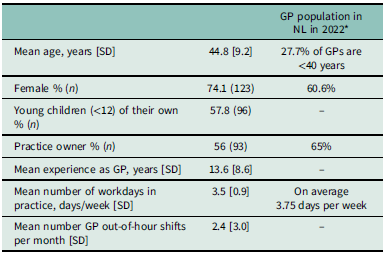
166 GPs completed the entire survey. Participating GPs had a mean age of 44.8 years (SD 9.15, range 30–67 years). More females than males responded to the survey and 58% (96/166) of the participants had young children of their own. The average working experience was 13.6 years (SD 8.6) and GPs worked on average 3.5 days per week. Other characteristics are described in Table 1.
Characteristics of responders (n = 166)

Table 1. Long description
The table presents the characteristics of 166 general practitioners (GPs) who completed a survey in the Netherlands in 2022. It includes various demographic and professional attributes. The table has 8 rows and 3 columns. The columns are labeled as follows: the first column lists the characteristics, the second column provides the corresponding values or percentages, and the third column offers additional context or comparisons. Row 1: Mean age, years (SD), 44.8 (9.2), 27.7 percent of GPs are less than 40 years. Row 2: Female percent (n), 74.1 (123), 60.6 percent. Row 3: Young children (<12) of their own percent (n), 57.8 (96), not applicable. Row 4: Practice owner percent (n), 56 (93), 65 percent. Row 5: Mean experience as GP, years (SD), 13.6 (8.6), not applicable. Row 6: Mean number of workdays in practice, days/week (SD), 3.5 (0.9), On average 3.75 days per week. Row 7: Mean number GP out-of-hour shifts per month (SD), 2.4 (3.0), not applicable.
n = number of participants in that specific category out of all 166 study participants, NL = the Netherlands, SD = standard deviation.
*Based on online data provided by NIVEL.
Clinical presentation and seasonal patterns
When asked whether GPs experienced a general change in the health care for children with infections since the COVID-19 pandemic, 32% (53/166) GPs agreed, while 43% (116/166) disagreed.
Most GPs did not experience a change in the presentation of infectious diseases. Nonetheless, 44% of participating GPs agreed that the seasonal pattern of infections did change. GPs noticed an earlier peak of typical winter infections, an increase in the recurrence rate of infections and that there seemed to be more complications or atypical infections than before the pandemic.
Clinical management and reassurance
While the majority of participants (70%) did not report an overall change in the provision of care, specific changes were noted, including an increased use of point-of-care C-reactive protein testing (30%) and a rise in antibiotic prescriptions (25%). Most GPs (91%) felt confident in their skills to reassure parents with sick children, but 48% of participating GPs remarked that parents have become more demanding. Consultations seem to last longer (26%), children visit the practice more often with the same symptom (45%) and the same child will come in more frequently with various symptoms of infection (44%).
Challenges in management
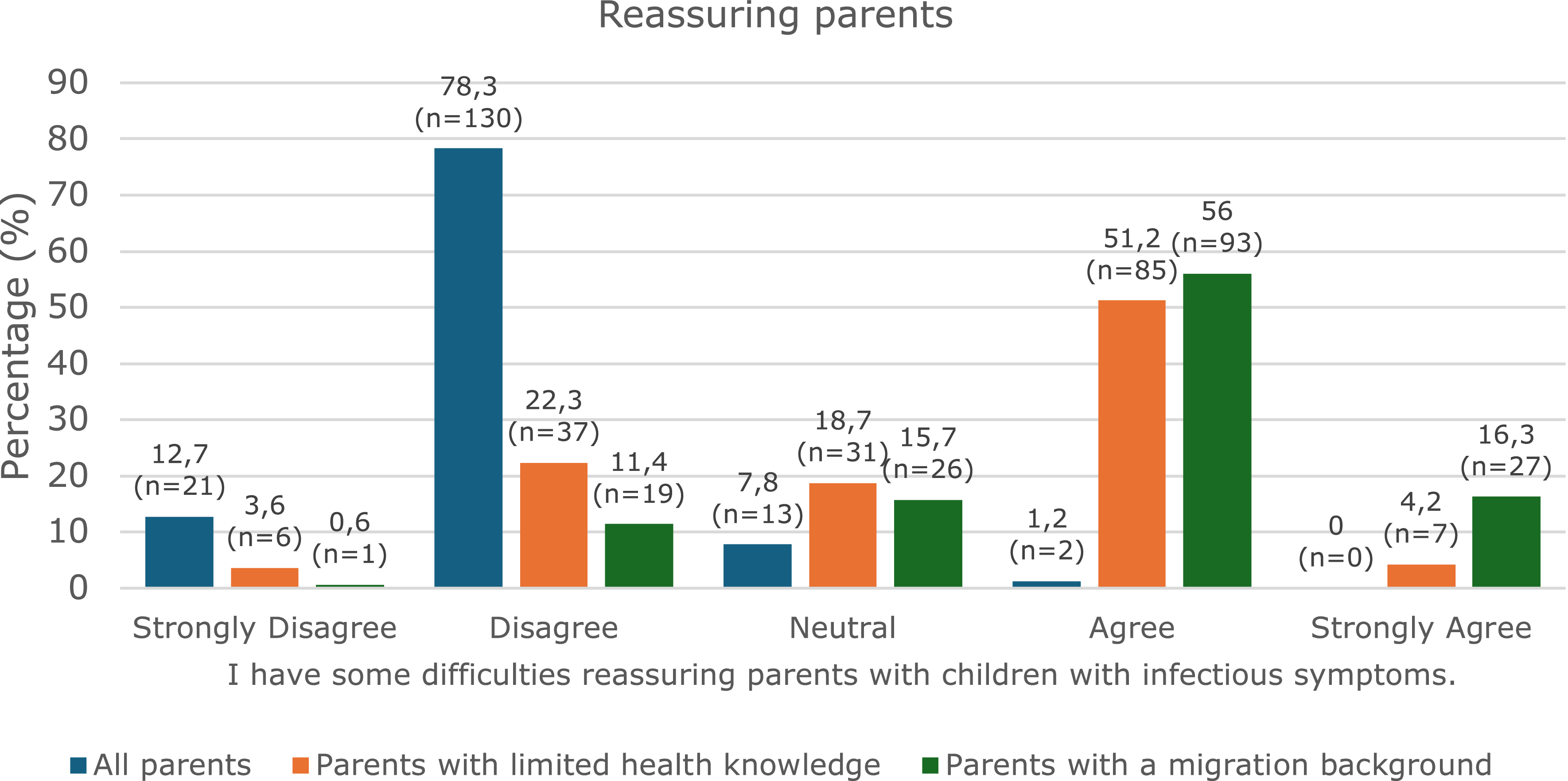
GPs reported to be less confident at reassuring parents with limited health literacy and with migration backgrounds, as depicted in Figure 1. 55% of GPs found it difficult to reassure parents with lower health literacy and 72% found it difficult to reassure parents with a migration background. Additionally, GPs agreed that they prescribe antibiotics more frequently for children of parents with low health literacy (23%) or a migration background (41%). Participants mentioned the need for a translated version of official governmental websites regarding disease patterns, but also more education regarding the Dutch health care system.
Obtained responses (percentage and number) from participating GPs (n = 166) to the statement whether GPs have difficulties reassuring different groups of parents with children with symptoms of infection. All parents in blue, lower health literacy in orange, and migration background in green.

Discussion
Summary of main findings
While paediatric infection management in general practice has mostly returned to pre-pandemic status, GPs still experience some changes. These include earlier and larger incidence peaks, an increase in diagnostic testing, and an increase in antibiotic prescriptions. Additionally, GPs felt that parents became more demanding, visiting the practice more frequently. GPs reported difficulties in reassuring parents with lower health literacy or a migration background. One potential consequence of this was an increase in antibiotic prescriptions for children from these groups.
Strengths and limitations
This exploratory survey is the first study to objectively assess potential changes in GPs’ experiences in managing childhood infections during general practice consultations. By employing snowball sampling, we collected data with the necessary context from a large sample, making the findings generalizable to Dutch GPs.
However, the study has some limitations. A limited validity check was performed through a pilot study, leaving some questions open to misinterpretation. The online distribution method may have introduced selection bias, as participants from only two Dutch provinces were actively recruited. Furthermore, the study’s findings are limited in global applicability due to differences in COVID-19 measures and their effects between countries. For instance, variations in pandemic responses between the Netherlands and neighbouring countries have been reported (Billard and Bont, Reference Billard and Bont2023).
Comparison with existing literature
Forty percent of responding GPs reported that care for children with symptoms of infection had returned to pre-pandemic levels. Following the end of COVID-19 prevention protocols in the Netherlands in March 2022, exposure to common community pathogens gradually resumed, allowing for a restoration of herd immunity that had existed prior to the pandemic (Rijksoverheid, 2022). This perception aligns with GPs’ experiences and is supported by recent literature indicating that population immunity levels are returning to pre-pandemic norms (Billard and Bont, Reference Billard and Bont2023).
Nonetheless, surveillance data from governmental institutions such as the RIVM and NIVEL confirm shifts in seasonal disease patterns, as observed by GPs. For example, the incidence of respiratory infections has increased, with premature peaks in pathogens such as respiratory syncytial virus occurring earlier than before (RIVM, 2024). Similar trends have been reported internationally, reflecting a widespread disruption in typical viral circulation patterns post-pandemic (Baker et al., Reference Baker, Park, Yang, Vecchi, Metcalf and Grenfell2022).
Although many GPs expressed confidence in their ability to reassure parents, studies suggest this confidence may be overestimated. Research by Hugenholtz et al. (Reference Hugenholtz, Bröer and van Daalen2009) and Cabral et al. (Reference Cabral, Lucas, Ingram, Hay and Horwood2015) found that parents often leave consultations feeling less reassured than clinicians assume. This study similarly found that GPs reported lower confidence in reassuring parents with limited health literacy or a migration background, which appeared to influence their management decisions – particularly through increased antibiotic prescribing. This finding is consistent with previous research indicating that perceived parental pressure or communication challenges can lead to higher prescribing rates (Mangione-Smith et al., Reference Mangione-Smith, McGlynn, Elliott, McDonald and Franz2006; Biezen et al., Reference Biezen, Grando, Mazza and Brijnath2019).
Additionally, evidence suggests that communication barriers not only affect prescribing, but may also influence the duration and quality of consultations. Studies have shown that GPs may spend less time explaining decisions to parents they perceive as harder to reassure (Stivers, Reference Stivers2002), potentially compounding misunderstandings and dissatisfaction. These dynamics highlight a broader need to support GPs in adapting their consultation strategies to meet the needs of diverse populations.
As self-reported data often underestimate the scale of such challenges (Althubaiti, Reference Althubaiti2016), it is likely that the difficulty of effectively reassuring parents, particularly those from vulnerable groups,is even greater than reported. While GPs expressed confidence in their interpersonal skills, the findings underscore the importance of targeted support systems and communication training, particularly in multicultural and low-literacy contexts.
This study contributes to a growing body of evidence highlighting structural and interpersonal challenges in paediatric primary care post-COVID. Strengthening communication frameworks and improving awareness of unconscious biases may be key steps in improving health outcomes for all children.
Implications and conclusion
Further, more in-depth research is needed, using interviews or focus groups, to gain a deeper understanding of the observed changes in infectious disease management in general practice. It is important for GPs to be mindful of parental expectations and to effectively reassure parents of children with symptoms of infection.
There is a potential need for developing additional tools for GPs, such as translations of existing resources or expanding information pamphlets on childhood fever. These tools could facilitate better care for children with parents who have lower health literacy or a migration background (de Bont et al., Reference de Bont, Dinant, Elshout, van Well, Francis, Winkens and Cals2016; Thuisarts.nl, 2025).
Supplementary material
The supplementary material for this article can be found at https://doi.org/10.1017/S1463423626101522.
Data availability statement
The data that support the findings of this study are available from the corresponding author upon reasonable request.
Author contributions
FV: Conceptualization, Methodology, Investigation, Data Curation, Formal Analysis, Writing – Original Draft
MB: Methodology, Validation, Writing – Review & Editing, Supervision
AP: Investigation, Data Curation, Writing – Review & Editing
JC: Conceptualization, Supervision, Writing – Review & Editing, Project Administration
EB: Conceptualization, Methodology, Supervision, Writing – Review & Editing, Project Administration
Funding statement
Open access funding provided by Maastricht University.
Competing interests
No funding was obtained and the authors have no competing interests.
Ethical standards
The Medical Ethics committee of the Maastricht University Medical Centre in Maastricht approved this study (METC 2023-0161). All participants provided informed consent prior to taking part in the study.


 Open access

