INTRODUCTION
Orcinus orca (Linnaeus, 1758) is a species of cetacean that is distributed widely in all the world's oceans but is known to prefer high latitude, cool, temperate waters in both hemispheres (Matkin & Leatherwood, Reference Matkin, Leatherwood, Kirkevold and Lockard1986). It is most common in coastal waters of temperate areas, where food productivity is high (Ford, Reference Ford, Perrin, Würsig and Thewissen2009). The species occurs in the Indian Ocean (Nishiwaki, Reference Nishiwaki1983), including in tropical areas such as the Maldive Islands (Anderson, Reference Anderson2005), but its ocean-wide distribution is still poorly defined. Elsewhere in the tropics too, its distribution is reported to be patchy (Leatherwood et al., Reference Leatherwood, Prematunga, Girton, McBrearty, Ilangakoon, McDonald, Leatherwood and Donovan1991) though it occurs regularly in certain locations (Visser & Bonoccorser, Reference Visser and Bonoccorso2003).
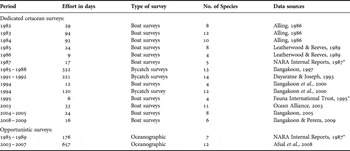
There are very few records on the occurrence of this species around Sri Lanka (N5°55′–9°50′ E79°42′–81°53′), an island in the northern Indian Ocean. Since the early 1980s there have been several dedicated cetacean surveys covering the coastal and offshore waters around most of the island (Table 1), excluding only the northern waters (Leatherwood et al., Reference Leatherwood, Peters, Santerre, Santerre and Clark1984; Alling, Reference Alling1986; Leatherwood & Reeves, Reference Leatherwood and Reeves1989; Ilangakoon, Reference Ilangakoon1997, Reference Ilangakoon2005; Ocean Alliance, 2003; Ilangakoon & Perera, Reference Ilangakoon and Perera2009). None of these surveys recorded any sightings of killer whales though cetacean diversity was generally high and all other related species commonly referred to as ‘blackfish’ were sighted (Leatherwood et al., Reference Leatherwood, Peters, Santerre, Santerre and Clark1984; Alling, Reference Alling1986; Leatherwood & Reeves, Reference Leatherwood and Reeves1989; Ilangakoon, Reference Ilangakoon1997, Reference Ilangakoon2005, Reference Ilangakoon2008; Ilangakoon, et al., Reference Ilangakoon, Ratnasooriya and Miththapala2000; Ocean Alliance, 2003; Broker & Ilangakoon, Reference Broker and Ilangakoon2008; Ilangakoon & Perera, Reference Ilangakoon and Perera2009). In addition to these dedicated cetacean surveys, opportunistic observations from oceanographic surveys off Sri Lanka and India in the past three decades have also not recorded killer whales in the waters around Sri Lanka (Ilangakoon, Reference Ilangakoon2002; Afsal et al., Reference Afsal, Yousuf, Anoop, Anoop, Kannan, Rajagopalan and Vivekanandan2008).
Summary of cetacean survey effort around Sri Lanka (1982–2009).

Note: sources marked with an * are unpublished internal reports of the relevant organizations.
Killer whale records for Sri Lanka have therefore been limited to two very old, unconfirmed sightings from the west coast in 1868 and 1872 respectively (de Silva, Reference De Silva1987), a few specimens in the fisheries bycatch on the west and south coasts (Leatherwood & Reeves, Reference Leatherwood and Reeves1989; Leatherwood et al., Reference Leatherwood, Prematunga, Girton, McBrearty, Ilangakoon, McDonald, Leatherwood and Donovan1991; Ilangakoon et al., Reference Ilangakoon, Subasinghe and Mahendra1992; Ilangakoon, Reference Ilangakoon2002) and anecdotal evidence from fishermen who reported seeing them 25 nautical miles (46.25 km) and further offshore (Leatherwood et al., Reference Leatherwood, Prematunga, Girton, McBrearty, Ilangakoon, McDonald, Leatherwood and Donovan1991). As a result, killer whales are considered to be rare in Sri Lanka's waters (Leatherwood & Reeves, Reference Leatherwood and Reeves1989; Ilangakoon, et al., Reference Ilangakoon, Subasinghe and Mahendra1992; Ilangakoon, Reference Ilangakoon2002).
In neighbouring India, a single sighting was recorded north-east of the Andaman Islands in the Bay of Bengal in 1983 (Leatherwood et al., Reference Leatherwood, Peters, Santerre, Santerre and Clark1984); two unconfirmed sightings have been reported in 1976 (near Madras) and 2000 (Lakshadweep islands); and a single stranding is reported from Armada in Barroda State in 1943 (Sathasivam, Reference Sathasivam2004). In the Maldive Islands located to the south-west of Sri Lanka, Anderson (Reference Anderson2005) reported nine killer whale sightings recorded in 535 days of survey effort over a 12 year period (1990–2002). While the species accounted for only 0.1% of relative abundance in that survey, he states that ‘killer whales are not especially common in the Maldives’ (Anderson, Reference Anderson2005).
RESULTS
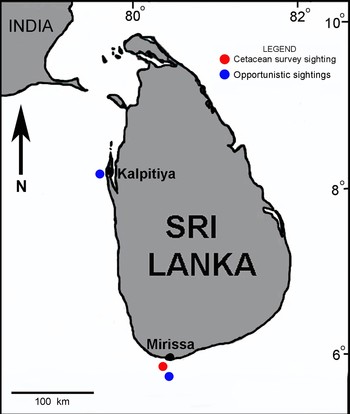
In the twelve-month period from March 2008 to February 2009, three new sightings of Orcinus orca were recorded off the coast of Sri Lanka. Of these, one sighting was off the north-west coast and two sightings were off the south coast of the island (Figure 1). While two of these were opportunistic observations by recreational boaters, one sighting was recorded during a dedicated cetacean research survey.
Location of Sri Lanka and recent Orcinus orca sightings. Note: the opportunistic sightings denoted by blue dots are not exact locations but estimated approximate locations based on distance.

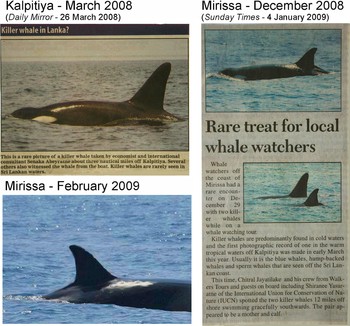
During a cetacean diversity survey off the south coast on 8 February 2009, a small pod of three killer whales was sighted in coastal waters at location N05° 53.060′ E080°26.704′, 6.4 km south-west of the fisheries port of Mirissa (Figure 1). One of these animals was an adult male, by the appearance of its diagnostically straight, high dorsal fin, while the other two appeared to be females. The sighting was brief, as the animals were moving rapidly away in a northerly direction at the time of sighting and therefore, could not be approached for a longer period. However, at first sighting the pod was only 150 m away from the survey vessel enabling a very clear view and positive identification (Figure 2).
Newspaper reports of recent killer whale sightings off Sri Lanka.

The opportunistic observations included a single animal seen and photographed off the north-west coast (15 March 2008) as well as two animals observed and photographed together (29 December 2008) off the south coast (Chitral Jayatilleke, personal communication). No exact location was available for either of these opportunistic sightings but both were within coastal waters. Both sightings along with corresponding photographs were reported in local newspapers soon after the sightings were made (Figure 2) because sightings of this species are not common in Sri Lanka and were therefore considered newsworthy. The newspaper account of the sighting off the north-west coast was reported as being approximately three nautical miles (5.5 km) offshore from the fisheries port of Kalpitiya and the sighting off the south coast as being 12 nautical miles (19.4 km) offshore from the fisheries port of Mirissa (Figure 1). Examination of photographs from both these observations left no doubt with regard to species identification on either sighting (Figure 2). The single animal in the north-west coast sighting was an adult male, while one of the two animals photographed off the south coast was an adult male and the other could have been a female or an immature male.
DISCUSSION
Before the recent sightings reported here, killer whales were not recorded in any of the dedicated cetacean surveys in Sri Lanka's waters during the past three decades. Accidental bycatch of cetaceans in fishing gear has also been extensively studied in Sri Lanka (Alling, Reference Alling1986; Ilangakoon, Reference Ilangakoon, Leatherwood and Reeves1989, Reference Ilangakoon1997; Dayaratne & Joseph, 1993, Ilangakoon et al., Reference Ilangakoon, Ratnasooriya and Miththapala2000) but only one confirmed specimen of this species was recorded during all these surveys (Ilangakoon et al., Reference Ilangakoon, Subasinghe and Mahendra1992). This paucity of documented killer whale sightings, strandings and fisheries bycatch in the available literature on cetaceans in Sri Lanka indicated that the species was not common in the waters around the island. Therefore, it is extremely interesting that three separate sightings occurred within a twelve-month period in 2008/2009 when none had been recorded before.
Two of the three recent sightings were from the same general area off the south coast and occurred within a two-month period (29 December 2008 and 12 February 2009). Both sightings included an adult male accompanied by one and two other animals in the two respective sightings. Therefore, it is not impossible that these two sightings consisted of the same pod of animals.
Generally, killer whales have a varied diet ranging from small schooling fish and squid to other marine mammals including large baleen and sperm whales, but certain pods are known to specialize on either mammals or fish (Reeves et al., Reference Reeves, Stewart, Clapham and Powell2002). During the research survey in February 2009, when the pod of three killer whales was observed, other cetaceans were also observed feeding in the waters off southern Sri Lanka (Ilangakoon, Reference Ilangakoon2009). Other species recorded on the same day and within a 10 km radius of the killer whale sighting include six schools of spinner dolphins (Stenella longirostris, Gray, 1828), one blue whale (Balaenoptera musculus, Linnaeus, 1758) and one Bryde's whale (Balaenoptera edeni, Anderson, 1879). All the schools of spinner dolphins and the blue whale observed were engaged in feeding, indicating the general productivity of the area at the time. This area is known for local upwelling (Vinayachandran et al., Reference Vinayachandran, Chauhan, Mohan and Nayak2004) and it is very likely that the resultant food abundance was the reason for the concentration of these cetaceans in the coastal waters off southern Sri Lanka. Killer whales, with their varied diet will not lack for feeding opportunities in these waters, especially if they are of the fish eating type. The propensity of killer whales taking advantage of local upwellings to feed on a wide variety of prey in coastal waters has been reported before off Brazil in the Atlantic Ocean (Siciliano et al., Reference Siciliano, Lailson-Brito and Azevedo1999; Santos & da Silva, Reference Santos and da Silva2009).
Based on these recent sightings, we conclude that it is important to continue monitoring killer whale sightings in Sri Lanka's coastal waters, to determine if occurrence of this species is increasing over time in this area. These sightings raise questions about whether there has been a recent invasion of this species into waters where they have not been sighted before. While this possibility needs further examination, it is also useful to photograph animals whenever possible in order to determine if there are re-sightings of any distinctive individuals over time. It is only with more monitoring and long-term data sets that the patterns of killer whale occurrence and distribution in the northern Indian Ocean waters around Sri Lanka can be discerned.
ACKNOWLEDGEMENTS
The Whale and Dolphin Conservation Society, UK, is gratefully acknowledged for funding the cetacean survey off southern Sri Lanka. We thank Chitral Jayatilleke for sharing information and photographs on the opportunistic sighting in December 2008.