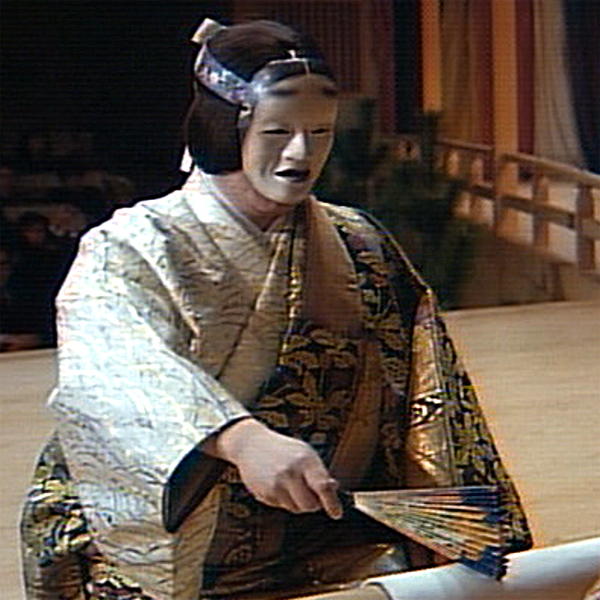
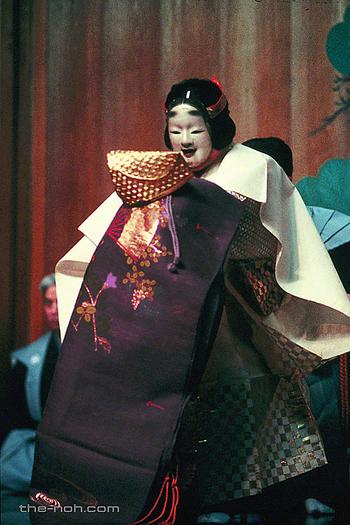
Nageki wabi sora ni midaruru wagatama wo
musubitodome yo shitagahe no tsuma
[Bind it down for me! My strewn soul: wailing, wounded, rambles ragged skies. Knot this robe-skirt's inside hem—slit like a flung-aside wife.]
—The Tale of Genji Footnote 1How should we understand the role robes play within noh dance-drama's enactments of femininity? In the above poem Genji's jilted lover, Rokujō, bemoans her inability to keep her vengeful spirit from besieging the Lady Aoi, for whom Genji has spurned her. Within the worldview of Murasaki Shikibu's early eleventh-century narrative, to bind the hem was to tether the restless spirit to its host's body, like a tourniquet stanching spectral energies from seeping to infect victims.Footnote 2 The famous noh play Aoi no Ue (Lady Aoi), in which Aoi is played not by an actor but by a short-sleeved robe (kosode), activates the poem's metaphor onstage. Moreover, the Japanese poem's final term, tsuma, signifies both as “robe hem” and “wife,” foregrounding a gendered dimension sutured to problematic notions of feminine deportment and mobility whose dramatic manifestations merit exploration.Footnote 3
Here I examine noh plays whose use of robes as props and tropes intertwines with enactments of internal or interpersonal conflict along gendered lines.Footnote 4 I am interested in how robes work within noh narratives to present specific ideas of femininity. The significance of robes in noh dance-drama cannot be overstated. Given this theatre form's sparse, nonrealistic staging, robes command massive thematic significance and theatric attention. Noh robes serve as transformative vehicles that can trigger metaphysical transcendence even as they encumber motion, binding the actor's body. Importantly, however, although noh spotlights this dramatic tension between bound and unbound spatial and emotional states as being especially feminine, it is not only feminine. Noh subjectivities routinely traverse boundaries of individual bodies and personalities—across status, gender, and even species lines. This can occur both through a narrative voice that shuttles from the chorus to actors, and between characters. Thus these issues of costuming are by no means solely about gender; rather, gender represents only one, albeit significant facet of a vaster analytical spectrum. Within that broader spectrum, I narrow my focus on noh robes to delineate how femininity, mobility, and embodiment intersect, spotlighting instances where robes assume the status of a surrogate body. My goal is to theorize gender performance in this Japanese dramatic context through the notion of “frayed fabrication.”
I use the term “fabrication” to highlight two related aspects of noh performance. The first involves the gap between the body of the male actor and that of the female character he plays. Although noh’s historical formation relied on key contributions by female performers, such as kusemai (warped dance) and shirabyōshi (white rhythm) dancers, the art's official form has been all-male for centuries, with the more recent modern exception of some female practitioners.Footnote 5 Thus men perform female roles, fabricating impressions of femininity unaligned with their own sex. Fabrication in this sense refers to the performance of an archetypal femininity by men, according to noh’s theatric conventions. The second aspect to stress is the centrality of costuming in these men's performance of female roles. Here I underscore the “fabric” in “fabrication,” since robes play such substantial roles in materializing male actors’ renditions of women.
I situate my discussion of medieval Japanese drama within the broader scholarly discourses of critical costume studies and mobility studies. These discourses offer helpful frameworks for theorizing noh robe usage, even as noh’s conventions of costuming and movement can pose productive challenges to these accounts. Beginning with costume studies, Rachel Hann and Sidsel Bech write, “A critical discourse of costume aims to promote new questions and scholarship on the intersections between body, design and performance.”Footnote 6 Beyond promoting new inquiry in this vein, my analysis aims to reorient and supplement Eurocentric studies of costuming and common assumptions of verisimilitude in staging and representation. In the absence of realistic acting or set design, costumes in noh occupy a far greater proportion of visual interest and symbolic import in comparison to those in traditional Western stage drama, an effect reminiscent of what Aoife Monks describes as the “kaleidoscop[ic]” effect of perceiving costume as prop, set design, and pleasurable spectacle.Footnote 7 The interactions we witness in plays involving spirit possession, like Lady Aoi and Pining Wind, echo Monks's assertions that “costume is a body that can be taken off” and “does not remain stable or fully knowable.”Footnote 8 Helpfully, in proposing that we look at costume as costume, and not just as an impediment to the interpretive piercing of surface layers to a deeper kernel of truth, Monks's more expansive notion of costuming carries epistemological consequences for a more malleable, mobility-oriented framework.
Furthermore, these dramas demonstrate that costume should be reconceived more as a vehicle for symbolic transit and metaphysical transformation than mere clothing. For instance, noh robes’ use as currency, both onstage in plays like The Feather Mantle and off, adds another facet to the ensemble of embodied practices observed in other dramatic traditions. My turn to critical costume studies therefore stems from an interest in what Dorita Hannah and Sven Mehzoud pose as “how design elements not only actively extend the performing body, but also perform without and in spite of the human body.”Footnote 9 By linking this emphasis on the relative autonomy and performativity of costume to mobility studies scholarship, I hope to outline new avenues for engaging critically with robes to enhance our understanding of how gender and movement intersect in less Eurocentric contexts.
Before any gendered considerations enter the picture, the fabric of noh costumes makes an actor's body “stage-ready,” primarily, rather than rendering it particularly masculine or feminine. Both male and female costumes are spectacular, and a considerable degree of gender fluidity exists within the plays and their Ur-texts, as we see in plays like Izutsu (The Well Cradle) and Matsukaze (Pining Wind), wherein female protagonists assume aspects of their male lovers’ personality and clothing. Pragmatically, these costumes conceal the male body to reshape its contours toward a more stylized feminine ideal, marshaling silk to smooth away angles like a plump girl's mask might a grown man's rigid chin and cheekbones. That said, this concealment can ever be only partial, and given the visibility of modern male actors’ facial skin protruding along the bottom edge of the mask, especially, it seems fairer to suggest not outright disguise but rather a signifying of femininity without wholly obscuring the male actor.
As for this fabrication's “frayed” character, beyond the sartorial metaphor I want to foreground a recurring motif in noh portrayals of women: namely, their predominant depiction as bewitchingly unhinged, swaying on the fringe of unraveling. Part of my argument concerns the dramaturgical theories of Zeami Motokiyo (1363–1443). While Zeami could also feature the distress of male characters in his plays, I contend that his investment in feminine madness as a conduit for unparalleled artistic accomplishment make this frayed quality vital to women's characterization in noh. It appears that female roles exploit this potential disintegration to greater dramatic effect. Yet at the same time, I invoke this notion of feminine fraying to connect the emphases of critical costume studies and mobility studies. For Tim Cresswell, “mobility is more than about just getting from A to B. It is about the contested worlds of meaning and power. It is about mobilities rubbing up against each other and causing friction.”Footnote 10 Accordingly, noh’s robe usage registers this friction, dragging gendered and status-based contestations for dominance into stark relief through portrayals of frayed femininity.
The next part of the argument weaves that discussion of aestheticized derangement into how robes function dramatically. Concerns central to critical costume studies and recent work in mobility studies meet at this juncture. Specifically, I demonstrate how the always already disturbed, disaffected female character routinely requires recourse to robes to resolve her drama's driving conflict. This often involves approaching the robe as a rival's or lover's surrogate body. Hence mobility becomes a pivotal concept: both physical mobility and a more affective notion of mobility surrounding how to move audiences with precise theatric techniques. In this vein, my work on noh also draws from and contributes to “new mobilities” scholarship. As Cresswell notes, we should remain aware of the “historical conditions that produce specific forms of movement, which are radically different.”Footnote 11 Gender, status, and the historical realities of systemic economic dispossession frame how noh’s female figures’ capacities for movement were imagined onstage. In this context of medieval Japanese drama, supernatural female figures, such as the celestial maiden, possessing spirit, and aggrieved ghosts, introduce protagonists less visible within Eurocentric theatre histories. These figures’ ability to emerge liminally between material and immaterial realms takes shape through recourse to distinctive styles of robe usage. In short, robe usage in noh frequently foregrounds an underlying logic of feminine deficiency and compromised mobility whose tensions are poignantly exploited onstage.
In this vein, analyzing how costuming functions in medieval noh drama can help “extend existing discourses of mobility,” in Fiona Wilkie's words.Footnote 12 In keeping with John Urry's notion of multiple, differently privileged mobilities,Footnote 13 I would also stress noh dance-drama's investment in contested feminine mobilities as a vital trope. To dramatize feminine mobility in noh is most often also to depict the confrontations with spiritual, social, and physical impediments that attend such motion. Therefore, in accordance with Cresswell's reminder that opposing models of sedentarist and nomadic metaphysics might ignore “the ideological nature of the meanings they ascribe to mobility,”Footnote 14 I would like to consider the use of robes in noh plays in terms of their role within mobile practices that can intersect yet exceed those models. Specifically, each female protagonist's particular plight highlights the limitations of both the sedentarist and nomadic paradigm. Insofar as these female figures remain both conspicuously mobile yet bound to a precise site by resentment or lust, their fraught mobilities trouble notions of either utter freedom or fixity.
In all four of the plays discussed below, tensions around social rootedness of the sort Urry interrogates are thematized onstage through conflicts involving robes as emotional or physical anchors to a site. However, these conflicts also dramatize situations such as spirit possession, in which women normally bound socially to certain circumscribed locations or social roles can move otherwise. For example, in the case of Lady Aoi we observe how its robe usage spans Urry's paradigmatic five mobilities: corporeal travel of people; the movement of objects; imaginative travel; virtual travel; and communications.Footnote 15 Moreover, through oscillations between unfettered movement across bodies and metaphysical planes, on the one hand, and corporeal arrest within patriarchal systems, on the other, these figures foreground the complex convergence of multiple mobilities. It is precisely this capacity to traverse and transgress spaces that necessitates multiple styles of robe use onstage, recruiting unconventional theatric techniques that attest to the disparate meanings and interwoven forces that infuse these fabrics’ deployment to move medieval and modern audiences.
In Cresswell's assessment, “Mobility seems self-evidently central to Western modernity.”Footnote 16 But gender also conditions this capacity for social movement. As Mimi Sheller explains, “Modernity, progress, and privileged forms of masculinity have long been associated in Western thought with mobility, while immobility, stasis and sedentary states have been attributed to ‘backward’ societies of so-called Oriental despotism, Eastern serfdom and Medieval feudalism.”Footnote 17 I offer these readings of noh robe usage in contrast to Cresswell and Sheller's analyses of Western modernity, so as to complicate our understandings of the relative immobility ascribed to European feudal society. As a counterpoint to these contexts, noh drama becomes a venue within which to explore enactments of feminine mobility situated beyond the purview of working assumptions that have characterized the mobility turn as tethered to Western modernity. By surveying how robes are deployed in these plays, as both literary motifs and performative implements, my discussion of noh robe usage aims to extend ongoing conversations within theatre history by drawing on untapped and undertheorized resources from medieval Japanese performance.
Robes and Noh Theory's Framing of Feminine Performance
The foundational writings of medieval actor, playwright, and theorist Zeami constitute a touchstone for understanding noh’s history and theatrical conventions. Regarding women's roles, Zeami distinguishes between the performance guidelines for male and female characters in terms of the emphasis placed on imitative gesture versus costume. For women's roles, the costume is of utmost importance:
Now, to start with, a woman's look is something well-suited to a young actor's training efforts. That said, it is the most demanding endeavor.
First, if the costuming is unsightly, then nothing deserves watching. Since we don't have a chance to observe closely the deportment of empresses, consorts, and the like, impersonating them requires making subtle inquiries. How they wear their robes and trousers is not some matter of your own personal preference. You'd better investigate. The way run-of-the-mill women of basic means look should be quite straightforward, since you're able to watch them anytime. For such a woman, going as far as a general semblance of how she sports her robes and short-sleeve gowns should suffice. Regarding the appearance of a dancer, shirabyōshi, or a madwoman, she should grasp a fan or decorative sprig with the barest possible force, holding it with an unsure grip. She should wear her robes and trousers very long, long enough to step on, with hips and knees straight and a gentle posture. As for how to hold the face: it will look ugly if she tilts her gaze upward; if she looks downward, then the view from behind will suffer. Plus, if she holds her head up straight, stiff-necked, she won't resemble a woman. Regardless of the situation, she should wear something with long sleeves and not show the tips of her hands at all. Her sash should be loosely tied.
Thus, in the end, a deep consideration of costuming entails the successful display of the full visual effect. Although it's surely the case that any type of dramatic imitation can't go well with bad costuming, this is especially true for a woman's appearance. You must make the way she's dressed the foundation of everything.Footnote 18
Although Zeami does not give his reasons for why a young actor should perform a woman's role, his preference is likely based upon an idea that younger actors are more naturally attractive than older ones, and that this physical appeal is an important feature of the female role.Footnote 19 This could involve softer features, should the younger actor perform unmasked, or with their having a slighter, more supple frame before full-blown manhood. However, whatever the actor's physical appeal, it can't rescue shoddy costuming. Certain handheld props and a loosened waistband assemble an image of “female gentleness” otherwise unattainable without such supplements.Footnote 20 Zeami's mention of the sprig or fan's feminizing function suggests that such props sand the coarsest corners of the madwoman's derangement, enhancing outward poeticism.
Similarly, the actor's costume might mitigate exposure of unseemly attributes of his body by enfolding them with patterns that code toward the perceived feminine.Footnote 21 The long sleeves advocated could conceal unsavory male hands, and the trailing trousers would temper a masculine gait. The loose sash suggests some sensuality, but also avoids the tight fit that would accentuate the male actor's broader shoulders and narrower hips. Likewise, Zeami's persnickety head positioning tips maximize a beautiful visage from all audience angles. But they also preempt protrusions of an errant Adam's apple, which would rupture any ladylike illusions. Tellingly, Zeami prizes mimetic accuracy when it comes to elite women: Do your homework for the highborn ladies, but feel free to fudge it for the peasants. Given the outcast status of performers at this time, Zeami betrays here an aspirational concern for appeasing potential patrons so as to lift himself and his troupe out of poverty and redress the ingrained stigma socially abject entertainers had to shoulder. Hence the floral sprig reads partly as a talisman to deflect prejudice, even as the prosthesis lengthens the arm to magnify visual interest with color and an enhanced gestural sweep.
Yet we mustn't forget Zeami's opening admission: that performing female roles as a man is “the most demanding endeavor.” Indeed, this difficulty becomes the basis for Zeami's conceptualization of noh’s highest levels of achievement, as evidenced by the “old-woman plays” (rōjomono), in particular, being designated the pinnacle of noh performance in terms of their capacity to actuate the master actor's full potential.Footnote 22 While there is more to consider regarding how aging adds layers of emotional and physical complexity to the noh actor's inflections of femininity, suffice it to say that enacting female decrepitude furnishes a rich acting palette that allowed performers, in Edward Drott's words, to “harness the otherworldly charisma” of such characters.Footnote 23 This is due largely to its combination of the best features of Zeami's cherished Woman's Mode and Aged Mode of dramatic imitation (monomane).
We might note that noh favors frayed characters as particularly ripe for dramatization—regardless of age or gender. Moreover, my own selection of examples arguably only stresses this basic tendency further. These details demonstrate that the frayed disposition I highlight does not equate to some inherent femininity or define it in any total way. At the same time, however, given Zeami's remarks on playing female characters—be they elderly or deranged—his view seems to skew toward a less expansive notion of femininity. Zeami's preference appears to be for femininity to be portrayed as somehow frayed: both legible enough for medieval audiences inclined to comprehend femininity in terms of deficiency or distress, and malleable enough for male performers to inhabit female protagonists as vehicles for achieving acting mastery. Thus, in describing the Woman's Mode and the Woman's Dance in Figure Drawings of the Two Arts and the Three Modes (1421), Zeami explains, “The most difficult elements of dramatic imitation are here…. I'll say it again and again: don't forget the body”; and “the Woman's Mode should be considered the greatest achievement.”Footnote 24 Not to forget the body entails an actor keeping cognizant of his posture and, more precisely, mindfully dialing back the customary degree of force in his gestures, so as not unwittingly to admit undue strength into the woman's portrayal—without diluting it completely. Questions of misogyny or reductive female depictions notwithstanding, such an admonition always to remember the body implies an insufficiency present at the core of dramatic imitation, one operative within the naturalized femininities whose incomplete character must be perpetually redressed through performance.
Zeami revisits the topic later in Pick Up a Jewel and Take the Flower in Hand (1428), indicating this predicament's persistence:
It is all too easy to misconstrue this and to assume that all you need to do to be a woman is put on a pretty appearance. Thus, when it is time to assume a role in the Woman's Mode, you fail to take “intent as Substance, cast[ing] force aside” and move directly into the mimicry of a woman, even while remaining in the physical state that takes “force as Substance, mak[ing] the intent intricate”; in such a situation, the object of dramatic imitation withers away, indeterminate, resulting in a manner of expression of no genuine substance…. That's why it is so extraordinarily difficult to assume the role of a woman when you have the body of a man.Footnote 25
Clearly, copious calibration is required to enact womanhood convincingly. Casting force aside entails lessening tension in the actor's body and infusing his physicality (i.e., “Substance”) with emotional intent apropos of the female role. Note that “mov[ing] directly into mimicry of a woman” falls through. Instead, such a role must be apprehended more thoughtfully slantwise than other types, with the actor bearing feminine lightness distinctly in mind. Neglecting this delicate equilibrium produces an unconvincingly rough-hewn performance, likely tinged with inklings of the Martial Mode, whose less subtle warrior roles inexperienced actors could hack more comfortably. Here I would emphasize the indirectness Zeami advocates alongside his earlier comments about the female character's robe. In light of these later comments, that loose sash, especially, now seems substantial—not simply as a costume, but rather as an extension of the actor's body designed to exude something of the gentle aura the actor envisions internally. If the robe strikes the audience as being merely a garment concealing a male body and not indissoluble from a holistic performance of femininity, then the actor has failed: his robe must meld with his embodied persona so as to tame its artifice. In this regard, how the garment moves determines how convincingly the actor effects his mobility across gender lines before an audience.
Although much has been written about the importance of noh masks, robes possess immense potency in selling the character.Footnote 26 Characters’ costumes refine further the protagonists’ personae by elaborating upon the basic identity assigned by the mask. On this point, we should recognize the multiplicity of feminine identities enacted in noh: grieving mother, poetess, itinerant performer, madwoman, prostitute, bodhisattva, demoness, salt burner, dishonored noblewoman, celestial goddess, shrine deity, aging beauty, shamaness, innkeeper, jealous wife, mountain crone, and so on.Footnote 27 These characters comprise noh’s repertory of gender performance.
The notions of femininity and masculinity that constitute dramatic and societal personae are quoted, exceeded, and potentially remade with every costumed gesture. A robe worn on the noh stage signifies on several levels, as a kind of tacit, scintillating code. The color and pattern of the robe, along with the design motifs marking it, may signify various aspects of a character's personality, class, geographic origin, religious status, gender, species, supernatural abilities, or themes of the play as a whole.Footnote 28 As Monica Bethe and Karen Brazell explain:
The costume helps to establish the nature of the character being portrayed. The cut and type of weave help indicate sex, profession, and status. Each major role type has its own assemblage of garments: aristocratic warriors wear one type of costume, lowly villagers another. Refinements or adjustments within the general type are made for each play; the colors and designs suggest age and mood—a young woman has red in her costume and a vigorous character wears garments with bold designs. Within the limitations of the prescribed types and the number of different garments actually available to him, the actor selects the costume which best represents his interpretation of the play. The same combination of garments is rarely used twice; the visual impact of a well-chosen costume brings freshness to a performance.Footnote 29
Like physical gestures, robes also “exaggerate the body, extending it into space, breaking through the mute boundaries of the skin to create a deformed image of the self in a social relationship,” in Aaron Betsky's words.Footnote 30 This phenomenon flares with warriors or demons, whose splayed stances and canted torsos broaden their dimensionality, especially when magnified further by stiff planes of fabric jutting like samurai armor or a crustacean's carapace. Costumes in this style aim to make the actor occupy more stage space, scaffolding his formidable presence. At another end of the spectrum, less audacious styles also exist for signifying humbler characters’ capacity to move and work. For example, the outer robe sleeve that is bent down and tied to expose the woman's under-robe denotes that the wearer is not as restrained as other, fuller dressed females: “The right sleeve of the outer robe is slipped off and draped down the back. This indicates active movement and often symbolizes that the woman is mad.”Footnote 31 This style is called nugi-sage (“doffed and draped”). Unbridled by the mores that bind higher women's behavior, baseborn female performers wander the provinces, often as prostitutes, their theatric skill and conspicuous attire granting them a mobility withheld from more staid counterparts.
This style of wearing a robe has been tailored to fit other women's roles as well, such as the female characters of Hanjo (Lady Han), Hanagatami (The Flower Basket), and Semimaru (Semimaru), and can denote physical labor, emotional anguish, or madness. But the practicality of this alteration of a female character's clothing moreover symbolizes an extended mobility. To be sure, as Janet Goodwin notes, this mobility can carry erotic connotations, specifically when women such as performing courtesans (asobi) circulate sexually throughout the land.Footnote 32 This style, for all the freedom it grants, also makes the female character's “body”—abstracted though it is—more visible as well. Take, for example, the boat pilot in Eguchi (one of the attendants to the shite, or main actor), whose sleeve is loosened to steer; she links the clothing's alteration to transportation as she and her accomplices trawl the coast for clients.
Other female characters, such as the protagonists of Sumidagawa (The Sumida River) and Hyakuman (Million), signify heightened degrees of mobility differently. Both of these women are “madwomen” (monogurui). As Royall Tyler notes, in the fifteenth century “the ravings of the mad were scarcely distinguished from the antics of entertainers, and monogurui often are entertainers. It was Zeami (according to Yamanaka Reiko) who gave his monogurui such depth that the pretext of their being entertainers dropped away. They became simply women in acute distress.”Footnote 33 These women traveled the provinces and signified their skewed mentality with a sacred sakaki branch in one hand, which by extension indexes the widened range of geographic movement female madness enabled. Princess Sakagami, Semimaru's unhinged sister, wields such a prop—with her right sleeve tucked back. Elsewhere, the removal or donning of a robe onstage denotes more volatile motion between bodies and across planes of existence, usually prompted by erotic fixations. Examples of this movement emerge in the plays Hagoromo (The Feather Mantle), Aoi no Ue (Lady Aoi), Kinuta (The Fulling Block), and Matsukaze (Pining Wind).
Robe as Ransom and Conveyance in The Feather Mantle
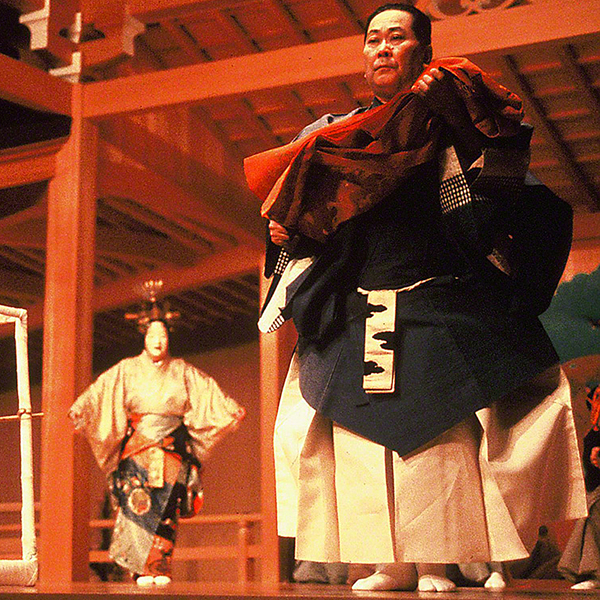
In The Feather Mantle, a celestial maiden descends to earth and leaves her feather cloak unattended on the shore, where Hakuryō, a mean-spirited fisherman, discovers it. He demands she dance for him to earn it back, which she eventually does, before reascending to the heavens. Here the robe becomes a symbol of unearthly splendor and feminine grace, but also functions as the priceless plot element upon which the drama hangs. When the fisherman refuses to cooperate (Fig. 1), the Angel exclaims, “Oh no! Without my feather mantle, the pathways of flight are closed to me. Never again will I return to Heaven! Please, please give it back!” (rt102). The fisherman covets the robe, resolving to “make it a treasure of the realm…. Rather than heed her plea” (rt102). The exquisite robe permits movement between realms, even as it highlights the social and ontological chasms separating Angel and rustic. The fisherman's poverty and boorish nature explain his insensitivity to the Angel's plight. However, the gendered slant of his cruelty stands out.
Fisherman Hakuryō (Kaburaki Mineo) withholds robe from Angel in The Feather Mantle. Photo: © Toshiro Morita, provided by “the-noh.com” site (www.the-noh.com).

Social status’ importance notwithstanding, The Feather Mantle presents a paradigmatic case of women's mobility being dependent upon men's whims. This plays out on two levels. First, the fisherman prohibits the Angel from traveling home, relishing being able to level his sanction incontestably. She must stay exposed before his eyes, weeping and beginning to decay as she languishes among mortals:
Angel: … in distress she cries,
Hakuryō: and when Hakuryō withholds the mantle,
Angel: helpless,
Hakuryō: hopeless,
Chorus: the dewdrop tears fall;
her jewelled crown, the flowers in her hair,
wilt and droop:
the five signs of an angel's decline
are plain to see, heart-breaking. (rt103)
By denying the Angel her robe, the fisherman sentences her to an immobility equivalent to death. Staging Hagoromo involves a “cubical bamboo frame, placed at center front, with a diagonal crossbar supporting a fresh-cut pine branch on which a chōken [a gossamer, loose outer robe] representing the feather mantle is draped.”Footnote 34 This style of robe is voluminous, with its double-width sleeves, open cuffs, and tassel cords. The play's climax occurs when the fisherman, having hoarded the billowy robe in his arms, finally relents, passing it to the Angel so that the stage attendant may dress her in it for the felicitous farewell dance.Footnote 35
Although he experiences a humanizing change of heart by ultimately ceding the garment, preceding this transition the fisherman exploits his leverage through the robe in an inflated display of masculine advantage. Worth considering in this regard is the historical custom of cloistering high-ranking women from the Heian period (794–1185) onward, which involved aristocratic women being hidden behind multiple walls, blinds, screens, and even robes, manifested in the iconic convention of “twelve-layer” robes (jūnihitoe). These mediating materials buffered figures like court ladies from men's visual access, with less visibility generally denoting more authority. Hakuryō’s retention of the robe thus reads as a refusal to respect those protective concealments. At another level, to withhold the robe is to deny the female deity's divinity and enforce upon her a vulgarity that lifts the mundane man's standing. That his own capacity for social mobility is so limited only makes stealing the robe more desirable; caressing it is as close as he'll ever come to escaping an inferior station. Hence he must withhold the robe to replicate in the Angel some gratifying rendition of his own socioeconomic debility.
This subordination has an additional aspect, which involves Hakuryō bending the Angel to his will: forcing her to dance to earn back her robe. This trope of dramatic transactions in which performances serve as currency recurs throughout noh plays, predominantly requiring the female character to dance for men's favor, often to gain access to spaces from which women have been barred.Footnote 36 In Hagoromo the fisherman ransoms the robe, in echo of the medieval milieu in which actors would be rewarded with robes and bolts of silk as payment for stunning performances.Footnote 37 As Sharon Takeda explains, “Since this established mid-Muromachi-period [1392–1568] etiquette dictated that actors immediately employ gifts of clothing onstage, it is reasonable to assume that the offerings may have included not only fashionable attire as spontaneously presented in earlier times, but also expensive clothing consciously made with the notion that it would be worn on stage, to the delight and satisfaction of the patron.”Footnote 38
This historical practice of tribute established a template for conferring recompense through performing subservience. Prompt, grateful recognition of the clothing gifts demanded an anxious urgency of the performer's movements, as they strived to convey shiny delight and reverence simultaneously. As the robe changes hands, the performers’ instant enactment of gratitude congeals their indenture to the avid patron. Hagoromo’s conflict quotes this context of lopsided reciprocity insofar as it features the fisherman citing dominative protocols far above his pay grade. Bestowing the robe for the instant gratification of savoring a dance performed in the gifted garment allows Hakuryō to mime a dominative relation otherwise unavailable to him. Seizing the robe lets him concretize a fantasy. As long as he clings to the peerless garment, he can subordinate the fallen Angel, acting as though she were his beholden dancer and he her charitable samurai lord. Even after relinquishing the mantle he can continue, unpunished, to savor the spectacle of the Angel's dance of gratitude, performed in her restored regalia.
Within this play's profane earthly setting Hakuryō demands payment in graceful feminine dance. This precondition authorizes the celestial maiden's journey skyward. Male control over female mobility thus spans mundane and celestial realms. By withholding the robe and making the Angel dance, the fisherman holds sway over a miraculous feminine mobility he could never embody otherwise. His ransoming of the feather mantle fabricates a sovereignty that lends provisional reprieve from social impotence. In this manner, The Feather Mantle connects questions of exploitation tied to gender and to status, as it relates to figures like the lowly fisherman—or to the all-male acting troupes who, like the female Angel, had to perform their subordination at the whim of more powerful men.
Invading Proxy Bodies: Lady Aoi’s Exorcism
Entering an eerier setting, the style in which a robe is worn can also symbolize spirit possession. The play Lady Aoi is famous for representing the eponymous character as a short-sleeve kosode robe neatly folded flat and placed centrally downstage. Its color is often white or reddish orange, with a conspicuously unelaborate pattern. Drawn from the pages of the eleventh-century fictional masterwork The Tale of Genji, Aoi lies on her deathbed, afflicted by the spirit of her husband's mistress, the widowed crown princess Rokujō, who is jealous of Aoi's pregnancy by Genji. In Lady Aoi, the robe used to symbolize Aoi epitomizes her inert body and nullified subjectivity. Aoi is simultaneously present and absent, becoming a phantom participant in the unfolding drama: no moving human body enacts her, but the robe acts a residual evocation of frail female physicality susceptible to performers’ manipulation. Hence the robe becomes a foil, letting other actors take center stage in their wielding of it—as an object of contempt or of compassion.
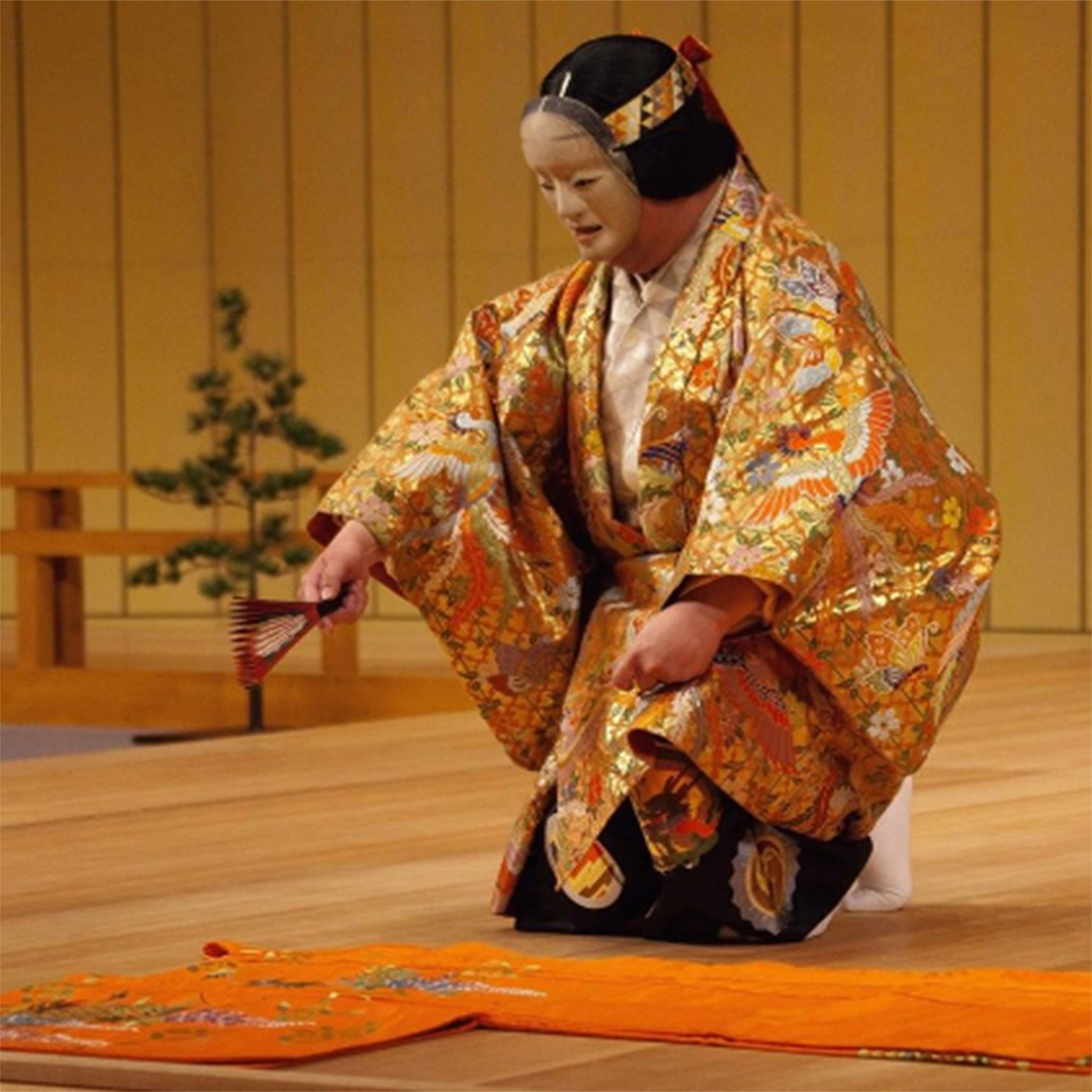
The living spirit of Rokujō laments her uncontrollable resentment toward Aoi, cutting glances at her limp form and eventually kneeling to mime striking it with her fan (Fig. 2), staging the Genji Ur-text's depiction: “The malign spirit was more insistent, and Aoi was in great distress…. More than once [Rokujō] had the same dream: in the beautifully appointed apartments of a lady who seemed to be a rival she would push and shake the lady, and flail at her blindly and savagely.”Footnote 39 Lady Aoi adds flesh, bone, and fabric to the violent fantasy: “I must strike her now. So saying, I walk towards the pillow of Lady Aoi and strike her.”Footnote 40 To absent an actor's body as the recipient of this beating ensures we concentrate on Rokujō’s gestures as manifestations of internal torment, in lieu of sympathizing with the battered fabric victim.
Rokujō (Katayama Shingo) hitting Aoi, signified by a robe in Lady Aoi. Photo: Courtesy of Katayama Shingo, Kashu-juku Noh Theater.

Although Lady Aoi revises the Genji narrative—which killed Aoi—to end the play instead with Rokujō’s enlightened expulsion, we might nonetheless understand the noblewoman's wrath in less two-dimensional, often misogynistic terms than those imposed by medieval playwrights. Rokujō’s vengeful movement, for all the thrilling havoc it causes, could be dismissed as a clichéd jealousy. Yet it might instead be interpreted as the attempt of a woman—here, one who had lost her authority when her crown prince-husband died—to assert herself within the restrictive patriarchal setting of aristocratic society. Such a reading has the benefit of opening the play to a fuller contextualization of the conflict's history and a more complex theorization of female action. Even without aiming somehow to restore to Lady Aoi aspects of the original Genji text's complexity, this interpretive gesture expands our sense of Zeami's rendition of femininity.
For example, advancing a feminist reading, Doris Bargen deems spirit possession an “oblique aggressive strategy” that, rather than being a random affliction, instead signifies women's deliberate, evasive, empowerment: “[We can] interpret spirit possession as a predominantly female strategy adopted to counter male strategies of empowerment such as incestuous transgressions and kaimami [peeping], a custom that inspired Heian noblemen not only to compose poetry but to take physical possession of the glimpsed woman.”Footnote 41 Hence spirit possession allows women surreptitious opportunities to vent grievance, prowling below the radar of patriarchal surveillance to an extent foreclosed in court life's official channels. In Lady Aoi, spirit possession's terrifying mobility succeeds in curtailing the roving courtier's behavior; for in caring for the bedridden Aoi and worrying over Rokujō’s role in this possession, the wanton Genji “had been persuaded to stop his nocturnal wanderings.”Footnote 42
Understanding better the stakes of this male immobility and the mercurial female spirit imposing it requires that we extend a feminist reading to include the broader workings of medieval Japanese patriarchies. After all, possessions never happen in a vacuum. For example, Wakita Haruko explains that “society was moving toward patriarchal domination in the seventh century” and that by the late medieval period women “had lost inheritance rights and were only esteemed for their motherhood,” as part of a centuries-long process of patriarchal consolidation that evolved during the era of Genji's composition.Footnote 43 Similarly, Steven Brown comments that “[Rokujō] is not so much a jealous monster in the Shakespearean mode … as she is a malevolent spirit avenging the sociopolitical injustices she has suffered at the hands of Aoi, Genji, and opposing political factions at court…. Rokujō desires both to avenge and to repossess that of which she has been dispossessed.”Footnote 44 Spirit possession thus redresses socioeconomic dispossession, felt acutely by Lady Rokujō following her fall from the highest echelon of aristocratic society once her husband died. This displacement from her perceived rightful status sets the stage for a spiritual displacement designed to right the injustice suffered, enacted through the inventive deployment of robe props.
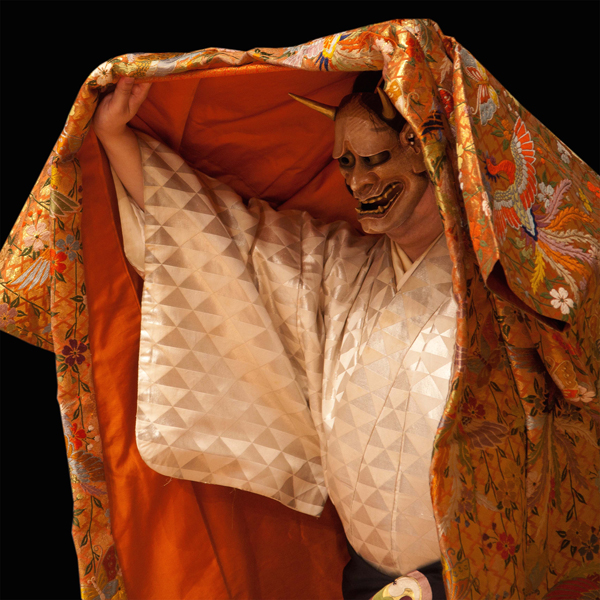
Lady Aoi provides perhaps the starkest example of the noh robe being used as a proxy body. Among the various plays involving spirit possessions or exorcisms, Lady Aoi stands out for the way its robe usage illustrates so literally the drama of possession as a contestation over bodily territory. Another form of mobility unfolds when the divide between bodies is crossed. Rokujō reemerges in the second half of the play as a full-fledged demon, her ability to possess another female body effected dramatically by her skulking about the stage with a completely untied robe draped above the actor's head (Fig. 3). This robe is a karaori: “lavishly brocaded with feminine designs, the karaori is a [short-sleeve robe]-style government worn as a main garment, an overgarment, or an undergarment, usually by women, occasionally by men or sprites…. Flowers predominate.”Footnote 45 When Rokujō first appeared earlier in the play she was wearing this robe, whose sumptuous layers evoke the Heian era in which Genji was written and during which karaori (lit.: “Chinese weave”) became popular among elites. But the robe hem mentioned in the epigraph's poem comes irreparably unbound. Now the outer karaori robe, akin to an aristocratic feminine casing, peels off as Rokujō’s conventional, inscribed social body shrivels to unveil darker strains of womanhood. Anguish has cleaved her skin from her soul. Hence she carries her own stripped surrogate body above her like a tarp, inhabiting it only provisionally as a wilted remnant of her tattered life.
Demoness Rokujō (Katayama Shingo) skulking under a robe in Lady Aoi. Photo: Courtesy of Katayama Shingo, Kashu-juku Noh Theater.

To be sure, there are other ways to read the robe usage in this scene, especially if considered retrospectively from the perspective of early modern woodblock prints that show women traveling with covered heads to shelter themselves from the elements. But historically these depictions materialize much later than the noh play, which centers squarely on the struggle with hatred and indignity. Indeed, soon after her entrance, Rokujō says, “Ah, how shameful that even now / The eyes of others I should shun / As on that festive day.”Footnote 46 Symbolically this act of covering herself dilates the earlier weeping that accompanied Rokujō’s declarations of shame at having sunk so low. Before we saw a rigid palm raised to the eyes in the mildly abstracted shiori weeping gesture; now the character braces both arms overhead, erecting a private canopy with the robe to obscure her entire head and torso. Whatever chagrin previously took hold now mutates into a mounting humiliation that appropriates more of the performer's body to express it, even as the canopy sags a bit with each step, signaling an impending failure to stanch shame's overflow. Covering herself with the aristocratic brocade would seem to protect Rokujō from burgeoning shame, the compact silken tent fashioning a makeshift site of quarantine.
With Cresswell's earlier mention of friction between differential mobilities in mind, we observe that contestations over feminine mobility inform the background of this scene. Specifically, this posture relays vestiges of bygone stage practice by recalling a different form of mobility in miming the vehicular structure of an ox-drawn carriage, a central motif of the play cribbed from the Tale of Genji’s “carriage brawl” (kuruma arasoi) scene in which Aoi humiliated Rokujō by crippling her carriage to make her, in the language of Rokujō’s stage entrance, “A lady gentle-born riding in a ragged coach.”Footnote 47 As Zeami relates in his Talks on Sarugaku (Sarugaku Dangi, 1430), “In the noh [Lady Aoi], Inuō Dōami [d. 1413] rode in a carriage, a robe with willow-green lining blanketing his steps. While a female carriage porter, played by Iwamatsu, gripped the carriage shafts, Inuō sang the entrance song … and set the carriage moving.”Footnote 48 This pre-1413 staging may have fallen out of favor for its gaudily literal insistence on a bulky prop, which contravened Zeami's dictate that, “in writing of women of exalted rank, such as queens and royal consorts, Ladies Aoi, Yūgao, and Ukifune, and the like, the writer must remember that the noble bearing of such persons exhibits a grace and elegance unparalleled among ordinary people…. The slightest deficiency will spoil the effect.”Footnote 49 While Rokujō waxing poetic about the carriage suited Zeami just fine, actually stuffing her in a cart prop was too louche. Thus the robe: a proxy capable of evoking Rokujō’s socially inscribed body and her sabotaged coach. In reentering the stage with the robe draped overhead, Rokujō revisits a moment of relative anonymity, when she was situated more safely within the confines of the carriage—although recalling that disgrace crooks her limbs into simulating an ox-cart's frame.
Yet the festering urge to spew vitriol engulfs her. She unsheathes herself, removing the lustrous embodiment of her dignified identity and social stigma as the actor sloughs the outer robe like a loathsome sack of spent skin. Rokujō’s movement in the play's first act had grown increasingly agitated, but was still characterized by a restraint befitting her lofty status. Far from unbridled fury, we witnessed Rokujō work through escalating tiers of vexation as she confesses a semirighteous anger and laments her own descent into mortifying violence. When she first took the stage, coaxed into materializing by the shamaness’ divination, Rokujō announced her entrance this way: “Now the ghost has come, / Drawn by the birch-bow's sound, / To find a moment of respite. / Ah, how shameful that even now / The eyes of others I should shun.”Footnote 50 Whereas Rokujō cries leading up to her physical attack on Aoi, she now abandons that gesture of regret as she embraces a narrower emotional bandwidth that unbolts an expanded physical mobility onstage.
At the same time that it represents Rokujō’s discarded social body and broken coach, the slack robe also implies the helplessly possessed Aoi. Wearing an untied robe overhead signifies Rokujō’s unleashed jealousy as well as the fluidity with which her restive spirit unfastens from her own body to infiltrate her prey's. This staging has the added dramatic benefit of allowing the actor to skulk back toward the main stage area carrying a cowl of shadow to conceal the demoness as she sidles nearer. Given noh’s lack of stage lighting or a front curtain, the robe in this instance serves both functions, heightening anticipation among audience members for when the noblewoman peels back her sumptuous hood to divulge the monster seething underneath.
The scale-patterned surihaku—in this case, a satiny short-sleeved robe with interlocking gold triangle pattern appliqué—now displaces the staid karaori as the outermost robe, signifying that the woman's inner demonic nature has irrupted, fracturing any former decorum. This displacement of garments also signals the shift in the character's gender presentation. An emblem of aristocratic femininity, this robe is now no longer worn, but literally held at a slight distance from the shite’s body: rumpled around the demon's ribcage. When the demon sheds its karaori at the bridgeway, the tempered femininity that garment bore succumbs along with it.
This lets the less encumbered villainess occupy more space. She moves onto the bridge before at last releasing her formerly worn robe, called a “scale dropping” (uroko otoshi). She then returns to the main stage—indicative of the human realm's dramatic present—to attack the holy man. This doubling back to conduct an additional crossing of the boundary between stage and bridgeway reinforces the female character's emotional and physical transformation. As a gesture, it emphasizes an excessive feminine mobility: her capacity to traverse spatial boundaries according to how her robes constrain or catalyze bodily movement. The shite’s costume change shows that she's shifted to a powerful demon, physically manifesting the frustration and deep indignity she feels for hazing a woman of lower status than she. This final persona is fearsome. No more kimono-tapered thighs swathed in floral patterns: instead, crimson trousers cascade like punctured parachutes. Accordingly, the posture now assumed becomes more brazen than her prior ones: the actor's chest swells as his shoulders back-bow slightly, the curve of his arms broadens, his legs spread and stiffen as he effects the more voluminous hanmi or “half-body” pose, turning his body at a slight diagonal with respect to the front of the stage to acquire a more three-dimensional magnitude.Footnote 51
Enfolding this newly distended stance is apparel better-suited to such a figure. The form that molts forth now is the embodiment of what might be deemed the woman's demonic recesses, or (somewhat aslant of the misogynistic medieval mindset in which the play was originally crafted and enjoyed) her ample, unrepentant femininity. Once the karaori is shed, Rokujō’s demon form is unburdened entirely, and can thus attack the mountain ascetic with fresh ferocity. Dropping the robe to the floor, allowing the actor a greater range of movement, in turn enables him to amplify the motions of the demoness he portrays. When still holding the robe clasped about its body with the left hand, the demon had engaged in a gesture of self-restraint. Discarding the robe, its bodily proportions are magnified: not only are we allowed unmitigated visual access to the new form (gold scales glimmering, red trailing trousers pouring past the feet, slender red wand tipped skyward), but we are also struck by this character's bodily expansion, which augments the sense of spectacle.
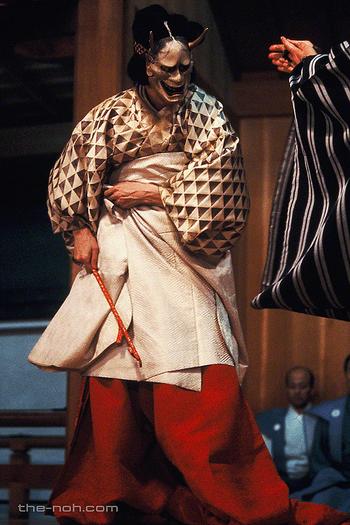
During the play's climax, the demon and exorcist battle over Aoi's robe-body, with Rokujō’s demonic incarnations angling to kill her rival while the mountain ascetic tries to scoop Aoi from the jaws of death (Fig. 4): “Whereas the Genji speaks of numerous priests performing incantations and exorcisms, intimating that they are ineffectual, the play introduces a single figure, the holy man (kohijiri) of Yokawa, who confronts the shite directly.”Footnote 52 Although staging varies among schools and actors, one treatment of this mortal battle seems particularly emblematic: demon and exorcist clutch opposite ends of Aoi's robe-body, with Rokujō attempting to drag it away with her and the exorcist refusing to unclench his hands to relinquish it. One couldn't ask for a clearer-cut depiction of the clash between good and evil. Yet at the same time, the staging also foregrounds gendered distinctions worth unpacking. The holy man displays his salvific resolve by effectively putting his foot down when the demonic woman tries to body-snatch Aoi—kneeling with audible impact to gain more leverage against the upright, thrashing demoness. His masculinity in this scene is performed through movements whose spartan directness conveys a solemnity, in bold contrast to the picture of feminine excess struck by Rokujō. Whereas his costume maintains a more understated impression, hers floods forth, her long trailing red pants, especially, seeming to outstrip the waistband and bloody the unassuming stage as she carves to and fro, slashing with her demon mallet. Unmasked, the exorcist plainly belongs to the human world. But Rokujō’s demonic femininity flashes as the actor cuts the mask in quick left–right flicks of the neck: teeth gnash air, and gold-stained eyes bulge ripe from the horned Hannya mask's lacquered sockets. The long coiffed hair trailing down the actor's spine fades behind these more fearsome frontal elements of Rokujō’s human female form once she starts whipping her demon mallet, assailing the ascetic trying to protect Aoi.
Demoness (Hashioka Kyūma) and exorcist fighting for Aoi's robe-body in Lady Aoi. Photo: © Toshiro Morita, provided by “the-noh.com” site (www.the-noh.com).

Although she snatches at the robe-Aoi, Rokujō cedes the embattled fabric body to the holy man once her grip on its collar gives way. He wrests it free of Rokujō’s grasp with emphatic gentleness—using two arms, not a single, clenched fist—to cradle the robe in his arms and lull it safely back floorward. With this gesture, the holy man oozes chivalry. But that chivalrous appearance becomes legible as such only beside the heavy shadow cast by Rokujō’s manic hostility toward the robe embodying her female rival.
Aoi's vacant, flaccid body being saved by the saintly man demonstrates its utter powerlessness to resist both his aid and Rokujō’s attack; the femininity it exemplifies is wholly passive. Both male hero and female villain benefit from this untrammeled pliancy. The robe's total responsiveness to the willful movement of others potentially heightens the pathetic nature of Aoi's position, but it also foregrounds each character's respective style of gender performance as enacted in palpable contact with this susceptible vessel. Rokujō’s slithering feminine wrath mushrooms alongside the demure robe she besieges. Similarly, our hero can swoop in to set his jaw and save the day precisely to the extent that that same robe underscores his ceremonious masculinity by staying fragile and supple. Significantly, Rokujō’s emotional unraveling entails her attempting to shred the robe prop symbolizing Lady Aoi's frail body. In this manner, Lady Aoi’s conflict hinges upon fraying as a metaphor for female anguish—one especially well suited to dynamic mobilization through robes.
From Battered to Embraced: Fabric Bodies in The Fulling Block and Pining Wind
As it happens, Lady Aoi is not the only play in which robe beating, as a simulation of corporal punishment, takes center stage. In The Fulling Block, we witness not just a swipe or a tug but a full-on pummeling. An aging wife, “believing herself abandoned, dies insane and suffers in Hell” (rt156), waiting in vain for her husband to return from pressing a lawsuit far away. (He describes his situation to us at the top of the play.) As in Lady Aoi, the robe encapsulates wrongful clinging. Like most noh plays, The Fulling Block operates according to a Buddhist worldview in which clinging is a sin that binds one to the phenomenal world even after death. In this case, that clinging connects the robe motif to erotic attachment and gendered mobility.
Whereas the robes in The Feather Mantle and Lady Aoi enabled varying degrees of traversal across space, if not metaphysical planes, The Fulling Block robe connotes paralysis. Mores inhibiting women of her nonmarginal status from traveling keep the wife from ever leaving to locate her husband. Unable to communicate with her beloved (unlike in Lady Aoi, no spirit medium is summoned), Wife is relegated to the home while Husband travels. Installed at the fulling block—her own robe's right sleeve undone to work easier—she dutifully beats with a small mallet (represented by a fan) a robe of his she has laid across it, ostensibly to resoften its silk and restore its luster. We could read this as a mourning work devised to sublimate the pain of lost love through hard but beautifying toil. However, this condition of melancholic immobility proves intractable, causing her to slip into resentful madness as she sits and hits: day in, day out. Unrelenting monotony takes its toll. It drives her insane as she struggles to sustain the laborious ritual of enacting care for her distant husband through the medium of his suffocating clothing.
Seasons come and go as she suffers on:
Winds of fall, that sweep in from the west,
blow him my message. Come,
beat upon his robe, of weave so thin! … Take up this block's voice, O wind,
blow it to my husband yonder!
…
Ah, summer robe, so thin: so thin,
his old promises, I hate them!
Yes, may the man I love live long
as those long nights the moon
keeps me from sleep!
Come, beat upon the robe! (rt164–5)
The circumscribed mobility presented here has a paradoxical quality. Caught in limbo, the wife performs a perpetual motion within her geographically static state of perennial longing. Here, in echo of Fiona Wilkie's invitation to “tease out the disparity and power imbalance of vastly different mobilities,” we notice that the disparity between the wife's immobile lower body and her hard-working arms spotlights her inability to travel.Footnote 53 This contrast indexes larger gender and status constraints leveraged against her capacity to move with the liberty her husband enjoys. Evoking Cresswell's notion of “mobilities rubbing up against each other and causing friction,”Footnote 54 Wife goes at it: kneeling at the fulling block, pounding away in growing anger at the static robe her husband left, she produces a literal friction that attests to deeper contestations over the disproportionate distribution of gendered mobilities.
Wife beats the robe restlessly to affirm her steadfast commitment to her absent spouse. And yet her indignation mounts with each blow to the unresponsive garment. Ensnared in a surreal loop, Wife batters the robe to strengthen her devotion to Husband, despite the fact that, past a certain point, striking the robe only thins its threads, symbolically eroding their nuptial bond. As her own sanity unravels, Wife frays the robe to fabricate an intimacy whose futility surfaces in that cycle of unrequited contact. Tragically, she can never pound the garment long or hard enough to snap its chains and mend her fate.
Simultaneously, she holds out hope that the rhythm of her insistent yearning will somehow manage to reach his ears, carried by the wind. This is not the naïve femininity of the celestial maiden, nor that of the scorned dowager. Rather, The Fulling Block woman's femininity is that of a world-weary wife of moderate means who is forced to wait in vain, toiling in protest of time's callous passage. Although the beating motif (along with a shared stress on sound) also occurs in the play The Damask Drum, The Fulling Block’s choice of prop radically alters that gesture's tenor.Footnote 55 That is, the fulling block reverberates with added violence.
The wife abuses the robe as a fabric proxy body of her absent husband (Fig. 5). Notwithstanding patriarchal protocols of the time that would undercut her complaints, he is too far removed to berate; the robe is her best recourse for establishing whatever tenuous sense of contact with him—and exacting whatever impression of reprisal against him—she can. At the same time, to what extent is her attack not also a purgatorial self-flagellation? When the woman reappears as a tortured ghost in part two of the play, she moans,
Yet love's lustful karma rules me still.
Fires of longing smoulder night and day.
Now as before, I have no peace: this sin,
a heart in pain, yields me its reward:
assaults of hell-fiends, the Ahōrasetsu
brandishing their rods and raining blows.
Beat on, beat (they howl), as you deserve,
the block: for all my hate
reaps me the fruit of wrongful clinging. (rt168)
Wife (Asami Masakuni) beats the robe in The Fulling Block, 1992. Screenshot from NHK DVD Nōgaku meienshū: Kinuta.

Instead of a female rival like Lady Aoi, the protagonist of The Fulling Block lashes herself by proxy. Indeed, even when her ghost cries, “O you are hateful!” and “moves towards Husband, goes down on one knee before him, strikes stage with her fan, points left hand accusingly, and suddenly weeps” (rt170), the play's action still orbits the fulling block and battered robe as its major axis, making this swipe at a living being in the drama's closing moments seem less consequential than the countless strikes at inanimate fabric preceding it. Through the act of rapt beating, the woman winds up more corporeally bound to the robe than to its owner. The habituated violence of her gesture betrays the harsh asymmetry delimiting women's mobility within a medieval Japanese domestic sphere. While her husband roams free, the lonely wife's drudgery in maintaining the marriage always falls short.
The final play to which I turn, Pining Wind, involves another obsessive female protagonist, but her plight is far less dire than that of The Fulling Block’s wife, in large part because she is younger, poorer, and unconfined to a domestic framework. Consequently, her movement is less hampered and her rapport with her lover's robe more pleasurable. Pining Wind and her sister, Autumn Rain, are young women who collect ocean brine to make salt. They are visited by the famed (real-life) paramour poet Ariwara no Yukihira (818–93), who romances them for three years before returning to the capital from whence he'd been exiled, leaving them a hunting cloak (kariginu) memento. This courtier's visit is a dream for the humble sisters, and they die entranced by the memory of his life-changing visit. When a monk visits the same shore, he happens upon two women: in truth, the sisters’ ghosts. They recount their story, giddily reminiscing and reaching for the keepsake cloak and hat (eboshi) Yukihira left them. Despite her sister's protestations, Pining Wind enters a frenzied state resembling madness and dances dressed in her male lover's clothing, mistaking a lone pine tree for Yukihira and encircling it rapturously as the drama concludes.
Pining Wind surges with shamanistic resonance and erotic innuendo. The eponymous woman's use of the dead courtier's clothing resembles the actions of a medium luring a male spirit to the human plane through the antennalike tree to channel it temporarily into the receptacle of her willing body. As Carmen Blacker notes, “sacral power was believed to reside more easily and properly in women, and where in consequence women were recognised to be the natural intermediaries between the two worlds.”Footnote 56 The communion Pining Wind pursues requires the deceased's clothing, and is activated through a dance recalling an utsurimai or “dance of possession” (lit.: “dance of transfer”): “A dance performed by the spirit of another that has entered the body, generally through the donning of a robe. It has its origins in ancient Shinto rituals, where the shrine maiden, miko, functioned also as a shaman…. Utsurimai appear in quite a number of Nō plays, particularly plays about women.”Footnote 57 The female protagonists’ entrance in white robes and red trouser-skirts imparts the appearance of purified shrine maidens. In confessing to the monk their connection to Yukihira, the sisters reminisce about the famous lover's visit in sartorial terms:
Both: Yes, Yukihira, those three years,
lightened his leisure with pleasant boating
and watched the moon here on Suma shore.
While seafolk maidens each night drew brine,
he chose and courted us, two sisters.
…
We Suma seafolk, familiars of the moon,
Wind: found our saltburner's clothing suddenly changed
Both: to silken summer robes censed with sweet fragrance.
Wind: So those three years slipped quickly by. (rt200)
The courting and seaside leisure meant sexual relations as surely as it meant moon gazing. The sisters miss Yukihira, but they also miss the Cinderella-esque way they were whisked from a life of burning brine. This lifestyle upgrade materializes in the sisters’ new wardrobe: fresh silken summer robes replace old salt-stained ones. The texture of their daily life improves with the fabric shift. The summer robes’ softness denotes an eminence, sensuality, and social mobility at odds with the rough-and-tumble functionality of saltburner's clothing. Yukihira's visit is fantastic for freeing them from daily hardship; to lose him is to forfeit that luxurious freedom he endowed. In this regard the sisters are all too happy to stay still, insofar as remaining at this site while basking in Yukihira's presence obviates their manual labor.
The sisters’ normal robes become drenched with longing as they draw brine, the fabric becoming heavier and more degraded with each trawl of seawater: “these sleeves can only wilt away” (rt195). The sisters grieve the past as they work, wetting their sleeves with the tide and their tears. Acrid water warps their clothing and their minds; these are conjoined since the women's robes comprise their social identity and exemplify their lives’ work. As the sisters haul their brine cart closer to the sea to collect water with their buckets, they peer at the water, contemplating their wretched life without Yukihira. Pining Wind says, “tides leave behind stranded pools, / and I, how long will I linger on?” (rt195). She understands her plight as being akin to the stagnant brine, abandoned by the force that would enliven it. Pining Wind becomes all too aware of her mortality, and that her fate is to rot like her saltmaker's sleeves.
But Yukihira's clothing alters all that. A different liquid image replaces the brine once Pining Wind holds Yukihira's keepsake hat and hunting cloak: “his tall court hat, his hunting cloak. / Each time I see them, ever more / passion grasses spring, / the pale dewdrops on each blade / so swiftly gone—might I so soon / forget this agony!” (rt201). Like the visiting courtier who grants lowly women a taste of the Cinderella tale, the robe keepsake that embodies this courtier performs a similar function in briefly delivering Pining Wind from eternal dross. To look on the clothing is to become more aroused at the thought of Yukihira's presence; pale dewdrops allude to Buddhist transience, but their capacity to moisten each tip of “passion's tangled grasses” when “dew and longing mingle wildly” (rt200) also connotes the ephemeral pleasures of intercourse.
The robe stirs carnal undercurrents. Its patterned fabric transmits the residual presence of a sexual partner; to don it is physically to reenter an erotic intimacy. This resurrected intimacy doesn't come easily, however. For despite her adoration, Pining Wind's response upon reencountering the garments reveals rifts: “His parting gifts, / O they are enemies: / were they gone from me, / a moment of forgetfulness / might even now be mine…. / My love for him only deepens” (rt201). To this she adds the following:
Wind: Night after night,
I remove on lying down
this, my hunting cloak,
Chorus: and on and on I only pray
that he and I might share our life—
but fruitlessly.
His keepsakes bring me no joy!
She throws them down but cannot leave them;
picks them up, and his own face
looms before her. Do as she may,
From the pillow,
from the foot of the bed,
love comes pursuing.
Down she sinks in helpless tears,
lost in misery. (rt201–2)
Pining Wind's proximity to Yukihira's clothes makes it hard to put him out of mind, but she is conflicted, alternately dropping and gathering his mementos, hating then loving him again. This fraught fondling of the clothes heralds her descent into madness. Simultaneously, eroticism attending contact with them builds, with her stripping off his hunting cloak—which she now labels her own—and envisioning his face as she imagines him engulfing her prostrate body from head to toe. Notably, Pining Wind's fantasy, kindled by her involuntary craving to touch her former lover's clothes, casts her as an increasingly passive participant in the lustful exchange. She goes from gathering brine, to relishing summer silk, to waiting for a man to join her in bed. This transition toward immobility marks the onset of Pining Wind's possession dance, in which she transcends the wavering disposition to—quite literally—embrace the phantom of her lover.
Once she collapses to a sitting position and the stage assistant clothes her in Yukihira's garb, Pining Wind vacillates no more: “O what happiness! Yukihira is standing there, calling my name, Pining Wind! I am going to him!” (rt202). The dance we witness after the main actor has donned the lover's robe expresses Pining Wind's ecstasy—however ephemeral—conferred through a reunion possible only by proxy. The robe symbolizes a lover resurrected in fabric form. As Monica Bethe notes, “In [Pining Wind], the donning of the robe of a former lover has precipitated a mad scene where time is collapsed and wishes become reality.”Footnote 58 This temporal collapse accompanies a spatial rupture that occurs when the shite encircles the central downstage pine tree prop symbolizing Yukihira: “By breaking through the established space conventions, the circling of the prop exposes it as three-dimensional and at the same time envelops the pine within the Shite's psyche.”Footnote 59 Skirting the front edge of the stage like this embodies an unmatched mobility not performed in any other noh plays.Footnote 60
Now that he is standing (as opposed to floating at her bedside), Pining Wind must make haste to meet him, mustering a wider range of movement to approach him and merge her body with his. Yukihira's garments spark a fusion of bodies, sexes, statuses, with dance enacting an intercourse in which Pining Wind inserts herself into the surrogate body of her male lover while his spirit infuses her (Fig. 6). Rather than parse who has penetrated whom, the point I want to stress is that the proxy body this female character wears enables her to move to a degree foreclosed without the robe. Communion with Yukihira's spirit through the robe keepsake, especially, allows a fleeting reprieve from social, sexual, or spiritual restraints. During her “dance of possession” she escapes these confines as the robe becomes a vehicle for transcendence.
Pining Wind (Kita Roppeita) prepares to don and dance in her lover's clothes in Pining Wind, 1987. Photo: © Toshiro Morita, provided by “the-noh.com” site (www.the-noh.com).

Conclusion
Robes trigger transformation. To be sure, this transformational motif recurs throughout noh plays of all eras and categories, and is by no means anchored to gender or femininity alone. However, as we've seen, interactions with robes reconfigure social relationships or serve as transformative vehicles through which female protagonists in particular may escape enclosure to access other realms of possibility. So, too, may these women ultimately come to embrace masochistically the security of a captive existence. For a woman to don a robe at the height of her distress is to be temporarily transported from her mundane purgatory or the assaults of hell itself. The female protagonist, often an otherworldly being, perpetually occupies a state of unrest as she searches for restitution or solace of some sort. The waki, the “side” actor who plays the shite’s foil and interlocutor, is conventionally lodged as a stable witness to the unfolding events and lends some mooring support. Noh’s basic schema shows unstable women who dance—at least as performance, and sometimes as plot—while this anchored male observer looks on with delight, disgust, or concern: the fisherman Hakuryō, the exorcising holy man, the Husband gone away, the solicitous visiting monk. In Pining Wind the conventional waki, visiting a poetic topos and probing her story, disquiets the title character such that she can't help but relive past losses by dancing out her passions and moving onlookers situated past the stage proper.
Robes serve as lush reminders of women's sacrifices and often become the pivotal implement through which they might be redressed—or at least amplified for audience enjoyment. As a spectral presence, a woman may crave contact with some tangible facet of a faded reality. Often, the male waki stokes the woman's pleasure, passion, or despair by coaxing her toward the embodiment of her lover (Pining Wind) or enemy (Lady Aoi). Even if that figure has perished, their fabric remnant can be caressed, inhabited, and tailored to her shifting needs. She's drawn to the robe—perhaps literally tied to it or inside it—but exercises extraordinary (if conflicted) initiative in retreating to its folds. She places the proxy onto her body, inserts herself within it, dances with it—or as it—threading a maze of constraints while enraged, enraptured, or possessed.
To be sure, the feminine capacity for movement portrayed often falls within a category of what Cresswell calls “other, often allegedly pathological, mobilities that are threatening and excessive.”Footnote 61 Consequently, male characters like the fisherman or exorcist arrive to police them, detaining or expelling the female figures in The Feather Mantle or Lady Aoi. Yet robe usage in these plays adds other layers to this schema by foregrounding other possibilities for movement: restored mobilities. According to Sunny Stalter-Pace, “restored mobilities can call upon the audience and actors’ own experiences with the particular mobility, their knowledge of its unspoken codes, and their feelings when such codes are violated.”Footnote 62 Although some of these feelings likely aligned with misogynistic mores of the time, so too could they have bolstered empathy for the female protagonists or prompted disidentifications with their most monstrous embodiments.
If, as Stalter-Pace suggests, “these restored mobilities differ from prescriptive ideological representations of mobility, which tend to produce an ideal body,” then we might interpret these particular instances of noh robe usage as potentially undermining prescribed mobilities or bodily ideals.Footnote 63 Whatever ideal body might be depicted becomes destabilized through interaction with the masses of fabric whose function and significance shift as the robes themselves assume different shapes. Functioning alternately as vehicle, dwelling, mortal enemy, or departed lover, these robes distend staid notions of a fixed human form, to say nothing of any clear partition between animate subject and inanimate object. The robe can both supplement and unsettle movement—sometimes simultaneously. If a robe can not only adorn but surrogate a body, being entered, adored, or abused in the process, then its sheer malleability also gestures toward mobilities that outstrip any singular meaning. This is not to romanticize freedom of movement at all costs, or unwittingly hail masculine mobility as exemplary. To the contrary, robe usage in noh should be read as a way to portray feminine mobilities that, while rooted in historical conditions of subjection, nevertheless skirt inertia, unfurling styles of embodiment irreducible to stasis.
Noh’s trope of women possessed of differing degrees of mobility being attractively damaged constitutes an enduring element of their characterization. Whatever form it takes on noh’s stage, this “frayed fabrication,” or aestheticized derangement, recurrently features robes as a means of resolving the drama's driving yet routinely unstated conflict: namely, How should female figures maneuver amid a mesh of restrictions and brutal pressures impossible to unravel directly? Zeami labels this condition madness, and it was, overwhelmingly, gendered feminine within his historical milieu. Yet we might diagnose the predicament differently: not as inherent, but rather as the trace of an omnipresent violence that medieval Japanese women confronted disproportionately. After all, what's marked “madness” can be merely an urgent dance across a minefield of tacit rules and toxic options.
Noh’s robe usage can hinge on this feminine vulnerability—and this goes further than Zeami's stressing loose sashes and softened postures for male actors. For in the end, the staging techniques discussed allow noh performers to fabricate a calculated attenuation of violence, while preserving the lure of women's physical, emotional, and spiritual torment. Violent dynamics can play out without being recognized beneath robes’ shimmering fabulations. A palpable, serviceable dramatic tension pervades those scenes where female protagonists must tackle their particular circumstances of compromised mobility. These women apprehend the root of their anguish with an oblique insistence especially well suited to the robe's ample capacity for distension, diversion, revaluation, and reinvention. In the process, the ugliest shows of force can recede for a spell—like the burnished fangs of a demon's mask, sheathed in makeshift shadow.