


Half of all countries depend economically on primary commodities such as crude oil and wheat, a 20-year high (UNCTAD 2019).Footnote 1 Policy makers worry that such dependence stymies economic growth and leaves countries vulnerable to price shocks; the UN warns that commodity-dependent states will not meet its Sustainable Development Goals.
Decades of social science research underlie these concerns. Scholars argue that these countries experience three maladies: macroeconomic shocks from volatile commodity prices (Gelb Reference Gelb1988), reduced state capacity and accountability (Mahdavy Reference Mahdavy and Cook1970), and armed conflict (Collier and Hoeffler Reference Collier and Hoeffler2004).
We focus on whether changes to the value of primary commodities cause armed civil conflict in producing regions, a claim that has inspired an outpouring of theoretical and empirical work. Since 2002, we count over 350 empirical papers that study the relationship between armed civil conflict and the value of primary commodities, a body of work that has collectively generated over 20,000 citations (see Appendix Figure A.1). We examine work that studies three outcomes related to armed civil conflicts: onset (start of conflict), incidence (presence of conflict), and intensity (number of battles or fatalities).
The increased attention has led to debate about when, or even whether, commodity price shocks affect armed conflict.Footnote 2 Prominent studies offer contradictory accounts: Dube and Vargas (Reference Dube and Vargas2013), for example, find that violence increases in Colombia’s oil-producing municipalities as the international price of oil rises. By contrast, Bazzi and Blattman (Reference Bazzi and Blattman2014, 1) state that “[p]rice shocks have no effect on new conflict, even large shocks in high-risk nations.” However, studies often examine different sets of commodities, outcomes, and countries, which may explain apparently incongruous findings.
We conduct a formal meta-analysis of natural experiments.Footnote 3 We proceed in four steps. First, we conduct an expansive literature search that yields over 3,300 study records. Second, we screen studies on research-design and topical grounds: the 46 included studies (102 estimates) quantitatively analyze the effect of plausibly exogenous variation in world commodity prices on armed civil conflict by using a generalized difference-in-difference design with unit and time fixed effects. Third, we standardize estimates to place coefficients on a common scale. When needed, we reanalyze study data to increase uniformity (e.g., when authors report coefficients from probit models). Finally, we use two standard meta-analytic techniques to evaluate prominent hypotheses about whether and which primary commodity prices affect armed conflict.
When we pool studies across commodity types, we find no effect. The same is true when we restrict attention to estimates that bundle together multiple types of commodities. It does not appear that commodity price increases uniformly generate windfalls that make the state or other territory a prize worth fighting for.
The overall null effect comprises cross-cutting effects for different commodities. First, price increases for agricultural commodities reduce the likelihood of armed conflict, while price increases for oil and gas have the opposite effect. These divergent results match theoretical predictions that price increases for labor-intensive commodities such as agricultural goods generate employment and thus raise the opportunity cost of fighting (Dal Bó and Dal Bó Reference Dal Bó and Bó2011). By contrast, higher prices for capital-intensive goods like oil and gas boost the returns to fighting without offsetting opportunities for legal employment. Second, we find that price increases for artisanal minerals such as alluvial diamonds and gold increase the likelihood of armed conflict. This supports arguments that such commodities are especially “lootable” (shorthand for features that reduce the costs that rebels pay to appropriate production) and thus likely to provoke conflict when prices increase (Rigterink Reference Rigterink2020; Snyder and Bhavnani Reference Snyder and Bhavnani2005).
Meta-analyses remain rare in political science, especially for observational work. We count just five meta-analyses published in the top three political science journals between 1999–2018 (see Appendix I). Only one synthesizes exclusively observational research. A recent meta-analysis, O’Brochta (Reference O’Brochta2019), studies questions similar to our own.Footnote 4 We note several key differences: most importantly, the analysis omits all studies in our sample by excluding work on commodity prices and does not screen studies based on their research design (see Appendix A.4). O’Brochta is particularly interested in how different analysis decisions affect authors’ findings. By contrast, we attempt to standardize the analysis across our studies in order to test theoretical claims about how effects vary by commodity type.
COMMODITY PRICES AND CONFLICT: THEORETICAL PREDICTIONS
The outpouring of empirical research on primary commodities and conflict builds on rationalist, economic theories of civil war. Keen (Reference Keen1998, 11) argues that “internal conflict persisted not so much despite the intentions of rational people, as because of them. The apparent ‘chaos’ of civil war can be used to further local and short-term interests. These are frequently economic.” In short, economic interests often motivate people to form and join armed groups that challenge the state (for a critique, see Kalyvas Reference Kalyvas2003).
Control of natural resources is among the most common economic explanations for conflict (for a review, see Ross Reference Ross2004). Well-known formal models predict that the likelihood of armed conflict increases with the value of primary commodities (e.g., Besley and Persson Reference Besley and Persson2011). The prediction about natural resources builds on a more general insight: increasing the value of the “prize” to be won by controlling the state induces conflict over who governs (see also Fearon and Laitin Reference Fearon and Laitin2003; Garfinkel and Skaperdas Reference Garfinkel, Skaperdas, Sandler and Hartley2007).Footnote 5 Laitin (Reference Laitin2007, 22) offers a simple summary of these arguments: “If there is an economic motive for civil war in the past half-century, it is in the expectation of collecting the revenues that ownership of the state avails.” This, Laitin argues, accounts for the strong empirical association between oil and civil war, but the logic extends to other primary commodities that generate government revenues and should be most apparent when these commodities command high prices, leading to the first hypothesis that has been commonly tested in the empirical literature:
(H1) Rapacity: Increases in the prices of primary commodities raise the likelihood of conflict in places producing those commodities.
A number of scholars argue, on the other hand, that commodity price increases should have no—or even a negative—effect on armed conflict. Some contend that, absent commitment or informational problems, actors ought to be able to devise a bargain they prefer to conflict, whatever the size of the prize (e.g., Fearon Reference Fearon1995). Still others claim that governments use the revenues generated by rising primary commodity prices to build state capacity and thus deter would-be challengers. In well-known models of autocratic politics, leaders use resource revenues to buy off or eliminate potential challengers, limiting instability (Bueno de Mesquita and Smith Reference Bueno de Mesquita and Smith2010).
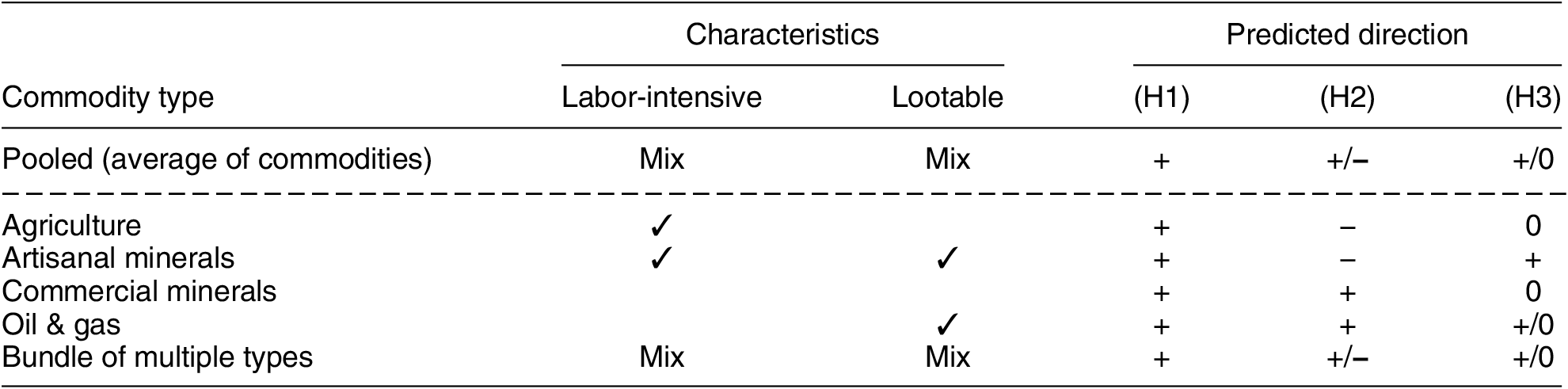
These first two effects—sometimes termed the “state prize” and “state capacity” effects—do not depend on which commodities generate windfalls. Yet, a growing body of work argues that commodity prices have varied effects, depending on how different commodities are produced.Footnote 6 Prominently, Dal Bó and Dal Bó (Reference Dal Bó and Bó2011) predict that price increases for labor-intensive commodities reduce armed conflict. Higher prices for such commodities generate gainful employment, raising the opportunity cost of conflict and drawing would-be combatants into the productive sector. By contrast, higher prices for capital-intensive commodities lower the opportunity cost of conflict. The returns to appropriation increase, for example, as oil theft becomes more lucrative, without offsetting increases in legal employment. These arguments produce a second, commonly tested hypothesis:
(H2) Opportunity Cost: Increases in the prices of labor-intensive (capital-intensive) primary commodities lower (raise) the likelihood of conflict in places producing those commodities.
Commodities also vary in their “lootability,” characteristics that affect the costs armed groups or the state pay to appropriate production. Lootable primary commodities have a high value-to-weight ratio, require few specialized inputs like high-skill labor or physical capital to produce, and cannot be easily defended (Snyder and Bhavnani Reference Snyder and Bhavnani2005). Artisanally-mined diamonds are exemplary: small, precious stones can be easily transported; unskilled labor is the primary input; and alluvial diamond fields can cover large areas, making them costly to fortify (Rigterink Reference Rigterink2020, 92). Scholars have argued that higher prices for lootable commodities provoke conflict, providing a third hypothesis:
(H3) Lootability: Increases in the prices of lootable primary commodities raise the likelihood of conflict in places producing these commodities.Footnote 7
Testing (H2) and (H3) requires information about whether a particular primary commodity is labor intensive or lootable. Though we planned to classify commodities along these dimensions, authors rarely directly measure either feature.Footnote 8 Instead, we follow the literature in associating these features with particular types of commodities (see Table 1 and Appendix A.9). We note three challenges. First, this classification does not capture heterogeneity within types (e.g., crops can vary in capital intensity). Second, differences across commodity types that the literature attributes to lootability and labor- and capital-intensity could be confounded by other unmeasured characteristics. Third, once oil is extracted and in transport, it takes on some lootable features: long stretches of pipeline are costly to defend and can be attacked with few specialized inputs. The lootability of oil, thus, varies along its supply chain.
Commodity Classifications and Predicted Effect Direction from Each Hypothesis

The literature on natural resources and conflict suffers from what Humphreys (Reference Humphreys2005, 510) calls “an embarrassment of mechanisms.” We test many prominent claims, but not all. The studies we examine focus on (nearly) contemporaneous effects of commodity price changes on conflict and thus do not speak to processes that unfold over long periods: Mahdavy (Reference Mahdavy and Cook1970), for example, argues that oil wealth reduces domestic taxation and, over the long term, undermines state capacity; Collier and Hoeffler (Reference Collier and Hoeffler2004) note long-standing grievances in resource-rich regions.
RESEARCH DESIGN
Data Collection
To generate the most complete universe of studies, we combine three approaches: (1) we run keyword searches on Google Scholar, (2) include studies citing prominent early works, and (3) publicly solicit recent and unpublished work. This yields 3,346 studies (see Table 2).
Stages of Filtering and Number of Studies Selected

Note: * Second filter also requires that the study uses a fixed effects panel model;
 $ \dagger $
two working papers were abandoned by the authors.
Our topical filter requires that studies include a quantitative analysis where armed conflict is the dependent variable and commodity prices are an independent variable. Among 376 relevant studies, our research design filter retains 46 natural experiments that leverage plausibly exogenous price variation. These studies represent 201 countries and 10,926 unique country-years.Footnote 9 Included countries are on average 40% as wealthy, somewhat more unequal, two-thirds more prone to conflict, and somewhat less democratic than the world at large; they more closely resemble those countries that experienced an intrastate conflict in the postwar period (see Appendix B.3). Identification relies on the inclusion of unit and time fixed effects to absorb time-invariant confounds and global shocks.Footnote 10 This second filter increases the internal validity of included studies. We retain one estimate per paper for every commodity and conflict type (onset, incidence, and intensity) following prespecified rules (see Appendix A.5).
Together, these two filters ensure the conceptual comparability of study estimates. We take two additional steps to ensure that the estimates are numerically comparable. First, we standardize all estimates to address potential differences in the scales of the conflict outcomes (e.g., binary or count) and price variables (e.g., in different currencies). Our standardized effects are expressed in terms of standard deviation changes in the prices and conflict variables:
 $$ {\hat{\beta}}_{std}=\hat{\beta}\times \frac{sd\hskip0.18em \left(\mathrm{Price}\right)}{sd\hskip0.18em \left(\mathrm{Conflict}\right)} $$
Following Mummolo and Peterson (Reference Mummolo and Peterson2018), we residualize the variables using the unit and time fixed effects before computing the standard deviations. More commonly reported pooled standard deviations often overstate the variation used to estimate
 $ \hat{\beta} $
in a two-way fixed effects model. We compute these statistics (or receive them from authors) for 37 studies (see Appendix Table A.3).
Second, we ensure that all studies use a common functional form:
 $$ {\mathrm{Conflict}}_{it}={\delta}_i+{\gamma}_t+\beta \hskip0.5em {\mathrm{Prices}}_{it}+\kappa {X}_{it}+{\varepsilon}_{it}, $$
where
 $ i $
indexes the authors’ cross-sectional unit (which we use to cluster the standard errors) and
 $ t $
indexes their temporal unit;
 $ {X}_{it} $
includes the other time-varying controls included in the authors’ original specification. This overcomes noncomparability that arises from the use of models with nonlinear link functions (e.g., logistic regression) or the choice of fixed effects (e.g., using year fixed effects where the temporal unit in the panel is month). We acquire replication data for 32 studies and estimate this model; we confirm the remaining five estimate a similar linear model.Footnote
11
These standardization steps exclude nine papers for which we lack the necessary statistics (see Appendix Table A.6). We can, however, compute an alternate measure of effect size, the partial r (
 $ {\rho}_p $
), which requires only the t-statistic (
 $ t $
) and degrees of freedom (
 $ df $
):
 $ {\rho}_p=t/\sqrt{t^2+ df} $
(see Appendix B.4). Reassuringly, the distribution of
 $ {\rho}_p $
does not change with the inclusion of these nine studies.
Meta-analysis
We first estimate the fixed effects meta-analysis model (Rosenthal and Rubin Reference Rosenthal and Rubin1982), which is a precision-weighted average of the standardized estimates (
 $ \hat{\beta} $
std
from Equation 1, with weights equal to the inverse of the standardized variance).Footnote
12
Under minimal assumptions, this model consistently estimates the average effect for the studies in our sample (Rice, Higgins, and Lumley Reference Rice, Higgins and Lumley2018). We also compute the random effects meta-analysis model (DerSimonian and Laird Reference DerSimonian and Laird1986).Footnote
13
This model assumes that the true effects differ across studies, but that these are drawn from a common (normal) distribution.
The fixed and random effects models both recover quantities of interest: the former provides an efficient estimator for the average effect within our sample of studies, while the latter provides both an estimated mean and variance of true effects, which permits generalization to out-of-sample studies. For numerical reasons, the standard errors from the random effects model will always be weakly larger. We estimate both models for each type of commodity. We also present a pooled effect, which averages our estimates across commodity types, giving equal weight to each commodity type.Footnote 14
Our estimates pool across conflict types (incidence, onset, and intensity).Footnote 15 In Appendix C, we show that coefficient estimates are stable when re-estimating our models while leaving out each conflict type and, additionally, that conflict type is nonsignificant when entered as a moderator.Footnote 16
We take steps to mitigate publication bias and assess whether it skews our estimates. We include working papers. We also perform several diagnostic tests: p-curves, funnel plots, and meta-regression analysis (see Appendix H). These find no evidence of publication bias. Prominent papers in this literature have published null results (e.g., Bazzi and Blattman Reference Bazzi and Blattman2014), ameliorating concern that only positive findings escape the file drawer. We also find that our results are not driven by outliers in effect size or precision (Appendix G).
RESULTS
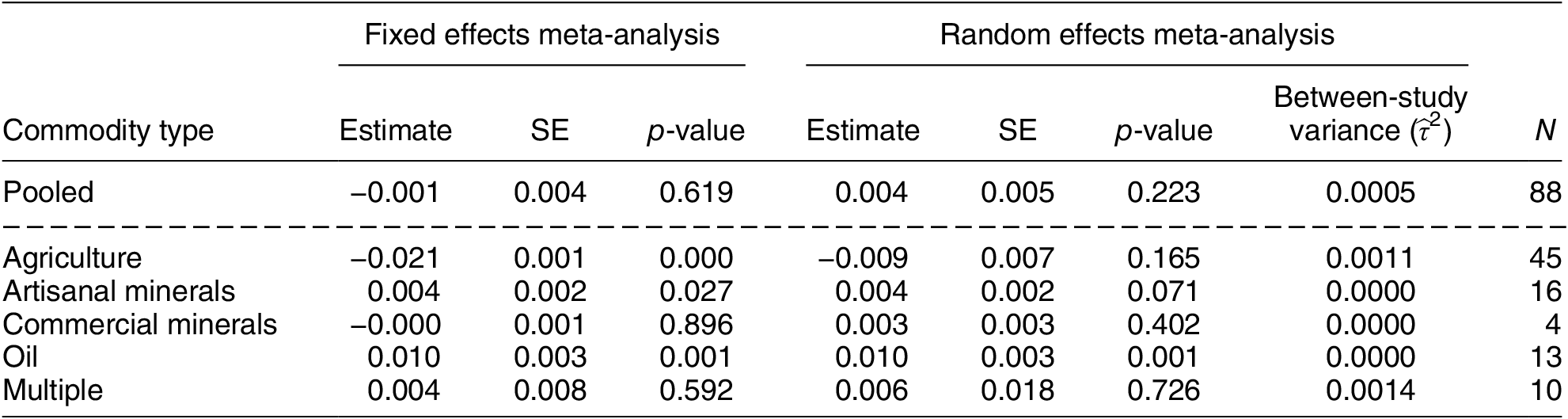
In Table 3, when we pool our study estimates, we find no overall effect (fixed effects:
 $ =-0.001 $
, p
 $ =0.619 $
; random effects:
 $ 0.004 $
, p =
 $ 0.223 $
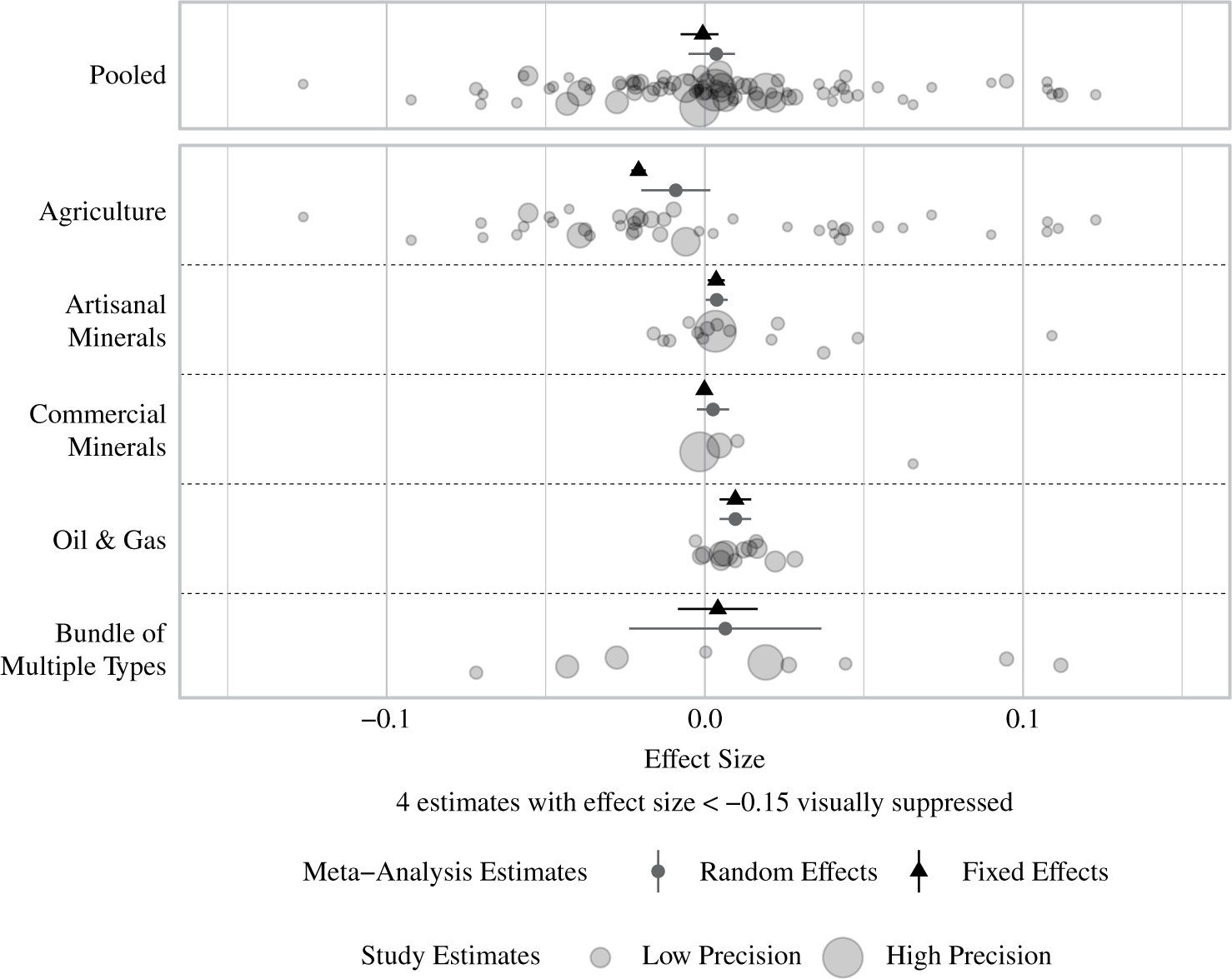
). In the top panel of Figure 1, we display these estimates along with 90% confidence intervals and the raw data from each study.Footnote
17
We also see no effect for bundles that include multiple commodity types. We find little support for H1: windfalls from commodity prices do not generally make producing states or regions more or less attractive targets for attacks.
Meta-Analysis Estimates of the Effect of Commodity Price Changes on Armed Conflict

Effects of Commodity Prices on Conflict by Commodity Type

Yet, this reflects cross-cutting effects by commodity type. Consistent with our second hypothesis, we find that rising prices for oil and gas (capital-intensive commodities) increase armed conflict. Both fixed and random effects estimates are 0.01 and significant at the 1% level. How large are these standardized effects in real-world terms? From 1998 to 2000, crude oil prices increased 115%. Our meta-estimate, when applied to the context studied by Carreri and Dube (Reference Carreri and Dube2017), implies a 16.5% increase in paramilitary attacks in Colombia’s oil-producing municipalities (see Appendix F).
By contrast, we find that price increases for agricultural commodities—which are labor-intensive relative to other types—reduce armed conflict: the fixed effects estimate is
 $ -0.021 $
and significant. Applied to the context studied in Guardado (Reference Guardado2018), our estimate implies that the 190% increase in coffee prices from 1993 to 1998 drove a 55% reduction in attacks in coffee-producing areas in Peru and Colombia.
There does appear to be heterogeneity in the effect estimates for agricultural commodities (
 $ \hat{\tau}=0.0011 $
), which is reflected in the smaller estimate from the random effects model,
 $ -0.009 $
, with
 $ p=0.165 $
. Some authors argue that particular crops are more capital-intensive and thus exacerbate conflict when prices rise; for example, Crost and Felter (Reference Crost and Felter2019, 3) report that price increases for bananas only exacerbate conflict where production occurs on large plantations, not where smaller-scale, labor-intensive production predominates (see also, Gehring, Langlotz, and Stefan Reference Gehring, Langlotz and Stefan2018).
H2 and H3 do not generate a clear prediction for artisanal minerals, which are both labor-intensive and lootable. Across 13 estimates, we find a small but significantly positive effect of 0.004 with no evidence of heterogeneity, suggesting that lootability offsets the opportunity-cost mechanism.
Finally, we do not find any effect for commercial minerals.Footnote 18 We are wary of overinterpreting a null result from four studies. However, this could indicate that lootability is a necessary condition: if it is prohibitively costly to appropriate production, then realistic price increases would not induce fighting. The difficulty of operating a commercial mine (e.g., hiring engineers, refining or shipping ore) may dissuade rebels from fighting over these operations (Christensen Reference Christensen2019). The same is not necessarily true of oil, which may be cheaper to loot through attacks on pipelines.
DISCUSSION
While on average commodity prices do not affect conflict, this masks cross-cutting effects by commodity type. We find, in line with theory, that price increases in labor-intensive (capital-intensive) commodities prevent (provoke) conflict. We also find evidence that price increases for lootable commodities lead to conflict.
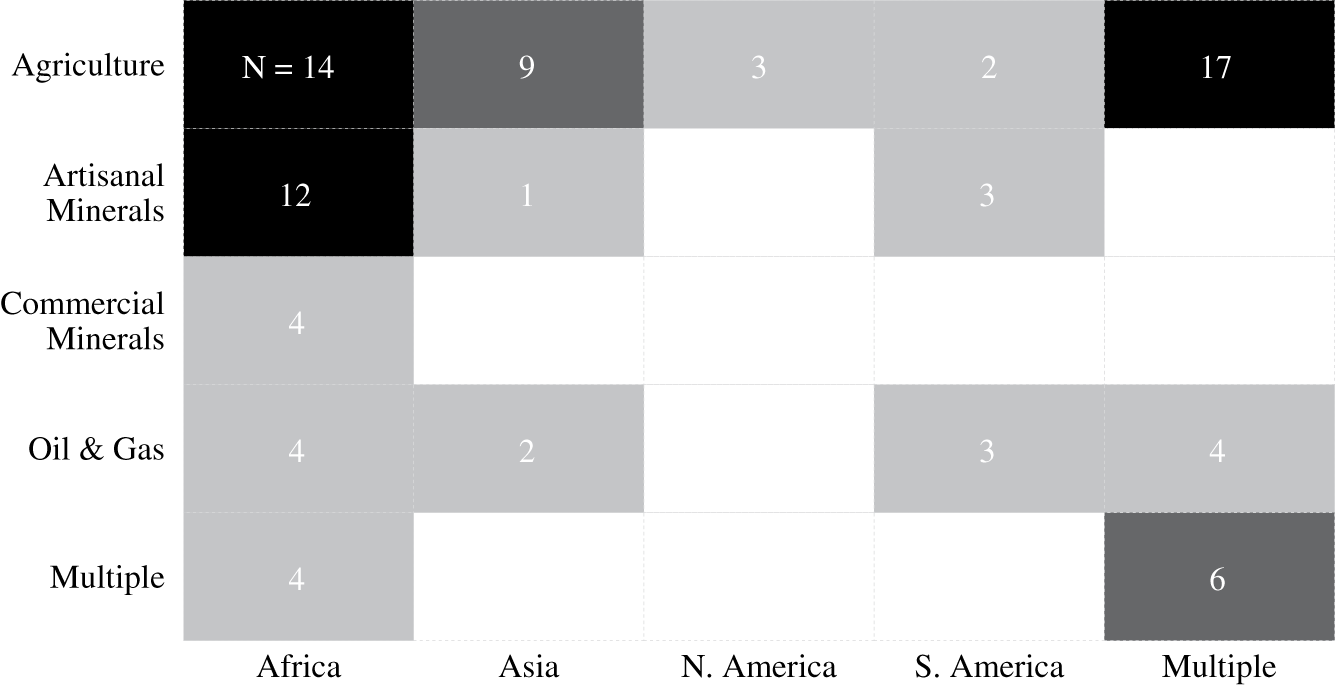
A meta-analysis not only reveals what we have learned but also identifies gaps in our knowledge. While we find no evidence of publication bias, some regions and commodities are overrepresented in our sample of studies (see Figure 2). The 16 estimates for artisanal minerals largely come from three regions: the three estimates from South America come from Colombia; the Asia estimate comes from Myanmar. Artisanal mining is not confined to these places: the World Bank estimates that 14 million people work in artisanal and small-scale mining in Africa and Latin America and over 26 million people in East and South Asia.
Evidence Gap Map (Number of Estimates) by Commodity Type and Continent

We have a rich set of theoretical predictions about factors that moderate the relationship between commodity prices and conflict. Yet, we found the measures needed to evaluate these moderators lacking. Future research should directly measure features such as capital intensity, illegality, lootability, and taxability. We also expect new insights will come from more comparisons of the same commodity or crop where the input mix or scale of production vary (e.g., Crost and Felter Reference Crost and Felter2019; Rigterink Reference Rigterink2020).
SUPPLEMENTARY MATERIALS
To view supplementary material for this article, please visit http://dx.doi.org/10.1017/S0003055420000957.
DATA AVAILABILITY STATEMENT
Replication files are available at the American Political Science Review Dataverse: https://doi.org/10.7910/DVN/BGCVOW.
The study preanalysis plan is registered with EGAP at http://egap.org/registration/4993 (further details and code are registered at OSF at https://dx.doi.org/10.17605/OSF.IO/DY9UF). Deviations from the PAP are described in Appendix J.
ACKNOWLEDGEMENTS
We are grateful to Emily Allendorf, Albert Na, Jacquelyn Nguyen, Jinqi Song, and Pei Yin Teo for excellent research assistance. We thank the many authors included in this meta-analysis for generously sharing data, replication codes, and other statistics. We thank three anonymous reviewers, Chris Blattman, Alex Coppock, Chad Hazlett, Macartan Humphreys, Dan Posner, Anouk Rigterink, Michael Ross, Renard Sexton, Tara Slough, and Yael Zeira, as well as seminar participants at APSA, CEGA, ESOC, UCLA, and UCSB for their helpful comments.
FUNDING STATEMENT
Blair and Christensen received support from the Project on Resources and Governance.
CONFLICT OF INTEREST
The authors declare no ethical issues or conflicts of interest in this research.
ETHICAL STANDARDS
The authors affirm this research did not involve human participants.





Comments
No Comments have been published for this article.