INTRODUCTION
A key aspect of goal-directed behavior is an adaptive cognitive control system that can evaluate task completion and dynamically adjust performance when change is needed. Effective cognitive control, therefore, requires the ability to regulate, maintain, and adjust the degree of control according to task difficulty and current performance. These abilities are subsumed under dissociable regulative and evaluative cognitive control component processes. Regulative control processes, mediated by the dorsolateral prefrontal cortex (dlPFC), implement top-down control to allow task-relevant processes to compete effectively against task-irrelevant processes (Botvinick, Braver, Barch, Carter, & Cohen, Reference Botvinick, Braver, Barch, Carter and Cohen2001; MacDonald, Cohen, Stenger, & Carter, Reference MacDonald, Cohen, Stenger and Carter2000). Evaluative component processes, mediated by the anterior cingulate cortex (ACC), monitor for the presence of response conflict (i.e., the simultaneous activation of two competing response options), monitor performance for errors, and signal for subsequent regulative adjustments in top-down control (Botvinick et al., Reference Botvinick, Braver, Barch, Carter and Cohen2001; Carter & van Veen, Reference Carter and van Veen2007; Kerns, Cohen, MacDonald, Cho, Stenger, & Carter, Reference Kerns, Cohen, MacDonald, Cho, Stenger and Carter2004).
The Stroop color-naming task (Stroop, Reference Stroop1935) is frequently used to examine the nature of cognitive control performance adjustments. In the Stroop task, conflict is greater for incongruent (e.g., the word BLUE written in red) than congruent (e.g., RED written in red) color-naming trials due to the simultaneous activation of competing word and color representations as well as the requirement that participants inhibit the prepotent response to read the word in favor of naming the color. Previous investigators suggest that high conflict on an incongruent trial leads to recruitment of greater cognitive resources than on congruent trials (Botvinick et al., Reference Botvinick, Braver, Barch, Carter and Cohen2001; Gratton, Coles, & Donchin, Reference Gratton, Coles and Donchin1992). Conflict-enhanced cognitive resources remain elevated for a brief period of time and are then used on the subsequent trial to enhance performance (Botvinick et al., Reference Botvinick, Braver, Barch, Carter and Cohen2001; Kerns et al., Reference Kerns, Cohen, MacDonald, Cho, Stenger and Carter2004). In consequence, incongruent trial response times (RTs) following incongruent trials are faster than incongruent trials following congruent trials because the preceding incongruence leads to increased signaling for regulative control resources (see Egner, Reference Egner2007, for review). These adjustments in RTs due to differing levels of previous-trial conflict are referred to as “Gratton” or “conflict adaptation” effects (Gratton et al., Reference Gratton, Coles and Donchin1992).
Few studies have examined the neural time course of conflict adaptation effects with the millisecond resolution of event-related potential (ERP) methods. To date, we know that conflict arising from competing response options (e.g., incongruent condition of the Stroop task) consistently evokes a late fronto-central negative-going deflection in the ERP that peaks approximately 450 ms following stimulus presentation, frequently referred to as the N450 (Liotti, Woldorff, Prez, & Mayberg, Reference Liotti, Woldorff, Perez and Mayberg2000; West & Alain, Reference West and Alain1999, Reference West and Alain2000). Functional magnetic resonance imaging (fMRI) and ERP source localization efforts implicate the ACC as the neural generator of the N450 (Liotti et al., Reference Liotti, Woldorff, Perez and Mayberg2000; MacDonald et al., Reference MacDonald, Cohen, Stenger and Carter2000; West, Reference West2003). A more tonic slow potential is frequently seen following the N450 and is referred to as the conflict-sensitive slow potential or conflict slow potential (conflict SP; West, Reference West2003). The conflict SP appears as a sustained centro-parietal positivity/lateral-frontal negativity beginning approximately 500 ms after stimulus onset and is more positive following correct incongruent trials than congruent trials or errors—perhaps indicating a role in conflict resolution. The neural generator of the conflict SP remains somewhat uncertain, though a source localization study suggests neural contributions from areas of the middle and inferior frontal gyri as well as the extrastriate cortex (West, Reference West2003).
We previously directly addressed the neural time course of conflict adaptation effects in neurologically healthy participants using ERPs (Larson, Kaufman, & Perlstein, Reference Larson, Kaufman and Perlstein2009). Our results indicated N450 amplitude was sensitive to current trial congruency (i.e., greater for incongruent trials), but did not vary as a function of previous trial congruency. This finding suggests that the N450 may reflect neural processes that are automatically activated by conflict regardless of the amount of top-down control needed during a particular trial. More importantly, the conflict SP was sensitive to both current trial congruency and the effects of previous-trial context. That is, conflict SP amplitude was greatest on trials when the most conflict was present (i.e., incongruent trials preceded by a congruent trial), and decreased systematically on trials with lesser degrees of conflict (incongruent trials preceded by incongruent trials > congruent trials preceded by incongruent trials > congruent trials preceded by congruent trials). Thus, the conflict SP appears to be an electrophysiological reflection of the controlled cognitive resources recruited in the effort to resolve conflict and make the necessary adjustments for accurate task completion.
POTENTIAL ALTERNATIVES TO CONFLICT ADAPTATION
Conflict adaptation effects offer a theoretically sound description of the nature of repetition effects in paradigms such as the Stroop task, yet other possible explanations should also be considered and addressed. Conflict adaptation effects may be accounted for by bottom-up associative priming mechanisms that respond to repetitive stimulus features, to such as repetitions of the color or word on the Stroop (Mayr & Awh, Reference Mayr and Awhin press; Mayr, Aw, & Laurey, Reference Mayr, Awh and Laurey2003). Other studies have explained conflict adaptation effects as a form of feature integration, when stimulus and response features become intertwined because they co-occur in time (Hommel, Reference Hommel1998; Hommel, Proctor, & Vu, Reference Hommel, Proctor and Vu2004; Notebaert, Soetens, & Melis, Reference Notebaert, Soetens and Melis2001; Wendt, Kluwe, & Peters, Reference Wendt, Kluwe and Peters2006). Conflict adaptation effects may also be influenced by negative priming, which occurs when the response-related stimulus (i.e., color-naming) corresponds with the irrelevant or inhibited portion of the stimulus (i.e., word-reading) on the previous trial (Hanslmayr, Pastotter, Mauml, Gruber, Wimber, & Klimesch, Reference Hanslmayr, Pastotter, Mauml, Gruber, Wimber and Klimesch2008; Ullsperger, Bylsma, & Botvinick, Reference Ullsperger, Bylsma and Botvinick2005). Negative priming effects tend to increase Stroop-related interference (i.e., increase RTs on negatively primed incongruent trials). A final issue that may affect conflict adaptation effects is the inclusion of error and post-error trials (Egner & Hirsch, Reference Egner and Hirsch2005). Error trials are associated with faster RTs due to impulsive responding (Ridderinkhof, Reference Ridderinkhof, Prinz and Hommel2002), while post-error trials are associated with RT slowing (Rabbitt, Reference Rabbitt1966).
TRAUMATIC BRAIN INJURY AND COGNITIVE CONTROL
The preponderance of current evidence suggests that traumatic brain injury (TBI) is associated with severity-dependent deficits in both the regulative and evaluative aspects of cognitive control. For example, functional neuroimaging studies demonstrate altered dlPFC activity in patients with mild (McAllister et al., Reference McAllister, Saykin, Flashman, Sparling, Johnson and Guerin1999; McAllister, Sparling, Flashman, Guerin, Mamourian, & Saykin, Reference McAllister, Sparling, Flashman, Guerin, Mamourian and Saykin2001) and moderate-to-severe TBI (Cazalis, Feydy, Valabreque, Pelegrini-Issac, Pierot, & Azouvi, Reference Cazalis, Feydy, Valabreque, Pelegrini-Issac, Pierot and Azouvi2006; Christodoulou et al., Reference Christodoulou, DeLuca, Ricker, Madigan, Bly and Lange2001; McAllister, Flashman, McDonald, & Saykin, Reference McAllister, Flashman, McDonald and Saykin2006; Newsome et al., Reference Newsome, Scheibel, Steinberg, Troyanskaya, Sharma and Rauch2007, Reference Newsome, Steinberg, Scheibel, Troyanskaya, Chu and Hanten2008; Perlstein et al., Reference Perlstein, Cole, Demery, Seignourel, Dixit and Larson2004; Sanchez-Carrion et al., Reference Sanchez-Carrion, Fernandez-Espejo, Junque, Falcon, Bargallo and Roig2008; Scheibel et al., Reference Scheibel, Pearson, Faria, Kotrla, Aylward and Bachevalier2003; Turner & Levine, Reference Turner and Levine2008) during working memory tasks heavily dependent upon regulative control functions. Accordingly, performance deficits in TBI patients relative to controls have also been identified on other paradigms that tap regulative control functions, including the AX-CPT (Larson, Perlstein, Demery, & Stigge-Kaufman, Reference Larson, Perlstein, Demery and Stigge-Kaufman2006), the cued-Stroop (Perlstein, Larson, Dotson, & Kelly, Reference Perlstein, Larson, Dotson and Kelly2006; Seignourel, Robins, Larson, Demery, Cole, & Perlstein, Reference Seignourel, Robins, Larson, Demery, Cole and Perlstein2005), and dual-task paradigms (Dockree et al., Reference Dockree, Bellgrove, O’Keeffe, Moloney, Aimola and Carton2006; Leclercq et al., Reference Leclercq, Couillet, Azouvi, Marlier, Martin and Strypstein2000; McDowell, Whyte, & D’Esposito, Reference McDowell, Whyte and D’Esposito1997; Rasmussen et al., Reference Rasmussen, Xu, Antonsen, Brunner, Skandsen and Axelson2008).
Alterations in ACC-mediated evaluative control processes are also present following TBI. An fMRI study using a Stroop task showed a relative decrease in ACC activity in five TBI patients relative to controls during conflict trials (Soeda, Nakashima, Okumura, Kuwata, Shinoda, & Iwama, Reference Soeda, Nakashima, Okumura, Kuwata, Shinoda and Iwama2005). Another fMRI study used a stimulus-response compatibility task with blocks of congruent and incongruent trials to show a relative increase in ACC activity during conflict blocks in 14 TBI participants relative to orthopedically injured controls (Scheibel et al., Reference Scheibel, Newsome, Steinberg, Pearson, Rauch and Mao2007). These studies differed not only in their task presentation and number of participants, but also in their incorporation of accuracy data. Scheibel et al. reported that, despite the increased activation in the ACC for TBI patients relative to controls, the controls exhibited a strong relationship between accuracy and activation than the TBI patients—suggesting an inefficient utilization of neural resources in the TBI patients. Soeda et al. did not explore relationships with accuracy. Future research clarifying these differences is warranted. In addition to these results, previous findings from our laboratory show reduced-amplitude N450 and conflict SP amplitudes, along with altered error-related negativity (ERN) and feedback-related negativity components of the ERP in survivors of severe TBI, suggesting impairments in performance monitoring, contingency sensitivity, and reward prediction (Larson, Kaufman, Schmalfuss, & Perlstein, Reference Larson, Kaufman, Schmalfuss and Perlstein2007a; Larson, Kelly, Stigge-Kaufman, Schmalfuss, & Perlstein, Reference Larson, Kelly, Stigge-Kaufman, Schmalfuss and Perlstein2007b; Perlstein et al., Reference Perlstein, Larson, Dotson and Kelly2006). A growing consensus from these studies is that ACC-related changes following TBI are the result of diffuse axonal damage that disturbs fronto-cortical and subcortical networks.
Conflict adaptation effects on the Stroop task provide an ideal paradigm for elucidating reactive adjustments in cognitive control and the relationship between regulative and evaluative control component processes. Thus, the primary aim of the current study was to examine the impact of severe TBI on behavioral and electrophysiological manifestations of conflict adaptation. We predicted control participants would demonstrate robust conflict adaptation effects as manifest by a decreased Stroop effect (incongruent- minus congruent-trial difference) when preceded by incongruent trials relative to congruent trials and smaller N450 and conflict SP components (incongruent- minus congruent-trial differences) when preceded by incongruent trials. For TBI participants, we predicted that, if cognitive control component processes are impaired, then conflict adaptation effects should be reduced in magnitude relative to control participants for both RT and ERP indices.
METHODS
Participants with severe TBI were recruited from two Northern Florida trauma and rehabilitation hospitals; control participants were recruited via advertisement. Study enrollment initially included 21 participants with severe TBI and 21 healthy control participants. Data from three TBI participants were lost due to equipment malfunction or incorrect task performance. Thus, final analyses included 18 participants with severe TBI and 21 healthy control participants. All participants provided written informed consent according to University of Florida Health Science Center Institutional Review Board procedures and were compensated.
Traumatic brain injury severity was determined from medical record review of lowest postresuscitation Glasgow Coma Scale (GCS) score (Teasdale & Jennett, Reference Teasdale and Jennett1974), with severe TBI defined as a GCS score < 9. Neurological indices, including duration of loss of consciousness (LOC) and duration of posttraumatic amnesia (PTA), were also acquired from medical record review or, when LOC and PTA information were not available in medical records, from structured participant and significant other interview (King, Crawford, Wenden, Moss, & Wade, Reference King, Crawford, Wenden, Moss and Wade1997; McMillan, Jongen, & Greenwood, Reference McMillan, Jongen and Greenwood1996).
All participants were screened for major psychiatric disorder using the Mental Health Screening Form-III (Carroll & McGinley, Reference Carroll and McGinley2001). Exclusion criteria included a history of psychotic or bipolar disorder, learning disability, alcohol or substance abuse, other acquired brain disorders (e.g., epilepsy, stroke), inpatient psychiatric treatment, clinically significant depression or anxiety, anti-epileptic medication use, color-blindness, or current litigation.
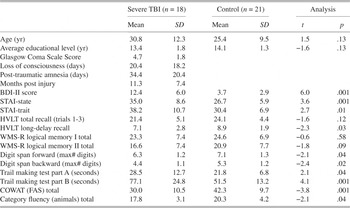
Demographic information, injury characteristics, and neuropsychological test summary data for control and TBI participants are provided in Table 1. Participant groups were comparable in age, education, and gender distribution χ2(1) = 1.86; p > .17 (TBI: 14 male/4 female; Control: 12 male/9 female). Compared with controls, participants with TBI endorsed more depression symptoms and higher levels of state and trait anxiety.Footnote 1
Demographic and Mean Summary Data for Severe TBI and Control Participants

Note
BDI-II = Beck Depression Inventory-2nd Edition; STAI = State Trait Anxiety Inventory; HVLT = Hopkins Verbal Learning Test; WMS-R = Wechsler Memory Scale-Revised Edition; COWAT = Controlled Oral Word Association Test.
Assessment of Cognitive Functioning
A brief battery of neuropsychological tests was administered to all participants. Measures administered included the Digit Span forward and backward subtests from the Weschler Adult Intelligence Test–Third Edition (Wechsler, Reference Wechsler1997), Trail Making Test Parts A and B (Reitan, Reference Reitan1958), the Controlled Oral Word Association Test [COWAT] and Category Fluency (Benton & Hamsher, Reference Benton and Hamsher1976), the Hopkins Verbal Learning Test--Revised (Brandt & Benedict, Reference Brandt and Benedict2001) and the Wechsler Memory Scale-Revised (WMS-R) Logical Memory I and II subtests (Wechsler, Reference Wechsler1987).
Computerized Experimental Task
Participants performed a modified version of the single-trial Stroop task (Stroop, Reference Stroop1935) wherein they were presented with one of three words (RED, GREEN, BLUE) printed in one of the same three colors at a visual angle of 3.65°. Congruent trials comprised words presented in their same color of ink (e.g., BLUE printed in blue ink); incongruent trials comprised color-words printed in a different color of ink (e.g., BLUE printed in red ink). Participants were instructed to respond as quickly and accurately as possible to the color of the word with a button press to one of three response keys using the index, middle, and ring fingers of their right hand. Color-to-key mapping was practiced before task performance using 40 presentations of each color-key combination. Trials consisted of a color-word presented for 1.5 s followed by a 1.5-s-duration fixation cross. Six blocks of 100 trials (600 total trials) were presented. To increase the potency of the conflict stimulus, 70% of trials were congruent and 30% were incongruent.
Electrophysiological Data Recording
Electroencephalogram was recorded from 64 scalp sites using a geodesic sensor net and Electrical Geodesics (EGI; Eugene, OR) amplifier system (20 K gain, nominal bandpass = .10–100Hz). Electroencephalogram data were initially referenced to Cz and digitized continuously at 250 Hz with a 16-bit analog-to-digital converter. A right posterior electrode approximately two inches behind the right mastoid served as common ground. Electrode impedance was maintained below 50 kΩ. Eye movement and blink artifacts were corrected using a spatial filtering method (Berg & Scherg, Reference Berg and Scherg1994; Ille, Berg, & Scherg, Reference Ille, Berg and Scherg1997, Reference Ille, Berg and Scherg2002) used through Brain Electric Source Analysis (BESA) software (Scherg, Reference Scherg, Grandori and Hoke1990). Data from the EEG were then segmented into condition-related epochs. Single trial epochs with voltages that exceeded 150 μV or transitional (sample-to-sample) thresholds of 100 μV were discarded. Electroencephalogram data were digitally average re-referenced and low-pass filtered at 15 Hz.
Event-related Potential Reduction and Measurement
Individual-subject stimulus-locked averages were derived for correct trials for each congruency (congruent, incongruent) and sequential trial repetition possibility (congruent-congruent, congruent-incongruent, incongruent-congruent, and incongruent-incongruent). Epochs spanned 100 ms before stimulus presentation and 900 ms following stimulus presentation. Data were baseline corrected using the 100 ms prestimulus window. Analyses of ERP data focused on selected electrode sites based on previous findings indicating that the ERP modulations of interest are relatively focal over fronto-medial (N450; Liotti et al., Reference Liotti, Woldorff, Perez and Mayberg2000; West & Alain, Reference West and Alain1999, Reference West and Alain2000) and centro-parietal sites (conflict SP; Liotti et al., Reference Liotti, Woldorff, Perez and Mayberg2000; West & Alain, Reference West and Alain2000), as well as the current scalp-distribution maps. The stimulus-locked phasic fronto-central N450 was quantified as the mean voltage between 450 and 500 ms at sites 4 (FCz), Ref (Cz), 5, and 55, while values for the more tonic conflict SP were measured as the mean voltage from 650 to 750 ms at electrode sites 34 (Pz), 38, 33 and 41 (Figure 1). Voltages for both components of interest were averaged across all four sites before analyses. Latency measurements for the N450 were indexed as the time of the peak negative-going amplitude between 400 and 500 ms. No latency measurements are provided for the conflict SP, as it is a slow, tonic component.
Sensor layout and international 10–20 equivalents of 64-channel geodesic sensor net (EGI; Eugene, Oregon). Solid-line circle indicates the recording sites averaged for the N450; dashed-line circle indicates the recording sites averaged for the conflict slow potential.

To assess the potential for nonspecific or generalized ERP amplitude decrements and/or latency shifts in TBI participant ERP waveforms, P1 amplitude and latency data were extracted. Both P1 amplitude and latency were quantified at the first peak positive deflection in the ERP between 50 and 150 ms for congruent and incongruent trials averaged across the bilateral locations of maximum P1 amplitude (average of posterior electrode sites 32 and 45—Figure 1).
Data Analysis
Median correct-trial RTs (Ratcliff, Reference Ratcliff1993), arcsine transformed error rates excluding nonresponse trials, and ERP component amplitude and latency data were analyzed using separate repeated-measures analyses of variance (ANOVA). Arcsine-corrected error rates were used to normalize the data due to a positive skew in the error-rate data (Neter, Wasserman, & Kutner, Reference Neter, Wasserman and Kutner1985). Error trials and trials immediately following errors were excluded from conflict adaptation analyses. The dependent variables were RTs, error rates, and ERP component amplitudes and latencies. The Huynh-Feldt epsilon adjustment was applied for ANOVAs with more than two levels of a within-subject factor to correct for possible violations of sphericity and partial-eta2 (η2) reported as a measure of effect size. Tests of between-group simple effects were used to decompose interactions, while planned comparisons were used to examine congruency effects within each group.
Initial analyses used two-factorial ANOVAs with group (TBI, control) as the between-subjects factor and congruency (congruent, incongruent) as the within-subject factor. To examine potential conflict adaptation effects, “congruency-related adjustment scores” were calculated by taking the incongruent minus congruent difference for trials preceded by a congruent stimulus (i.e., congruent-incongruent minus congruent-congruent trials) or an incongruent stimulus (i.e., incongruent-incongruent minus incongruent-congruent trials). Difference scores were then subjected to two-factorial ANOVAs with group (TBI, control) as the between subjects factor and “congruency-related adjustment score” (difference score for trials preceded by congruent trials; difference scores for trials preceded by incongruent trials) as the within-subjects factor. To assess the contribution of feature integration and associative priming effects, we re-analyzed RT and error- rate data excluding trials that repeated the same stimulus color or word. To examine the role of negative priming (Ullsperger et al., Reference Ullsperger, Bylsma and Botvinick2005), we excluded all trials where the color of the current-trial stimulus corresponded with the word of the preceding trial.Footnote 2
RESULTS
Behavioral Performance
Response times
Data for correct-trial RTs as a function of group, previous trial congruency, and current trial congruency are presented in Table 2. Analyses of RTs revealed the expected TBI-related generalized slowing, as reflected in a significant main effect of group, F(1,37) = 10.52; p < .002; η2 = .22. A main effect of current-trial congruency showed the anticipated RT interference, F(1,37) = 111.95; p < .001; η 2 = .75, with both groups showing longer RTs to the incongruent than congruent condition (i.e., the standard Stroop effect [TBI: t(17) = 6.60; p < .001; controls: t(20) = 9.43; p < .001]). The Group × Congruency interaction was not statistically reliable, F(1,37) = 2.97; p = .09; η 2 = .07, this is potentially due to a lack of sufficient statistical power in light of the other significant RT effects.
Mean RT (± Standard Deviation) for Congruent (C) and Incongruent (I) Trials as a Function of Previous Trial Congruency

Note
RT = response time; TBI = traumatic brain injury.
Of greater interest to the present study were the conflict adaptation effects. The Group × Congruency-Related Adjustment Score ANOVA yielded a main effect of adjustment score, F(1,37) = 135.32; p < .001; η 2 = .79, indicating a robust overall conflict adaptation effect was present across participant groups; however, the Group × Adjustment Score interaction was not significant, F(1,37) = 2.03; p > .16; η 2 = .05, indicating the magnitude of the conflict adaptation effect was similar between groups. Supporting this observation, planned contrasts indicated incongruent minus congruent trial RTs were greater following congruent than following incongruent trials for both TBI, t(17) = 7.49; p < .001, and control participants, t(20) = 9.32; p < .001.
Error rates
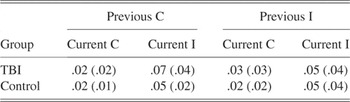
Data for mean error rates as a function of group, previous trial congruency, and current trial congruency are presented in Table 3. The Group × Congruency ANOVA indicated comparable error rates between groups, as the main effect of group was not statistically significant, F(1,37) = 1.10; p > .30; η 2 = .03. A significant main effect of current trial congruency, F(1,37) = 85.16; p < .001; η2 = .70, reflected Stroop error rate interference, with both groups committing more errors to the incongruent than congruent condition (TBI: t(17) = 6.43; p < .001; controls: t(20) = 6.57; p < .001). A nonsignificant Group × Congruency interaction, F(1,37) = .72; p > .40; η2 = .02, indicated similar error-rate profiles between groups as a function of congruency.
Mean Percent Errors (± Standard Deviation) for Congruent (C) and Incongruent (I) Trials as a Function of Previous Trial Congruency

Note
TBI = traumatic brain injury.
The Group × Congruency-Related Adjustment Score ANOVA on arcsine-corrected error rates yielded a main effect of adjustment score, F(1,37) = 7.71; p < .01; η 2 = .17, indicating the presence of a conflict adaptation effect when data were collapsed across groups (Table 3). The Group × Adjustment Score interaction, however, was not significant, F(1,37) = .58; p > .45; η 2 = .02.
Conflict Adaptation Alternatives
The pattern of results for the Group × Congruency-Related Adjustment Score ANOVA on RTs and arcsine-corrected error rates with both color and word repetitions removed was largely consistent with previous analyses. For RTs, a main effect of adjustment score remained, F(1,37) = 8.79; p < .005; η2 = .19, while the Group × Adjustment Score interaction was not significant, F(1,37) = 2.79; p > .10; η 2 = .07. For arcsine-corrected error rates, the main effect of adjustment score was not maintained, F(1,37) = .01; p > .98; η2 < .01, indicating the modest conflict adaptation effect on error rates reported above may be influenced by the repetition of color and word stimuli. The Group × Adjustment Score interaction remained nonsignificant, F(1,37) = .23; p > .63; η 2 = .006.
When negative priming trials were removed for analyses of conflict-adaptation RTs, there was a significant main effect of adjustment score, F(1,37) = 22.48; p < .001; η 2 = .38, while the Group × Adjustment Score interaction was not statistically significant, F(1,37) = 3.68; p < .07; η2 = .09. For arcsine-corrected error rates, the results were consistent with the original analyses. The main effect of difference score was significant, F(1,37) = 6.21; p < .02; η2 <.14, while the Group × Adjustment Score interaction was nonsignificant, F(1,37) = .08; p > .78; η 2 = .002.
Because the overall pattern of expected RT-related conflict adaptation results did not meaningfully change when color and word repetitions and negative priming trials were removed ERP analyses were conducted on all correct trials to maximize signal-to-noise ratio.
Event-related Potential DataFootnote 3
P1 amplitude and latency
A Group × Congruency ANOVA on P1 amplitudes revealed no main effect of congruency, F(1,37) = .34; p > .57; η2 = .009, no Group × Congruency interaction, F(1,37) = .78; p > .38; η2 = .02, and no main effect of group, F(1,37) = .33; p > .57. Latency data for the P1 component were similar, with no significant main effect of congruency, F(1,37) = .01; p > .92, no Group × Congruency interaction, F(1,37) = .44; p > .51; η2 = .009, and no main effect of group, F(1,37) = 1.19; p > .28; η2 = .03. Thus, data suggest that there is not a significant generalized amplitude decrement or latency shift in the ERPs as a function of congruency or in the TBI participants relative to controls.
N450 amplitude
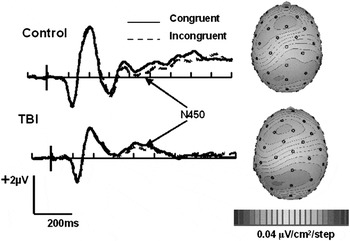
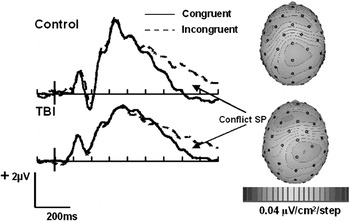
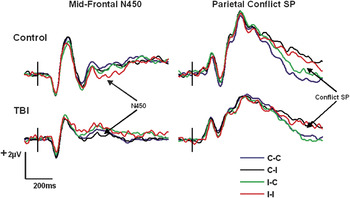
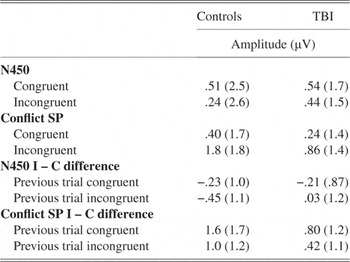
Stimulus-locked grand average ERP waveforms and spline-interpolated current source density maps for the fronto-medial N450 are presented in Figure 2; those for the conflict SP are presented in Figure 3. Grand average ERPs for both groups and each repetition category are presented in Figure 4. Mean (± SD) component amplitude data are presented in Table 4.
Grand average event-related potential waveforms of stimulus-locked congruent and incongruent trials averaged across fronto-medial electrode locations for the N450 (left) and top view of the spline-interpolated current source density incongruent minus congruent difference wave at 477 ms (right).

Grand average event-related potential waveforms of stimulus-locked congruent and incongruent trials averaged across posterior electrode locations for the conflict SP (left) and top view of the spline-interpolated current source density maps of the incongruent minus congruent difference wave at 711 ms (right). Conflict SP = conflict slow potential; TBI = traumatic brain injury.

Grand average event-related potential waveforms of stimulus-locked waveforms for congruent (C) and incongruent (I) waveforms as a function of previous trial congruency. Thus, C-C indicates a congruent previous trial and a congruent current trial, C-I indicates a congruent previous trial and an incongruent current trial, etc. Conflict SP = conflict slow potential; TBI = traumatic brain injury.

Mean (± Standard Deviation) ERP Amplitude (μV) Data for the N450 and Conflict SP Components. Differences Represent the Incongruent (I) Minus Congruent (C) Difference

Note
ERP = event-related potential; conflict SP = conflict slow potential; TBI = traumatic brain injury.
Examination of stimulus-locked ERP waveforms revealed a negative-going deflection that is more negative to incongruent than congruent trials. The Group × Congruency ANOVA on N450 amplitudes did not yield a significant main effect of current trial congruency, F(1,37) = 1.97; p > .16; η2 = .05; neither group showed reliable N450 amplitude differentiation of the incongruent and congruent conditions (TBI: t(17) = .58; p > .57; controls: t(20) = 1.38; p > .18). The main effect of group on N450 component amplitude was also not significant, F(1,37) = .03; p > .86; η2 = .001.
Consistent with the absence of congruency differentiation on N450 component amplitude, the Group × Congruency-Related Adjustment Score ANOVA on incongruent minus congruent difference scores did not demonstrate a conflict adaptation effect as evidenced by a nonsignificant main effect of congruency, F(1,37) = .002; p > .96; η2 = .001. Similarly, there was not a significant Group × Congruency interaction, F(1,37) = 1.25; p > .27; η2 = .03, nor a main effect of group, F(1,37) = .94; p > .34; η2 = .03. Planned comparisons on incongruent minus congruent difference scores confirmed the absence of conflict adaptation changes in N450 amplitude for both TBI, t(17) = .68; p > .50, and control participants, t(20) = .93; p > .36.
N450 latency
A Group × Congruency ANOVA indicated N450 peak latencies were similar for both congruencies, as reflected by a nonsignificant main effect of current trial congruency, F(1,37) = .45; p > .51; η 2 = .01. There were no group differences in N450 latency, with no significant Group × Congruency interaction, F(1,37) = .001; p > .97, or main effect of group, F(1,37) = .001; p > .96; η2 = .001. Similarly, there were no main effects or interactions involving group or congruency-related adjustment scores for N450 latency data, Fs < 1.05; ps > .31.
Conflict SP amplitude
Analyses of conflict SP amplitudes revealed a significant main effect of current trial congruency, F(1,37) = 22.81; p < .001; η2 = .38, as well as a significant Group × Congruency interaction, F(1,37) = 4.03; p = .05; η2 = .10. The current trial congruency effect reflected greater positivity to the incongruent than congruent condition; planned contrasts revealed the conflict SP was significantly more positive to incongruent relative to congruent trials in both controls, t(20) = 4.44; p < .001, and severe TBI participants, t(17) = 2.78; p < .01. The Group × Congruency interaction reflected a more positive conflict SP difference between congruent and incongruent trials for control participants relative to their TBI counterparts and was found in the absence of an overall main effect of group on conflict SP component amplitude, F(1,37) = 1.05; p > .31; η 2 = .03.
For conflict adaptation effects on the conflict SP, the Group × Congruency-Related Adjustment Score ANOVA on incongruent minus congruent trials yielded a significant main effect of adjustment score, F(1,37) = 4.61, p < .04; η2 = .11, consistent with the presence of a conflict adaptation effect on conflict SP amplitudes. The Group × Adjustment Score interaction was not significant, F(1,38) = .28; p > .60; η2 = .007. Planned contrasts indicated the conflict SP for the incongruent minus congruent difference was greater following congruent than incongruent trials for control, t(20) = 2.10; p < .05, but not TBI participants, t(17) = 1.04; p > .32.
DISCUSSION
We examined the behavioral and electrophysiological correlates of conflict adaptation in survivors of severe TBI and demographically matched controls. Behavioral data revealed the anticipated increases in RTs and error rates on incongruent trials relative to congruent trials (i.e., Stroop interference) for both TBI and control participants. Contrary to predictions, TBI and control participants did not differ in the magnitude of RT or error rate interference. Likewise, both groups showed a conflict adaptation effect wherein the incongruent minus congruent Stroop RT effect disproportionately decreased when preceded by incongruent relative to congruent stimuli. Error rates on incongruent trials similarly decreased when preceded by incongruent trials relative to congruent trials, but only when pooled across control and TBI groups. This modest conflict adaptation effect on error rates did not remain when color and word repetitions were removed. The pattern of RT-related conflict adaptation effects remained, however, when repetition and negative priming trials were excluded. Indeed, RT-related conflict adaptation effects decreased in magnitude when negative priming trials were removed, indicating that negative priming did not mask the conflict adaptation effect in the current data, as has been hypothesized as a possibility in previous studies (Ullsperger et al., Reference Ullsperger, Bylsma and Botvinick2005).
Survivors of severe TBI showed RT and error-rate conflict adaptation effects of similar magnitude to those of healthy control participants. These results, while somewhat surprising, are consistent with a recent study indicating patients with focal lesions to the rostral ACC following anterior communicating artery aneurysm demonstrated abolished conflict adaptation effects, while neurologically injured participants with more diffuse neural damage not specifically affecting the ACC showed conflict adaptation effects the same in magnitude to those of neurologically healthy controls (Di Pellegrino, Ciaramelli, & Ladavas, Reference Di Pellegrino, Ciaramelli and Ladavas2007). Several studies suggest an interplay between medial- and lateral-frontal cortices in monitoring for conflict and using conflict information to dynamically allocate cognitive control resources and improve task performance (Egner & Hirsch, Reference Egner and Hirsch2005; Hanslmayr et al., Reference Hanslmayr, Pastotter, Mauml, Gruber, Wimber and Klimesch2008; Kerns, Reference Kerns2006; Kerns et al., Reference Kerns, Cohen, MacDonald, Cho, Stenger and Carter2004). The presence of behavioral conflict adaptation effects that did not differ from those of healthy control participants in the current heterogeneous TBI sample—none of whom, to the best of our knowledge, experienced focal ACC lesions—indicates direct insult to the ACC (or potentially the dlPFC) may be necessary for disruption of conflict adaptation mechanisms. Supporting this view, West and Moore (Reference West and Moore2005) found conflict adaptation effects of similar magnitude between older adults with known cognitive control impairments (e.g., West, Reference West2004), but no direct lesion to the ACC, and neurologically healthy young adults.
Event-related potentials were used to temporally dissociate neural activity reflecting conflict monitoring and conflict adaptation. Consistent with predictions, the conflict SP differentiated congruent and incongruent trials. The conflict SP is thought to reflect regulative aspects of cognitive control, perhaps involving processes devoted to response selection, the resolution of response conflict, or signaling for increased implementation of attentional control (Liotti et al., Reference Liotti, Woldorff, Perez and Mayberg2000; Perlstein et al., Reference Perlstein, Larson, Dotson and Kelly2006; West, Reference West2003; West & Alain, Reference West and Alain2000). Whereas both healthy controls and participants with TBI demonstrated a clear conflict SP, control participants showed significantly greater differentiation between incongruent and congruent trials than participants with TBI. Considered in the context of previous studies indicating impaired conflict-related processing following severe TBI (e.g., Larson et al., Reference Larson, Kaufman, Schmalfuss and Perlstein2007a), this finding may indicate participants with TBI did not implement regulative control to the same extent as control participants to adaptively resolve the conflict inherent in the incongruent Stroop color-naming condition.
If, as suggested by cognitive control theory, the detection of response conflict signals for the recruitment of controlled regulative strategies toward adaptive resolution of this conflict, the conflict SP should be smaller on trials preceded by incongruent stimuli where increased attentional control has been implemented. Consistent with this prediction and our previous study (Larson et al., Reference Larson, Kaufman and Perlstein2009), there was a main effect of adjustment score based on previous trial congruency. That is, previous trial congruency significantly affected the amplitude of the conflict SP on the current trial. Survivors of severe TBI and healthy control participants showed a modest differential conflict adaptation response on the conflict SP. When only control participants were considered in a planned contrast, trials preceded by incongruent stimuli demonstrated decreased amplitude conflict SP relative to trials preceded by congruent stimuli. These results may indicate a subtle change in conflict resolution processes following severe TBI.
In contrast to previous findings from our laboratory (Larson et al., Reference Larson, Kaufman and Perlstein2009; Perlstein et al., Reference Perlstein, Larson, Dotson and Kelly2006), N450 amplitude did not differentiate incongruent and congruent color-naming stimuli regardless of preceding trial congruency. The reasons for the lack of differentiation are unclear, and are unlikely to be due to the EEG acquisition parameters, because we have successfully obtained the N450 in a previous study using the same recording parameters and task (Larson et al., Reference Larson, Kaufman and Perlstein2009), or to the modality of response (i.e., vocal, manual), as the N450 has been obtained using both response modalities (Liotti et al., Reference Liotti, Woldorff, Perez and Mayberg2000), or to latency differences between groups, as the N450 latency did not differ between groups. Thus, the absence of a clear N450 that differentiates congruencies limits our ability to make firm conclusions regarding the integrity of stimulus-related conflict detection processes. One possible explanation is that the study was slightly underpowered to detect the effects of interest, although we have seen significant N450 differentiation with only 11 TBI participants and 11 healthy controls in a previous study (Perlstein et al., Reference Perlstein, Larson, Dotson and Kelly2006). We refer interested readers to Larson et al. (Reference Larson, Kaufman and Perlstein2009) for an in-depth discussion of the potential role of the N450 in conflict detection and conflict adaptation processes.
Current findings suggest automatic priming and feature integration do not account for RT-related conflict adaptation effects, as such effects persisted in both control and TBI participants when repetition of color and word trials were removed. The conflict adaptation effect present for error rates when pooled across control and participants with TBI was diminished when repetition trials were removed. This may suggest errors are more sensitive to repetition priming effects than RTs; however, the initial findings of conflict adaptation effects in the error rate data were tenuous and not significant for either the control or participants with TBI alone. Thus, the reduction in the number of trials contributing to the conflict adaptation effects may have been sufficient to reduce the previously significant effect.
In summary, the present findings indicate behavioral conflict adaptation effects are similar for participants with heterogeneous TBI and their control counterparts. Findings, in concert with previous studies showing intact conflict adaptation effects in groups with known cognitive control deficits but no direct lesions to the ACC (Di Pellegrino et al., Reference Di Pellegrino, Ciaramelli and Ladavas2007; West & Moore, Reference West and Moore2005), may suggest direct insult to ACC- or other dlPFC-mediated cognitive control mechanisms are necessary for impaired conflict adaptation processes. The conflict SP component of the ERP was more sensitive to conflict adaptation effects in control relative to TBI participants, supporting the hypothesis of altered conflict resolution and signaling mechanisms following severe TBI.