


Shopping centres and cinemas have long been distribution nodes in the international consumer economy. Both underwent significant change through the twentieth century as they responded to external events, incorporated technological developments, introduced new business models and adapted to customer expectations. In the 1970s and 1980s, these urban forms of consumer capitalism came together with the establishment of multiplex cinemas within or attached to shopping malls.Footnote 1 This article uses an Australian industry definition of multiplexes being those cinemas housing six or more screens; those with 16 or more screens are termed megaplexes.Footnote 2 The conjunction of such complexes with shopping centre development is widely recognized, and there is a considerable literature on their usage, as well as broader analysis of the ways that cities themselves have been reshaped by the global entertainment economy.Footnote 3 Less attention, though, has been paid to the local social, economic, planning and business environments that allowed and influenced the shape of multiplex development in particular places – despite the often profound impact such development has had on the cultural economy of cities and the leisure pathways of their citizens.
Literature exploring the spatial distribution of multiplexes has tended to focus on business decision-making and the strategies of exhibitors. Davis, for example, examines the degree of cannibalization that has occurred with what is now commonly seen as the over-development of cinema screens in the United States, concluding that competitors have taken market share from one another.Footnote 4 Yamamura argues that in Japan multiplex development has been guided by a monopolization strategy with new developments occurring in geographical areas previously underserviced by exhibitors.Footnote 5 Elsewhere, Hubbard's study in the United Kingdom also underscores the importance of demand to exhibitors’ locational decision-making.Footnote 6 This article provides further evidence that demand for cinema spatially informs its supply, but suggests that in dense urbanized environments a range of competing interests intersect to influence the shape of this development process: Australian exhibitors, too, sought profitable sites close to large and under-serviced suburban populations, but had to operate within frameworks determined by a range of stakeholders. In his study of The Point at Milton Keynes, in the United Kingdom, Hanson has provided one of the most detailed examinations of the ways in which such interaction can inform multiplex development. There, a government-appointed development corporation drove the strategic agenda, securing the services of the United States’ firm, American Multi-Cinema, to develop the complex.Footnote 7
In this article, I expand on such work by examining cinema development across a city – Sydney, Australia. Observation at this level provides sufficient scale for observing multiple forces and interests, whilst still allowing local patterns to emerge. Further, such research contributes to the story of the city, explaining urban contours shaped by consumer capitalism, and identifying their linkage with particular imaginings and economic interests. Focusing on Sydney also allows for the specific mapping of development trajectories in a concentrated case-study, informing discussion of the broader Australian experience. In this article, the latter is outlined in the first two sections, setting the frame for the detail on Sydney that follows. The article shows that in this market, the emergence of multiplex cinemas echoed international developments, but also resulted from coalescing interests between local retail developers and film exhibitors, was guided by state-based planning legislation and shaped by escalating institutional investment in the retail industry. Retail developers pursued a share of the growing entertainment economy, encouraging exhibitors to open multiplexes in large-scale ‘regional’ shopping centres.Footnote 8 Exhibitors, for their part, sought to recapture a suburban audience lost to the home video market and to expand their distribution network from its concentration in the urban core. Superannuation funds and property trusts found both stability and regular returns in a form of property that was, to a degree, protected from competition by planning legislation and which held a steady income stream from tenant rentals that consistently recorded high levels of growth.Footnote 9 From the late 1980s onwards, these local forces formed a coalition of interests that combined with international influences to shape the pattern of cinema and retail property development in Australia.
A number of sources provide the evidence to map this history. There have been two excellent reports into the exhibition sector in Australia. The first, Developments in the Cinema Distribution and Exhibition Industry (1998), examined the competitive matrix of the industry; the second, Cinema in Australia: An Industry Profile (2013), emerged from a broader research project that explored the ways in which Australians access audio-visual stories.Footnote 10 Statistical data is available from the Federal Government agency Screen Australia, the Australian Bureau of Statistics and business directories. The narrative of change presented here, however, comes primarily from media and industry sources. The former provide commentary on business decision-making and the impact of development; the latter, insights into how and why these decisions were made. Industry journals have been particularly valuable for providing the voice of business leaders, executives and industry insiders in whom so much operational and strategic knowledge resides.
The appeal of multiplex cinemas to retail property developers
Enclosed, pre-planned shopping centres began being built in Australia in the late 1950s. They were a business response to suburbanization, high rates of economic growth, the expansion of consumer activity and rising car ownership.Footnote 11 As urban populations decentralized and became more dependent on private automobile transport, the traditional retail structure of the country's capital cities became unworkable.Footnote 12 City department stores lost custom while suburban retail precincts struggled to cope with traffic congestion.Footnote 13 Related issues had accompanied suburbanization in the United States, which brought the development of out-of-town shopping complexes that integrated parking with comprehensive retail mixes.Footnote 14 Australia was one of the first countries to follow the North American lead in developing stand-alone, pre-planned, internalized shopping complexes, with Australian developers making frequent investigative trips to the United States as they developed their own projects.Footnote 15
The Australian regional shopping centre thus came to incorporate many of the principles of its North American predecessor: it was a cohesively designed one-stop shop model, with convenient parking, air-conditioning, major store anchors and strategically selected and positioned specialty shops. It differed in its positioning and aspects of its design. Where the large-scale American mall was a luxury, leisure destination, the Australian regional centre catered to everyday needs with a tenancy mix that included supermarkets, specialty food outlets, everyday clothing stores and services.Footnote 16 Where the American mall tended to be located on greenfield sites by freeways, Australian shopping centres were initially constructed in established suburban environments, resulting in smaller footprints for both specialty stores and centres overall, closer integration with public transport and innovations such as decked car parking.Footnote 17 While some regional shopping centres took time to establish profitable trading levels,Footnote 18 by the 1980s they dominated the retail hierarchy of Australian capital cities.
The rise of shopping centres took place in an urban landscape being reshaped towards consumption.Footnote 19 Australia shared with other western economies a crisis in its manufacturing sector in the 1970s that followed the end of its post-war boom. One of the subsequent roads to recovery was increased investment in real estate and the cultural economy,Footnote 20 creating what Zukin has termed ‘landscapes of consumption’.Footnote 21 An example of the flow of finance that underpinned this reconfiguration of urban geographies was the investment by listed property trusts and institutional investors such as superannuation or pension funds in the retail industry.Footnote 22 Australian development companies such as Lend Lease and Westfield had set up their own property trusts in the 1970s while continuing to develop and manage completed shopping centres.Footnote 23 And when the Commonwealth Superannuation Act 1976 introduced amendments that allowed superannuation funds to invest in property, the door was opened for new avenues of institutional investment in shopping centres.Footnote 24
Established rental incomes and solid growth potential made retail property particularly appealing to institutional investors.Footnote 25 Frank Lowy, the co-founder of Westfield, Australia's most successful retail development company and the world's largest retail property group by equity market capitalization, claims that shopping centres have been safer, more profitable investments than other property assets because long-term leases with major tenants provided security, while Australia's state-based zoning regulations shielded complexes from rival developments.Footnote 26 By the early 1990s, property trusts and superannuation funds owned the majority of regional centres in Australia.Footnote 27 The investment capital flowing into the industry from property trusts and superannuation funds, especially after the introduction of compulsory superannuation in 1992, provided retail developers with ongoing opportunities for expansion, further consolidating their position in the retail hierarchy of Australian cities.Footnote 28 Between 1995 and 2005, the gross lettable retail area of regional shopping centres in New South Wales (NSW) – the Australian state of which Sydney is the largest city and capital – and the Australian Capital Territory (ACT) (which the Australian Shopping Centre Council grouped with NSW for statistical purposes) rose from 1,291,374 to 2,362,989 square metres.Footnote 29
Lowy's point concerning the protection offered by planning legislation is important, as this shaped not only the spatial distribution of regional shopping centres but, later, the locations of multiplex cinemas. Major retailers pursuing suburban branch decentralization had largely determined site selections for large-scale shopping centres built in the 1960s in Sydney.Footnote 30 These centres were established via approval processes through local municipal governments under the auspices of the County of Cumberland Planning Scheme (1951). This was the country's first statutory plan for a capital city, and employed land-use zoning and local government planning schemes in an attempt to manage growth and encourage decentralized development.Footnote 31 The scheme identified a number of existing suburban district centres with the potential to grow and accommodate projected population increases.Footnote 32 However, implementation was difficult, not least because local councils had to finance many of its initiatives and baulked at developing their own local planning schemes. As a result, Allport has argued, ‘the only successful decentralisation of services that did occur under the Cumberland Plan was the decentralisation of shopping centres’.Footnote 33 This occurred through ad hoc development along high streets, as well as, by the late 1950s, via pre-planned, privately owned projects as developers pursued opportunities in rapidly growing suburban areas.Footnote 34
The Sydney Region Outline Plan (SROP) (1968), which followed the Cumberland Scheme, further reinforced the importance of such locations, determining that all new major commercial and retail developments should be located in established suburban centres that were served by rail. This new principle was initially resisted by the retail property sector, but ‘state planners successfully convinced successive planning ministers that this was a sensible long term strategy to enable suburban centres to evolve into comprehensive regional and sub-regional employment, cultural and recreational nodes’.Footnote 35 In response, the private sector developed or expanded existing regional shopping centres in the SROP-nominated centres. SROP's guidelines thus brought a closer integration between regional shopping centres and Sydney's rail network, as well as positioning major 1970s centres adjacent to, or nearby, existing retail precincts that had grown organically around public transport hubs.Footnote 36 It also had the effect of limiting competition because of the shortage of sites that could meet such requirements. With their investments protected by planning legislation, developers expanded established sites, many of which were positioned on railway hubs in the heart of municipalities.
This is not to suggest that the SROP was uniformly implemented: Macquarie Centre (1983) and Westfield Eastgardens (1987), for example, were not located in designated regional hubs and changes in bus routes and scheduling were required to improve public transport to each complex.Footnote 37 Both developments were approved following intervention ‘from above’ in local government decisions. The State Planning Authority approved Macquarie Centre after the instigating developer, the Grace Bros. department store firm, appealed a municipal council decision rejecting the proposal;Footnote 38 construction of Westfield Eastgardens proceeded after the NSW state government introduced legislation designed to render invalid an appeal against the development then underway in the Land and Environment court.Footnote 39 These new developments, in conjunction with the redevelopment and expansion of existing sites, had the effect of expanding trade areas and increasing competition.
A considerable body of both academic literature and industry research, usually traced back to Huff's analysis in the 1960s, has examined the operation of trade areas and the spatiality of consumer demand in relation to shopping centres.Footnote 40 In the UK, Dennis argues that consumer preferences ‘are moving towards larger shopping centres’.Footnote 41 In Australia, Baker has shown that the scale of centres, and the corresponding range of tenants housed within them, has a relationship to the size of their trade area: consumers are willing to travel further to larger centres because of the advantages they gain from greater shopping opportunities and choice.Footnote 42 Further, Dennis has demonstrated, it is different characteristics of shopping centres, rather than different consumer profiles, that drive customer visitation patterns.Footnote 43 As Sydney's regional shopping centres expanded, their trade areas began to overlap, which created direct competition between one another. The development of more sophisticated environments that offered a greater range of stores and entertainment facilities including multiplex cinemas thus provided, initially, an avenue of differentiation and, subsequently, a means of competing with rival centres.Footnote 44
These 1990s expansion programmes followed a long period of relative gloom amongst retailers. In the 1980s, the imposing façades of regional shopping centres stood as emblems of car-based retail activity across Sydney's suburban landscape. They were hubs of commerce and social space, and had marginalized many traditional strip-shopping precincts. But even from within these bustling commercial epicentres, the retail industry was widely viewed as depressed, with changes in consumption patterns identified as a contributing factor.Footnote 45 Australian Bureau of Statistics (ABS) figures show a general growth in recreational spending between 1984 and 2010. More significantly, they indicate that purchases in a number of staple product areas decreased as a percentage of total spending over this same time period: food and non-alcoholic beverages dropped from 19.7 to 16.5 per cent; clothing and footwear, from 6.5 to 3.6 per cent; and household furnishings and equipment, from 7.7 to 4.7 per cent.Footnote 46 By adding multiplex cinemas to tenant mixes, retail property developers strategically broadened their sites’ appeal by pushing into other, growing, categories of consumer spending.Footnote 47
The attractions of the mall for exhibitors
Suburban multiplexes were also a key development for the Australian exhibition industry, which, as with its counterparts internationally, had long been conditioned by environmental and technological forces.Footnote 48 In the 1920s, movie-going was the most popular form of entertainment in the country. While attendances remained relatively high during the 1930s Depression, upmarket cinemas struggled to maintain their grand stalls and dress circles, out-competed by smaller, cheaper rivals. World War II brought a recovery and, after a small post-war decline, attendance remained relatively stable. In 1953, three years before the introduction of black and white television to Australia, there were 15.7 cinema admissions per head of population in the country. Klinger has shown that since its inception cinema has always held a presence in domestic space,Footnote 49 but this provided scant competition compared with the scale of television consumption, which brought an immediate and significant impact. Per capita annual attendance dropped to 6.1 in 1962, and 3.8 in 1969 before recovering a little to 5.0 in 1974. With the arrival of colour television in 1975, annual cinema admissions in Australia dropped to 2.1 per head of population.Footnote 50
In 1976, videocassette recorders (VCRs) were introduced to Australia. By 1983, one in every six Sydney households owned or rented one. More than half of these played at least two videos a week, which further impacted on admissions. The growth of VCR ownership in other countries such as the United Kingdom and United States brought similar declines in movie attendance and increasing amounts of time spent on home-based leisure.Footnote 51 Echoing cinema in its heyday, video offered cheap, accessible, escapist entertainment, with areas of high unemployment recording correspondingly high levels of video usage.Footnote 52 Collins argues that the comfort and convenience of video movie-watching was a natural fit for suburbia: an environment centred on the home and socially constructed around the nuclear family, which was increasingly time poor with the growth of women's participation in the paid workforce.Footnote 53 While shopping centre operators sought a greater share of the entertainment dollar, then, cinemas faced competition from within the audio/visual entertainment industry itself. Managing director of the Greater Union exhibition chain, David Williams, argued that exhibitors were in ‘a major fight against a drive to turn the lounge room into the ultimate entertainment centre’, and that in response they had to offer ‘something better’: that was, multiplex cinemas.Footnote 54
In the United States, a very gradual uptake from the first multiscreen complex in 1964 turned into a wave of development through the 1980s when almost 7,000 new screens were added to sites across the country.Footnote 55 From the late 1970s multiplexes were introduced to malls, and between 1980 and 2000 the number of screens in the United States jumped from 17,590 to 37,396.Footnote 56 The model was emulated in other markets and out-of-town multiplexes became the dominant form of cinema construction in industrialized countries.Footnote 57 By most accounts, they reinvigorated the exhibition industry, turning around a long downward trend in attendances.Footnote 58 Australia was one of the first countries to introduce the American multiplex model, and to a large degree copied its rationalized, functional design, albeit on a smaller scale.Footnote 59
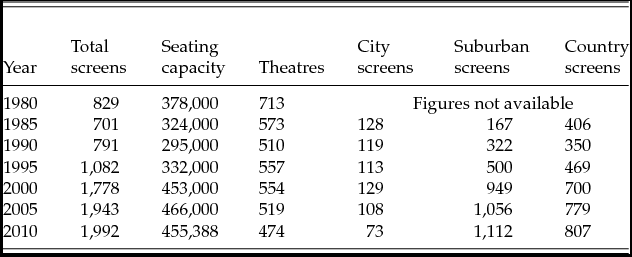
The decline in Australian cinema attendance figures during the early 1980s was undoubtedly influenced by the growth of home video. Video's competitive strength, however, needs to be considered in light of the country's distribution of cinema screens.Footnote 60 As Table 1 shows, in the mid-1980s cinema screens were, if one considers Australia's population distribution, disproportionately located in the hearts of major cities.Footnote 61 After more than 30 years of suburban sprawl, when middle and outer-ring suburbs were still attracting the highest rates of population growth, and inner-city areas had declining or stagnating populations,Footnote 62 the latter still housed 43 per cent of total metropolitan screens in Australia.Footnote 63 In such an imbalanced network, the convenience of video was magnified, requiring exhibitors to confront their spatial disadvantage by decentralizing screen distribution. The multiplex development that followed brought cinema – according to the chairman of the Motion Picture Distributors’ Association of Australia – ‘back to the people. In the suburbs. . .with good screens, good sound and parking.’Footnote 64
Australian cinema screens by location 1980 to 2010

Source: Screen Australia, www.screenaustralia.gov.au/research/statistics/cinema.aspx, accessed 30 Aug. 2014.
Multiplex development transformed screen distribution in Australia. Table 1 indicates a considerable increase in the total number of screens between 1980 and 2010, even as the number of theatres housing them declined. Capacity climbed in the 1990s with a big increase in the number of screens, although theatre numbers never recovered. The total number of screens more than doubled over the period.Footnote 65 The overall increase in screens and decline of theatres indicate closures of small single and twin screen operations. This included some iconic independent cinemas that failed to attract sufficient patronage to compete in the multiplex era – although two national chains, Palace and Dendy, emerged with multi-screen theatres exhibiting a mix of mainstream, art-house and foreign-language films.Footnote 66 The other big change indicated in Table 1 is the growth in suburban screen numbers, driven by multiplex and then later megaplex development. In 1980, there were 128 screens located in major cities. This dropped to 73 in 2010, even as suburban screens rose from 167 to 1,112. This distribution of screens is reflected in box-office takings. Between 1988 and 2010, Australian suburban box office shares increased from 31 per cent ($68.5 million) to 63 per cent ($710 million) of total receipts. The city, by contrast, declined from 39 per cent ($87 million) to 6 per cent ($72.6 million) over the same period, with the remaining 29 per cent taken in country areas.Footnote 67
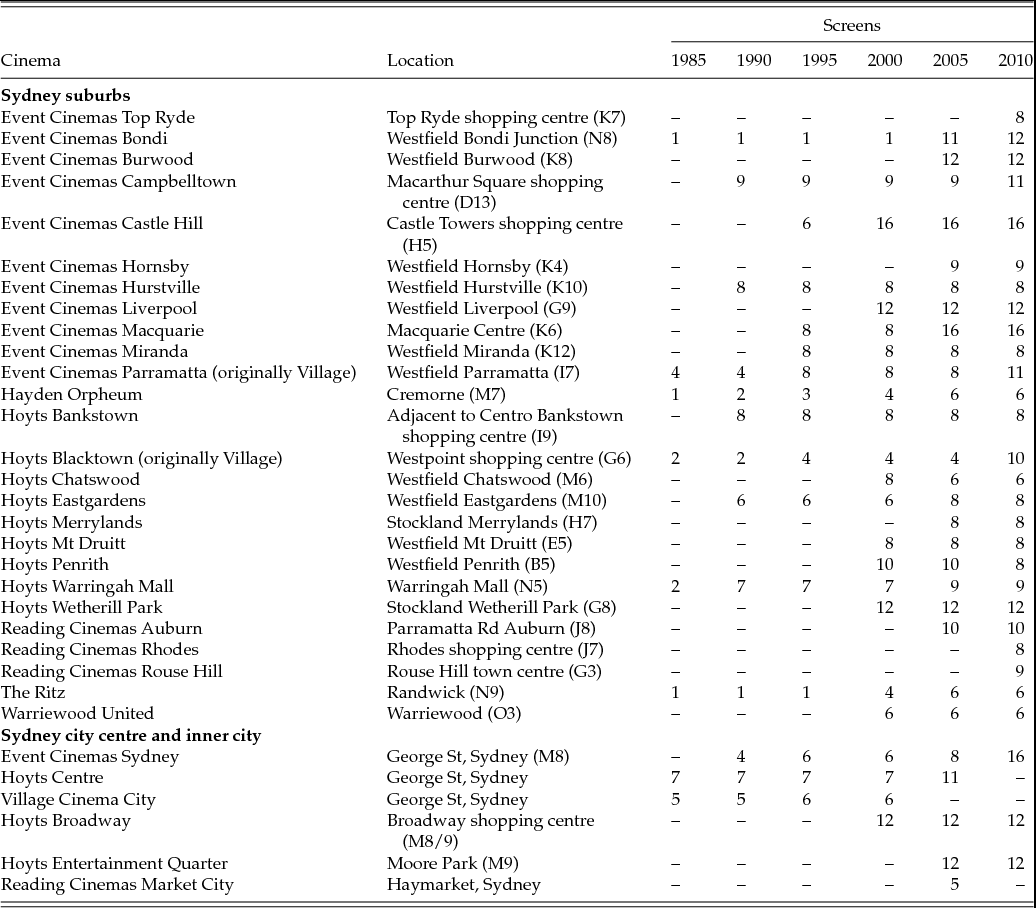
Multiplex development in Sydney began in the centre of the city during the 1970s. While twin and quad complexes began appearing in the suburbs during the 1980s, it was not until later in the decade that suburban multiplexes emerged. By the mid-1990s, multiplexes were being used to reposition many of the city's regional shopping centres (see Table 2). For exhibitors, shopping centres were close to their market and provided strong existing infrastructure. Their substantial parking stations and existing footprints made development approvals easier to obtain and allowed for relatively low up-front construction costs.Footnote 68 Arrangements varied in detail, but the general pattern was for retail developers to build an outer shell as part of a site redevelopment, with a major exhibitor paying for the auditorium itself and all the equipment and facilities within it.Footnote 69
Locations and screen numbers of Sydney multiplexes, 1985 to 2010
Note: grid references to Figure 1 are contained in the Location column.
Sources: The Encore Directory (Chatswood, 1995, 2000, 2005, 2010); BOMA, Directory of Shopping Centres: New South Wales and Australian Capital Territory (Sydney, 1985, 1990).
Development was dominated by a powerful duopoly: Hoyts built 10 multiplexes across Australia between 1986 and 1991, and a partnership formed by Greater Union, Village and Warner Brothers pursued them with 11 between 1989 and 1991.Footnote 70 Shopping centre operators had a clear preference for these major players, with independents very rarely succeeding in gaining leases. Even the major US group, Reading Cinemas, was frustrated in its attempts to enter the market. Its initial strategy of constructing free-standing complexes and surrounding them with bookshops, restaurants and other family-style amusements was frustrated by Australian state planning laws which required cinemas to open in shopping centres or within designated town centres.Footnote 71 Reading also faced considerable opposition from the major Australian exhibitors that contested virtually every development application it submitted.Footnote 72 After entering Australia in 1995, Reading did not manage to install a shopping centre multiplex in Sydney until the opening of GPT Group's Rouse Hill Town Centre in 2008.Footnote 73
The relationships between shopping centre developers and the largest exhibitors continued the former's historical association with big retail and chain stores. Lizabeth Cohen has noted the American industry's preference for chains and franchises, and it was a similar story in Australia, Britain and Canada.Footnote 74 Institutions such as superannuation funds, which as we have seen expanded their role in the Australian industry through the 1970s and 1980s, were geared towards risk management and regular returns.Footnote 75 They exercised a conservative influence on tenancy selection: once major anchors had been established, developers sought chains and franchises with proven success records to fill the majority of specialty shop leases.Footnote 76 Hoyts and Greater Union had a guaranteed supply of blockbuster films because of their strong market position and their relationship with distributors: Australia's largest distributor, for example, Roadshow Film Distributors, was owned by Greater Union and Village, providing a vertically integrated supply line to their multiplex outlets.Footnote 77 There were also cases of overlapping interests: Lend Lease had held since the 1980s a significant stake in Hoyts, which established cinemas associated with malls owned by Lend Lease's General Property Trust such as Bankstown Square.Footnote 78 Lend Lease, however, was not consistent in its allegiance to Hoyts and the ongoing sale and purchase of whole or part-ownership of shopping centres by the major retail developers and financial institutions, combined with anchor tenants’ long leases, complicates any attempt to trace patterns of association between particular retail property owners and the two major exhibitors.
Locations and screen numbers of Sydney multiplexes
An examination of Sydney offers a case-study in how these broad Australian trends operated at a local level. Table 2 shows that in Sydney more recently developed complexes tended to have more screens, while some earlier cinemas added more in expansion programmes. With strong economic growth through the 1990s, living standards rising at the highest rates since the 1960sFootnote 79 and entertainment expenditure climbing, 12 screens became the norm for new complexes by the end of the decade. In September 1999, Greater Union launched the city's first megaplex in Castle Towers shopping centre, adding 10 screens to bring its total to 16.Footnote 80 Castle Towers was situated in Castle Hill in Sydney's booming north-west sector, renowned for its ‘McMansion’ housing developments. The area had high disposable income levels, with the shopping centre recording, for four years running in the late 1990s, the highest sales turnover per square metre of retail space in the country.Footnote 81 Already one of Greater Union's most successful Sydney sites, in the first week of opening a spokeswoman claimed it was the busiest cinema in Australia.Footnote 82
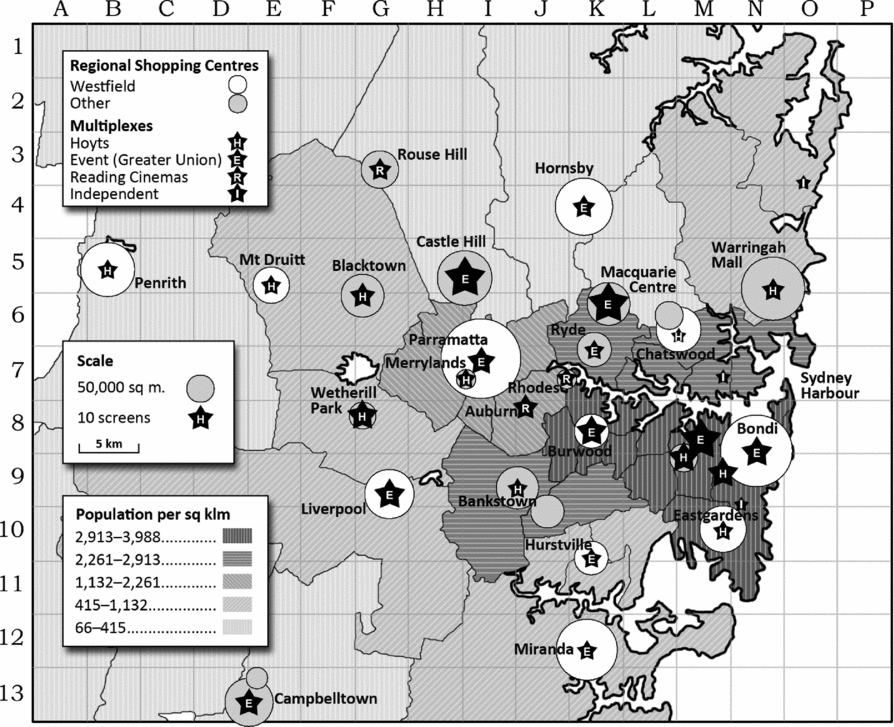
Figure 1 indicates the location of Sydney's multiplex cinemas and regional shopping centres in 2010. The only multiplexes outside of the inner city not inside or adjacent to shopping centres were Reading's Auburn complex (J8), Warriewood United on the Northern Beaches (O3), The Ritz at Randwick (N9) and the Hayden Orpheum at Cremorne (M7). The latter two were both 1930s cinemas that were redeveloped into multiscreen operations by private owners who identified this as the only profitable means of operation. Both offered a combination of alternative, classic, foreign language and mainstream products to appeal to affluent local markets. Warriewood United was also privately owned. Located approximately 15 to 20 minutes drive from the closest regional shopping centre, Warringah Mall, it was constructed in 1999 to meet demand on Sydney's affluent upper Northern Beaches.Footnote 83 Reading's Auburn multiplex resulted from its ongoing efforts described above to establish an Australian foothold.
Locations of Sydney multiplexes and regional shopping centres, 2010
Sources: The Encore Directory (Chatswood, 2010); BOMA, Shopping Centre Directory NSW & ACT (Sydney, 2010).
The remaining suburban multiplexes were all conjoined with major shopping centres. Early developments, such as at Westfield Eastgardens (M10), Warringah Mall (N5) and Westfield Hurstville (K10) were located in middle-ring suburbs, but this should not be taken as a rigid pattern. Circumstances played a significant role in the chronology of development. Eastgardens’ cinemas were a logical inclusion for a new centre that opened in 1987 at the cusp of the developmental turn towards entertainment anchors. Warringah Mall's multiplex (1990) was a redevelopment of a successful Hoyts Twin complex that had been operating since 1975, and so can be seen as an expansion in an established market.Footnote 84 Another 1990 opening, Greater Union's multiplex at Macarthur Square, Campbelltown (D13), continued Lend Lease's substantial investment in the area.Footnote 85 At the time, Campbelltown, a designated satellite city at the south-west extremity of the Sydney region, had a relatively small population to support a major retail and entertainment complex.Footnote 86 Having built Macarthur Square and invested heavily in surrounding residential developments, Lend Lease saw the multiplex as a final touch in establishing the complex as the prime commercial and entertainment centre in south-west Sydney.Footnote 87
By the 1990s, exhibitors in Australia had adopted a trading area model informed by the retail property industry, defining their market by driving time to their complex. Most claimed that moviegoers would not drive more than 20 minutes to a suburban cinema complex, and identified their market as a geographic area within around 10 kilometres of their site.Footnote 88 This, the desire to avoid direct competition with the other major exhibitor, planning legislation and the advantages of shopping sites that have been described above, explains the relatively dispersed distribution of multiplexes across the city. There are some anomalies. The Greater Union multiplex in Stockland Merrylands (H7) is only four kilometres from the older Hoyts complex in Westfield Parramatta (I7). Stockland was a major developer, but operated smaller centres than Westfield, and was later in introducing cinemas. It joined the response to shifting consumer expenditure patterns by introducing cinema complexes from the late 1990s.Footnote 89 The Merrylands multiplex, then, should be seen as a competitive challenge to Westfield's dominance of the Parramatta trading area, and was part of the Stockland centre's expansion from a sub-regional into a regional complex. Reading Cinemas, Auburn (J8), is also only six kilometres from the heart of Parramatta. Its location reflects Reading's late entry into the market and its willingness to challenge the market leaders.
In the city centre, the concentration of multiplexes was part historical: the 1976 Hoyts multiplex had been joined by Greater Union and Village complexes to form a cinema precinct in George Street (M8), at the southern end of Sydney's central business district. With the rise of suburban multiplexes and the decline in city audiences, the Village complex closed and joined with Hoyts to redevelop its complex into an 11-screen venue in 2000.Footnote 90 Conjoined brands in a shared facility became problematic almost immediately, beginning with disagreement over its name, and in December 2005 Greater Union took control of this consolidated complex that was adjacent to its own. Greater Union, which changed the branding of all its theatres to Event Cinemas in 2009, thus became the sole occupant of the city's traditional cinema precinct with a 16-screen complex.Footnote 91 While this represented only a small reduction of the precinct's screens since the mid-1990s, such ownership rationalization reflects the challenges that large-scale suburban development brought to bear on operations in the city centre.
Just beyond the city core, however, demographic shifts encouraged a late wave of inner-city multiplex construction with the development of Hoyts Broadway (M8/9), Hoyts Entertainment Quarter (M9) and Greater Union Bondi (N8) in the late 1990s and early 2000s. While the last catered to a historically affluent and densely populated market in the city's eastern suburbs, the Broadway and Entertainment Quarter complexes both serviced a growing inner-urban, gentrified demographic. By the 1990s, the population decline in Sydney's urban core had been reversed;Footnote 92 as the economic base of the city shifted to the service sector, tourism boomed and the city ‘established itself as a major financial and corporate centre’.Footnote 93 Government support for brownfield development to limit the costs of sprawl, and entrepreneurial construction by developers brought a considerable increase in apartment stock in a number of inner suburbs. The population of Pyrmont, for example, grew from 1,590 in 1981, to 4,615 in 1996, and to 14,165 in 2001.Footnote 94 This expanding market provided a base for both retail and cinematic development: the Broadway Shopping Centre was developed in nearby Glebe through the conversion of a disused 1920s department store building and, when opened in 1998, included a 12-screen multiplex.Footnote 95 Where early multiplex development had targeted latent demand in under-serviced suburban areas, later developments such as Hoyts Broadway followed demographic change more immediately because the exhibition sector had established organizational capabilities for multiplex development and co-operative relationships with the retail property industry.
The impact of multiplex development
Doyle has argued that the accessibility that multiplexes created through regular screenings in smaller more numerous cinemas recreated the ‘habit’ of cinema-going in Britain.Footnote 96 In Australia also, a marked increase in movie visits has accompanied multiplex development: annual cinema admissions per head of population increased from 1.9 at the peak impact of video rentals in 1985 to 3.9 in 1995 and as high as 4.7 in 2002.Footnote 97 Changes in production, most notably through blockbusters, have played an important part in this resurgence. Designed for a mass audience, using cutting-edge special effects, promoted through saturation marketing and distributed via simultaneous release on a huge scale,Footnote 98 the blockbuster was relied upon heavily to compete against home video.Footnote 99 These were largely United States’ productions, but there were also breakout, lower-budget, Australian-made hits such as Crocodile Dundee (1986) and Strictly Ballroom (1992).Footnote 100
However, the attraction of multiplexes as new, technologically sophisticated cinema environments in convenient locations also remains central to understanding exhibitions’ 1990s revival, not least in allowing ‘latent demand to be satisfied’.Footnote 101 In Sydney, cinema development had not kept pace with changes in the urban framework of the city. When exhibitors moved to suburban locations through shopping centre multiplex development, they regained access to the bulk of the city's population. A detailed examination of this cinema-going demographic sits beyond the scope of this article, but there are some trends worth noting. Young people are a key demographic, with 18- to 24-year-olds more likely than any other age group to visit the cinema. In the mid-1980s, 82 per cent had visited a cinema in the previous 12 months. In the late 1990s, 92 per cent of 18- to 24-year-olds had visited the cinema over the previous year. Since then, this figure has declined to 86 per cent, most probably due to competing technologies. The most significant long-term change, though, is amongst older consumers, particularly for those over the age of 50, where attendance has been growing since the mid-1980s. This has been attributed in part to an aging baby boom generation that experienced the emergence of blockbusters in its youth, but it also reflects the comfort and convenience offered by suburban multiplexes, as well as the ways the industry has employed screen numbers, session times, branding and product mix to strategically target audience segments.Footnote 102
Despite these competitive advantages and strategies, a fragmenting distribution market has operated to restrict further admission growth.Footnote 103 From their peak in 2002, admissions began to fall, settling at an average of around four visits per head of population per annum between 2005 and 2010.Footnote 104 Since then, they have fallen further to an average of 3.5 visits in 2013 as competing technologies such as DVDs, the internet, video games, pay TV and home theatre systems have shifted cinema's ‘material bases and exhibition contexts’.Footnote 105 Such changes require further research, but they do emphasize the vertical and horizontal continuities that have developed through and across the supply chain, as mainstream blockbusters have been reconfigured as a core product around which a variety of distribution channels are leveraged to sell a diverse range of consumables to ‘media-saturated households’.Footnote 106 Exhibitors were only one group of stakeholders operating within this dynamic, functioning as an outlet for the central filmic brand but in at least partial competition with some of its ancillary products.Footnote 107 Whilst such fragmentation of distribution carries a variety of cultural, social and economic resonances,Footnote 108 in terms of the focus of this article, it also further emphasizes the spatial imperatives that brought multiplexes closer to cinematic markets.
Conclusion
In the 1960s, retail developers pursued their customers out of central Sydney, uncomfortably aware that a car-dependent population domiciled in the suburbs had moved beyond their reach. The largest cinema exhibitors faced a similar dilemma in the 1980s and were prompted into action when video brought a further decline in a long downward trajectory of attendance. Suburban multiplex development revived cinema-going and added further weight to the competitive strength of malls. For retail developers, multiplexes provided an anchor through which they could reposition their sites as entertainment and leisure destinations to complement their strong retail offer. Incorporating cinemas brought to the mall people who might not otherwise have visited,Footnote 109 reduced the ‘down-time’ of shopping centres by extending their trading hoursFootnote 110 and provided direct income from rents, which were charged as a percentage of box office sales.Footnote 111
Multiplexes are ‘everywhere’ spaces, with standardized designs, most often showing movies produced for global mass consumption, but they are situated and built within particular urban frameworks. The multiplex form held advantages in delivery, convenience and quality that were shared internationally. When conjoined with regional shopping centres in Australia, multiplexes brought cinema closer to its largest market, in a familiar and accessible environment, with parking and an array of additional retail and service offerings. By examining such patterns in Sydney – by mapping them to a specific urban environment – this article has explored how this translated at a local level. While following international and national trends, multiplex development in Sydney had its own history. Suburban multiplexes were, until recently, established largely within regional shopping centres, distributed fairly evenly across the metropolitan area and with a few exceptions owned by one of two dominant major chains. While showing much of the same content, they were built later and were smaller than the American models on which they were based. Local investment priorities, business synergies, planning policies and demographic shifts, then, gave particular shape to the establishment of the global, multiplex urban form in Sydney, Australia.