The commentaries on our original paper are interesting and informative. That of Malcomson illustrates nicely the costing and case-mix issues that are critical to the successful design of activity-based funding arrangements. The second commentary describes some more general issues and the scope for reformers to learn from international experience.
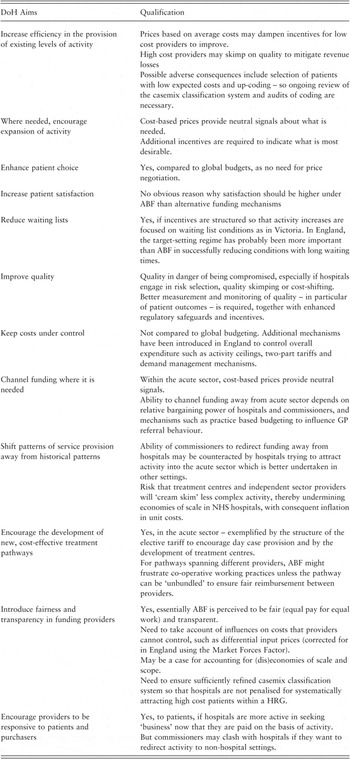
The policy documents put out by the English Department of Health (DoH) relating to Payment by Results list an array of ‘key’ objectives that the funding reform is designed to achieve (Miraldo et al., Reference Miraldo, Goddard and Smith2006), which are listed in Table 1 together with some qualifying statements. Of course, if activity-based funding was easily able to achieve all of these objectives, no country would be slow in adopting it – yet England is fully 20 years behind the United States in introducing these payment arrangements. It is also notable that many other policy initiatives cite a similar list of desirable objectives. Rarely are these objectives ranked by priority and often insufficient consideration is given to the possibility that policies that advance some objectives may frustrate others.
Stated aims of activity-based funding – with qualifications

Activity-based funding does have advantages over the alternatives of cost-based reimbursement and global budgets, notably in linking hospital revenue much more closely to activity and in allowing greater transparency in funding arrangements.
But the extent to which these advantages improve efficiency depends on the specific form that activity-based funding takes, and how prices are set. Prices (tariffs) could simply reflect the (average) costs of existing practice, as they do in England. In this case, activity-based funding would encourage hospitals to ensure that their costs were below average. As we have argued, this pricing rule would take the existing mix of services as given and appropriate.
But tariffs could play a more extensive role, so that they are analogous to prices in most markets. Usually (market) prices provide important signals to producers about the demand for particular services – if there is under-provision, prices rise, thereby encouraging providers to expand provision. Prices in the health system could be regulated in a similar way if there is evidence that some treatments are being under-supplied. Prices, therefore, can be used as a policy instrument to signal what the health system should be doing and to sharpen incentives so that good practice is rewarded and emulated. Use of such normative pricing requires careful piloting and evaluation.
Activity-based funding can lead to unintended consequences if case-mix descriptors and payment arrangements are not sufficiently well defined. For instance, activity-based funding may compromise quality by encouraging hospitals to be overly cost conscious, leading them to cut corners or shift costs on to other contributors to the care process, such as GPs. It might also lead to cost inflation, particularly in comparison to global budgeting arrangements. To guard against such behaviour, activity-based funding has to be supplemented by additional regulatory mechanisms, such as activity ceilings, marginal pricing, data audit, monitoring of care processes, and measurement of patient satisfaction and health outcomes.
The English form of activity-based funding needs a much clearer definition of the priority objectives it is intended to achieve. Clearly the many aims listed in Table 1 cannot be met by a single policy instrument. Payment by Results also needs to be integrated much more coherently with the many other regulatory interventions that have been subjected upon the NHS over the last decade under a banner of ‘System Reform’. Reformers have to demonstrate that these various policies improve efficiency in terms of their impact, particularly on patient outcomes, and cost. Fixing prices is relatively straightforward. But as the articles in this debate suggest, the true challenges are in defining a fixed price payment regime that is fair, rewards desired behaviour, and complements other policies. A further challenge is to refine this regime as evidence emerges about its intended and unintended effects.