Introduction
Schizophrenia is a chronic brain disorder with a 70%–90% heritability (I. I. Gottesman, Reference Gottesman1991; Hilker et al., Reference Hilker, Helenius, Fagerlund, Skytthe, Christensen, Werge and Glenthoj2018; Sullivan, Kendler, & Neale, Reference Sullivan, Kendler and Neale2003). It is, therefore, instructive to estimate heritability for putative pathogenetic processes, such as brain connectivity (Kochunov et al., Reference Kochunov, Fu, Nugent, Wright, Du, Muellerklein and Hong2016), and associated cognitive impairments (Hubbard et al., Reference Hubbard, Tansey, Rai, Jones, Ripke, Chambert and Zammit2016). Since schizophrenia may be a disconnection syndrome (Friston & Frith, Reference Friston and Frith1995), impaired connectivity could be a heritable component. Diffusion tensor imaging (DTI) has been used extensively to investigate white matter (WM) connections. DTI characterizes anisotropy of water diffusion to examine anatomical connections using the principle that water diffuses preferentially along the longitudinal axis than along the transverse axes of axons. A commonly examined metric, fractional anisotropy (FA), is a relative diffusion along the longitudinal compared to transverse axes (Beaulieu, Reference Beaulieu2002; Beaulieu & Allen, Reference Beaulieu and Allen1994). Lower FA is associated with impaired axonal integrity (Beaulieu & Allen, Reference Beaulieu and Allen1994), decreased myelination (Kubicki et al., Reference Kubicki, Park, Westin, Nestor, Mulkern, Maier and Shenton2005) and tract coherence (Kubicki et al., Reference Kubicki, Park, Westin, Nestor, Mulkern, Maier and Shenton2005) that may contribute to impaired connectivity.
Prior DTI studies have reported that the WM FA is heritable and is correlated with cognitive performance in both pedigree and healthy twins (Bertisch, Li, Hoptman, & Delisi, Reference Bertisch, Li, Hoptman and Delisi2010; Bohlken, Brouwer, Mandl, Kahn, & Hulshoff Pol, Reference Bohlken, Brouwer, Mandl, Kahn and Hulshoff Pol2016; Kochunov et al., Reference Kochunov, Fu, Nugent, Wright, Du, Muellerklein and Hong2016; Lee et al., Reference Lee, Steiner, Luo, Neale, Styner, Zhu and Gilmore2015; Shen et al., Reference Shen, Dore, Rose, Fripp, McMahon, de Zubicaray and Salvado2016). Global FA independently contributed to schizophrenia liability where frontal, thalamic and striatal connectivity contributed ≈85% variance (Bohlken et al., Reference Bohlken, Brouwer, Mandl, Van den Heuvel, Hedman, De Hert and Hulshoff Pol2016) while global FA, cortical thickness, cortical surface area and intelligence quotient (IQ) shared 28% of genetic variance for schizophrenia (Bohlken et al., Reference Bohlken, Brouwer, Mandl, Kahn and Hulshoff Pol2016). These studies suggest that brain connectivity and morphometric phenotypes may explain genetic liability that is not shared by intelligence. The Human Connectome Project (HCP) and the Enhancing Neuroimaging Genetics for Meta-analysis (ENIGMA) cohorts showed heritability of FA in 11 major tracts that were between 0.53 (the fornix) and 0.90 (the corpus callosum) (Kochunov et al., Reference Kochunov, Jahanshad, Marcus, Winkler, Sprooten, Nichols and Van Essen2015).
Prior studies report impaired anatomical and functional connectivity among schizophrenia patients and first-degree relatives of schizophrenia patients. Two mega-analyses (Kanaan, Picchioni, McDonald, Shergill, & McGuire, Reference Kanaan, Picchioni, McDonald, Shergill and McGuire2017; Kelly et al., Reference Kelly, Jahanshad, Zalesky, Kochunov, Agartz, Alloza and Donohoe2018) and four meta-analyses (Bora et al., Reference Bora, Fornito, Radua, Walterfang, Seal, Wood and Pantelis2011; Ellison-Wright & Bullmore, Reference Ellison-Wright and Bullmore2009; Vitolo et al., Reference Vitolo, Tatu, Pignolo, Cauda, Costa, Ando and Zennaro2017; Yang, Cao, Liang, & Zhao, Reference Yang, Cao, Liang and Zhao2017; Yao et al., Reference Yao, Lui, Liao, Du, Hu, Thomas and Gong2013) show decreased FA and increased mean diffusivity in schizophrenia compared to controls. Association of altered FA with impairments in neurocognitive (Alloza et al., Reference Alloza, Cox, Duff, Semple, Bastin, Whalley and Lawrie2016; Knochel et al., Reference Knochel, Schmied, Linden, Stablein, Prvulovic, de and Oertel-Knochel2016; Roalf et al., Reference Roalf, Ruparel, Verma, Elliott, Gur and Gur2013) and social functioning (Hamoda et al., Reference Hamoda, Makhlouf, Fitzsimmons, Rathi, Makris, Mesholam-Gately and Shenton2019) in schizophrenia, and neurocognitive impairments in healthy controls (Ohtani et al., Reference Ohtani, Nestor, Bouix, Newell, Melonakos, McCarley and Kubicki2017) supports the functional impact of impaired connectivity.
Existing studies have not examined the tracts based on the anatomical topology that broadly reflects the functions, namely the association, commissural and projection fibers (Catani & Thiebaut de Schotten, Reference Catani and Thiebaut de Schotten2008; Schmahmann & Pandya, Reference Schmahmann and Pandya2007). Association fibers connect brain regions within the hemisphere; commissural fibers connect between the hemispheres, and the projection fibers connect the brain with the spinal cord and other regions. Existing data do not specifically elucidate whether the diagnostic group-effect and associations with cognitive impairments are primarily associated with tracts with heritable FA or without heritable FA. This is important because shared genetic factors may affect heritability of schizophrenia, FA of WM fibers and cognitive performance. We examined the heritability of FA of 24 tracts in each hemisphere, diagnostic group-effects on FA and neurocognitive correlates of tract FA in a large sample of multigenerational multiplex schizophrenia families and unrelated psychiatrically healthy controls characterized under the Multiplex Genetics Investigation (MGI). Our primary goal was not identifying endophenotypes (Gottesman & Gould, Reference Gottesman and Gould2003). Instead, we hypothesized that the tracts with significantly heritable FA show diagnostic group-effects and correlate with neurocognitive performance since heritability of FA, reduced FA in schizophrenia and association of FA with neurocognitive impairments are extensively reported. We further hypothesized that tracts without significantly heritable FA will not show diagnostic-group effects and correlations with cognitive impairments. Additionally, we studied genetic correlations between sets of traits and tested which genetic factors impacting on one trait overlapped with genetic factors impacting on the other trait under investigation.
Methods
Clinical
The sample consisted of 438 participants (Pittsburgh = 190, Philadelphia = 248) (multigenerational relatives of multiplex schizophrenia = 175; unrelated healthy volunteers = 240; schizophrenia patients = 23). Details of recruitment and ascertainment are published (Gur et al., Reference Gur, Nimgaonkar, Almasy, Calkins, Ragland, Pogue-Geile and Gur2007). Briefly, participants were identified through mental health and consumer organizations in Pennsylvania and surrounding states. Participants who were ⩾18 years old at initial contact provided informed consent. Participants <18 years provided the assent, and their parent provided the consent. Relatives consisted of parents, siblings, offspring, maternal/paternal cousins, uncle, niece and nephews. The institutional review boards of both Universities approved the study. Trained interviewers with established reliability interviewed subjects under the supervision of experienced investigators. Consensus diagnosis was reached by two investigators blind to the subject group after reviewing data from the Diagnostic Interview for Genetic Studies (DIGS 2.0) (Nurnberger et al., Reference Nurnberger, Blehar, Kaufmann, York-Cooler, Simpson, Harkavy-Friedman and Reich1994), the Family Interview for Genetic Studies (FIGS) and medical records independently, and assigned DSM-IV lifetime diagnoses. Complex cases were discussed between the 2-sites. At each site, interrater reliability among investigators and interviewers was tested at regular intervals using videotaped interviews and bimonthly joint interviews. Inter-site reliability of psychiatric and neurocognitive assessments was maintained at κ>0.8.
Neurocognitive variables
Using the Penn Computerized Neurocognitive Battery (CNB), we assessed eight neurocognitive domains: complex cognition [abstraction and mental flexibility-Penn Conditional Elimination Test (PCET), logical reasoning-Penn Verbal Reasoning Test (PVRT)], sustained attention (Penn Continuous Performance Test, PCPT), working memory (Letter n-back), verbal memory (immediate/delayed components, Penn Word Memory Test), spatial processing (Penn Line Orientation Test), face memory (immediate/delayed components), visual memory (immediate/delayed components) and emotion processing. Accuracy and speed of processing were the outcome measures for all except the PCPT where sensitivity and specificity were examined. For the PCET, perseverative errors were used instead of accuracy. The test details are published (Almasy et al., Reference Almasy, Gur, Haack, Cole, Calkins, Peralta and Gur2008; Prasad et al., Reference Prasad, Almasy, Gur, Gur, Pogue-Geile, Chowdari and Nimgaonkar2010; Roalf et al., Reference Roalf, Gur, Almasy, Richard, Gallagher, Prasad and Gur2013).
Imaging
We examined DTI data collected on Siemens Tim Trio 3T MRI systems at both sites. Imaging parameters were: (b = 1000 s/mm2, slices = 64, thickness = 2.4 mm, TE = 90 ms, TR = 6300 ms, flip angle = 90°, matrix = 128 × 128). Four regularly interspersed B0 reference images were also acquired. The inter-scanner reliabilities were tracked using phantoms and test subjects with no significant differences (Roalf et al. Reference Roalf, Ruparel, Gur, Bilker, Gerraty, Elliott and Gur2014, Reference Roalf, Vandekar, Almasy, Ruparel, Satterthwaite, Elliott and Gur2015).
Diffusion data were pre-processed using FSL 4.1 (Jenkinson, Beckmann, Behrens, Woolrich, & Smith, Reference Jenkinson, Beckmann, Behrens, Woolrich and Smith2012). Diffusion scans were skull-stripped, manually checked for optimum brain extraction, and Eddy current corrected. FSL brain extraction tool generated a mask for each subject that was exported to DTI Studio. Linear registration was performed within Diffeomap using subject's B 0 as the reference image to set the noise threshold. Large Deformation Diffeomorphic Metric Mapping (LDDMM) was performed to morph DTI data in each subject's native brain space (Miller et al., Reference Miller, Priebe, Qiu, Fischl, Kolasny, Brown and Morphometry2009). LDDMM runs a landmark distortion algorithm to minimize B 0 distortion (Beg, Miller, Trouve, & Younes, Reference Beg, Miller, Trouve and Younes2005). Within DTI studio, each subject's FA was estimated from the following tracts in both hemispheres in the Johns Hopkins University (JHU) atlas V2.0: corpus callosum (genu, body, splenium), corona radiata (anterior, posterior, superior), internal capsule (anterior, posterior, retrolenticular limbs), cerebellar peduncles (superior, middle, inferior), cerebral peduncle, uncinate fasciculus, fornix, stria terminalis, corticospinal tract, superior longitudinal fasciculus, inferior fronto-occipital fasciculus, superior fronto-occipital fasciculus, posterior thalamic radiation, tapetum, external capsule, and medial lemniscus.
Statistical plan
Initially, polygenic inheritance (h 2r) of FA of each tract was examined using the Sequential Oligogenic Linkage Analysis Routines (SOLAR; www.solar-eclipse-genetics.org) (Almasy & Blangero, Reference Almasy and Blangero1998), which uses multipoint identity-by-descent to compute heritability (h 2) phenotypes in complex pedigrees. SOLAR uses standard maximum likelihood variance component methods (Almasy & Blangero, Reference Almasy and Blangero1998) to obtain model-estimated heritabilities. Specifically, we compared a matrix of observed covariances among family members with matrices that predicted what this sharing should look like based on shared deoxyribonucleic acid (DNA). The maximum likelihood methods estimated what portion of the population variance in the trait would be the result of additive genetic sharing. Thus, the FA of each tract from each individual was modeled as a function of measured covariates (age, sex, site and mothers’ highest education), additive genetic effects estimated from correlations among family members, and individual-specific residual environmental factors. A likelihood ratio test was used to assess statistical significance. Variance component methods generally assume that traits are normally distributed and are particularly sensitive to kurtosis in the trait distribution (Allison et al., Reference Allison, Neale, Zannolli, Schork, Amos and Blangero1999). All analyses reported in this study used the multivariate t distribution because it is robust to kurtosis in the trait distribution (Blangero, Williams, & Almasy, Reference Blangero, Williams and Almasy2000). The details are published (Almasy et al., Reference Almasy, Gur, Haack, Cole, Calkins, Peralta and Gur2008; Gur et al., Reference Gur, Nimgaonkar, Almasy, Calkins, Ragland, Pogue-Geile and Gur2007; Prasad et al., Reference Prasad, Almasy, Gur, Gur, Pogue-Geile, Chowdari and Nimgaonkar2010). Data from controls were used to estimate the population mean of the phenotype and covariate effects so that the multigenerational relatives in the multiplex families could be evaluated in the context of the general population. Significance of heritability was corrected for false discovery rate (FDR) <0.05 using the Benjamini-Hochberg approach because FA was correlated among these tracts, and the Bonferroni approach is not appropriate.
We conducted pleiotropy analysis to examine whether heritability of FA in multiple tracts would be secondary to the genetic correlation of FA among the examined tracts, using bivariate correlations within SOLAR. Observed genetic correlations of FA among the tracts were corrected at FDR<0.05.
Group differences in FA were examined using multivariate analysis of covariance (MANCOVA) controlling for age, sex, site and mother's education followed by Bonferroni-corrected between-subjects tests to investigate pairwise diagnostic group-effect on FA of each tract, and neurocognitive performance. Partial correlation tests were used to test the correlation of FA of heritable tracts with cognitive performance on the entire sample of patients, relatives and controls. Critical α was p < 0.000063 after applying Bonferroni correction for multiple tests (24 tests*33 tracts with significant heritability = 792 tests). Similar corrections were applied for correlation of neurocognitive performance with FA of tracts without significantly heritable FA (critical α p < 0.00014, 24 tests*15 tracts with non-significant FA heritability = 360 tests). In addition, since cognitive function is heritable and genetically correlated with schizophrenia, by regressing out mother's education there is a likelihood that the variance due to schizophrenia risk may also be regressed out. Therefore, the diagnostic group effect on FA in the above MANCOVA model was examined without including the mother's highest education.
Results
Demographic and clinical
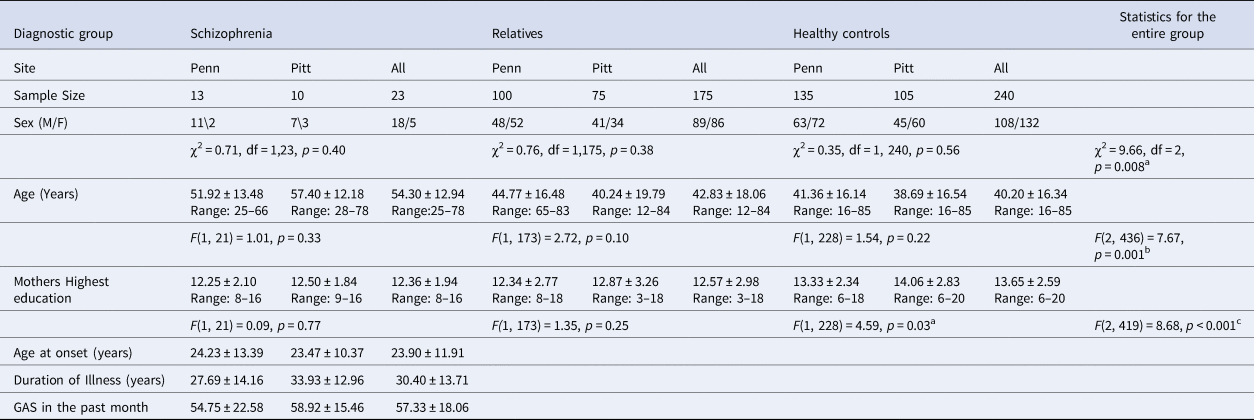
The diagnostic groups significantly differed in age at scan (p = 0.001), sex (p = 0.008) with more male schizophrenia patients compared to relatives (p = 0.014) and controls (p = 0.002) but not between relatives and controls (p = 0.24), and duration of mother's education (p < 0.001). Education of mothers of relatives was intermediate between that of schizophrenia and controls. There were no site differences in age (p = 0.08) and sex (p = 0.96); however, mothers in the Pittsburgh cohort had 0.64 years of less education compared to mothers in the Philadelphia cohort (p = 0.02). Therefore, age, sex, site and mother's highest education were covaried in all analyses (Table 1).
Demographic and clinical characteristics of the study sample
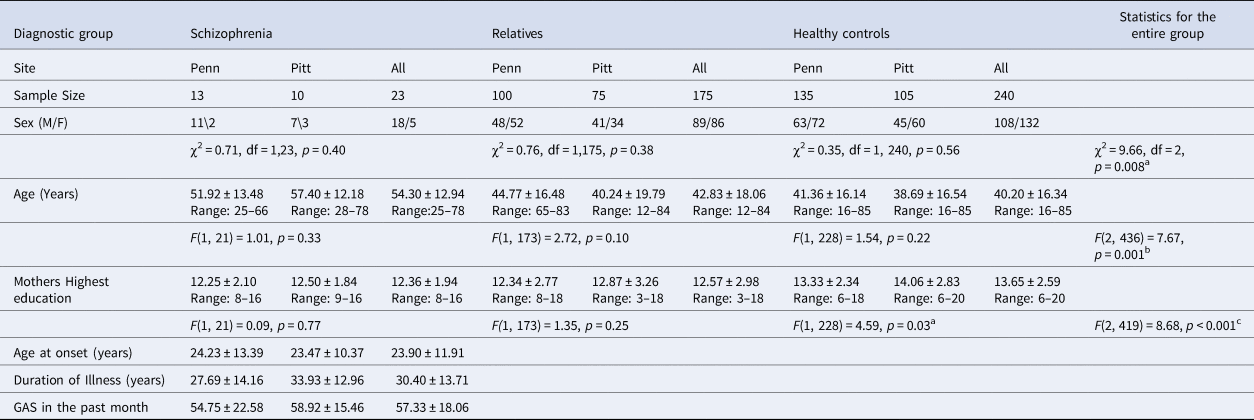
a There were no site differences in sex (Pittsburgh: M/F 93/97; Philadelphia: M/F 122/126; χ2 = 0.003, p = 0.96). There more male schizophrenia patients compared to relatives (χ2 = 6.15, p = 0.014) and controls (χ2 = 9.30, p = 0.002) but there was no difference in sex distribution between relatives and controls (χ2 = 1.39, df = 1, p = 0.24).
b There were no site differences in age (Pittsburgh: 43.29 ± 16.31 years; Philadelphia: 40.30 ± 18.12 years; t = 1.78, p = 0.08).
c Mothers in the Pittsburgh cohort had 12.87 ± 2.6 years of education compared to mothers in the Philadelphia cohort, which was statistically significant (13.51 ± 3.01 years; t = 2.32, p = 0.02).
Heritability
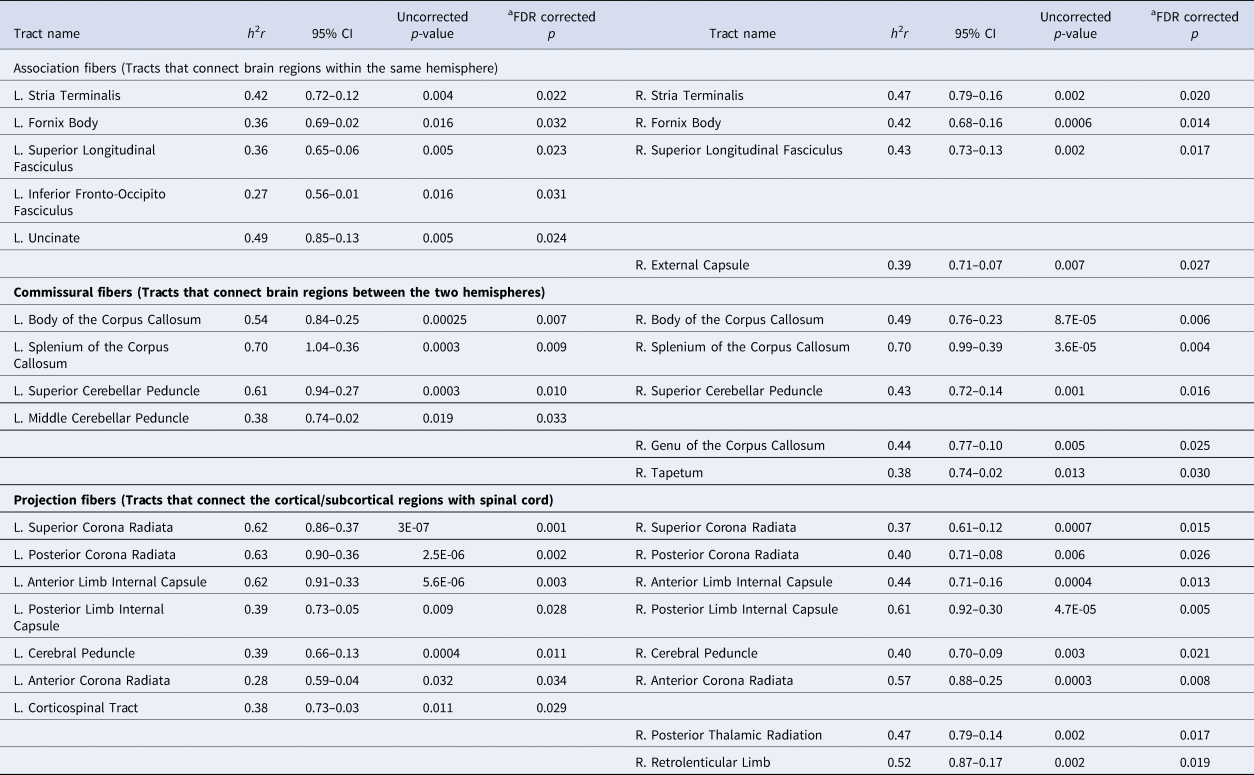
Total additive genetic heritability of FA was significant in all 3-classes of tracts after controlling for age, sex, mother's education and site. Of the 48 tracts (24/hemisphere), FA of 33 tracts was significantly heritable (FDR corrected p < 0.05). Among the association tracts, FA of bilateral stria terminalis, fornix, superior longitudinal fasciculi, left uncinate, left inferior fronto-occipital fasciculus, and right external capsule were significantly heritable (h 2r = 0.27–0.49). Among the commissural fibers, FA of bilateral body and splenium of the corpus callosum, bilateral superior cerebellar peduncles, left middle cerebellar peduncle and the right tapetum and genu of the corpus callosum were heritable (h2r = 0.38–0.70). Projection fibers with significant heritability were: bilateral anterior, superior and posterior corona radiata, anterior and posterior limbs of the internal capsule, cerebral peduncles, and left corticospinal tract, right posterior thalamic radiation and right retrolenticular limb of the internal capsule (h 2r = 0.28–0.63) (Table 2).
Heritability of FA of white matter fiber tracts
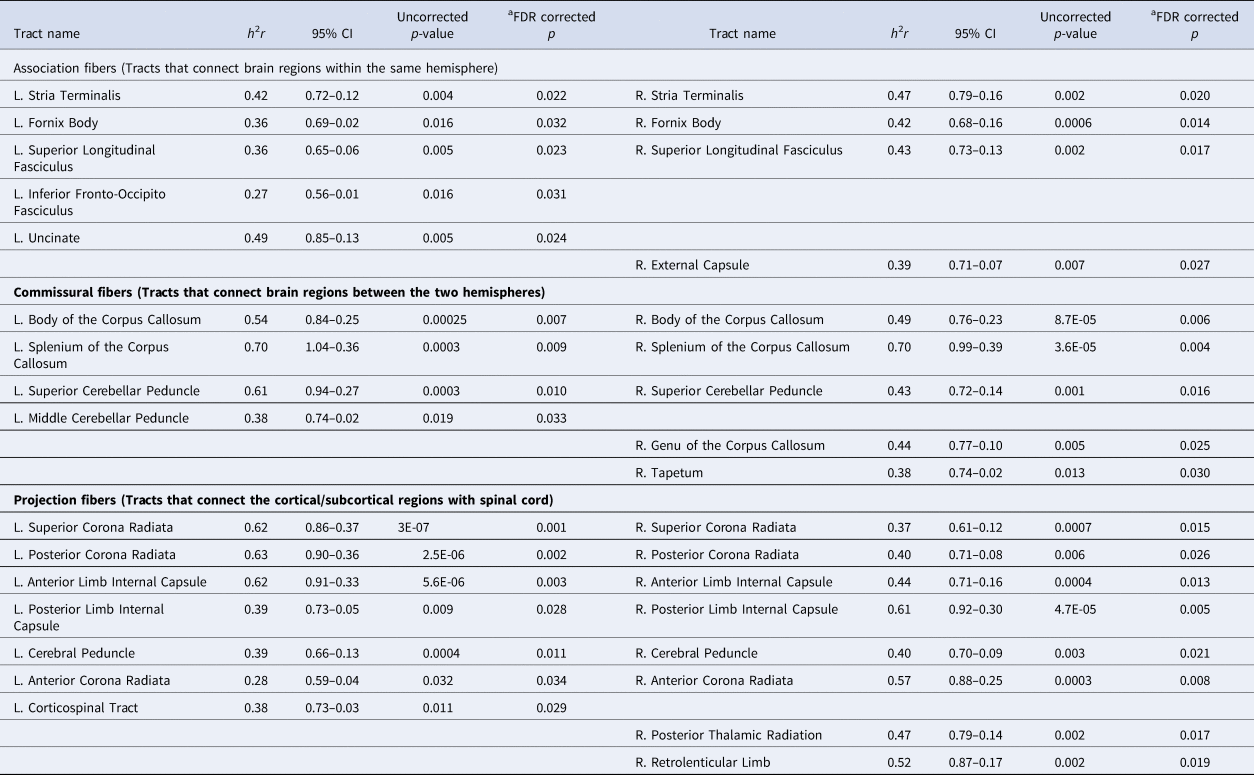
a Corrected significance at 5% False Discovery Rate using the Benjamini-Hochberg procedure. CI refers to confidence interval.
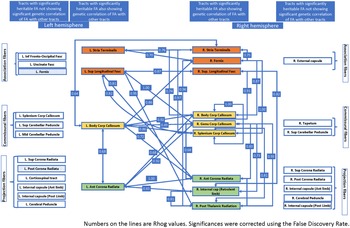
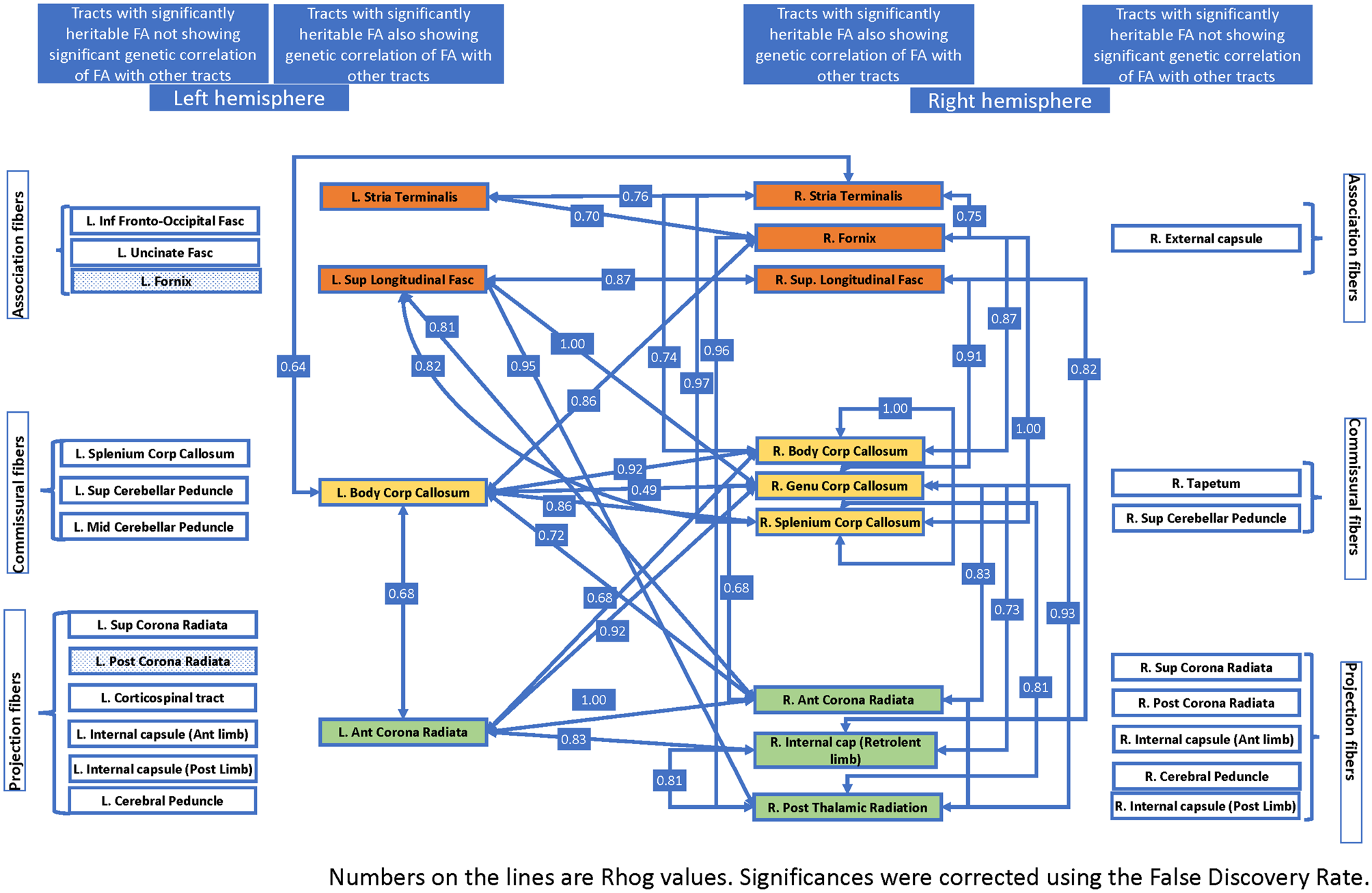
Pleiotropy analysis revealed significant genetic correlation (Rhog) in 13 of the 33 tracts after FDR-correction. Genetic correlation was observed in all three-classes of tracts with greater genetic correlation among commissural fibers followed by association fibers (range 0.49–1.0). More tracts on the right and the corpus callosum regions showed significant genetic correlations (Fig. 1).
Pleiotropy analysis showing genetic correlation among tracts with heritable FA.
Diagnostic group-effect on FA
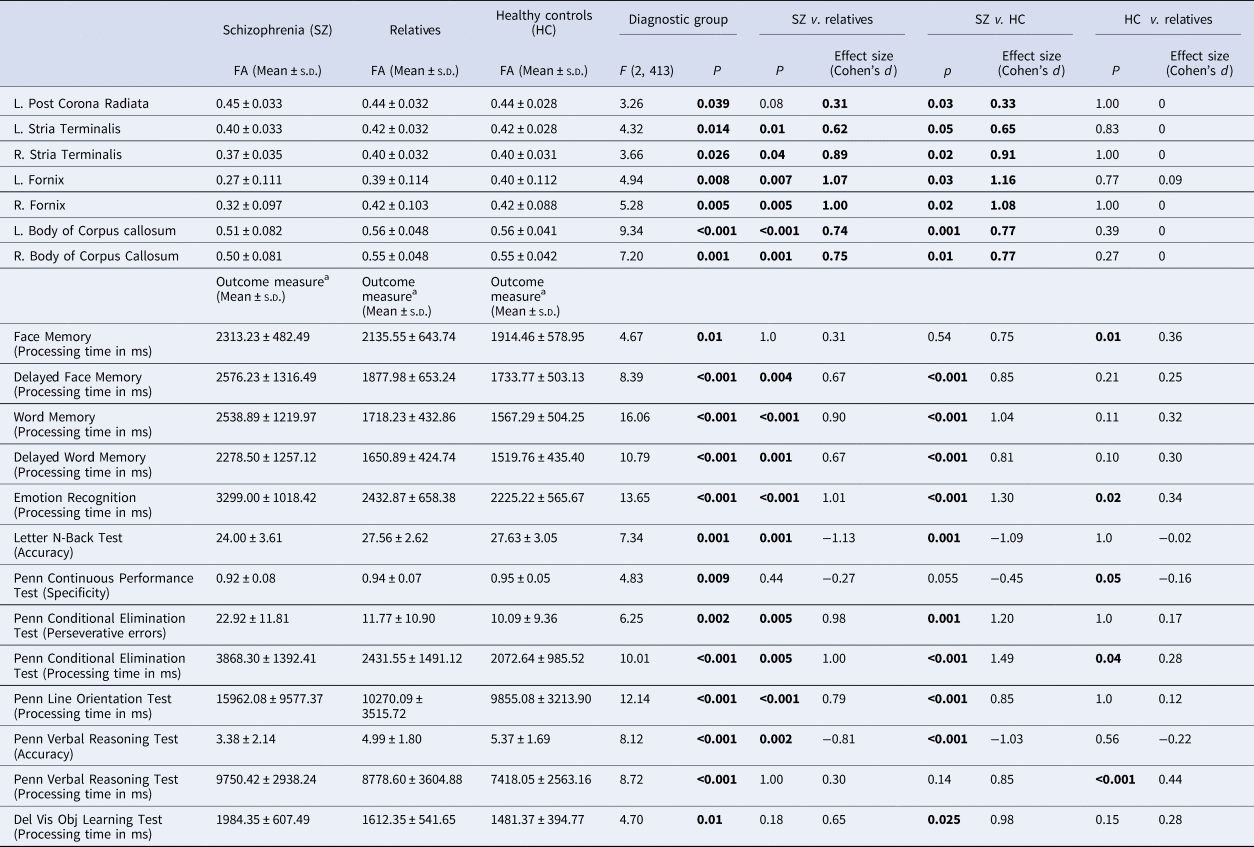
MANCOVA model consisting of FA of 33 tracts with heritable FA, age, sex, site and mother's education was significant (Wilk's λ = 0.752, F(86 744) = 1.32, p = 0.034). Tests of between-subjects effects showed diagnosis main effect in 7 of the 33 tracts (left posterior corona radiata, and bilateral stria terminalis, fornix and body of corpus callosum). Post-hoc pairwise Bonferroni-corrected comparisons revealed that FA was significantly decreased among patients compared to controls and relatives, but not between controls and relatives (Table 3). Effect sizes for schizophrenia-relatives and for schizophrenia-control comparisons were small to large whereas relatives-control comparison was small (Table 3). The MANCOVA model that did not include mother's education was, also, significant (Wilk's λ = 0.746, F(86, 778) = 1.43, p = 0.009) but showed diagnostic group-effect on posterior thalamic radiation, additionally (online Supplemental Table 1).
Diagnostic group main effect on FA of white matter tracts and neurocognitive outcome measures
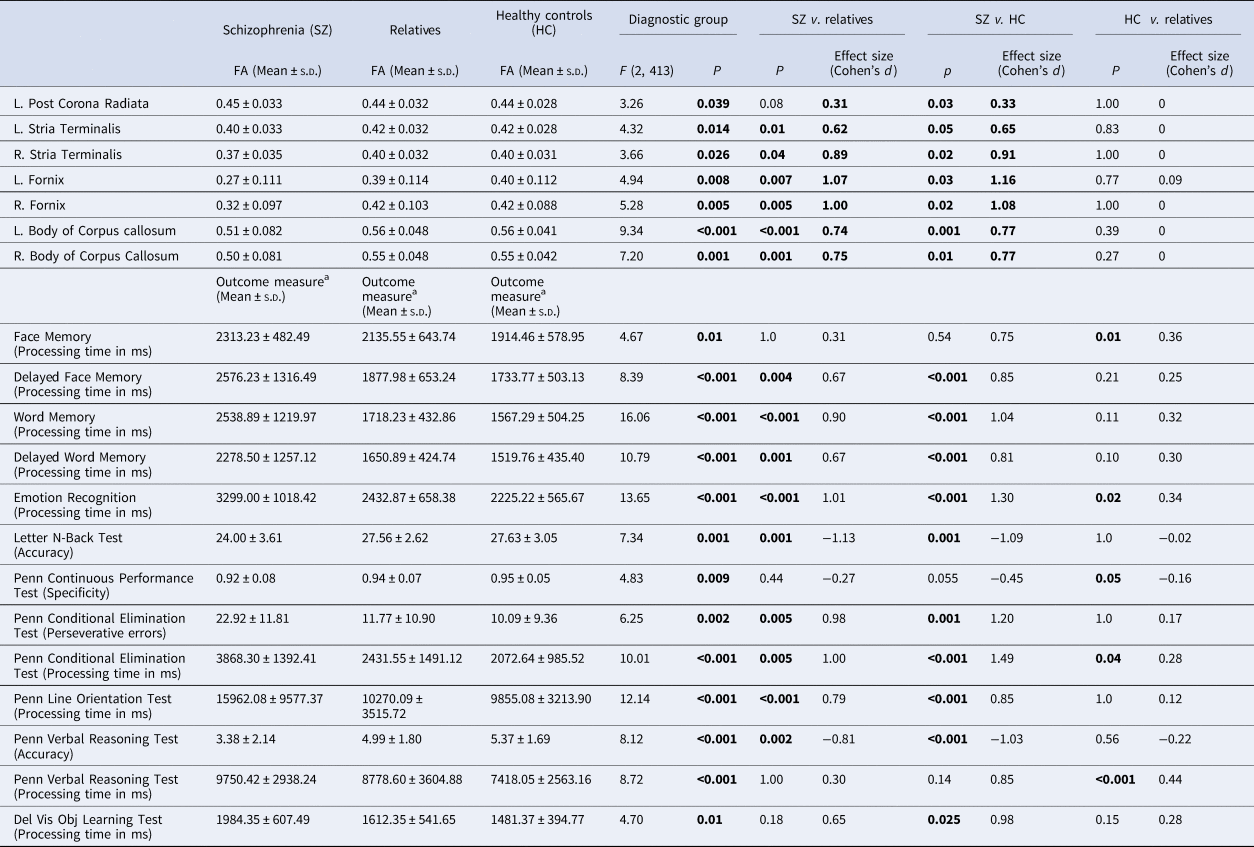
p values in bold font denote Bonferroni-corrected statistical significance.
a Indicates that the outcome measures for cognitive domains in the respective cells. Briefly, processing time (in ms) was significant for immediate and delayed face memory, immediate and delayed word memory, emotion recognition, Penn Conditional Elimination Test, Penn Line Orientation Test, Penn Verbal Reasoning Test and delayed Visual Object Learning Test. Accuracy was significant for the Letter N-back Test and Penn Verbal Reasoning Test. Specificity was used for the Penn Continuous Performance Test and number of Perseverative Errors was significant for the Penn Conditional Elimination Test.
A similar MANCOVA model for 15 tracts that did not show heritable FA, revealed no diagnosis main effect (Wilk's λ = 0.92, F = 1.07, p = 0.37) or between-subjects effects for any tract.
Diagnostic group-effects on neurocognitive performance
Neurocognitive impairments significantly differed among the groups controlling for age, sex, site and mother's education (MANCOVA; Wilk's λ = 0.70, F = 2.59, p < 0.001) on the accuracy of two tasks (letter n-back and verbal reasoning) and processing time of seven tasks [face memory (immediate and delayed), word memory (immediate and delayed), and emotion recognition, conditional elimination, line orientation, verbal reasoning and delayed visual memory]. Bonferroni-corrected post-hoc tests showed more severe impairments in relatives compared to controls on processing times of immediate face memory, emotion recognition, conditional elimination and verbal reasoning tests. Specificity on PCPT showed differences between relatives and controls, but not among patients and relatives or patients and controls. Schizophrenia patients showed more severe impairments on all tasks except immediate face memory, PCPT specificity and processing times of verbal reasoning and delayed visual learning compared to relatives and controls (Table 3).
Correlation of neurocognitive performance with FA of tracts showing significant heritability
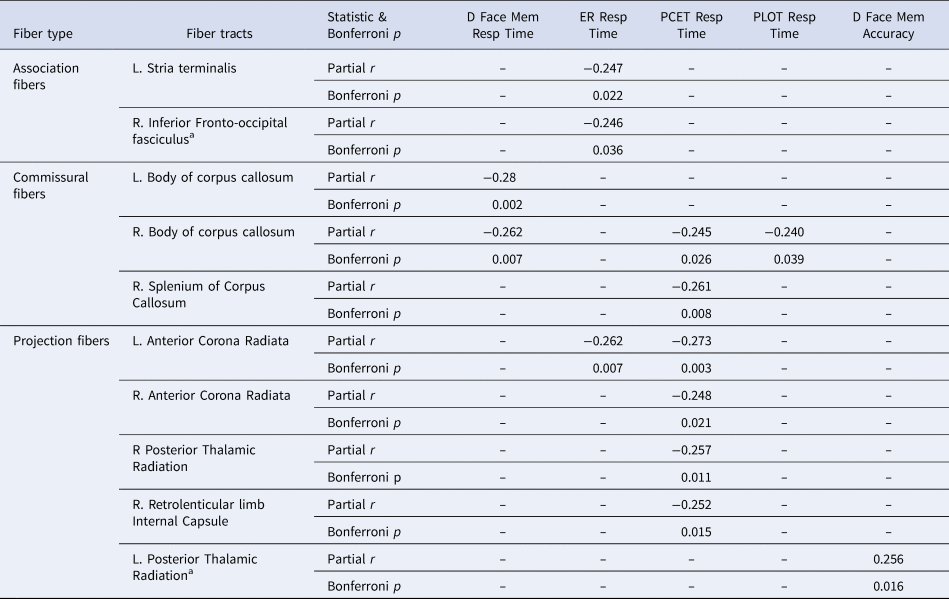
Significant correlations were observed mainly for the processing times for executive functions (PCET), emotion recognition, spatial processing, and delayed face memory after controlling for age, sex, site, mother's education and diagnostic status. The processing times correlated negatively while accuracy correlated positively with FA.
Accuracy of delayed face memory positively correlated with left posterior thalamic radiation FA but not of other domains. Processing time of emotion recognition correlated negatively with the left stria terminalis, right inferior fronto-occipital fasciculus and left anterior corona radiata FA. Correlation of the processing time for executive functions with FA was more widespread across commissural and projection fibers. Delayed face memory processing time-correlated negatively with bilateral body of the corpus callosum (Table 4).
Correlation of FA of white matter tracts with neurocognitive performance controlling for age, sex, site and mother's highest education
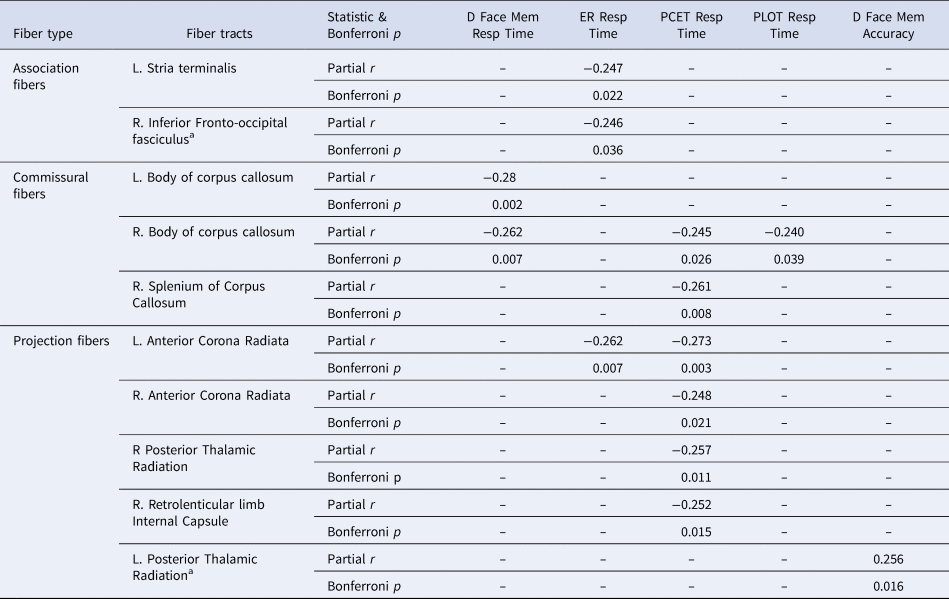
a Heritability of these tracts did not survive the Bonferroni correction for multiple comparisons.
All correlations were of small effect (partial r = 0.24–0.28). Commissural and projection fibers with significantly heritable FA showed the highest number of correlations with more cognitive processes, especially with the processing times of executive function and emotion recognition.
Only two of the 15 tracts that did not show significant FA heritability were correlated with cognitive performance, namely the left genu of the corpus callosum (h 2r = 0.31) and left tapetum (h 2r = 0.22).
Discussion
Our study shows significant heritability of FA of all three-classes of WM pathways totaling 68% of examined tracts suggesting that FA is under strong genetic control. Genetic correlation of FA was observed in ≈40% of tracts with heritable FA suggesting that similar sets of genes may contribute to FA heritability. Diagnostic-group main effect on FA was observed only in tracts with significantly heritable FA but not in tracts without heritable FA. Only 1/5th of tracts with heritable FA showed diagnostic-group effect suggesting that heritability of FA alone may not be sufficient for FA differences across diagnostic groups. Further, observed neurocognitive impairments among relatives and patients correlated mainly with tracts with heritable FA but not with tracts without heritable FA. These findings suggest that heritability is an important determinant of white matter impairments and their impact on neurocognitive performance among the diagnostic groups.
Heritability of FA of several tracts among relatives of multiplex schizophrenia families and correlation of FA with cognitive performance is consistent with prior studies on psychiatrically healthy twins showing higher heritability of many tracts reported in this study (Bertisch et al. Reference Bertisch, Li, Hoptman and Delisi2010; Kochunov et al. Reference Kochunov, Jahanshad, Marcus, Winkler, Sprooten, Nichols and Van Essen2015, Reference Kochunov, Fu, Nugent, Wright, Du, Muellerklein and Hong2016; Lee et al. Reference Lee, Steiner, Luo, Neale, Styner, Zhu and Gilmore2015; Shen et al. Reference Shen, Dore, Rose, Fripp, McMahon, de Zubicaray and Salvado2016). Except for one study that examined a smaller sample of relatives of multiplex schizophrenia families (Bertisch et al., Reference Bertisch, Li, Hoptman and Delisi2010), others have examined twins, old order Amish and elderly populations. We previously reported smaller corpus callosum among familial high-risk subjects suggesting reduced inter-hemispheric axonal fibers (Francis et al., Reference Francis, Bhojraj, Prasad, Kulkarni, Montrose, Eack and Keshavan2011) that may partly contribute to reduced FA noted in this study examining whole-tract FA heritability that may better represent the integrity of entire pathways and its correlation with cognitive performance related to schizophrenia risk in a larger sample of multigenerational relatives of multiplex schizophrenia families.
Heritability varied from 0.28 to 0.70, suggesting that the FA of different tracts are variably impacted by environmental factors. Further, heritable FA was observed primarily in the white matter within the limbic circuitry, corpus callosum, long association fibers and projection fibers. Our prior study on the same sample noted heritability of volume and shape of the subcortical and limbic regions (Roalf et al., Reference Roalf, Vandekar, Almasy, Ruparel, Satterthwaite, Elliott and Gur2015). Some WM tracts with heritable FA observed in this study connect these regions. Heritability of multiple projection fibers that are conventionally called ‘motor fibers’ merits discussion. Reduced FA in corticospinal tract in schizophrenia (Mamah, Ji, Rutlin, & Shimony, Reference Mamah, Ji, Rutlin and Shimony2019), and association of FA of projection fibers (e.g. corona radiata, internal capsule) with positive symptoms (Caprihan et al., Reference Caprihan, Jones, Chen, Lemke, Abbott, Qualls and Bustillo2015), social cognition (Fujino et al., Reference Fujino, Takahashi, Miyata, Sugihara, Kubota, Sasamoto and Murai2014) and cognitive performance (Spalletta, Piras, Piras, Caltagirone, & Orfei, Reference Spalletta, Piras, Piras, Caltagirone and Orfei2014) suggests that classifying them as ‘motor fibers’ is too narrow, and should be included in investigating ‘disconnection’ in schizophrenia. The intricate relationship between motor system and neurocognition is also proposed (Abboud, Noronha, & Diwadkar, Reference Abboud, Noronha and Diwadkar2017).
Pleiotropy analysis showed that ≈40% of the tracts with heritable FA were genetically correlated. Among the tracts that showed significant genetic correlations of FA, corpus callosum was genetically correlated with FA of more tracts. Five of the seven tracts that showed genetic correlation also showed diagnosis main effects suggesting a common set of genes may be associated with schizophrenia risk and connectional integrity. This is consistent with findings from discordant twin pairs showing association of WM volume with genetic risk while gray matter was related to disease-related factors (Hulshoff Pol et al., Reference Hulshoff Pol, Schnack, Mandl, Brans, van Haren, Baare and Kahn2006) and environmental factors (van Haren et al., Reference van Haren, Rijsdijk, Schnack, Picchioni, Toulopoulou, Weisbrod and Kahn2012). This is consistent with our observation of phenotypic correlation of FA of 2/3rd of tracts without genetic correlation. Thus, our data provide a systematic prediction to group sets of genes likely to impact these traits related to schizophrenia risk.
Differences in FA among schizophrenia and their relatives compared to controls have been consistently reported (Ellison-Wright & Bullmore, Reference Ellison-Wright and Bullmore2009). Our study shows that the heritability of FA of WM tracts contributed to such differences, especially the tracts with heritable FA that are more susceptible to diagnosis effects suggesting that the tracts with heritable FA more relevant for genetic risk for the illness. However, not all tracts with heritable FA showed diagnostic group-effect suggesting that the genetic control of FA may be necessary but not sufficient for diagnosis effects and importance of the contribution of disease-related factors such as illness chronicity, medications, comorbid illnesses and environmental factors. Further studies on larger samples that include specific environmental factors are necessary to address this question.
Processing times of cognitive tasks more often showed diagnosis effects and correlated with FA of tracts with heritability compared to accuracy. A prior publication on this MGI sample reported significant heritability of speed of performance on abstraction and mental flexibility (PCET), attention (PCPT), face memory, spatial processing, and sensorimotor speed, and accuracy of verbal memory, face memory, spatial memory, spatial processing and emotion recognition tasks (Gur et al., Reference Gur, Nimgaonkar, Almasy, Calkins, Ragland, Pogue-Geile and Gur2007) suggesting that the genetic influence may differentially affect performance speed and accuracy. In this sample subset, we did not observe significant heritability of these domains possibly because of reduced power (online Supplemental Table 3). Other studies reported significant heritability of cognitive performance among healthy (Tuulio-Henriksson et al., Reference Tuulio-Henriksson, Haukka, Partonen, Varilo, Paunio, Ekelund and Lonnqvist2002) and schizophrenia (Alfimova & Uvarova, Reference Alfimova and Uvarova2003; Gur et al., Reference Gur, Nimgaonkar, Almasy, Calkins, Ragland, Pogue-Geile and Gur2007) subjects. Previous meta-analyses showed the impaired speed of processing to be a central feature of cognitive deficits in schizophrenia (Dickinson, Ramsey, & Gold, Reference Dickinson, Ramsey and Gold2007; Henry & Crawford, Reference Henry and Crawford2005). Cognitive remediation treatments show improvements in processing speed with the largest effect sizes (Hogarty et al., Reference Hogarty, Flesher, Ulrich, Carter, Greenwald, Pogue-Geile and Zoretich2004) suggesting that performance speed may be an interventional target. Thus, genetic influence on anatomical connections that regulate cognitive performance may significantly contribute to processing speed although other factors such as differences in IQ between patients and controls and antipsychotic medications may have a role (Knowles, David, & Reichenberg, Reference Knowles, David and Reichenberg2010).
About 1/4th of tracts with heritable FA correlated with cognitive performance after multiple test corrections. Prior twin studies, also, report correlations of tracts with heritable FA with full-scale IQ, performance IQ and object assembly, specifically with FA of association and projection fibers (Chiang et al., Reference Chiang, Barysheva, Shattuck, Lee, Madsen, Avedissian and Thompson2009). We examined individual cognitive domains providing more refined correlation patterns. We reported association of radial diffusivity of forceps minor (a component of tapetum) with sustained attention among first-degree relatives of schizophrenia (Prasad, Upton, Schirda, Nimgaonkar, & Keshavan, Reference Prasad, Upton, Schirda, Nimgaonkar and Keshavan2015) but not decreased FA and increased radial diffusivity of the superior longitudinal fasciculus. This study with greater power supports our previous observation that the FA of superior longitudinal fasciculi, although heritable, does not correlate with cognitive performance. Further, FA of only three of the seven tracts showing diagnostic-group main effect was correlated with cognitive performance. Similarly, FA of three of the 10 tracts that correlated with cognitive performance also showed diagnostic group main effect; of these 10 tracts, FA of two tracts was not significantly heritable. These observations suggest that different sets of genes may regulate associations with disease risk and cognitive performance.
Diffusion measures of WM fibers are proposed as potential endophenotypes (Keshavan, Prasad, & Pearlson, Reference Keshavan, Prasad and Pearlson2007; Voineskos, Reference Voineskos2015). Our study showed heritability of FA among relatives of multiplex schizophrenia, and diagnostic-group effect on FA between schizophrenia patients and relatives but not between controls and relatives. Thus, FA did not meet all proposed criteria for endophenotypes (Gottesman & Gould, Reference Gottesman and Gould2003; Prasad & Keshavan, Reference Prasad and Keshavan2008). The degree of heritability of FA in this study was similar to the heritability of neurocognitive profile on the same sample (Gur et al., Reference Gur, Nimgaonkar, Almasy, Calkins, Ragland, Pogue-Geile and Gur2007) and healthy twins (Lee et al., Reference Lee, Steiner, Luo, Neale, Styner, Zhu and Gilmore2015; Shen et al., Reference Shen, Dore, Rose, Fripp, McMahon, de Zubicaray and Salvado2016) but were lower than in other healthy twin studies (Chiang et al., Reference Chiang, Barysheva, Shattuck, Lee, Madsen, Avedissian and Thompson2009; Kochunov et al., Reference Kochunov, Jahanshad, Marcus, Winkler, Sprooten, Nichols and Van Essen2015) and large family pedigree samples (Kochunov et al., Reference Kochunov, Fu, Nugent, Wright, Du, Muellerklein and Hong2016). Estimating heritability within multiplex multigenerational samples minimizes the effect of the family environment as could happen in nuclear family studies, because the degree of sharing of environmental risk may not follow a Mendelian pattern. We did not observe differences in FA between relatives and controls possibly because of the smaller sample size in our study and also because multigenerational sample consists of relatives with different degrees of relationship to the proband. Further, the degree of relationship varies depending on which affected individual is indexed as proband in multiplex families. Lower FA has been reported in unaffected first-degree relatives compared to controls more consistently (Prasad et al., Reference Prasad, Upton, Schirda, Nimgaonkar and Keshavan2015; Skudlarski et al., Reference Skudlarski, Schretlen, Thaker, Stevens, Keshavan, Sweeney and Pearlson2013) while some have reported higher FA in relatives (Boos et al., Reference Boos, Mandl, van Haren, Cahn, van Baal, Kahn and Hulshoff Pol2013). Replication of these findings may contribute to building ‘extended endophenotypes’ (Hulshoff Pol et al., Reference Hulshoff Pol, Brans, van Haren, Schnack, Langen, Baare and Kahn2004; Hulshoff Pol et al., Reference Hulshoff Pol, Schnack, Mandl, Brans, van Haren, Baare and Kahn2006; Prasad & Keshavan, Reference Prasad and Keshavan2008; van Haren et al., Reference van Haren, Rijsdijk, Schnack, Picchioni, Toulopoulou, Weisbrod and Kahn2012).
Strengths of our study are that the number of relatives is large compared with many prior studies. We have controlled for age, sex, mother's education and site that could influence the findings, and corrected for multiple testing to minimize false-positive results. Unlike other studies, we used whole tract diffusivity compared to voxel-wise differences. Some limitations include the examination of FA as the main metric instead of multiple diffusion metrics that could provide a better estimate of WM integrity (Hasan, Reference Hasan2006). Since this study was conducted on multiplex schizophrenia families, the generalizability of findings to sporadic schizophrenia may be limited. The number of schizophrenia subjects was smaller because enrollment of multigenerational relatives was predicated on multiplex schizophrenia subjects. A smaller sample of schizophrenia could have biased the results; however, relatively larger samples of relatives and controls were used in testing our main goal to find the differences between relatives and controls. Further, a larger sample would have improved the power of the sample to estimate the heritability of FA and FA differences between controls and relatives. Future studies should examine larger samples of multiplex family data using orthogonal diffusion measures (e.g. FA and RD) to better elucidate the association of heritability with impaired white matter integrity.
In summary, our study shows that heritability of FA is observed in all three-classes of WM tracts and not restricted to those proposed to be involved in cognitive processing. Further, our observations suggest that a similar set of genes may contribute to the heritability of multiple tracts and, of neurocognitive performance differences. Heritability estimates of our study compare well with twin studies suggesting that the estimates are not inflated. Although the diagnostic-group effect on FA was observed only in tracts with significantly heritable FA, only 20% of tracts with heritable FA showed diagnostic-group effect suggesting that heritability of FA alone may not be sufficient to contribute to diagnostic-group differences in FA. Thus, heritability is an important determinant of WM impairments among the diagnostic groups and their impact on neurocognitive performance. Further studies are needed to elucidate genetic variants and related gene expression patterns associated with these observations to understand the molecular genetic basis of pathophysiology of schizophrenia and risk for the illness. Taken together, anatomical connectional integrity, and regional volumes and shape are heritable and impact underlying cognitive processing.
Supplementary material
The supplementary material for this article can be found at https://doi.org/10.1017/S0033291720002883
Acknowledgements
This work was funded through grants from the NIMH R01MH63480, R01MH105634 and 07R-1712 of the Stanley Medical Research Institute (VLN), R01MH042191 (REG), and R01MH061622 (LA), and R01MH112584 and R01MH115026 (KMP). Authors thank Ms. Sue Clifton, Ms. Joette Zarotney, Ms. Jane Sharpless and Mr. Robert Witalec for subject characterization, and Ms. Rachel Bender and Dr Ayesha Khan for image processing.
Disclosures
None of the authors has any conflict of interest applicable to this manuscript.