1 Introduction
In many countries pay-as-you-go (PAYG) pension systems are being replaced by (partly) funded pension systems, a shift largely motivated by population aging. Proponents of these shifts also argue that funded pension systems can lead to higher economic growth. If this effect arises during the transition, it could partly alleviate the transition burden associated with the shift from PAYG to funding (Borsch-Supan et al., Reference Borsch-Supan, Koke and Winter2005). Considering the vast number of countries undertaking similar transitions, it is useful to examine whether these shifts led to higher economic growth rates.
A few empirical studies (Holzmann, Reference Holzmann1997a, Reference Holzmannb; Davis and Hu, Reference Davis and Hu2008) argue that funding of pensions is associated with higher economic growth rates, due to higher saving rates, capital market development and reduced labor market distortions. In a PAYG system, pension contributions represent transfers from the young to the old; in a funded pension system, the contributions can be viewed as savings. Therefore, a higher degree of funding means more people save through their mandatory pension scheme, which should lead to a higher aggregate saving rate. Capital market development could also be stimulated because more resources become available for the capital market when pensions are funded. Finally, labor market distortions might be mitigated, because funded pension systems have less distorting effects on labor supply decisions than do unfunded systems. These three effects suggest higher growth.
Our evidence of an effect of funding on growth is mixed. For the short-run, we do not find any effect at all, whereas we find some evidence for an effect in the long-run. However, this latter evidence highly depends on the empirical model that we use. There seems to be a positive effect when we estimate a model with overlapping observations, but we do not find this positive effect when we use a simple cross-sectional model.
The data set we use spans 54 countries, 29 of which are Organization for Economic Co-operation and Development (OECD) countries, during the years 2001–10. To examine whether changes in the degree of funding affect economic growth in the short-run, we estimate a dynamic growth model with the growth rate of the ratio of pension assets over Gross Domestic Product (GDP) as the main explanatory variable. We employ a bias-corrected least square dummy variable (LSDV)-estimator with bootstrap standard errors where we assume country-specific steady-state growth rates. The growth rate of pension assets is insignificant in all specifications, with coefficient estimates that are very close to zero. We also estimate a model without country fixed effects, and the results are comparable.
To find a possible long-run effect, we use a simple cross-sectional growth model and estimate it by Ordinary Least Squares (OLS). Once we also include initial income, which has a negative effect on growth as predicted by the convergence literature (see Barro (Reference Barro1997)), the growth rate of pension assets becomes insignificant. However, when we estimate a growth model with overlapping observations the growth rate of pension assets has a significantly positive effect on economic growth, which remains after the inclusion of initial income, although the coefficient estimates become smaller. We correct the standard errors in the overlapping observations model for serial correlation that is caused by the overlapping nature of the data.
Davis and Hu (Reference Davis and Hu2008) also examine empirically whether the level of pension assets, scaled by GDP, is related to economic growth; they conclude that pension fund growth is positively related to economic growth, especially in emerging market economies. Holzmann (Reference Holzmann1997a, Reference Holzmannb) finds a positive relationship between pension reform and total factor productivity in Chile, and Davis (Reference Davis2002, Reference Davis and Goodhard2004) has examined the link between institutionalization (i.e., the proportion of equity held by institutional investors) and GDP growth but finds no effect. However, these last two studies do not test the hypothesis that pension funding increases economic growth, because they include insurance companies and mutual funds as part of institutional investors.
The rest of the paper is organized as follows: In Section 2 we present the theory. Then in Section 3, we describe the data, followed in Section 4 by a description of the empirical strategy and the results. Finally, we conclude in Section 5.
2 Theory
In this section, we consider the channels through which funding might influence economic growth. We divide these into the effect through the aggregate saving rate, which has received most attention in the literature, and other channels.
Pension systems can be funded, unfunded, or partly funded. In an unfunded pension system, or PAYG system, the currently young pay taxes that are used to pay pensions to the currently old in the same period. In a funded pension system, young workers contribute to a pension fund and then receive pension benefits from this fund when they retire. In a PAYG system, no pension assets exist, because the contributions are immediately used to pay pension benefits; a funded system instead has a pool of assets available. In most countries, pension systems combine PAYG and funded elements, although worldwide trends indicate increased switching from PAYG to (partly) funded pension systems. This switch creates considerable transition costs, because the windfall gain for the first generation of pension beneficiaries must be paid back implicitly (Sinn, Reference Sinn2000). Borsch-Supan et al. (Reference Borsch-Supan, Koke and Winter2005) argue however that such pension reforms lead to higher economic growth, because they increase saving rates and the efficiency of capital markets, which partly compensates for the transition costs. Furthermore, increased growth should alleviate problems associated with an aging population, which are the primary motives for reforming pension systems. These arguments suggest that funding of pensions can increase economic growth rates by increasing the aggregate saving rate, development of capital markets, reducing labor market distortions, and improving corporate governance.
2.1 Aggregate saving rate
The contributions of workers to a PAYG system represent a pure tax, because they are used immediately to pay pension benefits to retirees. In contrast, the pension premiums in a funded system constitute savings that get invested in the capital market. A shift toward more funding therefore might increase the aggregate saving rate and, accordingly, may increase economic growth. For this effect to be operative in practice, three conditions must be fulfilled (Barr, Reference Barr2000): funding must lead to a higher saving rate than PAYG, the additional savings must induce more investment, and additional investments must lead to a higher economic growth rate.
Although the effect of funding on saving could be permanent, it might be highest during the transition from the PAYG system to the funded system. That is, during the transition, funds build-up and this leads to a net increase in pension fund assets. At some point in time although, the pension fund matures, and the net inflow of funds slows or even becomes negative, such that the outflow of funds to pension beneficiaries creates dissaving.
A few other issues may play a role as well. The transition to a funded system must be financed by either the government or the workers. In the former case, the government issues debt that might undo the possible positive effect on the aggregate saving rate. Furthermore, as Blanchard and Fischer (Reference Blanchard and Fischer1989) point out, a funded pension system can increase the aggregate saving rate only if the pension fund forces people to save more than they would have saved voluntarily. If saving rates are already high, people simply replace part of their voluntary saving with mandatory pension saving, and the aggregate saving rate might stay the same.
Davis and Hu (Reference Davis and Hu2006) argue that financial liberalization affects the relationship between funding and saving. That is, households living in countries with a relatively repressed financial sector might face liquidity constraints, so in these countries forced saving should have a greater effect on the national saving rate than it does in countries with a more liberalized financial system. However, there liquidity constraints could play a role among low-income households.
The question of whether funding leads to more saving has been examined extensively in the empirical literature. The comprehensive international study of Reisen and Bailliu (Reference Reisen and Bailliu1997) considers the link between pension fund assets and saving rates, using data from 11 OECD- and non-OECD countries. They conclude that the accumulation of pension fund assets has a positive and significant impact on private saving, although the effect is eight times greater for non-OECD countries than for OECD countries. Lopez-Murphy and Musalem (Reference Lopez-Murphy and Musalem2004) test whether the accumulation of pension fund assets influences national saving rates; they find that it increases national saving when the funds are part of a mandatory pension program but decreases it if the pension funds represent public programs to foster voluntary pension saving. Bosworth and Burtless (Reference Bosworth and Burtless2004) also provide evidence that pension saving substitutes for other forms of private saving in OECD countries.
According to Samwick (Reference Samwick2000), the effect of funding on saving depends primarily on the way the government chooses to finance the transition. There is a cohort that has paid pension premiums into a PAYG system, but will not be able to collect benefits from it. That is, the cohort immediately after them pays its pension premiums into the new funded system (i.e., their contributions are invested in the capital market, instead of being paid immediately as pension benefits). The government must finance this ‘gap’, which often entails higher taxes or government debt. Samwick (Reference Samwick2000) undertakes an empirical analysis: first, he analyzes the time-series behavior of several countries that have undergone a pension reform and finds that none of them, with the exception of Chile, experienced a significant increase in national saving after the reform. Second, he assesses saving rates in a cross-sectional data set and finds that countries with PAYG systems tend to have lower saving rates than those with funded pension systems. Thus, evidence on the link between funding and saving is mixed.
Moreover, a priori it is not clear whether higher saving automatically translates into more investment. On the one hand, a lot of pension funds invest members’ contributions in a portfolio of worldwide securities. For example, in 2003, Dutch pension funds invested 57% of their funds abroad (Kakes, Reference Kakes2006). Thus, a higher saving rate could have only limited influence on domestic investment. On the other hand, in some countries the government forces pension funds to invest a large part of their funds in their own country. Furthermore, the ‘Feldstein–Horioka puzzle’Footnote 1 (Feldstein and Horioka, Reference Feldstein and Horioka1980) indicates that domestic investment is strongly related to domestic saving (Davis and Hu, Reference Davis and Hu2008). It also depends on the quality of investment. An example from the latter days of communism shows extremely high investment rates in the Soviet Union, with economic growth rates close to nil (Barr, Reference Barr2000). Finally, when pension funds use funds to finance government debt, it is questionable whether productive investments result.
It is important to stress that the saving channel reflects a possible long-term effect. It simply takes a few years before higher saving might translate into higher economic growth.
2.2 Other channels
The development of capital markets might also allow funding to influence economic growth. The literature has established a clear positive link between funding and financial development (Catalan et al., Reference Catalan, Impavido and Musalem2000; Impavido et al., Reference Impavido, Musalem and Tressel2003; Hu, Reference Hu2005), and financial development is positively associated with economic growth (Levine and Zervos, Reference Levine and Zervos1998; Beck and Levine, Reference Beck and Levine2004). Thus, it appears that funding leads to better developed capital markets, which enhance growth in turn. Yet, Barr and Diamond (Reference Barr and Diamond2006) argue that capital market development is a less relevant argument for developed economies, whose capital markets are already quite well developed. On the other hand, in developing countries with capital markets that are hardly developed yet, this could affect economic growth in the short-run already.
A shift from a PAYG system to a funded pension system decreases the amount of distorting taxes that the government has to collect (Disney et al., Reference Disney, Boeri and Jappelli2004). Also, the weak link between pension contributions and benefits in PAYG systems leads workers to retire earlier and engage in less job mobility (Disney, Reference Disney2002). Therefore, a shift from PAYG to funding might increase economic efficiency and lead to higher growth. However, simulation studies show that the effects are actually rather small (Raffelhuschen, Reference Raffelhuschen1993; Kotlikoff, Reference Kotlikoff1996).
Finally, another argument put forward in the literature indicates that funding of pensions could increase growth by improving corporate governance (Barr and Diamond, Reference Barr and Diamond2006; Davis and Hu, Reference Davis and Hu2008), perhaps due to pension funds’ demand for more transparency and accountability at the firm level, as well as pressures on pension funds to undertake socially responsible investments (Clark and Hebb, Reference Clark and Hebb2003). Despite clear evidence of such a positive impact at the firm level in the United States (Woidtke, Reference Woidtke2002; Coronado et al., Reference Coronado, Engen and Knight2003), only Davis (Reference Davis2002) argues that these effects may be economy-wide.
3 Data description
To examine the possible effect of changes in the degree of pension funding on economic growth, we use data on the amount of pension assets at the country-level. These data come from the OECD Statistics and consist of the total amount of pension assets for 54 countries during the period 2001–10. Of these, 29 are OECD countries and 25 are non-OECD countries. For 25 countries, we have data for all the years; for 29 countries the time series is incomplete. We thus have 416 observations pertaining to the amount of pension assets.
Contrary to earlier studies, we use the amount of pension assets instead of the amount of pension fund assets as a measure of funding. This total amount of pension assets is a broader measure than only the assets of pension funds. The difference between total pension assets and the assets of pension funds consists of pension insurance contracts, book reserves on balance sheets of sponsoring companies, banks’ managed funds, investment companies’ managed funds, and all kinds of other funds. For most countries, these represent just a small part of total pension assets; however, in the United States, Denmark, Sweden, France, and South Korea, they make up around or even more than 50% of total pension assets. In our view, whether pension savings are invested by pension funds or by some other institute does not make a difference in the context of our study.
Davis and Hu (Reference Davis and Hu2008) use the ratio of pension fund assets over GDP as a proxy for pension funding, because changes in the amount of pension assets over time can result from changes in the degree of funding. We believe that it may be necessary to correct the amount of pension assets for the rate of return that the pension sector earns. Increases in the amount of pension assets that result from capital market gains do not reflect changes in the degree of funding. On the other hand, there might be feedback effects as well; an increase in the degree of funding could have a positive impact on the rate of return. We will therefore estimate the empirical model that we describe in the next section with and without the rate of return of the pension sector included as control variable.
The GDP data come from the Penn World Tables 7.0. Furthermore, to calculate the rates of return on pension assets, we use several data sources. The OECD Statistics provide (incomplete) data about the shares of investment portfolios that pension funds allocate to stocks, bonds, loans, cash, and so on. The MSCI World Gross Return Index, which includes reinvested gross dividends, provides a measure of rates of return on stocks. Furthermore, we take returns on the Barclays Capital Global Aggregate Bond Index as a measure for bond returns. Finally, we use the interest rate on three-month Treasury bills as a measure of the return that pension funds earn on their cash.
The following equation shows how we calculate the rate of return of the pension sector for country i in year t:
 $$r_{it} \equals {{\lpar {\rm MSCI}_{t} \lowast \omega _{it} \plus {\rm Bond}\;{\rm Return}_{t} \lowast \alpha _{it} \plus T {\hbox -} {\rm bill}_{t} \lowast \pi _{it} \rpar } \over {\lpar \omega _{it} \plus \alpha _{it} \plus \pi _{it} \rpar }}.$$
ω, α, and π are the shares of the investment portfolio that are allocated to stocks, bonds (which we define to include loans), and cash, respectively.
We make three assumptions in this calculation. First, all pension funds (or other institutes that invest money for future retirees) invest in a worldwide portfolio of securities. Second, real estate earns the same rate of return as stocks and all other investments (land, unallocated insurance contracts, private investment funds, and other investments) earn the average rate of return for stocks, bonds, and cash combined. Therefore, ω, α, and π do not necessarily sum to one. Third, because we do not have data about the shares of the different investment categories for all country-year observations, for countries for which we lack some data, we take the average of the available years and use it to represent the shares for the missing years. For countries with no data at all, we take the average over all available countries in that year.
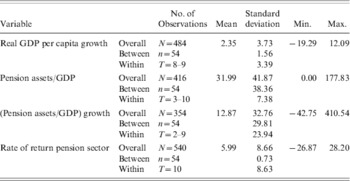
In Table 1, we provide descriptive statistics of our data. For each variable, the table displays the number of observations, mean, standard deviation, minimum, and maximum. Besides that, we show the between- and within-country standard deviations and the number of countries (n) and time periods (T). Note that the amount of pension assets as a fraction of GDP varies between 0% and about 178%; that is, our sample includes countries with completely PAYG and countries with nearly fully funded pension systems. Besides the level, we show the growth rate of pension assets/GDP. The maximum growth rate is over 400%, which is caused by the fact that there are some countries with hardly any pension assets at all. A tiny increase then immediately results in a very high growth rate.
Summary statistics data (percentages)

Notes: N is the total number of observations, n is the number of countries, and T is the number of years. The rate of return of the pension sector is calculated by using the MSCI World Gross Return Index, the Barclays Capital Global Aggregate Bond Index, and the 3-month T-bill rate plus data on the share of pension assets that is invested in stocks, bonds, and cash.
4 Empirical results
In this section, we present our empirical strategy and the regression results. We first examine possible short-run effects and then possible long-run effects.
4.1 Short-run effects
To examine whether changes in the degree of pension funding affect economic growth in the short-run, we estimate the following regression model:
 $$\eqalign{ {\rm log}\lpar y_{it} \sol y_{i\comma t \minus \setnum{1}} \rpar \equals \tab \mu _{i} \plus \delta _{t} \plus \gamma _{\setnum{1}} \;{\rm log}\lpar y_{i\comma t \minus \setnum{1}} \sol y_{i\comma t \minus \setnum{2}} \rpar \plus \gamma _{\setnum{2}} \;{\rm log}\lpar {\rm PA}_{i\comma t \minus \setnum{1}} \sol {\rm PA}_{i\comma t \minus \setnum{2}} \rpar \cr \tab \plus \gamma _{\setnum{3}} \;{\rm ror}_{it} \plus \varepsilon _{it} \comma \cr} $$
where y is real GDP per capita of country i in year t, PA is the ratio of pension assets over nominal GDP, ror is the rate of return of the pension sector, μi is a country fixed effect, δt is a time fixed effect, and ε is the error term. With this approach we focus on a possible short-run effect of funding on growth during the transition from a PAYG to a (partly) funded system.
The country fixed effect μi is included to allow different countries to have different steady-state growth rates. We also estimate equation (1) without country fixed effects, using a simple pooled OLS model. Although the fixed effects model can only identify the possible effect of changes in the degree of funding within countries, without the country fixed effects it is possible to identify the effect of changes within and between countries. The drawback is that we then assume that all countries grow at the same rate, ceteris paribus.
The amount of pension assets is measured on the last day of the year. Note that we take the first lag of the growth in pension assets to prevent possible reverse causality. Furthermore, it is very hard to think of a situation in which changes in pension funding would immediately influence economic growth. Therefore, changes in the amount of pension assets during period t − 1 are assumed to influence economic growth in period t.
Widely used estimators for dynamic panel models include the Arellano–Bond and Blundell–Bond estimators (Arrelano and Bond, Reference Arrelano and Bond1991; Blundell and Bond, Reference Blundell and Bond1998), both of which were developed for small T, large n panels, where T refers to the time dimension and n to the cross-sectional dimension of the data. With 54 cross-sections our n is too small relative to our T (8), to employ these estimators.
As an alternative, we consider the within (or LSDV) estimator. Nickell (Reference Nickell1981) shows that this estimator is not consistent for finite T in dynamic panel data models, where the inconsistency for n → ∞ is O(T −1). In other words, the inconsistency is inversely proportional to T and disappears when T becomes very large. However, our T is 8, and the bias in our estimates will be considerable when we use the within estimator for our dynamic panel model.
Accordingly, we use a bias-corrected LSDV estimator for equation (1). Bun and Kiviet (Reference Bun and Kiviet2003) provide LSDV bias approximations, extended to unbalanced panels by Bruno (Reference Bruno2005a). The analytical approximation of the bias that we use has order O(T −1), the simplest bias approximation that Bun and Kiviet (Reference Bun and Kiviet2003) consider. It still accounts for most of the bias in the LSDV estimator when nT ⩾ 400 and n ⩾ 10. We initialize this bias correction procedure with a standard Blundell–Bond estimator with no intercept (see Bruno (Reference Bruno2005b) for details). In addition, we use a non-parametric bootstrap procedure to estimate the asymptotic variance–covariance matrix of the bias-corrected LSDV estimates. Kiviet and Bun (Reference Kiviet and Bun2001) show that this variance estimator is superior to the standard analytical variance estimator.
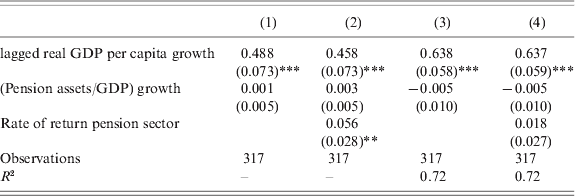
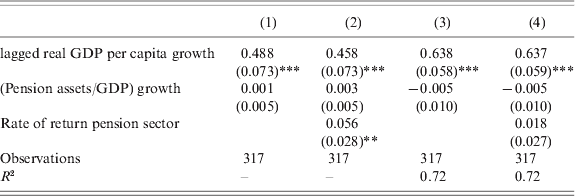
Table 2 presents the estimates of equation (1). We show results from four different specifications, with and without country fixed effects, and with and without the rate of return of the pension sector as control variable. All four specifications include a full set of time fixed effects. In columns 1 and 2, we show results with country fixed effects, estimated by the bias-corrected LSDV estimator. In columns 3 and 4, we show results without country fixed effects, estimated by pooled OLS. In order to account for possible serial correlation in the residuals, we cluster the standard errors across cross-sections (countries) in columns 3 and 4.
Dependent variable: real GDP per capita growth
Notes: Columns 1 and 2 are estimated by the bias-corrected LSDV estimator. The numbers in parentheses are bootstrap standard errors. Columns 3 and 4 are estimated by OLS (without country fixed effects). The numbers in parentheses are clustered standard errors.
** and *** denote significance at 5% and 1%. Growth variables and the rate of return are measured as fractions. The rate of return of the pension sector is calculated by using the MSCI World Gross Return Index, the Barclays Capital Global Aggregate Bond Index, and the 3-month T-bill rate plus data on the share of pension assets that is invested in stocks, bonds, and cash.
As discussed before, the relationship between pension assets and the rate of return might be two-sided. On the one hand, high rates of return increase the growth rate of pension assets beyond what is caused by changes in funding. On the other hand, if countries decide to increase the funding ratio of their pensions this might have a positive effect on the rate of return. Thus, if we include the rate of return as a control variable, we also correct for that part of the growth in pension assets that affects the rate of returnFootnote 2. However, if we do not include the rate of return we ignore the possible effect of the rate of return on pension assets. Therefore, the true effect of changes in funding on economic growth will be somewhere in between the estimates with and without the rate of return included.
In all specifications, the coefficient estimate of the growth of pension assets is very close to zero and insignificant. The autoregressive parameter (γ1) is between 0.4 and 0.7, while the rate of return has a positive effect, as expected, but is only significant in the model with country fixed effects. Furthermore, the inclusion of the rate of return hardly affects the relationship between changes in funding and economic growth, in contrast with our expectations.
All in all, we are led to conclude that changes in the degree of pension funding do not influence economic growth in the short-run. At least, not in the period between 2001 and 2010 in a large sample of OECD and non-OECD countries.
4.2 Long-run effects
Although we are not able to find an effect of changes in the degree of funding on economic growth in the short-run, there are several channels through which funding might impact upon growth that need somewhat more time. For example, it will probably take a few years before a larger pool of savings will translate into a higher rate of capital formation and thus higher economic growth. Therefore, we examine how changes in the degree of funding affect average economic growth in the years after the change. We start with a simple visual inspection of the data.
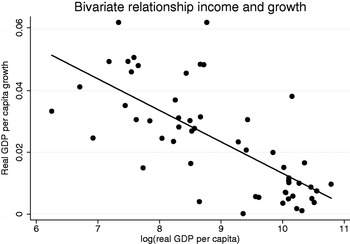
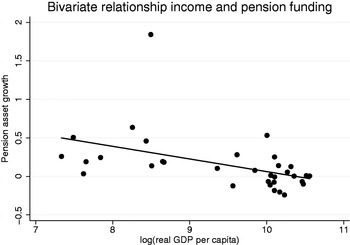
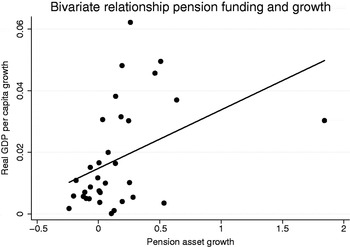
Figure 1 plots log(real GDP per capita) against real GDP per capita growth. As expected, and predicted by the convergence literature (see Barro (Reference Barro1997) ), the relationship is negative; poor countries grow faster than rich countries. However, from Figure 2 the relationship between log(real GDP per capita) and pension asset growth seems to be negative as well. Thus, mainly poor countries have high levels of pension asset growth. Then, simply looking at the bivariate relationship between pension asset growth and economic growth, as in Figure 3, reveals a positive relationship between the two; countries with high levels of pension asset growth tend to grow faster than countries with low (or negative) pension asset growth. The positive relationship becomes even stronger if we drop the obvious outlier.
log(real GDP per capita) plotted against real GDP per capita growth (measured as a fraction)

log(real GDP per capita) plotted against pension asset growth (measured as a fraction)

Pension asset growth plotted against real GDP per capita growth (both variables measured as a fraction)

However, the question is whether this positive link between changes in funding and economic growth remains when we control for initial income. It might be that poorer countries do not grow faster because they reformed their pension system, but simply because they are catching-up with the developed world. In that case, it is a convergence effect that is at work and not an effect of pension funding on economic growth. Besides that, for countries with hardly any pension assets at all it is much easier to achieve enormous growth in pension assets as it is for countries with almost fully funded pension systems. This is simply due to the nature of the growth rate as a measure of changes in funding. Therefore, we will estimate regression models with and without initial income included. Thus, to find out whether there are long-run effects of changes in the degree of funding of the pension system on economic growth, we use a classical empirical growth model (see e.g., Barro (Reference Barro2001); Rodrik (Reference Rodrik2008)):
 $$\eqalign{ {1 \over T}{\rm log}\lpar y_{i\comma t \plus T} \sol y_{it} \rpar \equals \tab \gamma _{\setnum{0}} \plus \gamma _{\setnum{1}} \;{\rm log}\lpar y_{it} \rpar \plus \gamma _{\setnum{2}} \;{\rm log}\lpar PA_{i\comma t} \sol PA_{i\comma t \minus \setnum{1}} \rpar \cr \tab \plus \gamma _{\setnum{3}} \;{\rm ror}_{it} \plus \varepsilon _{i\comma t \plus T} \comma \cr} $$
where the year t is 2002, T equals 7, and all other variables are as defined before. We thus regress the average growth rate over the period 2002–9 on the (log) level of income in 2002, the growth rate of pension assets from 2001 to 2002, and the rate of return of the pension sector in 2002. As the amount of observations is very limited, we use the period 2002–9 instead of 2002–10 as economic growth rates for 2010 are not (yet) available for all countries.
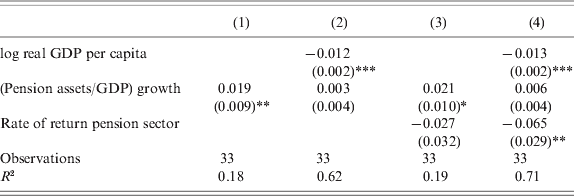
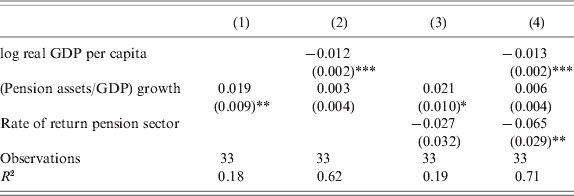
Table 3 presents the results of estimating equation (2). We show the results for several specifications; with and without the rate of return as control variable, and with and without initial income included.
Dependent variable: average real GDP per capita growth 2002–9
Notes: Regressions are estimated by OLS. The numbers in parentheses are robust standard errors.
* , ** and *** denote significance at 10%, 5%, and 1%. Growth variables and the rate of return are measured as fractions. The rate of return of the pension sector is calculated by using the MSCI World Gross Return Index, the Barclays Capital Global Aggregate Bond Index, and the 3-month T-bill rate plus data on the share of pension assets that is invested in stocks, bonds, and cash.
Looking at the estimates for the growth rate of pension assets, it turns out to be significantly positive when we do not include initial income in the regression. However, when we do include initial income, which is significantly negative, the point estimate of the growth rate of pension assets decreases and becomes insignificant. Furthermore, the R 2 dramatically increases. This is exactly what we discussed above; apparently relatively poor countries, with high growth rates of pension assets, grow faster than rich countries because they are poor and not because their pensions are being funded. Finally, the rate of return of the pension sector has a negative effect on growth, which seems to contradict theory, but does not qualitatively alter the effect of changes in funding on growth.
One of the drawbacks of the simple cross-sectional model is that it leaves us with only 33 observations. It might be that we do not find significant effects because we simply do not have enough data. We therefore estimate a model with overlapping observations as well. Average economic growth between 2002 and 2006 is regressed on income in 2002, the growth of pension assets from 2001 to 2002 and the rate of return of the pension sector in 2002, average economic growth between 2003 and 2007 is regressed on income in 2003, the growth of pension assets from 2002 to 2003 and the rate of return of the pension sector in 2003, and so on. This yields five observations for countries with no missing data, and a total of 199 observations for all countries together.
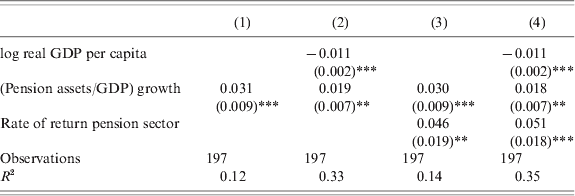
We estimate this model with pooled OLS, as the number of observations for each cross-section is too limited to estimate a fixed effects model. In order to account for serial correlation within clusters (countries), serial correlation caused by the overlapping observations, and correlation between groups we should calculate Hodrick-standard errors (Hodrick, Reference Hodrick1992). However, as these are not available for panel data, we calculate clustered bootstrap standard errors (see Cameron et al. (Reference Cameron, Gelbach and Miller2008) ) where we cluster by country. We thus assume correlation within countries over time. The results are shown in Table 4.
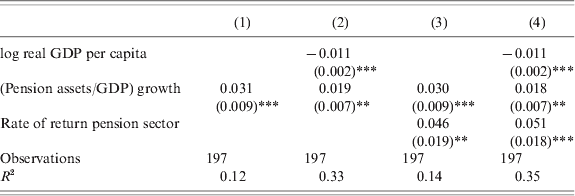
Dependent variable: average real GDP per capita growth (overlapping observations: full sample)
Notes: Regressions are estimated by OLS. The numbers in parentheses are clustered bootstrap standard errors.
** and *** denote significance at 5% and 1%. Growth variables and the rate of return are measured as fractions. The rate of return of the pension sector is calculated by using the MSCI World Gross Return Index, the Barclays Capital Global Aggregate Bond Index, and the 3-month T-bill rate plus data on the share of pension assets that is invested in stocks, bonds, and cash.
The growth rate of pension assets is significantly positive in all specifications although the point estimate becomes smaller when we include initial income, but it remains significant. The rate of return has a significantly positive effect on economic growth in all specifications. However, its inclusion seems to have hardly any effect on the estimate for change in pension funding.
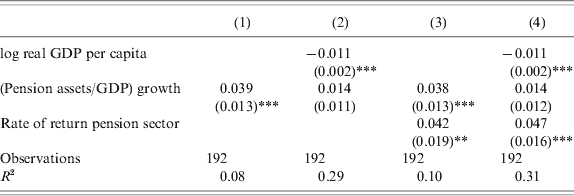
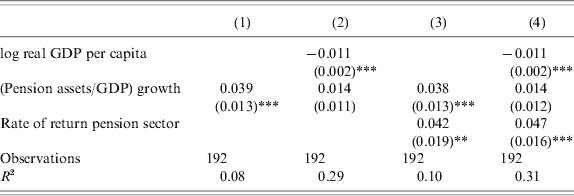
Finally, as Figures 1–3 reveal, there are some obvious outliers present in the data. Therefore, we also estimated all models without these outliers. Most results are comparable to the results with the outliers included, with the exception of the model with overlapping observations. Leaving out five observations where the growth rate of pension assets exceeds 100% results in an insignificant estimate for the growth rate of pension assets when initial income is included (columns 2 and 4). We show these results in Table 5. Furthermore, we also estimated the models with a few variables included that should proxy for steady-state growth (i.e., trade/GDP, investment/GDP). We do not show the results here, but they are also comparable with the results in Tables 3 and 4.
Dependent variable: average real GDP per capita growth (overlapping observations: without outliers)
Notes: Regressions are estimated by OLS. The numbers in parentheses are clustered bootstrap standard errors.
** and *** denote significance at 5% and 1%. Growth variables and the rate of return are measured as fractions. The rate of return of the pension sector is calculated by using the MSCI World Gross Return Index, the Barclays Capital Global Aggregate Bond Index, and the 3-month T-bill rate plus data on the share of pension assets that is invested in stocks, bonds, and cash.
The evidence for a long-run effect of changes in funding on economic growth seems to be mixed. We only find a positive effect when we use a model with overlapping observations, but this positive effect disappears when we exclude a few outliers. The point estimate in the model with the outliers included is 0.018, which means that a 10 percentage points increase in the funding ratio would increase the average economic growth rate in the 4 years after the change with 0.18 percentage points, which seems to be rather modest.
5 Conclusions
In the short-run, there does not seem to be a link between funding of pensions and economic growth. In light of the fact that most theoretical explanations of an effect of funding on growth focus on long-term effects, this finding is not surprising. However, especially for developing countries, increases in funding ratios might immediately lead to better developed capital markets and higher economic growth in turn. Nonetheless, it does not show up in our data.
In the long-run, there might be a positive effect of funding of pensions on economic growth, although the effect seems to be modest; at most, a 10 percentage points increase in the funding ratio would increase the average economic growth rate in the 4 years after the change with 0.18 percentage points. Furthermore, only when we use a model with overlapping observations is there a positive effect that does not disappear after the inclusion of initial income, but even this effect is sensitive to the treatment of outliers. Note that we corrected the standard errors for the overlapping nature of the data in this model.
However, the growth rate of pension assets as a measure of changes in the degree of funding merits some further discussion. Quite a few developing countries hardly have any pension assets at all. If their pension assets/GDP ratio would increase from, say 0.5% to 2%, which is still very low, the growth rate of pension assets is 300%. On the other hand, if a country with a pension assets/GDP ratio of 80% would increase funding toward a pension assets/GDP ratio of 100%, which is quite a remarkable increase, the growth rate would only be 25%. Of course, if there is any effect of funding on growth, it should be larger in the latter country. However, countries with low levels of pension assets seem to grow faster, simply because they are predominantly low-income countries which tend to grow faster than high-income countries according to the convergence literature. Then, this would show up as a positive effect of changes in the degree of funding on economic growth, while it is actually due to the nature of the measure that we use.
Finally, our findings might reflect a weaker link between funding and saving than is commonly found, perhaps because pension funds invest a significant amount of their assets abroad. It also could be that additional savings do not translate into greater economic growth, or capital market development and reduced labor market distortions are less important than we think. Another possible explanation is the presence of a long-horizon effect that our dataset, covering one decade, cannot pick up. Further research clearly should attempt to find satisfactory explanations for our results. In particular, data about the fraction of assets that pension funds invest abroad would be helpful in order to calculate more precisely country-specific rate of returns of the pension sector when using pension assets as a measure of funding.