Introduction
Bullying is currently recognized as a stable, ongoing, intentional one-way form of violent activity, involving a power relationship between a victim who feels helpless and a perpetrator who has control (Glew et al. Reference Glew, Rivara and Feudtner2000; Lamb et al. Reference Lamb, Pepler and Craig2009). In contrast to acts of aggression that involve a two-way process of attack and retaliation, bullying describes a one-way attack situation whereby the perpetrator has more power and where the victim rarely retaliates or feels able to do so (Rigby, Reference Rigby2003). There are three main types of bullying, i.e. verbal bullying (name-calling, insulting, making racist comments and constant teasing), physical bullying (hitting, kicking, slapping, stealing and destroying personal belongings) and relational − social bullying (spreading rumours and excluding and ostracizing others) (Smith et al. Reference Smith, Cowie, Olafsson, Liefooghe, Almeida, Araki, del Barrio, Costabile, Dekleva, Houndoumadi, Kim, Olafsson, Ortega, Pain, Pateraki, Schafer, Singer, Smorti, Toda, Tomasson and Wenxin2002).
Several large-scale surveys carried out in different countries have given an indication of the prevalence of bullying taking place in primary and secondary schools. A wide geographical variation in bullying rates (from 10 to 77%) suggests a high degree of differences in measures and definitions (Smith et al. Reference Smith, Cowie, Olafsson, Liefooghe, Almeida, Araki, del Barrio, Costabile, Dekleva, Houndoumadi, Kim, Olafsson, Ortega, Pain, Pateraki, Schafer, Singer, Smorti, Toda, Tomasson and Wenxin2002). In Italy, there has been little systematic research on bullying. The first study in Italian schools was conducted in Florence (central Italy) and Cosenza (southern Italy) on 1379 pupils from primary and middle schools (Genta et al. Reference Genta, Menesini, Fonzi, Costabile and Smith1996). The authors, using the Italian version of the bully/victim questionnaire, demonstrated that 42% of students in the primary school and 28% in the secondary school had been bullied by peers at least sometimes in the previous 3-month period. More recently, Baldry & Farrington (Reference Baldry and Farrington1999) evaluated 113 girls and 125 boys in a middle school in Rome (central Italy). The authors showed that 43.3% of students in their sample had been bullied by peers during the past 3 months.
There is evidence of a significant association between exposure to school bullying and psychological distress. Increased levels of psychological complaints, depression, anxiety and somatic health complaints have been reported in various studies (Rigby, Reference Rigby2003; Newman et al. Reference Newman, Holden and Delville2005; Sourander et al. Reference Sourander, Jensen, Rönning, Niemelä, Helenius, Sillanmäki, Kumpulainen, Piha, Tamminen, Moilanen and Almqvist2007b; Brunstein Klomek et al. Reference Brunstein Klomek, Marrocco, Kleinman, Schonfeld and Gould2007; Beaty & Alexeyev Reference Beaty and Alexeyev2008). Interestingly, Newman et al. (Reference Newman, Holden and Delville2005) have shown that the frequency and the duration of victimization were significant predictors of stress symptoms in students subjected to bullying. In addition, being bullied at school may increase the risk of suicide ideation and self-harm (Brunstein Klomek et al. Reference Brunstein Klomek, Marrocco, Kleinman, Schonfeld and Gould2007). Conversely, bullies are more likely to develop antisocial personality disorder (Sourander et al. Reference Sourander, Jensen, Rönning, Niemelä, Helenius, Sillanmäki, Kumpulainen, Piha, Tamminen, Moilanen and Almqvist2007b) and to commit violent, property, traffic and drunken driving offences in their late adolescence (Sourander et al. Reference Sourander, Jensen, Rönning, Elonheimo, Niemelä, Helenius, Kumpulainen, Piha, Tamminen, Moilanen and Almqvist2007a).
To our knowledge, no study so far has documented the pattern of bullying/victimization among students in northern Italy. In addition, only a pilot study has examined the putative association between cannabis use and bullying/victimization (Luukkonen et al. Reference Luukkonen, Riala, Hakko and Räsänen2010). Thus, the purpose of our investigation was twofold: (i) to assess the prevalence of bullying and victimization among students in the schools of Pavia (northern Italy) and (ii) to evaluate their relationships with subjective stress and cannabis use.
Method
Ethics
The study protocol was approved by the local Ethics Committee and all participants provided their written informed consent.
Participants
A total of 407 Italian students in three different secondary schools in the town of Pavia, northern Italy (population of about 80 000 people) took part in the present investigation. All participants were recruited consecutively to avoid selection bias. There was a 100% response rate in this study.
Procedures
All participants received a printed pocket containing: (i) a demographic information collection form; (ii) a form containing a single question asking for the history of cannabis use in the previous 6 months; (iii) the 44-item retrospective bullying questionnaire (RBQ) (Schafer et al. Reference Schafer, Korn, Smith, Hunter, Mora-Merchen, Singer and van der Meulen2004); (iv) the 10-item perceived stress scale (PSS-10) (Cohen et al. Reference Cohen, Kamarck and Mermelstein1983). Each questionnaire session was conducted by trained medical staff under the supervision of a senior psychiatrist. The participants were provided with appropriate referrals if they felt in need of further help.
Questionnaires
Two bilingual persons fluent in the original (English) and target (Italian) languages performed the translation of the RBQ and PSS questionnaires. The measures were independently back-translated into the original language by two additional persons. The back-translated versions were then compared with the original for linguistic equivalence. When the two versions were not identical, we worked with the translation team to revise problematic items through a translation/back-translation process until agreement was reached with regard to equivalence.
Retrospective accounts of active bullying and victimization were measured with the RBQ. The scale is a 44-item anamnestic instrument that begins with the following definition of bullying: ‘Bullying is an intentional hurtful behaviour. It can be physical or psychological. It is often repeated and characterized by an inequality of power so that it is difficult for the victim to defend him/herself’. In the first part, the questionnaire asks about the students’ involvement in bullying situations during primary school: forms of the received aggression, identification of the aggressors and duration of the experiences. The second section has a structure identical to the first one, but, in this case, centred on the experiences gathered during secondary school. The questionnaire includes a specific question about previous behaviour as a bullying perpetrator. Most of the questions had multiple choice answers among which only one answer may be chosen. The first task in the analysis of the RBQ results was to assign the students within two main involvement roles in the bullying problem: victims or bullies. Students who were involved with certain frequency in passive bullying situations both in primary and secondary school were considered as victims. The bullies were those students who bullied their fellows with certain frequency, again, during primary and secondary school.
The PSS-10 has been used to research on stress among different population groups including healthy university students, drug addicts, elderly populations as well as pregnant and postpartum women. The 10 items enquire about feelings and thoughts that tap the degree to which respondents find their current life situation unpredictable, uncontrollable and stressful. Respondents indicate how often in the past month they have felt or thought in a certain way on a 5-point Likert scale (0 = never, 1 = almost never, 2 = sometimes, 3 = fairly often and 4 = very often). The higher the score, the greater the perceived stress is.
Statistical procedures
The distributions of sex, cannabis use and the involvement roles in the bullying problem (bullies, victims) are presented as counts and percentages. Age and PSS-10 scores are reported as means and standard deviations. To test for independent associations, data were then analysed using two stepwise regression procedures. Predictor variables included age, sex, history of cannabis use and PSS-10 scores. The dependent variables in the first and second models were active bullying and victimization, respectively. All calculations were generated using the SPSS 17.0 software package (SPSS Inc., Chicago, IL, USA). A two-tailed p < 0.05 was considered statistically significant.
Results
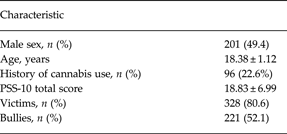
The general characteristics of the study participants are depicted in Table 1. All subjects were of Caucasian ethnicity and the male-to-female ratio was about 1:1. A total of 96 subjects (22.6%) had a history of cannabis use in the previous 6 months. There were 328 victims (80.6%) and 221 bullies (52.1%). The results of the stepwise regression analysis with bullying as the dependent variable are significant with either male sex (R 2 = 0.030, p = 0.024) or PSS-10 scores (R 2 = 0.056, p = 0.036) in the model. With victimization as the dependent variable, only the PSS-10 scores were retained in the model as an independent predictor variable (R 2 = 0.048, p < 0.001).
General characteristics of the study participants (n = 407)
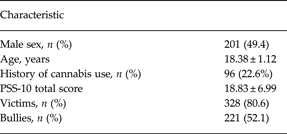
Data are given as counts and percentages or means and standard deviations, as appropriate.
Discussion
School bullying is currently considered an alarming phenomenon that can impair an individual's ability to handle school life and relationships confidently and successfully (Glew et al. Reference Glew, Rivara and Feudtner2000). The long-term cost of bullying to the community for counselling, support services and the treatment of substance abuse deserve special consideration (Sourander et al. Reference Sourander, Jensen, Rönning, Niemelä, Helenius, Sillanmäki, Kumpulainen, Piha, Tamminen, Moilanen and Almqvist2007b). The results from this study indicate an independent association between levels of perceived stress (as measured by mean PSS total score) with both bullying and victimization. In addition, we found an independent link between male sex and active bullying.
Evidence suggests that bullying may act as a developmentally salient stressor (Hamilton et al. Reference Hamilton, Newman, Delville and Delville2008), possibly associated with depressive symptoms in genetically vulnerable individuals (Rigby, Reference Rigby2003; Newman et al. Reference Newman, Holden and Delville2005; Brunstein Klomek et al. Reference Brunstein Klomek, Marrocco, Kleinman, Schonfeld and Gould2007; Sourander et al. Reference Sourander, Jensen, Rönning, Niemelä, Helenius, Sillanmäki, Kumpulainen, Piha, Tamminen, Moilanen and Almqvist2007b; Uba et al. Reference Uba, Yaacob and Juhari2009; Nolfe et al. Reference Nolfe, Petrella, Zontini, Uttieri and Nolfe2010). In addition, victims exhibit a wide range of maladjustment that includes internalizing problems, peer rejection, lack of close friendships, acceptance of deviance, less optimal temperament, negative emotionality and reactive aggression (Uba et al. Reference Uba, Yaacob and Juhari2009). Consistent with our predictions that being bullied by peers is a stressful experience, we found that victimization appeared to be linked with higher levels of perceived stress. Of note, one of the best coping strategies against perceived stress is the availability of a strong social support network. However, there is evidence that bullying victims are cut off from their peers and rated as less popular (Newman et al. Reference Newman, Holden and Delville2005). It is likely that bullies are drawn to those who are quiet and alone, or that their peers tend to stay away from chronic victims. Either way, the outcome faced by the victim is the same, i.e. a sense of isolation from one's peers that can increase perceived stress, most likely in the social domain.
PSS score and male sex were both independently associated with active bullying. The association between male sex and active bullying is in accordance with previous studies (Bentley & Li, Reference Bentley and Li1995; Wolke et al. Reference Wolke, Woods, Stanford and Schulz2001; Seals & Young, Reference Seals and Young2003; Kiriakidis, Reference Kiriakidis2007; Cerni Obrdalj & Rumboldt, Reference Cerni Obrdalj and Rumboldt2008). The potential reasons for aggressive behaviour in boys can be both psychological (i.e. related to the need of demonstrating their physical strength) and biological (i.e. testosterone-mediated aggressiveness) (Archer, Reference Archer2006; Cerni Obrdalj & Rumboldt, Reference Cerni Obrdalj and Rumboldt2008). While the relation between stress and being bullied has been extensively investigated in the literature (Björkqvist, Reference Björkqvist2001; Hamilton et al. Reference Hamilton, Newman, Delville and Delville2008), little information is available on the association between stress symptoms and being a perpetrator. The exact mechanisms underlying the link between stress and active bullying remains to be determined, but it is feasible to hypothesize that they could be mediated by concomitant psychopathology in perpetrators, including personality disorders and antisocial traits. In this regard, longitudinal results from the Finnish ‘From a Boy to a Man’ survey (Sourander et al. Reference Sourander, Jensen, Rönning, Elonheimo, Niemelä, Helenius, Kumpulainen, Piha, Tamminen, Moilanen and Almqvist2007b) found that bullying is a type of antisocial behaviour associated with antisocial personality disorder in early adulthood. Moreover, the authors suggested that frequent bullies more often display a callous − unemotional antisocial trait, a specific affective and interpersonal style described in children with severe conduct disorders that is characterized by absence of guilt, limited display of emotion and lack of empathy (Sourander et al. Reference Sourander, Jensen, Rönning, Elonheimo, Niemelä, Helenius, Kumpulainen, Piha, Tamminen, Moilanen and Almqvist2007a).
Several limitations in our study should caution against overinterpretation. First, the cross-sectional retrospective design of the present research does not allow making causal statements. Longitudinal studies are needed to elucidate the potential causal effect of these variables on bullying behaviour. Second, the RBQ questionnaire relies on memory recall of what happened even long time ago. Additionally, victimization was assessed only with a self-report questionnaire and peer-nomination methods were not used. Finally, inherent limitations are present in self-reporting that may be sensitive to the willingness to honestly narrate one's personal experience.
These limitations notwithstanding, the results from this study indicate that the level of perceived stress had an independent association with both bullying and victimization. Further studies are needed to clarify the psychobiological links between stress, cannabis use and bullying behaviours.
Acknowledgements
We are grateful to all students, teachers and directors of the schools involved in the project (Liceo Scientifico Statale ‘N. Copernico’, Istituto Professionale Statale per i Servizi Aziendali, Turistici, Grafici, Sociali e Alberghieri ‘L. Cossa’, and Istituto di Istruzione Superiore ‘A. Volta’, Pavia, Italy). We would like to thank Sean McLoughlin and Francesco Mungai, South Essex Partnership University NHS Foundation Trust, for their help with the back-translation of the RBQ questionnaire.
Declaration of interest
This study did not receive specific financial support. None of the authors have any conflicts of interest in relation to this paper.