Introduction
The mosquito, Culex pipiens Linnaeus (Diptera: Culicidae), is a ubiquitous species that colonizes a large variety of biotopes throughout temperate and tropical countries. It is usually considered as a complex including: C. p. pipiens Linnaeus, C. p. quinquefasciatus Say, C. p. pallens Coquillett and C. p. molestus Forskål (Knight & Stone, Reference Knight and Stone1977; Knight, Reference Knight1978). These are morphologically, physiologically, ecologically and behaviourally different. Culex p. pipiens (temperate type) and C. p. quinquefasciatus (tropical type) are the most widely found members and are both closely associated with human activity. They are major vectors of Wuchereria bancrofti and West Nile virus (Anderson et al., Reference Anderson, Andreadis, Vossbrinck, Tirrell, Wakem, French, Garmendia and Van Kruiningen1999). There has been much research on C. pipiens throughout the world on various subjects, such as insecticide resistance and population genetic structure. Understanding the population structure of the mosquito may provide valuable information about its migration pattern, which is essential for assessing the spread of selected traits such as insecticide resistant genes (Lenormand & Raymond, Reference Lenormand and Raymond1998).
All four subspecies from the C. pipiens complex have been found in China (Zhao & Lu, Reference Zhao and Lu1995; Qu, Reference Qu1999). Unlike for the western and central Palaearctic, where C. p. pipiens is the most common type, C. p. pallens is the dominant subspecies in northern China, whereas C. p. pipiens is only found in the Xingjiang Uygur Autonomous Region. Culex p. quinquefasciatus is found mainly in southern China and C. p. molestus has so far been detected only around Beijing (Zhao & Lu, Reference Zhao and Lu1995). Hybridization tests showed that there were no reproductive isolations between C. p. pipiens, C. p. pallens and C. p. quinquefasciatus, and there are some overlapping areas between the distributions of C. p. pipiens and C. p. pallens, C. p. pallens and C. p. quinquefasciatus (Zhao & Lu, Reference Zhao and Lu1996). Biosystematic studies (including hybridization), morphological studies and gas chromatography analyses of cuticular hydrocarbons confirmed C. p. quinquefasciatus and C. p. pallens as being subspecies in this complex (Zhao & Lu, Reference Zhao and Lu1995). The present study aimed to investigate the population genetic structure of the C. pipiens complex (C. p. quinquefasciatus and C. p. pallens) in China. Sampling was carried out at different scales over a south–north transect across the country, allowing us to determine genetic differentiation and isolation by distance.
Materials and methods
Mosquitoes
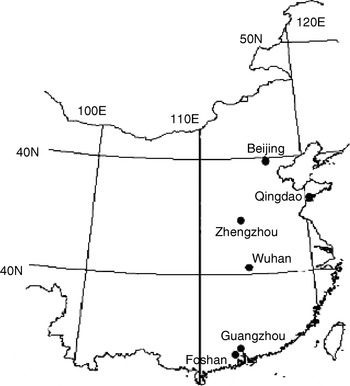
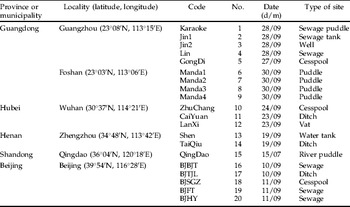
Larvae and pupae of C. pipiens were collected during 2003 from four provinces and one municipality (Beijing), from a total of 20 breeding sites (fig. 1, table 1). Whenever possible, every mosquito was raised until its adult stage and then deep frozen until used for enzyme characterization.
Locations of population collections of Culex pipiens complex in China in 2003.

Collection sites of Culex pipiens sampled in China in 2003.

Electrophoresis
Using starch gel electrophoresis (TME 7.4 buffer system) of adult mosquito homogenates (Pasteur et al., Reference Pasteur, Pasteur, Bonhomme and Britton-Davidian1988), we studied electrophoretic polymorphisms of the following four enzymes: glutamate-oxaloacetate transaminase (EC 2.6.1.1), hexokinase (EC 2.7.1.1), phosphogluco-isomerase (EC 5.3.1.9), and phosphoglucomutase (EC 2.7.5.1). Two strains, derived from S-LAB (Georghiou, Reference Georghiou, Metcalf and Gidden1966) and having the same genetic background were used as reference standards: SA2 and SB1 (Berticat et al., Reference Berticat, Rousset, Raymond, Berthomieu and Weill2002). For each enzyme, the electromorph band for the reference strain was designated ‘100’ and other electromorph bands (alleles) were numbered according to their relative electrophoretic mobility, that is 110, 120, etc. for faster bands and 90, 80, etc. for slower bands.
Data analysis
Each locus was tested for conformity with Hardy-Weinberg (HW) equilibrium using the exact U-score test with heterozygote deficiency being the alternative hypothesis (Rousset & Raymond, Reference Rousset and Raymond1995). A global test across samples and/or loci was also carried out (Rousset & Raymond, Reference Rousset and Raymond1995). Genotypic associations between each pair of loci, in each population, were tested using the probability test described by Raymond & Rousset (Reference Raymond and Rousset1995a). For each locus pair, global tests (Fisher's method) were carried out across all populations. Deviations from HW equilibrium were measured using the Fis estimator proposed by Weir & Cockerham (Reference Weir and Cockerham1984). Genotypic differentiation between populations was tested for by calculating an unbiased estimate of the P-value of a log-likelihood (G) based exact test (Goudet et al., Reference Goudet, Raymond, De Meeüs and Rousset1996). Population differentiation was measured using the Fst estimator (Weir & Cockerham, Reference Weir and Cockerham1984). Differentiation of larger set of populations (here province) was measured and tested using the computer package HierFstat (Goudet, Reference Goudet2005). Isolation by distance was analysed as described by Rousset (Reference Rousset1997), by calculating pairwise estimates of Fst/(1-Fst) with respect to the logarithm of geographic distance. Any possible positive relationship was tested with a Mantel test, using the Spearman rank correlation coefficient statistic. Geographical distances between samples were taken as the shortest distance on a map. Calculations were performed using Genepop version 3.4 (Raymond & Rousset, Reference Raymond and Rousset1995b) and the sequential Bonferroni method (Hochberg, Reference Hochberg1988) was used for multiple testing.
Results
Description of polymorphism
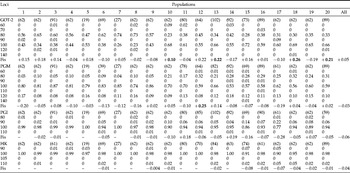
A total of 1376 mosquitoes were analysed for the four enzyme systems, among which five putative loci (Got-1, Got-2, Hk, Pgi and Pgm) were revealed. All loci were polymorphic except for Got-1, which was not used in the analysis because it was unreadable. Overall, 5245 genotypes were available for analysis. The frequencies of each allele for Got-2, Hk, Pgi and Pgm in each sample are shown in table 2.
Allelic frequencies observed at four putative allozyme loci for 20 mosquito populations. Population numbers are given in table 1.

The number of mosquitoes analyzed is given in parentheses. Bold Fis values indicate a significant (P<0.05) departure from HW due to heterozygote deficiency.
Statistical independence among loci
Genotypic associations were tested at each pair of loci in each sample. Random association was rejected (P<0.05) in seven out of 97 tests (or 7.2%) and one remained significant when taking into account multiple tests. A global test across populations for each locus pair revealed no pairs with significant values (P>0.05).
Hardy-Weinberg equilibrium
Significant departure from HW equilibrium, due to heterozygote deficiency, was observed in five out of 66 cases (table 2). When the number of tests was taken into account none of the results were significant. For all loci and samples, no significant (P>0.45) heterozygote excess or deficiency was found.
Genetic differentiation
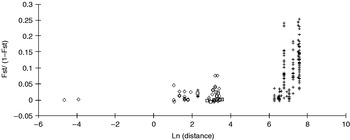
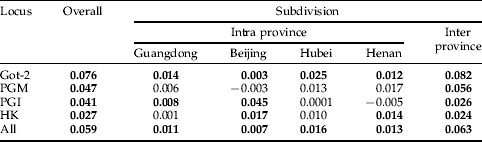
The overall genotypic differentiation found across China was moderate (Fst=0.059) and highly significant (P<10−4) (table 3). This genetic variation was partially explained by distance, as a significant (P<5.10−5) increase of differentiation was found with geographic distance, with a slope of 0.018 (fig. 2). In order to investigate the differentiation hierarchically, several groupings were considered.
Relationship between pairwise Fst/(1−Fst) values and the logarithm of geographic distance (in km) for all samples. Circles, squares, triangles and diamonds represent pairs of samples from Guangdong province, Beijing, Hubei province and Henan province, respectively. Pairs from different provinces are indicated with a ‘plus’. See text for details.

Differentiation (Fst) among populations of Culex pipiens in China.
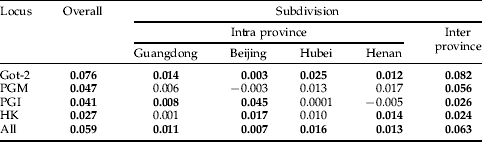
‘Overall’ refers to the estimate across all populations. ‘All’ refers to the multi-locus estimate. Bold characters indicate significant (P<0.05) genotypic differentiation.
The intra-province genotypic differentiation within each province was low but significant (Guangdong, Fst=0.011, P<0.001; Beijing, Fst=0.007, P<10−4; Hubei, Fst=0.016, P<0.001; Henan, Fst=0.013, P=0.01, see table 3). In Beijing and Guangdong province, the differentiation did not depend on geographic distances, with isolation by distance not being significant (Beijing, P>0.20; Guangdong, P=0.13; fig 2). The inter-province differentiation between the five provinces was moderate (hierarchical Fst=0.063) and highly significant (P<10−3), see table 3. A significant isolation by distance (P=0.016) was detected with a slope of 0.13.
Discussion
The present study showed that the overall genotypic differentiation across 20 Chinese C. pipiens populations was moderate (Fst=0.059), despite the maximum distance between the populations being about 2000 km and there being isolation by distance at this scale.
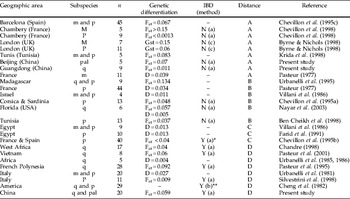
We reviewed the literature to compare this result with previous population genetic surveys of this mosquito species in different geographic regions. We found various geographical scales, from a few kilometres (e.g. a city) to the large part of a continent. Therefore, we attributed these distances to four classes to allow comparisons: 0–100 km (A), 100–500 km (B), 500–1000 km (C) and more than 1000 km (D). Population differentiation was estimated using either D (Nei, Reference Nei1972), Gst (Nei, Reference Nei1973) or Fst (Weir & Cockerham, Reference Weir and Cockerham1984). These measures do not use the same assumptions (e.g. the genetic distance, D, assumes a genetic independence between the samples, unlike Fst, which takes into account a possible gene flow between samples), and are tentatively given in table 4. Isolation by distance (IBD) is more consistent, as it is tested using a Mantel test on pairwise measures of distance and genetic differentiation. As the Mantel test is based on rank, it is not affected by monotonous transformations of pairwise measures. Therefore, the results of the Mantel test remain unchanged if distance is replaced by log (distance), or if Fst is replaced by Fst/(1-Fst) or by (1/Fst-1)/4. This latter case corresponds to the formula for the number of migrants, Nm, in the infinite island situation (Wright, Reference Wright1969), and only the sign of the correlation changes. However, when the genetic differentiation is measured using either D or Gst, the results are not immediately comparable. It is apparent from table 4 that isolation by distance cannot be detected if the areas considered are less than 500 km apart, but can be definitively detected for areas at least 1000 km wide. These results are independent of the continent considered; there are both small and large scales studies in America, Africa, Europe and Asia that show contrasting results for IBD. These results also seem to be independent of the subspecies; C. p. pipiens, C. p. quinquefasciatus and C. p. pallens all show an absence of IBD at local scales, and IBD at extended regional scales. There is no equivalent result for C. p. molestus, as there have been no large-scale studies for this subspecies. In conclusion, C. pipiens requires a considerable distance to display IBD, which appears to be true for most of its distribution ranges. In addition, none of the population genetic studies in table 4 are using highly informative loci (associated with a high mutation rate), such as microsatellites, thus extending the minimum distance at which IBD could be detected in these studies. Detection of IBD is a function of Dσ2, with σ2 the migration variance, and D the population density (Rousset, Reference Rousset1997; Leblois et al., Reference Leblois, Estoup and Rousset2003). The migration variance has been estimated around 6–7 km in the Montpellier area (Lenormand et al., Reference Lenormand, Guillemaud, Bourguet and Raymond1998); and its validity outside this area, including for other climatic and population density conditions, needs to be established. The population density itself is highly variable, and could display very high values (see e.g. Hayes, Reference Hayes1975; Reisen et al., Reference Reisen, Milby and Meyer1992), thus generating values of Dσ2 outside the range usually considered (Leblois et al., Reference Leblois, Estoup and Rousset2003). It is thus presently not possible to extract information from table 4 using the population genetics theory on IBD.
Review of population structure studies of the Culex pipiens complex.

Subspecies are C. p. pipiens (p), C. p. quinquefascaitus (q), C. p. pallens (pal), C. p. molestus (m). The number of populations sampled is indicated (n). Isolation by distance (IBD) was tested in each study using a Mantel test between pairwise geographical distance (or its log) and pairwise differentiation. Pairwise differentiation was measured using Fst (or Fst/(1−Fst), (1/Fst−1)/4, or log[(1/Fst−1)/4]), Gst or D (these three methods are referred to as a, b, or c, respectively). Y or N indicates significant or non-significant IBD, respectively. The geographic distance considered in each study is classified as A (0–100 km), B (100–500 km), C (500–1000 km) or D (>1000 km). See text for details.
* Reanalysed in Silvestrini et al. (Reference Silvestrini, Severini, Di Pardo, Romi, De Matthaeis and Raymond1998).
** Reanalysed in Chevillon et al. (Reference Chevillon, Pasteur, Marquine, Heyse and Raymond1995b).
This is the first population genetic survey of C. pipiens on an extensive scale in Asia. The south–north sampling encompasses the transition between two subspecies, C. p. quinquefasciatus and C. p. pallens, in which their relationship is not well characterized. Similar insecticide resistance genes have recently been found in both the Chinese C. p. pallens and C. p. quinquefasciatus (Cui et al., Reference Cui, Lin, Qiao, Xu, Marquine, Raymond and Weill2006a,Reference Cui, Raymond and Qiaob). Some of these resistance genes are endemic to China, suggesting that their co-occurrence in pallens and quinquefasciatus is due to gene flow between these two subspecies and not independent or recent introductions from elsewhere. Selected genes (such as insecticide resistance genes) are interesting tools for detecting possible gene flow between two related taxa (e.g. Weill et al., Reference Weill, Chandre, Brengues, Manguin, Akogbeto, Pasteur, Guillet and Raymond2000). The co-occurrence of the same insecticide resistance gene in the various subspecies of the C. pipiens complex worldwide shows that gene flow is possible (Raymond et al., Reference Raymond, Callaghan, Fort and Pasteur1991, Reference Raymond, Berticat, Weill, Pasteur and Chevillon2001). However, these gene categories are not sufficient to quantify the gene flow. The present study was not designed to estimate gene flow between pallens and quinquefasciatus in China, although we would probably have detected a drastically restricted gene flow. Further studies are required to understand the relationship between pallens and quinquefasciatus in China, which possibly reflects the hybrid zone between C. p. quinquefasciatus and C. p. pipiens in America (Cheng et al., Reference Cheng, Hacker, Pryor, Ferrell, Kitto, Steiner, Tabachnik, Rai and Narang1982).
The extended area that is required to detect IBD suggests that this mosquito migrates over large distances. This is consistent with indirect measures of the distribution of a one-generation migration, which has a standard deviation of 6–7 km (Lenormand et al., Reference Lenormand, Guillemaud, Bourguet and Raymond1998). This extensive migration has implications for insecticide resistance monitoring, as any new resistance gene will rapidly spread over a very large geographic area. As C. pipiens is a vector of several human pathogenic organisms (e.g. West Nile virus), this large migration distance has also epidemiological implications.
Acknowledgements
The authors are very grateful to N. Pasteur for comments, to L.-F. Lin for help in mosquito collection, to A. Berthomieu and C. Berticat for technical help, and to V. Durand for bibliographic help. This work was partly supported by PRA B02-06 and National Natural Science Foundation of China (No. 30470322). Contribution 2006.087 of the Institut des Sciences de l'Evolution de Montpellier (UMR CNRS 5554).