Regardless of whether political candidates explicitly address or actively avoid stereotypes, some voters continue to rely on stereotyping to form opinions about candidates. Gender stereotypes about women's inability to provide strong leadership and deal with substantive policy issues have translated into significant obstacles for women seeking elected positions (Huddy and Terkildsen Reference Huddy and Terkildsen1993a, Reference Huddy and Terkildsen1993b). Stereotypes about sexual, racial, and ethnic minorities have worked similarly, resulting in limited electoral opportunities for political candidates belonging to these groups (Alexander and Andersen Reference Alexander and Andersen1993; Dolan Reference Dolan2004a, Reference Dolan2004b; Fox Reference Fox1997; Sanbonmatsu Reference Sanbonmatsu2002).
The stereotyping literature focuses primarily on discrete categories of identity because very few political candidates have belonged to minority groups, and even fewer have shared membership in more than one (Howard Reference Howard2000). However, the field of contemporary political candidates has seen many notable exceptions, suggesting the need for a more complete framework for examining the potential effect of overlapping stereotypes on voters' evaluations of political candidates. Belonging to more than one stigmatized group shapes not only an individual's identity but also the way he or she is perceived in the eyes of others (Fiske and Neuberg Reference Fiske, Neuberg and Zanna1990; Jones and Shorter-Gooden Reference Jones and Shorter-Gooden2003).
Gay and lesbian political candidates share a common membership as sexual minorities, but their shared identity is intersected by gender. Gay and lesbian political candidates have been largely neglected in studies of stereotyping, with some notable exceptions. Rebekah Herrick and Sue Thomas (1999, 2001) and Ewa A. Golebiowska (Reference Golebiowska2001, Reference Golebiowska2003) examine stereotypes of gay and lesbian political candidates and find evidence that stereotyping creates barriers for the perceived viability and electability of these candidates. However, in these studies, less attention has been given to other salient political factors that are also relevant to a candidate's viability, such as the electorate's evaluation of gay and lesbian candidates' attributes and issue competency.
Although gender stereotypes continue to hamper female candidates' ability to win office, and stereotypes about gay men and lesbians could function similarly, little is known about how these stereotypes work in concert with each other. When faced with political candidates who can be stereotyped on the basis of their sexual orientation as well as their gender, how does the public evaluate them? We attempt to build on the research investigating stereotyping of gay and lesbian political candidates in two important ways. First, our research explicitly examines what we refer to as “intersectional stereotyping” of political candidates by voters. After reviewing the literature on gender and sexual orientation stereotyping, we offer a definition of intersectional stereotyping that is intended as a step toward creating a conceptual framework for examining the confluence of overlapping stereotyping on voters' evaluations of political candidates. Second, we are able to extend Herrick and Thomas's (1999) and Golebiowska's (2001, 2003) findings in a national survey that contains three distinct areas of candidate evaluation. This unique survey of American adults asks respondents to compare hypothetical gay and lesbian congressional candidates to “typical” congressional candidates. The survey queries respondents about their likelihood of voting against a gay or lesbian political candidate, requests their evaluation of gay and lesbian candidates' attributes (honesty, morality, and strength), and also asks respondents to evaluate gay and lesbian candidates' issue competency in education, the military, and taxes. Through this analysis we are able to take a preliminary look at intragroup differences at the intersection of gender and sexual identity. We attempt to ferret out the way the public might employ multiple—and potentially competing—stereotypes about gender and sexual orientation when evaluating the issue competency and personal traits of political candidates.
GENDER STEREOTYPES OF POLITICAL CANDIDATES
Women seeking office have historically faced significant barriers to entry, such as a lack of political or occupational experience, lack of resources, poorly run campaigns, and campaigning for offices in unwinnable races (Burrell Reference Burrell1996; Carroll Reference Carroll1995; Deber Reference Deber1982). The terrain for contemporary female candidates has substantially changed in recent decades. Women find themselves running for offices on a more level playing field. For example, being socialized into office (Fox Reference Fox, Rinehart and Josephson2000), amassing as much money as their male counterparts (Biersack and Herrnson Reference Biersack, Herrnson, Cook, Thomas and Wilcox1994), and acquiring professional staffs (Dabelko and Herrnson Reference Dabelko and Herrnson1997) have all significantly reduced these barriers.
Despite the reduction in resource barriers for women seeking elected office, the public continues to evaluate female candidates through gendered lenses. Likewise, potential female candidates are more likely to overestimate the challenges, especially in terms of campaign finance, than are their male counterparts (Lawless and Fox Reference Lawless and Fox2005). On the surface, gender stereotypes appear obviously to hamper female candidates' success at the polls, but the impact of gender stereotyping on electoral success is a more complex story. Considerable debate still exists in the literature over the extent to which voters' stereotypes shape their perceptions of female candidates and how that influences election outcomes.
Leonie Huddy and Nayda Terkildsen (1993a) argue that voters may use gender stereotyping while evaluating a candidate's beliefs and traits. Gendered beliefs structure a voter's perception of a political candidate's ability to handle various issues. Gender stereotyping of a female candidate leads to a more positive evaluation of her ability to deal competently with issues such as education, poverty, and health care (Shapiro and Mahajan Reference Shapiro and Mahajan1986) but less competently in dealing with policy issues such as foreign affairs, economics, and the military, which are linked with masculine stereotypes (Alexander and Andersen Reference Alexander and Andersen1993; Huddy and Terkildsen Reference Huddy and Terkildsen1993a, Reference Huddy and Terkildsen1993b). Gender stereotypes are also at play when evaluating personality traits of women (Langford and Mackinnon Reference Langford and MacKinnon2000). Female politicians are ascribed stereotypical traits, such as being more compassionate, warm, and passive in comparison to their male counterparts (Alexander and Andersen Reference Alexander and Andersen1993; Dolan Reference Dolan2004a, Reference Dolan2004b; Fox Reference Fox1997; Huddy and Terkildsen Reference Huddy and Terkildsen1993a, Reference Huddy and Terkildsen1993b; Leeper Reference Leeper1991; Sanbonmatsu Reference Sanbonmatsu2002).
Several experimental studies convincingly demonstrate that individuals routinely evoke gender stereotypes in assessing a candidate's policy expertise and related personality traits (Fox and Smith Reference Fox and Smith1998; Huddy and Terkildsen Reference Huddy and Terkildsen1993a, Reference Huddy and Terkildsen1993b; Rosenwasser and Seale Reference Rosenwasser and Seale1988). Outside of experimental research, Monika L. McDermott (Reference McDermott1997) found that candidate gender is used as a shortcut in low-information House races; voters stereotyped female candidates as being more liberal than their male counterparts in the same party (see also Koch Reference Koch2000).
Studies investigating gender stereotyping and electoral outcomes have found little to no difference between the vote totals and fund-raising success of women candidates when compared to men (Burrell Reference Burrell1996, Reference Burrell, Thomas and Wilcox2005; Dolan Reference Dolan1998; Fox Reference Fox, Rinehart and Josephson2000). Female political candidates may even do better at the polls when they stress stereotypical issues and traits, and in this regard gender stereotyping can function as a strategic advantage (Herrnson, Lay and Stokes Reference Herrnson, Lay and Stokes2003; Kahn Reference Kahn1996; Sanbonmatsu Reference Sanbonmatsu2002). This form of benevolent sexism may in the short term provide an advantage to women who use gender stereotyping as an asset on the campaign trail or encounter voters who perceive their issue position and ideological stance to be consistent with their own vis-à-vis gender stereotyping.
Other studies take a less sanguine view of the strategic advantage that gender can play in electoral outcomes. Playing up “positive” gender stereotypes has a limited utility for a female candidate because she quickly runs the risk of being perceived by the electorate as a one-dimensional candidate interested only in women's issues (Witt, Paget, and Matthews Reference Witt, Paget and Matthews1994). Although gender stereotypes may provide female candidates with a small benefit in certain elections, and when specific issues are salient to the electorate, they are particularly detrimental for women seeking national or executive offices, where primacy is placed on stereotypically masculine traits and issue areas (Fox and Oxley Reference Fox and Oxley2003; Huddy and Terkildsen Reference Huddy and Terkildsen1993b).
Gender stereotyping is further compounded by media portrayals of female political candidates, which tend to underscore, rather than challenge, the pervasive gender stereotypes used by the public to evaluate candidates (Bystrom, Robertson, and Banwart Reference Bystrom, Robertson and Banwart2001; Kahn Reference Kahn1992, Reference Kahn1994, Reference Kahn1996; Niven and Zilber Reference Niven and Zilber2001). Even in the high-profile presidential campaigns of Elizabeth Dole in 1999 and Hillary Clinton in 2008, media coverage disproportionately focused on their personality traits and appearances compared to their male counterparts seeking office (Aday and Devitt Reference Aday and Devitt2001; Heldman Carroll, and Olson Reference Heldman, Carroll and Olson2005; Lawless Reference Lawless2009). Media coverage of other underrepresented groups, such as African Americans, Latinos, and gay men and lesbians, also tends to foster and perpetuate stereotypes held by the general public (Entman and Rojecki Reference Entman and Rojecki2001; Golebiowska Reference Golebiowska2001, Reference Golebiowska2002, Reference Golebiowska2003).
Despite the myriad ways in which the public stereotypes stigmatize groups, the degree to which intersectional stereotyping influences the electorate's evaluation of a candidate is largely unknown.Footnote 1 McDermott (Reference McDermott1998) found that gender and racial stereotypes are used to assess female and African-American political candidates: Both are evaluated as more liberal and dedicated to policy areas that are salient in their respective group—women or minority. Although this study examines two prominent minority groups, women and African Americans, they are evaluated separately. When evaluating gender and race together, Luis Ricardo Frega and his colleagues (Reference Frega, Valerie Martinez-Ebers and Ramirez2006) argue that gender stereotypes may soften the stereotypically negative traits associated with a candidate's particular ethnic or racial group. However, most empirical studies examining the existence and influence of gender stereotyping on female candidates rarely take into consideration intragroup differences, such as sexual orientation, that may compound or mitigate stereotypes.
STEREOTYPES AND CANDIDATE SEXUAL ORIENTATION
Perhaps not surprisingly then, little is known about the interplay between sexual orientation and gender in shaping the public's opinion of political candidates (Howard Reference Howard2000). Several limitations contribute to the dearth of research in this area. Gays and lesbians continue to be one of the most disliked groups in the United States, and only a small minority of candidates are openly gay or lesbian, a situation that has limited empirical research on this unique subgroup (Golebiowska Reference Golebiowska2002; Smith and Haider-Markel Reference Smith and Haider-Markel2002). In addition, research is frustrated by the fact that sexual orientation can be concealed—unless a candidate is willing to self-identify as a gay man or lesbian, his or her sexual orientation can easily be hidden.
Another limitation of this literature is the persistent treatment of sexual minorities as a monolithic category.Footnote 2 Most studies have treated lesbians and gays as a homogenous group, which tends to erase the mediating impact of other important identities, namely gender, on how gays and lesbians are viewed in society. In his (1997) review of opinion polls, Alan S. Yang discovered that the majority of items (77 out of 79) included in the polls did not differentiate between gay men and lesbians. Yet studies examining sexual minorities demonstrate the importance of distinguishing between gay men and lesbians, as well as accounting for the gender of the respondent evaluating them. For example, people evaluate sexual minorities of their own sex as possessing more traits of the opposite sex; heterosexual women believe that lesbians possess more masculine traits, whereas heterosexual men think that gays possess more feminine traits (Herek Reference Herek2002; Kite and Whitley Reference Kite and Whitley1996).
Gender differences have also been found in areas other than trait attribution. Compared to their male counterparts, heterosexual women are more supportive of gay and lesbian rights and less condemning of sexual minorities (Herek Reference Herek2002; LaMar and Kite Reference LaMar and Kite1998). However, although heterosexual women tend to possess more positive attitudes toward sexual minorities in general, evidence suggests that heterosexual women harbor more negative stereotypes about lesbians than about gay men (LaMar and Kite Reference LaMar and Kite1998). In terms of tolerance of sexual minorities, gay men tend to receive harsher treatment in the court of public opinion, which seems to be driven largely by heterosexual men who embrace stereotypical beliefs about gay men and are more likely to cast them as mentally ill and as child molesters (Herek Reference Herek2002).
These studies persuasively argue that a sexual minority's gender makes a difference in how he or she is perceived by society. By extension, it seems reasonable to expect that gender may matter when the public evaluates a gay or lesbian political candidate. The scant research in this area, however, has turned up mixed results and is hampered by some research design limitations.
Nearly all previous research on the impact of candidate sexual orientation on candidate evaluations, success, or electoral margins has been conducted as experimental studies in which fictional voters (usually college students) evaluated hypothetical candidates (see Golebiowska Reference Golebiowska2001, Reference Golebiowska2003; Golebiowska and Thomsen Reference Golebiowska, Thomsen, Riggle and Tadlock1999; Herrick and Thomas Reference Herrick, Thomas, Riggle and Tadlock1999). One exception is Golebiowska's (2002) study of gay and lesbian candidates and elected officials. She conducted a survey of these individuals and asked them to assess the impact that sexual orientation had in their election contests. Her findings were consistent with experimental research, including Golebiowska (Reference Golebiowska2001), Golebiowska and Thomsen (Reference Golebiowska, Thomsen, Riggle and Tadlock1999), and Herrick and Thomas (Reference Herrick, Thomas, Riggle and Tadlock1999), all of which suggest that gay and lesbian candidates receive lower evaluations than their heterosexual counterparts and that gay and lesbian candidates are less likely to receive electoral support. This pattern is especially true for gay male candidates who fit a gay male stereotype of being effeminate (Golebiowska Reference Golebiowska2001).
A study by Herrick and Thomas (Reference Herrick, Thomas, Riggle and Tadlock1999) differs from Golebiowska's (2001) work in that their experimental research design involved the creation of hypothetical elections where respondents were asked more directly to state their voting preferences and their perceptions of candidates. Controlling for a variety of other factors, including respondent gender and ideology, they found that a candidate's sexual orientation does have a slight influence on voting preference and on perceptions of a candidate's electoral viability. A specific examination of the impact of a gay candidate's gender on evaluations of him or her has produced some mixed findings within these studies. At times, the evidence suggests that evaluations of gay male candidates are more negative (Herek Reference Herek2002; Herrick and Thomas Reference Herrick, Thomas, Riggle and Tadlock1999), and at other times it suggests that lesbian candidates are at a disadvantage due to their sexual orientation and gender (Golebiowska and Thomsen Reference Golebiowska, Thomsen, Riggle and Tadlock1999). Yet Golebiowska (Reference Golebiowska2001) discovered no differences in the evaluations of gay and lesbian political candidates, and she did not find a difference between male and female respondents' evaluations of gay and lesbian candidates.
INTERSECTIONAL STEREOTYPING
These studies have provided initial empirical support for anecdotal evidence indicating that for openly gay and lesbian political candidates, their sexual orientation is a factor in their campaigns (Smith and Haider-Markel Reference Smith and Haider-Markel2002). Although interconnectedness exists between individual and group experiences, various components of identity often compete and overlap, simultaneously marginalizing and privileging individuals within the same group. For example, compared to white women, Latinas experience multiple disadvantages in the labor market because of their combined social status as gender and ethnic minorities (Browne and Misra 2003). However, in a different context, such as running for political office, the strategic intersection of gender and ethnicity may function as an advantage for Latinas because their multiple identities provide them with greater options in terms of joining and building political coalitions once in office (Fraga et al. 2006).
Scholars have documented the limitations of studying inequality, in its various iterations, in discrete conceptual terms (Crenshaw Reference Crenshaw1991, Reference Crenshaw and Weisburg1993; Hancock Reference Hancock2007; Simien Reference Simien2007).Footnote 3 A singular focus on sexual minorities as a uniform category of people misses the important cleavages among them, most saliently the gender differences that exist between gay men and lesbians. Little research has explored the nexus between gender and sexual minority stereotypes. Stereotyping becomes entangled when intragroup differences exist within the larger stigmatized group. In this context, one-dimensional definitions of stereotyping ignore qualitative differences among individuals in the group. Intersectional approaches to the study of identity and inequality capture the complexity of “the relationship among multiple dimensions and modalities of social relations and subject formations” (McCall Reference McCall2005, 1771).
Incorporating intersectionality into a definition of stereotyping is a first step in recognizing that overlapping stereotypes may work in concert with each other, thus producing a unique stereotype that cannot be understood separately. Adapting M. Eaton's (Reference Eaton1994) definition of intersectional oppression, we define intersectional stereotyping as stereotyping that is created by the combination of more than one stereotype that together produce something unique and distinct from any one form of stereotyping standing alone. This definition creates a more nuanced conceptual and analytical framework that can be used to examine how individuals evaluate a stigmatized group and whether their evaluations of the stigmatized group vary across intragroup differences.
DATA AND METHODS
The data for our analyses come from a unique October 20 to November 4, 2003, random-sample telephone survey of American adults conducted by the Scripps Survey Research Center at Ohio University. The survey included questions about Iraq, the economy and unemployment, mental health, attitudes about hypothetical gay and lesbian politicians, and holidays. A total of 1,054 adults answered at least a portion of the survey questions, and all were asked the same questions (described in the following) about hypothetical gay and lesbian candidates. For most questions on the survey, the margin of error is ± 3.6 percentage points or less.
Our empirical investigation allows us to extend the line of research on stereotypes by testing the impact of intersecting stereotypes on the public's evaluation of gay male and lesbian candidates. We are interested in whether a candidate's sexual orientation matters more, less, or the same depending on the candidate's gender, as well as the gender of the respondents. We tease this out by focusing on three main issues as they pertain to sexual minority candidates: respondents' likelihood of voting for gay and lesbian candidates, respondents' evaluation of candidates' traits, and respondents' evaluation of candidates' issue competency.
Dependent Variables
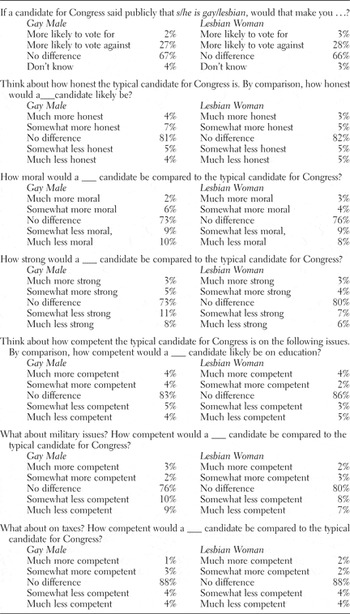
Central to our analysis is a series of questions pertaining to hypothetical gay and lesbian candidates running for Congress (the full question wording and descriptive statistics for the dependent variables in our analysis are displayed in Table 1). All respondents were asked if they would support a lesbian candidate in the following manner: “If a candidate for Congress said publicly that she is lesbian, would that make you more likely to vote for her, more likely to vote against her, or would it have no effect on your vote?” The same question was asked of all respondents substituting “gay” in place of “lesbian.” About 27% of respondents would oppose a gay congressional candidate, while 28% would oppose a lesbian congressional candidate.
Attitudes concerning gay and lesbian political candidates, 2003 survey

In the same poll, all respondents were asked a number of questions regarding the personal attributes of gay and lesbian candidates, as well as how competent gay and lesbian candidates would be on specific issues. In terms of the honesty, morality, and strength of gay and lesbian candidates for Congress, the great majority of respondents indicated that there would be no difference compared to the typical congressional candidate. However, 9% suggested that gay and lesbian candidates would be somewhat less honest, 17% indicated that gay and lesbian candidates would be somewhat less moral, and 13% suggested that lesbian and gay candidates would be somewhat less strong than the typical candidate for Congress. In terms of negative attributes, such as being less strong, respondents ranked gay and lesbian candidates nearly the same, but did attribute slightly more negative characteristics to gay male candidates. Specifically, simple t-tests reveal that respondents were more likely to believe that gay candidates would be less moral (1.694; p = .04) and less strong (4.1671; p = .00) than lesbian candidates.
The lower half of Table 1 displays attitudes concerning the competency of gay and lesbian candidates on education, military, and tax issues. Across all three issues, no less than 76% of respondents believed gay and lesbian candidates would be at least as competent as the typical candidate for Congress.Footnote 4 About 5% of respondents thought gay and lesbian candidates would be more competent, while at least 8% thought gay and lesbian candidates would be less competent than the typical congressional candidate. Between gay and lesbian candidates there are some small differences. On the basis of simple t-tests, gay male candidates were seen as less competent on education (1.673; p =.04) and military issues (3.008; p = .00) than were lesbians.
Each of the questions from Table 1 will serve as dependent variables for our analysis. Because each question has three or more categories, we employ ordered logit for our multivariate analysis. The coding of each variable is consistent with the order of responses in Table 1, with refusals and “don't know” responses coded as missing.
Independent Variables
Our primary focus in this analysis is the intersection between a political candidate's sexual orientation and gender. Intragroup differences can be examined because the survey is exceptional in that it specifically asked respondents to evaluate gay female political candidates separately from gay male political candidates. Although imperfect, the survey design enables us to capture a raw measure of intersectionality and begin to empirically examine the role that intersectional stereotyping may play in the public's evaluation of gay and lesbian political candidates.
Research is replete with evidence that the gender of both political candidates and voters plays an important role in politics. Female political candidates continue to be viewed through a gendered prism. In their campaigns, candidates have to surmount voters' stereotypical beliefs governing their competency and personality traits (Alexander and Andersen Reference Alexander and Andersen1993; Dolan Reference Dolan2004a, Reference Dolan2004b; Huddy and Terkildsen Reference Huddy and Terkildsen1993a, Reference Huddy and Terkildsen1993b). For lesbian candidates, the role that gender plays in their candidacy is not as well understood as that for heterosexual female candidates. The limited experimental evidence has turned up mixed results as to whether lesbian candidates are evaluated more or less favorably, or the same compared to gay male candidates (Golebiowska Reference Golebiowska2001; Golebiowska and Thomsen Reference Golebiowska, Thomsen, Riggle and Tadlock1999; Herrick and Thomas Reference Herrick, Thomas, Riggle and Tadlock1999). However, precisely whether the results are attributable to a lesbian political candidate's gender or sexual orientation is unclear. One issue that has been concretely established in this research is that gay and lesbian candidates are systematically evaluated less favorably than heterosexual candidates, which is attributable to sexual orientation.
Among the electorate, gender is also a factor; under certain conditions, men and women evaluate (and vote for) candidates differently. The Democratic primary exit polls of more than 39,000 voters in 2008 revealed, a clear gender gap appeared. Compared to men, women—in particular white women and Latinas—were more likely to vote for Hillary Clinton over Barack Obama (Huddie and Carey 2009). Moreover, from a Pennsylvania preelection poll, evidence suggests that the gender gap in support was attributable to female voters' belief in shared gender interests with Hillary Clinton (Huddie and Carey 2009). Whether or not female voters would feel a shared affinity for a lesbian candidate on the same basis is unknown.
Women, in general, are less hostile toward sexual minorities and less inclined to view same-sex relationships as morally wrong, compared to men (Haider-Markel and Joslyn Reference Haider-Markel and Joslyn2008; Herek Reference Herek2002; LaMar and Kite Reference LaMar and Kite1998). Yet research has also uncovered evidence that women are more likely to adhere to, and accept negative stereotypes about, lesbians than about gay men, especially concerning stereotypes about lesbians' masculine characteristics (Kite and Whitley Reference Kite and Whitley1996; LaMar and Kite Reference LaMar and Kite1998). However, these studies were not investigating evaluations of gay men and lesbians in the context of political candidates. In the political realm, lesbian candidates also have to contend with prevailing gender stereotypes about women's ability to effectively hold office. Within this context, it is possible that gender stereotypes are either neutralized or offset by prevailing stereotypes about lesbians' masculine characteristics. Female voters may also transcend any stereotypes they hold about lesbians in the context of politics and instead gravitate toward lesbian candidates on the underlying expectation of shared gender interests. Therefore, we expect that female respondents will be more supportive than male respondents of both gay and lesbian candidates, and we also expect that women will be more supportive of, and attribute less negative characteristics to, lesbian candidates relative to gay candidates (descriptive statistics for all independent variables are displayed in the Appendix).
Based on literature concerning more general affect toward gays and lesbians and opinions about gay and lesbian civil rights, we include a series of control variables in our models. These include education, ideology, age, religiosity, race, urbanity, region of residence, and partisanship (Brewer Reference Brewer2003a, Reference Brewer2003b; Egan and Sherrill Reference Egan and Sherrill2005; Haider-Markel and Joslyn Reference Haider-Markel and Joslyn2008; Herek Reference Herek2002). Research consistently demonstrates that liberals tend to have more positive affect toward sexual minorities and are more supportive of gay and lesbian civil rights than are conservatives (Haider-Markel and Joslyn Reference Haider-Markel and Joslyn2008; Herek Reference Herek2002). As such, we expect that liberals will be more supportive of gay and lesbian candidates for Congress and will be less likely to attribute negative characteristics to them. Respondents in our survey were asked to describe their political views as very conservative, conservative, moderate, liberal, or very liberal. We include responses to this question in our models to capture respondent ideology. Likewise, on average, Democrats tend to have more favorable attitudes toward gays and lesbians than do Republicans (Brewer Reference Brewer2003a; Haider-Markel and Joslyn Reference Haider-Markel and Joslyn2008; Herek Reference Herek2002). We account for partisanship by including a respondent self-assignment of partisanship that ranges from strong Republican to strong Democrat.
For religiosity, we utilized a conventional question assessing a respondent's level of church attendance—“have you gone to church in the past week.” Regardless of the specific denomination, respondents who attended church most frequently are the most religious, and these individuals are least likely to support sexual minority candidates and are more likely to attribute negative characteristics to gay male and lesbian candidates. In addition, given that conservative Protestant denominations and evangelical (born-again) Christians are most likely to publicly disapprove of gay men and lesbians (Haider-Markel and Joslyn Reference Haider-Markel and Joslyn2008), we also included control variables for Protestant, coded one if the respondent was Protestant and zero otherwise, and born-again, coded one if the respondent was born-again and zero otherwise.
Studies also suggest that citizens with a higher level of education are more positive toward gays and lesbians and are more supportive of gay civil rights (Brewer Reference Brewer2003a, Reference Brewer2003b). We account for education with a simple scale based on respondents' answers that range from no high school education to postgraduate education. Age and race are also sometimes related to affect toward sexual minorities, with mixed results. In most cases, older adults are less supportive of gay civil rights, while whites are more supportive, relative to Hispanics and African Americans (Brewer Reference Brewer2003a, Reference Brewer2003b; Haider-Markel and Joslyn Reference Haider-Markel and Joslyn2008; Herek Reference Herek2002). We include basic measures of a respondent's reported age and race to account for these factors.
Finally, place of residence can shape attitudes about a variety of issues, including attitudes toward sexual minorities. For example, citizens living in the South of the country and in rural areas tend to have less-than-positive attitudes toward gays and lesbians (Brewer Reference Brewer2003a, Reference Brewer2003b; Haider-Markel and Joslyn Reference Haider-Markel and Joslyn2008). To account for this potential difference in attitudes, we include a simple dichotomous variable indicating whether the respondent lives in a southern state. We also include a variable for size of the city in which a respondent resides, ranging from a rural area to a suburban area to a large city.
RESULTS AND DISCUSSION
Voting for Gay and Lesbian Candidates
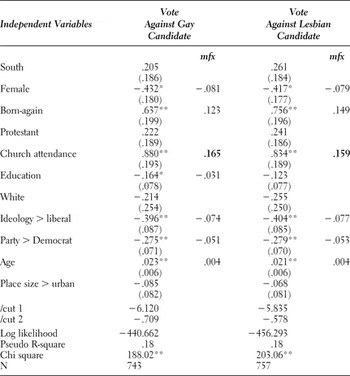
Respondents' likelihood of voting against a gay or lesbian candidate is displayed in Table 2. The fit statistics suggest that the models reasonably predict the likelihood of voting against a gay or lesbian congressional candidate. Voting against a gay male congressional candidate is significantly shaped by religion, religiosity, education, ideology, partisanship, and age. Consistent with more general research on gay issues, respondents who are male, born-again, frequent church attendees, less educated, conservative, Republican, and older are more likely to vote against a gay male congressional candidate. With the exception of education, respondents with these same characteristics are also more likely to oppose a lesbian candidate for Congress. Educational differences among respondents are not statistically significant predictors of voting against a lesbian candidate. However, the coefficient is in the expected negative direction, and the standard error is smaller than the coefficient. In concert with previous research, women are less likely to indicate that they would vote against a gay or lesbian candidate.
Predicting opposition to gay and lesbian candidates, national polls

Notes: Coefficients are ordered logit coefficients; standard errors are in parentheses. ** p < .01, * p < .05, # p < .10. Marginal effects (mfx) estimated following ordered logit model estimation with the value of the dependent variable set to “More likely to vote against” (3); marginal effects for dichotomous variables capture the discrete change from 0 to 1.
The data are from a national survey of adults by Scripps Survey Research Center, Ohio University, October 20 to November 4, 2003.
Table 2 also contains columns titled mfx. Each of these coefficients is a marginal effects coefficient that is estimated following the estimation of the original model, with the value of the dependent variable set to “more likely to vote against.” Marginal effects coefficients allow for the direct comparison of the relative influence of each variable on the probability of voting against the candidate. Thus, since the coefficient for church attendance is twice as large as the coefficient for gender, this indicates that the relative influence of church attendance in this model is twice as high as gender. In the first model, we can also conclude that although ideology and partisanship are important predictors, the religion (born-again) and church attendance variables are considerably more important predictors of vote choice.
We can also compare the relative role of variables across the model for a gay candidate versus a lesbian candidate. By comparing the relative size of the coefficients across the models, we can see that there is little difference in the importance of variables across the models. These models clearly indicate that religion, gender, ideology, and partisanship strongly shape the likelihood of supporting a gay or lesbian congressional candidate. However, level of education only significantly predicts voting against a gay candidate, and is not a significant predictor in the lesbian candidate model. Thus, relatively speaking, level of education is not an important predictor of the likelihood of voting for a lesbian candidate.
Candidate Trait Attribution
Turning to respondent attitudes regarding the characteristics of gay and lesbian candidates, we can employ the same multivariate model to predict opinion. However, recall that the questions displayed in Table 1 had five possible responses. Given the small percentage of responses in each category that is positive, these responses were combined with the “no difference” response and coded as zero. The responses for the negative characteristics were combined and coded as one. For example, regarding whether or not gay candidates are less honest, responses for “much more honest,” “somewhat more honest,” and “no difference” were all coded as zero. Affirmative responses for “somewhat less honest” and “much less honest” were coded as one.Footnote 5 Given the binary nature of each dependent variable, models were estimated using logistic regression. However, to compare the relative influence of variables within and across models, we display marginal effects coefficients that were estimated following the logit models. In each model, all of the independent variables from Table 2 were included.
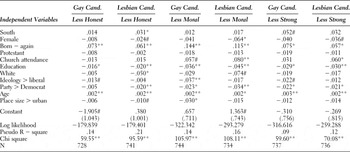
The results are reported in Table 3. Overall, the models predicting attitudes toward lesbian candidates have more robust fit statistics than do the models predicting attitudes towards gay candidates. In addition, most of the variables perform as expected; we see much the same pattern as we saw in Table 2—gender, religion, religiosity, education, partisanship, ideology, and age are consistent predictors of opinion. However, there are some interesting variations. The most salient difference is respondents' gender, which is a more consistent predictor of opinions about a lesbian candidate than a gay male candidate, suggesting that women are less likely to attribute negative traits to lesbian candidates, but differ little from men in attributing negative traits to gay male candidates. Urbanism functions in a similar manner across models. Religion (except born-again) and partisanship are more consistently significant predictors of attitudes toward a lesbian candidate than of attitudes toward a gay candidate. Meanwhile, ideology is a more consistently significant predictor of attitudes toward a gay candidate. This finding suggests that conservatives, on average, hold significant negative attitudes toward the traits of gay candidates, but not toward lesbian candidate traits, all other variables considered.
Predicting beliefs about gay and lesbian candidate attributes (honesty, morality, and strength)

Notes: Coefficients are marginal effects coefficients; marginal effects are estimated following logit model estimation; marginal effects for dichotomous variables capture the discrete change from 0 to 1. Model fit statistics are from the original logit model; ** p < .01, * p < .05, # p < .10.
The data are from a national survey of adults by Scripps Survey Research Center, Ohio University, October 20 to November 4, 2003.
Looking more explicitly at the specific characteristics of honesty, morality, and strength, there is no appreciable statistical difference between male and female respondents' opinions about gay male candidates. However, there is a significant gender difference when it comes to the traits of lesbian candidates. On the basis of statistical significance, women were less likely than men to attribute negative characteristics to lesbian female candidates, all other factors considered.Footnote 6 We interpret these findings to mean that women are less likely than men to stereotype lesbian political candidates with negative characteristics. In this regard, stereotypes about lesbians may mediate the impact of gender stereotypes in evaluations of lesbian candidates, but only among female respondents. When it comes to gay male candidates, female respondents are just as likely as male respondents to attribute negative characteristics to them. This is fairly strong evidence confirming a need to approach the study of stereotypes and attitudes about gays and lesbians by accounting for the simultaneous location of lesbians within the larger category of women, and distinct from their gay male counterparts.
Candidate Issue Competency
Finally, we analyzed opinions on the competency of gay and lesbian candidates across issues including education, the military, and taxes (see Table 4). Recall that respondents were asked if gay and lesbian candidates would be more competent, no different, or less competent on each of the three issues. Given the small percentage of respondents indicating that gay and lesbian candidates would be more competent, these responses were combined with the “no difference” response and coded as zero. The response for less competent was coded as one. Given the binary nature of each dependent variable, models were estimated using logistic regression, but as with the models in Table 3, we simply report postestimation marginal effects coefficients so that variable importance within models can be evaluated. In each model, all of the independent variables from Table 2 were included.
Predicting beliefs about gay and lesbian candidate lack of competency on issues

Notes: Coefficients are marginal effects coefficients; marginal effects are estimated following logit model estimation; marginal effects for dichotomous variables capture the discrete change from 0 to 1. Model fit statistics are from the original logit model; ** p < .01, * p < .05, # p < .10. The data are from a national survey of adults by Scripps Survey Research Center, Ohio University, October 20 to November 4, 2003.
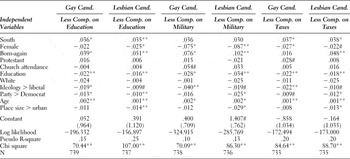
Across the models, the statistically significant variables are similar to those from the earlier models. Older and born-again respondents were more likely to indicate that gay and lesbians were less competent, while liberals, Democrats, and those with more education were less likely to suggest that gay and lesbian candidates were any less competent.
Consistent with the pattern found with trait attribution, female respondents evaluated lesbian candidates more favorably. Women were less likely than men to say lesbian candidates were less competent on education, but there was no gender difference in respondents' evaluation of gay male competency regarding the issue of education. Evaluations of competency on the military indicate that men were more likely to believe that both gay and lesbian candidates would be less competent. On taxes, women were less likely than men to indicate that a gay or lesbian candidate would be less competent. These findings suggest that lesbian candidates may benefit on an issue such as education, which is an issue where women are stereotypically viewed as stronger (Dolan Reference Dolan2005). In addition, lesbians, who are often stereotyped as being masculine, might be seen as more competent on military issues than gay men, who are often stereotyped as more effeminate (Golebiowska Reference Golebiowska2001), especially by female respondents.
In summary, the pattern in our results indicates that there are significant differences in male and female attitudes concerning gay and lesbian candidates, and it appears that intersectional stereotyping plays a complex role when political candidates belonging to more than one stigmatized group are evaluated. Intersectional stereotyping is nuanced and appears to be more evident when respondents, particularly women, evaluate lesbian candidates. In part, this pattern seems to result from gender stereotyping of candidates (i.e., evaluating lesbian candidates more favorably on soft traits), as well as a shared gender identity between female respondents and lesbian candidates. In this regard, gender stereotyping of candidates seems to take precedence over stereotypes of gay men and lesbians. However, when it comes to evaluating candidate competency on traditionally male issues such as the military, stereotypes of sexual minorities appear to depress gender stereotypes.
CONCLUSION
Although social scientists have increasingly examined the role of stereotyping on the public's perception of political candidates belonging to underrepresented groups, they have conducted little empirical research investigating how intersectional stereotypes shape attitudes. Research investigating the intersection of sexual orientation and gender is even more limited. Golebiowska (Reference Golebiowska2001, Reference Golebiowska2002, Reference Golebiowska2003) and Herrick and Thomas (Reference Herrick, Thomas, Riggle and Tadlock1999, Reference Herrick and Thomas2001) have laid a foundation for examining how stereotypes about sexual minorities inform peoples' evaluations of gay and lesbian political candidates. Their research indicates that stereotyping of sexual minorities is a nuanced process that is conditioned on the extenuating attributes of the candidates as well as the respondents evaluating them, and hints at the importance of accounting for intragroup context when the impact of stereotyping on gay and lesbian candidates is examined.
We have been able to build on their research by taking a more in-depth look at the intragroup context of sexual minorities, explicitly the gender differences that belie a shared gay identity among gay male candidates and lesbian candidates. We have also been able to extend this line of research to encompass other salient areas that come into play when the public evaluates political candidates: perceptions of candidates' character traits and perceptions of their competency in handling specific political issues. Our analysis indicates that the intersectional stereotyping that does occur is nuanced, contextual, and contingent on the gender of the respondent. From the results, we can draw several important conclusions.
First, our findings are consistent with previous research that suggests that women hold more liberalized attitudes toward gay and lesbians in general. Women are more willing to vote for a gay or lesbian congressional candidate. Indeed, in our models, gender is second only to religiosity in terms of predicting the likelihood of voting for a gay man or lesbian candidate for Congress.
Second, despite female respondents' greater willingness to vote for a sexual minority candidate, they were just as likely as male respondents to attribute negative characteristics to gay male candidates. This finding is consistent with other studies that find substantial negative stereotyping of gay men in general (Golebiowska Reference Golebiowska2001; Herek Reference Herek2002). However, our findings depart from Golebiowska's (2001) research. She did not discover a difference in the evaluations of gay and lesbian political candidates, nor did she find a difference between male and female respondents' evaluations of gay and lesbian candidates.
A different picture emerged in our analysis when respondents evaluated lesbian candidates. Women were significantly less likely to attribute negative characteristics to lesbians while assessing their strength, honesty, and morality. Intersectional stereotyping also appears to be operating when respondents evaluate the candidates' issue competency. For example, consistent with the gender stereotyping literature, our findings indicate that women candidates are perceived as better suited to deal with compassion issues such as education; lesbian candidates received a more positive evaluation of their ability to deal competently with education. On the more gender-neutral issue of taxes, female respondents saw little difference in gay and lesbian candidates' competency on the issue. However, when it comes to a stereotypical male issue—the military—we find that lesbian candidates are evaluated more favorably by female respondents than are gay candidates. Here, we find traditional gender stereotyping being experienced differently by gay male candidates and female candidates as a result of stereotypes surrounding their sexual orientation, where gay men are feminized and lesbians are masculinized by heterosexuals.
An examination of the intersection of gender and sexual orientation suggests that the perceived bending of gender stereotypes intrinsically shapes and underlies perceptions of gay and lesbian candidates, making it pertinent that intragroup differences be taken into account in studies of stigmatized groups. Our findings indicate that intersectional stereotyping leads to different evaluations of political candidates, depending on what aspects of the candidate are being evaluated. Given the analysis, we face several limitations in unraveling the process at play, and can only speculate about it at this time. For example, we can not decipher whether lesbian candidates are benefiting from the stereotypically masculine traits associated with them, whether gay candidates are being punished for the stereotypically feminine traits associated with them, or if both stereotypes are being invoked.
Although the exact underlying cause of these findings is unknowable from our data, we suspect that the intersection between sexual orientation and gender stereotypes is producing a unique dynamic that is interacting with a sense of a linked gender fate between heterosexual women and lesbian political candidates. Relative to gay political candidates, lesbians' gender identity may modify the saliency of their sexual identity while being evaluated by respondents. In this regard, the masculine characteristics stereotypically associated with lesbians by heterosexual women interact to offset, and even compliment, the gender stereotypes associated with female political candidates, particularly regarding the less tangible (but masculinized) dimensions of political capital, such as a candidate's strength of character and ability to handle the military.
However, given the widespread public hostility that continues to be directed at gay men and lesbians, as well as the limitations that gender stereotyping places on female candidates, we are reticent to conclude that intersectional stereotyping presents any form of a true “benefit” for lesbian political candidates. Rather, we believe that our findings should encourage additional research that examines the convergence of intersectional stereotyping as it relates to the public's opinion about political candidates, as well as more general attitudes about gays and lesbians.
APPENDIX: DESCRIPTIVE STATISTICS FOR INDEPENDENT VARIABLES
South: (not asked) respondent resides in U.S. Census South region
0 Non-South 67.65%
1 South 32.35%
Female: (not asked) coded by surveyor
1 Male 43.07%
2 Female 56.93%
Born-Again: “Do you consider yourself ‘born again?’”
0 No 61.22%
1 Yes 38.78%
Protestant: “What is your religious preference?”
0 Non-Protestant 60.74%
1 Protestant 39.26%
Church Attendance: “Have you gone to church in the last week?”
0 No 54.08%
1 Yes 45.92%
Education: “How much education have you completed?”
1 No high school 1.17%
2 Some high school 4.79%
3 High school grad 24.76%
4 Some college 24.76%
5 College graduate 27.79%
6 Postgraduate 16.73%
White: “What is your race?”
0 Non-White 18.42%
1 White 81.58%
Ideology > Liberal: “How would you describe your political views”
1 Very conservative, 17.81%
2 Conservative, (or) 25.69%
3 Moderate, 34.90%
4 Liberal, (or) 11.98%
5 Very liberal 9.62%
Party > Democrat
1 Strong Republican 18.30%
2 Republican .15.85%
3 Independent 29.36%
4 Democrat 15.53%
5 Strong Democrat 20.96%
Age: Respondent's exact age
Mean 47.9 years old
Place Size > Urban: “What kind of city do you live in?”
1 Rural area 19.47%
2 Suburb 20.75%
3 Small city 29.30%
4 Large city 30.48%