At the same time that the world has reached unprecedented prosperity, issues of economic inequality have attained great political salience. In the wake of the 2008 global financial crisis, there are major differences in opinion regarding the responsibility of the United States and other wealthy countries and what the proper response should be. In July 2008, the Doha round of negotiations at the WTO broke down after developing countries could not reach an agreement with wealthy countries on agricultural trade. The IMF is under pressure to reform its governance to provide better representation to middle-income and poor countries. And development experts admonish the world about the growing gap between the world's affluent countries and “the bottom billion” (Collier Reference Collier2007). It used to be that economic-development strategies would target economic growth and “let the rising tide lift all ships.” Now, there is growing concern that growth be inclusive in order to make optimal use of societal resources and mitigate the political volatility that results when substantial segments of societies are excluded from the benefits of development.
Why has inequality become an important issue? For one thing, global inequality is at historically high levels and the polarization of income and wealth is staggering. Measured in terms of interpersonal income disparities throughout the world, global inequality has risen steadily in the past two centuries. Even after conceding a modest decline in recent years, due primarily to the rapid growth of China and India, the mean log deviation of global inequality increased from 0.42 in 1820 to 0.83 in 1992 (World Bank 2005, 7).Footnote 1 At the same time, there has been a relentless increase to historically unprecedented levels in the polarization of income between rich and poor. In 1980, the richest 1% of the world population earned 216 times the poorest 1%. By 2000, this enormous gap had ballooned to 415 times. The gap in per capita gross national income (GNI)—calculated in purchasing power parity dollars—between the United States and the world's poorest country rose from 38.5:1 in 1960 to 158:1 in 2007 (Pritchett Reference Pritchett1997, 11; World Bank 2008, 352–53). More generally, the Gini index for absolute inequality rose 61% between 1970 and 2000 (Atkinson and Brandolini Reference Atkinson and Brandolini2004, 11). There is also a huge disparity in household wealth. In 2000, the top 10% of adults in the world owned 85% of global household wealth while the bottom half owned barely 1% (Davies et al. Reference Davies, Sandstrom, Shorrocks and Wolff2008, 8). Finally, economic inequality within countries has been on the rise. According to an authoritative study covering countries with 80% of the world's population, between the 1950s and the 1990s, inequality increased in 48 of 73 countries with 59% of the population of the countries studied. Inequality decreased in only nine countries with only 5% of the population (Cornia, Addison, and Klinski Reference Cornia, Addison, Klinski and Cornia2004, 40). A more recent World Bank study found that between the 1990s and 2000s 30 out of 49 countries recorded increases in inequality while only 13 recorded declines (Ferreira and Ravallion Reference Ferreira and Ravallion2008, 7).
In an era when new communications technology and growing international travel make people around the world increasingly aware of other peoples' livelihoods, these disparities will continue to have a greater impact on political attitudes. They threaten to prevent the cooperation necessary to surmount the formidable challenges facing the world today. Creating a stable financial system requires enhancing international coordination not only among wealthy countries but increasingly with middle- and low-income countries that hold a growing share of financial reserves. Advancing the trade agenda must be based on common agreements among wealthy and poor countries if global markets for services, agriculture, and intellectual property are to be properly developed. Sustainable global development will require prudent use of global resources and increased environmental protection. These objectives can be achieved only if international cooperation enables the world to avoid a tragedy of the global commons. Finally, the world can address the challenge of global security only if poor states are not allowed to fail and international cooperation mitigates the threats posed by international terrorism and crime.
This article highlights the objectionable consequences of persistent high levels of inequality. In particular it demonstrates that high inequality enables powerful actors to impose institutions and policies that prioritize private and club goods benefiting the powerful over public goods benefiting everyone. The problem is not only an issue of injustice, though that is a serious concern. It is also that the under-provision of public goods diminishes collective welfare. When public goods such as environmental protection, the protection of personal security, public education and health, and investment infrastructure are undersupplied, it is usually the people at the bottom of society that suffer the most. High domestic inequality enables elites to resist changes that enhance development and social welfare but threaten their interests. This is an especially important problem in an era where globalization and technological innovation require frequent modification of institutions and policies to maintain economic dynamism.
It is important to note what this article does not try to do. It does not analyze the initial causes of inequality. Nor does it argue that inequality is incompatible with high levels of economic growth. There are many cases where countries with high inequality have experienced rapid growth. It also does not argue that global inequality has created an institutional regime that makes rapid development impossible. It recognizes that some poor countries—for instance China and India—have achieved substantial benefits, but at the same time it points out that persistent inequalities produce economic and political institutions that structure economic development in ways that unnecessarily limit benefits to the poor.
The article begins by documenting how persistent inequality becomes endogenous to international and domestic political processes and consequently shapes institutions and policies that diminish potential benefits to the poor. Next, it investigates approaches to overcoming persistent inequalities. At the international level, the article proposes modest measures to increase the expertise badly needed by poor countries in trade negotiations and the creation of an independent agency to evaluate the foreign assistance programs of multilateral organizations. At the domestic level, the article considers what features of democracy might help to overcome persistent inequalities. The article concludes by speculating about future issues for research.
INSTITUTIONS AND POWER ASYMMETRIES: THE ENDOGENOUS POLITICAL PROCESSES THAT PERPETUATE HIGH INEQUALITY
Economic inequality has multiple causes. Disparate resource endowments at the individual and national levels can lead to differential trajectories of economic welfare that contribute to inequality over the short and long term (Coatsworth Reference Coatsworth2008; Haber, Razo, and Maurer Reference Haber, Razo and Maurer2003). Increasing returns—for instance to financial and human capital (Romer Reference Romer1994; Easterly Reference Easterly2001)—also promote patterns of development that underpin long-standing inequalities. Theories of economic geography explaining the spatial distribution of agriculture (von Thunen Reference von Thunen1966) and industry (Krugman and Venables Reference Krugman and Venables1995) provide mechanisms that produce inequality through their direct economic consequences as well as through their repercussions for building state capacity to promote development (Schwartz Reference Schwartz2007). Regardless of the initial causes, this article documents how the persistence of inequalities is often endogenous to the political process that sustains political and economic institutions. It demonstrates how power asymmetries enable global powers and domestic elites to shape institutions to perpetuate their dominant position. Charles Tilly (Reference Tilly1998) highlights how elites reinforced their capacity to exploit non-elites by institutionalizing paired categories that reinforce their positions atop of social hierarchies. Tilly's powerful approach far from exhausts the institutional mechanisms for maintaining durable inequalities. At least as important is the manner in which elites authorize rules that oblige actors to engage in identical compliance behaviors despite their disparate capacities and circumstances.
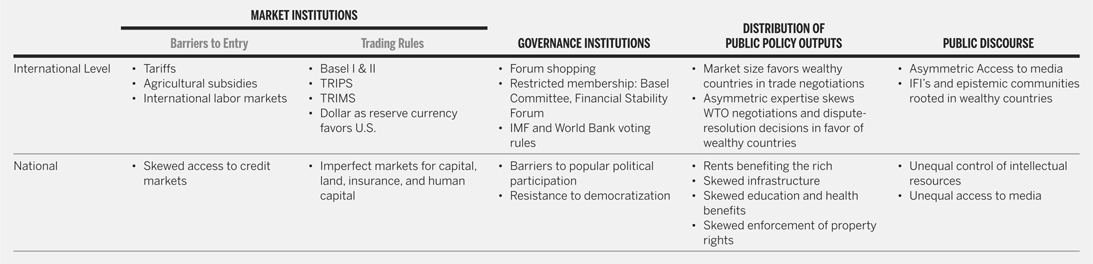
Table 1 summarizes the mechanisms through which elites have skewed benefits in their favor at the international and domestic levels (see APSA Task Force Reference APSA Task Force on Difference and Societies2008).
The Impact of Inequality on Economic Development

At the international level, wealthy countries use their large market size and greater technical expertise to shape international institutions, rules, and discourse to their advantage. Powerful countries shape international market institutions for their benefit by creating barriers to entry in the form of tariffs, agricultural subsidies, and restrictions on international migration. They also influence the formation of international trading rules to their advantage, as we have seen in the cases of trade-related intellectual property rights (TRIPs), trade-related investment measures (TRIMs), and the formulation of the norms for Basel I and II. Maintaining the U.S. dollar as a reserve currency benefits the world's most powerful nation by enhancing its ability to run historically unprecedented trade deficits. Dominant actors structure international governance institutions for their benefit. Wealthy countries have engaged in “forum shopping” to select favorable venues for international trade negotiations. In international finance, rich countries protect their privileges by imposing exclusive limits on membership in powerful organizations like the Basel Committee and the Financial Stability Forum. They have also established voting rules for international financial institutions that reflect power asymmetries. The United States and European Union use their large market size to control the agenda and increase their leverage in trade negotiations. In addition, wealthy countries are advantaged by their control over expertise in WTO negotiations and at the WTO dispute-resolution system. Finally, intellectual elites from powerful countries tend to dominate public discourse through their preponderance of resources, greater access to the media, and consequently greater capacity to articulate their ideas. A good example of this latter mechanism is the preponderant intellectual role played by experts from wealthy countries in international financial institutions and hegemonic epistemic communities.
A similar endogenous process works at the domestic level of many countries. Elites may shape market institutions to create barriers to entry that impede non-elite access to opportunities presented by markets. For instance, collateral requirements and an absence of social and political connections often prevent access to credit markets by would-be entrepreneurs from the lower echelons of society. Markets for capital, land, insurance, and human capital remain underdeveloped in ways that advantage the wealthy but allocate resources inefficiently and reduce the poor's incentives to invest (World Bank 2005, 89–104). Institutions of domestic governance may also be structured in ways that bias them against non-elites. In many cases, institutional rules skew opportunities for political participation against non-elites. Elites may even overthrow democratic regimes when the distributional demands of non-elites threaten their interests. Public policy outputs reinforce economic inequality when elites secure rents, or when their political influence skews in their favor the distribution of benefits from policies concerning public health, education, and infrastructure. Fundamental economic rights—such as property rights—may be enforced or voided in ways that disadvantage non-elites (De Soto Reference De Soto2000). Finally, elites may be able to articulate ideas that reflect their worldviews and interests more effectively than non-elites when they have disproportionate access to intellectual resources or the media (Rueschemeyer Reference Rueschemeyer2004).
High inequality in developing countries has played a direct role affecting their economic development and quality of life. As inequality increases, the impact of economic growth on poverty alleviation declines (Ferreira and Ravallion Reference Ferreira and Ravallion2008). Higher levels of inequality are associated with greater levels of violent crime (World Bank 2005; Fajnzylber, Lederman, and Loayza Reference Fajnzylber, Lederman and Loayza2002). Domestic inequality is an important explanation for why inefficient institutions persist because it provides privileged elites with the resources to resist changes that could undermine their position. And in many cases, where elites have implemented reforms, they have done so in ways that have protected their interests, increased inequality, and reduced economic security (APSA Task Force Reference APSA Task Force on Difference and Societies2008).
OVERCOMING PERSISTENT INEQUALITIES
The problems posed by persistently high inequality are especially hard to overcome because they are a consequence of an endogenous, self-reinforcing political process. Breaking this self-perpetuating process requires one of two developments: (1) the powerful come to see that it is in their interests to implement reforms whose benefits are more inclusive, or (2) the balance of power in the political process shifts in a manner that enhances the relative power of other groups.
Approaches to resolving the problems of inequality at the international level face a special challenge because powerful countries can more easily exit from international institutions or create more congenial new ones when their interests are threatened under an existing institutional regime. Challenges to wealthy-country interests must not be so threatening as to precipitate elite withdrawal or forum shopping. Changes in the structure of economic power are already putting pressures on global institutions to accommodate the interests of large, rapidly growing emerging economies like China, India, and Brazil. The most formidable challenges posed by global inequality are ensuring that the poorest countries do not get left behind. Two measures would have a substantial impact and be acceptable within the global power structure.
1. More Technical Assistance for Poor Country Representatives at the WTO
Because the WTO is a member-driven organization, disparities in the capabilities of its members shape the articulation of rules that structure the developmental trajectory of global trade markets. Representing the national interest through the 60,000 pages of jurisprudence generated by the WTO dispute-settlement proceedings is a challenge for any country, but it is especially formidable for poor countries that lack public- and private-sector expertise in international trade law. In the past, these countries have depended on the leadership of larger developing countries like China, India, and Brazil to represent their interests. The rapid growth of these emerging powers has widened the economic gap between them and the poorest countries, and their increasingly divergent interests raise questions about the degree to which they adequately represent the interests of the poorest countries.
2. Creating an International Development Evaluation Agency (IDEA)
The development of global financial markets has raised questions about the continuing necessity of international financial institutions. Evaluation of World Bank and IMF programs presents a principal-agent problem because most evaluation is conducted by the agents themselves, and assessment by member governments may appear motivated by their distinctive interests. Setting up the IDEA would improve evaluation of the World Bank, IMF, and other multilateral agencies. The IDEA should be staffed by international experts, and its governance should be more accountable to poor countries than is possible at the IMF and World Bank. Wealthy countries share a continuing interest in effective monitoring of the international financial institutions because it would help them assess whether they remain vital contributors to global welfare.
Understanding the dynamics of democracy is vital to devising ways of curtailing high inequality in developing countries. The relationship between inequality and democracy is complex and contingent. Assumptions that greater inequality in democracies will increase redistribution (Acemoglu and Robinson Reference Acemoglu and Robinson2006; Boix Reference Boix2003; Meltzer and Richard Reference Meltzer and Richard1981) are contradicted by the findings of empirical studies (Kaufman Reference Kaufman2009; Lubker Reference Lubker2007). Many studies find that democratic regimes do not have a significant direct impact on income inequality (Lee Reference Lee2005; Alderson and Nielsen Reference Alderson and Nielsen1999). Others find support for the hypothesis that democratic regimes are associated with lower inequality (Rudra Reference Rudra2004; Reuveny and Li Reference Reuveny and Li2003). Generalizing about the impact of political regimes like democracy is a risky endeavor: “Political regimes … are complex. They combine many institutional features that can have emergent effects and that may work at cross-purposes” (Przeworski et al. Reference Przeworski, Cheibub and Limongi2000, 1). To develop a better understanding of the relationship between democracy and inequality in developing countries, we have to disaggregate democratic regimes to unpack the variable quality of democracy and investigate the mechanisms that connect democratic politics to inequality.
Two mechanisms are particularly promising—the longevity of democracy and programmatic partisan competition. There is compelling evidence that democracy gradually reduces inequality over time. On average, as democracies persist, trade unions, interest groups, and left-of-center political parties become better organized to represent the interests of the poor (Huber et al. Reference Huber, Nielsen, Pribble and Stephens2006; also Rodrik Reference Rodrik2007; Muller Reference Muller1988). As the balance of representation becomes more favorable to the poor, governments are more inclined to implement and sustain social-welfare programs that are more responsive to their interests. Huber, Mustillo, and Stephens (Reference Huber, Mustillo and Stephens2008) find that cumulative years of democracy have a significant positive association with expenditures for social security, welfare, health, and education expenditures. The mechanism seems to be supported by Rodrik's (Reference Rodrik1999) finding of a robust and significant positive relationship between the level of democracy and wages received by workers. Przeworski et al. (Reference Przeworski, Cheibub and Limongi2000, 168–70) also find that labor receives a substantially higher share of manufacturing value added (43.7%) under democracies than under dictatorships (32.6%).
The nature of political competition is the second variable that reduces economic inequality. Its impact depends on whether political elites respond to special interests or whether they respond to broader public interests. Central to this issue is the nature of linkages between citizens and politicians, particularly whether political parties mobilize political support through clientelistic or programmatic appeals. Kitschelt and Wilkinson (Reference Kitschelt and Wilkinson2007) find that economic development generally promotes programmatic appeals when (1) markets, class, sectoral, and professional associations replace parochial social networks; (2) citizens become more educated and affluent; and (3) the media becomes more sophisticated and independent and therefore more likely to expose corruption. Ethnic heterogeneity (see also Keefer and Khemani Reference Keefer and Khemani2005; Bueno de Mesquita et al. Reference Bueno de Mesquita, Morrow, Siverson and Smith2003) and the politicization of a country's economic governance are positively associated with clientelism.
Political competition is also affected by the institutions of the political market. Lake and Baum (Reference Lake and Baum2001) find that lower barriers to entry and reduced cost of participation enhance the responsiveness of the state to broader public interests. Bueno de Mesquita et al. (Reference Bueno de Mesquita, Morrow, Siverson and Smith2003) observe that more public goods will be provided when political institutions require a broader “selectorate”—the set of people qualified to choose the political leadership. However, Kitschelt and Wilkinson (Reference Kitschelt and Wilkinson2007) warn that the impact of more intense competition can either promote more patronage or programmatic appeals depending on the prevalent supply and demand factors. In either case, more intense competition encourages parties to build more inclusive linkages.
Keefer (Reference Keefer, Boix and Stokes2007) underscores the role of politicians' credibility. In the extreme case, where politicians' pledges have no credibility and are useless in mobilizing popular support, political leaders have no incentive to be responsive to public interests. Politicians usually invest in acquiring credibility because it is an efficient means of mobilizing popular support. Where credibility is low and societies are diverse, politicians are likely to invest in clientelism because it is easier to build credibility through repeated interaction with relatively small numbers (Keefer and Vlaicu Reference Keefer and Vlaicu2008). Incomplete information also makes it difficult to build credibility. Citizens must have information about policies if they are to hold leaders accountable when policies fail and give them credit when they succeed. Corruption is higher in counties with lower newspaper circulation (Adsera, Boix, and Payne Reference Adsera, Boix and Payne2003). And better-informed citizens as measured by indicators of radio ownership (Stromberg Reference Stromberg2004) and newspaper circulation (Besley and Burgess Reference Besley and Burgess2002) receive more public policy benefits.
It takes time to build the reputations necessary for credible commitments to provide public goods, and it is difficult to build credibility when instability or fragile regimes shorten time horizons. Indeed, Keefer (Reference Keefer, Boix and Stokes2007, 904) concludes:
The more years that countries exhibit continuous elections, the greater are the secondary school enrollment, the rule of law, and bureaucratic quality (non-targeted goods); the fewer are the restrictions on public access to information; the less is corruption; and the lower are public sector wage bill and public investment which are targeted to narrow constituencies.
CONCLUDING REMARKS
The problem of inequality is fundamentally linked to the problem of difference. Difference in abilities and efforts should be rewarded, but differences in preferences must be equitably aggregated. Some degree of economic inequality is inevitable and desirable. How much inequality is too much? This article has not offered a precise answer to this question. It has merely suggested that important criteria for determining the answer lie in the political process. When inequality becomes so great that it produces a political process that results in inefficient economic institutions and an inability to achieve desirable public goals, then it is too great.
To conceptualize the problem in this way directs our attention to the impact of power asymmetries on the representation and aggregation of interests. Power asymmetries that cause the persistence of excessive inequality are also an impediment to its remedy. Realistically speaking, alleviating the problem of inequality is possible only when the powerful come to see it in their interest or when the balance of power shifts to enhance the relative power of other groups.Footnote 2 The prospects for alleviating the problems posed by excessive inequality are likely to improve when the wealthy are less able to escape the negative externalities of inequality. Increasing international interdependence may offer such a scenario, but the growing residential and social segregation of the wealthy and poor in many societies may impede efforts to alleviate their problems. The quality of democracy may also affect a polity's capacity for addressing the problems created by inequality. The consequences of inequality for political behavior in developing countries are complex, and we are only beginning to understand them. We are also only beginning to understand the impact of inequality on political party competition and interest representation in developing-country democracies.
Political scientists can make a vital contribution to resolving the problem of excessive inequality by improving our understanding of how diverse interests are represented and aggregated at the international and domestic levels. Effective interest representation is essential to enabling collective action necessary to address our biggest collective challenges. Reforming the representation process is likely to be the most effective and acceptable remedy for alleviating the problem of excessive inequality.