Introduction
Effective handover between shifts is vital to protect patient safety and ensure adequate continuity of care. Transfer of patient care to the incoming team is a vulnerable point in the patient's journey through the healthcare system.1 The General Medical Council has emphasised the importance of effective communication between colleagues at the end of shifts.2 Trusts should ensure that resources and facilities for handover are appropriate.
Progressive implementation of the European Working Time Directive has resulted in shortened hours, regular shift changes, and the need to provide cover for many specialties during the night. This is particularly true for junior doctors, who provide first-on-call cover for surgical departments out-of-hours. As a result of these changes, patient care must be effectively handed over more than once daily. A survey of handover practices among English ENT units found that the number of times on-call duties changed over a 24-hour period was inversely associated with the completeness of patient handover.Reference Karnwal, Ho, Pakalapati and Tyagi3 When adequate written handover is used to supplement verbal handover, loss of important information is minimised.Reference Pothier, Monteiro, Mooktiar and Shaw4, Reference Bhabra, Mackeith, Monteiro and Pothier5
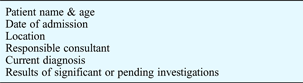
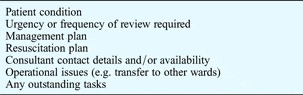
Handovers aim to convey high quality, appropriate clinical information to healthcare professionals, to enable the safe transfer of patient responsibilities. The Royal College of Surgeons of England has produced guidance on safe handover practices.1 This guidance does not advocate a ‘one-size-fits-all’ approach, but rather suggests principles of good practice which surgeons should be aware of. These principles are summarised in Tables I and II.
Minimum information required for handover
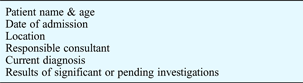
Copyright The Royal College of Surgeons of England. Reproduced with permission. Content has been modified in this article.
Other relevant information occasionally required for handover

Copyright The Royal College of Surgeons of England. Reproduced with permission. Content has been modified in this article.
Our practice
Most general surgical departments have a dedicated time set aside for a formal, verbal handover at the beginning and end of the night shift. Several ENT units, however, rely on informal handover methods, usually via telephone communication.6 In our ENT Department at the Cumberland Infirmary, Carlisle, we used a notebook for written handover. This supplemented informal verbal handover, regarding particularly important patient issues.
The handover book was kept on the surgical ward in the ENT doctors’ office, and was thus easily accessible to any junior doctor covering the surgical wards at night. As the room was not available to members of the public, patient confidentiality was maintained.
Any patient admitted during normal working hours as an emergency or for elective surgery was recorded in the handover book by the ENT team (i.e. foundation doctors, core trainees, registrars and consultants). Any patient admitted out-of-hours was recorded by the on-call junior doctors. We encouraged documentation of important and relevant handover data only. Thus, at the end of every 24-hour period there should have been a complete list of all patients admitted under the care of the ENT team within that period, together with relevant clinical details. This information should then have been readily available to the incoming ENT team in the morning.
Objectives
The current study aimed to analyse the completeness and accuracy of written handover within our ENT department, in line with the standards established by the Royal College of Surgeons of England in its publication Guidance on Safe Handover.1 Our objective was to determine the proportion of days on which a written handover was present, and, when present, the completeness of that handover.
We were particularly interested in identifying how often the written handover was completely absent, as this could potentially result in patients being missed by morning ward rounds. We wanted to identify any shortcomings, take the necessary action to improve the system, and then repeat the audit to assess whether standards had improved.
Methods
The first cycle of this audit was conducted over 30 consecutive days in September 2009.
Data were collected in a prospective manner by a single ENT registrar, who did not contribute to patient handover so as not to bias the results. Every morning, after having seen all patients admitted overnight, the written handover was analysed and the quality of information recorded was compared to the minimum required by the Royal College of Surgeons of England guidance. The handover was described as present and complete if all patients had been included in the written handover and if all necessary information had been recorded. The handover was described as present but incomplete either if the list of patients admitted was incomplete, or if information deemed necessary was not included; handovers that were illegible were also included in this category. The handover was described as absent if no information whatsoever was recorded in the handover book regarding patient admissions.
A similar exercise was conducted just after normal working hours every day, to determine whether the handover recorded by the day ENT team was present and complete, present but incomplete, or absent.
After collecting all the results, we presented them during a clinical governance meeting and then implemented necessary changes.
We then repeated our audit over a period of 18 consecutive days in January 2010. We used a shorter, 18-day study period as this was the longest period of consecutive days in that month during which the absence of doctors due to annual leave would not bias the results. Both the first and second audits were timed so as not to coincide with changes in junior doctor staffing.
Results
First cycle
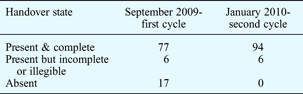
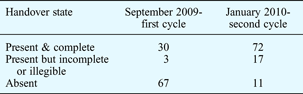
During the first audit period (September 2009), the written morning handover (representing all patients admitted out-of-hours) was present and complete on 77 per cent of days, present but incomplete or illegible on 6 per cent of days, and completely absent on 17 per cent of days. In this same period, the afternoon handover (representing patients admitted during normal working hours for elective treatment or as emergencies) was present and complete on 30 per cent of days, present but incomplete or illegible on 3 per cent of days, and absent on 67 per cent of days.
Implemented change
In order to improve our handover results, the importance of accurate, relevant handover was emphasised to the ENT team and to the junior doctors (during their initial induction sessions when starting a surgical placement) who provided cross-cover for ENT departments during night shifts. A reminder of the Royal College of Surgeons of England guidelines for safe handover was included in the ENT handover book. This reminder comprised a concise list of essential information necessary for an effective handover. Important data commonly omitted (such as the patient's ward) were also pointed out. In addition, junior doctors received regular reminders and feedback.
We also urged doctors to sign the written handover even if no patients had been admitted, to make this fact clear to the incoming morning team.
Second cycle
During the second, 18-day audit period, the morning written handover was found to be present and complete on 94 per cent of days, and present but incomplete on 6 per cent of days. The afternoon written handover was present and complete on 72 per cent of days, present but incomplete on 17 per cent of days, and absent on 11 per cent of days. These results are summarised in Tables III and IV.
State of written handover for emergency out-of-hours admissions
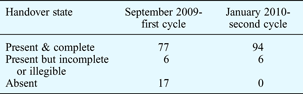
Data represent days as a percentage of each audit period.
State of written handover for normal working hours admissions
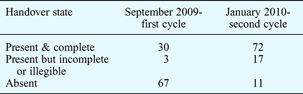
Data represent days as a percentage of each audit period.
Discussion
The results of the first audit indicated significant deficiencies in written handover by the ENT team at the end of normal working hours. This handover was only present and complete on 30 per cent of days, and was completely absent on 67 per cent of days.
One possible reason for this result was that the ENT doctors did not appreciate the importance of the handover, as they believed that they themselves would be caring for these same patients the following day. Despite this, we still encouraged written handover of all patients under our care during normal hours, for two reasons. Firstly, incoming doctors working later shifts would have access to concise, documented information on any outstanding issues regarding patients' care. Secondly, due to the rather complex nature of some junior doctors' rotas, there were several days on which junior doctors working in the ENT department were not present in the department in the morning. Furthermore, registrars and consultants might not be present on the wards every morning. Thus, we considered it essential that a written handover be available for doctors on the wards on those days.
The second cycle of this audit identified significant improvement in the written handover for patients admitted during normal working hours. The proportion of days on which the handover was present and complete rose from 30 to 72 per cent, and the proportion of days on which it was absent dropped from 67 to 11 per cent. However, there was still room for improvement.
In the first cycle of the audit, results for overnight emergency admissions were better than those for daytime admissions; for the former, the handover was present and complete on 77 per cent of days. Although this might seem satisfactory, one must bear in mind that there may have been no verbal handover from night shift doctors before they left the hospital.
On 5 of the 30 days in the first cycle (17 per cent), written handover for emergency out-of-hours admissions was completely absent. On these days, there may have been patients admitted to outlier wards (rather than to the main ENT ward) who were still under the care of the ENT team. Thus, the ENT team may potentially not have been aware of such patients until later in the day, when the ward nurses noticed that a patient admitted overnight had not yet been seen.
Handover practice improved substantially after implementing the above-described changes. In the second cycle, the morning handover was present and complete on 94 per cent of days. Thus, we believe that the implemented changes had increased junior doctors' appreciation of the importance of accurate, complete handover in enabling adequate continuity of patient care. We believe that our emphasis of the importance of written handover, during junior doctors' initial induction sessions, was particularly important in ensuring their compliance with written handover.
• Effective handover is essential for proper patient care and safety
• The Royal College of Surgeons of England have published guidance on safe handover practice
• This study audited written handovers, in line with this guidance, and found significant shortcomings; these were appropriately addressed with good effect
• These findings emphasise the importance of auditing and maintaining good handover practice within ENT units
Junior doctors who provide cross-cover for ENT patients attend formal handovers at specified times at the beginning and end of night shifts, for general surgery, trauma and orthopaedic patients. It would be impractical to also attend formal handovers for other, smaller specialties such as ENT. The ENT handover book effectively addresses this problem, as it can be used at any time of the day or night.
Our results showed that, when doctors used the handover book, the data recorded, when present, were often complete. There was only a small percentage of incomplete handovers. In actual practice, too much detail was more commonly noted than too little. Further improvements may be possible with the use of standardised handover pro formas, which specify the quality and quantity of information necessary for an adequate written handover.Reference Ferran, Metcalfe and O'Doherty7
Conclusions
Effective handover is an essential part of patient care and has recently become more important due to changes in shift patterns implemented as a result of the European working time directive. Inadequate or incomplete handover coult have potentially serious consequences for patients. We have significantly improved the process of handover in our Department by auditing our practice and this could in turn lead to better patient care.