Introduction
Recently, increased prostate cancer incidence and mortality rates have been reported in many developed countries. Increasing age is a well-established risk factor for prostate cancer. With an estimated 29,720 deaths in 2013, prostate cancer is the second-leading cause of cancer-related mortality among men. Approximately 60% of all prostate cancer cases are diagnosed in men aged 65 years and older, with 97% of cases occurring in men 50 years and older (American Cancer Society, 2013). Although Asians have had the lowest incidence and mortality rates of prostate cancer worldwide, numerous Asian countries have reported increased prostate cancer rates during the last two decades (Pu et al., Reference Pu, Chiang, Lin, Huang, Huang and Chen2004).
Cancer is a potential risk factor for mood disorders (Brintzenhofe-Szoc et al., Reference Brintzenhofe-Szoc, Levin, Li, Kissane and Zabora2009; Khan et al., Reference Khan, Ward, Watson and Rose2010b). Numerous studies focusing on the association between prostate cancer and the risk of depressive disorder development have indicated the need for psychiatric treatment in prostate cancer patients (Lintz et al., Reference Lintz2003). An association study for incidence of prostate cancer among Swedish men reported a marked increase in antidepressant usage and psychiatric hospitalization among patients with depressive disorders (Bill-Axelson et al., Reference Bill-Axelson2011). Another study in the United Kingdom reported that prostate cancer survivors received more antidepressant prescriptions than non-cancer patients – even five years after prostate cancer diagnosis (Khan et al., Reference Khan, Ward, Watson and Rose2010b). Moreover, previous research findings have indicated an association between prostate cancer diagnosis and suicide risk (Fall et al., Reference Fall2009; Bill-Axelson et al., Reference Bill-Axelson2010; Fang et al., Reference Fang2010). Although the aforementioned studies have clarified the association between prostate cancer and comorbid mood disorders, no related nationwide epidemiological data were available for Asian regions.
Hormones may play a critical role in the onset of bipolar disorder. Previous studies have reported a correlation between hormone levels and bipolar episodes (Khan et al., Reference Khan, Ludvigson, Stewart and Gorman2007; Sher et al., Reference Sher2012). However, the effect of prostate cancer on the development of subsequent bipolar disorder – another major category of mood disorder according to the Diagnostic and Statistical Manual of Mental Disorders, 4th Edition, Text Revision (DSM-IV-TR) – is seldom mentioned in the literature. Moreover, no study has examined whether there is an independent risk factor for newly diagnosed mood disorders in prostate cancer patients.
To address these inadequacies in the literature, we conducted a retrospective nationwide population-based study to investigate newly diagnosed incidences of mood disorder in Taiwanese patients diagnosed with prostate cancer. Independent risk factors for newly diagnosed mood disorders among patients with prostate cancer were also identified.
Material and methods
Data sources
The Taiwan NHI program offers a comprehensive, unified, and universal health insurance program to all Taiwanese citizens. In 2006, 98.29% of Taiwanese residents were enrolled in this program (Lin et al., Reference Lin, Deng and Chou2009). The NHI initiative covers comprehensive medical care, including outpatient, inpatient, emergency, dental examinations, and prescriptions. Multiple NHI databases (e.g. NHI enrolment files, claims data, and prescription drug registry) are managed and publicly released by the National Health Research Institutes, Taiwan. Available sociodemographic information on patients included birth date, occupational category, income level, and residential area. The Bureau of NHI and the National Health Research Institute's regulations guarantee patient confidentiality, and any data that identifying patients have been encrypted. The Institutional Review Board of Taipei Veterans General Hospital approved this study (2013-06-010BC). Written consent was not obtained from the study participants because the NHI data set contains de-identified secondary data for research purposes. Furthermore, the Institutional Review Board of Taipei Veterans General Hospital issued a formal written waiver of the need for consent.
Patient population
We conducted a retrospective cohort study from January 1, 2000, to December 31, 2006. Prostate cancer was defined as International Classification of Diseases, 9th Revision, Clinical Modification (ICD-9-CM) Code 185. The confirmation of the diagnosis of prostate cancer was based on the registry of catastrophic illness patient database (CIPD), a subset of the NHI Research Database. Catastrophic illnesses are diseases defined by the Taiwan government, such as cancer. Patients with catastrophic illness certification are exempt from copayments under the NHI program. Regulations about applying for a catastrophic illness certification require sufficient medical records and an independent peer review as supporting evidence. Furthermore, for a diagnosis of cancer to be recorded in the CIPD, histological confirmation is required. Thus, in this study, the diagnoses of prostate cancer are valid. Newly diagnosed patients with prostate cancer were selected from January 1, 2000, to December 31, 2006. The study recruited patients aged 20 years or older at the time of prostate cancer diagnosis who had no history of mood disorder. Mood disorders were defined according to relevant ICD-9-CM codes (depressive disorders, 296.2X–296.3X, 300.4, 311.X; bipolar disorders, 296.0X–296.1X, 296.4X–296.8X) (Huang et al., Reference Huang, Su, Chen, Chou and Bai2009; Wu et al., Reference Wu, Wang, Cheng and Gau2011). We included ICD-9-CM codes such as 296.3X and 296.5X, which refer to recurrent mood episodes; therefore, we should clarify that our study was not conducted to explore the relationship between prostate cancer diagnosis and “new-onset” mood disorder, but to determine the incidence of “newly diagnosed” mood episodes that were severe enough to receive psychiatrist consultation or intervention (particularly those involving psychopharmacological intervention) among Taiwanese patients with prostate cancer, and to analyze the possible precipitating factors related to newly diagnosed mood episodes among prostate cancer patients.
To enhance the reliability of the mood disorders diagnoses, cases of diagnosed mood disorder were included only when the diagnostic process or assessment was performed by a qualified psychiatrist in Taiwan. Moreover, we collected information on the use of antidepressants for treating depressive disorder and psychotropic agents approved by the Food and Drug Administration of Taiwan for treating one (or more) phases of bipolar disorder, including acute mania/mixed episodes, bipolar depression and bipolar maintenance. In addition to mood stabilizers, atypical antipsychotics (e.g. aripiprazole, olanzapine, quetiapine, risperidone, and ziprasidone) were included. These drugs were classified according to the World Health Organization Anatomical Therapeutic Chemical Classification System. Only patients who were prescribed these drugs for at least one month were included in our study (Huang et al., Reference Huang, Su, Chen, Chou and Bai2009; Townsend et al., Reference Townsend, Walkup, Crystal and Olfson2012; Hu et al., Reference Hu2013). Although we relied primarily on the psychiatrists’ ability to confirm their diagnosis, a lack of using standardized screening instruments diminishes the validity of the mood disorders diagnoses in the study; however, the results of this observational study could indicate the incidence of newly diagnosed mood disorders among prostate cancer patients, particularly those requiring psychiatric intervention.
Moreover, adjustment disorders were not included in the analysis. An adjustment disorder typically occurs when a person is unable to adjust to or cope with a particular stressor, such as prostate cancer diagnosis. According to the DSM-IV-TR, an adjustment disorder may be considered chronic if it persists longer than six months; however, adjustment disorders typically involve stress-related, short-term, and nonpsychotic disturbances. Psychotherapy is the recommended treatment for adjustment disorders, the goals of which are symptom relief and behavior modification. However, in Asian culture, oncologists typically view the symptoms of adjustment disorder as physical discomfort-related or normal psychological responses with which family support and folk beliefs could assist cancer patients in coping with many ethical or existential issues during this period. Therefore, the role of psychiatrists in treating adjustment disorders among cancer patients is relatively vague in Taiwan. Therefore, we did not choose the incidence of adjustment disorder as a major observational event in this study.
Matched cohort
Men without prostate cancer (non-exposed patients) served as a matched cohort. These patients were randomly selected during the same study period. For each prostate cancer patient in the NHI registry, one non-exposed patient was matched for age, comorbidities (Khan et al., Reference Khan, Perera, Harper and Rose2010a), geographic region, socioeconomic status, and enrollment date.
Baseline variables
For the prostate and control patients, we obtained baseline variable data on their age, urbanization level, geographic region, and comorbidities such as diabetes mellitus, congestive heart failure, nephropathy, chronic liver disease, autoimmune disease, CVD and coronary artery disease.
We divided the comorbid medical disorders according to ICD-9-CM codes into the following categories: (1) diabetes mellitus (250.1–250.9); (2) congestive heart failure (428.xx); (3) nephropathy (580–589); (4) chronic liver disease – hepatitis B (070.2, 070.3, and V02.61), hepatitis C (070.41, 070.44, 070.51, 070.54, and V02.62), unspecified chronic hepatitis (070.9, 571.4, 571.8, and 571.9), alcoholic liver disease (571.0, 571.1, 571.2, and 571.3), cirrhosis (571.5 and 571.6), and biliary tract disease (574–576); (5) autoimmune disease (710.0, 710.1, 714.0, 710.4, 710.3, 446.0, 446.2, 446.4, 446.5, 443.1, 446.7, 446.1, 136.1, 694.4, 710.2, 555, and 556); and (6) CVD (430–438). Similar to other epidemiological studies, particularly those involving an experimental design, this study tested the association between prostate cancer diagnosis and newly diagnosed mood disorders by controlling or reducing the occurrence of mood disorders by controlling the effects of confounding factors. However, in psychiatry, there are only a few clearly defined and modifiable risk factors; consequently, most studies have focused on largely unmodifiable ones, such as age and sex. In addition, although many studies have indicated several comorbidities as risk factors for prostate cancer (e.g. old age, diet, obesity, smoking, or sexually transmitted infections), most of these risk factors have not been clearly associated with prostate cancer risk. Considering the relatively advanced age and higher prevalence of physical comorbidities among the studied population, we selected only those patients involving typical physical comorbidities. Although the design of this study may have caused overmatching, which could result in an underestimation of the risk of development of mood disorders among the prostate cancer patients in this study, we could avoid the influence of other chronic physical illnesses that are frequently related to the occurrence of mood disorders in elderly adult patients.
In addition, insurance premiums, which are calculated according to the beneficiary's total income, were used to estimate monthly income. Monthly income was grouped into low income (monthly income <NT$20,000), medium income (NT$20,000 ≤ monthly income <NT$40,000), and high income (monthly income ≥NT$40,000). Additionally, urbanization was divided into three groups; urban, suburban, and rural. Urbanization and monthly income level were used to indicate socioeconomic status.
Furthermore, to analyze for the possible risk factors of mood disorder development in the prostate cancer patients, we collected data on the various types of treatment for prostate cancer, such as prostatectomy, radiotherapy, and androgen deprivation therapy (ADT; including orchiectomy and prescriptions of adrenal blockers, antiandrogens, estrogens, and gonadotropin-releasing hormone).
Statistical analysis
The occurrence of mood disorders was considered as the main dependent variable. Both the prostate cancer patients and matched cohort were followed until the development of a mood disorder, death, withdrawal from the NHI program, or until the end of 2006. Each patient was followed for a maximum of seven years.
For the analysis, we collected information on comorbidities, the treatment of prostate cancer (e.g. surgery, hormone therapy, and radiotherapy), geographic region, and monthly income. Insurance premiums, which are calculated according to the beneficiary's total income, were used to estimate the patients’ monthly income. Urbanization level and monthly income were used to represent socioeconomic status.
We analyzed mood disorder incidence rates (per 1,000 person-year) and incidence rate ratios (IRRs). Formal comparisons between groups were made using the χ2 test for categorical variables. The Kaplan–Meier method was employed to estimate the cumulative incidence of depressive and bipolar disorders separately.
A Cox proportional hazards model was used to compute the hazard ratios (HRs) and accompanying 95% confidence intervals (CIs) after adjusting the model to control the effects of confounding variables. The multivariate Cox proportional hazards model was used to identify risk factors for developing depressive or bipolar disorders in the prostate cancer cohort. The matched variables (i.e. age, comorbidities, geographic regions, and monthly income level) were included in the model. In addition, various types of prostate cancer treatment were assessed, including radical prostatectomy, ADT, and radiotherapy. Those with P < 0.1 in the univariate model were used in the multivariate analysis. Moreover, radical prostatectomy, ADT, and radiotherapy were treated as time-dependent variables to prevent immortal time bias. The Perl programming language (Version 5.12.2) was used to extract and compute the data. Microsoft SQL Server 2005 (Microsoft Corp., Redmond, WA, USA) was used to link and process the data and to control the sampling procedure. All statistical analyses were performed using SPSS for Windows (Version 19.0; IBM Corp., New York, NY, USA) and SAS (Version 9.2; SAS Institute Inc., Cary, NC, USA). Cases were considered statistically significant where P < 0.05.
Results
Study population characteristics
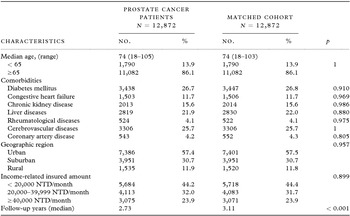
Table 1 shows the demographic and comorbidity data of the prostate cancer and matched patients. The patients ranged in age from 18 to 105 years, with a median age of 74 years. Diabetes mellitus (26.7%), cerebrovascular accident (25.7%), and liver diseases (21.9%) were the most frequently occurring comorbidities. According to a Mann–Whitney U test, the median follow-up period of the matched comparison group was 3.11 years was significantly longer than the 2.73-year follow-up of the prostate cancer group (P <0.001).
Baseline characteristics of patients with and without prostate cancer

NTD indicates new Taiwan dollars.
Mood disorder incidence rates
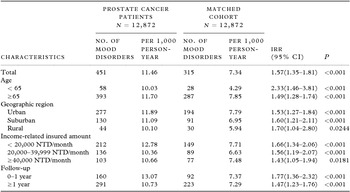
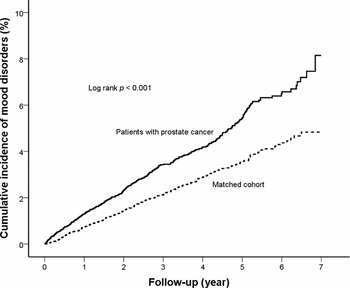
Table 2 presents the incidence rates of mood disorders, and Figure 1 shows the Kaplan–Meier estimates of the cumulative incidences of mood disorders among all study patients. The results show that the prostate cancer patients had a significantly greater cumulative incidence of mood disorders than control participants (P <0.001). During the first year of diagnosis, the prostate cancer patients exhibited higher incidence rates of mood disorder development than did the matched cohort (IRR 1.77, 95% CI 1.36–2.32, P <0.001) and the higher risk of mood disorders development persisted in the prostate cancer patients after the first year of follow-up (IRR 1.47, 95% CI 1.23–1.76, P <0.001).
Incidence of mood disorders in patients with and without prostate cancer

IRR indicates incidence rate ratio; CI, confidence interval; NTD, new Taiwan dollars.
The cumulative incidences of mood disorders (i.e. depressive and bipolar disorders) in patients with and without prostate cancer.

Mood disorders types
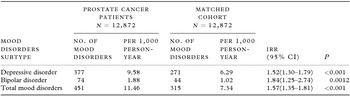
Table 3 shows a significantly increased incidence of various types of mood disorder among the newly diagnosed prostate cancer population. The development of newly diagnosed depressive disorder and bipolar disorder exhibited an increased IRR of 1.52 (95% CI 1.30–1.79) and 1.88 (95% CI 1.25–2.74), respectively.
Incidence of mood disorder subtypes in patients with and without prostate cancer

IRR indicates incidence rate ratio; CI, confidence interval.
Risks factors for mood disorders
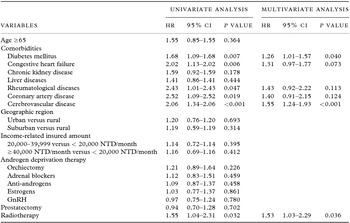
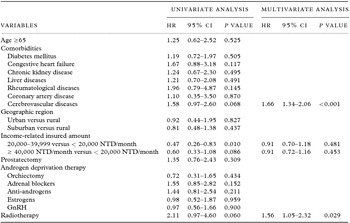
Tables 4 and 5 respectively show the Cox regression analysis results for predicting depressive and bipolar disorder development, respectively, in the prostate cancer patients group. As shown in Table 4, comorbidities of diabetes mellitus (HR 1.26, 95% CI 1.01–1.57, P = 0.042), CVD (HR 1.55, 95% CI 1.24–1.93, P <0.001), and radiotherapy treatment (HR 1.53, 95% CI 1.03–2.29, P = 0.036) were independent risk factors for developing depressive disorder. Table 5 shows that CVD (HR 1.66, 95% CI 1.34–2.06, P < 0.001) and radiotherapy treatment (HR 1.56, 95% CI 1.05–2.32, P = 0.029) were independent risk factors for developing bipolar disorder.
Analyses of risk factors for depressive disorder in prostate cancer patients

HR indicates hazard ratio; CI, confidence interval; GnRH, gonadotropin-releasing hormone; NTD, new Taiwan dollar.
Analyses for risk factors of bipolar disorder in prostate cancer patients

HR indicates hazard ratio; CI, confidence interval; GnRH, gonadotropin-releasing hormone; NTD, new Taiwan dollar.
Discussion
In this retrospective nationwide population-based study, prostate cancer patients exhibited an increased incidence of mood disorders compared to the matched patients over a seven-year follow-up period. The findings of this study are detailed as follows. First, an increased risk for mood disorders was observed for both depressive and bipolar disorders among the prostate cancer patients. Second, we observed a trend indicating that prostate cancer patients were at higher risk for mood disorder development, even beyond the first year of diagnosis. Finally, prostate cancer patients with underlying diabetes mellitus, CVD, and those receiving radiotherapy exhibited an increased risk of depressive disorder development, while comorbid CVD and radiotherapy treatment was associated with increased risk of bipolar disorder development among the prostate cancer patients.
Although several large-scale studies have investigated the association between prostate cancer and depressive disorders by using nationwide databases such as Prostate Cancer Data Base Sweden (Bill-Axelson et al. Reference Bill-Axelson2010; Reference Bill-Axelson2011) and the UK General Practice Research Database (Khan et al., Reference Khan, Ward, Watson and Rose2010b), the Taiwan NHI database may provide a more comprehensive assessment of the association between prostate cancer and mood disorders. Because enrollment in the NHI is mandatory and most Taiwanese residents can access healthcare with low copayments, referral bias is of no concern and follow-up compliance is high. In addition, the current study design involved an unbiased patient selection process and an age- and comorbidity-matched cohort was used as the comparison group. Furthermore, to apply for catastrophic illness certification, pathologic evidence of malignancy is mandatory, and laboratory and imaging studies must be provided. Therefore, the cancer diagnoses observed in this study can be considered reliable. The strengths of this study include its large sample size, long-term (seven years) follow-up period, use of clinical mood disorders diagnoses defined according to ICD-9-CM codes, and the prescription of psychotropic agents.
Previous studies have reported that prostate cancer patients exhibit an increased risk for depressive disorder development. In our study, we observed that our study group exhibited increased risk for both depressive and bipolar disorders. This finding is critical, because although a small-scale study indicated that antiandrogens may induce manic-like episodes (Lajeunesse et al., Reference Lajeunesse, Parent and Villeneuve1986), no study has investigated the association between prostate cancer and bipolar disorder. Although the onset of true bipolar disorder in elderly adults is relatively rare and therefore psychiatrists are typically hesitant in acknowledging a diagnosis of bipolar disorder in elderly adults unless all other possible differential diagnoses could be ruled out, bipolar disorder could indeed affect elderly adults. In addition to the hormone-based hypothesis of depressive and bipolar disorders (Lajeunesse et al., Reference Lajeunesse, Parent and Villeneuve1986), there are other explanations for the association between cancer and bipolar disorder. For example, cancer is a chronic inflammatory disorder, and prostate cancer includes a chronic inflammatory process (McCarron et al., Reference McCarron2002; Pfitzenmaier et al., Reference Pfitzenmaier, Vessella, Higano, Noteboom, Wallace and Corey2003; Maggio et al., Reference Maggio2006; De Marzo et al., Reference De Marzo2007). Previous studies have shown that cytokines circulating in the plasma may impair the function of the blood-brain barrier (Abbott et al., Reference Abbott, Ronnback and Hansson2006), which could indicate that peripheral inflammation is associated with the upregulation of central nervous system inflammation, thereby establishing a possible association between proinflammatory cytokine dysregulation and bipolar disorder (Munkholm et al., Reference Munkholm, Vinberg and Vedel Kessing2013). To summarize, a significantly increased risk of newly diagnosed bipolar disorder among prostate cancer patients was observed in this study, and some possible mechanisms may explain this association; however, it remains highly probable that some so-called “idiopathic” bipolar disorders identified following prostate cancer diagnosis are “secondary” bipolar disorders. The results, therefore, should be treated circumspectly.
The result that the initially higher incidence rates among prostate cancer patients subsequently declined after one year is unsurprising because patients experience profound stress during the first year of diagnosis. Previous research showed that depressive symptoms are typically recognized in the acute phase following cancer diagnosis (Chochinov, Reference Chochinov2001). Depressive disorders may also present because of the stress associated with prostate cancer management, such as invasive examination, surgical intervention, radiotherapy, and ADT within the first year. Another possible explanation is that surveillance for depressive disorders during this period may have resulted in detection bias. However, when excluding patients of depressive disorder in the first year, the increased risk of developing depressive disorder persisted among the prostate cancer patients in the follow-up period.
Although increased risks for depressive disorder and high levels of anxiety have been observed in prostate cancer patients who underwent prostatectomy (Steineck et al., Reference Steineck2002), our results show that prostatectomy was not a risk factor for mood disorder development. However, our finding that radiotherapy increased the risk of depressive disorder development is in agreement with the findings of previous research (Van Onselen et al., Reference Van Onselen2010). Regarding ADT treatments, which have increased in recent years and are applied at all stages of prostate cancer, the results of our study show that newly diagnosed depressive disorders were not associated with ADT, which contrasts with the findings reported by most previous studies. A growing body of the literature has shown that ADT is associated with increased risk of depressive disorders (Cherrier et al., Reference Cherrier, Aubin and Higano2009; Van Tol-Geerdink et al., Reference van Tol-Geerdink, Leer, van Lin, Schimmel and Stalmeier2011; Sharpley et al., Reference Sharpley, Bitsika and Christie2012), and some researchers have hypothesized that ADT-induced depression in prostate cancer patients may be related to low testosterone levels (Seidman et al., Reference Seidman2002). However, some doubt remains about the conclusion of those studies and the relationship among depression, ADT, and prostate cancer continues to be debated (Wiechno et al., Reference Wiechno, Sadowska, Kalinowski, Michalski and Demkow2013). Regardless, our findings are valuable because large-scale studies on the association between ADT and risks for newly diagnosed depressive disorder are not available.
We acknowledge that several limitations were encountered while conducting this study. First and most importantly, numerous data and potential confounding variables were not available for the analyses, including education level, occupation, marital status, social support, as well as the patients’ cognitive status, family history, and cancer stage. These factors may contribute to a patient's risk and resilience toward mood disorders. Second, most cases of prostate cancer were observed in elderly men with comorbid medical conditions. Therefore, any inferences regarding the association between prostate cancer and “idiopathic” bipolar disorder in this study must be made carefully. Third, prostate cancer patients with concurrent depressive disorders who preferred psychological therapy instead of antidepressants were not included in this study; consequently, this study may not be representative of all prostate cancer patients with depressive disorders. Forth, it is worth mentioning that since our study is based on an observational design rather than experimental one, the association between the possible risk factors mentioned above and mood disorders development in prostate cancer patients does not lead us to infer a causal relationship. Finally, previous studies have shown that Asian patients may focus more on their physical symptoms rather than psychological ones (Bailey et al., Reference Bailey, Geyen, Scott-Gurnell, Hipolito, Bailey and Beal2005). Moreover, in addition to the difficulty in evaluating the etiology of physical symptoms while diagnosing depressive disorders among elderly adults, oncologists may also be uncertain regarding the effectiveness of treatment of depressive disorders, which may limit the number of referrals for psychiatric intervention. Consequently, this study may have underestimated the number of prostate cancer patients with depressive disorders.
In conclusion, this study shows that prostate cancer patients are at higher risk for developing mood disorders, including depressive and bipolar disorders, compared to the matched cohort. Based upon our data, we recommend that clinicians focus on the comorbidities of CVD and radiotherapy treatment when assessing the development of mood disorders among newly diagnosed prostate cancer patients. Further prospective studies, particularly those involving more patient-level data, are warranted to confirm our findings.
Conflict of interest
None.
Description of authors’ roles
L-Y Hu, S-C Chen, and P-M Chen designed the study and authored the manuscript. C-J Liu, Y-W Hu, and C-M Yeh collected the data. C-C Shen, M-H Chen, C-F Tsai, and T-J Chen were responsible for the statistical design of this study and for conducting the statistical analysis. M-H Hung, T-P Su, and T Lu assisted with writing the paper and editing the English.
Acknowledgments
The authors thank Huei-Sing Chang and Cheng-Fang Hong for their technical assistance. This study was supported partially through grants received from Taipei Veterans General Hospital (V103B-022 and V103E10-001) and Taiwan Clinical Oncology Research Foundation. This study is based in parts on data from the NHI Research Database, provided by the Bureau of NHI, Department of Health, and managed by National Health Research Institutes. The interpretation and conclusions contained herein do not represent those of the Bureau of NHI, Department of Health, or National Health Research Institutes.