Introduction
Agricultural systems do not operate in a vacuum. Rather, they are situated within social and political environments that influence the way in which they operate. Therefore, if agricultural systems are to be sustainable, it is critical to understand how they are influenced by the prevailing social and political environments. For researchers and extension educators involved with the physical and biological aspects of agricultural systems, understanding potential social and political influences may mean the difference between beneficial discoveries that are accepted and used and discoveries that, although potentially beneficial, are socially or politically unacceptable and are therefore not applied. For social scientists and policymakers, understanding social and political influences on agricultural systems may mean the difference between policies and social structures that improve social, economic and environmental sustainability, and those leading to disastrous consequences for agriculture and the environment. In identifying barriers to adoption of sustainable practices, the social, political and cultural context of agriculture has often been ignoredReference Vanclay and Lawrence1. Indeed, with regard to sustainability, the environmental and economic indicators are well established, but ‘what is lacking is an awareness of the social issues’Reference Vanclay2.
Most people involved with agriculture can identify social and political factors that have impacts on agricultural systems; however, there is a danger that some of the cause–consequence relationships are ‘myths’ or simplifications that miss the true underlying causeReference Lambin, Turner, Geist, Agbola, Angelsen, Bruce, Coomes, Dirzo, Fischer and Folke3. There is a need to increase awareness and develop consensus about the factors that have the greatest influence and for which the greatest research needs exist to improve sustainability of agricultural systems. The objective of this study was to identify and begin developing consensus on the most important social and political factors influencing agricultural systems in the US. The objective went beyond simply listing the most important factors by providing some insight into their impacts, interactions and mechanisms by which they influence agricultural system. This was part of a coordinated effort to identify (1) social/political, (2) economic, (3) environmental and (4) technological factors influencing agricultural systems as a first step towards developing a set of guiding principles for integrated agricultural systems. A similar framework was used as part of the Millennium Ecosystems Assessment, with the idea that ‘understanding the factors that cause changes in ecosystems and ecosystem services is essential to designing interventions that capture positive impacts and minimize negative ones’Reference Capistrano, Samper, Lee and Raudsepp-Hearne4. With this study, we help advance the effort to better understand the factors that cause changes in agricultural systems by identifying and analyzing those factors that have the greatest impacts on agricultural systems. In the following section we provide a brief overview of the historical trends in US agriculture to provide the social and political setting for our analysis.
Historical Trends
As society changes with time, influences on agricultural systems also change. Therefore, any assessment of the social and political drivers affecting agricultural systems is time-specific, and should be seen in light of changes that have occurred. Many of these changes can be tied to demographic trends. In the US, farm population has dropped in absolute terms and as a percentage of the total population. From 1900 to 1990, the proportion of population living on a farm dropped from nearly 40 to <2%5. As a result, most of US society has little personal connection with agriculture. Population in rural areas has also shown a long-term declineReference Hobbs and Stoops6, and although there is some evidence that rural population losses have stabilizedReference Johnson7, there are regional differences in this trend. From an economic standpoint, the number of farming-dependent counties has dramatically decreased in the past 50 yearsReference Dimitri, Effland and Conklin8. Even in places where rural populations have increased, the composition of these populations has changed. These areas have increasingly become homes for metro-area commuters and retirees, and those seeking recreational opportunities and natural amenitiesReference Johnson7, Reference McGranahan9. As a result, much of the rural population has little connection to production agriculture, and may have lifestyle expectations that conflict with agricultural production practices and the traditional rural way of lifeReference Johnson7, Reference Smithers, Joseph and Armstrong10.
There have also been important demographic changes at the farm level. The average age of farm operators has steadily increased, from 50.3 in 1978 to 55.3 in 2002. In 2002, 26.2% of farm operators were over the normal retirement age of 6511. As the farm population continues to age, issues related to healthcare, retirement costs and transfer of the farm to future generations will become important influences on management decisions.
Over the past century, the structure of agriculture has changed dramatically. In 1900, half of US agricultural sales were accounted for by the largest 17% of farms, compared to the largest 2% of farms in 1997Reference Hoppe and Wiebe12. In addition, farms have become more specialized. In 1900, the average farm produced five different commodities, while by 2002, the number of commodities produced per farm was just over oneReference Dimitri, Effland and Conklin8. Drastic changes have also occurred beyond the farm level. There has been a general trend of consolidation within the agricultural input, processing and retail markets. In 1998, the top four firms marketed 67% of corn seed, 46% of soybean seed and over 97% of cotton seed in the United StatesReference Kalaitzandonakes, Hayenga and Lesser13. In specific processing industries, the top four firms marketed 90% of malt beverages in 1992 and 83% of beef packing in 2004Reference Hendrickson and Heffernan14. By 2004, the top five food retailers accounted for 46% of retail food sales in the USReference Hendrickson and Heffernan14.
Since the 1960s, agriculture has become more globalized and US agricultural exports have increased rapidlyReference Dimitri, Effland and Conklin8. Interestingly, US is both the leading exporter and leading importer of agricultural products, and in recent years imports have increased at nearly twice the rate of exportsReference Jerardo15. This shift has tended to further separate the public from production agriculture.
World population continues to grow with increasing demands for food production and increasing pressure on natural resources. Cultivated systems now cover about 25% of the Earth's terrestrial surface16. Water withdrawals from lakes and rivers and flows of biologically available nitrogen in terrestrial ecosystems have doubled since 196016. Yet, in 2004, 1.1 billion people were estimated to be hungry worldwideReference Shapouri and Rosen17. Within the next 50 years, demand for food crops is expected to grow by 70–85% and demand for water by 30–85%16.
Ironically, in the face of chronic malnutrition and the challenge of feeding a growing population, the world faces an obesity epidemic. In 2000, over 1.1 billion people worldwide were estimated to be overweight with 300 million people classified as obese18. In US, the population is becoming heavier (35% of adults overweight and 30% obese19), especially among minorities and the poorReference Drewnowski20. Public concern about this trend could have a tremendous influence on food consumption and agricultural production.
Other demographic trends may also influence food consumption. The US population is aging, becoming more affluent and more ethnically diverse. These changes are anticipated to lead to increased demand for higher food quality, convenience and varietyReference Blisard, Lin, Cromartie and Ballenger21. Although the US median household income has generally increased since 1967Reference DeNavas-Walt, Cleveland and Webster22, inequalities in incomes have also increased since that timeReference Jones and Weinberg23. Diverging income levels between individuals within the US and between the US and other countries lead to differing social expectations for agricultural systems. A common perception is that affluent individuals have greater expectations for convenience and variety of foods, for scenic landscapes, for a clean and healthy environment, and for recreational opportunities to be provided by agricultural systemsReference Freshwater24, Reference Schweikhardt and Browne25. While limited-resource individuals may have these same desires, economic forces often mean they struggle to obtain enough calories, let alone nutritious foods and a safe environment.
These trends provide the relevant background for identifying the social and political factors influencing agricultural systems at this point in time. As will be shown, many of these trends have a direct connection to the factors that will be identified. Given this background, we now provide a conceptual framework for the analysis.
Conceptual Framework
Although the term ‘agricultural systems’ can pertain to a range of spatial scales, the farm level is the focus of this analysis as this is where production decisions are made. Farms are where social, economical and ecological factors interact most profoundlyReference de Koeijer, Wossink, van Ittersum, Struik and Renkema26. Also, because any assessment of the social and political factors influencing agriculture is time-specific, this assessment will be contemporary. Conceptually, it may be useful to group social and political influences on agriculture into three categories: external social factors (those originating outside of the farm), internal social factors (those originating within the farm) and political factors. This division allows for analysis of a wide range of factors, while keeping comparisons among factors tractable. The division between social and political factors occurs naturally along discipline lines. The division between internal and external social factors is consistent with Van Calker et al.Reference Van Calker, Berentsen, Giesen and Huirne27 in identifying sustainability attributes in dairy farming and with Geist and LambinReference Geist and Lambin28 in analyzing the drivers of tropical deforestation. This division serves to distinguish between factors that are associated with individual farmer and farm household behavior; and general public attitudes, values and beliefs. These three categories of factors interact with agricultural systems in different ways (Figure 1). External social factors generally do not directly affect agricultural systems, but influence agricultural systems through internal social factors via social norms, through markets for agricultural products and through the political process. Internal social factors have a direct influence on agricultural systems as they are a part of the farmer's decision-making environment. Internal social factors may also indirectly influence agricultural systems as farmers participate in the political process. Political factors interact with agricultural systems both directly and indirectly. Direct political influences are experienced by farmers through associated regulations and definitions of property rights that constrain management options. Indirect political influences generally come through the markets via such mechanisms as subsidies for agricultural production or conservation measures, and through government investments in public infrastructure.
Social and political influences on agricultural systems.

Although this framework describes useful linkages, it should be used with some caution. The danger in identifying a set of factors that influence agricultural systems is that they may be seen as factors that are not a part of the system and over which we have no control. It is important to note that these factors are not independent of the systems they influence. Analytical methods for this conceptual framework are described in the following section.
Methods
An expert panel approach, following the procedure outlined by Van Calker et al.Reference Van Calker, Berentsen, Giesen and Huirne27, was used to identify and rank the importance of various social and political influences on agricultural systems. Van Calker et al.Reference Van Calker, Berentsen, Romero, Giesen and Huirne29 developed this procedure as part of an effort to construct a multi-attribute utility function to evaluate the sustainability of Dutch dairy farming systems. This procedure was developed based on weight elicitation methods used in decision analysisReference Poyhonen and Hamalainen30, Reference Bottomley and Doyle31. In the Van Calker et al.Reference Van Calker, Berentsen, Giesen and Huirne27 analysis, the expert panel approach was used initially as a tool for identifying and defining the relevant issues, and was designed to be universally applicable for other agricultural sectors, for other countries, and for other time periods. Our process included five steps: (1) panel selection, (2) questionnaire development by research project team, (3) expert panel completion of initial questionnaire, (4) compilation by research project team of factor list from expert panel, and (5) expert panel ranking of factors. The steps of the procedure were conducted sequentially as follows.
Panelists were selected in a two-stage process, first by compiling a list of recognized experts, then selecting a diverse subset of the qualified experts. For this analysis, the research project team decided to focus on academic experts within the agricultural social science field. It was recognized that other stakeholders such as farmers, industry representatives, consumers and members of environmental organizations would also be capable of assessing these factors. However, similar to Van Calker et al.Reference Van Calker, Berentsen, Giesen and Huirne27, the decision was made, based on the judgment of the research team, that academicians would have the expertise needed to identify the most important social and political factors influencing agricultural systems. Since this group is well known for participatory research where they constantly interact with other stakeholder groups, it was expected that the views of these other stakeholder groups would be represented. The initial list of 30 recognized academic experts was compiled from the recommendations of the research project team, based on discussion of their stature and competence related to the social and political aspects of agricultural systems. A diverse subset of the recognized experts was then selectively extracted to represent a broad range of areas of expertise, scientific institutions and geographic experience. Again, this followed closely the Van Calker et al.Reference Van Calker, Berentsen, Giesen and Huirne27 process in which competence was the main selection criterion for the experts, and panelists were selected from a range of scientific institutions. A panel size of nine was selected to provide a sufficient range of expertise, while keeping data collection and analysis manageable, and allowing a greater breadth of information to be collected from each panelist versus collecting a more superficial level of information from a larger group of panelists. A key objective of this project was to go beyond compiling a list of important factors and to gather insights into the mechanisms by which these factors might influence agricultural systems. The research team recognized that the small panel size might have reduced the validity of the ranking results; however, it was deemed that the more detailed insights gathered in this manner would be more valuable to social scientists, policymakers and others. This panel size was comparable to the 7–10 panelists used by Van Calker et al.Reference Van Calker, Berentsen, Giesen and Huirne27. The panel was selected to include three rural sociologists, three agricultural economists, and three other agricultural and food systems experts.
Using the three conceptual categories of external social factors, internal social factors and political factors, an initial list of factors for each category was developed by the research project team to provide the expert panel with a starting point. The initial list of factors was included in the questionnaire sent to the panelists. The panelists could then add or remove items from the list of factors under each category. In addition to simply identifying factors, the panelists were asked to provide reasoning on why specific factors were added to or removed from the list. They were also asked to identify newly emerging factors and factors for which there were critical research needs. After sending the questionnaires to the panelists, they were contacted by telephone to answer any questions they might have about the survey. They were also given the opportunity to decline participation at this point. If the panelist declined to participate, an alternate panelist was contacted. After the questionnaires were returned, the panelists were contacted by telephone a second time to discuss their responses in more detail.
Responses from each of the panelists were compiled into a single list of factors under each subdivision: external social, internal social and political. The consolidated list of factors was then sent back to the panelists for ranking. Again following Van Calker et al.Reference Van Calker, Berentsen, Giesen and Huirne27, two ranking procedures were used to allow testing for internal consistency. In the first ranking procedure, ordinal ranking, the panelists were asked to select the five most important factors in each category, and then to rank them from highest to lowest in terms of importance, with 5 being the most important factor and 1 being the least important factor of the top five. Factors that were not included among the top five were assigned a numerical value of zero. In the second ranking procedure, interval ranking, panelists were asked to rate all of the factors using a Likert-type scale of 1 to 5, with 1 being not an important factor at all and 5 being an extremely important factor. To facilitate comparisons between ranking procedures, relative importance weights W ij, for each factor i, were calculated within each category and ranking method for each respondent:

Within each category and ranking method, X ij is the numerical ranking value of factor i for respondent j, and  is the average ranking value of all factors for respondent j. Relative importance weights less than (greater than) one indicate factors with a ranking lower (higher) than the average ranking given by that respondent within that category. The Spearman rank correlation test was used with the relative importance weights to test the internal consistency of responses for each panelist. Again following Van Calker et al.Reference Van Calker, Berentsen, Giesen and Huirne27, correlations not significantly greater than zero (α=0.05) were judged to be inconsistent and that panelist's responses were excluded from further analysis within that category.
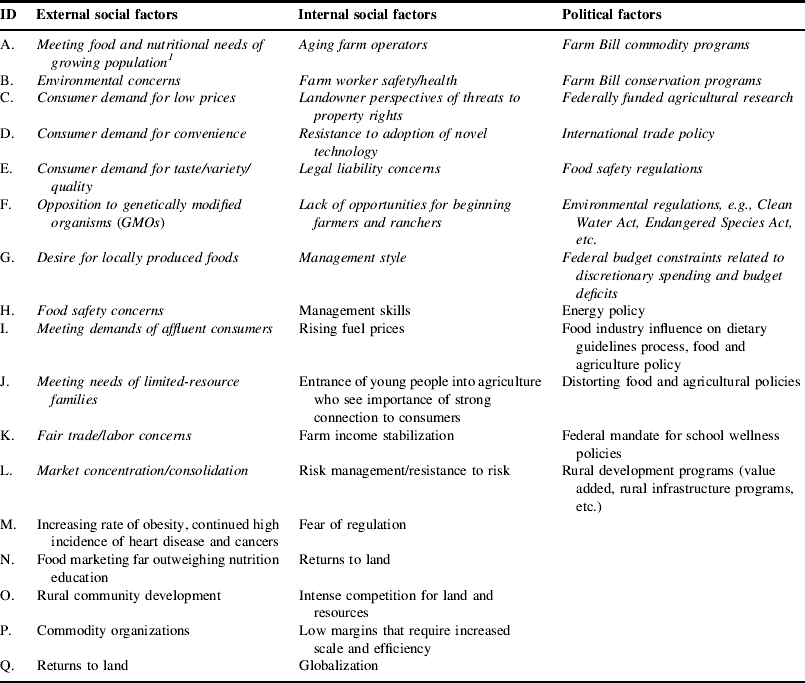
Table 1 shows the factors that were initially presented to the panelists and the final list after including the panelists' recommendations. Although some of the panelists recommended removing some of the factors from the initial list, no factor was suggested for removal by more than three panelists, so all of the factors were left on the final list for ranking. They were initially presented with 11 external social factors, seven internal social factors and seven political factors. They added five external social factors, ten internal social factors and five political factors. Among the external social factors, factors C and D were initially presented as one, but were sub-divided at the recommendation of the panelists.
List of most important external social factors, internal social factors and political factors affecting agricultural systems.
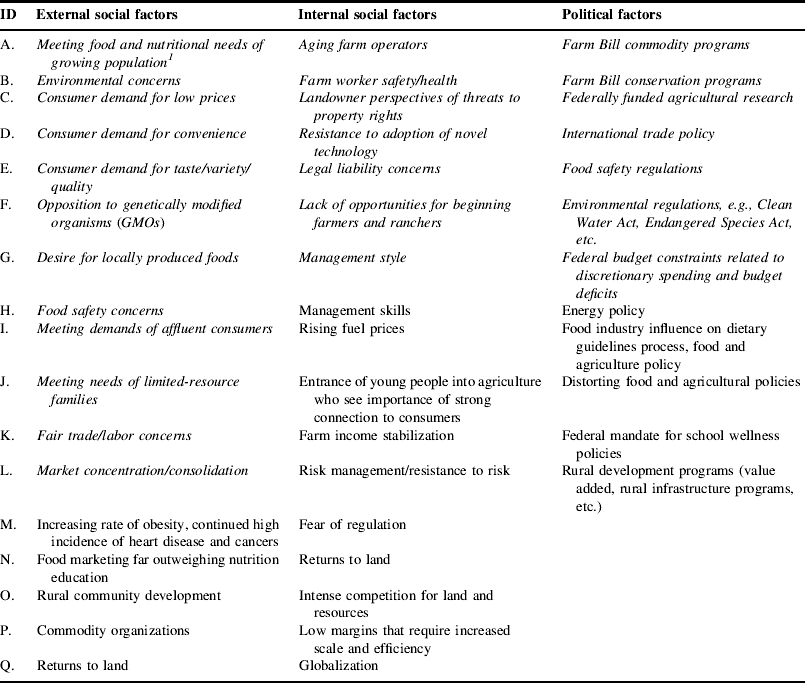
1 Factors in italics were among those initially presented to the panelists.
Results and Discussion
Panelist response rate and consistency
Even with the small panel size, intensive follow-up and replacing panelists who declined to participate, the response rate was <100%. Seven of the panelists completed the initial questionnaire and follow-up telephone interview. The eighth panelist indicated willingness to participate, but never completed the questionnaire. The ninth panelist declined to participate and three additional panelists were contacted sequentially as replacements; however, each of them declined as well. By this time, nearly a month had passed since the initial panelists had completed their surveys, and it was decided to proceed with the ranking portion while the topic was still on the minds of the remaining seven panelists. However, only six of those panelists completed the ranking questionnaire. These included two economists, two sociologists and two other agricultural and food systems experts, so the even representation of the three groups was maintained.
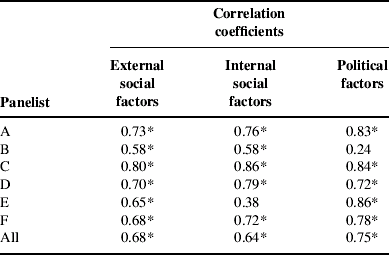
Within each category, internal consistency of responses between the two ranking procedures was checked for each panelist and for all panelists together (Table 2). Correlations for all panelists within each category showed that responses were consistent overall. Rankings for political factors showed the highest level of internal consistency (0.75 versus 0.68 for external social factors and 0.64 for internal social factors). Individual responses were also generally consistent with the exceptions of the internal social driver rankings for panelist E, and the political driver rankings for panelist B. The extreme lack of consistency among political driver ranking responses for panelist B was explained by the difficulty this panelist had in deciding importance among factors. Under interval ranking, this panelist gave all but one of the factors a score of 5, while the panelist was forced to choose among factors under ordinal ranking. Ranking responses for these panelists were excluded from further analysis within these categories.
Internal consistency of panelists.
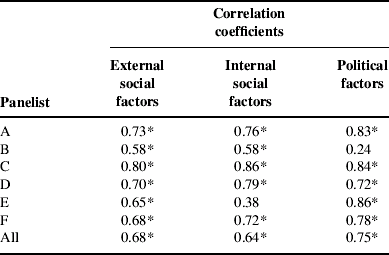
* The association between ranking methods is significantly different from zero (P<0.05).
External social factors
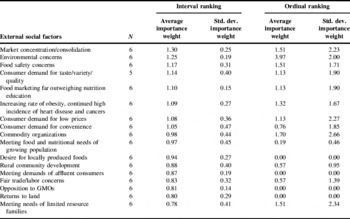
The average relative importance ranking values for external social factors are shown in Table 3 in descending order of the interval ranking procedure average importance weights. Standard deviations of importance weights under interval ranking were generally low. Standard deviations of importance weights tended to be higher using ordinal ranking than under interval ranking. This is not surprising since the ordinal ranking process was designed to produce separation among the scores given to each factor with all but the top five given scores of zero. Although rankings of external social factors were shown to have an acceptable level of internal consistency, there were differences in the ranking order of the factors depending on the ranking method used. Ordinal data provide a valid method for checking internal consistency for each respondent, but the ranking process does not provide a measure of the strength of preferences between choicesReference Labovitz32, and caution should be used in interpreting the average importance weights under ordinal rankingReference Lowry33. Thus, greater confidence should be placed on the interval rankings.
Average and standard deviation of relative importance weights for external social factors using interval ranking and ordinal ranking procedures.

Interval ranking of the external social factors showed market concentration/consolidation and environmental concerns as the top two factors. Using ordinal ranking, panelists ranked environmental concerns as the most important factor but they made few comments about why this was an important factor. One panelist commented that environmental problems are more visible and people are more aware of the issues now than in the past, with the implication that this increased awareness will affect agricultural systems. This panelist also identified an important linkage between environmental concerns and the aging of farm operators internal social factor, indicating that, if there is a need to shift towards more ecologically based agriculture due to environmental concerns, it will be necessary to have people ‘living in local ecologies long enough and intimately enough to learn how to manage farms well from an ecologically restorative perspective’. There is growing concern with the environmental costs of agricultural productionReference Tegtmeier and Duffy34. However, there is also some evidence that the concept of multi-functionality is gaining acceptance in the US. There is a realization that agricultural enterprises can provide goods and services that society demands beyond food and fiber, such as improved water quality, wildlife habitat, landscape amenities, flood control, nutrient cycling and carbon sinksReference Batie35. There is also evidence that social demands for these attributes are higher in more populated areasReference Hellerstein, Nickerson, Cooper, Feather, Gadsby, Mullarkey, Tegene and Barnard36 and that they increase with increasing incomesReference Schweikhardt and Browne25. Some have envisioned an agriculture where farmers are primarily managers of rural landscapes and only secondarily as producers of food and fiberReference Bromley37. Economic evidence shows this might not be unreasonable as the income elasticity of demand for environmental quality may be greater than that for food in the United States, suggesting that as incomes increase, consumers' demand for environmental quality may grow faster than their demand for foodReference Schweikhardt and Browne25.
Market concentration/consolidation was also included among the top five factors under ordinal ranking. Panelists agreed that market concentration/consolidation ‘has been a powerful driver shaping the realities of production agriculture’. One panelist thought the influence of this driver may be changing, indicating that ‘the wealth concentration that this consolidation has created is now becoming increasingly dysfunctional and the need for wealth expansion will likely be one of the significant drivers of the future’. Wealth concentration may not provide the same returns to financial institutions as having capital distributed among more entities, so these institutions will not see an economic advantage to continue concentrating capital. A second panelist saw the emergence of a dualistic agriculture with ‘continual pressure on some kinds of firms to get large and become integrated upward to the industrial buyer’ while there is an increasing opportunity ‘for niche/boutique producers to serve a more astute and demanding consumer’. This panelist identified these two areas as topics needing further research. Another panelist identified a linkage among market concentration/consolidation, desire for locally produced foods, and food safety concerns. Concentration, rather than local, more diffuse production, may lead to a higher risk of targeted contamination or major disruption of food supplies.
The issue of vertical integration from the farm upward is the latest incarnation in the continuing tension between farming as a business and farming as a way of life, which one panelist commented, ‘has been around forever’. In a recent discussion with Alabama chicken producers who produce under rigid integrator contracts, there was great frustration expressed about the loss of independence that had once been part of their way of life. One producer commented, ‘We are slaves on our own farms!’ Yet, one factor that appears to perpetuate the system is a continuing influx of people who are looking to get into farming for lifestyle reasons and see contract chicken farming as an easy way to get into farming because of the systems of available credit and management control that support contract poultry productionReference Heffernan and Hendrickson38.
Concern over food safety was also among the top five factors under both ranking methods. One panelist indicated, ‘Food scares make people more aware of where food comes from and the risks of the current system’. This is particularly evident in the UK where a series of crises in agriculture and food production has been seen as a violation of a social contract and has led to a distrust of regulatory authorities and a more critical eye towards technologyReference Bruce39. Two of the panelists described this factor in broad terms indicating it was related to how food is produced, including the desire for locally produced foods, consumer demand for taste/variety/quality, meeting the demands of affluent consumers, fair trade/labor concerns, and opposition to genetically modified organisms (GMOs). One panelist described safety with a small ‘s’, saying people do not feel desperately threatened (by chemicals, GMOs, etc.) but they just do not want it. ‘I want my food grown differently’. As another panelist put it, this contrasts with the industry notion of food safety being reduced to a set of standards that ‘further industrialize the process of producing food’. Another panelist added, ‘certainly not everyone wants to be an active participant in the food system;’ however, ‘there is a growing dissatisfaction with the status quo, a desire to know where food is produced and how it got to them’. One panelist identified this as an emerging factor, indicating there is a growing concern of civil society regarding issues ‘like consumer demands to know how food is produced, their desire for locally produced food, and their concern for labor’. This is reflected in tremendous growth in direct sales of food to consumers and the growing evidence that local exchange of foods provides health, food-security, and well-being benefits for people, communities, and ecological systems. However, there is a danger that local direct sales of foods can create a premium market for wealthy clientele rather than democratizing the economyReference Guptill and Wilkins40.
Increasing rate of obesity, and continued high incidence of heart disease and cancers were ranked sixth under both ranking methods. This was identified as an emerging driver by two of the panelists, both of whom indicated there was rising concern about this health crisis, and a need to understand how the current food system contributes to the problem. Emphasizing the magnitude of the problem, one of these panelists predicted ‘that the anti-GMO issues will be overcome by the anti-obesity issues in industrialized agricultural production’.
Meeting the needs of limited resource families was among the top five factors using ordinal ranking while it ranked lowest using interval ranking. Standard deviations of importance weights were high for this factor under both ranking processes, indicating widely differing views among panelists. Two panelists selected this factor as second in priority, while none of the remaining panelists included the factor among the top five. One of the panelists who ranked this factor highly indicated that the issues of meeting the needs of limited resource families, meeting the food and nutritional needs of a growing population, and meeting the needs of affluent consumers were all interrelated. ‘The kind of poverty that continues to make it impossible to keep populations fed despite over production simply will not be tolerated in a world that is now a global village with world-wide communications systems. Consequently the demand to develop a food system that provides healthy, nutritious, good tasting food at affordable prices for all of the planet's citizens will be a major driver shaping the food systems of the future’.
Internal social factors
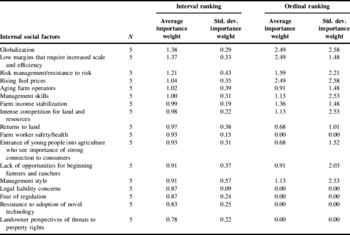
Our intent was to categorize social factors originating outside the farm as external and those originating inside the farm as internal. However, it appears that the panelists interpreted this division differently, classifying external social factors as those having an influence beyond the farm level and internal social factors as those having an influence at the farm level. Although the panelists indicated factors appearing on the initial internal factors list were important, once they had an opportunity to add additional factors and rank them, none of the initial factors were included among the top-ranked factors. Globalization, low margins that require increased scale and efficiency, risk management/resistance to risk, and rising fuel prices were included among the top four factors under both ranking procedures (Table 4). It was unexpected that globalization would be identified as a top internal social factor and not as an important external social factor. This may reflect a sense among the panelists that US farmers are acutely aware of the effects of globalization at the farm level. As one panelist indicated, ‘US farmers are increasingly competing in a global agricultural market. This means they will have to produce competitively with farmers elsewhere in the world but it also means growth in the potential markets for their products’. The effect of globalization was also seen from a different perspective. Another panelist observed that many people see globalization as a form of tyranny, and as such, may be on the verge of collapse. There has been an ongoing debate regarding the current and future ability of globalization to improve economic well being and lead to free societies versus impinging on the rights of countries for self-determination, including protection of the environment and protection of its citizens from health risks. This debate is at the core of the issue of free trade and the ability of countries to restrict the importation of genetically modified food products. To some, the restriction is seen as a type of protectionism that reduces opportunities for farmers to market their products abroad and, therefore, suppresses economic growth and reduces food availability to the poorReference Borlaug41, Reference Anderson42. However, others question whether farmers and the poor actually benefit from free tradeReference Peters43. Some see these restrictions as a means for consumer and environmental protection, and contend that free trade rules interfere with a basic right of people to determine what they put in their collective mouthsReference Saul44. US farmers have an acute interest in this issue, as evidenced by news reports in the popular farm pressReference Kollock45.
Average and standard deviation of relative importance weights for internal social factors using interval ranking and ordinal ranking procedures.

Low margins requiring increased scale was among the top two internal social factors under both ranking procedures. One panelist commented that increased scale and efficiency were important if a producer wishes to farm full-time. ‘Its the race for technology, allowing farms to get bigger, (and) driving down costs …’. This ‘technology treadmill’ is an often identified phenomenon in agricultural economics literatureReference Cochrane46 that leads to increasing reliance on off-farm incomeReference Zulauf47, decreasing farm numbers, and increasing farm sizeReference Levins and Cochrane48. Farmers feel the need to adopt new technologies at an early stage in order to survive economically. In the US, agriculture has suffered from this treadmill for over a centuryReference Blank49, and it has been argued that farmers need to be able to get off the technology treadmill in order to be truly sustainableReference Ikerd50. The technology treadmill has also been shown to have a direct economic connection to returns to land, which was identified as a newly emerging external social factor. In the original treadmill theory, farmers adopt new technologies to drive down their cost of production and improve their incomes. However, this leads to increased production, driving prices (and profits) down. The theory was revised to include the impact of government price supports. In the presence of government price supports, prices are not driven down. Instead, farmers try to expand profits by acquiring more land, which drives up land prices. Therefore, farmers who rent land must adopt new technology to generate enough revenue to pay higher land rents, while farmers who own land must either adopt new technology or they can quit farming and rent their land to other farmersReference Levins and Cochrane48. The challenge in getting off of the treadmill is finding other alternatives besides acquiring new technology, getting bigger or getting out. Options that have been proposed include increasing farmer bargaining power through collective actionReference Levins51, and a movement towards smaller, more flexible and intensively managed farms that are able to fill niche marketsReference Ikerd50. In addition to the economic aspects of this factor, one panelist commented that competition for land within a local community can lead to deterioration in community relationships as neighbors are pitted against one another.
Rising fuel cost was identified as a newly emerging driver among the top internal social factors that may affect agricultural systems in several ways. One panelist indicated that, ‘Fuel costs will be a driver in the adoption of energy-saving production practices as well as strengthening support for local food systems to reduce the distance between consumers and producers. The driver might also provide support for the rebuilding of value-added enterprises in areas where they have been lost’. Another panelist stated that rising fuel cost would lead agricultural production to rely more on biological synergies rather than energy inputs and increase the movement towards use of agricultural products for energy production.
Aging farm operators was ranked fifth under interval ranking and among the top ten under ordinal ranking. Two panelists made a connection between this factor and lack of opportunities for beginning farmers and ranchers. However, they had contrasting views about the magnitude of the problem, with one panelist indicating that there were many aging farm operators who would be willing to rent their land, but not to outsiders. ‘Thus, there are a lot of opportunities for beginning farmers within the community, particularly if they have the right social networks to access it’. The other panelist indicated that persistent low profits in agriculture have ‘prevented retiring farmers from setting aside funds for their own retirement, and so less of the farm's assets can be transferred to the next generation’.
Political factors
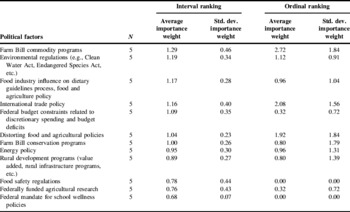
Farm Bill commodity programs were the highest ranked factor under both interval ranking and ordinal ranking (Table 5). Using interval ranking, all but one of the panelists gave Farm Bill commodity programs a ranking of 5 or ‘extremely important’. Most of the panelists made comments related to this factor. Two of them drew a connection between commodity programs and one of the external social drivers, ‘increasing rate of obesity, continued high incidence of heart disease and cancers’. One of these panelists indicated that current commodity programs ‘perpetuate an overabundance of cheap commodities that the food industry can use to create high fat, high sugar, and nutrient-poor food products’. It has been hypothesized that there is a connection between obesity and the low cost per unit of energy for refined grains, sugars and fats compared to more healthy alternativesReference Blisard, Lin, Cromartie and Ballenger21. This connection may be especially strong for people with low incomes who may choose these foods simply because they are the cheapest sources of dietary energyReference Blisard, Lin, Cromartie and Ballenger21. The connection between obesity and the cost of healthy foods was identified by one of the panelists as an area needing further research. Also, both panelists identified the connection between commodity programs and obesity as an area that is poorly understood and would merit extra attention by researchers and policymakers, and they proposed that a better understanding of the interconnections between these factors may lead to policies targeted towards growing healthier food at the farm level.
Average and standard deviation of relative importance weights for political factors using interval ranking and ordinal ranking procedures.

These panelists also raised concerns about the influence of food industry and commodity organizations on current agricultural policy. Food industry influence on the dietary guidelines process, food and agricultural policy was ranked among the top five political factors under both ranking systems, and commodity organizations were the second most important external social factor under ordinal ranking.
Two panelists commented on the effect of Farm Bill commodity programs in influencing the decision about what crop to plant. Both indicated that the current program is a disincentive for farmers to try new crops or production methods, and one of them related this to the risk management/resistance to risk, identified as an internal social factor. This panelist lamented that Farm Bill commodity programs discount the value of alternative risk management methods, such as diversification into other crops. This is supported by recent research findings indicating that the value of crop diversification as a risk management tool is reduced when farmers can utilize commodity programs and crop insuranceReference Archer, Pikul, Riedell, Hanson and Krupinsky52. The panelist indicated that this was an area needing further research. Several panelists indicated that commodity program payments may decrease in the future due to federal budget constraints and international trade pressures, but one panelist was skeptical that budget constraints would lower commodity payments because ‘the constraints are always balanced by well-entrenched vested interests’.
Environmental regulation was the second ranked factor under interval ranking and the fourth ranked factor under ordinal ranking. Only one panelist commented on this driver, relating it to Farm Bill conservation programs. This panelist indicated that Farm Bill conservation programs were not strictly oriented towards conservation, but were ways to indirectly support commodity programs by helping farmers comply with environmental regulations. This comment was primarily in regard to the use of conservation programs to fund manure management practices and facilities for confined animal feeding operations. Advocates of this use see it as a way to reduce the economic burden on farmers for complying with the regulations that require them to adopt these practices and build these facilities. However, many in the sustainable agriculture community see this as a corruption of the program's intent, paying for conservation measures that would occur anyway, providing incentives for larger livestock operations, and taking resources away from other conservation priorities.
Although rural development programs were near the bottom of the rankings for political factors, one panelist indicated that these may become more important in the future as the non-farm rural population increases, and their political power increases relative to the farm population. This panelist indicated that the needs of limited-resource farmers and the rural poor were areas needing a renewed research focus.
Overall factor rankings
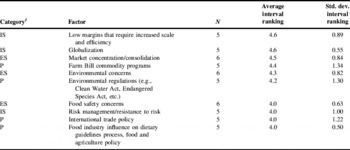
The interval ranking process used a consistent ranking scale across all categories of factors. This allowed comparison among factors independent of category. In order to compare responses among categories, raw ranking scores were used rather than relative importance weights which were normalized within each category. Also, using raw ranking scores showed the importance the panelists placed on these factors. Based on average interval ranking scores, the top ten factors included a mix of external social, internal social and political factors (Table 6), indicating that no single category of factors dominated the others in influencing agricultural systems. The top ten factors all had average interval ranking scores of at least 4.0 on a scale from 1 to 5. The internal social factors: globalization and low margins that require increased scale and efficiency were the top two factors overall.
Factors with the ten highest average interval ranking scores.

1 IS=internal social factor, ES=external social factor, P=political factor.
Conclusion
A wide range of social and political factors affect agricultural systems. Insights provided by a diverse group of academic experts in the areas of agricultural economics, rural sociology and agriculture and food systems identified factors they considered to be particularly important influences on agricultural systems. This analysis utilized a limited sample size in order to gather more in-depth information from each of the participants and thus gain a broader understanding of how these factors are perceived to affect agricultural systems. The research project team deemed a small panel would be capable of identifying the most important factors without loss of generality. The low standard deviations of importance weights (using the interval ranking procedure) provided some support for this assumption. Nonetheless, because the sample size was limited, and panelists were limited to academic experts, it will be important to verify that these findings reflect the views of a larger population and differing segments of society (e.g., farmers, consumers and policymakers).
Although there were contrasting views about the importance of some factors, there was strong consensus about many of them. Rankings of the most important factors produced no major surprises, except that globalization was identified as an internal social factor. Presumably this reflected how acutely globalization affects decisions at the farm level. In addition to identifying and ranking the most important factors, panelists provided information on the reasoning behind their selections, and identified factors that were newly emerging or for which there were critical research needs. Newly emerging factors identified by the panelists included rising fuel costs, obesity, potential decreases in commodity subsidies due to budget constraints or trade rulings, consumer awareness and demands to know how food is produced, and economic returns to land. Research needs identified by the panelists included the relationship between agricultural policy and health, risk behavior on the farm, the connections between obesity and the cost of healthy foods, the needs of limited resource farmers and the rural poor, the continual pressure on farms to become larger and more integrated towards the industrial buyer, and the opportunity for niche/boutique producers to serve more discriminating consumers.
For physical and biological scientists, this information will help confirm or deny preconceived notions and improve awareness of social and political factors that impact the relevance of their research. For example, while most scientists involved in cropping systems research might recognize that rising fuel costs could generate interest by farmers in energy saving production technologies like reducing tillage or using legumes in place of purchased nitrogen, many would not have considered the potential that demand for locally produced foods may increase due to increased transportation costs, and that opportunities to diversify crop rotations may be driven more by increasing fuel costs than by risk management concerns. In addition, the linkages among many of the factors have not received a lot of attention in the cropping systems or animal science journals. Yet, these linkages, such as panelists' concern about obesity and its link to an industrialized food system, could be a very important area of study for natural scientists since these health concerns have the ability to impact markets for agricultural products and government policies.
Although most social scientists and policymakers may have a good general understanding of the most important social and political influences on agricultural systems, the newly emerging factors and research needs identified in this study outline priority research topics and testable hypotheses. A comprehensive understanding of these factors is imperative to help guide scientific research so that beneficial discoveries are accepted and used, and to ensure that policy decisions enhance the future sustainability of agricultural production. By identifying the most important factors, providing supporting insights into their effects, and delineating emerging issues and research needs, this study provides a basis upon which a comprehensive understanding of these factors may be built.
Acknowledgements
We thank the panelists for their valuable input.