Introduction
North Carolina is the largest producer of sweetpotato in the United States. In 2017 approximately 36,400 ha were harvested for a value of $350 million (USDA 2018). The majority of the sweetpotato acreage (>90%) in North Carolina is planted to ‘Covington’ (NCDACS 2015), a cultivar released by North Carolina State University in 2008 (Yencho et al. Reference Yencho, Pecota, Schultheis, VanEsbroeck, Holmes, Little, Thornton and Truong2008). The wide adoption of Covington is due to its disease resistance and consistency to produce a high percentage of no.1 grade sweetpotato roots that result in greater economic return (Yencho et al. Reference Yencho, Pecota, Schultheis, VanEsbroeck, Holmes, Little, Thornton and Truong2008). ‘Beauregard’ was the standard cultivar that dominated the U.S. market soon after its release in 1987 (Rolston et al. Reference Rolston, Riley, Wilson, Robbins, Clark, Cannon and Randle1987) and continues to be an important orange-fleshed variety in Mississippi and internationally.
Due to the low sweetpotato canopy, storage root yield and quality can be limited by weeds (Barkley et al. Reference Barkley, Chaudhari, Jennings, Schultheis, Meyers and Monks2016; Coleman et al. Reference Coleman, Chaudhari, Jennings, Schultheis, Meyers and Monks2016; Meyers et al. Reference Meyers, Jennings, Schultheis and Monks2010b). Palmer amaranth is the most problematic and competitive weed and is the main focus of growers when developing weed management programs in sweetpotato. Marketable yield of Beauregard and Covington sweetpotato can be reduced by as much as 50% with as few as one Palmer amaranth plant per m–1 of crop row (Meyers et al. Reference Meyers, Jennings, Schultheis and Monks2010b).
Sweetpotato growers utilize multiple weed management strategies including herbicides, between-row cultivation, and hand-removal of weeds (J. Haley and J. Curtis, unpublished data). A limited number of herbicides are registered for use in sweetpotato (Kemble Reference Kemble2017) and growers must rely on PRE herbicides to provide control of Palmer amaranth and other weeds. PRE herbicides clomazone, flumioxazin, and S-metolachlor can provide excellent residual weed control (Barkley et al. Reference Barkley, Chaudhari, Jennings, Schultheis, Meyers and Monks2016; Meyers et al. Reference Meyers, Jennings and Monks2013) but require rainfall or irrigation for activation, and weed control can be compromised if the soil surface is disturbed after application. The recommended herbicide program in North Carolina is flumioxazin pretransplant (PREtr) followed by (fb) S-metolachlor 10 to 14 d after transplanting (DAP). This sequential program provides>90% season-long control of Palmer amaranth if applications are made and activated prior to Palmer amaranth emergence (Coleman et al. Reference Coleman, Chaudhari, Jennings, Schultheis, Meyers and Monks2016; Meyers et al. Reference Meyers, Jennings, Schultheis and Monks2010a).
Flumioxazin is applied in sweetpotato and in many of the crops grown in rotation with sweetpotato including cotton (Gossypium hirsutum L.), corn (Zea mays L.), peanut (Arachis hypogaea L.), and soybean [Glycine max (L.) Merr.] (Anonymous 2016b). The use of flumioxazin and other protoporphyrinogen oxidase enzyme (PPO)–inhibiting herbicides in these crops puts intense selection pressure on weeds to develop resistance. There are increasing reports of PPO-resistant weeds throughout the United States, including Palmer amaranth, goosegrass [Eleusine indica (L.) Gaertn.], and common ragweed (Ambrosia artemisiifolia L.) (Heap Reference Heap2018). Therefore, it is important to explore residual herbicides with alternative modes of action to help reduce selection pressure for PPO-resistant biotypes.
Fierce® (Valent U.S.A. Corporation, Walnut Creek, CA) is a newly registered premix of flumioxazin (33.5%) and pyroxasulfone (42.5%) predominantly for use in cotton, field corn, and soybean (Anonymous 2016a). Pyroxasulfone (WSSA group 15) is a relatively new herbicide that inhibits very long chain fatty acid synthesis (Tanetani et al. Reference Tanetani, Kaku, Kawai, Fujioka and Shimizu2009) in sensitive weeds (Anonymous 2016a; Mahoney et al. Reference Mahoney, Shropshire and Sikkema2014; Refsell et al. Reference Refsell, Ott, Dale and Pawlak2009). When applied in conventional tillage soybean, flumioxazin/pyroxasulfone 71/89 g ha–1 provided≥94% control of common lambsquarters (Chenopodium album L.), redroot pigweed (Amaranthus retroflexus L.), smooth pigweed (Amaranthus hybridus L.), and velvetleaf (Abutilon theophrasti Medik.) (Mahoney et al. Reference Mahoney, Shropshire and Sikkema2014). Miller et al. (Reference Miller, Smith and Mathews2013) reported 30% injury to sweetpotato cultivar ‘LA 07-146’ (since then released as ‘Bayou Belle’) when pyroxasulfone was applied POST immediately after transplanting. However, in another study, Miller et al. (Reference Miller, Smith and Mathews2013) reported≥88% control of goosegrass, carpetweed (Mollugo verticillata L.), morningglory (Ipomoea spp.), and yellow nutsedge (Cyperus esculentus L.) from flumioxazin/pyroxasulfone PREtr with no injury to sweetpotato cultivar LA 07-146 and no reduction of no.1 or marketable yields. Similarly, Shankle et al. (Reference Shankle, Garrett and Abukari2013) reported≤5% injury to Beauregard sweetpotato at 35 DAP from flumioxazin/pyroxasulfone 71/89 and 105/133 g ha–1 PREtr, and yields similar to a nontreated check. However, Meyers et al. (Reference Meyers, Jennings and Monks2013) reported excessive Covington sweetpotato crop injury and reduced yields in one of two years when 70/89 g ha–1 flumioxazin/pyroxasulfone was applied fb>5 cm of rainfall 1 d after application.
Herbicide movement in the soil profile depends on several factors, including application rate, herbicide persistence and mobility, rainfall, topography, and climate (Wauchope 1994). Mueller and Steckel (Reference Mueller and Steckel2011) reported the dissipation half-life (DT50) values of pyroxasulfone and S-metolachlor were 8.2 to>70 d and 8.7 to 27 d, respectively. Both S-metolachlor and pyroxasulfone have low Koc (268 ml g–1 and 117 ml g–1, respectively) values that suggest the higher availability of these herbicides in the soil water solution for plant uptake (Westra et al. Reference Westra, Shaner, Barbarick and Khosla2015). Short and round sweetpotato roots have been described as a symptom of S-metolachlor injury (Monks et al. Reference Monks, Shankle, Jennings and Meyers2013). Meyers et al. (Reference Meyers, Jennings and Monks2012) reported that no.1 and marketable sweetpotato yields and storage root length-to-width ratio were reduced when S-metolachlor applications were made within 1 DAP and fb 3.8 cm irrigation. Although the interactive effects of application timing, application rate, and simulated rainfall have been thoroughly investigated for S-metolachlor, these same interactions have not been explored for pyroxasulfone. Therefore, the objective of this research was to determine the response of sweetpotato and Palmer amaranth to flumioxazin plus pyroxasulfone PREtr fb irrigation.
Materials and Methods
Greenhouse Study
Greenhouse studies were conducted at the Horticulture Field Laboratory (35.7948°N, 78.7000°W) at North Carolina State University, Raleigh, NC and the Pontotoc Ridge-Flatwoods Branch Experiment Station (34.1375°N, 89.0058°W), Pontotoc, MS, in Fall 2015. At both locations, the potting medium used was a 1:1 (v/v) mixture of white sand and field soil (Pontotoc Ridge–Flatwoods Branch Experiment Station or Horticultural Crops Research Station, Clinton, NC). Soil had pH 5.3 and 0.49% organic matter and pH 5.8 and 1.8% organic matter in Pontotoc and Raleigh, respectively. Polyethylene pots (ITML Horticultural Products, Brantford, Canada) 25-cm wide by 25-cm deep (Pontotoc) and 25-cm wide by 20-cm deep (Raleigh) were filled then received enough water to saturate the potting medium.
The experimental design was a randomized complete block with four (Pontotoc) and six (Raleigh) replications. Treatments consisted of a factorial arrangement of four herbicide rates (flumioxazin/pyroxasulfone [57/72 and 105/133 g ai ha–1], 803 g ai ha–1 S-metolachlor, and nontreated) by three irrigation timings (2, 5, and 14 DAP). Two d after pot filling, herbicide applications were made with a CO2-pressurized backpack sprayer fitted with two 8002 XR nozzle tips (Teejet 8002 XR Teejet Technologies, Springfield, IL) and calibrated to deliver 140 L ha−1 at 138 kPa. On the same day but after herbicide application, Beauregard (Pontotoc) and Covington (Raleigh) nonrooted sweetpotato shoot cuttings (slips), each measuring 25 to 30 cm in length, were transplanted into pots. Irrigation was withheld, and only designated pots received water at each irrigation event. Irrigation applications were made by evenly applying 500 ml of water to the soil surface in each pot by hand. After completing all irrigation events, all pots were watered and fertilized (Osmocote Classic 14-14-14) as needed to ensure optimum growth for the remainder of the study.
Sweetpotato injury (chlorosis and necrosis) was estimated visually 16 DAP using a scale from 0 (no injury) to 100% (plant death) (Frans et al. Reference Frans, Talbert, Marx and Crowley1986). At trial termination 76 (Pontotoc) and 84 DAP (Raleigh), sweetpotato vine length was measured from the soil surface to the longest shoot tip, and shoots were severed at the soil surface to measure shoot fresh biomass. Below-ground plant portions were removed from pots, and the media was hand-removed from plant roots by gentle shaking followed by a steady stream of water. Roots were separated into storage roots (pigmented and demonstrating lateral expansion), pencil roots, and fibrous roots, and fresh biomass by root type was recorded.
Field Study
Studies were conducted in 2015 at the Horticultural Crops Research Station in Clinton, NC, in a field heavily infested (25 to 50 plants m–2) with Palmer amaranth. Field-grown Covington slips were mechanically transplanted 10-cm deep and 30-cm apart in-row on June 12 and July 8, 2015 at location 1 (35.0232°N, 78.2804°W) and location 2 (35.0237°N, 78.2780°W), respectively. Soil at location 1 and 2 was a Norfolk loamy sand (Fine-loamy, kaolinitic, thermic Typic Kandiudults) and an Orangeburg loamy sand (Fine-loamy, kaolinitic, thermic Typic Kandiudults), respectively, with pH 5.9 and 0.6% organic matter. Plot size was 4 rows, each row 1.1-m wide by 6-m long. The first and fourth row of each plot were nontreated and served as border rows; treatments were applied to the second and third rows. The experimental design was a randomized complete block with four replications. Treatments consisted of a two-way factorial of seven herbicide treatments (flumioxazin/pyroxasulfone PREtr at 40/51, 57/72, 63/80, and 105/133 g ai ha–1, 107 g ha–1 flumioxazin PREtr fb 803 g ai ha–1 S-metolachlor 7 to 10 DAP, and season-long weedy and weed-free checks) by three irrigation timings (0 to 2, 3 to 5, or 14 DAP). PREtr applications were made 1 d prior to transplanting. All herbicide applications were made with a CO2-pressurized backpack sprayer calibrated to deliver 187 L ha–1 through a 2-nozzle boom equipped with TeeJet XR 11002VS flat fan nozzles. At each irrigation timing, 1.9 cm of water was applied via a rainfall simulator. After all irrigation events, supplemental irrigation to the entire field was provided throughout the growing season as necessary to maintain crop growth.
Sweetpotato injury and Palmer amaranth control were estimated visually on a scale from 0 (no injury or no control) to 100% (crop death or complete control) 16 and 38 DAP and 8, 16, 38, and 103 DAP, respectively. Sweetpotato storage roots were harvested 124 and 103 DAP at location 1 and 2, respectively, using a chain digger and hand-graded into jumbo (≥8.9-cm diam), no. 1 (≥4.4 cm but <8.9 cm), and canner (≥2.5 cm but <4.4 cm) grades (USDA 2005). Total marketable yield was calculated as the sum of no. 1, jumbo, and canner grades. Twenty-five no. 1 storage roots were randomly chosen from each plot to determine the influence of treatment on storage root shape. The length and width of each storage root were measured using a digital caliper according to USDA (2005) grading standards and length-to-width ratio was calculated.
Both greenhouse and field data were subjected to ANOVA by PROC MIXED (SAS 9.3, SAS Institute Inc., Cary, NC) considering the factorial treatment arrangement. All data were checked for homogeneity of variance by plotting residuals. Fixed effects included herbicide, irrigation, and their interaction. Location and replication within location were included as random effects where data were combined for both locations; otherwise replication was considered as a random effect. Weedy and weed-free check plots were included in the analysis for sweetpotato yield. However, because of a lack of variance, these treatments were not included in the analysis of sweetpotato injury and Palmer amaranth control data. Data for storage, pencil, and fibrous roots from greenhouse studies and sweetpotato injury from field studies were transformed to the arcsine square root before analysis; however, back-transformed means are presented. Means were separated using Tukey’s honest significant difference (HSD) test at the 0.05 significance level.
Results and Discussion
Greenhouse Study
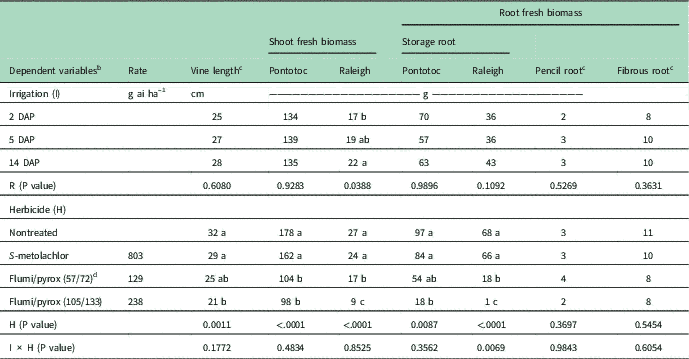
Sweetpotato injury (chlorosis/necrosis) was only observed 16 DAP and was≤7% regardless of herbicide or irrigation timing (data not presented). The location by treatment interaction was not significant for vine length or pencil and fibrous root fresh biomass, but this interaction was significant for shoot and storage root fresh biomass (Table 1). Therefore, data were combined across both locations for vine length and pencil and fibrous root fresh biomass, but analyzed by location for shoot and storage root fresh biomass. The effect of irrigation timing was only significant for shoot fresh biomass at Raleigh and resulted in a 23% reduction when irrigation was applied 2 DAP compared to 14 DAP. Herbicide application, however, had a significant effect on vine length and shoot and storage root fresh biomass. Vine length of the nontreated check was 32 cm and longer than plants treated with 105/133 g ha–1 flumioxazin/pyroxasulfone (21 cm). Compared to the nontreated check (178 and 27 g at Pontotoc and Raleigh, respectively), both rates of flumioxazin/pyroxasulfone reduced shoot biomass by a minimum of 41%. Storage root biomass of the nontreated check was 97 and 68 g at Pontotoc and Raleigh, respectively, and decreased to 54 and 18 g with 57/72 g ha–1 flumioxazin/pyroxasulfone and 18 and 1 g with 105/133 g ha–1 flumioxazin/pyroxasulfone. S-metolachlor did not reduce vine length or shoot or root biomass compared to the nontreated check.
Effect of flumioxazin/pyroxasulfone, S-metolachlor, and irrigation timing on sweetpotato vine length, shoot fresh biomass, and root fresh biomass in greenhouse at Pontotoc, MS, and Raleigh, NC, in 2015.Footnote a

a Abbreviations: DAP, d after transplanting; Flumi/pyrox, flumioxazin/pyroxasulfon.
b Means within columns for dependent variables (herbicide or irrigation) followed by the same letter are not significantly different according to Tukey’s HSD (α=0.05).
c Data were combined for both locations.
d Values in parenthesis are rates of flumioxazin/pyroxasulfone as g ai ha–1.
Field Study
Palmer Amaranth Control
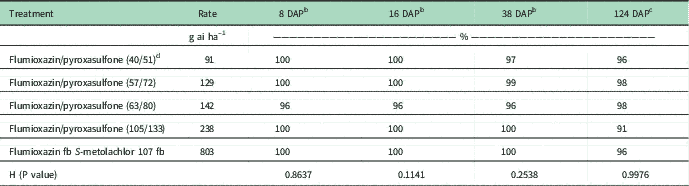
The interaction for location by treatment was not significant for Palmer amaranth control; therefore, data were combined for both locations. Further analysis indicated that the main effects of herbicide and irrigation timing and their interaction were not significant for Palmer amaranth control, and control was ≥91% at all evaluation dates regardless of herbicide application or irrigation timing (Table 2). These results are similar to previous research that found pigweed spp. control with flumioxazin/pyroxasulfone to be≥94% in soybean (Mahoney et al. Reference Mahoney, Shropshire and Sikkema2014; Norsworthy et al. Reference Norsworthy, Meyer, Stepanovic, Steckel, Young, Bradley, Johnson, Loux, Davis, Eubank and Kruger2014). Meyers et al. (Reference Meyers, Jennings and Monks2013) reported≥95% control of Palmer amaranth at 74 DAP from flumioxazin/pyroxasulfone PREtr in sweetpotato.
Palmer amaranth control with flumioxazin/pyroxasulfone and flumioxazin fb S- metolachlor at Clinton, NC, 2015.Footnote a

a Abbreviations: DAP, d after transplanting; fb, followed by.
b Data were combined for both locations. All means within a column are not different according to Tukey’s HSD (α=0.05).
c Data were collected only from location 1.
d Values in parenthesis are rates of flumioxazin/pyroxasulfone as g ai ha–1.
Foliar Sweetpotato Injury
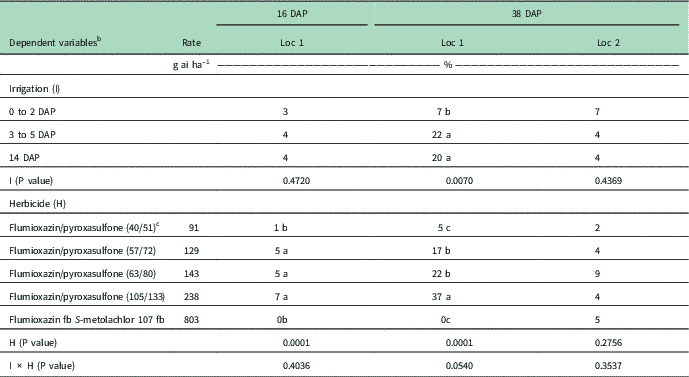
At 16 DAP, sweetpotato injury (chlorosis/necrosis and stunting) was present only at location 1 and increased from 1 to 7% as flumioxazin/pyroxasulfone rates increased from 40/51 to 105/133 g ha–1 (Table 3). At 38 DAP, stunting was observed at both locations. Location 1 had injury ranging from 2 to 37% and followed a significant linear trend of increasing injury with increasing flumioxazin/pyroxasulfone rate. Stunting injury from herbicides was greater when irrigation was applied 3 to 5 or 14 DAP (22 and 20%, respectively) compared to 0 to 2 DAP (7%). At location 2, stunting was≤9% regardless of herbicide application or irrigation timing. Stunting from all treatments was transient and no injury was reported later in the season (data not shown). Meyers et al. (Reference Meyers, Jennings and Monks2013) reported 23 to 26% sweetpotato stunting 18 and 37 DAP when flumioxazin/pyroxasulfone was applied PREtr at 70/89 g ha–1. However, sweetpotato plants recovered from injury by 74 DAP. Miller et al. (Reference Miller, Smith and Mathews2013) and Shankle et al. (Reference Shankle, Garrett and Abukari2013) observed≤10% injury to sweetpotato vines when flumioxazin/pyroxasulfone was applied at 71/90 g ai ha–1. Some level of initial injury from pyroxasulfone PRE has been observed in cotton (Cahoon et al. Reference Cahoon, York and Jordan2012), peanut (Prostko et al. Reference Prostko, Grey, Webster and Kemerait2011), and sweet corn (Nurse et al. Reference Nurse, Sikkema and Robinson2011), but it did not impact crop yield.
Effect of flumioxazin/pyroxasulfone rate and irrigation timing on ‘Covington’ sweetpotato plant injury at Clinton, NC, 2015.Footnote a

a Abbreviations: DAP, d after transplanting; fb, followed by; Loc, location.
b Means within columns for dependent variables (herbicide or irrigation) followed by the same letter are not significantly different according to Tukey’s HSD (α=0.05). The weed-free and weedy checks were not included in the statistical analysis.
c Values in parenthesis are rates of flumioxazin/pyroxasulfone as g ai ha–1.
Sweetpotato No.1 Storage Root Length-to-Width Ratio
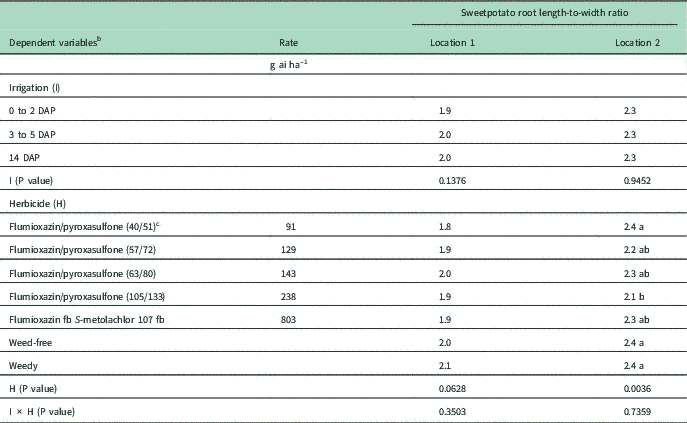
The treatment-by-location interaction (P < 0.0001) was significant; therefore, data were analyzed separately by location (Table 4). At both locations, sweetpotato storage root length-to-width ratio was similar regardless of irrigation timing. Storage roots from flumioxazin/pyroxasulfone and flumioxazin fb S-metolachlor treatments were similar to the weed-free check in length-to-width ratio except at location 2 where flumioxazin/pyroxasulfone 105/133 g ha–1 had a lower ratio (2.1) than the weed-free check (2.4). This finding indicates that the shape of the storage root is not affected by flumioxazin/pyroxasulfone rates except for flumioxazin/pyroxasulfone 105/133 g ha–1 at one of two locations.
Effect of flumioxazin/pyroxasulfone rate and irrigation timing on ‘Covington’ sweetpotato no.1 storage root length-to-width ratio at Clinton, NC, in 2015.Footnote a

a Abbreviations: DAP, d after transplanting; fb, followed by.
b Means within columns for dependent variables (herbicide or irrigation) followed by the same letter are not significantly different according to Tukey’s HSD (α=0.05).
c Values in parenthesis are rates of flumioxazin/pyroxasulfone as g ai ha–1.
Sweetpotato Storage Root Yield
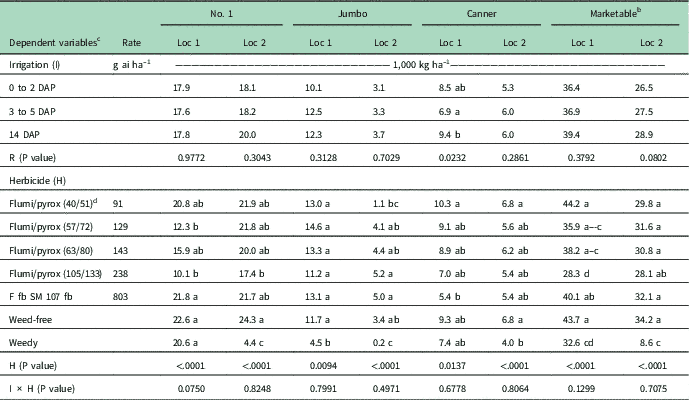
Due to a treatment-by-location interaction for all grades of sweetpotato, data were analyzed separately by location (Table 5). At both locations, irrigation timing did not influence sweetpotato yield except at location 1 where canner yield was reduced 23% when irrigation was applied 3 to 5 DAP compared to 14 DAP. No.1 yield at both locations and marketable yield at location 1 were lower for flumioxazin/pyroxasulfone 105/133 g ha–1 than other rates of flumioxazin/pyroxasulfone and the weed-free check. With the exception of no.1 (location 1) and jumbo (location 2) yields with flumioxazin/pyroxasulfone at 57/72 and 40/51 g ha–1, respectively, yields from flumioxazin/pyroxasulfone at 40/51, 57/72, 63/80 g ha–1 were similar to the standard herbicide program of flumioxazin fb S-metolachlor. Meyers et al. (Reference Meyers, Jennings and Monks2013) reported reduced marketable yield in sweetpotato treated with flumioxazin/pyroxasulfone (70/89 g ha–1) compared to flumioxazin 107 g ha–1 alone in one of two years. However, Miller et al. (Reference Miller, Smith and Mathews2013) and Shankle et al. (Reference Shankle, Garrett and Abukari2013) found that marketable yield of sweetpotato treated with either flumioxazin/pyroxasulfone or pyroxasulfone alone was no different than a weed-free check.
Effect of flumioxazin/pyroxasulfone application rate and irrigation timing on ‘Covington’ sweetpotato storage root yield at Clinton, NC 2015.Footnote a

a Abbreviations: DAP, d after transplanting; F fb SM, flumioxazin followed by S-metolachlor; Loc, location.
b Marketable is the aggregate of jumbo, no. 1, and canner grades of sweetpotato roots.
c Means within columns for dependent variables (herbicide or irrigation) followed by the same letter are not significantly different according to Tukey’s HSD (α=0.05).
d Values in parenthesis are rates of flumioxazin/pyroxasulfone as g ai ha–1.
These results indicate that flumioxazin/pyroxasulfone PREtr provides excellent control (≥ 91%) of Palmer amaranth. Irrigation timing did not impact the activity of flumioxazin/pyroxasulfone in greenhouse or field studies. In field studies, early season sweetpotato injury following PREtr flumioxazin/pyroxasulfone application was temporary, and sweetpotato was able to recover from injury with little to no effect on yield and storage root length-to-width ratio compared to a weed-free check or the North Carolina grower standard herbicide program of flumioxazin fb S-metolachlor. A flumioxazin/pyroxasulfone application rate response was observed in both greenhouse and field studies. In the greenhouse, the reduction in vine length and root biomass of sweetpotato was greater from flumioxazin/pyroxasulfone at 105/133 g ha–1 compared to 57/72 g ha–1. Similarly, flumioxazin/pyroxasulfone 105/133 g ha–1 resulted in greater injury, lower storage root length-to-width ratio, and lower yield to sweetpotato in at least one of two field locations compared to all other rates.
Flumioxazin/pyroxasulfone would fit well into North Carolina sweetpotato production and provide another herbicide to manage Palmer amaranth, especially in situations where weeds have evolved resistance to PPO herbicides. A premix of flumioxazin/pyroxasulfone would provide farmers an effective means to manage these herbicide-resistant weeds. The addition of pyroxasulfone PREtr would reduce the selection pressure for flumioxazin and help to avoid or delay the evolution of herbicide-resistant weeds. However, further testing of flumioxazin/pyroxasulfone under weed-free conditions and on additional soil types and sweetpotato varieties is needed to ensure crop safety in other situations. More research must be done to determine the effect of pyroxasulfone application timing to increase the application-timing window.
Acknowledgements
The authors would like to thank Kumiai Chemical Industry Co., LTD for providing funding; Dr. Cavell Brownie for helping with the statistical analysis; fellow graduate students and undergraduate summer employees in the fruit and vegetable weed science group for putting in many hours of hard work conducting this research. In addition, the authors would like to thank the staff at the Horticultural Crops Research Station in Clinton, NC, for management of these studies. No conflicts of interest have been declared.