




No CrossRef data available.
Adaptive neurofuzzy inference systems networks design using hybrid genetic and singular value decomposition methods for modeling and prediction of the explosive cutting process
Published online by Cambridge University Press: 01 November 2003
Abstract
Genetic algorithm (GA) and singular value decomposition (SVD) are deployed for the optimal design of both Gaussian membership functions of antecedents and the vector of linear coefficients of consequents, respectively, of adaptive neurofuzzy inference systems (ANFIS) networks that are used for modeling of the explosive cutting process of plates by shaped charges. The aim of such modeling is to show how the depth of penetration varies with the variation of important parameters, namely, the apex angle, standoff, liner thickness, and mass of charge. It is demonstrated that SVD can be effectively used to optimally find the vector of linear coefficients of conclusion parts in ANFIS models and their Gaussian membership functions in premise parts are determined by a GA.
Keywords
Information
- Type
- Research Article
- Information
- Copyright
- 2003 Cambridge University Press
1. INTRODUCTION
Modeling of processes and system identification using input–output data have always attracted many research studies. In fact, system identification techniques are applied in many fields in order to model and predict the behaviors of unknown and/or very complex systems based on given input–output data (Astrom & Eykhoff, 1971). Theoretically, in order to model a system, it is necessary to understand the explicit mathematical input–output relationship precisely. Such explicit mathematical modeling is, however, very difficult and is not readily tractable in poorly understood systems. Alternatively, soft-computing methods (Sanchez et al., 1997), which concern computation in an imprecise environment, have gained significant attention. The main components of soft computing, namely, fuzzy logic, neural networks, and genetic algorithms (GAs), have shown great ability in solving complex nonlinear system identification and control problems. Among these methodologies, evolutionary methods have been mostly used as effective tools for both system identification and optimal design of fuzzy and neural network systems (Koza, 1992; Kristinson & Dumont, 1992; Iba et al., 1993; Porter & Nariman–Zadeh, 1994). Fuzzy rule based systems have been an active research field for their unique ability to build models based on experimental data. The concept of fuzzy sets that deal with uncertain or vague information paved the way for applying them to real and complex tasks (Lee, 1990). Indeed, fuzzy logic, coupled with rule-based systems, has the ability to model the approximate and imprecise reasoning processes that are common in human thinking or human problem solving. This results in a policy that can be accordingly evaluated mathematically by using fuzzy set theory. Therefore, fuzzy systems as universal approximators (Wang, 1992; Kosko, 1993; Zeng & Singh, 1994), can be effectively employed to perform input–output mapping. Such fuzzy systems can be iteratively designed using different evolutionary search methods (Karr, 1991; Porter & Nariman–Zadeh, 1995), and such genetic-fuzzy systems continue to become more visible (Cordon et al., 2001). In fact, these fuzzy systems are trained by examples (Xi, yi) (i = 1, 2, … , m) in terms of input–output pairs. Recently, a combination of orthogonal transformation and backpropagation methods has been proposed to train a candidate fuzzy model and to remove its unnecessary fuzzy rules (Wang et al., 1999). In some other very recent work, it is also shown that singular value decomposition (SVD) can be used to enhance the performance of both fuzzy and group method of data handling (GMDH) type neural networks models obtained using some simple heuristic approaches (Darvizeh et al., 2001; Nariman–Zadeh & Darvizeh, 2001). In such networks, all two input neurons are connected to produce a hidden or output neuron using a linear or, more commonly, nonlinear quadratic form of function.
Moreover, SVD has also been recently applied in combination with GAs to optimally design a fuzzy system for modeling purposes, which demonstrated its superior performance in comparison with previous work (Nariman–Zadeh et al., 2002). However, a fuzzy model consisting of large number of IF–THEN rules to map inputs to outputs is not desired because of the phenomenon of overfitting that reduces the generalizing property of the fuzzy model to predict the unforeseen data. In this way, the Takagi–Sugeno–Kang (TSK) type fuzzy models (Takagi & Sugeno, 1985; Sugeno & Kang, 1988) are widely used for control and modeling because of their high accuracy and relatively small models (Delgado et al., 2001; Mannle, 2001). In the TSK models, which are also known as neurofuzzy systems, the consequents of the fuzzy rules are explicit functions, usually linear relationships, of the input variables rather than fuzzy sets. In other words, the crisp linear relation part in the consequents of a TSK fuzzy rule describes the underlying model in the local multidimensional region specified in the premise part of that fuzzy rule (Hoffmann & Nelles, 2001). Therefore, two types of tuning procedures are required for proper partitioning of the input space and number of fuzzy rules, which is known as structural tuning, and for parameters in consequent parts of the fuzzy rules, which is known as parametric tuning. In recent years, different approaches have been adopted for optimal tuning of such models based on either heuristic search or fuzzy clustering for the premise part and least squares for linear parameters in the conclusion part of the fuzzy rules (Mannle, 1999; Hoffmann & Nelles, 2001; Mannle, 2001). GAs have received much attention for optimal selection of the premise part of TSK-type fuzzy rules in recent work (Nemes & Lantos, 1999; Setnes & Roubos, 1999; Wang & Yen, 1999; Delgado et al., 2001; Hoffmann & Nelles, 2001). In addition, in order to identify the consequents' parameters, there have been some attempts to use SVD as a linear optimization technique (Delgado et al., 2001; Nariman–Zadeh et al., 2002). An equivalent approach to the TSK models has been proposed as an adaptive neurofuzzy inference system (ANFIS; Jang, 1993), in which a hybrid learning method is used for tuning parameters in both antecedents and consequents of embodied TSK-type fuzzy rules. The effectiveness of using ANFIS for control and modeling has been pointed out in Jang et al. (1997) and Rizzi et al. (1999). There has been some research effort in the literature to optimally design the premise and conclusion parts of such ANFIS or TSK models. A backpropagation algorithm is used in conjunction with SVD in Mannle (1999) for both nonlinear and linear parameters embodied in the antecedent and consequent parts of fuzzy rules, respectively. The Levenberg–Marquardt method has been used for the same purpose by Jang and Mizutani (1996). A GA together with a Kalman filter has been used in Wang and Yen (1999). A hierarchical GA has been used by Delgado et al. (2001) in combination with the least-squares method and a pruning procedure has been developed to avoid redundancy in each rule consequent.
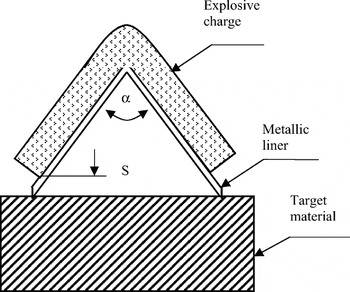
Explosive cutting of plates using shaped charges is one of the processes in mechanical engineering in which the physical interactions of the various parameters involved are rather complex (Salem & Al-Hassani, 1983; Cheezari, 1999). In fact, during the last few decades the use of explosives as a source of energy has found many applications in engineering. The main difference between explosives, magnetomotive forces, impact, and any other source of energy is that a very large amount of energy is made available to do work in a very short period of time. Explosives are now used in such diverse fields as welding, bulk cladding of plates, forming, sizing, powder compaction, hardening, and cutting. The use of explosives is due to their speed, but sometimes there may be no other way of achieving the same results, as in explosive welding of dissimilar metals. In cutting metals using a linear shaped charge, an explosive charge with a metallic liner is placed at a certain distance from the metal part. The cutting action is the consequence of the development of a high-speed jet of molten metal produced by the collapse of the liner. A linear shaped charge consists of a long metal liner backed with an explosive charge as shown in Figure 1.

A linear shape charge; S, standoff distance; α = apex angle.
In this paper, a hybrid GA and SVD is used for the optimal selection of Gaussian membership functions of the premise part and the linear parameters of the conclusion part, respectively, in an ANFIS network for the modeling of the explosive cutting process. In order to reduce the complexity of the rule base, the “bottom up” rule-based approach of Mannle (1999) is adopted to search for the best structure according to the training or validation error versus the number of rules. The obtained results demonstrate the superiority of such a learning method in comparison with the ANFIS hybrid learning method originally proposed in Jang (1993) and Jang et al. (1996). In this way it is shown that such a hybridization of GA and SVD in a cross-validation process can effectively design and tune an ANFIS network with a reduced number of fuzzy rules for the modeling of a complex process such as the high-energy rate explosive cutting process.
2. MECHANISM OF JET FORMATION
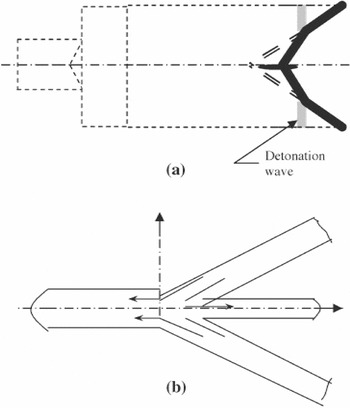
The mechanism of liner collapse is illustrated in Figure 2a. A detonation wave has traveled to the right and it is in the process of collapsing the liner, which is shown in the figure. This wave has produced pressures so great that the strength of the liner may be neglected and the material may be treated as a nonviscous fluid. When the walls collide, very high pressures are generated, which are well in excess of the dynamic yield strength of the liner material, thus causing the material in the collision zone to behave as a fluid. Behind the advancing collision point, a low velocity slug is formed from the outer layers of the liner whereas the inner layers form a high velocity reentrant jet traveling ahead of the collision point as shown in Figure 2b. By virtue of its very high energy, such a jet is capable of penetrating a thick metal target. The process of the penetration of a target material by a shaped-charge jet is much like that of a high speed jet of water from a fire hose nozzle penetrating a bank of soft mud.

(a) The mechanism of liner collapse and (b) the formation of jet and slug by a cone or wedge shaped liner.
It has been shown that, under certain conditions, the rate of penetration and depth of penetration into some target materials is independent of the strength of the target material because of the fact that the high velocity jets produce pressures at their point of impact on the order of 0.25 million atmospheres, which is far above the yield point of most materials. Hence, the strengths and viscosities of target materials can be neglected and the problem can be treated by hydrodynamics (Salem & Al-Hassani, 1983; Cheezari, 1999).
3. MODELING USING ANFIS
An ANFIS that consists of a set of TSK-type fuzzy IF–THEN rules can be used in modeling in order to map inputs to outputs. The formal definition of such an identification problem is to find a function

so that it can be approximately used instead of the actual one, f, in order to predict output

for a given input vector X = (x1, x2, x3, … , xn) as close as possible to its actual output y. Therefore, given m observations of multiple input single-output data pairs so that

it is now possible to build a look-up table to be used to train a fuzzy system to predict the output values

for any given input vector X = (xi1, xi2, xi3, … , xin), that is,

The problem is now to determine an ANFIS so that the difference between the actual output and the predicted one is minimized, that is,

In this way, a set of linguistic TSK-type fuzzy IF–THEN rules is designed to approximate f by

using m observations of n input single-output data pairs (Xi, yi) (i = 1, 2, … , m). The fuzzy rules embodied in such ANFIS models can be conveniently expressed using the following generic form:

in which ji ∈ {1, 2, … , r} and Wl = {w1l, w2l, … , wnl, w0l} is the parameter set of the consequent of each rule. The entire fuzzy sets in xi space are given as

These entire fuzzy sets assume a Gaussian shape defined on the domains [−αi, +βi] (i = 1, 2, … , n). In this way, the domains are appropriately selected so that all the fuzzy sets are complete; that is, for any xi ∈ [−αi, +βi] there exist A(j) in Eq. (5) such that the degree of membership function is nonzero, μA(j)(xi) ≠ 0. Each fuzzy set A(j) in which j ∈ {1, 2, … , r} is represented by Gaussian membership functions in the form

where cj, σj are adjustable centers and variances in antecedents, respectively. It is evident that the number of such parameters involved in the antecedents of ANFIS models can be readily calculated as nr, where n is the dimension of input vector and r is the number of fuzzy sets in each antecedent. The fuzzy rule expressed in Eq. (4) is a fuzzy relation in

in which A(i) are fuzzy sets in Ui, such that U = U1 × U2 × U3 × ··· × Un and Rule = A(j1) × A(j2) × A(j3) × ··· × A(jn) → y. It is evident that the input vector

. Using Mamdani algebraic product implication, the degree of such a local fuzzy IF–THEN rule can be evaluated in the form

where

In these equations μAl(ji)(xi) represent the degree of membership of input xi regarding their lth fuzzy rule's linguistic value, Al(ji). Using a singleton fuzzifier, product inference engine, and aggregating the individual contributions of rules leads to the fuzzy system in the form
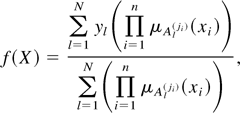
when a certain set containing N fuzzy rules in the form of Eq. (4) is available. Equation (9) can be alternatively represented in the following linear regression form:
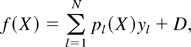
where D is the difference between f (X) and corresponding actual output, y, and

It is therefore evident that Eq. (10) can be readily expressed in matrix form for a given M input–output data pairs (Xi, yi) (i = 1, 2, … , m) in the form

where

. It should be noted that each (n + 1) components of vector wi corresponds to the conclusion part of a TSK-type fuzzy rule. Such a firing strength matrix P is obtained when input spaces are partitioned into a certain number of fuzzy sets. It is evident that the number of available training data pairs is usually larger than all the coefficients in the conclusion part of all TSK rules when the number of such rules is sufficiently small, that is, m ≥ S. This situation turns Eq. (12) into a least-squares estimation process in terms of unknowns, W = [w1, w2, … , ws]T, so that the difference D is minimized. The governing normal equations can be expressed in the form

Such modification of coefficients in the conclusion of TSK rules leads to better approximations of given data pairs in terms of the minimization of the difference vector D. However, such a direct solution of normal equations is rather susceptible to round-off error and, more importantly, to the singularity of these equations.
Therefore, in this work SVD is used as a powerful numerical technique to optimally determine the linear coefficients embodied in the conclusion part of the ANFIS model to deal with probable singularities in Eq. (12). However, a hybridization of a GA and SVD is proposed for the optimal design of an ANFIS to model the high energy rate explosive cutting process. Such a combination of GAs and SVD is described in Sections 4 and 5, respectively.
4. APPLICATION OF GA TO THE DESIGN OF ANFIS
The incorporation of a GA into the design of such ANFIS models starts by representing the N(n + 1) real-value parameters of {cj, σj} as a string of concatenated substrings of binary digits. Thus, each such substring represents the fuzzy partitioning of antecedents of fuzzy rules embodied in such ANFIS models in binary coded form. The fitness (Φ) of each entire string of binary digits that represents an ANFIS system to model the explosive cutting process is readily evaluated in the form

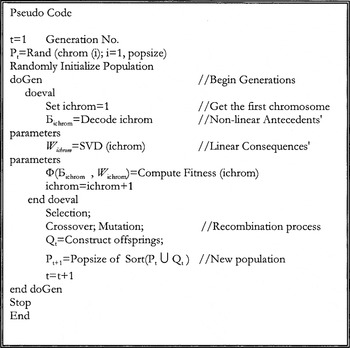
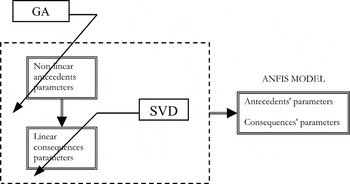
where E is the objective function given by Eq. (3) and it is minimized through an evolutionary process by maximization of the fitness, Φ. The evolutionary process starts by randomly generating an initial population of binary strings, each candidate solution representing the fuzzy partitioning of the premise part of rules. Then, using the standard genetic operations of roulette wheel selection, crossover, and mutation (Goldberg, 1989), entire populations of binary strings are caused to gradually improve. Simultaneously, the linear coefficients of the conclusion parts of TSK rules, corresponding to each chromosome representing the fuzzy partitioning of the premise parts, are optimally determined by using SVD. Therefore, ANFIS models of the explosive cutting process with progressively increasing fitness are produced with their premise and conclusion parts determined by GAs and SVD, respectively. In other words, each chromosome representing the fuzzy partitioning of antecedents is related to the corresponding linear coefficients of consequents obtained by the SVD method. Pseudocode for such a design process is given in Figure 3, which is also schematically represented in Figure 4. The following section describes a summary of the detailed application of SVD to optimally determine the linear coefficients in the linear equations.

The pseudocode of the hybrid GA/SVD design method.

A schematic diagram of the hybrid GA/SVD design method.
5. APPLICATION OF SVD TO THE DESIGN OF ANFIS
In addition to the genetic learning of antecedents of fuzzy sets involved in ANFIS networks, SVD is also deployed for the optimal design of consequents of such fuzzy systems. SVD is the method for solving most linear least-squares problems for which some singularities may exist in the normal equations. The SVD of a matrix,

, is a factorization of the matrix into the product of three matrices, a column-orthogonal matrix

, a diagonal matrix

with nonnegative elements (singular values), and an orthogonal matrix

, such that

The most popular technique for computing the SVD was originally proposed in Golub and Reinsch (1970). The problem of optimal selection of W in Eq. (12) is first reduced to finding the modified inversion of the diagonal matrix Q (Press et al., 1992), in which the reciprocals of zero or near zero singulars (according to a threshold) are set to zero. Then, such optimal W values are obtained using the following relation:

6. GENETIC/SVD BASED ANFIS MODELING OF EXPLOSIVE CUTTING PROCESS OF PLATES
The parameters of interest in this multiple input single-output system that affect the magnitude of the depth of penetration are the liner material, the explosive material, the liner shape, the apex angle, the liner thickness, the explosive weight and distribution, and the standoff distance. Among these parameters, the liner and explosive material together with the liner shape were kept fixed. The liner material, explosive material, and the liner shape were selected as copper/polymer, SX2, and a V shape, respectively. Accordingly, there were a total of 43 input–output experimental data considering four input parameters, namely, the apex angle, the standoff, the liner thickness, and the explosive weight, in four different groups. For the first group of data, the standoff distance was varied while the liner thickness, the apex angle defined as the perpendicular distance from the end of the charge to the target, and the weight of the charge were constant. In the second group of data, the standoff distance was varied while the apex angle, the liner thickness, and the weight of the charge were maintained. In the third group of data, the liner thickness was varied while the apex angle, the standoff, and the liner thickness were kept constant. It should be noted that this particular test was repeated for three different charge weights. Finally, in the fourth group of data, the charge weight together with the liner thickness was varied while the apex angle and the standoff were held constant.
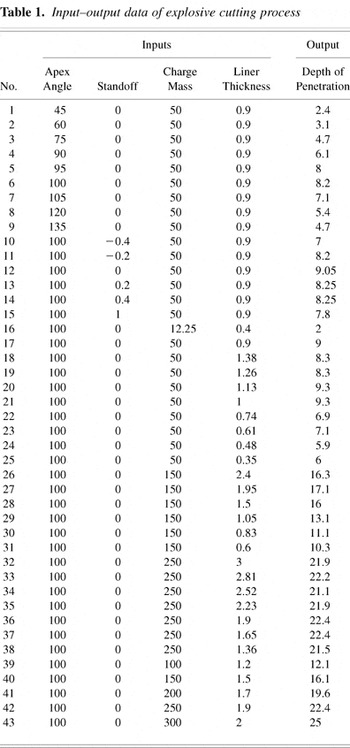
The output parameter in this work is the depth of penetration. Its 43 different experimentally obtained values and the four corresponding values of input parameters are given in Table 1. In the first set of data, the apex angle varied from 45° to 135° and the other parameters were fixed as a zero standoff, a 50-g explosive weight, and a 0.9-mm liner thickness. In the second set of data, the standoff varied from −0.4 to 1 (or, equivalently, a noneffective standoff from 4.3 to 14.5 mm) but the other parameters were fixed as a 100° apex angle, a 50-g explosive weight, and a 0.9-mm liner thickness. In the third set of data, the liner thickness varied whereas the other parameters were fixed (apex angle = 100°, standoff = 0) for three different explosive weights (50, 150, and 250 g). Finally, in the fourth set of data, the explosive weight and the liner thickness were varied simultaneously while the other parameters were fixed (apex angle = 100°, standoff = 0).
Input–output data of explosive cutting process

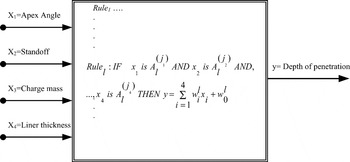
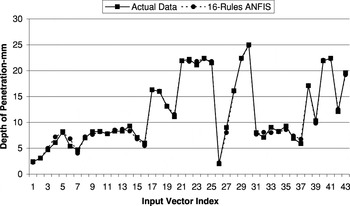
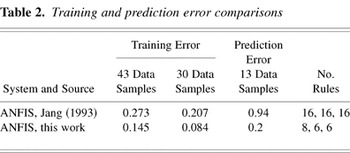
In order to model such a four-input single-output set of data as shown in Figure 5, an ANFIS with two linguistic terms in each antecedent, which is equivalent to two Gaussian membership functions for each input variable, was considered, that is, n = 4 and r = 2. It should be noted that the number of parameters in each vector of coefficients in the conclusion part of each TSK-type fuzzy rule is five, according to the assumed linear relationship of input variables in the consequents. Consequently, 24 = 16 TSK-type fuzzy rules were identified using the ANFIS given in the MATLAB fuzzy-logic toolbox. The good behavior of the derived ANFIS with 16 TSK-type fuzzy rules to model the data of the explosive cutting process of plates is shown in Figure 6. The corresponding mean square of errors (MSE) is calculated as 0.273.

A conceptual ANFIS model of the explosive cutting process.

The variation of penetration with input data samples (ANFIS with 16 rules).
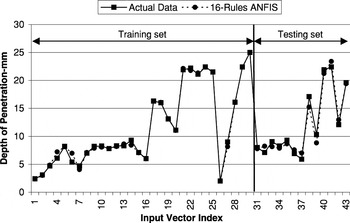
However, in order to demonstrate the prediction ability of such an ANFIS model, the data are divided into two different sets: training and testing. The training set, which consists of 30 out of 43 input–output data pairs, is used for training the ANFIS model. The testing set, which consists of 13 unforeseen input–output data samples during the training process, is merely used for testing to show the prediction ability of such an ANFIS model during the training process. Figure 7 demonstrates the training and prediction behavior of the ANFIS model obtained using the MATLAB fuzzy-logic toolbox.

The variation of penetration with input data samples (ANFIS with 16 rules).
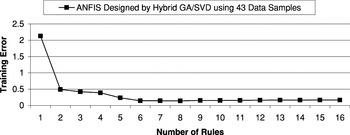
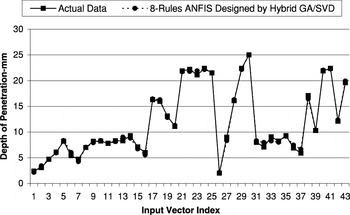
To demonstrate the effectiveness of the hybrid design method using a GA and SVD, which was developed in this work, the same procedure of training and/or predicting discussed above was applied for the modeling of a four-input single-output set of data of the explosive cutting process. The number of Gaussian membership functions for each input variable in the premise part of the rules was again considered as two. In this case, however, the number of TSK-type rules was determined in a cross-validation process using the hybrid GA/SVD design method developed here. In the cross-validation process different ANFIS systems in terms of a different number of fuzzy rules are compared with each other according to their performance, which might be either training the MSE or predicting the MSE. It should be noted that each of these ANFIS systems is designed using the same procedure, which is the so-called hybrid GA/SVD design method. During the evolutionary process, the population size, mutation probability, crossover probability, and generation number were selected as 20, 0.002, 0.6, and 80, respectively. It should be noted that 4 bits was chosen as the binary representation of each variable, which makes the length of a chromosome 64 bits with respect to 4 × 2 × 2 = 16 parameters. Figure 8 shows the performance of different hybrid, genetically obtained ANFIS network having a different number of rules in the cross-validation process. It is clearly evident from this figure that an ANFIS with only eight rules (considering the exact value of errors) is sufficient to effectively model the 43 pairs of the four-input single-output data set of the explosive cutting process with a corresponding MSE of 0.145, which is considerably smaller than the value obtained previously with a larger number of rules. The very good behavior of the ANFIS network designed by a hybrid GA/SVD method with eight TSK-type fuzzy rules to model the data of the explosive cutting process of plates is shown in Figure 9.

The training errors of the GA/SVD designed ANFIS with a different number of rules.

The variation of penetration with input data samples (GA/SVD ANFIS with eight rules).
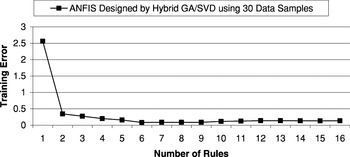
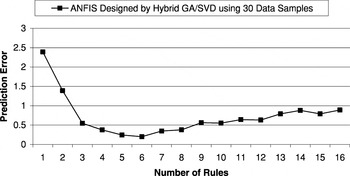
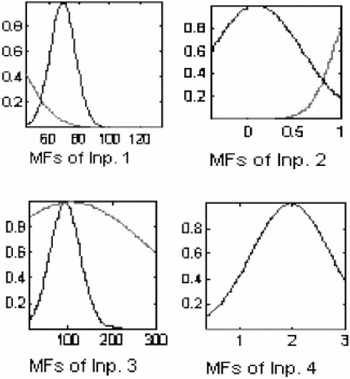
Similarly, in order to demonstrate the prediction ability of the GA/SVD designed ANFIS model, the procedure of training and testing has been performed in a cross-validation process on the data sets consisting of 30 and 13 data samples, respectively. In this way, Figures 10 and 11 show training and prediction errors, respectively, versus the number of rules embodied in such a GA/SVD designed ANFIS. In these cases, the measure of performance in the cross-validation process is accomplished on the 30- and 13-data training sets, respectively. Consequently, it is very evident from these figures that the phenomenon of overfitting can be readily prohibited when the number of rules in such a GA/SVD designed ANFIS is kept to six. Figure 12 shows the Gaussian membership functions of input variables for which the obtained set of TSK-type fuzzy rules for the modeling of the explosive cutting process of plates are as follows:
Rule 1: If apex_angle is A1 and standoff is A3 and charge_mass is A5 and liner_thickness is A7 Then Penetration=−0.1247*apex_angle−0.9346*standoff+0.0899*
charge_mass+4.922*liner_thickness+14.7462
Rule 2: If apex_angle is A2 and standoff is A4 and charge_mass is A6 and liner_thickness is A8 Then penetration=0.0111*apex_angle+0.0159*standoff+0.0182*
charge_mass+0.6772*liner_thickness+0.0673
Rule 3: If apex_angle is A1 and standoff is A3 and charge_mass is A6 and liner_thickness is A8 Then penetration=0.0269*apex_angle−0.0137*standoff + 0.0687*
charge_mass+2.1674*liner_thickness+0.2157
Rule 4: If apex_angle is A2 and standoff is A4 and charge_mass is A5 and liner_thickness is A7 Then penetration=0.1477* apex_angle +1.0904*standoff−0.1978*
charge_mass+1.534*liner_thickness+4.6035
Rule 5: If apex_angle is A1 and standoff is A4 and charge_mass is A6 and liner_thickness is A7 Then penetration=−0.1474*apex_angle+1.5555*standoff− 0.0724*charge_mass+8.8549*liner_thickness+6.5728
Rule 6: If apex_angle is A2 and standoff is A3 and charge_mass is A5 and liner_thickness is A8 Then penetration=−1.7623*apex_angle−0.0096*standoff+1.8222*charge_mass−0.7871*liner_thickness+0.1332

The training errors of the GA/SVD designed ANFIS with a different number of rules (30 data samples).

The prediction errors of the GA/SVD designed ANFIS with a different number of rules (13 data samples).

The genetically evolved Gaussian membership functions of the input variables (GA/SVD designed ANFIS with six rules).
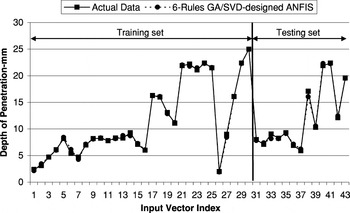
The very good behavior of the ANFIS network designed by the hybrid GA/SVD with six TSK-type fuzzy rules to model the data of the explosive cutting process of plates is depicted in Figure 13. The comparisons of the training and prediction errors of both ANFIS networks with different numbers of rules are summarized in Table 2. The superiority of the hybrid GA/SVD design approach presented in this paper is clearly evident from these results.

The variation of penetration with input data samples (GA/SVD designed ANFIS with six rules).
Training and prediction error comparisons

7. CONCLUSION
Hybrid GA/SVD designed ANFIS networks have been successfully used for the modeling of the very complex process of the explosive cutting process of plates. In this way, it has been shown that an ANFIS provides effective means to model and predict the depth of penetration according to different inputs. This has been achieved by dividing the whole data set into two different sets, namely, training and testing sets. The training set has been used for learning the parameters of the ANFIS models whereas the testing set has been merely used to demonstrate the prediction ability of the optimally designed ANFIS networks. Finally, it has been demonstrated that the methodology of hybrid GA/SVD in the design of the ANFIS presented in this work is remarkably effective in terms of both training and/or prediction errors and the number of rules.
References
REFERENCES
Astrom, K.J. &
Eykhoff, P.
(1971).
System identification, a survey.
Automatica,
7,
123–162.CrossRefGoogle Scholar
Cheezari, M.
(1999).
Explosive separation using shaped charges.
MS Dissertation.
Guilan University.
Cordon, O.,
Herrera, F.,
Hoffmann, F., &
Magdalena, L.
(2001). In
Genetic Fuzzy Systems: Evolutionary Tuning and Learning of Fuzzy
knowledge Bases.
Advances in Fuzzy Systems.
Riveredge, NJ:
World Scientific.CrossRef
Darvizeh, A.,
Nariman–Zadeh, N., &
Gharababei, H.
(2001).
GMDH-type neural network modelling of explosive cutting process of
plates using singular value decomposition.
Proc. ESM'2001.
Delgado, M.R.,
Von Zuben, & F.,
Gomide F.
(2001).
Hierarchical genetic fuzzy systems.
Information Sciences,
136,
29–52.CrossRefGoogle Scholar
Goldberg, D.E.
(1989).
Genetic Algorithms in Search, Optimization, and Machine Learning.
New York:
Addison–Wesley.
Golub, G.H. &
Reinsch, C.
(1970).
Singular value decomposition and least squares solutions.
Numerical Mathematics,
14(5),
403–420.CrossRefGoogle Scholar
Hoffmann, F. &
Nelles, O.
(2001).
Genetic programming for model selection of TSK-fuzzy systems.
Information Sciences,
136,
7–28.CrossRefGoogle Scholar
Iba, H.,
Kuita, T.,
deGaris, H., &
Sator, T.
(1993).
System identification using structured genetic algorithms.
Proc. Fifth Int. Conf. Genetic Algorithms, ICGA'93.
Jang, J.-S.R.,
Sun, C.-T., &
Mizutani, E.
(1997).
Neuro-Fuzzy and Soft Computing: A Computation Approach to Learning
and Machine Intelligence.
Englewood Cliffs, NJ:
Prentice Hall.
Jang, J.-S.R. &
Mizutani, E.
(1996).
Levenberg–Marquardt method for ANFIS learning.
Proc. Int. Joint Conf. North American Fuzzy Information Processing
Society, Biannual Conf.
Jang, J.-S. R.
(1993).
ANFIS: adaptive-network-based fuzzy inference system.
IEEE Transactions on Systems, Man, and Cybernetics,
23,
665–685.CrossRefGoogle Scholar
Kosko, B.
(1994).
Fuzzy systems as universal approximator.
IEEE Transactions on Computers,
43(11),
1324–1333.CrossRefGoogle Scholar
Koza, J.
(1992).
Genetic Programming, on the Programming of Computers by Means of
Natural Selection.
Cambridge, MA:
MIT Press.
Kristinson, K. &
Dumont, G.
(1992).
System identification and control using genetic algorithms.
IEEE Transactions on Systems, Man, and Cybernetics,
22(5),
1033–1046.Google Scholar
Lee, C.C.
(1990).
Fuzzy logic in control systems: fuzzy logic controller.
IEEE Transactions on Systems, Man, and Cybernetics,
20(2),
404–434.CrossRefGoogle Scholar
Mannle, M.
(2001).
FTSM-Fast Takagi–Sugeno Fuzzy Modelling.
Karlsruhe, Germany:
Institute for Computer Design and Fault Tolerance, University of
Karlsruhe, Germany.
Mannle, M.
(1999).
Identifying rule-based TSK fuzzy models.
Proc. Seventh Eur. Congr. Intelligent Techniques Soft Computing,
EUFIT'99.
Nariman–Zadeh, N. &
Darvizeh, A.
(2001).
Design of fuzzy systems for the modelling of explosive cutting process
of plates using singular value decomposition.
Proc. WSES 2001 Conf. Fuzzy Sets Fuzzy Systems,
FSFS'01.
Nariman–Zadeh, N.,
Darvizeh, A., &
Oliaei, F.
(2002).
Genetic algorithm and singular value decomposition in the design
of fuzzy systems for the modelling of explosive cutting process.
Proc. WSES Conf. Fuzzy Sets Fuzzy Systems, FSFS '02.
Nemes, A. &
Lantos, B.
(1999).
Genetic algorithm based optimization of fuzzy logic systems for
dynamic modelling of robots.
Periodica Polytechnica Electrical Engineering,
43(33),
177–187.Google Scholar
Porter, B. &
Nariman–Zadeh, N.
(1994).
Genetic design of computed-torque controllers for robotic
manipulators.
Proc. IASTED Int. Conf. Systems Controllers.
Porter, B. &
Nariman–Zadeh, N.
(1995).
Genetic design of computed-torque/fuzzy-logic controllers for
robotic manipulators.
Proc. IEEE Int. Symp. Intelligent Control.
Porter, B. &
Nariman–Zadeh, N.
(1997).
Evolutionary design of fuzzy-logic controllers for manufacturing
systems.
Annals of the CIRP,
46(1).Google Scholar
Press, W.H.,
Teukolsky, S.A.,
Vetterling, W.T., &
Flannery, B.P.
(1992).
Numerical Recipes in FORTRAN: The Art of Scientific Computing,
2nd ed.,
New York:
Cambridge University Press.
Rizzi, A.,
Mascioli, F.M.F., &
Martinelli, G.
(1999).
Automatic training of ANFIS networks.
Proc. IEEE Int. Fuzzy Systems Conf.CrossRef
Salem, S.A. &
Al-Hassani, S.T.S.
(1983).
Penetration by high speed oblique jets: theory and experiments.
International Journal of Mechanical Science,
25(12).CrossRefGoogle Scholar
Sanchez, E.,
Shibata, T., &
Zadeh, L.A.
(1997).
Genetic Algorithms and Fuzzy Logic Systems.
Riveredge, NJ:
World Scientific.CrossRef
Setnes, M. &
Roubos, J.A.
(1999).
Transparent fuzzy modeling using fuzzy clustering and GA's.
Proc. NAFIPS, pp.
198–202.
Sugeno, M. &
Kang, G.T.
(1988).
Structure identification of fuzzy model.
Fuzzy Sets and Systems,
28,
15–33.CrossRefGoogle Scholar
Takagi, T. &
Sugeno, M.
(1985).
Fuzzy identification of systems and its applications to modelling
and control.
IEEE Transactions on Systems, Man, and Cybernetics,
15,
116–132.CrossRefGoogle Scholar
Wang, L. &
Yen, J.
(1999).
Extracting fuzzy rules for system modeling using a hybrid of
genetic algorithms and Kalman filter.
Fuzzy Sets and Systems,
101,
353–362.CrossRefGoogle Scholar
Wang, L.,
Langari, R., &
Yen, J.
(1999).
Identifying fuzzy rule-based models using orthogonal
transformation and backpropagation. In
Fuzzy Theory Systems: Techniques and Application
(Leondes, C.T., Ed.),
Vol. 1.
New York:
Academic Press.
Wang, L.X.
(1992).
Fuzzy systems are universal approximators.
Proc. IEEE Int. Conf. Fuzzy Systems, pp.
1163–1170.CrossRef
Zeng, X.J. &
Singh, M.G.
(1994).
Approximation theory for fuzzy systems—SISO case.
IEEE Transactions on Fuzzy Systems,
20(2),
162–176.CrossRefGoogle Scholar
A linear shape charge; S, standoff distance; α = apex angle.
(a) The mechanism of liner collapse and (b) the formation of jet and slug by a cone or wedge shaped liner.
The pseudocode of the hybrid GA/SVD design method.
A schematic diagram of the hybrid GA/SVD design method.
Input–output data of explosive cutting process
A conceptual ANFIS model of the explosive cutting process.
The variation of penetration with input data samples (ANFIS with 16 rules).
The variation of penetration with input data samples (ANFIS with 16 rules).
The training errors of the GA/SVD designed ANFIS with a different number of rules.
The variation of penetration with input data samples (GA/SVD ANFIS with eight rules).
The training errors of the GA/SVD designed ANFIS with a different number of rules (30 data samples).
The prediction errors of the GA/SVD designed ANFIS with a different number of rules (13 data samples).
The genetically evolved Gaussian membership functions of the input variables (GA/SVD designed ANFIS with six rules).
The variation of penetration with input data samples (GA/SVD designed ANFIS with six rules).
Training and prediction error comparisons
 You have
Access
- 6
- Cited by