INTRODUCTION
Prospective memory (PM) refers to memory for delayed intentions, commonly referred to as “remembering to remember.” In contrast to retrospective episodic memory (RM) wherein we remember information from past events such as a list of words or details of a conversation, PM refers to a type of episodic memory requiring that we remember an event to occur in the future (Einstein et al., Reference Einstein, McDaniel, Thomas, Mayfield, Shank, Morrisette and Breneiser2005). Additionally, rather than relying on an external command to trigger recall (e.g., being explicitly asked a question) as in traditional RM tasks, PM involves remembering to complete a specified intention when an external event (e.g., cue) occurs (McDaniel & Einstein, Reference McDaniel and Einstein2000). For example, a common PM task for persons with TBI is remembering to take medication with dinner. Research has demonstrated that individuals with TBI show deficits in PM on both objective assessments (Groot, Wilson, Evans, & Watson, Reference Groot, Wilson, Evans and Watson2002; Shum, Levin, & Chan, Reference Shum, Levin and Chan2011) and self-report questionnaires (Roche, Fleming, & Shum, Reference Roche, Fleming and Shum2002) of PM. In fact, deficits in PM are the most frequently reported memory problem in persons with TBI (Mateer, Sohlberg & Crinean, Reference Mateer, Sohlberg and Crinean1987) significantly contributing to difficulties performing activities of daily living (Fortin, Godbout, & Braun, Reference Fortin, Godbout and Braun2003).
PM has been shown to rely on numerous cognitive skills for effective execution. Both executive functioning (Delprado et al., Reference Delprado, Kinsella, Ong, Pike, Ames, Storey and Rand2012; Martin, Kliegel, & McDaniel, Reference Martin, Kliegel and McDaniel2003; McDaniel, Glisky, Guynn, & Routhieaux, Reference McDaniel, Glisky, Guynn and Routhieaux1999; Schnitzspahn, Stahl, Zeintl, Kaller, & Kliegl, 2012) and RM (Burgess & Shallice, Reference Burgess and Shallice1997; Delprado et al., Reference Delprado, Kinsella, Ong, Pike, Ames, Storey and Rand2012; McDaniel et al, Reference McDaniel, Glisky, Guynn and Routhieaux1999) have been demonstrated to significantly contribute to PM performance. Researchers have investigated the relationship between neuropsychological abilities and PM by examining multiple phases of the PM process as outlined in Kliegel’s model. This model includes four phases: (1) intention formation, (2) intention retention, (3) intention initiation, and (4) intention execution (Kliegel, Martin, McDaniel, & Einstein, Reference Kliegel, Martin, McDaniel and Einstein2002). While intention retention has been proposed to depend upon RM abilities, the intention formation, intention initiation, and intention execution phases have been shown to relate significantly to performance on tests of executive functioning (Kliegel, Altgassen, Hering, & Rose, Reference Kliegel, Altgassen, Hering and Rose2011). Deficits in executive functioning (Draper & Ponsford, Reference Draper and Ponsford2008; Mathias & Wheaton, Reference Mathias and Wheaton2007; Rios, Perianez, & Munoz-Cespedes, Reference Rios, Perianez and Munoz-Cespedes2004), RM (Arenth, Russell, Scanlon, Kessler, & Ricker, Reference Arenth, Russell, Scanlon, Kessler and Ricker2012; DeLuca, Schultheis, Madigan, Christodoulou, & Averill, Reference DeLuca, Schultheis, Madigan, Christodoulou and Averill2000; Wright, Schmitter-Edgecombe, & Woo, Reference Wright, Schmitter-Edgecombe and Woo2010), and PM (Shum et al., Reference Shum, Levin and Chan2011) are all common following TBI.
Studies have sought to understand the relationship between PM functioning and neuropsychological abilities following TBI, with inconsistent results. While some studies have failed to detect a significant relationship between PM and neuropsychological performance in persons with TBI (Mathias & Mansfield, Reference Mathias and Mansfield2005; Pavawalla, Schmitter-Edgecombe, & Smith, Reference Pavawalla, Schmitter-Edgecombe and Smith2012), others have demonstrated a significant relationship between the two. Specifically, intact executive functioning has been found to be associated with better PM performance (Clune-Ryberg et al., Reference Clune-Ryberg, Blanco-Campal, Carton, Pender, O’Brien, Phillips and Burke2011; Fleming et al., Reference Fleming, Riley, Gill, Gullo, Strong and Shum2008; Groot et al., Reference Groot, Wilson, Evans and Watson2002; Knight, Harnett, & Titov, Reference Knight, Harnett and Titov2005; Maujean, Shum, & McQueen, Reference Maujean, Shum and McQueen2003; Potvin, Rouleau, Audy, Charbonneau, & Giguere, 2011; Raskin, Buckheit, & Waxman, Reference Raskin, Buckheit and Waxman2012; Schmitter-Edgecombe & Wright, Reference Schmitter-Edgecombe and Wright2004).
In studies of PM in TBI, researchers have investigated separable prospective and retrospective components to gain insight regarding the different neuropsychological abilities involved in PM. Specifically, the prospective component of PM (ProPM) involves spontaneous activation of the intention to complete the specified task at the correct time and is consistent with the intention initiation phase of Kliegel’s model (Kliegel et al., Reference Kliegel, Altgassen, Hering and Rose2011). Hence, it is this prospective component that makes PM distinct from RM in that one must remember to remember in a PM task instead of relying on an external command (e.g., being explicitly asked a question or quizzed) to remember the information on RM tasks (Einstein & McDaniel Reference Einstein and McDaniel1996). In contrast, the retrospective component of PM (RetPM) involves remembering the specific action to be performed (Einstein & McDaniel, Reference Einstein and McDaniel1990; Smith & Bayen, Reference Smith and Bayen2004), which is consistent with the intention formation and intention execution phases of Kliegel’s model (Kliegel et al., Reference Kliegel, Altgassen, Hering and Rose2011). When compared with healthy individuals, TBI participants with impaired executive functioning, but intact memory have demonstrated impairment when ProPM was assessed, but not RetPM (Kliegel, Eschen, & Thöne-Otto, 2004). Likewise, RetPM, but not ProPM, has been found to be significantly correlated with neuropsychological tests of RM in TBI participants (Carlesimo, Casadio, & Caltagirone, Reference Carlesimo, Casadio and Caltagirone2004). Thus, studies suggest that the relationship between executive functioning and PM depends on the specific phase of PM that is assessed.
Additionally, executive functioning encompasses multiple component cognitive processes that facilitate goal-directed behavior (Banich, Reference Banich2009; Miyake & Friedman, Reference Miyake and Friedman2012). Despite evidence of a positive association between executive functioning abilities and PM performance post-TBI, the specific facets of executive functioning that are most critical for accurate PM performance post-TBI have not yet been identified. Our incomplete understanding of the relationship between executive functioning and PM post-TBI may be due to limitations of the methods used to assess executive functioning in previous studies. Specifically, executive functioning has been quantified as the total level of achievement on neuropsychological tests of executive functioning in previous studies of PM. Given that neuropsychological tests are multifactorial (Stuss & Alexander, Reference Stuss and Alexander2000), total achievement scores do not provide detailed information about the specific executive processes that are impaired. Thus, the relationship between specific aspects of executive functioning and PM has yet to be examined in TBI.
In previous studies, executive functioning has been shown to be especially important for the spontaneous detection and interpretation of the cue involved in PM (ProPM). Therefore, we hypothesized that specific aspects of executive functioning such as the ability to simultaneously monitor one’s behavior and one’s environment would be important for PM, and particularly for ProPM, following TBI. One such aspect of executive functioning is rule monitoring. “Rule monitoring” refers to the ability to self-monitor performance and is measured as the number of errors committed on a given executive functioning task (Carey et al., Reference Carey, Woods, Damon, Halibi, Dean, Delis and Kramer2008; Cattie et al., Reference Cattie, Doyle, Weber, Grant and Woods2012; Possin et al., Reference Possin, Brambati, Rosen, Johnson, Pa, Weiner and Kramer2009). For example, on the Trail Making Test wherein participants are instructed to alternate between sequencing letters and numbers, the commission of errors could indicate a failure to maintain the goal of the task, monitor one’s performance, or monitor attention to stimuli. Assessment of rule monitoring provides information about performance that is not available when only examining total achievement scores that reflect total time taken to complete a task or total correct responses on an executive functioning measure. Despite equivalent total achievement scores, participants may differ significantly in the process by which they achieve these scores, such that one participant produces errors whereas another participant is slow in sequencing numbers and letters. Assessment of rule monitoring has been shown to effectively characterize executive functioning deficits in neurological populations (Carey et al., Reference Carey, Woods, Damon, Halibi, Dean, Delis and Kramer2008; Cattie et al., Reference Cattie, Doyle, Weber, Grant and Woods2012; Possin et al., Reference Possin, Brambati, Rosen, Johnson, Pa, Weiner and Kramer2009). The ability to self-monitor performance and avoid commission errors is a dissociable component of executive functioning (Garavan, Ross, Murphy, Roche, & Stein, Reference Garavan, Ross, Murphy, Roche and Stein2002), which has been demonstrated to be impaired post-TBI on experimental cognitive tests (O’Keefe, Dockree, & Robertson, 2004) and everyday activities (Hart, Giovannetti, Montgomery, & Schwartz, Reference Hart, Giovannetti, Montgomery and Schwartz1998). However, rule monitoring has not been investigated in relation to PM performance post-TBI. Thus, greater insight regarding the specific aspects of executive functioning required for effective PM may be obtained by an assessment of rule monitoring.
PM performance has also been found to be significantly correlated with performance on neuropsychological tests of RM in individuals with TBI (Clune-Ryberg et al., Reference Clune-Ryberg, Blanco-Campal, Carton, Pender, O’Brien, Phillips and Burke2011; Groot et al., Reference Groot, Wilson, Evans and Watson2002; Knight et al., Reference Knight, Harnett and Titov2005; Potvin et al., Reference Potvin, Rouleau, Audy, Carbonneau and Giguere2011; Schmitter-Edgecombe & Wright, Reference Schmitter-Edgecombe and Wright2004). While some studies suggest that one cannot demonstrate intact PM in the presence of impaired RM (Burgess & Shallice, Reference Burgess and Shallice1997), recent data demonstrates independence between RM and PM post-TBI. Mioni and colleagues noted that individuals with TBI do not show greater deficits on PM tasks when RM demands increase (Mioni, Rendell, Henry, Cantagallo, & Stablum, Reference Mioni, Rendell, Henry, Cantagallo and Stablum2013). Similarly, Carlesimo and colleagues (2004) demonstrated that among TBI participants with impaired RM, some show intact PM and others impaired PM. The same is true for those with intact RM (Carlesimo et al., Reference Carlesimo, Casadio and Caltagirone2004). Taken together, these findings suggest that intact RM is not necessary for successful PM performance in persons with TBI. However, the relative independence of PM and RM abilities leads one to question the cognitive processes that contribute to PM when RM is impaired post-TBI. It has been hypothesized that, when RM is impaired, individuals with TBI may rely on executive functioning processes to successfully complete a PM task (Carlesimo et al., Reference Carlesimo, Casadio and Caltagirone2004). This hypothesis is supported by a recent study demonstrating that PM is significantly correlated with executive functioning performance, but not RM (Raskin et al., Reference Raskin, Buckheit and Waxman2012). We hypothesize that, when RM is impaired, individuals with TBI may rely on a specific aspect of executive functioning, rule monitoring, to actively maintaining the PM intention instead of relying on RM abilities to retrieve the PM intention from long-term memory. Yet the relative influence of RM abilities and executive abilities on PM performance remains unexplored.
To address this void in the literature, we first examined the relationship between PM and neuropsychological abilities on two specific aspects of executive functioning: (a) total achievement on neuropsychological tests of executive functioning, and (b) ability to avoid committing errors on tests of executive functioning (rule monitoring). We hypothesized that individuals with TBI with intact rule monitoring abilities would demonstrate better PM performance. Given that RM performance does not always correlate with impaired PM performance in individuals with TBI, a third variable is likely involved. We hypothesized that PM performance in individuals with impaired RM may depend on executive functioning, more specifically rule monitoring abilities. We thus hypothesized a stronger relationship between rule monitoring and PM performance in individuals with impaired RM than those with intact RM. This is the first study to our knowledge to investigate the contribution of rule monitoring to PM performance in individuals with TBI.
METHODS
Participants
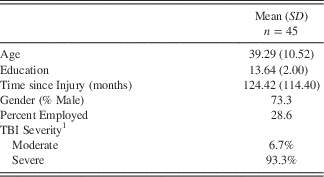
Participants consisted of 45 individuals with moderate or severe TBI with a mean age of 39.29 (SD=10.52) and a mean education of 13.64 (SD=2.00). TBI participants were at least 1 year post-injury and free of a history of alcohol or drug abuse, major psychiatric disturbance, and neurological disease other than TBI. Potential participants were screened for a history of significant psychiatric diagnoses with a structured interview, the Diagnostic Interview Schedule (Robins, Helzer, Croughan, & Ratcliff, Reference Robins, Helzer, Croughan and Ratcliff1981). Demographic information and disease characteristics are presented in Table 1.
Demographic information for all participants

1 As determined by TBI Model Systems Criteria (lowest Glasgow Coma Scale (GCS) in the first 24 hours following injury falling below 13).
Materials
Prospective memory measures from Rivermead Behavioral Memory Test
Prospective Memory (PM) was assessed with three subtests from the Rivermead Behavioral Memory Test (RBMT; Wilson, Cockburn, & Baddeley, Reference Wilson, Cockburn and Baddeley1985) administered according to standard instructions.
-
1. Belonging: At the beginning of the RBMT, the examiner asked the participant for a belonging (e.g., pen, car keys) and indicated that it would be hidden in a specific place. The participant was instructed to ask the examiner for the belonging and indicate where it had been hidden at the end of the test, when the examiner said “We have finished this test.” Performance is scored as ability to recall the place and item, with a maximum score of 4.
-
2. Appointment: Also, at the beginning of the RBMT, the examiner sets an alarm for 20 minutes and instructs the participant to ask, “When will this session end?” when the alarm sounds. Performance is scored as ability to ask pre-specified question, with a maximum score of 2.
-
3. Message: In conjunction with a route learning task, the examiner picks up an envelope with the word “message” written on the front. The examiner demonstrates a specific route around the room with five pre-specified stops and sets the envelope in a pre-specified final location. The examiner then returns the envelope to its original location. The participant is then instructed to complete the same route. After a 15-min delay, the participant is again asked to repeat the same route, Consistent with a previous study of PM in TBI (Mathias & Mansfield, Reference Mathias and Mansfield2005), PM performance was scored as the ability to pick up the message and deliver it to the correct location following a 15-min delay, with a maximum score of 3.
For all correlational and regression analyses conducted, we calculated the total correct across all three PM tasks with a maximum score of 9, referred to as the PM Total score.
Separable prospective and retrospective PM scores were calculated according to the following criteria: (1) The prospective PM composite (ProPM) score represents points earned for spontaneously indicating that a task needed to be completed at the accurate time during the evaluation without a prompt (e.g., at the end of the session, when an alarm sounds), regardless of whether the action to be taken was accurately completed. ProPM scores were calculated as proportion correct out of the four possible prospective points. (2) A retrospective PM composite (RetPM) score represents the participant’s ability to accurately remember and complete the intended action at the correct time, regardless of whether they were awarded prospective points for spontaneously indicating the intention without a prompt. RetPM scores were calculated as the total retrospective points earned out of the five possible retrospective points. The ProPM and RetPM scores were, therefore, independent of one another.
Neuropsychological evaluation
Standard tests of RM administered included the California Verbal Learning Test – Second Edition (CVLT-II; Delis, Kramer, Kaplan, & Ober, Reference Delis, Kramer, Kaplan and Ober2000), the Open Trial Selective Reminding Test (Chiaravalloti, Blazano, Moore, & DeLuca, 2009), and Prose Memory from the Memory Assessment Scales (Williams, Reference Williams1991). Executive functioning was assessed with the Trail Making, Color-Word Interference, Tower, and Verbal Fluency subtests from the Delis-Kaplan Executive Function System (D-KEFS; Delis, Kaplan, & Kramer, Reference Delis, Kaplan and Kramer2001). The Symbol Digit Modalities Test (Smith, Reference Smith1982) and Letter and Pattern Comparison Tests (Salthouse & Babcock, Reference Salthouse and Babcock1991) were administered to assess processing speed. Working memory was assessed with the Digit Span subtest from the Wechsler Adult Intelligence Scale – Third Edition (WAIS-III; Wechsler, Reference Wechsler1997b) and Letter Number Sequencing subtest from the Wechsler Memory Scale – Third Edition (WMS-III; Wechsler, Reference Wechsler1997a).
Procedure
Data was collected as part of the baseline evaluation of a large-scale clinical trial testing the efficacy of a memory intervention in TBI. Participants were recruited through mailings, advertisements at local support groups and referrals from area physicians. Participants from previous studies who had consented to be contacted for future research were also invited to participate.
Before enrollment, all potential participants underwent a 2-part screening: an initial telephone screen for age, severity of TBI, neurological history, and current medications was conducted via telephone. Potential participants who passed the initial screening then completed a detailed, in-person screening which evaluated psychiatric and substance abuse history, visual acuity, language comprehension and new learning and memory abilities. Participants signed an IRB-approved consent form before the detailed screening. If the individual qualified for study participation, he/she then completed a neuropsychological battery lasting approximately 2 to 3 hours. All participants received compensation for participation.
Data Analyses
Neuropsychological composite scores
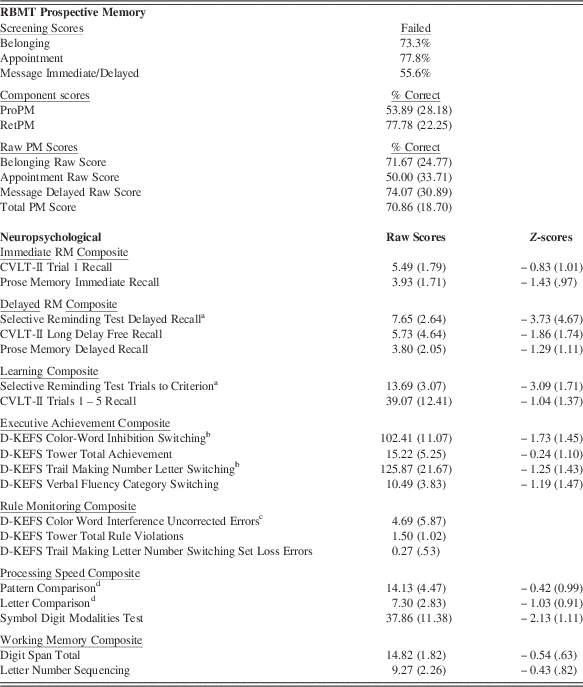
Composite measures for each neuropsychological domain (i.e., Processing Speed, Working Memory, Immediate RM, Delayed RM, Executive Achievement, Rule monitoring) were calculated from averaged z-transformed raw scores on neuropsychological tests. Table 2 shows scores included in each composite. Scores were inverse scored as necessary such that higher scores were consistently associated with better performance for all composite scores. Derivation of the two executive composites are described in detail below
Performance on RBMT prospective memory measures and neuropsychological tests

RBMT: Rivermead Behavioral Memory Test.
a Z-scores for Selective Reminding Test performance derived from normative data provided (Chiaravalloti et al., Reference Chiaravalloti, Balzano, Moore and DeLuca2009).
b Residual scores used to parse executive from speed, but z-scores reported here are not residual scores.
c D-KEFS Color Word Interference Uncorrected Errors for Inhibition and Inhibition/Switching subtests.
d Z-scores for Letter and Pattern Comparison Tests derived based on data from published study (Salthouse, Reference Salthouse1994).
• The Executive Achievement Composite represents performance on tests of executive functioning that are typically used when examining the relationship between PM and executive functioning (D-KEFS Color-Word Interference Switching, D-KEFS Trail Making Number Letter Switching, D-KEFS Verbal Fluency Category Switching, D-KEFS Tower Total Achievement). A processing speed correction was completed for measures with a speeded component (i.e., D-KEFS Color-Word Interference Switching, D-KEFS Trail Making Number Letter Switching) to examine executive abilities with variance associated with speeded processing removed. This correction involved subtraction of unstandardized residual scores (determined by regressing the higher order score on the lower order score) for each participant from the sample mean (Denney & Lynch, Reference Denney and Lynch2009). Specifically, when deriving residuals with D-KEFS tests, we used Number Sequencing as the lower order speed component for Trail Making Number Letter Switching. We similarly used Color Naming as the lower-order speed component for Color-Word Inhibition Switching. After correcting for processing speed, higher scores indicated better performance.
The Rule Monitoring Composite represents the ability to monitor performance and avoid making errors. This is not traditionally used as a measure of executive functioning, but rather has been used in previous studies of rule violation and monitoring (Carey et al., Reference Carey, Woods, Damon, Halibi, Dean, Delis and Kramer2008; Cattie et al., Reference Cattie, Doyle, Weber, Grant and Woods2012; Possin et al., Reference Possin, Brambati, Rosen, Johnson, Pa, Weiner and Kramer2009). To determine the error scores from executive functioning tests that would form a reliable rule monitoring composite score, we conducted an exploratory principal components analyses (PCA) with varimax rotation including errors scores from the four executive functioning tests included in the executive achievement composite index. The PCA revealed two factors: (1) errors from three subtests: D-KEFS Tower, D-KEFS Color Word Interference, and D-KEFS Trail Making Test, and (2) errors from one subtest: D-KEFS Verbal Fluency. We completed another PCA without the D-KEFS Verbal Fluency measure and found that the remaining three subtests loaded on one factor. Given evidence that D-KEFS Verbal Fluency does not adequately share variance with the other error measures, error scores from only the D-KEFS Tower, D-KEFS Color Word Interference, and D-KEFS Trail Making Test formed the rule monitoring composite. The scores composing the rule monitoring composite were not normally distributed and a square root transformation was thus applied to reduce bias.
Correlations were conducted to identify the neuropsychological composite scores that are significantly related to PM performance post-TBI. Stepwise regression analysis was then used to compare the strength of the neuropsychological composite scores in predicting PM performance. Finally, we examined the relationship between rule monitoring and PM performance as a function of RM abilities through an additional regression analysis.
RESULTS
Cognitive Test Performance
On the RBMT, 77.8% of TBI participants scored in the impaired range on the Appointment task, 73.3% of participants scored in the impaired range on the Belonging tasks, and 55.6% of participants performed in the impaired range on the Message task (Table 2). The TBI sample thus demonstrated impaired PM performance. When performance on separable components of PM was examined, TBI participants demonstrated better RetPM compared with the ProPM performance.
Significant variability was noted on standard neuropsychological tests, with TBI participants ranging in performance from average to severely impaired (Table 2). Such variability is consistent with reports in the TBI literature.
Correlational Analysis
The PM Total score was significantly correlated with educational attainment (r=.32, p<.05). No other significant relationships were noted between PM Total score and demographic or disease-related factors including age, severity of injury, gender, employment, and months since injury. Education and TBI severity were included as covariates in all subsequent analyses.
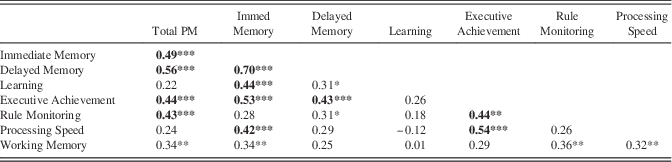
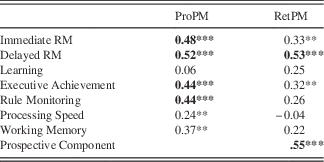
Partial correlations were conducted between neuropsychological composites and PM performance, covarying for education and TBI severity. After applying the Bonferroni correction for multiple comparisons, a significant positive correlation was found between PM Total scores and immediate RM, delayed RM, executive achievement, and rule monitoring composite scores (Table 3). The same pattern of results was noted for ProPM scores. In contrast, RetPM scores were found to be significantly correlated with only the delayed RM composite (Table 4).
Partial correlations between Total PM score and neuropsychological scores accounting for variance in education and TBI severity

***p<.01; **p<.05; *p=.05.
Significant correlations that survived Bonferroni correction presented in bolded font.
Partial correlations between Prospective component of PM (ProPM) and the Retrospective Component of PM (RetPM) scores and neuropsychological scores accounting for variance in education and TBI severity

***p<.01; **p<.05; *p=.05.
Significant correlations that survived Bonferroni correction presented in bolded font.
Linear Regression Analyses
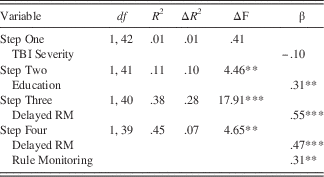
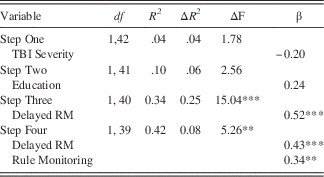
Stepwise linear regression was used to further examine the relationship between neuropsychological composite scores and PM performance. Multicollinearity was not a concern as evidenced by variance inflation factors (VIF) that were lower than 3 in all models. Regression analyses were conducted with PM Total score as the dependent variable. After controlling for TBI severity and education in Steps 1 and 2, neuropsychological composites demonstrating a significant correlation with PM Total scores (immediate RM, delayed RM, executive achievement, and rule monitoring) were entered in Step 3. TBI severity was not a significant predictor of PM Total scores, but education significantly predicted PM Total scores (t=2.11; p<.05). Delayed RM (t=4.23; p<.01) and rule monitoring (t=2.16; p<.05) were entered stepwise into the regression analysis, accounting for 45% (R2Δ=.07; p<.05) of the variance in PM Total scores (Table 5). An analogous stepwise regression analysis was conducted to examine the contribution of neuropsychological composites demonstrating a significant correlation with ProPM specifically (immediate RM, delayed RM, executive achievement, and rule monitoring) after controlling for TBI severity and education. TBI severity and education were not significant predictors of ProPM scores. Delayed RM [t=3.88; p<.01] and rule monitoring [t=2.29; p<.05] were entered stepwise into the regression analysis, accounting for 42% (R2Δ=.08; p<.05) of the variance in ProPM performance (Table 6).
Stepwise Regression of Neuropsychological Composite Scores on Total PM Scores

Note.*p=.05, **p<.05, ***p<.01.
Stepwise regression of neuropsychological composite scores on Prospective component of PM (ProPM) scores

Note.*p=.05, **p<.05, ***p<.01.
The effect of RM Impairment on Total PM Scores
Additional regression analyses were conducted to determine whether TBI participants with impaired delayed RM demonstrated a different relationship between rule monitoring and PM performance, as compared with those with intact delayed RM. TBI participants were classified as RM impaired (n=24) or RM intact (n=21) with impairment defined as performance on the CVLT-II Long Delay Free Recall score falling 2 or more SD below the mean. The RM impaired group demonstrated significantly worse PM as measured by the PM Total scores, [t(43)=4.18; p<.001].
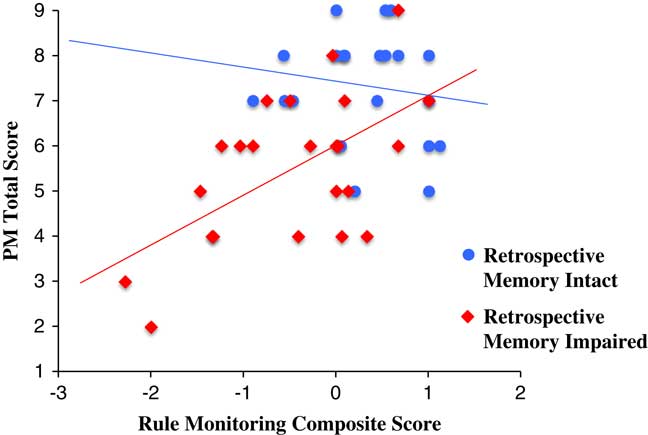
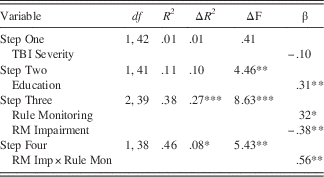
A hierarchical regression analysis was conducted with the PM Total score as the dependent variable. Step 1, controlling for variance associated with TBI severity, was not significant. Step 2, controlling for variance associated with educational attainment, was significant (t=2.11; p<.05). In Step 3, RM impairment classification (impaired vs. intact) and rule monitoring composite scores were entered as separate predictor variables. RM impairment (t=−2.62; p<.01) and rule monitoring (t=2.03; p<.05) together accounted for 38% of the variance. The interaction between RM impairment classification and rule monitoring composite scores was entered in Step 4 and was found to significantly predict the PM Total scores (Table 7; t=2.33; p<.05). The rule monitoring composite scores were significantly and positively correlated with PM Total scores (r=.58; p<.01) in RM impaired participants, with no relationship noted for RM intact participants (Figure 1; r=−.15; p=.51).
Relationship between prospective memory (PM) from the Rivermead Behavioral Memory Test (RBMT) and Rule monitoring composite scores in traumatic brain injury (TBI) participants with intact or impaired RM performance as determined by performance on the California Verbal Learning Test-Second Edition (CVLT-II) Long Delay Free Recall Score.

Multiple hierarchical regression testing moderating effect of Delayed Memory Performance on relationship between Rule monitoring and Total PM scores

Note.*p=.05, **p<.05, ***p<.01.
To test the specificity of our finding that the relationship between rule monitoring and PM depended on RM classification, we conducted analogous regression analyses to test whether the relationship between PM and the other neuropsychological composite scores changed as a function of RM classification. When entered into the regression analyses, the interactions between RM classification and working memory (p=.95), processing speed (p=.43), learning (p=.33), and executive achievement (p=.28) did not significantly predict PM Total scores.
Discussion
The current study investigated the relationship between prospective memory (PM) assessed with the Rivermead Behavioral Memory Test (RBMT) and specific aspects of episodic retrospective memory (RM) and executive functioning following traumatic brain injury (TBI). This study represents the first investigation of the relationship between PM and rule monitoring, a specific aspect of executive functioning involving error commission on neuropsychological tests. Stepwise regression analyses demonstrated that both delayed RM and rule monitoring abilities predicted PM performance.
Results provide insight regarding the relationship between RM processes and PM following TBI. Previous studies have demonstrated an inconsistent relationship between PM and RM following TBI. While some studies failed to consistently detect significant correlations between RM and PM (Mathias & Mansfield, Reference Mathias and Mansfield2005; Raskin et al., Reference Raskin, Buckheit and Waxman2012), other studies demonstrate that PM performance is significantly correlated with RM (Clune-Ryberg et al., Reference Clune-Ryberg, Blanco-Campal, Carton, Pender, O’Brien, Phillips and Burke2011; Groot et al., Reference Groot, Wilson, Evans and Watson2002; Knight et al., Reference Knight, Harnett and Titov2005; Potvin et al., Reference Potvin, Rouleau, Audy, Carbonneau and Giguere2011; Schmitter-Edgecombe & Wright, Reference Schmitter-Edgecombe and Wright2004). Of the relatively few studies examining the relationship between PM and both immediate and delayed RM, some provide evidence that both immediate and delayed measures of RM were correlated with PM performance (Clune-Ryberg et al., Reference Clune-Ryberg, Blanco-Campal, Carton, Pender, O’Brien, Phillips and Burke2011; Groot et al., Reference Groot, Wilson, Evans and Watson2002). However, these previous studies did not statistically examine whether PM was most strongly predicted by immediate or delayed RM post-TBI. Current results demonstrate that delayed RM is a statistically stronger predictor of PM than immediate RM in TBI participants, suggesting that the cognitive processes involved in delayed RM are more closely related to the cognitive processes involved in PM as assessed with the RBMT.
An important aim of the current study was the examination of distinct aspects of executive functioning in predicting PM. We noted that rule monitoring is a stronger predictor of PM than executive achievement, the index that is traditionally used to assess executive functioning. Rule monitoring was assessed as one’s ability to avoid making errors on neuropsychological tests of executive functioning, representing the ability to maintain goals and monitor performance to avoid making errors. Consistent with previous studies investigating the relationship between executive functioning and PM, the executive achievement composite was derived from total achievement scores on tests of executive functioning. Our results indicate that the ability to avoid committing errors while completing executive functioning tasks more closely represents the executive abilities required for accurate PM post-TBI than total achievement on executive functioning tests. In a previous study, rule monitoring scores were found to be significantly associated with volume of the right lateral prefrontal cortex, an area of the brain associated with ability to maintain goals in working memory and inhibit goal-irrelevant information (Possin et al., Reference Possin, Brambati, Rosen, Johnson, Pa, Weiner and Kramer2009). Previous studies have shown that rule monitoring scores are stronger predictors of self-reported impairment in everyday functioning than executive achievement scores in individuals with neurocognitive deficits (Cattie et al., Reference Cattie, Doyle, Weber, Grant and Woods2012). Likewise, our findings provide evidence that rule monitoring is a stronger indicator of PM than commonly used executive achievement scores. Furthermore, we found that performance on the prospective aspect of PM (ProPM) was significantly predicted by rule monitoring instead of executive achievement, which is consistent with evidence from studies using experimental PM tests and demonstrating that monitoring is involved in the intention initiation phase of Kliegel’s model (Smith & Bayen, Reference Smith and Bayen2004).
Findings from the current study also indicate that the relationship between PM and rule monitoring varies with the degree of delayed RM impairment. In TBI participants with delayed RM impairment, a significant positive relationship was noted between rule monitoring and PM performance. Thus, some individuals with TBI and RM impairment are capable of demonstrating the same level of PM performance as individuals with TBI without RM impairment. These findings are consistent with previous studies suggesting that intact RM abilities are not necessary for accurate PM performance post-TBI. We noted that PM performance is significantly predicted by rule monitoring abilities in TBI participants with RM impairment. Overall, as has been suggested by others (Carlesimo et al., Reference Carlesimo, Casadio and Caltagirone2004; Raskin et al., Reference Raskin, Buckheit and Waxman2012), individuals with TBI demonstrating RM impairment may rely on a specific aspect of executive functioning, rule monitoring, to perform PM tasks. In contrast, TBI participants with intact delayed RM abilities did not demonstrate a significant relationship between PM abilities and rule monitoring, suggesting that they may rely more on their intact RM abilities than rule monitoring abilities to complete PM.
The contribution of monitoring processes to PM performance has been investigated most extensively in studies with healthy adults using experimental tests of PM. In one of the few studies investigating monitoring and PM performance in individuals with TBI, results demonstrated that individuals with TBI showed less effective monitoring than healthy adults and ability to strategically monitor time was found to be positively associated with time-based PM accuracy in only healthy adults (Mioni, Stablum, McClintock, & Cantagallo, Reference Mioni, Stablum, McClintock and Cantagallo2012). Thus, the current findings expand our current understanding of the way in which monitoring processes contribute to PM in demonstrating that stronger ability to monitor one’s performance and avoid making errors on neuropsychological tests is associated with stronger event-based PM performance in TBI participants demonstrating impairment in RM.
The current results suggest that TBI participants demonstrate variability in the cognitive processes used to complete PM tasks, likely due to differences in level of RM functioning. In interpreting the current results, it is important to consider that executive functioning deficits can contribute to impaired performance on tests of RM such as the CVLT-II. As a result, it is possible that, in the current study, TBI participants classified as RM impaired may have demonstrated impaired performance in delayed RM due, at least in part, to executive functioning deficits. Given that RM performance was found to be significantly correlated with performance on the executive achievement composite, but not with performance on the rule monitoring composite, it is possible that rule monitoring is an aspect of executive functioning that facilitates more accurate PM performance, even in TBI participants demonstrating impaired performance in a delayed memory task, due to executive functioning deficits. These questions should be explored further in future studies.
Results of the current study have significant clinical implications. Neuropsychologists traditionally assess components of executive functioning, including inhibition, set shifting, and problem solving using standard achievement scores from neuropsychological tasks. However, they rarely examine the integrity of rule monitoring; that is one’s ability to monitor performance and avoid inaccuracies. Our results indicate that rule monitoring ability specifically represents the executive abilities required to successfully perform PM tasks, rather than measures of total achievement on executive functioning tasks. Thus, the inclusion of measures of rule monitoring on commonly used neuropsychological tests in a clinical neuropsychological evaluation is likely to increase the utility of that evaluation in drawing conclusions about memory abilities in daily life, such as PM.
Cognitive rehabilitation frequently targets specific cognitive deficits in an effort to maximize cognitive functioning. In treatment planning for individuals with TBI with PM impairment, it should be considered that interventions aiming to improve rule monitoring abilities may result in greater improvement in PM performance post-TBI than interventions aiming to improve executive functioning abilities more generally. Also, given evidence that individuals with TBI demonstrate variability in the strategies used to complete PM, rehabilitation of PM post-TBI may be most successful when interventions are individualized based on level of memory functioning and rule monitoring abilities. Hence, it may be especially important that individuals with TBI demonstrating impairment in both RM and rule monitoring participate in interventions aimed to improve rule monitoring or compensatory strategies such as implementation intentions (McDaniel, Howard, & Butler, Reference McDaniel, Howard and Butler2008) that automatize PM tasks and reduce executive demands. If individuals with TBI demonstrate intact rule monitoring abilities and impairment in RM, then interventions training individuals to rely on their intact rule monitoring during PM tasks could facilitate greater success on PM tasks.
In future studies, it will be important to continue to investigate the relationship between rule monitoring and PM to answer several remaining questions. In previous studies, monitoring has referred to several dissociable aspects of executive functioning such as the ability to accurately respond on memory tests requiring executive functioning (Rajah & McIntosh, Reference Rajah and McIntosh2006), ability to assess and adapt actions to be consistent with goals (Berkman, Falk, & Lieberman, Reference Berkman, Falk and Lieberman2012), ability to maintain vigilance while completing challenging tasks (Stuss et al., Reference Stuss, Alexander, Shallice, Picton, Binns, MacDonald and Katz2005), and ability to check information in working memory (Petrides et al., Reference Petrides, Alivisatos, Meyer and Evans1993). However, in the current study, we examined rule monitoring as a single cognitive process and found that rule monitoring is an aspect of executive functioning that shows a stronger relationship with PM than executive achievement. It will important to investigate the component executive processes involved in rule monitoring in future studies. Specifically, future studies should investigate the relationship between rule monitoring and performance on PM tasks that vary in complexity and executive demands to more precisely identify the component executive processes involved in rule monitoring and important for PM post-TBI. Also, given evidence that the aspect of monitoring that has been assessed with error scores in previous studies has depended on specific cognitive demands of tasks used (Stuss & Alexander, Reference Stuss and Alexander2007), it will be important to compare the relationship between PM and rule monitoring when rule monitoring is assessed with different types of error scores. Lastly, future research should investigate the relationship between PM and rule monitoring in samples of TBI participants with comorbid psychiatric disorders to investigate the generalizability of our current findings.
In summary, the current results demonstrate that PM is most strongly predicted by delayed RM as well as a specific aspect of executive functioning, rule monitoring. Furthermore, individuals with TBI with RM impairment are able to demonstrate better PM performance when rule monitoring abilities are intact, suggesting that, even when RM is impaired, stronger ability to monitor performance and avoid making errors is associated with more accurate PM performance. The limitations of the current study include a modest sample size of TBI participants. Also, the PM measures used in the current study did not allow for assessment of strategic monitoring during PM, as has been extensively studied in the experimental literature on PM (e.g., Scullin, McDaniel, Shelton, & Lee, Reference Scullin, McDaniel, Shelton and Lee2010). Thus, the current study did not determine whether rule monitoring measured with neuropsychological tests involve the same cognitive abilities required to effectively engage in strategic monitoring during a PM task post-TBI. Future studies should specifically address this question.
ACKNOWLEDGMENTS
The authors acknowledge grant support from the National Institute on Disability and Rehabilitation Research (N.D.C., H133A070037 & H133P090009). However, these contents do not necessarily represent the policy of the Department of Education, and endorsement by the Federal Government should not be assumed. The authors report no conflicts of interest.