Background
Cognitive deficits are a core feature of schizophrenia (ScZ) and have been found in the domains of working memory (WM), verbal learning, motor abilities, attention, processing speed and social cognition (Green et al., Reference Green, Nuechterlein, Gold, Barch, Cohen, Essock, Fenton, Frese, Goldberg, Heaton and Keefe2004). There is substantial evidence that neuro-cognitive and social cognitive impairments in ScZ are associated with poor occupational and social outcomes (Green et al., Reference Green, Kern, Braff and Mintz2000; Hooker and Park, Reference Hooker and Park2002; Fett et al., Reference Fett, Viechtbauer, Penn, van Os and Krabbendam2011), making them a potential target for therapeutic interventions.
More recently, one focus has been the identification of neurocognitive impairments in participants meeting clinical high-risk criteria (CHR) for the development of psychosis (Klosterkötter et al., Reference Klosterkötter, Hellmich, Steinmeyer and Schultze-Lutter2001; Yung et al., Reference Yung, Yung, Pan Yuen, Mcgorry, Phillips, Kelly, Dell'olio, Francey, Cosgrave, Killackey and Stanford2005). These include ultra-high-risk (UHR) criteria that involve the presence of attenuated, psychotic symptoms (Miller et al., Reference Miller, McGlashan, Rosen, Cadenhead, Ventura, McFarlane, Perkins, Pearlson and Woods2003; Yung et al., Reference Yung, Yung, Pan Yuen, Mcgorry, Phillips, Kelly, Dell'olio, Francey, Cosgrave, Killackey and Stanford2005). Moreover, UHR-criteria include a genetic risk plus functional deterioration syndrome as well as brief limited intermittent psychotic symptoms (BLIPs).
In addition, CHR-criteria have been developed based on the basic symptom (BS) concept proposed by Huber and colleagues (Schultze-Lutter, et al., Reference Schultze-Lutter, Ruhrmann, Berning, Maier and Klosterkötter2008). BS involve the presence of self-experienced perceptual and cognitive anomalies that are thought to represent the earliest manifestation of psychosis risk (Schultze-Lutter et al., Reference Schultze-Lutter, Ruhrmann, Berning, Maier and Klosterkötter2008). CHR-criteria confer a 10–30% risk of developing ScZ within a 2–5 year period (Fusar-Poli et al., Reference Fusar-Poli, Borgwardt, Bechdolf, Addington, Riecher-Rössler, Schultze-Lutter, Keshavan, Wood, Ruhrmann, Seidman and Valmaggia2013, Reference Fusar-Poli, Cappucciati, Rutigliano, Schultze-Lutter, Bonoldi, Borgwardt, Riecher-Rössler, Addington, Perkins, Woods and McGlashan2015a, Reference Fusar-Poli, Schultze-Lutter, Cappucciati, Rutigliano, Bonoldi, Stahl, Borgwardt, Riecher-Rössler, Addington, Perkins and Woods2015b). More recent studies have shown that the combined presence of both BS- and UHR-criteria increases the predictive power significantly (Schultze-Lutter et al., Reference Schultze-Lutter, Klosterkötter and Ruhrmann2014).
There is extensive evidence on the presence of neurocognitive deficits in CHR-populations across a range of domains that mirror observations in established ScZ, including impairments in WM, attention, speed of processing, verbal memory, verbal fluency, executive functions and motor speed with small-to-medium effect sizes (Fusar-Poli et al., Reference Fusar-Poli, Deste, Smieskova, Barlati, Yung, Howes, Stieglitz, Vita, McGuire and Borgwardt2012; Giuliano et al., Reference Giuliano, Li, Mesholam-Gately, Sorenson, Woodberry and Seidman2012; Bora et al., Reference Bora, Lin, Wood, Yung, McGorry and Pantelis2014). Follow-up studies have suggested that certain deficits may indicate stable vulnerability markers, e.g. sustained attention (Francey et al., Reference Francey, Jackson, Phillips, Wood, Yung and McGorry2005), whereas others may be predictive of transition to psychosis, such as verbal IQ, processing speed, verbal memory and WM (Brewer et al., Reference Brewer, Francey, Wood, Jackson, Pantelis, Phillips, Yung, Anderson and McGorry2005; Lencz et al., Reference Lencz, Smith, McLaughlin, Auther, Nakayama, Hovey and Cornblatt2006; Pukrop and Klosterkötter, Reference Pukrop and Klosterkötter2010; Seidman et al., Reference Seidman, Giuliano, Meyer, Addington, Cadenhead, Cannon, McGlashan, Perkins, Tsuang, Walker and Woods2010; Michel et al., Reference Michel, Ruhrmann, Schimmelmann, Klosterkötter and Schultze-Lutter2014).
Moreover, previous studies have found deficits in emotion recognition, theory of mind and social perception in CHR-participants (Thompson et al., Reference Thompson, Bartholomeusz and Yung2011) in agreement with extensive evidence for dysfunctions in social cognition in ScZ-patients (Green et al., Reference Green, Horan and Lee2015). More specifically, impaired facial emotion recognition in CHR-groups has been reported in several studies (Addington et al., Reference Addington, Penn, Woods, Addington and Perkins2008a, Reference Addington, Penn, Woods, Addington and Perkins2008b; van Rijn et al., Reference Van Rijn, Aleman, de Sonneville, Sprong, Ziermans, Schothorst, Van Engeland and Swaab2011; Amminger et al., Reference Amminger, Schäfer, Klier, Schlögelhofer, Mossaheb, Thompson, Bechdolf, Allott, McGorry and Nelson2012), suggesting that emotion recognition deficits may emerge before the onset of psychosis.
The current study aimed to extend these findings by examining the relationship between neurocognition, social cognition and current psychosocial functioning in a CHR-sample recruited from the general community. The large majority of studies investigating neurocognition in CHR-populations involve participants who are help-seeking and recruited through clinical pathways. Accordingly, it is unclear to what extent neurocognitive deficits generalise to more representative samples recruited outside clinical pathways. This is potentially an important question as there may be differences between clinically referred v. community CHR-samples, for example, regarding transition rates (Fusar-Poli et al., Reference Fusar-Poli, Schultze-Lutter, Cappucciati, Rutigliano, Bonoldi, Stahl, Borgwardt, Riecher-Rössler, Addington, Perkins and Woods2015b).
To address this issue, we recruited a sample of n = 108 CHR-participants through an online-screening platform (McDonald et al., Reference McDonald, Christoforidou, Van Rijsbergen, Gajwani, Gross, Gumley, Lawrie, Schwannauer, Schultze-Lutter and Uhlhaas2018) as well as a group of n = 42 participants who did not fulfil CHR-criteria (CHR-negatives) but were characterised by psychiatric comorbidities, such as affective disorders and substance abuse, and a group of n = 55 healthy controls (HCs). Neurocognition was assessed with the Brief Assessment of Cognition in Schizophrenia Battery (BACS) (Keefe et al., Reference Keefe, Goldberg, Harvey, Gold, Poe and Coughenour2004) as well as tasks from the Penn Computerized Neurocognitive Battery (CNB) (Moore et al., Reference Moore, Reise, Gur, Hakonarson and Gur2015). The Global Assessment of Functioning (GAF) as well as scales for role (GF: Role) and social (GF: Social) functioning (Cornblatt et al., Reference Cornblatt, Auther, Niendam, Smith, Zinberg, Bearden and Cannon2007) were used to assess psychosocial functioning.
A secondary objective was to examine the relationship between neurocognitive deficits and social and occupational functioning in community-recruited CHR-participants. Previous studies reported conflicting findings on this relationship in CHR-participants recruited from clinical pathways. Niendam et al. (Reference Niendam, Bearden, Johnson, McKinley, Loewy, O'Brien, Nuechterlein, Green and Cannon2006) reported that impairments in verbal learning and memory were associated with current social functioning. A follow-up study found that improvements in social functioning predicted gains in processing speed and visual learning and memory (Niendam et al., Reference Niendam, Bearden, Zinberg, Johnson, O'brien and Cannon2007). Similar findings were reported by Lin et al. (Reference Lin, Wood, Nelson, Brewer, Spiliotacopoulos, Bruxner, Broussard, Pantelis and Yung2011). However, findings by Jahshan et al. (Reference Jahshan, Heaton, Golshan and Cadenhead2010) indicated that improvements in neurocognitive performance were not significantly associated with functioning as measured by the GAF scale. Finally, Carrión et al. (Reference Carrión, Goldberg, McLaughlin, Auther, Correll and Cornblatt2011) examined impairments in both social and role functioning in relation to neurocognitive performance and found that speed of processing was predictive of poorer social and role functioning.
Methods
Recruitment and participants
The YouR-Study is a longitudinal study to identify neurobiological and psychological mechanisms and predictors of psychosis-risk (Uhlhaas et al., Reference Uhlhaas, Gajwani, Gross, Gumley, Lawrie and Schwannauer2017) and is funded by the Medical Research Council (MRC).
CHR-participants were recruited through an online-screening approach (see http://www.your-study.org.uk) that identified CHR-participants from the general population through email invitations, posters and flyers over a 4-year period (see McDonald et al., Reference McDonald, Christoforidou, Van Rijsbergen, Gajwani, Gross, Gumley, Lawrie, Schwannauer, Schultze-Lutter and Uhlhaas2018). Specifically, email invitations were sent out to colleges and universities in Glasgow and Edinburgh through which the majority of study participants were identified. It is estimated that ~100 000 participants were invited to the study.
Approximately 2800 participants filled out the online versions of the (a) the 16-item Prodromal Questionnaire (PQ-16) (Ising et al., Reference Ising, Veling, Loewy, Rietveld, Rietdijk, Dragt, Klaassen, Nieman, Wunderink, Linszen and van der Gaag2012) and (b) a nine-item scale of perceptual and cognitive anomalies (PCA) that was developed to assess BS. Participants were invited for clinical interviews if they positively endorsed six or more items on the PQ-16 or three or more on the PCA.
Previous analysis (McDonald et al., Reference McDonald, Christoforidou, Van Rijsbergen, Gajwani, Gross, Gumley, Lawrie, Schwannauer, Schultze-Lutter and Uhlhaas2018) had shown that ~50% participants fulfilled the PQ-16 cut-off criteria while ~70% met criteria for the PCA. Out of the ~2800 of participants who met online cut-offs, ~20% took part in clinical assessments. Moreover, an additional sample of n = 21 participants meeting first-episode criteria were identified.
To establish CHR-criteria, the positive scale of the Comprehensive Assessment of At-Risk Mental States (CAARMS) (Yung et al., Reference Yung, Yung, Pan Yuen, Mcgorry, Phillips, Kelly, Dell'olio, Francey, Cosgrave, Killackey and Stanford2005) and items of the Schizophrenia Proneness Instrument (SPI-A) (Schultze-Lutter, et al., Reference Schultze-Lutter, Addington, Ruhrmann and Klosterkötter2007) as defined by Cognitive-Perceptive Basic Symptoms (COPER) and Cognitive Disturbances (COGDIS) were administered through trained research assistants and M.Sc./Ph.D. level researchers. Inter-rater reliability of CHR-status as determined by the CAARMS and SPI-A ratings was assessed over 18 sessions, reaching good-to-excellent reliability (CAARMS: 92%; SPI-A: 95.7%).
CHR-participants were excluded for current or past diagnosis with Axis I psychotic disorders. Other co-morbid Axis I diagnoses, such as mood or anxiety disorders, were not exclusionary and all participants were between 16 and 35 years of age (for more details, see Uhlhaas et al., Reference Uhlhaas, Gajwani, Gross, Gumley, Lawrie and Schwannauer2017).
Participants were recruited into the CHR-group if they met (a) SPI-A COGDIS/COPER-criteria; (b) CAARMS criteria for the attenuated psychosis group (subthreshold psychotic syndrome present in the last year without a decline in functioning); (c) CAARMS criteria for genetic risk plus functional deterioration (family history of psychosis plus a 30% drop in GAF); and (d) CAARMS criteria for the BLIPs group (BLIPs).
Moreover, the M.I.N.I. International Neuropsychiatric Interview (M.I.N.I. 6.0) (Sheehan et al., Reference Sheehan, Lecrubier, Sheehan, Amorim, Janavs, Weiller, Hergueta, Baker and Dunbar1998), the scales for premorbid adjustment (Cannon-Spoor et al., Reference Cannon-Spoor, Potkin and Wyatt1982) and social and role functioning scales (Cornblatt, et al., Reference Cornblatt, Auther, Niendam, Smith, Zinberg, Bearden and Cannon2007) were administered. Neuropsychological assessment consisted of the BACS (Keefe et al., Reference Keefe, Goldberg, Harvey, Gold, Poe and Coughenour2004) as well as three tasks from the CNB battery (Moore et al., Reference Moore, Reise, Gur, Hakonarson and Gur2015): (a) the Continuous Performance Test, (b) the N-Back Task and (c) the Emotion Recognition Task.
In addition to CHR-participants, two samples were recruited consisting of (1) participants who entered the study similar to CHR-participants but who did not meet CHR-criteria (CHR-negative) and (2) a group of HCs without an Axis I diagnosis or family history of psychotic disorders. The former group was included to assess the impact of psychiatric comorbidity, such as affective disorders and substance abuse, on neurocognitive parameters.
Statistical analyses
All statistical analyses were performed using SPSS version 24. BACS and CNB raw test scores for each neurocognitive domain were standardised by creating z-scores using the means and standard deviations of HCs. BACS raw scores were additionally corrected for gender. When the homogeneity of variances assumption was violated in one-way analysis of variance (ANOVA) analyses, Welch's F was reported. Since the one-way ANOVA is considered a robust test against the normality assumption, no alternative tests were applied. The Hochberg's GT2 test was used as a post hoc test for ANOVA analyses whereas the Games–Howell test was used as a post hoc test for Welch analyses. For Kruskal–Wallis H tests, Dunn's pairwise tests were carried out post hoc.
All BACS and CNB neurocognitive domains were entered into stepwise multiple linear regressions in order to assess the relationship between functioning, neurocognition and psychopathology in the CHR group.
Results
Sample characteristics
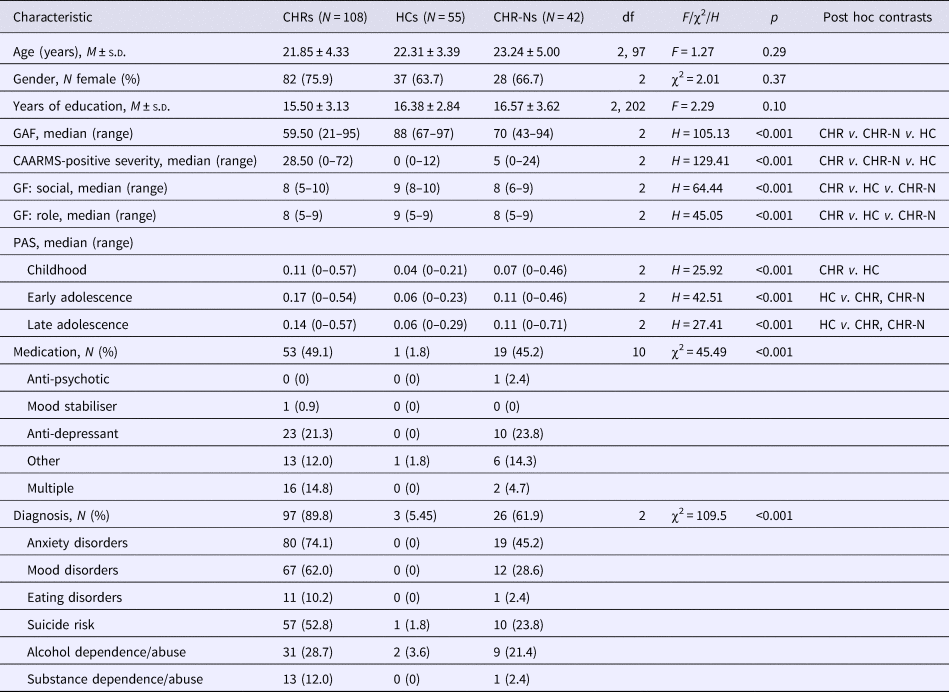
Baseline demographic and clinical characteristics of the three groups are summarised in Table 1.
Baseline demographic and clinical characteristics of CHR, HC and CHR-negative participants

CHR, clinical high-risk; HC, healthy control; CHR-N, clinical high-risk-negative.
CHRs, CHR-negatives and HCs did not differ significantly on age, gender or years of education. The CHR-group had significantly higher CAARMS-positive severity scores, poorer premorbid adjustment, lower GAF scores as well as reduced role and social functioning compared with HCs and CHR-negatives. Significant differences between groups were also found for medication status with 49.1% of CHR-participants receiving current medication. The CHR-group was also characterised by extensive psychiatric comorbidity, in particular with affective disorders. Moreover, differences in CHR-subgroups [UHR (n = 34), BS (n = 29), UHR/BS (n = 45)] were explored (online Supplementary Table S1). The BS group had significantly higher GAF scores and lower CAARMS-positive severity scores than the UHR/BS group.
Neuropsychology
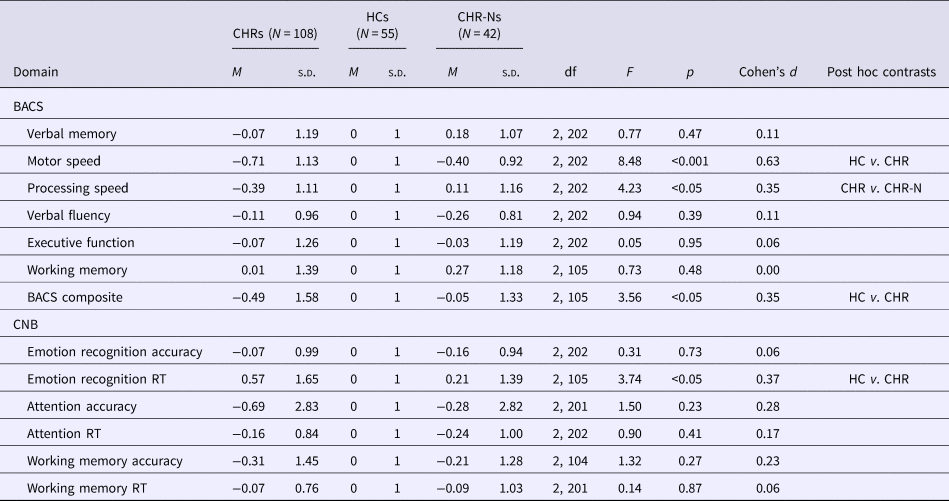
Table 2 summarises the neurocognitive performance for CHRs, CHR-negatives and HCs. Due to incorrect task performance, one CHR participant was removed from the CNB WM accuracy and WM RT analysis, and one CHR-negative participant was removed from the CNB attention accuracy analysis.
Neurocognitive performance of CHR, HC and CHR-N participants

CHR, clinical high-risk; HC, healthy control; CHR-N, clinical high-risk-negative; RT, response times.
CHR effect sizes, measured by Cohen's d, are classified as small (0.2), medium (0.5) and large (0.8).
Significant group effects were demonstrated for motor speed [F (2,202) = 8.48, p < 0.001], BACS composite [F (2,105) = 3.44, p < 0.05], emotion recognition RT [F (2,105) = 3.74, p < 0.05] and processing speed [F (2,202) = 4.23, p < 0.05]. These effects were observed between CHRs and controls for all domains apart from processing speed where CHRs significantly differed only from CHR-negatives. Fig. 1 displays the effect sizes for each neurocognitive domain for both CHRs and CHR-negatives.
CHR and CHR-negative effect sizes, as measured by Cohen's d, for BACS and CNB data: classified as small (0.2), medium (0.5) and large (0.8). Error bars indicate standard errors of the mean. Positive values indicate impaired performance while negative values indicate better performance compared with HCs.

In the CHR-group, motor speed had the largest effect size (Cohen's d = 0.63). A small-to-medium effect size was found for emotion recognition RT (d = 0.37), processing speed (d = 0.35), BACS composite (d = 0.35), attention accuracy (d = 0.28) and WM accuracy (d = 0.23). In the CHR-negative group, a small-to-medium effect size was found for motor speed (d = 0.43), verbal fluency (d = 0.29) and attention RT (d = 0.24).
Furthermore, analysis was carried out to explore recognition of specific emotion categories (online Supplementary Table S2). CHR-participants were significantly slower in their RTs compared with HCs for recognising happy faces [F (2,102) = 6.90, p < 0.01; d = 0.46]. No additional emotion recognition deficits emerged.
We also examined differences in neurocognition in relation to CHR-subgroups (online Supplementary Table S1). There was a significant difference between groups on motor speed [F (3,159) = 5.47, p < 0.01], while a trend was observed for emotion recognition RT [F (3,74) = 2.72, p = 0.05], BACS composite [F(3,72) = 2.30, p = 0.09] and attention RT [F (3,159) = 2.28, p = 0.08]. CHR-participants in the UHR and UHR/BS groups had significantly slower motor speed than HCs. Individuals in the UHR/BS groups also had significantly slower emotion recognition RTs than HCs (p = 0.046). No post-hoc differences were found for BACS composite or attention RT. CHR subgroup effect sizes for each neurocognitive domain are reported in online Supplementary Fig. S1.
Cognition, psychopathology and functioning
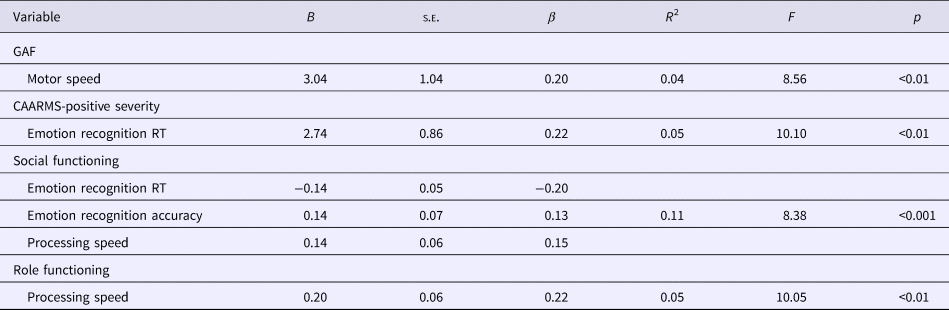
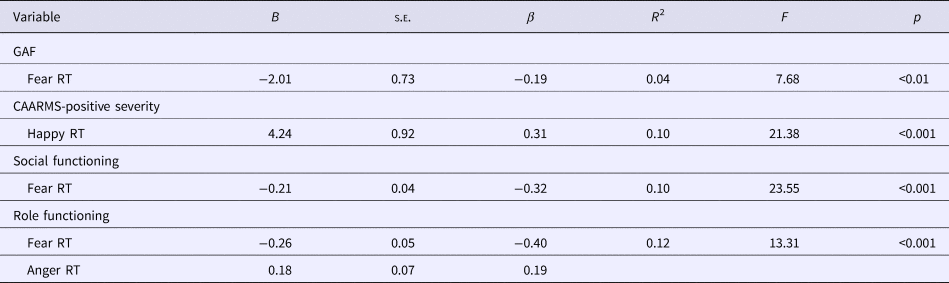
Stepwise multiple linear regressions were performed to assess the relationship between functioning, neurocognition and psychopathology in the CHR-group (Tables 3–4). All BACS and CNB neurocognitive domains were included in the regression. Motor speed significantly predicted GAF, accounting for 4% of the variance while emotion recognition RT explained 5% of the variance in CAARMS-positive severity scores. Emotion recognition RT together with emotion recognition accuracy and processing speed significantly predicted social functioning, accounting for 11% of the variance while processing speed alone significantly predicted role functioning, explaining 5% of the variance.
Linear regression results for the effects of neurocognitive performance on clinical characteristics at baseline in CHR participants

RT, response times.
Linear regression results for the effects of emotion specific RTs on clinical characteristics at baseline in CHR participants

RT, response times.
Fear RT was found to be a significant predictor for both GAF and social functioning, accounting for 4% and 10% of the variance, respectively, and together with anger RT, fear RT significantly predicted role functioning, accounting for 12% of the variance. Happy RT significantly predicted CAARMS-positive severity scores, accounting for 10% of the variance.
Discussion
The current study examined neurocognition and its relationship to functioning in a sample of CHR-participants recruited from the general community. Deficits in neurocognition are a hallmark of ScZ (Heinrichs and Zakzanis, Reference Heinrichs and Zakzanis1998; Rajji et al., Reference Rajji, Ismail and Mulsant2009) and have been observed in CHR-participants across a number of domains with small-to-medium effect sizes (Fusar-Poli et al., Reference Fusar-Poli, Deste, Smieskova, Barlati, Yung, Howes, Stieglitz, Vita, McGuire and Borgwardt2012; Giuliano et al., Reference Giuliano, Li, Mesholam-Gately, Sorenson, Woodberry and Seidman2012; Bora et al., Reference Bora, Lin, Wood, Yung, McGorry and Pantelis2014). Importantly, there is evidence to suggest that impairments in neurocognition impact on psychosocial functioning in CHR-participants (Niendam et al., Reference Niendam, Bearden, Johnson, McKinley, Loewy, O'Brien, Nuechterlein, Green and Cannon2006, Reference Niendam, Bearden, Zinberg, Johnson, O'brien and Cannon2007; Carrión et al., Reference Carrión, Goldberg, McLaughlin, Auther, Correll and Cornblatt2011; Lin et al., Reference Lin, Wood, Nelson, Brewer, Spiliotacopoulos, Bruxner, Broussard, Pantelis and Yung2011). However, it is unclear to what extent these findings generalise to CHR-samples recruited from the general community.
Recent evidence has highlighted the importance of studying CHR-populations outside clinical referral pathways to identify the similarities and differences in clinical characteristics, demographic variables and neurocognition (Mills et al., Reference Mills, Fusar-Poli, Morgan, Azis and McGuire2017; Schultze-Lutter et al., Reference Schultze-Lutter, Michel, Ruhrmann and Schimmelmann2018). Overall, our sample of CHR-participants recruited through a novel online screening platform (McDonald et al., Reference McDonald, Christoforidou, Van Rijsbergen, Gajwani, Gross, Gumley, Lawrie, Schwannauer, Schultze-Lutter and Uhlhaas2018) was characterised by similar levels of functioning and psychiatric comorbidity as previously observed in cohorts recruited through early intervention centres.
However, with regard to the pattern of neurocognitive deficits, there were differences and similarities with previous studies. We observed neurocognitive impairments that are consistent with a large body of work that has highlighted neurocognitive deficits in CHR-samples with mild-to-moderate effect sizes (Fusar-Poli et al., Reference Fusar-Poli, Deste, Smieskova, Barlati, Yung, Howes, Stieglitz, Vita, McGuire and Borgwardt2012; Giuliano et al., Reference Giuliano, Li, Mesholam-Gately, Sorenson, Woodberry and Seidman2012; Bora and Murray, Reference Bora and Murray2014). However, there were also certain differences to previous data, particularly with regard to the extent of dysfunctions in neuropsychological variables (see online Supplementary Fig. S2). Specifically, we observed that the neurocognitive domains that were most prominently impaired were processing and motor speed.
The symbol-coding task has been consistently shown to be impaired in ScZ-patients with large effect sizes (Dickinson et al., Reference Dickinson, Ramsey and Gold2007). Moreover, it discriminates between CHR and controls (Seidman et al., Reference Seidman, Giuliano, Meyer, Addington, Cadenhead, Cannon, McGlashan, Perkins, Tsuang, Walker and Woods2010; Fusar-Poli et al., Reference Fusar-Poli, Deste, Smieskova, Barlati, Yung, Howes, Stieglitz, Vita, McGuire and Borgwardt2012) and predicts psychosis onset in CHR-individuals (Pukrop and Klosterkötter, Reference Pukrop and Klosterkötter2010; Michel et al., Reference Michel, Ruhrmann, Schimmelmann, Klosterkötter and Schultze-Lutter2014). In the current study, we observed that CHR-participants showed a similar deficit that was associated with an effect size of d = 0.35. Interestingly, processing speed was largely intact in the CHR-negative group (effect size: d <0.1), highlighting that the symbol-coding task may delineate specific cognitive impairments associated with psychosis risk.
In addition, CHR-participants were characterised by pronounced impairments in motor speed. While abnormalities in the motor system that involve psychomotor slowing are considered a core feature of ScZ (Morrens et al., Reference Morrens, Hulstijn and Sabbe2006), alterations in the motor system in CHR-participants are only recently being investigated. Evidence suggests that youths who later develop a ScZ-spectrum disorder have been reported to show poorer motor function in childhood (Dickson et al., Reference Dickson, Laurens, Cullen and Hodgins2012) and abnormal involuntary movements were linked to CHR symptoms in a child and adolescent community sample (Kindler et al., Reference Kindler, Schultze-Lutter, Michel, Martz-Irngartinger, Linder, Schmidt, Stegmayer, Schimmelmann and Walther2016). These findings are consistent with reduced motor speed, dexterity and movement abnormalities in CHR-populations (e.g. Niendam et al., Reference Niendam, Bearden, Johnson, McKinley, Loewy, O'Brien, Nuechterlein, Green and Cannon2006; Carrion et al., Reference Carrión, Goldberg, McLaughlin, Auther, Correll and Cornblatt2011; Fusar-Poli et al., Reference Fusar-Poli, Deste, Smieskova, Barlati, Yung, Howes, Stieglitz, Vita, McGuire and Borgwardt2012; Bora et al., Reference Bora, Lin, Wood, Yung, McGorry and Pantelis2014; Dean and Mittal, Reference Dean and Mittal2015; Dean et al., Reference Dean, Orr, Newberry and Mittal2016). However, in contrast to the symbol-coding task, impairments in motor speed were also present in the CHR-negative group (effect size: d = 0.4), suggesting that psychomotor-slowing may be related to aspects of general psychopathology rather than psychosis risk per se.
In addition to impaired motor and processing speed, we also observed slower RTs during emotion recognition, while the accuracy of emotion recognition was intact, highlighting the importance of reduced processing speed across different domains of functioning. Emotion recognition deficits have been reported in some CHR studies (Addington et al., Reference Addington, Penn, Woods, Addington and Perkins2008a, Reference Addington, Penn, Woods, Addington and Perkins2008b; van Rijn et al., Reference Van Rijn, Aleman, de Sonneville, Sprong, Ziermans, Schothorst, Van Engeland and Swaab2011; Amminger et al., Reference Amminger, Schäfer, Klier, Schlögelhofer, Mossaheb, Thompson, Bechdolf, Allott, McGorry and Nelson2012) while others have found emotion recognition to be intact (Pinkham et al., Reference Pinkham, Penn, Perkins, Graham and Siegel2007; Seiferth et al., Reference Seiferth, Pauly, Habel, Kellermann, Shah, Ruhrmann, Klosterkötter, Schneider and Kircher2008; Gee et al., Reference Gee, Karlsgodt, van Erp, Bearden, Lieberman, Belger, Perkins, Olvet, Cornblatt, Constable and Woods2012). There is also preliminary evidence for the possibility of emotion recognition deficits as a predictor for transition to psychosis (Allott et al., Reference Allott, Schäfer, Thompson, Nelson, Bendall, Bartholomeusz, Yuen, McGorry, Schlögelhofer, Bechdolf and Amminger2014).
Interestingly, other domains of neurocognition that were found to be impaired in previous studies were not replicated in our community-recruited CHR-group. Verbal memory, for example, which has been associated with medium effect sizes in CHR-populations (Fusar-Poli et al., Reference Fusar-Poli, Deste, Smieskova, Barlati, Yung, Howes, Stieglitz, Vita, McGuire and Borgwardt2012), was relatively intact in the current study. Previous reports have found verbal fluency and memory to be associated with subsequent transition to psychosis (Fusar-Poli et al., Reference Fusar-Poli, Deste, Smieskova, Barlati, Yung, Howes, Stieglitz, Vita, McGuire and Borgwardt2012). Moreover, there is evidence to suggest that poorer verbal memory predicts more rapid transitioning (Seidman et al., Reference Seidman, Giuliano, Meyer, Addington, Cadenhead, Cannon, McGlashan, Perkins, Tsuang, Walker and Woods2010).
The current study could not replicate impaired memory, executive function and attention in our CHR-group. Evidence is emerging of deficits in declarative memory in FEP (Mesholam-Gately et al., Reference Mesholam-Gately, Giuliano, Goff, Faraone and Seidman2009) and in CHR populations (Seidman et al., Reference Seidman, Shapiro, Stone, Woodberry, Ronzio, Cornblatt, Addington, Bearden, Cadenhead, Cannon and Mathalon2016). The domain of attention has been argued to represent a stable vulnerability marker in CHR-populations (e.g. Francey et al., Reference Francey, Jackson, Phillips, Wood, Yung and McGorry2005). More recent data from the NAPLS-2 cohort has demonstrated impairments in WM and attention in CHR-participants who later transitioned to psychosis relative to CHR-participants who did not transition (Seidman et al., Reference Seidman, Shapiro, Stone, Woodberry, Ronzio, Cornblatt, Addington, Bearden, Cadenhead, Cannon and Mathalon2016).
Finally, executive functions have been found to be impaired in CHR samples (Lencz et al., Reference Lencz, Smith, McLaughlin, Auther, Nakayama, Hovey and Cornblatt2006; Carrión et al., Reference Carrión, Goldberg, McLaughlin, Auther, Correll and Cornblatt2011; Fusar-Poli et al., Reference Fusar-Poli, Deste, Smieskova, Barlati, Yung, Howes, Stieglitz, Vita, McGuire and Borgwardt2012; Seidman et al., Reference Seidman, Shapiro, Stone, Woodberry, Ronzio, Cornblatt, Addington, Bearden, Cadenhead, Cannon and Mathalon2016). A meta-analysis found executive functioning, along with domains of memory and attention, to be the most consistently impairment and already established at the time of the FEP (Mesholam-Gately et al., Reference Mesholam-Gately, Giuliano, Goff, Faraone and Seidman2009).
Our data show that there are subtle differences between neurocognition and functioning levels in CHR-subgroups. Current evidence suggests that self-experienced BS represent the earliest manifestation of psychosis risk or an early prodromal state (EPS) while positive symptoms constitute coping mechanisms that emerge later during development (late prodromal state, LPS) (Fusar-Poli et al., Reference Fusar-Poli, Borgwardt, Bechdolf, Addington, Riecher-Rössler, Schultze-Lutter, Keshavan, Wood, Ruhrmann, Seidman and Valmaggia2013). Consistent with this notion, we observed that CHR-participants who met UHR-criteria and UHR/BS-criteria had more pronounced cognitive impairments, in particular in motor speed, compared with the BS only group. This is consistent with previous findings that neurocognitive impairments differentiate EPS from the LPS-participants. Frommann et al. (Reference Frommann, Pukrop, Brinkmeyer, Bechdolf, Ruhrmann, Berning, Decker, Riedel, Möller, Wölwer and Gaebel2010) found individuals in in the LPS to be impaired across all domains, while those in the EPS showed a specific deficit in the executive control/processing speed domain, raising the question of potentially progressive impairments in cognition across the at-risk phase. Alternatively, it has been suggested that BS criteria help to identify a more homogenous group with respect to neurocognitive profiles (Simon et al., Reference Simon, Dvorsky, Boesch, Roth, Isler, Schueler, Petralli and Umbricht2006).
Our data also support previous findings that deficits in neurocognition impact on functioning parameters in CHR-participants (Niendam et al., Reference Niendam, Bearden, Johnson, McKinley, Loewy, O'Brien, Nuechterlein, Green and Cannon2006, Reference Niendam, Bearden, Zinberg, Johnson, O'brien and Cannon2007; Carrión et al., Reference Carrión, Goldberg, McLaughlin, Auther, Correll and Cornblatt2011; Lin, et al., Reference Lin, Wood, Nelson, Brewer, Spiliotacopoulos, Bruxner, Broussard, Pantelis and Yung2011). Consistent with previous findings that highlighted that reduced processing speed is an important determinant of functioning (Carrión et al., Reference Carrión, Goldberg, McLaughlin, Auther, Correll and Cornblatt2011), our data suggest that impaired processing speed significantly correlates with role and social functioning. Emotion recognition RT, emotion recognition accuracy and processing speed combined explained 11% of the variance in social functioning while processing speed alone accounted for 5% of the variance in role functioning in our CHR-sample. In addition, we found that emotion recognition RT explained 5% of the variance in CAARMS-positive severity scores, while motor speed alone explains 4% of the variance in global functioning.
While these data replicate previous findings (e.g. Carrion et al., Reference Carrión, Goldberg, McLaughlin, Auther, Correll and Cornblatt2011) and highlight the importance of processing speed for explaining psychosocial functioning, the relatively low amount of variance that is being accounted for also suggests that other factors are involved in contributing towards impaired functioning in CHR-participants. Given the importance of psychosocial functioning as an outcome parameter in CHR-populations, further studies need to address the contribution of other factors that could potentially allow insights into origin and mechanism(s) of impaired role and social functioning in CHR-participants.
Limitations
The current study has several limitations. With regard to the sample characteristics, the number of female CHR-participants in the current study exceeded previous studies in the field. The reason of the higher number of self-referrals is not completely clear but may be in part explained by the greater willingness of female participants to engage in studies and perhaps increased awareness of mental health issues. If the latter is correct, different strategies may have to be employed to engage male participants in early intervention. Secondly, we did not assess negative symptoms in CHR-participants that have been shown to mediate the relationship between neurocognitive deficits and functioning in previous studies (Meyer et al., Reference Meyer, Carrión, Cornblatt, Addington, Cadenhead, Cannon, McGlashan, Perkins, Tsuang, Walker and Woods2014; Glenthoj et al., Reference Glenthøj, Jepsen, Hjorthøj, Bak, Kristensen, Wenneberg, Krakauer, Nordentoft and Fagerlund2017). Finally, it is currently unclear whether neurocognitive deficits in our community recruited CHR-sample are predictive for the persistence of sub-threshold psychosis symptoms and/or conversion to psychosis as has been suggested by previous findings (Seidman et al., Reference Seidman, Shapiro, Stone, Woodberry, Ronzio, Cornblatt, Addington, Bearden, Cadenhead, Cannon and Mathalon2016; Lam et al., Reference Lam, Lee, Rapisarda, See, Yang, Lee, Abdul-Rashid, Kraus, Subramaniam, Chong and Keefe2018).
Summary and conclusions
The current data support the view that neurocognitive deficits are a core feature of the CHR-participants recruited from the general community, replicating previous findings from CHR-cohorts recruited from clinical referral pathways. This is also supported by the fact that cognitive impairments were largely specific to the CHR-group. Thus, participants who did not meet CHR-criteria but who were characterised by affective disorders and substance abuse did not show neurocognitive impairments to the same extent as observed in the CHR-group, supporting the view that dysfunctional cognition is related to an extended psychosis phenotype.
Follow-up data need to confirm whether such deficits are also predictive for clinical outcomes and transitioning to psychosis in community-recruited CHR-participants. If this is the case, neurocognitive testing could potentially be used to stratify young people with subthreshold psychotic symptoms and support targeted interventions for improving cognitive processes. This approach is furthermore motivated by the finding that neurocognitive deficits were related to aspects of psychosocial functioning, replicating existing data from clinically identified CHR-groups.
Supplementary material
The supplementary material for this article can be found at https://doi.org/10.1017/S0033291718003975.
Author ORCIDs
Peter J. Uhlhaas 0000-0002-0892-2224
Acknowledgement
We acknowledge the support of the Scottish Mental Health Research Network (http://www.smhrn.org.uk) now called the NHS Research Scotland Mental Health Network (NRS MHN: http://www.nhsresearchscotland.org.uk/research-areas/mental-health) for providing assistance with participant recruitment, interviews and cognitive assessments. We would like to thank both the participants and patients who took part in the study and the research assistants of the YouR-study for supporting the recruitment and assessment of CHR-participants.
Financial support
This study was supported by the project MR/L011689/1 from the Medical Research Council (MRC).