Introduction
Consanguineous marriage refers to marriage between close biological relatives (Bittles, Reference Bittles2012). Consanguineous marriage can be categorized by the level of relationship between spouses: for example, first cousins either paternal or maternal side, second cousins, third cousins, uncle–niece or distant relations (Bittles, Reference Bittles2012; Islam, Reference Islam2018). Worldwide, the prevalence of consanguineous marriage is around 10% (Bittles & Black, Reference Bittles and Black2010) and is widely practised in the Middle East, sub-Saharan Africa, the Gulf region and South Asian countries (Al-Gazali et al., Reference Al-Gazali, Bener, Abdulrazzaq, Micallef, Al-Khayat and Gaber1997; Tadmouri et al., Reference Tadmouri, Nair, Obeid, Al-Ali, Al Khaja and Hamamy2009; Bittles, Reference Bittles2011; Islam, Reference Islam2012; Kelmemi et al., Reference Kelmemi, Chelly, Kharrat and Chaabouni-Bouhamed2015). Studies have revealed education, place of residence, wealth possession, religious beliefs and cultural practices bring differences to the prevalence of consanguineous marriage and its types (Hussain & Bittles, Reference Hussain and Bittles2000; Bittles, Reference Bittles2001; Jurdi & Saxena, Reference Jurdi and Saxena2003; Bittles, Reference Bittles2011; Kelmemi et al., Reference Kelmemi, Chelly, Kharrat and Chaabouni-Bouhamed2015). For example, a study conducted in Turkey in 2006 found that around 20% of people living in the urban study area had married a relative, while 26% of those in the rural area had married a relative (TFSS, 2006). The Muslim community has a higher prevalence of consanguineous marriage than other religious communities (Bittles & Black, Reference Bittles and Black2010). The prevalence of consanguineous marriage is higher in low socioeconomic groups compared with high socioeconomic group globally (Bittles et al., Reference Bittles, Mason, Greene and Appaji1991; Bittles, Reference Bittles1994).
Several studies have shown that marriage between first cousins is the most common form of consanguinity (Modell & Darr, Reference Modell and Darr2002; Bittles, Reference Bittles2011; Islam, Reference Islam2012). For example, while in Egypt more than half of consanguineous marriages take place between first cousins (Bittles, Reference Bittles2011), in Jordan the prevalence is one quarter (Islam, Reference Islam2018), and in South Asian countries such as Pakistan, 80% of consanguineous marriages take place between first cousins (Hussain & Bittles, Reference Hussain and Bittles1998).
In India, the prevalence of consanguineous marriage ranges from 14% to 16% (Padmadas & Nair, Reference Padmadas and Nair2002; Banerjee & Roy, Reference Banerjee and Roy2002), and it varies with socioeconomic condition, educational attainment, geographical region, religious belief and cultural practices (Krishnamoorthy & Audinarayana, Reference Krishnamoorthy and Audinarayana2001; Iyer, Reference Iyer2002; Bittles, Reference Bittles2002). For example, the prevalence of consanguineous marriage in the southern region of the country is six times more than that in the northern region (Bittles, Reference Bittles2001; Banerjee & Roy, Reference Banerjee and Roy2002). Perhaps uncle–niece marriage is culturally endorsed in some Hindu communities living in South India (Krishnamoorthy & Audinarayana, Reference Krishnamoorthy and Audinarayana2001; Padmadas & Nair, Reference Padmadas and Nair2002). The prevalence of consanguineous marriage is higher in rural areas, among low socioeconomic groups (Rao et al., Reference Rao, Inbaraj and Jesudian1972; Bittles et al., Reference Bittles, Mason, Greene and Appaji1991; Bittles & Black, Reference Bittles and Black2010) and among the Muslim community (Bittles & Hussain, Reference Bittles and Hussain2000; Banerjee & Roy, Reference Banerjee and Roy2002; Bittles, Reference Bittles2002).
Over the last few decades, especially during the post-globalization era, India has witnessed an incredible development in its socioeconomic situation (MOSPI, 2017; Chatterjee & Ramu, Reference Chatterjee and Ramu2018). Against this backdrop, the aim of the present study was to determine the prevalence of consanguineous marriage and its types in India and to examine its determinants using data from the fourth round of the National Family and Health Survey (NFHS-4) conducted in 2015–16.
Methods
Data
Data for this study were drawn from the fourth round of the NFHS, which was carried out between 2015 and 2016 by the International Institute for Population Sciences (IIPS), Mumbai, and International Classification of Functioning, Disability and Health (ICF). The NFHS is an Indian variant of the Demographic and Health Surveys (DHSs), which collect and disseminate information on fertility, mortality, family planning and important aspects of reproductive health, nutrition and health care based on nationally representative household surveys for 90 countries (IIPS & ICF, 2017). The dataset is available in the public domain subject to a prescribed registration and approval process. Requisite permission to access and use the dataset was obtained from the DHS Program archive (www.dhsprogram.com).
The survey collected information from 601,509 households and interviewed 699,686 women (in the age group 15–49 years) in all states and union territories of India. A total of 493,927 (456,646 weighted cases) women were included in present analysis after excluding 169,814 women who were never-married, 18,718 who were not usual residents in the households, 10,183 who reported more than one marriage and 7674 who were from the union territories.
The survey included two questions pertaining to consanguineous marriages. First, whether the respondent was biologically related to her husband before marriage, and second, if answered in the affirmative, the exact nature of the relationship. In the latter question respondents were supposed to report whether their spouses were an uncle, equivalent in their progeny to a coefficient of inbreeding of F = 0.125, a first cousin (F = 0.0625), a second cousin (F = 0.0156) or ‘other biological relative’ (F unspecified).
A total of 57,215 respondents reported a consanguineous marriage in response to the first question, and the number decreased to 36,149 (45,057 weighted cases) when the more rigorous second-stage definition was used, after excluding the 21,066 cases in the ‘other biological relative’ category, which was not defined precisely in terms of the level of genetic relatedness of the marriage partners. In the present study, the response to the second question was accepted as more accurate in defining consanguinity, and for this reason they were used in the analysis.
Background characteristics
The background characteristics included were: marriage cohort (before 1990, 1990–99, 2000 and later), education (no education, primary, secondary, higher), type of family (nuclear, extended), religion (Hindu, Muslim, Other), caste (Scheduled Caste [SC], Scheduled Tribe [ST], Other Backward Caste [OBC], Other), household wealth quintile (poorest, poorer, middle, richer, richest), place of residence (urban, rural) and region of residence (North, East, Central, North-East, West, South).
Tribal communities in India are endogamous social groups in a traditional society consisting of families or communities linked by social, economic, religious or blood ties, with territorial affiliation and dialect, typically having a recognized leader (Majumdar, Reference Majumdar1958). Caste is the hereditary class of Hindu society, distinguished by relative degrees of ritual purity or pollution and of social status and are endogamous in nature (Ghurye, Reference Ghurye1961). ‘Schedule Tribe’ and ‘Schedule Caste’ are the tribal and caste groups recognized by the President of India according to article numbers 341 and 342 of the Constitution of India (MOPPP, 2019). ‘Backward Class’ is the term used by the Government of India to classify groups that are educationally or socially disadvantaged (MOSJE, 2020). Household wealth index was used as a proxy for household economic status. The wealth index was computed from economic proxies such as household durable assets, availability of safe drinking water and sanitation and landholding. The index was constructed by first dividing these into sets of dichotomous variables and indicator weights were assigned using principal component analysis (PCA). The wealth index thus derived was divided into five quintiles: poorest, poorer, middle, richer and richest (Filmer & Pritchett, Reference Filmer and Pritchett2001).
Analysis
To assess the prevalence and determinants of consanguineous marriages, initially bivariate analyses were performed to understand the regional variation in the prevalence of consanguinity and type of consanguineous marriages. The prevalence of each type of consanguineous marriage by respondent’s background characteristics was also estimated. Then, to determine the factors associated with type of consanguineous marriage, multinomial logistic regression was used. Multinomial logistic regression is an expansion of logistic regression in which one equation is set up for each logit relative to the reference outcome. Consanguineous marriages were grouped into four categories: i) marriage with first cousin (paternal and maternal), ii) second cousin, iii) uncle–niece and iv) not related. For a dependent variable with four categories, this requires the estimation of three equations, one for each category relative to the reference category (not related) to describe the relationship between the dependent and the independent variables. The equations are:
 $${\rm{ln }}\left[ {\left\{ {P({Y_i} = 2)|{X_i}} \right\}/\{ P({Y_i} = 1)|{X_i}\} } \right] = {\alpha _2} + {\beta _1}^2{X_{1 \ldots \ldots .}}{{\rm B}_k}^2{X_{ik}}$$
 $${\rm{ln }}\left[ {\left\{ {P({Y_i} = 3)|{X_i}} \right\}/\{ P({Y_i} = 1)|{X_i}\} } \right] = {\alpha _3} + {\beta _1}^3{X_{1 \ldots \ldots .}}{{\rm B}_k}^3{X_{ik}}$$
 $${\rm{ln }}\left[ {\left\{ {P({Y_i} = 4)|{X_i}} \right\}/\{ P({Y_i} = 1} \right)|{X_i}\} ] = {\alpha _4} + {\beta _1}^4{X_{1 \ldots \ldots .}}{{\rm B}_k}^4{X_{ik}}$$
where α 2, α 3 and α 4 are the intercepts for the category first cousin, second cousin and uncle and β k 2, β k 3 and β k 4 are the slope coefficients of the X i variables for the respective category of the dependent variable.
Results
Prevalence of consanguineous marriage
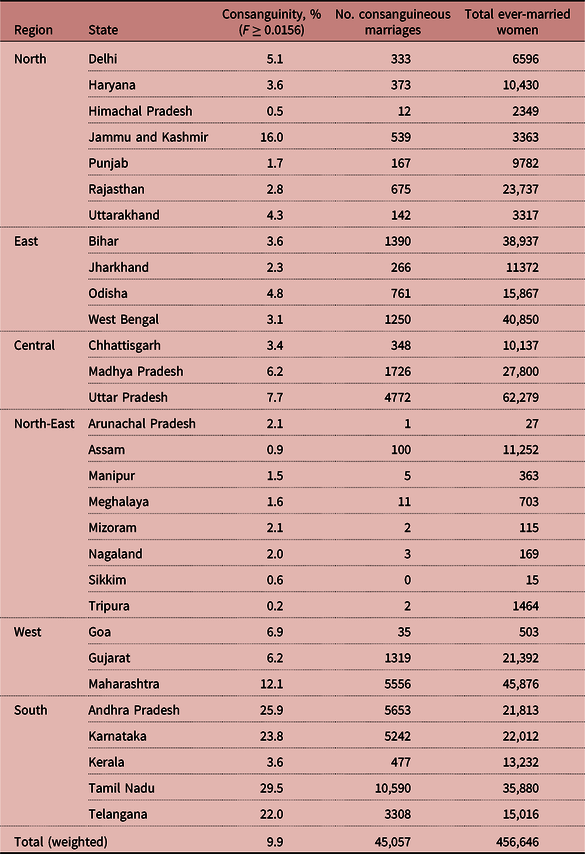
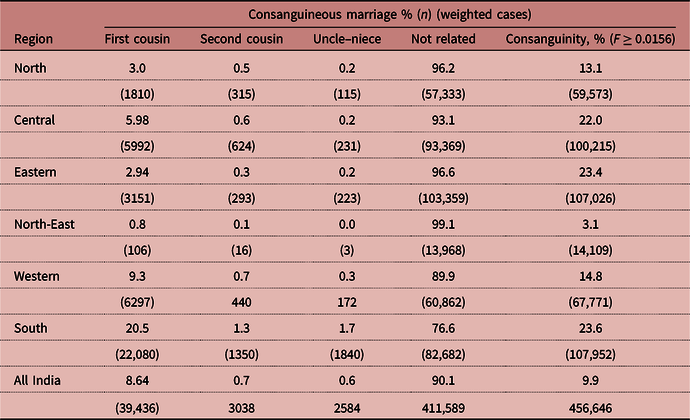
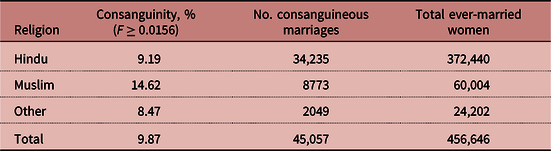
The distribution of consanguineous marriages and its types by region indicates that around 10% of all marriages in India were consanguineous in 2015–16 (Tables 1 and 2). The prevalence of consanguineous marriage was not uniform across the nation; the highest prevalence was observed in the South region and the lowest in the North-East region. The state of Tamil Nadu (located in the South region) showed the highest prevalence of consanguineous marriage, while Sikkim (in the North-East region) showed the lowest prevalence of consanguineous marriage. First-cousin marriage was the preferred form of consanguineous marriage, being more prevalent than second cousin or uncle–niece marriages in all regions (Table 2). Muslims had the highest prevalence of consanguineous marriage, followed by Hindus (Table 3).
Prevalence of consanguineous marriage by Indian region and state (excluding UTs), NFHS-4, 2015–16

Prevalence of types of consanguineous marriage by region, Indian (excluding UTs)

Prevalence of consanguineous marriage by religion, India (excluding UTs)

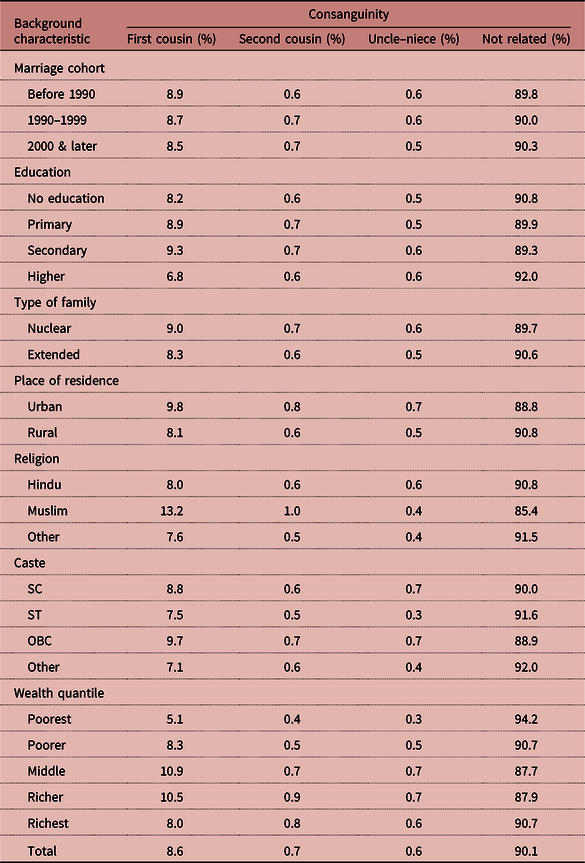
The prevalence of first cousin marriage was slightly higher among respondents who were married before 1990, those with lower levels of education, those living in a nuclear family, those residing in urban areas, those from the Muslim community and those belonging to the OBC category and richer and middle wealth quintiles (Table 4). For second cousin marriage, the prevalence was similar for the background characteristics family type, place of residence, religion, caste and wealth quintile; for uncle–niece marriage, the trend was similar for all the background characteristics except education and religion.
Prevalence of types of consanguineous marriage by background characteristics, India (excluding UTs)

Determinants of consanguineous marriage
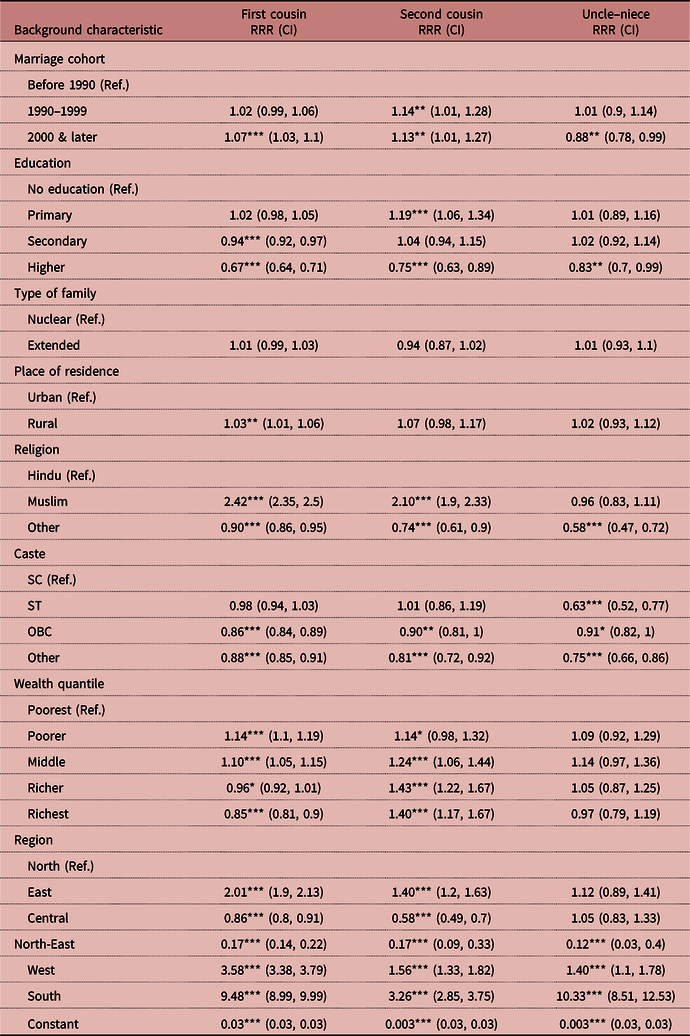
Relative risk ratios (RRRs) obtained from multinomial logistic regression identified plausible correlates of consanguineous marriage types (Table 5). Type of consanguineous marriage (first cousin, second cousin or uncle–niece marriage) was used as the dependent variable in this analysis. The independent variables used were: marriage cohort (to observe the change in the type of consanguinity with time), education level, place of residence (to observe the effect of urbanization), family type, religion and caste (to observe the effect of cultural practices), wealth quintile (to observe the economic effects) and region (to observe the regional effect).
Relative risk ratios (RRRs) obtained from multinomial logistic regression of consanguineous marriage by background characteristics, India

RRR = Relative risk ratio; CI = Confidence interval.
***p < 0.001; **p < 0.01; *p < 0.05; base category = ‘other’ or ‘not related’.
Compared with those who married before 1990, respondents who married after 1999 (in the 2000 & later group) were 1.07 times more likely to marry a first cousin (p < 0.001); those who married between 1990–1999 and those who married in 2000 or later were 1.14 and 1.13 times, respectively, more likely to marry a second cousin (p < 0.01); those who married after in 2000 or later were 0.88 times less likely to marry an uncle (p < 0.01); those educated up to secondary level and up to higher level were 0.94 and 0.67 times, respectively, less likely to marry a first cousin (p < 0.001). The likelihood of a second cousin marriage reduced significantly with an increase in the education level of the respondent (p < 0.001). Similarly, uncle–niece marriage was 0.83 times less likely among the respondents who had a higher level of education compared with non-educated respondents (p < 0.01). No significant association was found between nuclear/extended family type and the prevalence of consanguineous marriage. Rural respondents were 1.03 times more likely to marry first cousins than urban respondents (p < 0.01). Muslims were 2.42 and 2.10 times more likely to marry first and second cousins, respectively, compared with Hindus (p < 0.001). The likelihoods of first cousin (0.90 times), second cousin (0.74 times) and uncle–niece marriages (0.58 times) were significantly decreased for the ‘Other’ religious group compared with Hindus (p < 0.001).
The caste of the respondent was a significant determinant of the likelihood of consanguineous marriage. Those from OBC and ‘Other’ categories were 0.86 and 0.88 times less likely to marry first cousins, respectively, compared with the SC category (p < 0.001). A similar trend was observed for second cousin and uncle–niece marriages. The wealth or economic status of a respondent was a significant determinant of consanguineous marriage. For example, the prevalences of first cousin marriage were 1.14 and 1.10 times more likely among respondents in the poorer and middle wealth quintile groups, respectively, (p < 0.001) compared with the poorest group. The likelihood of first cousin marriage decreased significantly with an increase in the respondent’s wealth quintile. The chances of second cousin marriage were 1.14 (p < 0.05), 1.24, 1.43 and 1.40 times (p < 0.001) higher among the poorer, middle, richer and richest groups, respectively, compared with the poorest group. Also, there was no significant relationship between uncle–niece marriage and respondent’s economic status.
Table 5 also shows that the likelihood of consanguineous marriage varied by region. For example, in the East region, the likelihoods of first cousin and second cousin marriages were, respectively, 2.01 and 1.40 times more compared with the North region (p < 0.001). The Central region had 0.86 and 0.58 times lower likelihood of first cousin and second cousin marriages, respectively, compared with the North region (p < 0.001). The North-East region showed 0.17, 0.17 and 0.12 times lower likelihood of first cousin, second cousin and uncle–niece marriages, respectively, compared with the North region (p < 0.001). The West region showed 3.58, 1.56 and 1.40 times higher likelihoods of first cousin, second cousin and uncle–niece marriages compared with the North region, respectively (p < 0.001). Similarly, compared with the North region, the South region showed 9.48, 3.26 and 10.33 times higher likelihoods of first cousin, second cousin and uncle–niece marriages, respectively (p < 0.001).
Discussion
Consanguineous marriage is one of the most discussed forms of marriage all over the world (Hamamy et al., Reference Hamamy, Antonarakis, Cavalli-Sforza, Temtamy, Romeo and Kate2011; Kelmemi et al., Reference Kelmemi, Chelly, Kharrat and Chaabouni-Bouhamed2015), both in terms of its genetic effect and socio-demographic characteristics. The present study in India reveals that, despite an appreciable improvement in the socioeconomic condition of the country, the decrease in prevalence of consanguineous marriage is not marked. It could be that the religious beliefs of a community play a significant role in determining consanguineous marriage rather than socioeconomic conditions. Regional culture is perhaps another important determinant of consanguineous marriage. Similar to some earlier studies (Bittles et al., Reference Bittles, Coble and Rao1993; Krishnamoorthy & Audinarayana, Reference Krishnamoorthy and Audinarayana2001; Banerjee & Roy, Reference Banerjee and Roy2002; Padmadas & Nair, Reference Padmadas and Nair2002), the higher prevalence of consanguineous marriages in the south of India than elsewhere reflects the cultural dichotomy between the north and south of the country (Dyson & Moore, Reference Dyson and Moore1983).
This study shows that first cousin marriage constitutes the major type of consanguineous marriage in India, corroborating the findings of other studies in the Palestinian Territories (Assaf & Khawaja, Reference Assaf and Khawaja2009), Oman (Islam, Reference Islam2012) and Jordan (Islam, Reference Islam2018). Several studies have shown that Muslims have the highest prevalence of consanguineous marriage (Al-Gazali et al., Reference Al-Gazali, Bener, Abdulrazzaq, Micallef, Al-Khayat and Gaber1997; Bener & Hussain, Reference Bener and Hussain2006; Assaf & Khawaja, Reference Assaf and Khawaja2009; Hamamy et al., Reference Hamamy, Antonarakis, Cavalli-Sforza, Temtamy, Romeo and Kate2011), since some believe it to be the prescribed form of marriage in Islam. Among Muslims, cousin marriage could possibly be described as an example provided by the sunnah (deeds) of the Prophet (Bittles, Reference Bittles2012). It is believed that among six wives of the Prophet, two of the wives were biological relatives. He also married his daughter Fatima to his paternal first cousin, Ali (Armstrong, Reference Armstrong1991).
Several anthropological studies have found a declining trend in consanguinity in many societies (Tfaily, Reference Tfaily2005; Mukherjee et al., Reference Mukherjee, Das and Banik2007; Assaf & Khawaja, Reference Assaf and Khawaja2009; Bittles & Black, Reference Bittles and Black2010; Kalam et al., Reference Kalam, Pal and Ray2016). For example, Assaf and Khawaja (Reference Assaf and Khawaja2009) found a declining trend in consanguinity among women in a recent marriage cohort in the Palestinian territories and found that urban living, household affluence and late age at marriage were possible determinants of this declining trend. In congruence with such studies, the present study also observed a low prevalence of consanguinity among the women of the more recent marriage cohorts and those residing in urban areas. In India, the process of urbanization has been underway very fast (MOSPI, 2017; Bhagat, Reference Bhagat2017). A number of places that were once considered as rural are now equipped with urban facilities and are now treated as urban centres. The expansion of the urban base has led to an increase in the educational attainment of the people, the nuclearization of families, change in occupational pursuits and perhaps an increased opportunity to choose one’s own life partner (Bhagat, Reference Bhagat2017). Several studies have reported an inverse association between consanguineous marriage and women’s educational attainment (Bittles et al., Reference Bittles, Mason, Greene and Appaji1991; Givens & Hirschman, Reference Givens and Hirschman1994; Hamamy et al., Reference Hamamy, Jamhawi, Al-Darawsheh and Ajlouni2005; Shenk et al., Reference Shenk, Towner, Voss and Alam2016; Kaplan et al., Reference Kaplan, Pinar, Kaplan, Aslantekin, Karabulut, Ayar and Dilmen2016), and South Asian countries like India are no exception (Hussain & Bittles, Reference Hussain and Bittles1998; Hamamy et al., Reference Hamamy, Jamhawi, Al-Darawsheh and Ajlouni2005; Bittles & Hussain, Reference Bittles and Hussain2000). The Government of India has also brought in some policies to promote education for all, especially women. Perhaps education as a modernizing variable has had a considerable effect on the socio-demographic transition of India in recent years (MOSPI, 2017). Recent reports show that the literacy level of Indian women is increasing and they are participating more in a number in wage-earning sectors (Chatterjee & Ramu, Reference Chatterjee and Ramu2018). Furthermore, with an increase in education, women are becoming more emancipated and are exercising their opinion in choosing their martial partners (Kelmemi et al., Reference Kelmemi, Chelly, Kharrat and Chaabouni-Bouhamed2015). The findings of the present study are in close agreement.
Economic status, measured as wealth index or wealth quintile, is an important indicator of the prevalence of consanguinity (Shami et al., Reference Shami, Grant and Bittles1994; Hamamy et al., Reference Hamamy, Jamhawi, Al-Darawsheh and Ajlouni2005; Koc, Reference Koc2008; Barbour & Salameh, Reference Barbour and Salameh2009). The changes in economic structure, and increased participation of woman in paid work in developing countries like India, have affected the socio-demographic structure of society (Mammen & Paxson, Reference Mammen and Paxson2000; Datta & Gailey, Reference Datta and Gailey2012). Higher income status signifies a higher standard of living, which plausibly makes family members more knowledgeable about the detrimental effect of consanguinity and allows freedom in choosing marital partners. The present study found that economically affluent households were less likely to marry first cousin, corroborating the findings of other studies (Bittles et al., Reference Bittles, Mason, Greene and Appaji1991; Bittles, Reference Bittles1994; Islam, Reference Islam2012). In this study socioeconomic status had less impact on consanguineous marriage. Close scrutiny of the trends in the results (odds ratios) revealed no clear relationship between socioeconomic status and consanguineous marriage, and religion and the north–south regional cultural dichotomy (Deshai, Reference Deshai2008; Washbrook, Reference Washbrook2009) were found to be the main determinants of consanguineous marriage.
The study would have been more insightful if data on property inheritance and ownership, husbands’ education, women’s parental background, relation with ethnic groups as well as power structure had been included in the analysis. In the NFHS-4 dataset, variables such as husbands’ education and women’s decision-making powers were collected at the state level and thus could not be included in the analyses. In addition, in-depth interviews with the respondents to understand the dynamics of consanguineous marriage in a multi-ethnic habitat like India would have been useful to gain deeper insight.
Acknowledgments
The authors acknowledge the anonymous referees for providing insightful comments in the earlier draft of the paper.
Funding
This research did not receive any specific grant from any funding agency, commercial entity or nor-for-profit organization.
Conflicts of Interest
The authors of this paper do not have any conflicts of interest.
Ethical Approval
The research was carried out by using publicly available database. The authors assert that all procedures contributing to this work comply with the ethical standards of the relevant national and institutional committees in human experimentation and with the Helsinki Declaration of 1978, as revised in 2008.