Introduction
In 2017, over 85,153 seriously ill individuals were served by palliative care (National Hospice Palliative Care Organization [NHPCO], 2018). With an aim to enhance the quality of life of both patient and family, palliative care provides comprehensive care to meet physical, intellectual, emotional, social, and spiritual needs via an interdisciplinary team approach for those with serious or advanced chronic illnesses (National Consensus Project for Quality Palliative Care, 2018; National Institute of Nursing Research [NINR], 2020). Although it has similar services as hospice care, palliative care has distinct features, such as being compatible with primary or curative treatments and addressing pain, difficult symptoms, and stresses from the illness and its treatment. Also, it does not just serve those in terminal stages — or in the last six months of life — but anyone with a serious illness (NHPCO, 2019; NINR, 2020). Additionally, palliative care is provided in diverse community-based settings (i.e., homes, hospices, nursing facilities, assisted living facilities, and long-term care) and hospitals and specialty clinics (NHPCO, 2019).
While palliative care services are growing (Center to Advance Palliative Care and National Palliative Care Research Center, 2019) and benefits are demonstrated (Connor and Bermedo, Reference Connor and Bermedo2014), knowledge about it is low among the general population. According to the 2018 Health Information National Trends Survey, only 29% of American adults reported having knowledge of palliative care (Boakye et al., Reference Boakye, Mohammed and Osazuwa-Peters2019). Moreover, of those, only 11% stated having knowledge enough to explain it to others (Taber et al., Reference Taber, Ellis and Reblin2019). Even among those who reported having some knowledge, most had inaccurate knowledge or misperception about palliative care (Taber et al., Reference Taber, Ellis and Reblin2019). For instance, about 43% of those reporting knowledge thought of death when thinking about palliative care, and 31.7% equated it to hospice care (Cheng et al., Reference Cheng, Wangmo and Hauser2019). Limited or incorrect palliative care knowledge is problematic because it can easily lead to low utilization of the service, as confirmed by prior studies reporting significant association between misconceptions about palliative care and lower acceptance of its services (Boucher et al., Reference Boucher, Raghavan and Smith2016; Litzelman et al., Reference Litzelman, Cottingham and Inui2016).
Racial and gender disparities in palliative care
Palliative care is no exception when it comes to racial and ethnic disparities in correct knowledge and utilization of various health care services. In a study using the 2018 National Cancer Institute Health Information National Trends, Dionne-Odom et al. (Reference Dionne-Odom, Ornstein and Kent2019) found that family caregivers who were minorities were more likely to have never heard of palliative care compared with their White counterparts. Similarly, in a survey study of Black and White cancer patients, Matsuyama et al. (Reference Matsuyama, Balliet and Ingram2011) reported that Blacks were less likely to have heard of palliative care than Whites. Prior studies also showed that utilization rates of palliative care service were significantly lower among minority groups than Whites. For example, among patients eligible for palliative care in two acute care hospitals, Black and Hispanic patients were less likely to receive primary palliative care compared with non-Hispanic Whites (Chuang et al., Reference Chuang, Hope and Allyn2017). Lower use of palliative care among minority patients was also found among stroke patients in inpatient hospital settings (Faigle et al., Reference Faigle, Ziai and Urrutia2017). Hence, previous studies consistently documented racial disparities knowledge and use of palliative care.
Unlike racial disparities, however, prior studies reported mixed results for gender disparity in palliative care knowledge. Some found that men were less likely to be aware of palliative care (Koffman et al., Reference Koffman, Burke and Dias2007; Boakye et al., Reference Boakye, Mohammed and Osazuwa-Peters2019) or less knowledgeable (Kozlov et al., Reference Kozlov, McDarby and Reid2018; Shalev et al., Reference Shalev, Phongtankuel and Kozlov2018) than women, while others reported the opposite results (Barwise et al., Reference Barwise, Cheville and Wieland2019) or no significant difference (Taber et al., Reference Taber, Ellis and Reblin2019). These studies did not provide a clear explanation as to why such mixed results may exist and anticipated further studies to examine gender as a determinant of disparity in palliative care knowledge. Still, studies that found women to be more knowledgeable than men about palliative care offered a possible explanation in that women usually seek more health information (Koffman et al., Reference Koffman, Burke and Dias2007; Boakye et al., Reference Boakye, Mohammed and Osazuwa-Peters2019) or take on caregiving roles more often than men do (Kozlov et al., Reference Kozlov, McDarby and Reid2018), therefore being more likely to hear or learn about different types of health care options such as palliative care.
Palliative care and caregivers of cognitively impaired older adults
Family or other informal caregivers play an important role in palliative care by participating in care discussions and decision-making as well as caregiving education (NHPCO, 2018). Despite their crucial role, Dionne-Odom et al. (Reference Dionne-Odom, Ornstein and Kent2019) reported that more than half of their caregiver participants never heard of palliative care, and, among those who were aware, close to half had misconceptions about it. The role of the caregiver becomes even more critical when the patients’ ability or capacity for decision-making is significantly compromised by cognitive impairment and the caregiver has to step in as a surrogate decision-maker. Prior studies found that, when compared with cognitively intact older adults, cognitively impaired ones are less likely to be treated for pain as serious as that of their counterparts (McDermott et al., Reference McDermott, Nichols and Lovell2014; Chang et al., Reference Chang, Edwards and Morrison2019). Therefore, special attention needs to be paid to cognitively impaired older adults’ needs for managing pain and symptoms from their chronic or serious illnesses. Their caregivers, therefore, should be informed about available care options, such as palliative care, to meet such needs and be provided with correct information.
The current study
Promoting a correct understanding of palliative care among caregivers may be effectively addressed by implementing educational interventions. A pilot educational intervention study in Japan, for example, found increased knowledge of palliative care and positive perception of the service among family caregivers and the general public (Akiyama et al., Reference Akiyama, Hirai and Takebayashi2016). However, past efforts to increase palliative care knowledge through education in the United States have mostly been focused on health care students (Von Gunten et al., Reference Von Gunten, Twaddle and Preodor2005; Chang et al., Reference Chang, Hu and Tsai2009; DeVader and Jeanmonod, Reference DeVader and Jeanmonod2012), professionals (Von Gunten et al., Reference Von Gunten, Twaddle and Preodor2005; Chang et al., Reference Chang, Hu and Tsai2009; DeVader and Jeanmonod, Reference DeVader and Jeanmonod2012; Corbett, Reference Corbett2018), or the general public (Kozlov et al., Reference Kozlov, Reid and Carpenter2017b), not particularly focusing on informal caregivers of cognitively impaired older adults. To address such a gap, the main purpose of this study is to (1) explore changes in palliative care knowledge among informal caregivers of cognitively impaired older adults from before to after an educational intervention and (2) explore the extent to which the intervention reduces gaps in the subgroups (i.e., race and gender) on palliative care knowledge.
Methods
Participants
Participants were recruited through various community venues: local aging service agencies, medical clinics, churches, and health fairs for older adults and family caregivers. Recruitment flyers were posted and distributed through these venues. In addition, advertisements for participant recruitment were published in local newspapers as well as on social media websites. The participant eligibility was: (1) 19 years of age or older and (2) identify oneself as an unpaid, informal caregiver providing any form of assistance or support on a regular basis to a chronically or seriously ill older adult (50 years old or older) who has had the illness for the past one year or more and was diagnosed with cognitive impairment, including but not limited to Alzheimer's Disease and Related Dementias (ADRD). The recruitment advertisement described cognitive impairment as “thinking or memory issues” to assist laypersons’ understanding of the terminology. Interested individuals contacted the research team, and the research team members — the principal investigator and a research assistant — asked questions to decide if the eligibility was met, answered any questions they had about the study, and provided further information if needed. The research team screened the interested individuals for their care recipients’ cognitive impairment by asking them if the care recipient was diagnosed by a doctor to have any type of cognitive impairment or thinking or memory issues, including but not limited to ADRD. When eligibility was confirmed, a face-to-face interview was scheduled at a time and location most convenient to the participant. A follow-up interview was scheduled for a date approximately one month after the first interview. A total of 50 interested individuals contacted the research team and were screened for eligibility. Excluding seven individuals not meeting the eligibility criteria, 43 individuals deemed to be eligible participated and completed both the first and follow-up interviews.
Sample size
To calculate sample size, we used G*Power version 3.1.9.4. Before we estimated our effect size, we started with estimates of effect size from a previous study (Kozlov et al., Reference Kozlov, McDarby and Reid2018), which examined the effectiveness of an educational intervention on palliative care knowledge among the general population utilizing the Palliative Care Knowledge Scale (PaCKS). In that study, its effect size for t-tests was moderate, which was close to medium (e.g., d = 0.4). Based on this calculation, we aimed to detect medium effect size (d = 0.50 or r = 0.30–0.49; Cohen, Reference Cohen1988) for statistical power of 0.80 at alpha 0.05, resulting in at least 34 participants being required.
Data collection
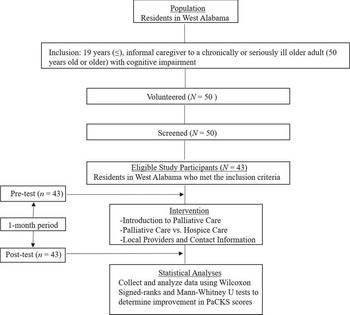
Participant recruitment and data collection occurred from December 2018 to October 2019. The data collection had two phases: (1) a pre-test in an initial, face-to-face interview with each participant with an educational intervention provided immediately after the completion of the interview and (2) a post-test in a follow-up interview, approximately one month after the initial one, either face-to-face or by phone depending on the participant's availability or preference (Figure 1). The interviews and intervention were conducted by the research team, which consisted of the principal investigator of this study (first author) and a graduate research assistant with past training and research experiences in the field of pain management and palliative care. In the initial interview, participants were asked about their demographic and socioeconomic information and tested on their familiarity with and knowledge of palliative care using the 13-item PaCKS. Immediately after the interview was conducted, the interviewer verbally gave a 30-min educational intervention on palliative care covering topics such as (1) definition, (2) purpose, (3) multi-disciplinary providers, (4) included services, (5) care settings, (6) eligibility, and (7) insurance coverage. In addition, the intervention provided information about hospice care in the same topic areas, so that the participant could understand both the similarities and differences between palliative and hospice care. This verbal intervention was accompanied by a brochure the principal investigator made based upon information available on the NHPCO and other national organizations and academic institutes specializing in palliative care. Participants were encouraged to ask any questions about palliative care during and after the intervention. The brochure also listed the contact information of local palliative care service providers. A post-test was conducted in the follow-up interview, given one month after the initial one, repeating PaCKS and asking about any additional questions or concerns participants might have about palliative care. All participants completed both the pre-test and the post-test. About half of the follow-up interviews (n = 22; 51.2%) were conducted face-to-face, while the other half (n = 21; 48.8%) were done by phone. Both face-to-face and over-the-phone follow-up interviews were conducted in private settings with little or no distractions, and all participants successfully completed answering the post-test questions in a single session. Either a face-to-face or a phone interview was used in the post-test depending on the participant's preference because the two methods were found to be similar in prior studies that compared them for administering questionnaires to various samples (Pridemore et al., Reference Pridemore, Damphousse and Moore2005; Janssen et al., Reference Janssen, Visser and Dorhout Mees2010; da Silva et al., Reference da Silva, Morano and Sales2014; Prasad et al., Reference Prasad, Kumar and Misra2018; Dauphinot et al., Reference Dauphinot, Boublay and Moutet2020). The Institutional Review Board (IRB) of the University of Alabama approved the study prior to implementation.
Summary diagram of palliative care knowledge educational intervention.

Measures
Palliative care knowledge
PaCKS is a 13-item, true or false question scale developed to assess general knowledge about palliative care (Kozlov et al., Reference Kozlov, Carpenter and Rodebaugh2017a, Reference Kozlov, McDarby and Reid2018). PaCKS items ask about various domains of palliative care knowledge from goals of palliative care to family coping (see Appendix A). The number of correct responses are tallied, and possible scores for the PaCKS range from 0 (lowest knowledge) to 13 (highest knowledge). As suggested by Kozlov et al. (Reference Kozlov, McDarby and Reid2018), “I don't know” responses were treated as incorrect when calculating total PaCKS scores. The validity and reliability tests met psychometric standards of scale development (Kozlov et al., Reference Kozlov, Carpenter and Rodebaugh2017a). For example, a previous study supported the reliability of PaCKS (α = 0.94; Kozlov et al., Reference Kozlov, McDarby and Reid2018). In our study, the Cronbach alpha values at the pre- and post-test were 0.75 (inter-item r = 0.22) and 0.73 (inter-item r = 0.17), respectively, which were fairly reliable.
Demographics
Participants’ demographic information was collected on their age, gender, race, education level, marital status, religion, and monthly household income.
Data analyses
Descriptive analysis was conducted to characterize the sample. Bivariate analyses including independent samples t-test and chi-square test for independence were also performed to present differences of participants’ characteristics between two racial groups (Whites and Blacks). Since our data did not conform to a normal distribution, nonparametric methods, such as a Wilcoxon signed-ranks test, which is equivalent to a paired samples t-test, were utilized to compare the pre- and post-test PaCKS scores. Also, a Mann–Whitney U test as an alternative to the independent sample t-test was conducted to compare the test scores among different subgroups. All statistical analyses were performed using the IBM SPSS Statistics version 25.
Results
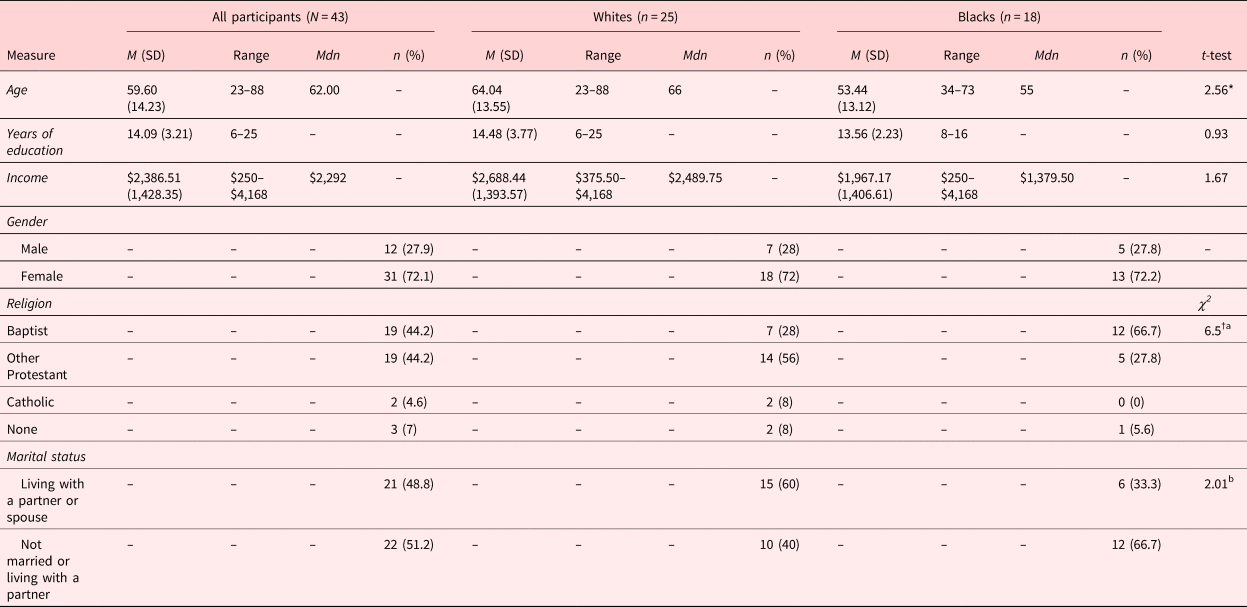
Among the participants (N = 43), the majority were Whites (58.1%), females (72.1%), Protestants (88.4%), and not married or living with a partner (51.2%). The monthly median income was $2,292; the mean years of schooling was 14.09; and the mean age was 59.60 (Mdn = 62; SD = 14.23). The two racial subgroups were not statistically different on sociodemographic characteristics with the exception of Blacks being younger (t(41) = 2.56, p < 0.05) and more likely to be Baptist than Whites (χ 2 = 6.5, p = 0.06). A detailed description of participants’ characteristics, including differences between White and Black participants are displayed in Table 1.
Demographic characteristics of study participants (N = 43)

† p < 0.10.
* p < 0.05.
a Fisher's exact test was used.
b Yates’ continuity correction was used.
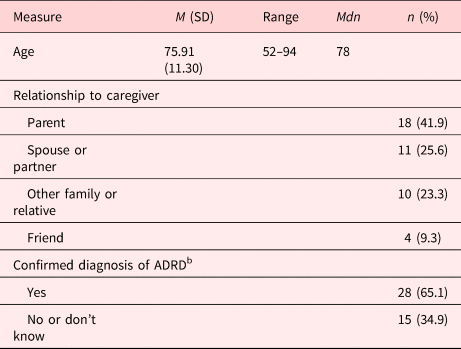
The mean age of study participants’ care recipients (N = 43) was 75.91 (Mdn = 78; SD = 11.30), and the majority of them were parents (41.9%) or spouses or partners (25.6%) of the participants. All the care recipients had been diagnosed by a doctor to have cognitive impairment, and approximately two-thirds (65.1%) of them were reported by the participants to have a confirmed diagnosis of ADRD (Table 2).
Characteristics of study participants’ care recipients (N = 43)a

a Each participant reported caring for one care recipient who met the eligibility (55+, chronically or seriously ill for the past one year+, diagnosed with cognitive impairment).
b ADRD: Alzheimer's Disease or Related Dementias.
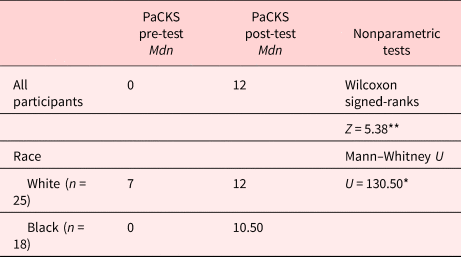
The Wilcoxon signed-ranks test was conducted to determine whether there was a difference in PaCKS scores between the pre- and post-test. Results of the analysis indicated that there was a statistically significant difference between the two tests, z = 5.38, p < 0.001 (Table 3). The median score for the post-test was 12 compared with 0 for the pre-test. Therefore, a statistically significant main effect of the educational intervention on the increase in palliative care knowledge was found. Effect size, defined by  $r = z/\sqrt {n_{{\rm pre}} + n_{{\rm post}}}$ was 0.58, indicating a large effect (Large: ≥ 0.50; Cohen, Reference Cohen1988), which is larger than our prior estimation shown in the sample size estimation.
Pre- and post-test PaCKS scores of all study participants and different races (N = 43)

* p < 0.05.
** p < 0.001; the median scores are reported for nonparametric tests.
As seen in Table 3, the Mann–Whitney U test was conducted to determine whether there was a difference in PaCKS scores in different subgroups. There was a significant difference (U = 143, p < 0.05) between Whites and Blacks in the pre-test. The median pre-test score was 7 for Whites compared with a 0 score for Blacks, which meant the pre-test scores were higher for Whites than Blacks. However, the Mann–Whitney U test also revealed that there was no significant difference (U = 173.50, p > 0.05) between Whites (Mdn = 12) and Blacks (Mdn = 10.50) in the post-test. This suggests that when comparing the scores before and after the intervention, the palliative care education was effective in improving the scores for both racial groups; however, the median post-test scores for Whites and Blacks were similar even though the median pre-test scores were widely different. In terms of the intervention effectiveness, therefore, the amount of increased PaCKS scores was significantly greater for Blacks (Mdn = 9.50) than for Whites (Mdn = 4.00, U = 130.50, p < 0.05). There were no significant differences in gender for the pre-, post-test, and difference between the two tests on PaCKS scores.
Discussion
The findings of this study suggest that a one-time, face-to-face educational intervention is effective in improving the level of palliative care knowledge among informal caregivers of chronically or seriously ill older adults with cognitive impairment. An intervention as simple as verbal and written introduction of palliative care was effective in educating participants about its purpose, components, benefits, and eligibility as well as its differences from hospice care, which was found to be least likely to be known among laypeople in a recent study (Kozlov et al., Reference Kozlov, McDarby and Reid2018). Another study utilized an online, self-administered educational intervention without any face-to-face interaction, which proved to be effective in increasing palliative care knowledge among laypeople (Kozlov et al., Reference Kozlov, Reid and Carpenter2017b). However, the current study adopted a face-to-face intervention to accommodate caregivers who resided in rural areas of West Alabama and may not have reliable access to the internet or computers/smartphones and to provide tailored responses on site in case participants had any questions or concerns.
While prior intervention efforts targeted either healthcare professionals or the general population, this study specifically recruited informal caregivers attending to older adults’ serious or chronic illnesses as well as their cognitive impairment, such as Alzheimer's disease and other dementias. Caregivers oftentimes play a critical role in the health care decision-making for their older family members or relatives, particularly when the patient's cognition is not intact enough to participate in the process. Many caregivers assume the role of surrogate decision-maker in such cases, discussing treatment and care options and making the choice for the patient. Therefore, it is essential for them to be aware of palliative care, have a correct understanding of its purpose, services, and benefits, and know of the availability of providers in their community, so that they can consider palliative care as a way to manage the patient's pain and uncomfortable symptoms from chronic or serious illnesses. A lack of knowledge or misconception about palliative care among patients as well as family caregivers may hinder its access or use by eligible patients, taking away from them the opportunity to improve their quality of life throughout the illness trajectory (Zimmermann et al., Reference Zimmermann, Krzyzanowska and Leighl2016; Kozlov et al., Reference Kozlov, McDarby and Reid2018; Shalev et al., Reference Shalev, Phongtankuel and Kozlov2018; Taber et al., Reference Taber, Ellis and Reblin2019). Informational needs among informal caregivers of seriously or terminally ill patients have been documented in multiple prior studies (McIlfatrick, Reference McIlfatrick2007; Washington et al., Reference Washington, Meadows and Elliott2011; Abramsohn et al., Reference Abramsohn, Jerome and Paradise2019; Kupeli et al., Reference Kupeli, Sampson and Leavey2019), and one of their major needs was information for palliative and supportive care. Therefore, an educational program such as the intervention in this study can meet their informational needs.
Awareness of palliative care is especially important for patients who do not meet hospice eligibility but are in need of specialized pain and symptom management. Therefore, it is important for caregivers to understand correctly both palliative and hospice care and their differences, so that they can seek each type of care appropriately depending on the patient's needs and prognosis. Though the focus of the intervention of this study was palliative care, it was still designed to compare both palliative and hospice care highlighting major differences (e.g., compatibility with curative treatments, requirement of a terminal diagnosis, services provided, available care settings, and local service providers of each type of care). At the same time, the intervention introduced the possibility of transition from palliative care to hospice care in the case of prolonged and advanced, serious illnesses so that caregivers could understand patients can benefit from both types of services in the context of the continuum of care. In healthcare practice, the education and discussion of palliative and hospice care should be provided to patients and caregivers early in the advanced chronic or serious illness trajectory, if possible, before the patient's cognitive impairment further progresses. Such an early intervention can enable patients and caregivers to discuss preferences for such care options and make informed healthcare decisions, including advance care planning, to minimize the pain and suffering accompanied by the illness and maximize the quality of life.
Regarding the educational intervention and PaCKS scores, Whites started out much higher than their Black counterparts and also had higher post-test scores. For Blacks, their baseline knowledge was significantly lower than that of White participants but it improved after intervention to the point where there was no significant difference between the two racial groups. Considering the existing racial disparities in the knowledge of palliative and end-of-life care (Johnson, Reference Johnson2013; LoPresti et al., Reference LoPresti, Dement and Gold2016), this finding is promising in that interventions similar to the one used in this study may contribute to reducing the racial gaps in palliative care knowledge, furthermore, in the use of palliative care services. Past studies shed light on cultural differences in end-of-life care preferences as well as lack of knowledge about alternative care options such as palliative care as major factors contributing to the lower use of palliative care among African-Americans and other minority groups. Therefore, educational interventions should be designed to accommodate such cultural differences to effectively reach African-American patients and family caregivers.
Strengths and limitations
This study has the following strengths. The sample size (N = 43) had an adequate power for a large effect size. Palliative care knowledge was assessed by a standardized measure, PaCKS, which showed a good internal reliability in this study sample. The intervention in this study was provided face-to-face to accommodate rural residents who do not always have access to reliable technology. In addition, by recruiting both Whites and Blacks, racial differences were examined, which is an important factor in disparities in palliative and end-of-life care. Furthermore, even though the sample size was not adequate to control for sociodemographic characteristics in the analyses, the lack of differences between the two racial groups on most of these characteristics minimizes the importance of this problem. Finally, there was no attrition from the pre-test to post-test.
This study also has some limitations. Although the mean (75.91) and median (78) age of participants’ care recipients are consistent with the conventional age criteria for older adult groups, the sampling criteria of this study used age 50 or older to define “older adult.” Such a definition resulted in the inclusion of caregivers of middle-aged care recipients in the sample. Despite the significant results of the intervention, the lack of a control group impacts the validity of the results. Aligned with this, one-group pre- and post-test design is susceptible to a threat to internal validity, such as testing as endogenous change (Engel and Schutt, Reference Engel and Schutt2013). In other words, the difference between pre- and post-test scores may be the result of testing exposing participants to palliative care knowledge at pre-test, therefore, influencing their responses at post-test when asked the same questions as the pre-test. Another limitation exists due to the small subgroup sample size of this study (e.g., 25 Whites and 18 Blacks), which affected the power of our analyses. Additionally, the findings of this study are based upon participants recruited only from West Alabama and cannot be generalized to the broader population. Finally, the study samples included only those who volunteered to participate in the study, therefore, posing a threat to the external validity of the findings. Finally, this study followed up with participants after only one month from the initial intervention, therefore, allowing for us to explore only its short-term effectiveness.
Future research implications
This study provides implications for future research direction. Having a sufficient number of participants in each racial group with a bigger sample is critical for future studies as it would provide adequate statistical power to conduct multivariable analyses controlling for potential confounding or modifying variables. In addition, recruiting a probability sample is important for external validity. Also, having control groups in the intervention will address threats to internal validity. In addition, a longer-term intervention and follow-up will help to assess the longitudinal effectiveness of an educational intervention on the actual service utilization by keeping track of the older adults’ use of palliative care later in their illness trajectory. Though this study adopted an individual-based intervention, individual- versus group-based interventions may be compared in future research to examine if effectiveness of each method differs. If shown to be as effective as or more effective than individual-based ones, group-based interventions may be used to increase the efficiency and feasibility of intervention.
Another strategy to improve the feasibility may be to use community health educators or student interns majoring in healthcare-related disciplines who are trained to deliver the didactic component to participants. While this study utilized a one-time, face-to-face educational intervention, the comparison of different modalities of intervention delivery should be made in future studies to determine the most effective types of intervention in increasing palliative care knowledge among a diverse group of populations with different learning styles, needs, or available resources. For example, this may include live webinars, audio or video recordings, intervention with brochures only, or brochures in combination with other sources. In testing technology-based formats, participants’ accessibility to and familiarity with different technology tools should be considered. Furthermore, it is necessary to investigate group differences in effectiveness of the different intervention formats by race, age, health literacy, and other various factors. Finally, considering the role of religion in some cultures in their views of comfort measures and end-of-life care, it would be worthwhile to test whether the difference in religious affiliation might be a modifying variable in the effectiveness of an intervention, and if so, to use a mixed-methods design with open-ended questions exploring the role of religion. Findings from such a future study would be useful to design an intervention that is tailored to beliefs and values that might affect the acceptance of palliative care.
Future practice implications
Healthcare professionals serving chronically or seriously ill older adults and their informal caregivers may include an educational intervention — as simple as a one-time intervention using verbal introduction with an informational brochure — on palliative care as well as hospice care as part of their discussion of goals of care and treatment plan. Such an intervention can be combined with existing efforts to promote advance care planning so that older adults and their family can make informed decisions for future care. Although older adults may not have an immediate need for palliative or hospice care at the time of an intervention, having knowledge about available options through discussions with their healthcare providers early on may help them readily consider and access needed care for pain and symptom management later in the illness trajectory. As older adults’ conditions change in the course of illness, the intervention may be repeated with more details as needed. For such discussions to happen between older adults and their caregivers and healthcare providers, however, it would be essential to increase palliative care knowledge among the providers through a palliative and end-of-life care focused curriculum and training programs in various healthcare settings.
Funding
This study was funded by the California State University Shiley Institute for Palliative Care (Award number: 203870).
Appendix A. Palliative Care Knowledge Scale (PaCKS; Kozlov et al., Reference Kozlov, Carpenter and Rodebaugh2017a)