Sepsis is a highly prevalent condition associated with significant morbidity and mortality worldwide.Reference Mayr, Yende and Angus 1 Patients treated for sepsis have longer hospital lengths of stay, higher hospital costs, and higher risk of mortality than patients without sepsis.Reference Hall, Williams, DeFrances and Golosinskiy 2 – Reference Kaukonen, Bailey, Suzuki, Pilcher and Bellomo 4 In patients with sepsis complicated by bloodstream infections, prompt identification of bloodstream pathogens and timely initiation of appropriate antimicrobial therapy are 2 cornerstones of therapy.Reference Dellinger, Levy and Rhodes 5 , Reference Kumar, Roberts and Wood 6
Antimicrobial stewardship programs (ASPs) have the potential to improve outcomes for patients with sepsis. ASPs have been shown to reduce time to pathogen identification and time to initiation of appropriate antimicrobial therapy.Reference Dellinger, Levy and Rhodes 5 , Reference Dellit, Owens and McGowan 7 With regard to pathogen identification, numerous rapid diagnostic assays (ie, polymerase chain reaction [PCR], matrix-assisted laser desorption ionization time of flight [MALDI-TOF], and FilmArray) have been used in ASPs to reduce time to pathogen identification.Reference Bauer, Perez, Forrest and Goff 8 In addition, when implemented within the context of real-time feedback, these assays have been associated with improved outcomes such as improved time to initiation of appropriate antimicrobial therapy, reduced hospital length of stay, reduced inpatient mortality, and reduced 30-day mortality.Reference Bauer, West, Balada-Llasat, Pancholi, Stevenson and Goff 9 – Reference Perez, Olsen and Musick 13
Despite these promising data, few studies have evaluated the impact of ASP on time to clinical response in patients with sepsis and concurrent bacteremia or fungemia. Time to clinical response is an important surrogate marker for patient outcomes because clinicians are unlikely to wait until the end of therapy to assess therapeutic failure. As such, early clinical response has been adopted in phase III clinical trials.Reference Powers 14 , Reference Lodise, Anzueto and Weber 15 Recent analyses have suggested that time to clinical response may also serve as a proxy for discharge readiness.Reference Lodise, Anzueto and Weber 15 However, it is unclear whether implementation of rapid diagnostics within ASPs has an impact on time to clinical response. Thus, the purpose of this study was to evaluate the effect of implementing rapid diagnostic technology in an organization with a preexisting ASP on the time to clinical response in patients with sepsis and concurrent bacteremia or fungemia.
METHODS
This study was a single-center, before-and-after study with 1 preintervention group and 1 postintervention group conducted at Albany Medical Center Hospital (AMCH); the institutional review board approved this study. Patients included were (1) >18 years old, (2) had at least 2 signs of systemic inflammatory response syndrome (SIRS), and (3) had concurrent bacteremia or fungemia. SIRS was composed of 4 mutually exclusive categories: (1) leukopenia (white blood cell count <4,000/cm3), leukocytosis (white blood cell count >10,000/cm3), or bandemia (>10% immature neutrophil forms); (2) tachycardia (heart rate >90 beats per minute); (3) tachypnea (respiratory rate >20 breaths per minute) or pCO2 <32 mmHg; and (4) fever (temperature >38.0°C) or hypothermia (temperature <36.0°C). Patients were excluded if they (1) were transferred from an outside hospital with an active bloodstream infection, (2) had polymicrobial blood cultures, (3) had coagulase-negative staphylococci in blood cultures consistent with contamination, (4) were pregnant, or (5) had an absolute neutrophil count <1,000/mm3.
Microbiology Workflow and Validation
The direct MALDI-TOF blood-culture identification method was approved for routine diagnostic testing at AMCH by the New York State Department of Health in October 2013. Identification using the MALDI-TOF Sepsityper Kit (Bruker Daltonics, Billerica, MA) was performed following manufacturer’s recommendations using their blood-culture data settings. Scores were interpreted as follows: scores ≥1.8 genus- and species-level identification, score ≥1.6 to ≤1.79 genus-level identification. Scores ≤1.599 were considered unreliable and were not reported. No discrepant results affecting clinical management were observed in this study. The FilmArray blood culture panel (BCID; BioFire Diagnostics, Salt Lake City, UT) is a method for rapid identification approved by the Food and Drug Administration (FDA) that was validated prior to implementation in the postintervention group.
Preintervention: Initial Standard of Care
The first observational period was February 4, 2013, through August 31, 2013. During this time, all blood cultures were processed through the onsite microbiology laboratory at AMCH. This laboratory processed all blood samples in real time and identified blood-culture pathogens 24 hours per day, 7 days per week. During this study period, the primary method of pathogen identification and susceptibility testing used Sensititre (ThermoFisher Scientific, Waltham, MA). Gram-positive cocci in clusters (ie, Staphylococcus species) were identified using an in-house validated PCR-based assay implemented in 2005.Reference Stellrecht, Grifasi, Graffunder and Lodise 16 The antimicrobial stewardship team at AMCH consists of 3 rotating part-time infectious diseases physicians and 1 full-time infectious diseases pharmacist. During this study period, the antimicrobial stewardship team reviewed the antimicrobial regimens for each admitted patient and conducted walking rounds to provide prospective audit and feedback to clinicians once daily. In addition, a member of the antimicrobial stewardship team was available for consultation Monday through Friday between 9:00 AM and 3:30 PM.
Postintervention: MALDI-TOF and FilmArray Implementation
As the intervention in this study, the bloodstream pathogen identification algorithm was augmented to include additional technologies. The postintervention period was February 4, 2014 to August 31, 2014. MALDI-TOF Sepsityper identification was utilized for blood-culture pathogen identification between 4:00 AM and 3:00 PM and was performed on-demand for positive blood cultures. Between 3:00 PM and 4:00 AM FilmArray blood-culture identification panels were used to identify bacterial genus and species as well as specific resistance elements (ie, mecA, vanA, vanB, and KPC). The identification of S. aureus was conducted using the BacT/Alert automated blood-culture system (bioMèrieux, Marcy-l'Étoile, France), and the rapid identification was primarily performed using the assay developed in house. The results of these tests were reported in the electronic medical record with no specific notification to the clinicians. No other changes were made to the ASP during this period.
Outcomes
The primary endpoint was clinical response. Clinical response was defined as sustained reduction in baseline signs of systemic inflammatory response syndrome to <2 of the aforementioned SIRS categories for at least 24 hours. Secondary endpoints included (1) time from blood-culture collection to reporting of positive blood culture, (2) time from blood culture collection to reporting of final result, (3) time from blood culture collection to administration of initial systemic antimicrobial treatment, (4) time from blood culture collection to active antimicrobial therapy (ie, administration of first antibiotic with documented in vitro antimicrobial activity based on blood culture susceptibility report), (5) time to administration of final antimicrobial regimen, (6) hospital length of stay, (7) ICU length of stay, and (8) all-cause inpatient mortality.
Statistical Analysis
Baseline characteristics and continuous data were analyzed utilizing the Student t test for continuous parametric data and the Mann-Whitney U test for continuous nonparametric data. Categorical baseline characteristics and outcomes were analyzed using the χ2 test for comparing proportions and Fisher’s exact test for proportions with small sample sizes (ie, expected cell count <5). Time-to-event analyses were conducted using stratified Kaplan-Meier estimators (ie, the product limit method). Time to event was analyzed in days for clinical response and in minutes for antimicrobial administration. Time to clinical response was followed until death, discharge, or 30 days post blood culture. Survival distributions were compared with a log-rank test. Cox proportional hazards regression was used to determine the independent effect of the study group on clinical response. Multivariate logistic regression was used to determine the effect of the study group on inpatient mortality. For both multivariate analyses, all baseline variables associated with the outcome of interest (P<.2) and with prevalence at least 5% of the study population were considered as potential confounders. Variables were considered confounders if stepwise entry or removal into the models produced a >10% change in hazards or odds ratios for the Cox and logistic models, respectively. All calculations were computed using SPSS version 22.0 (SPSS, Chicago, IL).
RESULTS
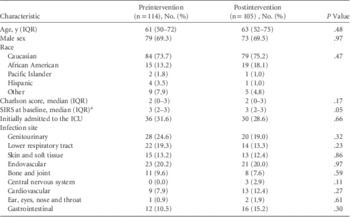
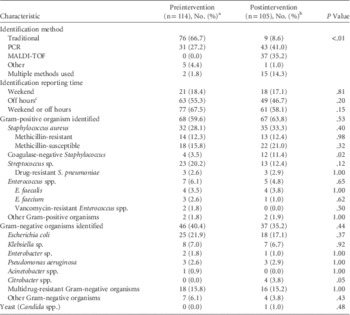
A total of 219 patients (115 preintervention patients and 104 postintervention patients) were enrolled in the study. Baseline characteristics were comparable between groups (Table 1). In the preintervention group, the 2 most common techniques for pathogen identification were traditional methods and PCR. In the postintervention group, the combined rapid diagnostics algorithm resulted in a statistically significant decrease in the use of traditional methods with a concurrent increase in the use of PCR and MALDI-TOF (P<.01). Gram-positive organisms were the most commonly identified pathogens in the cultures and accounted for approximately 60% of all pathogens identified (Table 2).
Baseline Characteristics

NOTE. SIRS, systemic inflammatory response syndrome; ICU, intensive care unit; IQR, interquartile range. Sites are not mutually exclusive.
a SIRS was divided into 4 categories: (1) leukopenia, leukocytosis, or bandemia; (2) tachycardia; (3) tachypnea or pCO2 <32 mmHg; and (4) fever or hypothermia. These data indicate the number of categories for which patients with SIRS were positive.
Pathogen Characteristics

a In the preintervention group, traditional bacterial identification was performed using Sensititre and PCR was performed utilizing only the in-house assay developed for identification of S. aureus.
b In the postintervention group, PCR included the in-house assay developed for identification of S. aureus and FilmArray.
c Off hours: 3:30 PM to 9 AM.
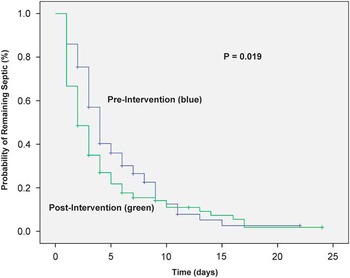
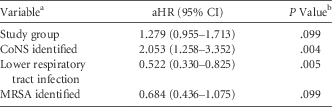
Addition of the rapid diagnostic technology to the ASP was associated with improved clinical response (Figure 1). Overall, clinical response improved in the postintervention group (90.5% vs 80.7%; P=.041). Time to clinical response also improved in the postimplementation group. Median time to clinical response was 4 days (interquartile range [IQR], 2–6 days) in the preintervention group and 2 days (IQR, 1–4 days) in the postintervention group (P=.002). By Cox regression, the distribution of clinical response integrated over time improved in the postintervention group (hazard ratio [HR], 1.360; 95% confidence interval [CI], 1.018–1.816). However, the association between the study group and clinical response was not independently observed after adjusting for potential confounders (Table 3).
Time to clinical response. Clinical response was defined as sustained reduction in baseline signs of systemic inflammatory response syndrome to <2 SIRS categories for at least 24 hours. Time-to-event analyses were conducted utilizing stratified Kaplan-Meier estimators (ie, the product limit method). Time to event was analyzed in days for clinical response and time points were followed until death, discharge, or 30 days after blood culture. Survival distributions were compared using the log-rank test.

Factors Associated with Clinical Response

NOTE. aHR, adjusted hazard ratio.
a Initial variables considered for inclusion included initially admitted to the intensive care unit, methicillin-resistant Staphylococcus aureus, methicillin-sensitive Staphylococcus aureus, methicillin-resistant coagulase-negative staphylococci, other Gram-negative organisms, study group, lower respiratory tract infection, skin and soft tissue infection, glycemic index, and age.
b P values were obtained by Cox regression.
To further evaluate the effect of the antimicrobial stewardship team on clinical response, we conducted 2 subgroup analyses. For the first subgroup (group A), we evaluated sepsis resolution in patients for whom pathogen identification results had been reported during normal stewardship hours (ie, weekdays, 9:00 AM to 3:30 PM). For the second group (group B), we evaluated time to sepsis resolution in those patients who had pathogen identification results reported during off hours (ie, between 3:30 PM and 9:00 AM) or any time during the weekend. In group A (n=81), overall sepsis resolution was numerically higher in the postintervention group than in the previntervention group (90.9% vs 83.8%; P=.50), and the median time to sepsis resolution was shorter in the postintervention group than in the preintervention group (2 days vs 4 days; P=.41). In group B (n=138), overall sepsis resolution improved in the postimplementation group compared with the preintervention group (90% vs 79.2%; P=.08). Median time to sepsis resolution was somewhat shorter in the postintervention group than in the preintervention group (3 days vs 4 days; P=.02).
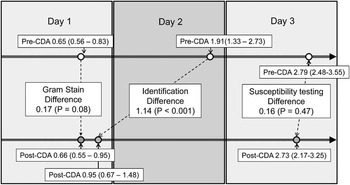
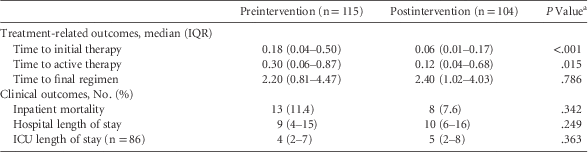
Process metrics related to the implementation of the algorithm were also examined (Figure 2). Time to Gram-stain reporting was unchanged between study periods. However, the combined identification algorithm resulted in decreased time to pathogen identification. Time-to-susceptibility reporting was unchanged. In the postintervention group, time to initial therapy was statistically significantly shorter than in the preintervention group (0.06 days vs 0.18 days; P<.001), and time to first active dose was also statistically significantly shorter than in the preintervention group (0.13 days vs 0.29 days; P=.015); however, no other treatment-related outcomes changed (Table 4). Median hospital length of stay was unchanged between study groups (9 days vs 10 days in pre-intervention and post-intervention groups, respectively; P=.249).
Implementation of combined diagnostic algorithm (CDA). Data are means (95% CI). P value was obtained from a Mann-Whitney U test.

Secondary Outcomes

NOTE. IQR, interquartile range; ICU, intensive care unit. Time in Days.
a P values were obtained using the Mann-Whitney U test, χ2 test, or Fisher’s exact test.
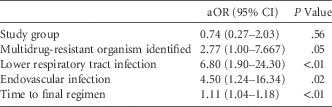
Mortality was also examined as a secondary endpoint. In the bivariate comparison, incidence of mortality was numerically lower in the postintervention study interval than in the preintervention interval (7.6% vs 11.4%; P=.342). In the multivariate logistic regression model, the postintervention group was associated with a nonsignificant decrease in the odds of mortality (adjusted odds ratio [aOR], 0.56; 95% CI, 0.27–2.03). Factors determined to be independently associated with mortality included presence of a multidrug-resistant pathogen, lower respiratory tract infection, endovascular infection, and time (in days) to final regimen (Table 5).
Factors Associated with Inpatient Mortality

NOTE. Initial variables considered for inclusion included, multidrug-resistant organisms identified: methicillin-resistant Staphylococcus aureus (MRSA), drug-resistant S. pneumonia (DRSP), vancomycin-resistant Enterococci (VRE), multidrug-resistant Gram-negative bacilli (MDRGNB), age, sex, initially admitted to the ICU, Charlson score, lower respiratory tract infection, endovascular infection, time to first antibiotic dose, time to first active antibiotic dose, time to final regimen; time in days.
DISCUSSION
Our study has demonstrated that, in the setting of a preexisting ASP, implementation of this rapid diagnostic algorithm was associated with improvement in time to clinical response. To our knowledge, this is one of the first studies to evaluate the effect of rapid diagnostics with antimicrobial stewardship on time to clinical response. To date, few studies have evaluated clinical response as a function of time.Reference Powers 14 Recently, however, the FDA has incorporated time to clinical response into guidance for conducting phase III clinical trials. 17 , 18 In the updated guidance, the FDA now suggests evaluation of early clinical response in phase III clinical trials for acute bacterial skin and skin structure infection and for community-acquired bacterial pneumonia. Accordingly, we evaluated the effect of an antimicrobial stewardship intervention on time to clinical response.
Another unique aspect of this study was that we did not use real-time notification or feedback. Instead, members of the antimicrobial stewardship team performed once-daily antimicrobial stewardship rounds of all patients on antibiotics. Previous studies evaluating the impact of rapid diagnostics have suggested that implementation of rapid diagnostics without real-time reporting to and real-time feedback from an antimicrobial stewardship team has little or no impact on patient outcomes.Reference Frye, Baker and Rustvold 19 – Reference Holtzman, Whitney, Barlam and Miller 22 In contrast, we have demonstrated the benefit of implementing this new rapid identification technology with once-daily antimicrobial stewardship rounds. This finding is important because many institutions may be hesitant to adopt these technologies due to limited ASP resources.Reference Johannsson, Beekmann, Srinivasan, Hersh, Laxminarayan and Polgreen 23
The implementation of once-daily antimicrobial stewardship rounds has the potential to be advantageous in hospitals with limited staffing for several reasons. Numerous studies have suggested that antimicrobial de-escalation is the most common stewardship intervention following implementation of rapid diagnostic technology.Reference Bauer, West, Balada-Llasat, Pancholi, Stevenson and Goff 9 – Reference Nagel, Huang and Kunapuli 12 One of the major benefits of de-escalation is the reduction of hospital costs directly through reduced antimicrobial use. The implementation of once-daily antimicrobial stewardship rounds can produce similar costs savings for once-daily antibiotics because discontinuation of a once daily drug at any point during the dosing interval will produce a net reduction in 1 dose. For drugs administered multiple times per day, there is a net loss equal to the number of daily doses minus one. However, depending on the frequency and costs of the antibiotics used, the cost of these extra doses may not exceed the full-time equivalents needed for real-time feedback. Hence, a once-daily antimicrobial stewardship approach may be appealing to hospitals with fewer staffing resources. Unfortunately, the theoretical decrease in antimicrobial expenditures and increase in antimicrobial utilization was beyond the scope of the present study. In addition to cost comparison, comparative data between once-daily and real-time feedback would be useful for evaluating this type of intervention.
In our study, reduction in hospital length of stay was not observed. This finding is consistent with other literature evaluating similar patient populations. Comparable to our study, Huang et alReference Huang, Newton and Kunapuli 11 did not observe a significant reduction in length of stay after the implementation of MALDI-TOF (14 days preintervention vs 11 days postintervention; P=.066). The length of stay observed by Huang et al is also analogous to our length of stay findings (9 days preintervention vs 10 days postintervention; P=.249). In contrast to our findings, Perez et alReference Perez, Olsen and Musick 13 observed a significant reduction in length of stay after implementation of MALDI-TOF (23.3 days preintervention vs 15.3 days postintervention; P=.0001). We believe that the difference in this finding is due to differences in baseline pathogens.
Mortality was not statistically significantly reduced in our study (11.4% preintervention vs 7.6% postintervention; P=.34). Perez et alReference Perez, Olsen and Musick 13 also examined in-hospital mortality after the implementation of MALDI-TOF technology within an ASP. In their study, mortality was reduced from 21% preintervention to 8.9% postintervention (P=.01). However, their study included a cohort of patients with antibiotic-resistant Gram-negative bacteremia. In the preintervention group, the authors note that a lack of rapid identification of resistance elements may have caused delays in time to appropriate therapy (mean time to active antibiotic therapy, 89.7 hours). Consistent with the literature,Reference Kumar, Roberts and Wood 6 delays in time to active antimicrobial therapy were associated with mortality risk.Reference Perez, Olsen and Musick 13 In contrast, our mean time to active antibiotic therapy in our preintervention group was 7.20 hours. The shorter time to active antimicrobial therapy in our study may have accounted for differences in baseline mortality between our study and previous investigations. Because our baseline mortality was lower than that observed by Perez et al, we may have experienced diminished returns compared with a population with a higher mortality risk.Reference Harris, Bradham, Baumgarten, Zuckerman, Fink and Perencevich 24
We are aware of several limitations of this study. As with any quasi-experimental study, temporal trends can affect study results. The 2 main temporal trends which may have affected this data were the “July effect”Reference Young, Ranji, Wachter, Lee, Niehaus and Auerbach 25 and the individual effect of implementing a novel rapid diagnostic without an ASP. The July effect refers to the theoretically decreased quality of inpatient care due to the changeovers that occurred at the beginning of a new academic year.Reference Young, Ranji, Wachter, Lee, Niehaus and Auerbach 25 To limit the impact of the “July Effect” on this study, we evaluated 2 groups during the same months in 2 different study years. Thus, any July effect would affect both groups equally. The effect of implementing a rapid diagnostic technology without an ASP has been well documented.Reference Frye, Baker and Rustvold 19 – Reference Holtzman, Whitney, Barlam and Miller 22 In settings with no ASP, implementation of a rapid diagnostic technology does not improve patient outcomes. Therefore, any changes in time to clinical response that we observed are likely due to the combination of the rapid diagnostic technology with once-daily antimicrobial stewardship rounds.
As with any retrospective observational study, confounding can affect the interpretation of the study results.Reference Harris, Bradham, Baumgarten, Zuckerman, Fink and Perencevich 24 , Reference Shardell, Harris, El-Kamary, Furuno, Miller and Perencevich 26 In our study, we observed an equitable distribution of baseline infection types and pathogens. For those disease states and pathogens with unequal distributions and adequate sample size, the impact of disease state and pathogen was assessed for the effect on clinical response. In the final model for clinical response, coagulase-negative staphylococci and lower respiratory tract infection were associated with probability of response. These findings are not surprising considering that coagulase-negative staphylococci have limited virulence factors and that pneumonia is still among the most common causes of prolonged hospitalization. However, these findings highlight the interplay between disease severity and clinical response. As such, these observations suggest that patients with more severe illness have prolonged time to clinical response.
Our results have numerous implications. This study is among the first to demonstrate the impact of an ASP on time to clinical response. Time to clinical response is an important outcome that has previously been associated with several important long-term outcomes.Reference Zasowski, Butterfield and McNutt 27 – Reference Aliberti, Peyrani and Filardo 29 In addition, we have proposed an efficient, low-resource method by which ASPs can implement rapid diagnostics within their health system. Lack of funding and/or personnel are often cited as barriers to functional and effective ASPs.Reference Johannsson, Beekmann, Srinivasan, Hersh, Laxminarayan and Polgreen 23 Our data suggest that combining rapid diagnostic technology with once-daily antimicrobial stewardship rounds can improve patient outcomes. Use of multiple technologies (ie, PCR, MALDI-TOF, and FilmArray) may also be efficient for the microbiology laboratory. FilmArray requires less “hands on” time than MALDI-TOF or other PCR methods; therefore, using FilmArray as an off-hours technology may be advantageous because it requires less staffing. As ASPs move toward implementing rapid diagnostic technologies, programs may consider once-daily antimicrobial stewardship rounds as an effective and efficient alternative model. However, comparative evaluations of once-daily versus multiple daily interventions are needed prior to widespread adoption of once-daily antimicrobial stewardship rounds in the context of rapid diagnostics.
In conclusion, time to clinical response was improved in patients with sepsis and concurrent bacteremia or fungemia after implementation of rapid diagnostic technologies within an existing ASP. This model may be of interest to administrators of health systems seeking to implement rapid diagnostic technology in settings with limited funding for staffing. Further research is required to determine the effect on time to sepsis resolution on long-term patient outcomes.
ACKNOWLEDGMENTS
The authors acknowledge Nicole Bilan, Stephen Bradley, Mara Garfinkel, Joseph Gervasio, Christopher Hunter, Lindsay Itro, Katherine Lyndaker, and Tori Smiraglia for their assistance with data collection. In addition, the authors acknowledge Kathleen Stellrecht and the molecular microbiology team for the development or implementation of the PCR based tools used in this study.
Financial support: J.J.C. received grant support from Albany College of Pharmacy and Health Sciences.
Potential conflicts of interest: J.J.C. reports that he has been a speaker for Cubist Pharmaceuticals, a wholly owned subsidiary of Merck and Company. All other authors report no conflicts of interest relevant to this article.