I. INTRODUCTION
Magnesium alloys have excellent properties such as high strength-to-weight ratio and stiffness, good biological compatibility, and electromagnetic shielding ability.Reference Liang, Srinivasan and Blawert1 They are widely applied in fields of aerospace, automobile, electronics, and medical industries.Reference Dhahri, Masse and Mathieu2 However, because magnesium has a close-packed hexagonal crystal structure, the number of slipping surfaces is very limited.Reference Park and Kwon3 This leads to a bad performance on plastic deformation at ambient environment. Therefore, hot forming and pressure casting have been main methods for magnesium alloy production in recent decades.Reference Cao, Wang and Wan4,Reference Barbagallo, Cavaliere and Cerri5 These conventional methods are difficult to fabricate precise and complicate structures. Besides, they generally cost a long time, which could not meet the requirement of the short design-to-manufacture period. It is necessary to develop a more advanced and efficient technology for magnesium alloy fabrication. At present, the selective laser melting (SLM) process becomes an advanced technology for precise and complicate structure fabrication.Reference Herzog, Seyda and Wycisk6 It needs no external machining tools or casting molds,Reference Xu, Brandt and Sun7 besides, cooling rates may reach 106 K/s in molten pools.Reference Li and Gu8 The grain refinement due to large cooling rates can significantly improve the mechanical properties of metal parts. As a result, the SLM technology is supposed to overcome the forming limit of magnesium alloys in conventional methods.
Ng et al.Reference Ng, Savalani and Lau9 and Zhang et al.Reference Zhang, Liao and Coddet10 studied the mechanical properties and relative density of SLM manufactured pure magnesium and as Mg–9% Al powder mixture, respectively. They found that the average hardness of pure magnesium decreases with laser input energy density (LIED) increasing in a moderate value range, and the maximum relative density of the Mg–9% Al alloy was only 82%. Pawlak et al.Reference Pawlak, Rosienkiewicz and Chlebus11 used a point exposure scan method to manufacture AZ31B alloys in the SLM process. Because of the relative low laser energy absorption and narrow temperature range between melting point (650 °C) and boiling point (1107 °C) of magnesium, the fabricated parts have a relatively lower densification than castings. Above research studies mainly focused on optimizing process parameters by experimental methods. Nevertheless, low laser absorption of magnesium is still a problem for magnesium alloy fabrication in the SLM process. Moreover, the influence of LIED on molten pool characteristic and vaporized porosity is seldom discussed.
It is reported that carbon nanotubes (CNTs) show excellent laser absorptions due to the high surface area to volume ratio.Reference Yang, Ci and Bur12 In this study, CNTs as additives are composited with AZ31B powders. An approach of numerical simulation is used to compare molten pool characteristics between AZ31B and CNTs/AZ31B composites in the SLM process. Furthermore, effects of LIED on molten pool characteristics and vaporized porosity of SLMed CNTs/AZ31B composites are analyzed by experiment and simulation. Besides, microstructure, surface morphologies, and mechanical properties of SLMed CNTs/AZ31B composites are investigated by experiments.
II. MATERIALS AND METHODS
A. Numerical model description of the SLM process
A three-dimensional finite element model was established by ABAQUS software to simulate the heat transfer procedure in the SLM process. Powder bed dimension is 1.2 × 0.6 × 0.03 mm, and the substrate is in 1.2 × 0.6 × 1.0 mm. The laser scanning is discontinuous, which is defined as a point exposure scanning mode.
There are some assumptions proposed to make physical problems in the SLM process mathematically treatable:
(i) The energy inputted by laser beams is regarded as a surface heat flux, whose density obeys Gaussian distribution.
(ii) The surrounding condition during the process is very stable, and consequently, heat emissivity and convection in the closed system are seemed as constant.
(iii) The powder bed is determined to be a uniform continuum whose physical properties only related to temperature.
(iv)The CNTs/AZ31B composite is defined as one homogeneous material other than two individual phases, so effects of individual phases on each other are ignored.
1. Moving Gaussian heat flux
The input laser heat flux density obeys Gaussian distribution,Reference Goldak, Bibby and Moore13 and it could be expressed as follows:
 $${q_{{\rm{in}}}} = {{2A{P_{{\rm{in}}}}} \over {\pi {\omega ^2}}}\exp \left( { - {{2{r^2}} \over {{\omega ^2}}}} \right),\;{r^2} = {\left( {x - {x_0}} \right)^2} + {\left( {y - {y_0}} \right)^2} + {\left( {z - {z_0}} \right)^2}\quad ,$$
where A is the laser absorptivity coefficient of powder bed, P in is the average input laser power in the pulsed process case, ω is the incident laser beam radius, r is the distance away from the laser beam center on the powder bed, and x 0, y 0, and z 0 represent the coordinate point of the laser beam center. During the SLM process, the laser functional time and input energy as well as input power should be defined as follows:
 $$t = {{{p_{\rm{d}}}} \over {{v_{\rm{l}}}}}\quad ,$$
 $${E_{{\rm{in}}}} = P \cdot {t_{\rm{e}}}\quad ,$$
 $${P_{{\rm{in}}}} = {{{E_{{\rm{in}}}}} \over t}\quad ,$$
where p d is the point distance, v l is the laser scanning velocity, P is the input laser power, and t e is the laser exposure time. Combining Eqs. (1)–(4), the simulated Gaussian heat flux density q in for the SLM process is eventually expressed as follows:
 $${q_{{\rm{in}}}} = {{2A{v_{\rm{l}}}} \over {\pi {\omega ^2}{p_{\rm{d}}}}} \cdot P{t_{\rm{e}}} \cdot \exp \left( { - {{2{r^2}} \over {{\omega ^2}}}} \right),\;{r^2} = {\left( {x - {x_0}} \right)^2} + {\left( {y - {y_0}} \right)^2} + {\left( {z - {z_0}} \right)^2}\quad .$$
2. Initial and boundary conditions
Initial temperatures of the powder bed (R1) and substrate (R2) are defined as the initial condition of heat transfer analysis, which is expressed by
 $${\left. {T\left( {x,y,z,t} \right)} \right|_{t = 0}} = \left\{ \matrix{ 25\;{\rm{^\circ C}},\;\left( {x,y,z \in {{\bf{R}}_{\bf{1}}}} \right) \hfill \cr 100\;{\rm{^\circ C}},\;\left( {x,y,z \in {{\bf{R}}_{\bf{2}}}} \right) \hfill \cr} \right.\quad .$$
The powder bed, substrate, and natural surrounding are regarded as a closed and adiabatic system, so the energy balance of the system obeys the first law of thermodynamics.Reference Dai and Shaw14 Therefore, natural boundary conditions can be described as follows:
 $$\left( {{q_{{\rm{in}}}} - q - {q_{\rm{c}}} - {q_{\rm{r}}}} \right)\left| {_{z = {z_0}}} \right. = 0,\left( {x,y,z \in {{\bf{R}}_{\bf{1}}}} \right)\quad ,$$
where z 0 stands for the interface between powder bed with laser beam; q, q c, and q r are the heat fluxes of energy losses through thermal conduction, convection, and radiation,Reference Vogt, Holst and Winter15 which could be further expressed as follows:
 $$q = {k_{\rm{p}}}{{\partial T} \over {\partial t}}\quad ,$$
 $${q_{\rm{c}}} = {h_{\rm{c}}}\left( {T - {T_0}} \right)\quad ,$$
 $${q_{\rm{r}}} = {\sigma _{\rm{c}}}\varepsilon \left( {{T^4} - {T_0}^4} \right)\quad ,$$
where h c is the heat transfer coefficient of natural thermal convection, σc is the Stefan–Boltzmann constant, and ε is the emissivity. Finally, Eq. (7) could be given as follows:
 $$\matrix{ { - {k_{\rm{p}}}{{\left. {{{\partial T} \over {\partial t}}} \right|}_{z = 0.03}} = {{2A{v_{\rm{l}}}} \over {\pi {\omega ^2}{p_{\rm{d}}}}} \cdot P{t_{\rm{e}}} \cdot \exp {{\left. {\left( { - 2{{{x^2} + {y^2}} \over {{\omega ^2}}}} \right)} \right|}_{z = 0.03}} - {h_{\rm{c}}}{{\left. {\left( {T - {T_0 }} \right)} \right|}_{z = 0.03}}} \cr { - {\sigma _{\rm{e}}}\varepsilon {{\left. {\left( {{T^4} - {T_0 }^4} \right)} \right|}_{z = 0.03}},\;\left( {x,y,z \in {{\bf{R}}_{\bf{1}}}} \right)} \cr} \quad .$$
3. Temperature distribution derivation
Heat transfer is dominated by heat conduction, so temporary temperature field distribution of the powder bed and substrate can be expressed as follows:
 $$\rho C{{\partial T} \over {\partial t}} = k\left( {{{{\partial ^2}T} \over {\partial {x^2}}} + {{{\partial ^2}T} \over {\partial {y^2}}} + {{{\partial ^2}T} \over {\partial {z^2}}}} \right),\;\left( {x,y,z \in {{\bf{R}}_{\bf{1}}} \cup {{\bf{R}}_{\bf{2}}}} \right)\quad ,$$
where ρ, C, and k are density, specific heat capacity, and thermal conductivity of materials.
B. Physical properties of the composite material
For deriving the physical properties of a solid composite, first, volume fractions of additives (V add) and the matrix (V m) could be derived from their individual densities (ρadd and ρm) and weight percentages (W add and W m):
 $${V_{{\rm{add}}}} = {{{\rho _{\rm{m}}} \cdot {W_{{\rm{add}}}}} \over {{\rho _{\rm{m}}} \cdot {W_{{\rm{add}}}} + {\rho _{{\rm{add}}}} \cdot {W_{\rm{m}}}}}\quad ,$$
 $${V_{\rm{m}}} = 1 - {V_{{\rm{add}}}}\quad .$$
Furthermore, composite density (ρm) and specific heat capacity (C) could be calculated by using the following equations:
 $$\rho = {\rho _{\rm{m}}} \cdot {V_{\rm{m}}} + {\rho _{{\rm{add}}}} \cdot {V_{{\rm{add}}}}\quad ,$$
 $$C = {C_{\rm{m}}} \cdot {V_{\rm{m}}} + {C_{{\rm{add}}}} \cdot {V_{{\rm{add}}}}\quad .$$
By considering the additive shape, size, and interfacial layer (additive/matrix interface) influences, this study adopts the model developed by Murshed et al.Reference Murshed, Leong and Yang16 to predict the thermal conductivity of the solid composite, which is expressed as follows:
 $$k = {k_{\rm{m}}}\left\{ {{{{V_{{\rm{add}}}}\delta \left( {{k_{{\rm{add}}}} - \delta {k_{\rm{m}}}} \right)\left( {\gamma _1^2 - {\gamma ^2} + 1} \right) + \left( {{k_{{\rm{add}}}} + \delta {k_{\rm{m}}}} \right)\gamma _1^2\left[ {{V_{{\rm{add}}}}{\gamma ^2}\left( {\delta - 1} \right) + 1} \right]} \over {\gamma _1^2\left( {{k_{{\rm{add}}}} + \delta {k_{\rm{m}}}} \right) - \left( {{k_{{\rm{add}}}} - \delta {k_{\rm{m}}}} \right){V_{{\rm{add}}}}\left( {\gamma _1^2 + {\gamma ^2} - 1} \right)}}} \right\}\quad ,$$
 $$\delta = {{{k_{{\rm{if}}}}} \over {{k_{\rm{m}}}}}\quad ,$$
 $$\gamma = 1 + {{{t_{\rm{i}}}} \over {{r_{\rm{p}}}}}\quad ,$$
 $${\gamma _1} = 1 + {{{t_{\rm{i}}}} \over {2{r_{\rm{p}}}}}\quad ,$$
where r p is the average radius of CNTs, t i is the interfacial layer thickness, and k if is the thermal conductivity of the interface.
There are some relationships of physical properties between solid with powders:
 $${\rho _{\rm{p}}} = \rho \cdot \left( {1 - \theta } \right) + {\rho _{\rm{g}}} \cdot \theta \quad ,$$
 $${C_{\rm{p}}} = C \cdot \left( {1 - \theta } \right) + {C_{\rm{g}}} \cdot \theta \quad ,$$
 $${{{k_{\rm{p}}}} \over {{k_{\rm{g}}}}} = \left( {1 - \sqrt {\left( {1 - \theta } \right)} } \right)\left( {1 + {{\theta \cdot {k_{\rm{r}}}} \over {{k_{\rm{g}}}}}} \right) + \sqrt {\left( {1 - \theta } \right)} \left\{ {{2 \over {\left( {1 - {{{k_{\rm{g}}}} \over k}} \right)}}\left[ {{1 \over {\left( {1 - {{{k_{\rm{g}}}} \over k}} \right)}}\ln \left( {{{{k_{\rm{g}}}} \over k}} \right) - 1} \right] + {{{k_{\rm{r}}}} \over {{k_{\rm{g}}}}}} \right\}\quad ,$$
where ρp, C p, and k p are those of powders; ρg, C g, and k g are those of argon gas; θ is the powder porosity, and k r is the thermal radiation among powder particles.Reference Sih and Barlow17
C. Numerical calculation
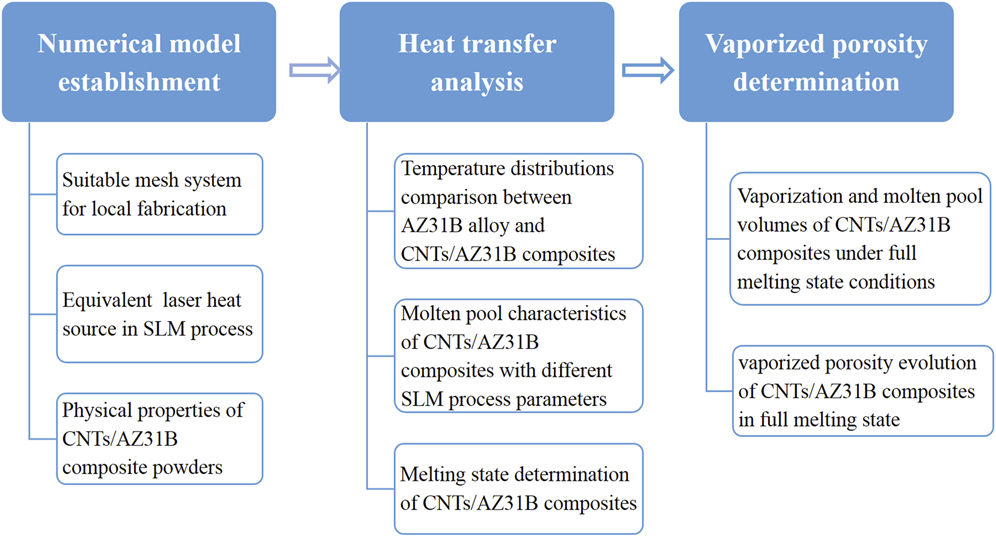
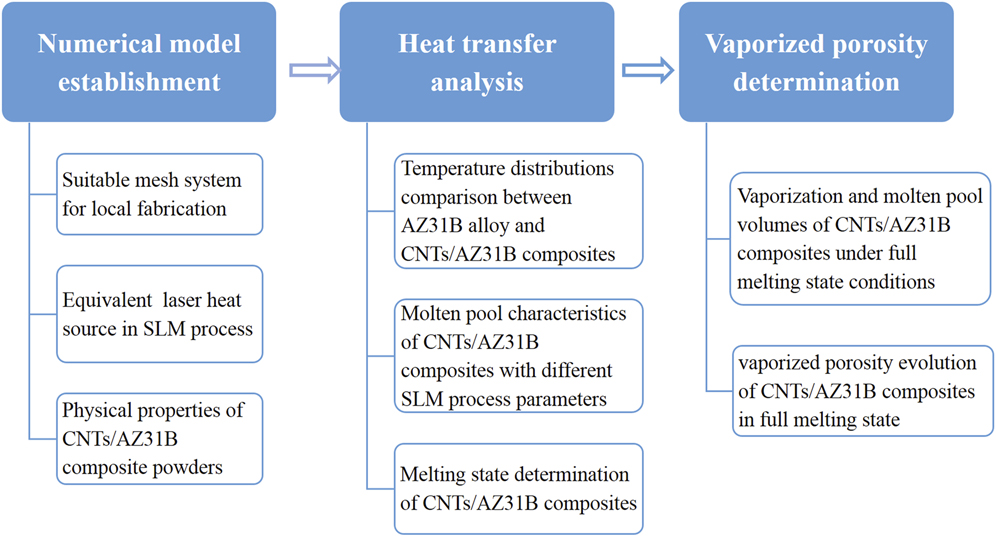
Figure 1 describes the numerical calculation methodology. First, a reasonable numerical model was established, which possesses an equivalent laser heat source for the process and suitable mesh system for the material. At the same time, physical properties of composite powders were imported before calculating. Second, heat transfer analysis was operated. Temperature distribution curves as well as molten pool characteristics for SLMed CNTs/AZ31B composites under various LIEDs could be obtained. In the following, corresponding melting states of composites in different processes were determined according to a referenced criterion. Third, vaporized porosities for SLMed CNTs/AZ31B composites under conditions of full melting state could be evaluated. Meanwhile, the evolution of the vaporized porosity of composites was deduced. Actually, LIED is not the only parameter that affects the laser processingReference Wandera and Kujanpaa18; however, other parameters seem as constant, so they are neglected in the process. LIED in the SLM processReference Harrison, Todd and Mumtaz19 could be expressed as follows:
 $${\rm{LIED}} = {{P \cdot {t_{\rm{e}}}} \over {{p_{\rm{d}}} \cdot {D_{\rm{p}}} \cdot {H_{\rm{s}}}}}\quad ,$$
p d (point distance), D p (layer thickness), and H s (hatch spacing) are kept constant, so LIED only concerns about laser power and exposure time.
Flowchart of numerical calculation methodology.
D. Experiments
1. Composite powder preparation
Experimental AZ31B alloy powders (with an average particle size of 30 μm) are supplied by Tangshan Weihao Magnesium Powder Co. Ltd., Tangshan, China. Multiwalled CNTs (purity >98%, outer diameter: 30–50 nm, length: 10–20 μm) are supplied by Chengdu Organic Chemicals Co. Ltd., Chengdu, China. According to previous research of Wang et al.,Reference Wang and Wei20 composite powders containing 1.5 wt% CNTs have the most excellent dispersion and preferable laser absorption. Therefore, a planetary ball mill (Fritsch Gmbh, Idar-Oberstein, Germany, Pulverisette 7) is applied to mix 1.5 wt% CNTs into AZ31B powders to fabricate composite powders. The weight ratio of ball to powders is 4:1, and the mill rotation rate is set as 200 rpm. For preventing powder oxidization, the whole process is executed for 4 h in a glove box (Etelux Inertgas-System Co., Ltd., Beijing, China, Lab2000) with absolute vacuity less than 10−3 Pa. The average particle size of prepared CNTs/AZ31B composite powders is 23 μm, which was smaller than that of original AZ31B alloy powders.
Physical properties of AZ31B and CNTs are referred to research studies from Gan et al.,Reference Gan, Wang and Cui21 Zhang et al.,Reference Zhang, Zhou and Chen22 and Li et al.Reference Li and Chou23 Because the addition of CNTs is very limited, their effects on temperature-independent properties are ignored. Meanwhile, temperature-dependent properties such as heat conductivity and heat capacity of composites are derived by Eqs. (16) and (17).
2. SLM process
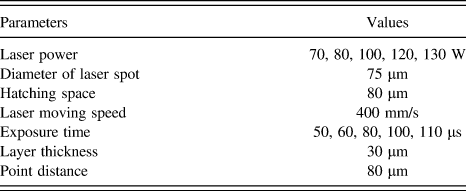
A self-made instrument is used to carry out SLM experiments. The equipment mainly contains laser generator, laser scanning system, powder laying system, atmosphere control system, and software automation system. The laser scanning system has a pulsed laser source with a wave length of 1070 nm, whose maximal power is 200 W. The SLM process mainly includes four procedures: (i) Air evacuation and argon gas charging in working volume until oxygen content is below 800 ppm; (ii) The substrate is preheated to 100 °C, then powders are laid on it as the first powder layer; (iii) Laser source is moving according to a preset point distance and hatch spacing to accomplish the first layer formation; (iv) The substrate is descended by one layer depth then powder laying and laser scanning are repeated. These steps are repeated until the whole part is completely constructed. To reduce temperature gradient influence on residual stress in the material, laser scanning direction rotates by 67° for each powder layer processing. All process parameters are listed in Table I, and corresponding LIEDs are derived by Eq. (24). The range of LIEDs is from 18 to 68 J/mm3, and nine typical values (26, 29, 31, 33, 42, 50, 52, 54, and 57 J/mm3) are chosen to analyze.
SLM process parameters in experiments.

3. Characterization methods
Laser absorptions of materials are measured by using an ultraviolet visible near-infrared spectrophotometer (PerkinElmer Co., Ltd., Waltham, Massachusetts, Lambda 950). A field emission scanning electron microscope (JEOL Co., Ltd., Tokyo, Japan, JSM-7800F) is used to observe the sample microstructures and surface morphologies. Sample densities are measured by using a densimeter (BEYONG TEST Co., Ltd., Dongguan, China, DE-120M) using the Archimedes method, whose mass accuracy is 0.1 mg. The calculation of the sample density as well as the relative density could be expressed by
 $$\rho = {{{M_{\rm{a}}} \cdot {\rho _{{\rm{water}}}}} \over {{M_{\rm{a}}} - {M_{\rm{w}}}}}\quad ,$$
 $${R_\rho } = {\rho \over {{\rho _0}}} \times 100\% \quad ,$$
where M a and M w are the sample weights in air and water, ρwater is the water density in ambient environment, and ρ0 is the theoretical solid density of the AZ31B alloy. Every sample is measured three times, then the averaged. Then, hardness measurements are performed by using a microhardness tester (Shanghai Optical Instrument Plant, Shanghai, China, HX-1000TM) with a loading force of 100 gf and a time of 20 s according to the ASTM E384-11 standard. Two adjacent measuring points have a certain distance of 0.3 mm. Ten points are respectively measured along vertical, horizontal, and tangential directions. The average hardness of 30 measuring points is taken as the final result for every sample. A tensile machine (SANS Co., Ltd., Shenzhen, China, CMT5105) with a maximal force of 100 kN is used to operate tensile tests in ambient environment. The tensile speed is set as 0.5 mm/min. All the samples are made according to the ASTM E8/E8M-08 standard. For each type of samples, tensile tests are repeated three times. Finally, the average value represents the mechanical property of the specific type of the sample.
III. RESULTS AND DISCUSSION
A. Comparison of laser absorption and molten pool characteristics for the AZ31B alloy and CNTs/AZ31B composites
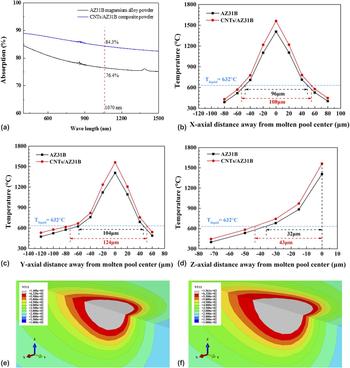
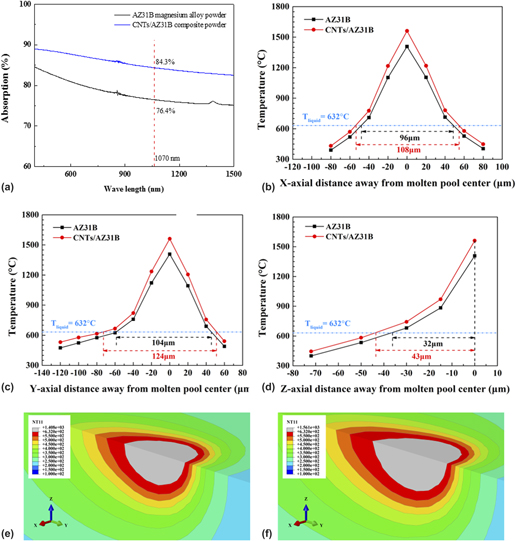
Figure 2(a) displays laser absorptions of the AZ31B alloy and CNTs/AZ31B composites in a laser wave length ranging from 400 to 1500 nm. For both the materials, laser absorptions have a descending tendency with laser wave length increasing. After compositing CNTs into AZ31B powders, laser absorptions are entirely enhanced in the wave length range. This suggests that compositing CNTs into the AZ31B alloy is helpful to enhance laser absorption. It may be attributed to extremely high laser absorption of CNTs, which was experimentally determined by Shi et al.Reference Shi, Ok and Baac24 Considering the laser applied in SLM experiments having a fixed wave length of 1070 nm, absorptions of laser with 1070 nm wave length of two materials are compared. The laser absorption of the AZ31B alloy is determined as 76.4%, while that of CNTs/AZ31B composites reaches 84.3%. The laser absorption is enhanced by 7.9% when compositing 1.5 wt% CNTs into AZ31B powders. The function mechanism is that only a very small wave length and material losses occur with a plane incident wave propagating inside the CNT array.Reference Hashemi and Nefedov25 It is supposed to solve the problem of low laser absorption in laser processing for magnesium alloys. Furthermore, laser absorptions of two materials are applied into the heat transfer model to compare temperature and molten pool characteristics.
(a) Measured laser absorptions of AZ31B powders and CNTs/AZ31B composite powders; (b–d) simulated X, Y, and Z-axial temperature distributions for the AZ31B alloy and CNTs/AZ31B composites; (e and f) simulated molten pool morphologies of the AZ31B alloy and CNTs/AZ31B composites.

Figures 2(b)–2(f) show the simulated temperature distribution curves and molten pool morphologies of the AZ31B alloy and CNTs/AZ31B composites with an LIED of 42 J/mm3. Temperature distribution along the width (X-axial direction) of a molten pool is symmetric, while it is near-symmetric along the length (Y-axial direction) of a molten pool. Actually, the maximal temperature locus shifts to the length direction, which coincides with the laser scan direction. On contrast, temperatures decrease along the depth (Z-axial direction) of a molten pool because thermal energy is conducted from the powder bed to the substrate. Temperatures of the molten pool in the CNTs/AZ31B composite are higher than those of the AZ31B alloy, and the maximal value changes from 1408 to 1561 °C. The molten pool dimension along X, Y, and Z-axial directions is increased by 12.5%, 19.2%, and 34.4%, respectively, after 1.5 wt% CNTs composited. The increments of temperature and molten pool dimension attribute to laser absorption enhancement.
B. Molten pool evolutions of CNTs/AZ31B composites under various LIEDs
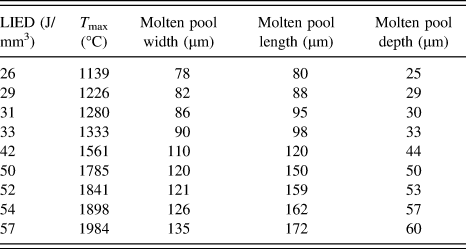
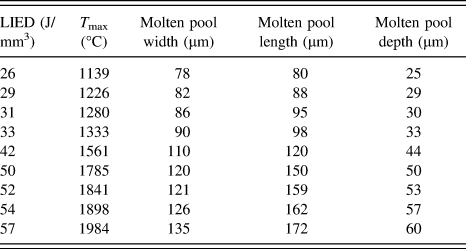
Table II lists simulated molten pool characteristics under nine various LIEDs. Both the temperature and molten pool dimension of CNTs/AZ31B composites increase with LIED increasing. A low LIED normally generates a small molten pool, which could not form a fully metallurgical bonding between adjacent scanning tracks or layers. As a result, the lack-of-fusion state of molten pools may lead to relatively low density of a SLMed part.
Molten pool characteristics in SLM processes with different LIEDs.
According to criterion given by Tang et al.,Reference Tang, Pistorius and Beuth26 the full melting condition for SLMed parts could be expressed as follows:
 $$N = {\left( {{{{H_{\rm{s}}}} \over {{W_{{\rm{mp}}}}}}} \right)^2} + {\left( {{{{D_{\rm{p}}}} \over {{D_{{\rm{mp}}}}}}} \right)^2} \le 1\quad ,$$
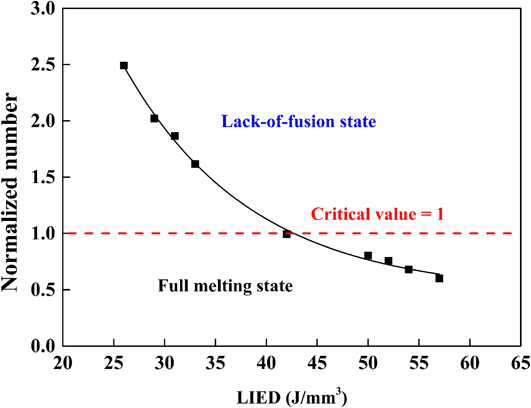
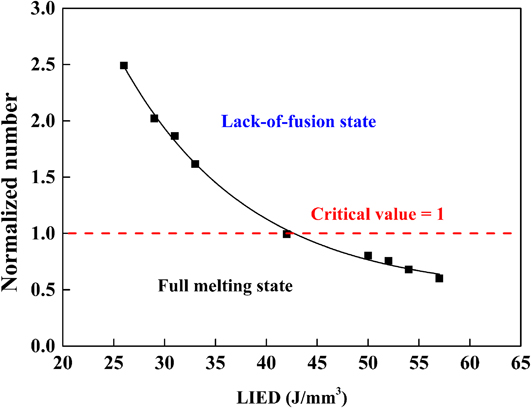
where W mp and D mp are the width and depth of the molten pool. The critical value of the normalized number N is given by one. If N was larger than one, it means that molten pools are in the lack-of-fusion state. Figure 3 displays normalized numbers for nine various LIEDs. As a result, only LIEDs of 42, 50, 52, 54, and 57 J/mm3 meet the condition of the full melting state. Thus, the SLM process window of CNTs/AZ31B composites should be determined by LIEDs larger than 42 J/mm3.
Melting states of molten pools in SLM processes with various LIEDs.
C. Vaporized porosity evolution of CNTs/AZ31B composites
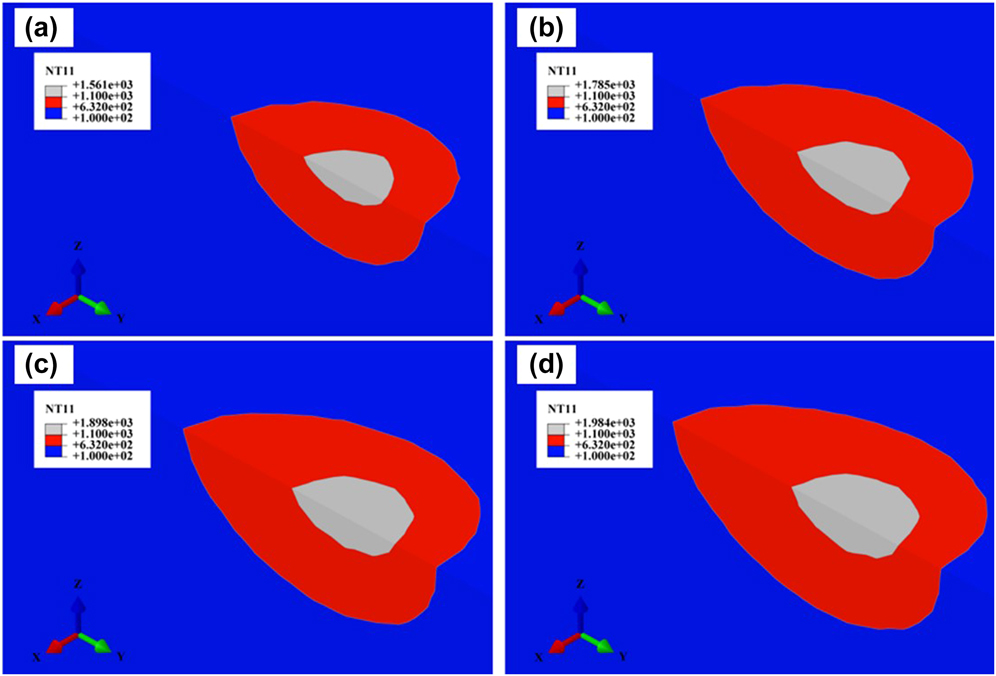
After determining the process window, vaporization of SLMed samples with LIEDs of 42, 50, 54, and 57 J/mm3 are investigated by simulation. Figure 4 illustrates the vaporization region (recognized as gray) with a temperature higher than boiling point (1100 °C). On contrast, the place with temperature range from melting point (632 °C) to boiling point seems as the molten pool with a full melting state and marked as red. Because input heat flux obeys Gaussian distribution, the molten pool and vaporization region are in half-ellipsoidal shapes. Differently, the vaporization region has a shape of similar equilateral ellipsoid while that of molten pool is inequilateral.
Simulated vaporization region in molten pools of SLMed CNTs/AZ31B composites: (a) 42 J/mm3, (b) 50 J/mm3, (c) 54 J/mm3, and (d) 57 J/mm3.
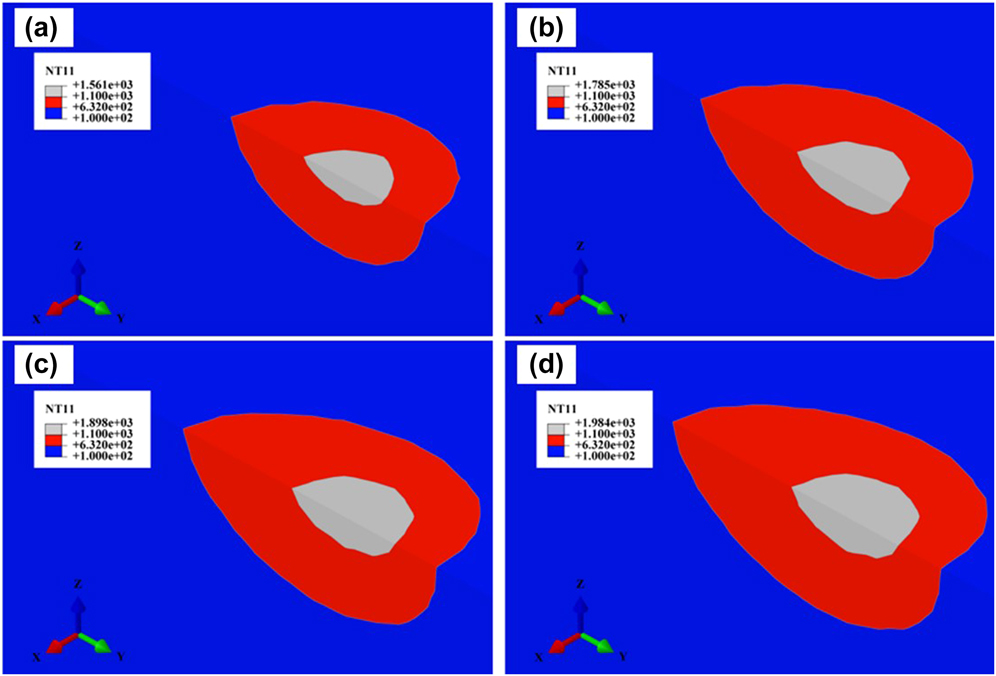
With the enhancement of the LIED, both the dimensions of the vaporization region and molten pool increase. This indicates that the mass loss due to vaporization becomes more intensive with a higher LIED applied. To make the vaporization mathematically comparable, volumes of the vaporized region and molten pool are first calculated. Furthermore, the volume ratio of vaporization region to molten pool is defined as vaporization porosity. Volumes of the vaporization region and molten pool as well as the vaporization porosity could be expressed as follows, while the empirical formula [Eq. (29)] estimating a molten pool volume was given by Temmler et al.Reference Temmler, Küpper and Walochnik27:
 $${V_{{\rm{vp}}}} = {{4\pi } \over 3} \cdot {{{W_{{\rm{vp}}}}} \over 2} \cdot {{{L_{{\rm{vp}}}}} \over 2} \cdot {D_{{\rm{vp}}}}\quad ,$$
 $${V_{{\rm{mp}}}} \approx {\pi \over 6} \cdot {D_{{\rm{mp}}}} \cdot \left( {{3 \over 4} \cdot W_{{\rm{mp}}}^2 + D_{{\rm{mp}}}^2} \right)\quad ,$$
 $${p_{{\rm{vap}}}} = {{{V_{{\rm{vr}}}}} \over {{V_{{\rm{mp}}}}}}\quad ,$$
 $${R_{{\rm{sim}}}} = \left( {1 - {p_{{\rm{vap}}}}} \right) \times 100\% \quad ,$$
where W vp, L vp, and D vp represent the width, length, and depth of the vaporization region, respectively. W mp and D mp are the width and depth of the molten pool, respectively. Thus, the vaporization region volume (V vp) and molten pool volume (V mp) could be calculated. Consequently, the relative density (R sim) could be deduced from the simulated vaporization porosity (p vap).
D. Experimental investigation
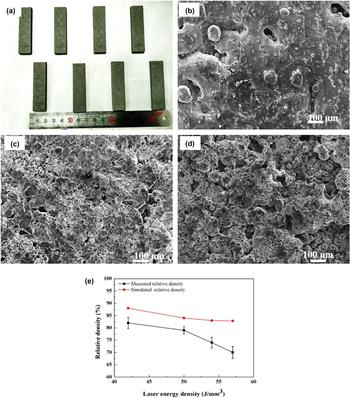
Figure 5(a) depicts the appearance of SLMed CNTs/AZ31B composite parts, which have been suffered from oxidization to some extent. Figures 5(b)–5(d) show the surface morphologies of parts manufactured with LIEDs of 42, 50, and 57 J/mm3. First, there is no cauliflower-like structure (reported by Zhang et al.Reference Zhang, Liao and Coddet10) which is formed due to low laser absorption of magnesium.Reference Kazzaz, Medraj and Cao28 It might be dispelled by the increment of laser absorption after CNTs compositing into magnesium alloys. In process with an LIED of 42 J/mm3, the part surface is relatively dense and smooth; however, vaporization becomes severer with LIED increasing. When LIED reaches 57 J/mm3, a large number of vaporized balls have formed on the part surface. Meanwhile, the shrinkage of the molten pool due to vaporization generates many micropores, exhibiting a rough and loose surface.
(a) Macroscopic appearance of SLMed CNTs/AZ31B composite parts; (b–d) surface morphologies of parts manufactured by LIEDs of 42, 50, and 57 J/mm3 respectively; (e) relative density evolution of parts manufactured by various LIEDs in simulation and experiment.
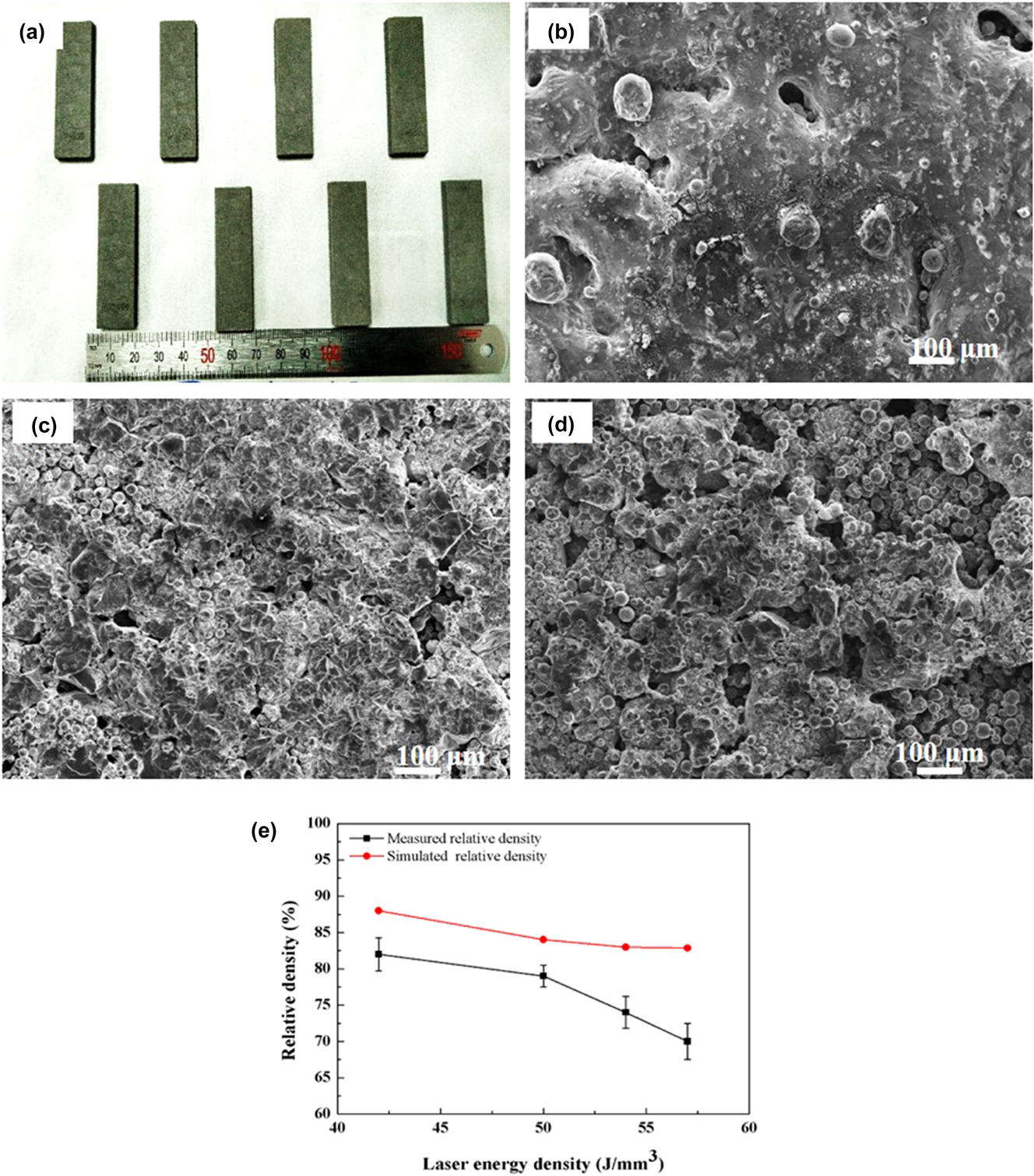
The relative densities of SLMed CNTs/AZ31B composites with different LIEDs are given in Fig. 5(e). They are compared between experiments with numerical simulations. When the LIED changes from 42 to 57 J/mm3, the experimental measured relative density of composites decreases from 82% to 70%, and the highest value is acquired by the optimal process with an LIED of 42 J/mm3. The tendency of relative density evolutions is similar between experiments and simulations. However, densities measured by experiments are all lower than simulated results. There might be two main reasons. First, heat accumulation during layer-by-layer manufacturingReference Carlone, Astarita and Rubino29 is not studied in simulation, which might aggravate vaporization and lead to intensive decrement of relative densities. Second, poor surface quality due to vaporization influences the homogeneity of the powder layer during real process, and nonuniform powder layers would generate more inner pores. For simulations, the surface morphology effect is not considered.
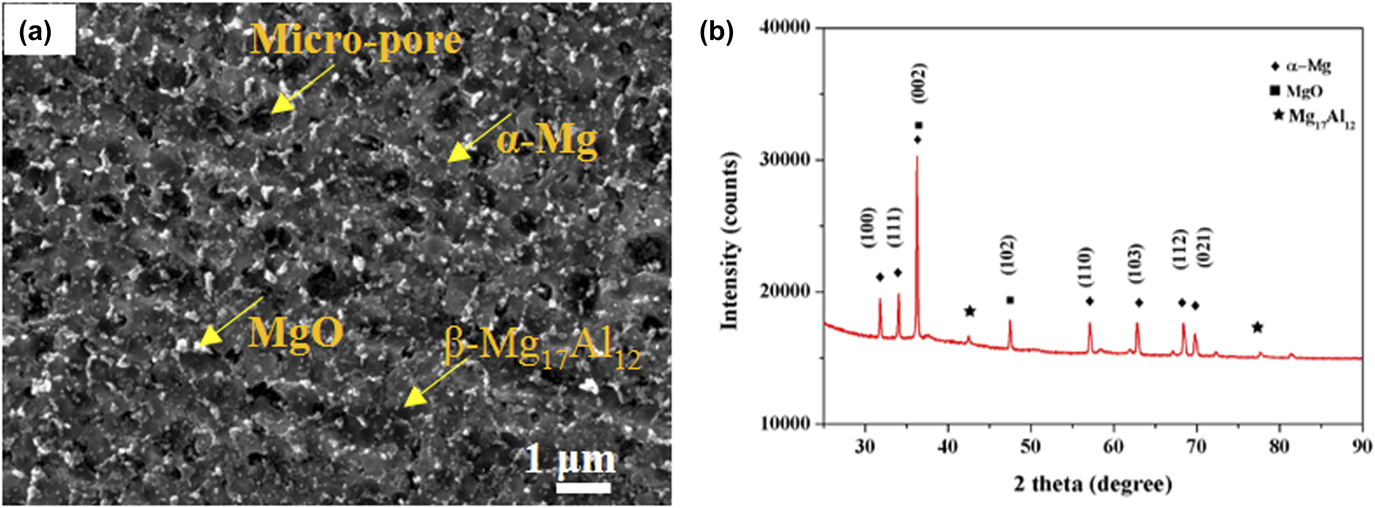
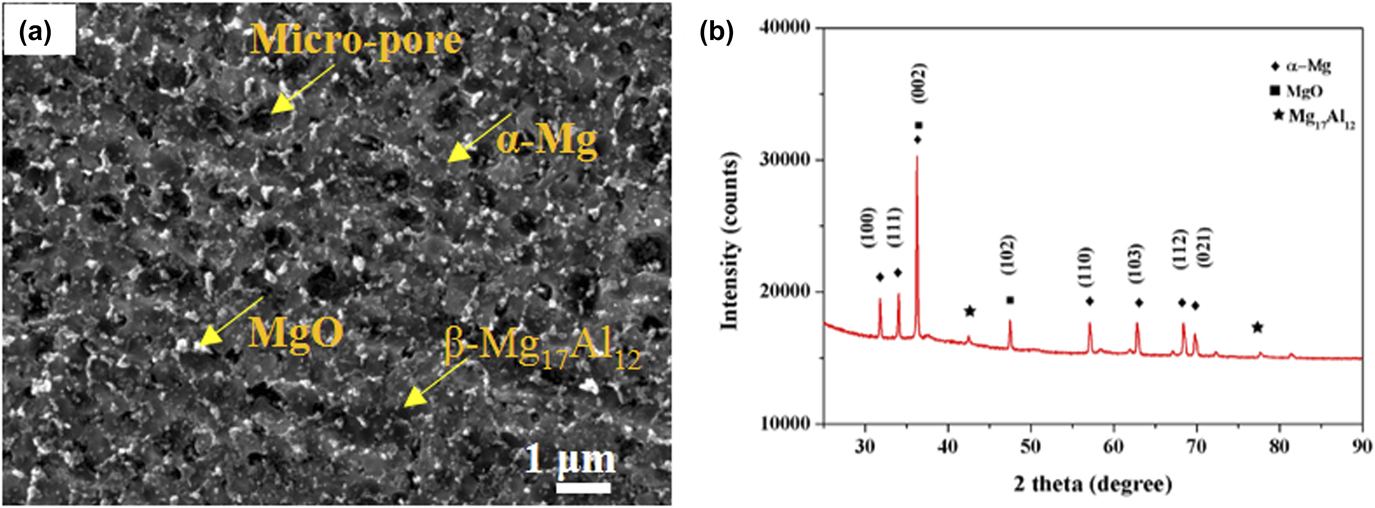
The microstructure of the CNTs/AZ31B composite manufactured by the optimal process (with an LIED of 42 J/mm3) is selected to analyze. As Fig. 6(a) displays, the microstructure is not in full-dense and some micropores are observed in the material. However, grains can still be recognized and their dimensions are generally less than 1 μm, which are much smaller than those in casting parts. Because the ratio of the nucleation rate to grain growth rate depends on undercooling of melts, large cooling rates of the molten pool are more beneficial for nucleation leading to grain refinement in the SLM process.Reference Yang, Ci and Bur12 According to XRD results shown in Fig. 6(b), a number of MgO particles are investigated in the microstructure. At the same time, the matrix structure is determined as α-Mg and the second phase distributed along grain boundaries is intermetallics of β-Mg17Al12. The extremely high temperature gradient makes intermetallics having not enough time to nucleate and precipitate from supersaturation solid solution. As a result, solute atoms like aluminum would prefer to segregate at grain boundaries, then forms β-Mg17Al12. Because the thermal history of the SLM process has an effect similar to self-aging for alloys,Reference Jägle, Sheng and Wu30 β-Mg17Al12 could precipitate at grain boundaries. Besides, diffraction peaks of carbon could not be recognized in the XRD spectrum that might attribute to the limited content of CNTs in composites.
(a) Microstructures and (b) XRD results of CNTs/AZ31B composites.
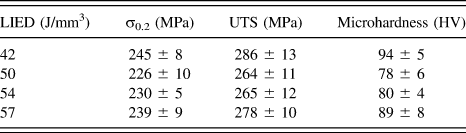
Mechanical properties of CNTs/AZ31B composites fabricated with different LIEDs are listed in Table III. With LIED increasing, microhardness, yield strength (σ0.2), and ultimate tensile strength (UTS) are all reducing. The main reason is the increase of vaporized porosity in manufactured composite parts. The most excellent composite has a hardness of 94 HV, yield strength of 245 MPa, and UTS of 286 MPa, which are close to the mechanical properties of conventional, unannealed AZ31B plates.
Mechanical properties of CNTs/AZ31B composites fabricated with different LIEDs.
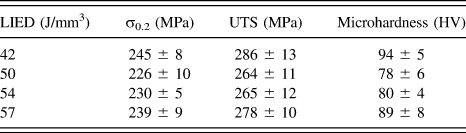
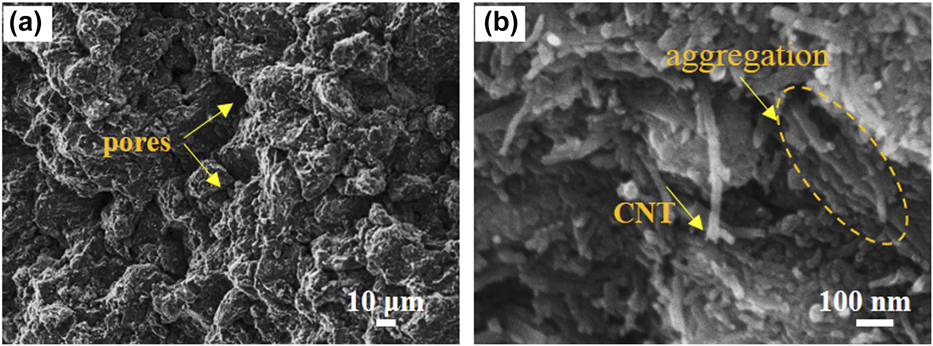
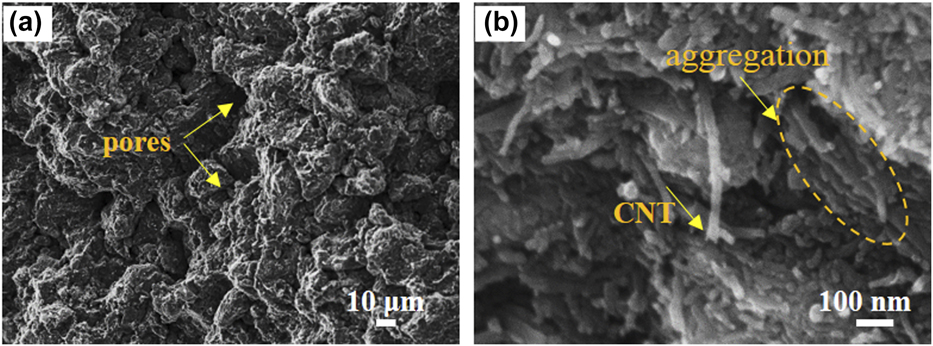
Figure 7 displays the tensile fracture morphology of SLMed CNTs/AZ31B composites manufactured by process with an LIED of 42 J/mm3. The fracture surface shows a characteristic of cleavage fracture. In addition, vaporized pores are observed at the fracture surface, which might be the origin of crack initiations. Furthermore, the aggregation of CNTs is found at the fracture surface when the morphology picture is locally magnified. The aggregation phenomenon might be related to the mass transfer mechanism in the SLM process.Reference Dai and Gu31 However, it could not be avoided for manufacturing of CNTs/AZ31B composites, especially when vaporization is taken place. Consequently, the positive impact of the SLM process on mechanical properties of alloys may be counteracted by CNT aggregation.
Tensile fracture morphology of SLMed CNTs/AZ31B composites with an LIED of 42 J/mm3: (a) overall review and (b) local magnification.
IV. CONCLUSIONS
The influence of CNTs on laser absorption of AZ31B alloy powders as well as effects of LIED on molten pool characteristics and vaporized porosity evolution of CNTs/AZ31B composites manufactured by the SLM process were investigated by this work, and the main conclusions could be summarized as follows:
(1) The laser absorption of AZ31B alloy powders at the laser wave length of 1070 nm is enhanced by 7.9% due to the addition of 1.5 wt% CNTs. It is supposed to solve the problem of low laser absorption in laser processing for magnesium alloys. Accordingly, temperature and molten pool dimension of CNTs/AZ31B composites both increase in the same process condition of the AZ31B alloy.
(2) With the increase of LIED, both the maximal temperature and molten pool dimension of CNTs/AZ31B composites gradually increase. The full melting SLM processes for CNTs/AZ31B composites are determined by LIED equal or greater than 42 J/mm3.
(3) The vaporized porosity of CNTs/AZ31B composites has an ascendent tendency with LIED increasing, which leads to relative poor density of SLMed composites. The optimized relative density (82%) of CNTs/AZ31B composites is obtained by LIED of 42 J/mm3 in experiment; meanwhile, the most excellent mechanical properties of CNTs/AZ31B composites are also achieved in the same process.
ACKNOWLEDGMENTS
The study is supported by the National Natural Science Foundation of China under Grant Number of 51405467 and Youth Innovation Promotion Association CAS.