Introduction
The development and cultivation of art music is inseparable from the wider cultural developments in Greek society and the hierarchical changes among social classes. It is the purpose of this essay to analyze ways in which music becomes attached to the growing demand for national culture during the belated rise of the bourgeois class since the last decades of the nineteenth century. The main period under examination, thus, is the end of the nineteenth- and the first decades of the twentieth century.Footnote 1
In the era under examination, the predominant notions of historic continuity and Hellenism, or ‘Greekness’, to which I will refer in more detail, are matters of shared inheritance; the past is deployed to forge ourselves a cultural lineage, to claim ancient Greece as our national inheritance and to accept Byzantium as a part of Greek history and historical consciousness, seamlessly woven into an evolution from the classical past.
In terms of music, the developing notion of ‘nationalism’ and, respectively, the influence of the Byzantine hymns and of the Demotic song, changed the nature of musical nationalism,Footnote 2 and with those tendencies grew an alienation from Italian musical culture. The upper- and middle-class audience, in turn, accepted folkloristic styles because of the elaboration of a nationalistic consciousness which embraced all cultural aspects including music.Footnote 3
The early twentieth century saw the emergence and subsequent dominance – for at least the first half of the century – of the Greek National School of Music. Representatives of the ‘national school’, such as Manolis Kalomiris and Georgios Lambelet, frequently and systematically drew upon German models in order to define what we call ‘the Greek soul’. At the same time, there developed voluminous literature on the subject of German composers and their work, which argued either that they had been strongly influenced by the ancient Greek civilization or that their way of dealing with tradition should be a model for all Greek composers because it is the way in which German composers express the soul of their people.
In my view, the prevalence of such aesthetic principles contributed greatly to the introduction of symphonic music to this country and to the gradual familiarization of audiences with it. In other words, the swing towards the symphonic repertoire (in the practice of performing, cultural and/or aesthetic preferences) in Greece, especially from the beginning of the twentieth century, was directly related to the increasing influence of German romantic idealism upon the ways of listening and understanding music. After all, the foundations of the conception of the superiority of symphonic music as a ‘proper’ aesthetic example, lie in its idealization by intellectuals and philosophers of German romanticism, like E.T.A. Hoffmann and Edward Hanslick. In Greece, this swing offered yet another excuse for the distancing of aesthetic standards from Italian music, which is better represented by the opera.Footnote 4 In other words, the above tendencies resulted in a (further) alienation from Italian musical culture.
From a sociological point of view, the late nineteenth century in Greece coincided with the historically belated rise of the middle class, which was seeking some form of self-definition through the search for a national identity in every aspect of culture. In an effort to create a national tradition in music, a considerable number of works in the area of the composition of art music, from the late nineteenth century onwards, attempted to strike a balance as well as to establish a relationship between European music and Greek tradition. The reason is obvious: if foreign influences were to become acceptable, they should satisfy the deeper needs of a wider public rather than those of an aristocratic elite, as was the case until then.Footnote 5
The hermeneutics of tradition and the theory of ‘historic continuity’
The issue of the search of cultural identity in Greece of that time is quite complex. In Greece of the 1890s–1920s, the historical, social and political circumstances were quite different from those in Western Europe. Before the First World War, Greece had fought in the two Balkan Wars (the first in 1912–13 against the Ottoman Empire, the second in 1913 against Bulgaria); a year after the end of the Great War, the shattering of the national dream of the Megali Idea [the Great Idea] (the dogma of the ‘Great Idea’ was directed towards the restoration of Byzantium and the identification of the Greek state with the Greek nation), took place after Greece's defeat in Asia Minor (1922).Footnote 6 The hermeneutics of tradition within that cultural environment, played an important role in constructing and contextualizing the notion of ‘national identity’ or, Hellenism.
A composer's attitude to tradition created links with the wider cultural environment by following either of the two main directions: the first saw the embodiment of the past within the present as an instinctive experience of tradition and the second developed the myth of Hellenism which had tradition as its cornerstone. These directions can also be seen as evolving progressively within a timespan. The first originated from the dogma of ‘national unity’ and the theory of ‘historic continuity’, developed up to 1922. At that period the main concern for the Greek nation was unity and continuity; the metaphors used for such ideological narratives were, accordingly, terms such as ‘organic’, ‘national soul’ and ‘Greek spirit’. The second was developed after 1923, that is, after the Asia Minor catastrophe, when the search for identity developed ideological constructs by means of comparison; therefore, the main question at that time was how we can distinguish ourselves from other nations and how we can develop and promote our uniquely Greek physiognomy.Footnote 7 The first direction differed from the second one in so far as the location of the core of the quest for the definition of the ‘national’ was concerned. Since the first direction is within the historical limits of the present essay, I will focus on the theory of ‘historic continuity’ and the ways it was embodied in perceptions of Greek art music during this period, while I will present briefly the second trend in order to clarify their essential similarity.
At the mid-nineteenth century, the notion of ‘nationalism’ changed; ‘romantic nationalism’ gradually replaced ‘democratic nationalism’, which was based on ideas of Enlightenment and French Revolution.Footnote 8 This coincided with the declaration of the dogma of the ‘Great Idea’, in 1844, by Ioannis Kolettis, and the beginning of the development of modern Greek historicism. Romantic historicism's quest, based on studies of the philosophy of history of the 1840s, put a different perspective upon the notion of Greek modern identity. The most important symbolic change was the attitude towards Byzantium. According to it, Byzantium and its culture developed from ancient Greek civilization. This sense of historic continuity, attributed to Greek culture, seemed to be a necessary gesture for the formation of national identity. By the 1890s, Byzantium was completely accepted as a part of Greek history and historical consciousness, seamlessly woven into an evolution from the classical past.
Music and the notion of ‘historic continuity’
In music, the above theory was substantiated in both the theory and work of (a) George Pachtikos and Ioannis Th. Sakellaridis, both composers involved in the staging of the productions of the Association for the Teaching of Ancient Drama,Footnote 9 and (b) Manolis Kalomiris and other representatives of the so-called National School of Music.Footnote 10 Pachtikos believed that since knowledge of ancient music was not enough for the composer to be able to reproduce it, music should form strong links with the more familiar tradition, that is, the Byzantine and folk music traditions. According to him, these traditions had been evolved from ancient Greek music; therefore, they preserved some of its characteristics and, furthermore, its ‘spirit’. Kalomiris based his music on the Western European tradition but also believed that a composer should use the rhythm, scales and character of Demotic songs and Byzantine hymns. Both composers believed that music should ‘breathe’ life by expressing what was perceived as ‘Greek soul’.
George Pachtikos, apart from being a composer, was chief editor of a monthly musicological journal entitled Mousiki, published in Constantinople from 1912 to 1915. The articles published in this journal had Greek music as a main topic. Pachtikos developed an extensive theory in a series of articles he wrote in this journal, on the ways that music for ancient tragedies should be written. According to him, the composer should have a good knowledge of ancient Greek civilization in order to be able to write music which is derived directly from his nation's soul. He wrote that music and language reflect the essence of a nation, but it is especially by means of music that the soul of a nation is directly expressed. Pachtikos’ ideas were embraced in practice by the Association for the Teaching of Ancient Drama.
Consequently, the changing hermeneutics of tradition were responsible for the decisive aesthetic turn in terms of placing music in the hierarchy of arts which were involved in the staging of productions of ancient dramas by the Association for the Teaching of Ancient Drama. Music was considered the ‘soul’ and the most important art in the total work of art of ancient drama; it articulated ethics and offered Bildung to the people in the very romantic sense of the word. It was in the process of ‘becoming’, always present, because it was derived from modern Greek tradition, which preserved, it is thought, the ‘spirit’ of ancient Greek culture. Moreover, music in an ancient drama was believed to be the most important means of articulating ethics. In other words, music was perceived as the embodiment of the romantic spirit in order to serve the most national of all arts: ancient music drama. In such a romantic perception of music, the chorus’ role could be interpreted as the embodiment of the Greek people and their culture, since choral music, based on Byzantine and folk melodies, was supposed to represent authentic Greek music tradition.Footnote 11
Similar ideas were supported later by Eva Palmer-Sikelianos (1874–1952), a highly educated and gifted American woman, who studied ancient Greek tragedy, music and choreography.Footnote 12 When she came to live in Greece in 1907, after her marriage to one of the most important Greek poets of his generation, Angelos Sikelianos (1874–1952), she embarked upon a thorough study of the modern and ancient Greek language, folk songs and dances, and Byzantine music. Angelos and Eva Sikelianos were the founders of the Delphic Festivals of 1927 and 1930.Footnote 13
Eva Palmer developed a comprehensive theory, rooted in her lengthy and thorough study of Byzantine music, which explained the necessity of using monophonic music, based on Byzantine modes, in revivals of ancient dramas. She believed that Byzantine hymns evolved from ancient Greek music and, unlike European music, they preserved many of its characteristics. Such views were developed in her autobiography Upward Panic Footnote 14 and in her Three Lectures (1921)Footnote 15 and materialized in music written by Konstantinos Psachos for the productions of ancient tragedies in the Delphic festivals of 1927 and 1930. According to Palmer, only Byzantine modes could express, to use her own words, ‘with amazing simplicity all [musical] intervals and all rhythms that a human voice can sing. European music language is far from such perfection.’Footnote 16
Kalomiris embraced traditional values within the ideological framework of historic continuity since, first of all, ‘tradition’ for him was perceived as the part of the past which was preserved alive in the present. Such a concept of tradition, as something alive in the present, was an important value in Greece at the end of the long nineteenth century – as I have already mentioned – as it was seeking a fusion and common development of nation and state. However, it was only the reformative policies of Venizelos, after the Balkan Wars, which would enable Greece to realize this aim. So, the power of tradition as a living cultural construct, or as a basis for artistic expression, was believed to be able to revive the nation within the Greek state, something also related to the strengthening of the quest for the use of the Demotic language and its gradual establishment as an official language. Such perception of tradition can be traced in every aspect of Kalomiris’ creativity: his compositions and his ideas on language, folk songs and the role of art. Kalomiris became a strong supporter of the Demotic language and, thus, created a strong bond with important representatives of art and literature and with the Demoticists, a movement which played a decisive role in cultural developments of that era, as I will explain later.
There is also plenty of evidence that the theory of the historic continuity of Greek music, in other words, the theory that the Byzantine hymns and folk music have evolved from ancient Greek music, was well received not only by Greek but also by foreign intellectuals, such as the German musicologist Ugo Athanasio Gaisser, German theorist Herr Scherder and Belgian musicologist Francois-Auguste Gevaert, to mention but a few.Footnote 17 According to this theory of historic continuity, the links of Europe with ancient Greece were different from those with modern Greece: by this account, Greeks were the only rightful inheritors of ancient Greek culture, whereas other Europeans could not experience its ‘soul’. In other words, Europeans saw ancient Greek culture from an archaeological and philological point of view. Such a reading of history was also acknowledged by foreign scholars like Bourgault-Ducoundray.Footnote 18 Bourgault-Ducoundray stated in 1912 that only in Greek folk music was the inheritance of ancient Greece fully preserved; whereas, a large part of this inheritance was not yet explored by Western culture.Footnote 19
German models for the expression of the ‘soul’ and the notion of Hellenism in music
We can find links between German romanticism and attitudes to ancient culture in the period under examination which strengthened the idea of the evolution of Byzantine music and Greek folk songs from ancient music (organic perception of the history of music). A characteristic example of such a link in performances of ancient dramas coincided with the establishment of the Association for the Teaching of Ancient Drama in 1895. President of this Society was George Mistriotis, professor at Athens University's School of Philosophy and a great supporter of the ancient Greek language.Footnote 20 The association staged its first ancient drama, Sophocles’ Antigone, in the original, at the Olympic Games in 1896. For almost two decades, the same society regularly initiated international prize-winning festivals for the composition of ancient Greek dramas.Footnote 21
George Mistriotis provided a perspective on the ontological notion of music by comparing music as the philosophy of the heart with philosophy as the music of the brain. He attributed the kindness of the Greek race to its music and its philosophy. Also, he stated that when, during the Byzantine period, Socrates’ philosophy collapsed, music took on its role in order to offer Bildung to our race. It goes without saying that music for Mistriotis had an immense educational power; also, German music culture was exemplary because, as he stated, German music is philosophical, as opposed to Italian music, which is popular.Footnote 22
Although the composer Pachtikos believed that the tools that musicians used in performing ancient tragedies should be derived from Greek music tradition, he did not dismiss European, especially German, models. On the contrary, his example in order to underline the importance of the harmonious unity between poetry, music and dance that should exist in a production of ancient tragedy was ‘the great German composer Richard Wagner’, as he called him, because he supported this principle and thus ‘brought contemporary operatic music to its highest levels’.Footnote 23
These attributions concerning music's role were much influenced by Western European (especially German) ideologies of that time. This is more evident from the cultural collaborations between Greece and Germany which took place during these years, where we can observe ideological parallels on this issue and mutual support of them. These ideological parallels had mainly to do with the interpretation of ancient Greek music as the beginning of music history, both in Greece and in Europe.
We find such views, to mention one example, in one of Pachtikos’ articles on ancient Greek dramas, published in July 1912.Footnote 24 Pachtikos stated that Europe has ancient Greece as the first stage of its civilization and, in support of this statement, he offered as examples Richard Wagner and Oscar Paul. In the Greek music journal Apollon, a series of translations of a long essay, originally in German, were published, under the title Aristotle's Ideas on Music (1905). It was written by the Belgian scholar Gevaert and the German scholars Wolfkraf and Gandis. Among the other ideas about Aristotle's influence in European culture, it is stated that German music was influenced by Greek ancient music, mainly in terms of its ethos and the articulation of a communal feeling; due to this influence, German music had developed to great heights. Another important idea, related to this argument, is that Schopenhauer continued Aristotle's tradition; consequently, the aesthetics of modern German music were based on ancient Greek theories, especially those of Aristotle. Finally, the main virtue that music expressed due to that influence was the idea of ‘catharsis’ or the spirit's Erlösung.Footnote 25
So, German cultural models were thought to be ideal by Greek intellectuals as long as they fulfilled the belief that German civilization had ancient Greece as its central point of reference. Wagner seemed to be the ideal example in support of this argument.Footnote 26
Admiration of German composers, especially Beethoven and Wagner, was also the attitude of quite a few composers of the so-called National School of Music from the beginning of the twentieth century. Kalomiris developed the most important directions of the school's aesthetics towards a definition of what Greek music ought to be and in which ways it communicated with the Greek soul. George Lambelet (1875–1945), another founder of this school of music, wrote his ideas on national music in Panathinaia journal in 1901.Footnote 27 However, he crystallized the notion of ‘national music’ in a later article of 1928, in which we read: ‘We usually consider as national art the art which originates her substance in the spirit of folk models, in which the soul and the character of a certain race is being reflected.’Footnote 28 In order to strengthen the definition given to ‘national art’, he presented as examples Beethoven and Wagner, who created, according to Lambelet, works which embodied the characteristics of the German race and were, at the same time, of international stature.Footnote 29
Representatives of the Greek National School of Music often, and systematically, derived their definition of the so-called ‘Greek soul’ from German examples. Even later, in the interwar era, a lot of written material in the field of music referred to the work of German composers, and developed more or less the view that these composers either had strong influences from ancient Greek civilization or used their own tradition in a way which should be exemplary for Greek composers, since they expressed the ‘soul’ of their people. Kalomiris had Wagner as an ideal example in support of this argument; moreover, KalomirisFootnote 30 and LambeletFootnote 31 believed that Wagner's work expressed German soul in the same way that a Greek composer should express his people's soul.Footnote 32 Contrary to the above and in search of articulating the ‘true’ soul which coincided with Hellenism, Italian works were believed to lack such meaning and, thus, were thought to be insignificant as far as this quest was concerned.Footnote 33
German music, especially symphonic music, was not particularly popular among nineteenth-century Greek audiences, if nothing else, because of the unfamiliarity of the Greek middle-class audience with it.Footnote 34 However, especially after 1880, the intellectual elite used its ideals (that is, Wagner's music as ‘the art of the future’ and Beethoven's music as ‘exemplary’) to gradually turn the ‘proper’ aesthetic example towards German musical models.Footnote 35 The preference for German models had also encouraged, as a consequence, the gradual establishment and development of symphonic music in Greece. According to my view, the important cultural phenomenon of the introduction of symphonic music to Greece and the gradual familiarization of the audience with it from the end of the nineteenth century onwards was linked with the increasing influence of German romantic idealism upon the ways of listening and understanding music. A characteristic example of such a preference is Synadinos’ History of Modern Greek Music, written in 1919. Synadinos argued that nineteenth-century Greece suffered from ‘ill-applied romanticism’ due to the popularity of Italian opera, whereas German music, introduced by the Bavarians in Greece, spoke directly to young Greek souls.Footnote 36
Symphonic music was cultivated more systematically by Greek composers from the 1890s and the creation of symphony orchestras contributed to this. The first symphony orchestra, consisting of 40 instruments under Italian conductor Riccardo Boniccioli, was formed by the ‘Society of Music-lovers’, founded in 1893. In the 1896 Olympic Games, that orchestra played the Olympic Anthem by Spyridon Samaras (1861–1917) and the symphonic poem Pentathlon by Dionyssios Lavrangas (1860–1941). In 1893, the Athens Conservatory Symphony Orchestra was formed, making regular appearances at the conservatory concert hall and, subsequently, at the Athens Municipal Theatre and other theatres. On the island of Corfu, a symphony orchestra under conductor Dimitris Andronis gave its first concert with symphonic works in December 1907.
The notion of Hellenism developed within the spirit of the musical aesthetic and sociological developments under discussion. In Kalomiris’ writings this notion was perceived as the inner spirit of the Greek nation; the folk's ‘soul’, for him, was the origin of every kind of creativity, an idea expressed in various written forms throughout his life. Greek music, as an aesthetic construct, was perceived as directly related to Greek soul; a true creator, therefore, should have faith in the Greek nation's soul so that his works would be of the same origin as the primitive creation of the folk.
Hellenism, or ‘Greekness’, conceived as a set of values, became established during the 1930s. During that decade, this notion was a central one and was discussed a great deal and the decisive turn to tradition that took place was closely related to the contextualization of the notion of Hellenism. Awareness of tradition became a common trend for the generation of the 1930s. Moreover, by the end of the nineteenth century, ‘tradition’ and Hellenism did not appear as notions grounded in Greek history but as diachronic constructs which could be approached by means of instinct and aesthetics. National identity, respectively, could be understood as something based on the aesthetic grounds of purity, immortality and uniqueness.Footnote 37
It is also important to mention that the myth of Hellenism is crystallized in the writings of Greek intellectuals sharing aspects in common with ‘Germanness’; such a notion is gradually established as the main thread in intellectual life of Greece.Footnote 38 According to these Greek intellectuals, similarities between Hellenism and ‘Germanness’ is not something which can be observed only retrospectively; it is, rather, developed through interpretations of Hellenism as the very origin and rightful progenitor of ‘Germanness’. The creators of the myth of Hellenism in the 1930s proudly declare that German civilization owes a lot to the ancient Greek spirit that is mainly the origin of Greek modern spirit. Distinctions such as ‘community versus individualism’, ‘national soul versus liberal ideas’ and ‘spiritual culture versus mechanical culture (or else, ‘modernism’)’ are indeed of German origin.Footnote 39 Since the beginning of the 1930s, similar ideas have been expressed by Greek intellectuals who have been decisively influenced by O. Spengler's views, developed in his Der Untergang des Abendlandes (1918–1912).Footnote 40
Such essential relationship to German ideas as found in German composers, especially in Wagner, can be found, in my view, in a few works of Kalomiris. He was an admirer of Wagner throughout his life. His most Wagnerian opera, The Mother's Ring (1917), is structurally influenced by the Wagnerian music-drama in lots of respects.Footnote 41 The most obvious of these influences are the use of melodic, harmonic and/or rhythmic leitmotifsFootnote 42 and the application of Wagner's unendliche Melodie in his music in order to achieve continuity in his operas.Footnote 43
The Mother's Ring possesses and communicates so-called extramusical meaning in a quite similar – although less sophisticated – manner to Wagner's music-dramas, as we can observe by interpreting this opera's deeper meaning. There are certain ways in which Greek culture is manifested musically as a Hegelian Aufhebung in The Mother's Ring, something which corresponds, to use Psychopedi's words, to the quest for ‘national evolution’; as she mentions, moreover, in relation to this idea, ‘the opera [The Mother's Ring] is ideologically influenced by the quest for national wholeness, but it contains evaluations, wishes and fears for the limits and the prospect of such realization’.Footnote 44
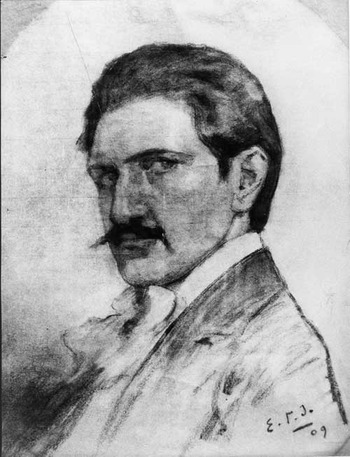
Portrait of Manolis Kalomiris. Property of Manolis Kalomiris’ archives

Views, referring to an essential connection between morality and aesthetics – articulated in ideas on issues of national identity – were reinforced by the views on music expressed by composers of the so-called National School of Music.Footnote 45 The proper moral example appeared to have a certain aesthetic code in musical language, which was related to diatonic and ‘traditional’ musical elements. On the other hand, the improper moral example, as defined by means of aesthetics in music, was related not only to what was considered to be ‘modern’ (especially serial music, during the interwar period) but, also, to what was thought to be commercial and thus superficial (mainly Italian music). All these ideas have their origin at the end of the long nineteenth century.
At the heart of the ideas of the National School of Music dwelt the notion of ‘Greek soul’: a composer should have a Greek soul. At the heart of the School's polemics was the question as to how Greek soul could be related to tradition, how could it embody the two different traditions of ancient Greece and Byzantium as a unified whole? Seeking continuity and homogeneity, in the same fashion as the myth of ‘nationalism’, was an idea ‘imported’ from Europe.Footnote 46
The linguistic battle
The importance of the language is evident in the continuous evolution of modern Greek culture. In the formation of ‘national consciousness’, Greek literature took up the role of the guardian of tradition and its works were received as national treasures. Such a phenomenon does not apply only to Greece, as A. Erjavec rightly argues;
Since in many of the small cultures ‘nation’ never ha[s] clear economical or political connotations (never signifie[s] real power vis-á-vis large nation states) it refer[s] primarily to culture, with language being its most outstanding part…
To attain this aim [i.e. to assert itself through culture] it also attempts to symbolically appropriate authors, works, trends, events and ideas that are or were somehow related either to its language or territory.Footnote 47
In Greek culture, of course, music and poetry had been linked for centuries in folk songs. Modern Greek poetry, in fact, had begun with song, not only with the sung poetry of the oral tradition (the demotika), but with poets like Solomos, Kalvos, Palamas and Sikelianos looking to that rich tradition for models as they began to write poetry for the first time in the spoken language of modern Greece.Footnote 48 Thus did nationalism become grounded in folk tradition and folk language. Demotic language assisted in the development of bourgeois democracy and in finding a solution to the problems of national identity.Footnote 49
From the end of the nineteenth century, studies in Greek folklore, mostly by foreigners, gave a new respectability to Demotic language, i.e. the language spoken by the majority of Greek people. However, when the philologist Yannis Psycharis published his book entitled My Journey (1888), advocating a complete turn to Demotic forms of written language, it caused a great deal of controversy. Even when the literary battle had been won at the turn of the nineteenth century, Psycharis and the poets were using Demotic language, and Katharevousa (i.e. the Greek formal language of that time which was a mixture of ancient Greek and Demotic language) remained the official language of the state, the Church and of education. All scholars who supported the revival of ancient Greek dramas and belonged to Mistriotis’ society (i.e. the Association for the Teaching of Ancient Drama), at that time, were against the use of Demotic language which, as they believed, was opposed to national causes, and they accordingly defended Katharevousa. This is the reason why performances – for example of Sophocles’ Electra with Sakellaridis’ music (1899) – were not attended by Demoticists.Footnote 50
It should be noted, however, that while both ideological sides in this linguistic battle had an interest in the revival of ancient drama, only Demoticists were using translations of ancient Greek texts into Demotic language.Footnote 51 Also, both sides had something in common: their search for ways to relate revivals of ancient dramas to the most immediate past in order to keep Greek tradition alive. So, the quest for relating our distant past with the present took place by different means of expression: for Mistriotis’ society by means of music, as analyzed earlier, and for the Demoticists by means of language. Therefore, re-imagining the ancient world as something alive, both as an ideal example for modern art and as the most precious part of our national inheritance, seemed to be a common, romantic view of our past held from both sides; the theory of historic continuity was put into practice using those means, respectively, which were considered to be the most important.
The increasingly strong influence of the cause for the use of Demotic language on Greek people since the 1880s, as well as the increasing influence of modern Western European values,Footnote 52 strengthened the role of the so-called Greek National School of Music, especially Manolis Kalomiris, since Kalomiris warmly supported the use of Demotic language and his music, based on his educational background in Vienna, followed European, especially German, styles. Being in line with the Greek intelligentsia, which supported Demotic language and wanted the complete abandonment of Katharevousa at the turn of the twentieth century, Manolis Kalomiris created a strong link with a movement which played a predominant role in the Greek culture of that time. At the same time, this school of music created a myth by taking for granted the importance of its gesture to serve the Greek nation in order to realize its desire for cultural rebirth.
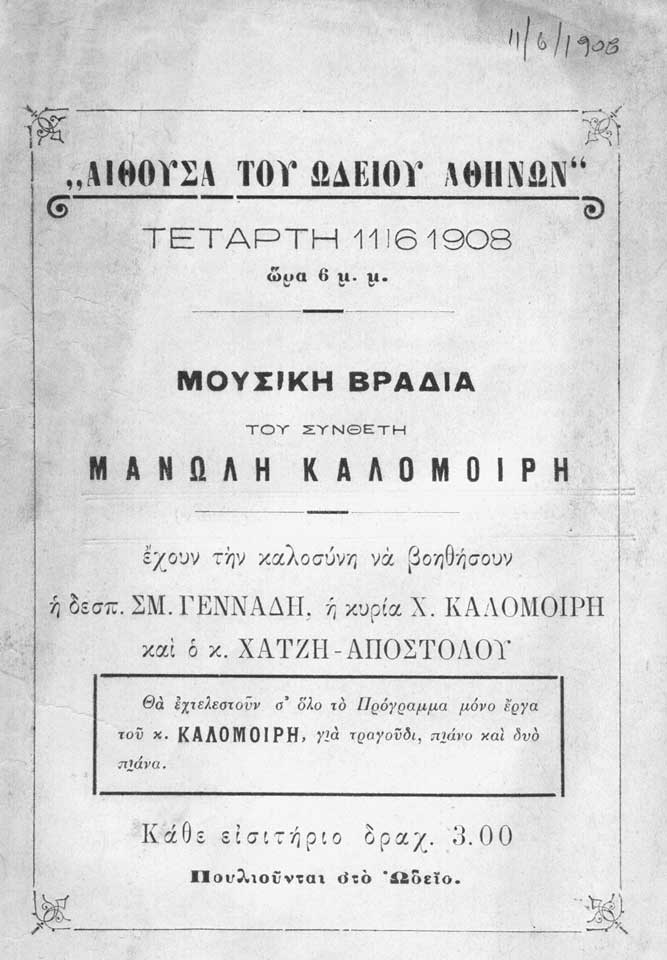
In 1908, the Greek journal Noumas announced Kalomiris’ concert and published its programme which was written, together with Kalomiris’ ideas on how to create Greek music, in an ‘extreme’ Demotic form of language. As a consequence, the great Greek poet Kostis Palamas dedicated a poem to Kalomiris, entitled To the Composer Manolis Kalomiris, marking thus the beginning of a life-long friendship. Also, the philologist Psycharis dedicated one of his poems to Kalomiris. Many writers expressed their belief that Kalomiris was bound to play the leader's role in music in the same fashion as Kostis Palamas did in poetry. Thus, the young composer was encouraged by important men of letters in Greece who supported him and his national ideal without hesitation since, moreover, this ideal strengthened their own fights and demands. The event of 1908 was just the beginning of such a support.Footnote 53
Programme cover of 1908 concert by Manolis Kalomiris. Property of the Lilian Voudouri Library, Music Hall of Athens

Opera and the construction of national identity
The changing hermeneutics of tradition, as analyzed earlier, narrated images of a nation through music which was experiencing important social changes; such narrations were also substantiated by means of opera. I will analyze briefly the way(s) in which opera, as an art genre and in relation to the social–political environment, becomes attached to the growing demand of the middle class for the creation of a national culture.Footnote 54
Greek opera during the nineteenth-century's fin de siécle
Opera, in that era, in line with the wider cultural environment in Greece, was discussed primarily as a means of expressing extra-musical ideas, mainly the nation's ideal in relation to the hermeneutics of tradition; moreover, it created contradictory trends in Athens. These trends were formed within the following main operatic activities:
1. The first Greek opera company, the so-called Elliniko [Greek] Melodrama, in 1888, survived only until 1890. In 1900, however, composers Dionyssios Lavrangas and Ludovikos Spinellis founded another ‘Greek Melodrama’ which survived with great difficulty (unassisted by the state) until 1943. Ionian composers in Athens (N. Lambelet and D. Lavrangas) wrote operas which were warmly received by a wide range of audiences.
The spreading of Ionian opera to Athens was related to the demand for national fulfilment, anti-monarchical ideas and national activism, and was influenced by the revolutionary movements in Italy at that time. The first performances of Ionian opera took place in 1875 and were warmly received by a middle-class audience. The operas were Pavlos Karrer's Markos Botsaris (1857–58) and Kira Frosini (1868),Footnote 55 performed by an Italian cast in the Apollon Theatre. Carrer used ‘patriotic’ themes and melodic folkloric references (music references within the framework of a typical orientalism in the mid- to late-nineteenth century).Footnote 56 Thus, 1875 marked the beginning of the foundation of a genre of national opera in Athens fulfilling (a few of) the demands of a fairly newly formed bourgeois class.
2. The revival of ancient Greek drama as music drama, which coincided with the establishment of the Association for the Teaching of Ancient Drama in 1895, discussed earlier. Such performances were encouraged and attended not only by a conservative intelligentsia but also by the palace and the aristocracy. The perception of ancient drama as music drama was due to the ideas, developed both by Mistriotis and Pachtikos, on the role of music.
As a broader observation, it is important to mention that Mistriotis, Pachtikos, Palmer-Sikelianos and George Lampelet,Footnote 57 all being knowledgeable about German, especially romantic ideas and culture, interpreted ancient dramas to a certain degree as music dramas and accepted the supreme role of the chorus. However, in practice, they suggested musical idioms based almost exclusively on Greek tradition, thus making no significant aesthetic and structural contributions by means of music within the total work of ancient drama, at least judging from the results.
The ideas of the above-mentioned intellectuals concerning the role of music were certainly ‘filtered’ through other philosophical views, like August Schlegel's (his critique on Euripides which, in turn, influenced Nietzsche), Arthur Schopenhauer's (his important idea that the universal will can be articulated only through the spirit of music) and, of course, Nietzsche's views developed in his Birth of Tragedy out of the Spirit of Music. Mistriotis, Pachtikos and Lampelet adopted a broader romantic attitude which included nationalistic sentiments and, as a result, preference for the folk elements, which provided a rationale for their attachment to Greek tradition.Footnote 58
3. The rise of the so-called National School of Music since 1908, which established an operatic tradition beginning with Manolis Kalomiris’ first operas, The Masterbuilder (1915) and The Mother's Ring (1917). These operas are of important cultural value because, as musicologist Demetre Yannou states, ‘Greek music-dramatic repertoire was enriched by two works which, by combining elements from the folk traditions, legends and symbols with the fusion of an indissoluble bond between music and pioneer, in terms of that era, Greek literature created national music-theatrical tradition.’Footnote 59
Opera through the looking glass of the bourgeoisie
As I mentioned earlier, opera in nineteenth-century Greece functioned as an innovation, part of a programme of ‘openness’ to Europe. Throughout the nineteenth century, opera in Athens – the capital of the newly formed state of Greece – was mainly a means of art supported and promoted by the palace and the aristocracy.Footnote 60 However, because of this support, the Italian genre of opera was not received positively by the bourgeois class from as early as 1841,Footnote 61 to the extent that it was perceived as alienated from the construction of the notion of ‘national identity’. It is worth mentioning that the juxtaposition of Italian opera – the kind of opera which was the most popular in Greece at that time – with ancient drama – the most national of all arts – appeared to be very influential, especially after 1850. An example is the case of the performance of Oedipus Tyrannous in 1901, by George Mistriotis’ society, with Petros Zahariadis’ music, which had an Italian character. The Greek newspaper Akropolis referred to this music as such: ‘The composer seems to have a thorough knowledge of Italian music, therefore, his choruses mostly remind us of the choruses of famous [Italian] operas … None of these choruses succeeded in transferring to the audience's soul something, no matter how insignificant, originating in the ancient world.’Footnote 62
The strongest movement against the monarchy found its voice in national theatre, while being opposed to Italian opera, owing to the palace's and the aristocracy's support for, and promotion of, this genre.Footnote 63 Opera, after all, was a new ‘imported’ art genre in mainland nineteenth-century Greece, and it thus created links with European culture. By no means, therefore, could it be considered suitable for creating a culture with the unique characteristics of a purely Greek nation.
According to the above, there are reasons which are rooted historically for the continuous juxtaposition of the operatic genre with national theatre, which should have ancient drama as a model. Naturally, in the framework of national drama, historical drama and patriotic tragedy shoulder the task of substantiating the existence of the nation in the remotest possible past; for modern Greeks this past was Greek antiquity. Up to the interwar era, at least, opera was overshadowed by the theatre; the latter was considered to be the heart of Greek civilization, being a ‘natural’ result of the historical development of ancient Greek tragedy. As a characteristic example, I refer to Ioannis Metaxas’ declaration in 1939, that theatre is the pure national art of Greece, from ancient times onwards.Footnote 64
It seems that the confrontation between national theatre and Italian opera, which took place in the nineteenth century as a social and political confrontation, expanded its polemical rhetoric to representatives of Ionian music who were under the influence of Italian music at the end of this century. Even if the language was Greek (as is the case with Lavranga's operas)Footnote 65 the ‘mark’ of this battle was left as an easy target for the debates to follow. According to these lines of reasoning, the gradual marginalization of ‘Greek Melodrama’, in spite of its attachment to the national cause, was a rejection of the ‘other’, a version of what should not be Greek.Footnote 66 Ionian music could not contribute to the creation of national identity by the bourgeois class because this culture did not belong to the dominant narration of the history of Greece.Footnote 67 Thus, marginalization appeared to be a gesture of expanding the notion of the ‘other’, beyond language and social class, to music.Footnote 68
Thus, the most important question that was formed at the close of the nineteenth century, in order to include opera in the formation of a national identity, was ‘how could a kind of art of European origin create a fusion with Greek tradition?’ In order to be part of Greek culture, foreign influences had to respond to the deeper needs of a wider audience and not of an aristocratic elite.
To summarize, musical language for the main operatic activities which was related to the notion of ‘national’ was as follows:
(a) (Mostly) following Italian models and, thus, Ionian tradition. Ionian operas used ‘patriotic’ themes and folklore-like melodies, making musical references within the framework of an orientalism found in the mid- to late-nineteenth century. This was, in effect, a kind of Greek melodrama.
(b) Traditional, mainly using Demotic and Byzantine melodies and modes to revive ancient Greek drama chiefly through George Mistriotis’ Association for the Teaching of Ancient Drama.
(c) Following German and French models, the incorporation of the rhythm, scales and character of Demotic songs and Byzantine hymns into a means of musical narration. Thus arose what was seen as a National School of Music.
Women in musicFootnote 69
It is important to refer briefly to the participation of women in music narratives of national identities in the period. Art music, as I attempted to analyze, can be interpreted in relation to layers of readings of culture and society in Greece. This should also be evident in relation to the changing role of women in public life.
Women were involved in the evolution of the roles of art music and bourgeois culture mainly by means of (1) their social role, which included music education, especially piano lessons of the newly imported romantic repertoire, as it was very much in fashion for a middle-class young lady to study piano rather than any other instrument, and (2) of being professionals in the concert hall participating actively in the newly established musical tendencies.
In regard to the social role, a bourgeois lady gradually adopted European standards for her social role in public. In music, such a role was imported by foreign piano teachers who taught at Greek conservatories, for example, at the Athens conservatory and the Apollon conservatory. This phenomenon was directly related to the increasing influence of German romantic idealism upon the ways of listening and understanding music, as well as music education, as mentioned earlier.
Piano lessons were given at Arsakeion School for Girls as early as 1844,Footnote 70 but piano teaching became a fashion in Athens from 1910. Subsequently, at the Athens conservatory, the largest and most important conservatory in Greece at that time, the number of piano students increased considerably. It was mostly girls from the high society of Athens who were registered for piano lessons since the piano, as an instrument, due to its high price and, mainly, solo repertoire, matched the financial status and moral principles of this social class.Footnote 71
The other category of women musicians was the professionals. Most professional women composers did belong to the artist–musician class, being members of musical families and receiving proper music education. Such women, to mention but a few, were Vivien Lampelet (1901–n.d.), whose father was the quite well-known composer Napoleon Lampelet; Eleonora Papadopoulou-Mauromati (1908–2003); and Eleni Mitropoulou (1905–1922), sister of the internationally-known conductor and composer Dimitris Mitropoulos.
It was however, mainly the first twentieth-century generation of women that raised musical quality to professional standards. Some quite exquisite and complex pieces were written at that time, mostly, but not only, for piano. A few women composers reflect the transition between old mores and new freedoms, as well as arguably patronizing attitudes towards music composed by women. They all wrote music for large-scale works, a few of them following the newly established tendencies of writing symphonies and other orchestral music, for example, Eleni Lampiri (1882/88–1960), the first woman in Greece to compose music for stage works, as well as chamber and symphonic music.Footnote 72
Epilogue
In conclusion, since the establishment of the Greek state in 1821, a repertory of grand opera entered into Greek musical life on a permanent basis, just as has occurred in so many regions outside Western or central Europe. The concept of cosmopolitanism can help understand the tension between international and regional or national contexts interacted since Italian music, opera especially, exerted hegemony as the cosmopolitan style. This is why the hermeneutics of tradition, based on the theory of historic continuity, marginalized this genre as the ‘other’ in the context of constructing a national identity. On the other hand, Byzantine music and Demotic song were recognized as potentially useful for the creation of a musical idiom with ‘national’ characteristics;Footnote 73 thus, they were incorporated into the musical means of narration in Greek national opera and also in symphonic music.Footnote 74
National identity, as I attempted to analyze, could be seen as aestheticized through art; aesthetics, in many cases, were interpreted as expressing morality; morality was articulated through this kind of art which was promoted by men of letters who were influential to the Greek audience;Footnote 75 finally, the distinction between ‘good’ and ‘bad’ was made by artists who were named (and named themselves) ‘spiritual leaders’ of the Greek nation, as was the case of the leaders of the so-called National School of Music.
The question remains, however, as to which kind of music can be considered as more national? Might we speak of political–aesthetic perspectives, which brought to the centre of historical circumstances the question of ‘national identity’? Should, for example, traditional music not be considered as a part of a national culture, especially when it serves the other side of the coin, which is the creation of a Greek culture ‘free’ from European influences? Is music that follows Ionian tradition ‘less national’ than music written for its similar operatic genre, nineteenth-century Italian opera, which promoted national subjects (for example, some of Verdi's operas)? Or, is the case of the so-called National School of Music more ‘appropriate’ since it followed models of other national schools, in spite of its establishment in an era when different musical trends were predominant in Europe? From the above perspective, one can claim that all cases presented in the present essay were attempts to ‘dream worlds of nation’ through music and, therefore, all of them are needed to complete the puzzle of the place of music in creating national identity(-ies) in Greece at the nineteenth-century's fin de siécle.