1. Introduction
The K–Ar ages of minerals from metamorphic and igneous rocks have been widely interpreted as cooling ages recording the timing of closure, or cooling through the blocking temperature, for argon retention in minerals (e.g. Purdy & Jäger, Reference Purdy and Jäger1976). The closure temperatures of K-bearing minerals such as biotite, muscovite and hornblende have been examined theoretically (cf. Dodson, Reference Dodson1973) and determined by experimental and field studies (cf. Dodson & McClelland-Brown, Reference Dodson, McClelland-Brown and Snelling1985). These minerals have been widely used for studying the cooling histories (e.g. Hurford, Reference Hurford1986) and determining continuous metamorphic gradients of metamorphic sequences (e.g. Itaya & Takasugi, Reference Itaya and Takasugi1988; Nishimura et al. Reference Nishimura, Coombs, Landis and Itaya2000). If the K–Ar ages reset only at the closure temperatures in the rocks with simple and conductive cooling histories, the same minerals from different lithologies within the same outcrop should present similar K–Ar ages, as they would have experienced identical cooling histories. Additionally, K–Ar mineral ages should be younger in higher-temperature rocks than in lower-temperature rocks from the same metamorphic sequence, as the lower-temperature rocks will cool through the closure temperature first.
Previous studies by Itaya & Takasugi (Reference Itaya and Takasugi1988) and Itaya & Fujino (Reference Itaya and Fujino1999) on various schistose rocks from the Sanbagawa high-pressure schist belt of central Shikoku, Japan, showed that different lithologies of the same outcrop recorded discordant phengite K–Ar ages. They also noted that the older phengite K–Ar ages were recorded in the higher temperature zone; this is in contradiction to the current understanding of the K–Ar system. Miyashita & Itaya (Reference Miyashita and Itaya2002), in studies on another part of the Sanbagawa belt, the Kanto Mts area 800 km east of the central Shikoku area studied by Itaya & Takasugi (Reference Itaya and Takasugi1988), reported younger ages in the higher-grade metamorphic zones. It therefore appears that the K–Ar phengite ages of high-pressure schists are not only reset at the theoretical closure temperatures for thermal retention of argon, but that the ages may also be reset by other processes such as those discussed by Itaya & Fujino (Reference Itaya and Fujino1999) and Miyashita & Itaya (Reference Miyashita and Itaya2002).
The presence of discordant and anomalously old K–Ar (Ar/Ar) ages in metamorphic rocks has also been widely reported (Scaillet, Reference Scaillet1996; Arnaud & Kelley, Reference Arnaud and Kelley1995; Li et al. Reference Li, Wang, Chen, Liu, Qiu, Zhou and Zhang1994; Giorgis, Cosca & Li, Reference Giorgis, Cosca and Li2000; Tonarini et al. Reference Tonarini, Villa, Oberli, Meier, Spencer, Pognante and Ramsay1993; Gouzu et al. Reference Villa2006a; Ruffet et al. Reference Ruffet, Féraud, Ballévre and Kiénast1995, Reference Ruffet, Gruau, Ballévre, Féraud and Philippot1997; Inger et al. Reference Inger, Ramsbotham, Cliff and Rex1996; Sherlock & Arnaud, Reference Sherlock and Arnaud1999; De Jong et al. Reference De Jong, Féraud, Ruffet, Amouric and Wijbrans2001). These results are likely due to the presence of excess 40Ar trapped in the metamorphic minerals during the metamorphism. The continental materials like the Dora Maira massif (e.g. Chopin, Reference Chopin1984; Schertl, Schreyer & Chopin, Reference Schertl, Schreyer and Chopin1991) have experienced polymetamorphism and to some extent may retain radiogenic 40Ar inherited from the protolith; this would produce discordant ages if there was incomplete degassing and resetting of minerals during metamorphism (Gouzu et al. Reference Gouzu, Itaya, Hyodo and Ahmad2006b). Recently, Gouzu et al. (Reference Gouzu, Itaya, Hyodo and Matsuda2006b) showed that the oceanic lithologies formed the excess argon-free phengites during the ultra-high-pressure and high-pressure metamorphism. This makes it possible to discuss the age–temperature–structure relations in the Pacific type metamorphic belt that consists of the metamorphosed oceanic material such as the Sanbagawa and Suo schists in SW Japan. K–Ar and Ar–Ar ages of phengites in these schists are completely the same (Takasu & Dallmeyer, Reference Takasu and Dallmeyer1990).
In this study we describe the K–Ar phengite age–temperature–structure relations in the Ishigaki high-pressure schist belt of the southern Ryukyu Arc. The results are correlated with the Suo high-pressure schist belt in southwest Japan and confirm the same contrasting age–temperature–structure relations in the Suo belt, which is distinct in metamorphic evolution from the Sanbagawa belt. We also discuss implications for the closure process of the K–Ar phengite system in high-pressure schists, which have been strongly deformed during exhumation and cooling.
2. Outline of geology and petrography
The Ishigaki and Iriomote islands in the southern Ryukyu Arc, 1000 km southwest of Kyushu (Fig. 1), consist mainly of pre-Tertiary rocks (Isozaki & Nishimura, Reference Isozaki and Nishimura1989; Kaneko, Kawano & Kaneko, Reference Kaneko, Kawano and Kaneko2004). The rocks have been subdivided into two formations, based on their geological setting and lithostratigraphy: the Tomuru and Fusaki formations (Isozaki & Nishimura, Reference Isozaki and Nishimura1989). The Tomuru Formation is composed of high-pressure schists, whereas the weakly metamorphosed complex is referred to as the Fusaki Formation.
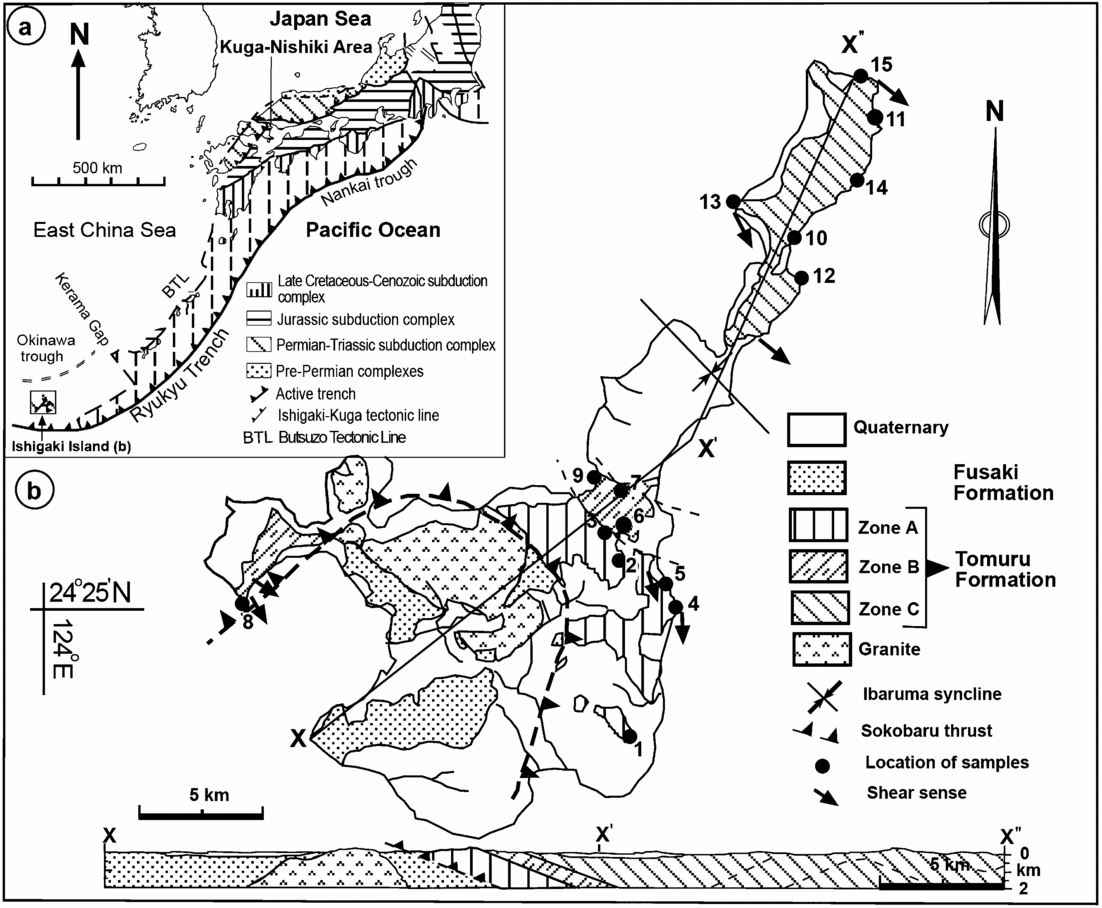
(a) Geotectonic map of southwest Japan–Ryukyu region, showing the Suo high-pressure metamorphic belt; the locations of two areas (Ishigaki and Nishiki) described in this paper are shown. (b) Mineral zone map of the Ishigaki high-pressure schist belt with the location of samples studied. Shear sense on the map is after Faure, Monie & Fabbri (Reference Faure, Monie and Fabbri1988).

The Fusaki Formation is composed of a complex of various blocks in a muddy matrix. The blocks consist mainly of chert, siliceous mudstone, sandstone and limestone. The presence of conodonts, radiolarians and smaller foraminifera in the allochthonous blocks indicates a Late Carboniferous to Early Jurassic age for the Fusaki Formation (Isozaki & Nishimura, Reference Isozaki and Nishimura1989). Although the age of the muddy matrix has not been determined, it is inferred that the Fusaki Formation was formed as part of an accretionary complex in a middle Jurassic subduction zone. The age of metamorphism, as determined by K–Ar dating of the recrystallized phengitic mica in pelitic rocks (Nishimura, Reference Nishimura1998), falls in the range 145–130 Ma (Early Cretaceous).
The Tomuru Formation is composed dominantly of basic and pelitic schists with minor siliceous and psammitic schists. Small blocks of meta-ophiolite, such as metagabbro and serpentinite, also occur within the schists. These rocks have been completely recrystallized and are divided into three zones, A, B and C, in accordance with the mineral parageneses of the basic schists (Fig. 1b; after Nishimura, Matsubara & Nakamura, Reference Nishimura, Matsubara and Nakamura1983). Zone A is characterized by the pumpellyite–glaucophane assemblage and the occurrence of lawsonite and aragonite (Ishizuka & Imaizumi, Reference Ishizuka and Imaizumi1988). Zone B is marked by the replacement of the pumpellyite, lawsonite and aragonite assemblage by epidote–glaucophane. Zone C is characterized by the appearance of barroisite in the basic schists and of garnet in the pelitic schists. The presence of aragonite indicates the P–T condition, which is estimated to be higher than 5–6 kbar at 200°C and 8–9 kbar at 400°C (Ishizuka & Imaizumi, Reference Ishizuka and Imaizumi1988; Carlson, Reference Carlson and Reeder1983). The boundaries between zones A, B and C are sub-parallel to the bedding schistosity with no apparent tectonic gap. The metamorphic grade increases from the lower to the upper stratigraphic levels in the Tomuru Formation, and represents an inverted metamorphic gradient. As the rocks have been completely recrystallized under a progressive metamorphism at high-pressure conditions, their depositional age remains unconstrained. Faure, Monie & Fabbri (Reference Faure, Monie and Fabbri1988) reported well-defined Ar–Ar plateau ages of 225 Ma for phengite from metapillow lava and 237 Ma for amphibole from basic schists in zone C. The K–Ar phengite age of the pelitic schists ranges from 220 to 190 Ma (Nishimura, Reference Nishimura1998).
The Fusaki Formation differs from the Tomuru Formation in its original depositional environment and metamorphic history. The younger and weakly metamorphosed rocks of the Fusaki Formation are thrust under the older and high-pressure Tomuru metamorphic rocks. Similar metamorphic and geochronological histories are recorded in the rocks of the Kuga–Nishiki area of western Chugoku (Nishimura et al. Reference Nishimura, Itaya, Isozaki and Kameya1989; Fig. 1a). This boundary thrust has been named the Ishigaki–Kuga tectonic line (Isozaki & Nishimura, Reference Isozaki and Nishimura1989).
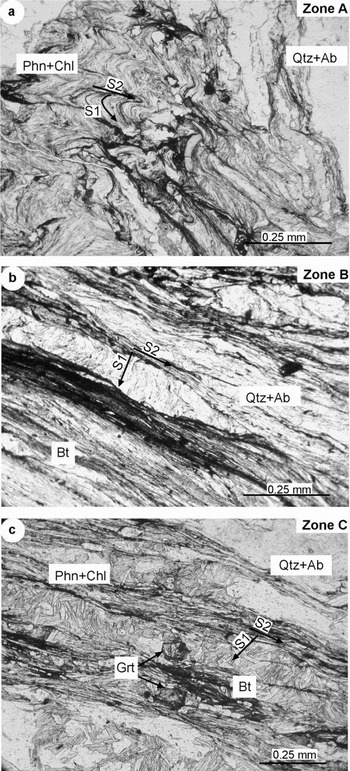
The fifteen samples studied in this paper were all pelitic schists collected from metamorphic zones A, B and C in the Ishigaki high-pressure schist belt (Fig. 1b). Thin-sections were made across the major foliation and normal to the lineation. The samples show medium-grade metamorphism. All samples show strong ductile deformation with two sets of foliations (S1 and S2) defined by the preferred orientation of stretched quartz, feldspar and phyllosilicate minerals (Fig. 2). Most of the samples contain the assemblage phengite + chlorite + albite + quartz + carbonaceous materials + opaques. Two samples (12 and 14) contain garnet, which is fine-grained (0.3–1.0 mm). Detrital minerals cannot be distinguished from recrystallized ones in these samples.
Photomicrographs of representative pelitic schists, showing strong ductile deformation with two sets of foliations (S1 and S2). Qtz – quartz, Ab – albite, Phn – phengite, Chl – chlorite, Grt – garnet, Bt – biotite.

3. K–Ar ages and apparent d002 spacing results
The samples were crushed with a jaw crusher and then sieved. Phengite was separated from the 140–200 or 170–235 mesh size fractions of samples from zone A and B, and from the 80–170 mesh size fractions from zone C. These size ranges were selected to separate the different mineral size fractions observed in thin-sections. Analyses of potassium and argon of phengite separates, and calculations of ages and errors, were carried out following the methods described by Nagao et al. (Reference Nagao, Nishido, Itaya and Ogata1984) and Itaya et al. (Reference Itaya, Nagao, Inoue, Honjou, Okada and Ogata1991). Potassium was analysed by flame photometry using a 2000 ppm Cs buffer with an analytical error within 2 % at a 2-sigma confidence level. Argon was analysed on a 15 cm radius sector-type mass spectrometer with a single collector system using the isotopic dilution method and argon 38 spike. Multiple runs of the standard (JG-1 biotite, 91 Ma) indicate that the error of argon analysis is about 1 % at a 2-sigma confidence level (Itaya et al. Reference Itaya, Nagao, Inoue, Honjou, Okada and Ogata1991). The decay constants of 40K to 40Ar, 40Ca and 40K content in potassium used in the age calculations are 0.581 × 10⁻¹⁰ year−1, 4.962 × 10⁻¹⁰ year−1 and 0.0001167, respectively (Steiger & Jäger, Reference Steiger and Jäger1977).
Carbonaceous material was separated from silicate minerals by a method similar to that used by Itaya (Reference Itaya1981). 50–150 g of pelitic rock were crushed in a stamp mill. Material passing through a 100 mesh screen was treated successively by (1) hydrochloric acid (1–2 N, 1–2 hours), (2) hydrofluoric acid (55 %, 8–10 hours) and (3) hydrochloric acid (4–5 N, 4–6 hours) on a hot plate. Steps (2) and (3) were repeated at least twice. In these treatments, drying of the residue was avoided. Between acid treatments, the residues were washed with distilled water and, at the end of the treatment, with ethanol. Insoluble minerals such as zircon, tourmaline and pyrite were removed by using the difference of the sedimentation rate in ethanol. Treatment with nitric acid to remove pyrite was not attempted because carbonaceous material is easily oxidized (Saxby, Reference Saxby1970) and its crystal structure may be affected. This method yields 70–94 % concentration of carbonaceous material. The carbonaceous material in ethanol was dried on a glass slide and analysed with an X-ray diffractometer using Ni-filtered Cu–Kα radiation. Diffractograms were calibrated with a silicon standard.
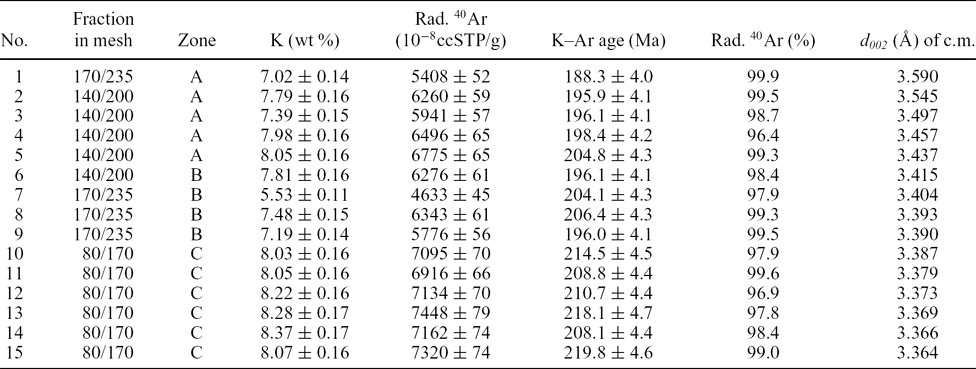
K–Ar age data of phengite separates and the apparent d002 spacing of carbonaceous materials from pelitic schists in the Ishigaki area are listed in Table 1. The ages were 188 to 205 Ma in zone A, 196 to 206 Ma in zone B and 208 to 220 Ma in zone C. The potassium content indicates that the phengite in a fraction from sample number 7 was probably impure (K content is 5.5 wt %). However, the sample has an age comparable to that of the neighbouring samples. From petrographic observations it was observed that the impurities in the phengite fractions were generally quartz, albite and carbonaceous material. These impurities do not significantly affect the phengite K–Ar ages (e.g. Itaya & Takasugi, Reference Itaya and Takasugi1988). Similar age results have been presented in a previous study of the geotectonic subdivision of the Sangun belt, inner zone of southwest Japan, by Nishimura (Reference Nishimura1998). The d002 values are 3.590 to 3.437 Å in zone A, 3.415 to 3.390 Å in zone B and 3.387 to 3.364 Å in zone C. These values provide an estimate of their metamorphic temperatures (Itaya, Reference Itaya1981), suggesting that the temperature of zone A is about 350°C and that of zone C is higher than 450°C.
K–Ar ages of phengite separates and the apparent d002 values of carbonaceous materials from pelitic schists in the Ishigaki high-pressure schist belt

c.m. – carbonaceous materials
4. Age–temperature–structure relations
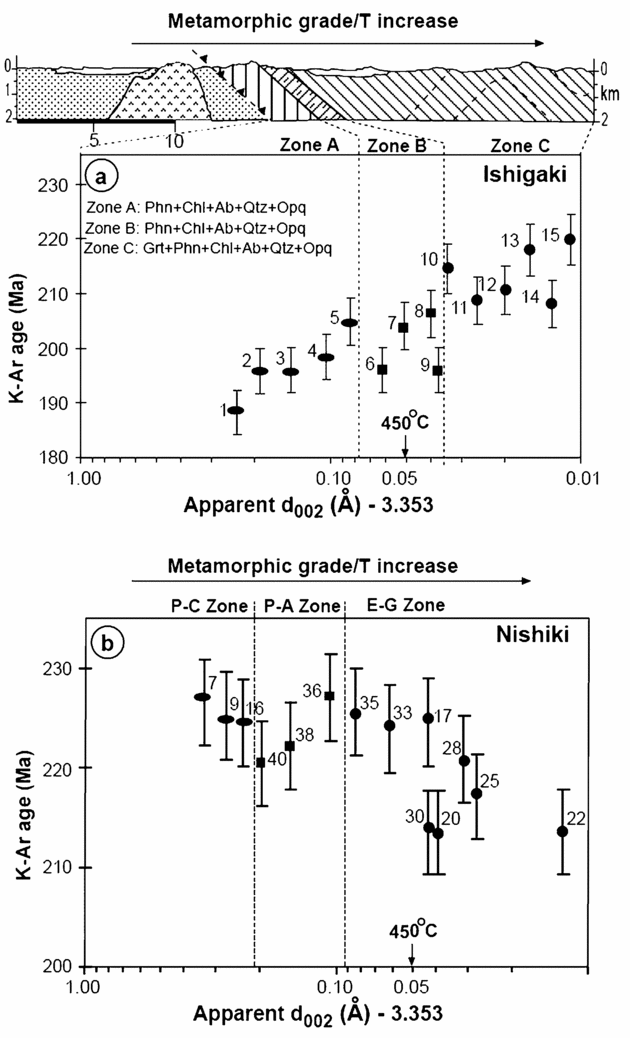
The relations between K–Ar phengite ages and the d002 values of carbonaceous material from the Ishigaki area indicate that the ages get progressively older with increasing metamorphic temperature (Fig. 3a). This positive correlation in age–temperature relationship was confirmed in a metamorphic belt that underwent a different temporal evolution to the Sanbagawa belt of central Shikoku (Itaya & Takasugi, Reference Itaya and Takasugi1988). In contrast to the Ishigaki area, the Nishiki area displays younger ages in the higher-grade metamorphic rocks (Nishimura et al. Reference Nishimura, Itaya, Isozaki and Kameya1989; Fig. 3b). These contrasting age–temperature variations correlate with the contrasting thermal structures of the two areas. The thermal structure in the Ishigaki area is inverted, so that the highest-grade zone occurs in the uppermost parts of the apparent stratigraphic succession. In contrast, the Nishiki area has a thermal structure in which the higher-grade zone is in the lower part of the apparent stratigraphic succession (Nishimura et al. Reference Nishimura, Itaya, Isozaki and Kameya1989).
Relations between K–Ar phengite ages and the d002 values of carbonaceous material from pelitic schists in the Ishigaki (a) and Nishiki (b) areas of the Suo high P–T metamorphic belt. P–C – pumpellyite–chlorite, P–A – pumpellyite–actinolite, E–G – epidote–glaucophane. For legend to cross-section, see Figure 1.

These contrasting age–temperature–structure relationships have been previously observed in the Sanbagawa belt (Itaya & Takasugi, Reference Itaya and Takasugi1988; Miyashita & Itaya, Reference Miyashita and Itaya2002). The Sanbagawa sequence in the central Shikoku area, which has an inverted thermal structure, has a positive correlation in age–temperature relationship; that in the Kanto Mts area, where the higher-grade zone is in the lower part of the apparent stratigraphic succession, displays a negative correlation. Thus, in both the Cretaceous Sanbagawa and Triassic Suo belts, the western areas show inverted thermal structures and older ages in the higher-grade zone, whereas the eastern areas of the belts have younger ages in the higher-grade zones, which belong to the lower part of the apparent stratigraphic succession. These observations strongly suggest that the K–Ar phengite ages of high-pressure schists are reset not only at the theoretical closure temperatures for thermal retention of argon, but are also reset by other geological processes.
5. Discussion
The high-pressure schists in the Sanbagawa and Suo belts have been strongly deformed as observed microstructural features that include a strong stretching mineral lineation and sheath folding (Faure, Reference Faure1983; Faure, Monie & Fabbri, Reference Faure, Monie and Fabbri1988; Wallis, Reference Wallis1990; Fig. 2). Wallis, Banno & Radvanec (Reference Wallis, Banno and Radvanec1992) demonstrated that the microstructures were formed during a post-metamorphic stage, suggesting that the ductile deformation took place during the exhumation and cooling of the high-pressure schist belts. Itaya & Fujino (Reference Itaya and Fujino1999) observed that phengite in the schists generally occurs as aggregates of fine-grained crystals and is also extremely fine-grained in domains close to rigid garnet. It was suggested that these microstructures indicated that deformation, accompanied by exhumation of the schists, resulted in size reduction of phengite by strain-induced recrystallization or dynamic recrystallization. Strain-induced recrystallization promotes the chemical reaction of phengites at the retrograde stage as documented in many metamorphic sequences (Itaya & Fujino, Reference Itaya and Fujino1999; Miyashita & Itaya, Reference Miyashita and Itaya2002; Takeshita, Gouzu & Itaya, Reference Takeshita, Gouzu and Itaya2004; Gouzu et al. Reference Gouzu, Itaya, Hyodo and Matsuda2006b). Recrystallization with significant rearrangement of major elements such Al and Si in the phengite crystal should involve argon release from phengite, as the trapped argon is not favoured in the K site of phengite, and easily diffuses out from the phengite crystal structure. In contrast, the phengite included in rigid garnet, which has a high Si value, does not release argon as documented by Gouzu et al. (Reference Gouzu, Itaya, Hyodo and Matsuda2006b). They suggested that the phengite included within garnet is significantly older than that in the matrix, as demonstrated by Ar–Ar spot analyses. Thus, the ages obtained are related directly to the ductile deformation history of the matrix phengite during exhumation and cooling of the host rocks.
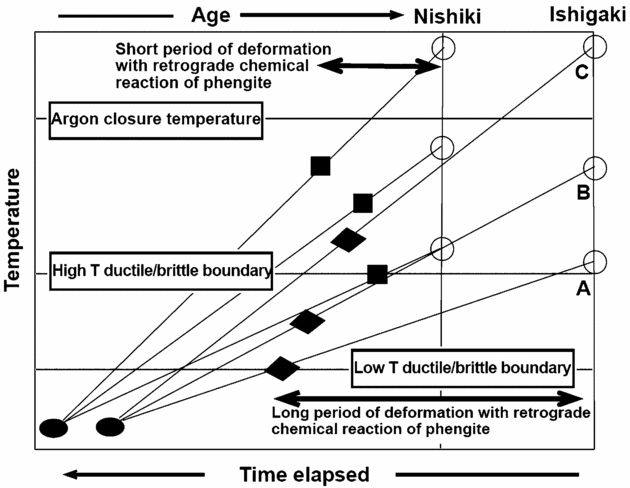
Discordant ages of phengite in different lithologies from the same outcrop are attributed to different degrees of recrystallization by ductile deformation of phengite, leading to differing amounts of argon depletion (Itaya & Fujino, Reference Itaya and Fujino1999). The resetting phenomenon must have occurred during deformation at temperatures below the closure temperature for thermal retention of argon in phengite. According to this model, argon depletion ceases and the K–Ar system for phengite closes when ductile deformation of phengite ceases. The resetting temperature will therefore be controlled by the ductile/brittle transition boundary within the pelitic schists, which have the most incompetent feature during deformation. During exhumation and cooling, low-grade rocks will reach the ductile/brittle boundary first. If the higher-grade rocks are still at a temperature above the argon closure temperature at the time when the low-grade rocks reach the ductile/brittle boundary, they will continue to lose argon from phengite. This process will continue until the rocks cool below the closure temperature and thereafter will only lose argon if the rocks are subjected to ductile deformation.
Villa (Reference Villa1998) examined Jäger's calibration of the closure (or blocking) temperature and proposed new closure temperatures of 500°C for muscovite. Takeshita, Gouzu & Itaya (Reference Takeshita, Gouzu and Itaya2004), who studied the resetting temperature of detrital white micas based on the systematic K–Ar analyses of phengite in calc-schists along the Chisone valley in the western Alps, supported the new closure temperature proposed by Villa (Reference Villa1998). This new insight suggests that most metamorphic sequences of both the Cretaceous Sanbagawa and Triassic Suo high-pressure schist belts have been metamorphosed below the closure temperature of phengite. The two contrasting age–temperature–structure relationships in the western and eastern areas of both belts can be explained by different tectonic styles related to the exhumation of the metamorphic sequences in both areas.
Five independent oceanic plates proximal to SW Japan, comprising the eastern margin of the Asian continent, have been documented: the Farallon, Izanagi, Kula, Pacific and Philippine Sea plates (e.g. Engebreston, Cox & Gordon, Reference Engebreston, Cox and Gordon1985). The boundary between the Kula and Pacific plates was a ridge which was subducted underneath SW Japan and is observed in an oceanic stratigraphic sequence in the Shimanto accretionary complex (Taira et al. Reference Taira, Katto, Tashiro, Okamura and Kodama1988). This suggests that the exhumation of the Sanbagawa high-pressure schists was triggered by the ridge subduction (Maruyama, Reference Maruyama1997; Itaya, Hyodo & Fukui, Reference Itaya, Hyodo and Fukui1993; Aoya et al. Reference Aoya, Uehara, Matsumoto, Wallis and Enami2003). The oblique ridge subduction underneath palaeo-SW Japan as a convergent margin was suggested for the along-arc variation in age of the Ryoke granitic rocks by Nakajima, Shirahase & Shibata (Reference Nakajima, Shirahase and Shibata1990) and Kinoshita (Reference Kinoshita1995). Correspondingly, the two areas which are separated by a large distance in the same metamorphic belt should display a significant time difference in the exhumation of the high-pressure metamorphics, for example, about 20 Ma, when the ridge moved at 4 cm y−1 away from Central Shikoku to the Kanto Mts, which are 800 km from each other. In the Sanbagawa belt, however, the western and eastern metamorphic sequences have the same K–Ar age ranges of phengite in pelitic schists, 65–85 Ma in central Shikoku (Itaya & Takasugi, Reference Itaya and Takasugi1988) and 58–82 Ma in the Kanto Mts area (Miyashita & Itaya, Reference Miyashita and Itaya2002). This suggests that the duration from the beginning of exhumation of metamorphic rocks to apparent resetting of the phengite K–Ar system was different between the two metamorphic sequences: significantly longer in central Shikoku than in the Kanto Mts area. It is realistic to consider that the Triassic Suo belt experienced an exhumation history similar to that in the Cretaceous Sanbagawa belt, although the western Ishigaki and eastern Nishiki areas have slightly different age ranges, 188–220 and 213–227 Ma, respectively, and are separated by 1000 km from each other.
Figure 4 shows two possible resetting mechanisms during the cooling history of a metamorphic pile which has been deformed during cooling, and also shows two different ductile/brittle boundaries. The position, or in this case the temperature, of the ductile/brittle boundary in the metamorphic succession depends on a number of variables, including lithology, pressure, strain rate and the presence or absence of fluids. The higher temperature boundary requires that higher-grade rocks have younger ages than the lower-grade rocks, as seen in the eastern areas (Kanto Mts and Nishiki) of the Cretaceous Sanbagawa and Triassic Suo belts. The lower temperature boundary requires an evolution whereby all rocks from high to low grade experience deformation related to argon depletion and have a comparatively long duration of deformation. This is required to get the age relationships similar to the western areas of both belts, where the lowest-grade rocks record the youngest ages. This resetting model is consistent with the contrasting thermal structures of western and eastern areas of both belts. The successions of schists, which have the inverted thermal structure with the large-scale recumbent folds, have undergone ductile deformation for a longer time and at lower temperatures, suggesting a relatively low strain rate for the deformation of the metamorphic pile in the western areas. A high strain rate would require ductile deformation at higher temperatures, which would not allow deformation of the low-grade rocks to continue for a sufficiently long time to produce an inverted thermal structure with large-scale recumbent folding.
Two possible resetting processes of phengite K–Ar system in the high-pressure schist belt.

Acknowledgements
The authors wish to thank to Drs C. Clark and R. Flowers for their critical comments and corrections on the early manuscript. We are grateful to Drs L. Paudel and K. Sajeev for their advice and comments, and all colleagues in RINS for sample preparation and analysis. The senior author is much indebted to Open Research Center of Okayama University of Science, Japan and Okayama University of Science foundation for financial support.