1. Introduction
The Proterozoic basins of India, also known as the Purana basins, comprise vast thicknesses (e.g. Cuddapah basin: area 44500 km2, thickness 10–12 km (Nagaraja Rao et al. Reference Nagaraja Rao, Rajurkar, Ramalingaswamy and Ravindra Babu1987); Vindhyan basin: area 162000 km2, thickness ~5 km (Prasad & Rao, Reference Prasad and Rao2006); Chhatishgarh basin: area 33000 km2, thickness ~2.3 km (Chakraborty et al. Reference Chakraborty, Das, Saha, Das, Mishra and Paul2012)) of undeformed and unmetamorphosed sediments. The crescent-shaped Cuddapah basin in southern India is one such Purana basin, well known for its thick sequence of Palaeoproterozoic and Mesoproterozoic sedimentary successions (Fig. 1). The basin is subdivided into four sub-basins: the Papaghni, Kurnool, Srisailam and Palnad (Nagaraja Rao et al. Reference Nagaraja Rao, Rajurkar, Ramalingaswamy and Ravindra Babu1987). The Nallamalai schist belt had earlier been thought to be the deformed eastern part of the Cuddapah sequence affected by Proterozoic tectonometamorphic events (King, Reference King1872; Narayanswami, Reference Narayanswami1966; Meijerink, Rao & Rupke, Reference Meijerink, Rao and Rupke1984; Lakshminarayana, Bhattacharjee & Ramanaidu, Reference Lakshminarayana, Bhattacharjee and Ramanaidu2001). Some recent studies (e.g. Saha & Chakraborty, Reference Saha and Chakraborty2003; Saha, Chakraborti & Tripathy, Reference Saha, Chakraborti and Tripathy2010), however, consider the schist belt to be a separate crustal entity juxtaposed against the Cuddapah basin rocks along a major N–S thrust. The Kurnool and Palnad sub-basins were earlier stratigraphically correlated with the Vindhyan and Chhattisgarh basins (Medlicott & Blanford, Reference Medlicott and Blanford1879; Raha, Reference Raha and Radhakrishna1987; Chaudhuri et al. Reference Chaudhuri, Saha, Deb, Deb, Mukherjee and Ghosh2002), which were assigned a Neoproterozoic age (Azmi, Reference Azmi1998; De, Reference De2003, Reference De2006; Azmi et al. Reference Azmi, Joshi, Tewari, Joshi, Mohan, Srivastava and Sinha2006, Reference Azmi, Joshi, Tiwari, Joshi and Srivastava2008; Joshi, Azmi & Srivastava, Reference Joshi, Azmi and Srivastava2006; Kumar & Pandey, Reference Kumar and Pandey2008). However, the oldest sediments in the Vindhyan basin have recently been shown to be Palaeo- to Mesoproterozoic in age (e.g. 1721–1600 Ma (Rasmussen et al. Reference Rasmussen, Bose, Sarkar, Banerjee, Fletcher and McNaughton2002; Ray et al. Reference Ray, Martin, Veizer and Bowring2002; Ray, Veizer & Davis, Reference Ray, Veizer and Davis2003; Sarangi, Gopalan & Kumar, Reference Sarangi, Gopalan and Kumar2004; Bengtson et al. Reference Bengtson, Belivanova, Rasumussen and Whitehouse2009)) and those in the Chhattisgarh basin to be ~1400 Ma (Bickford et al. Reference Bickford, Basu, Patranabis-Deb, Dhang and Schiber2011). The depositional age of the Kurnool Group of sediments in the Cuddapah basin is not yet adequately constrained.
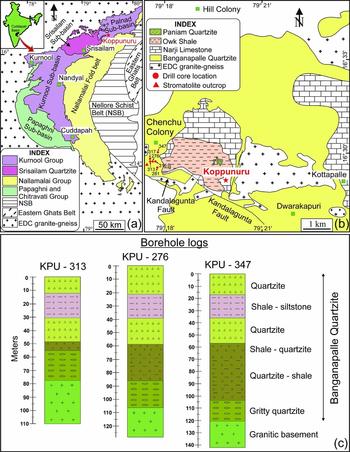
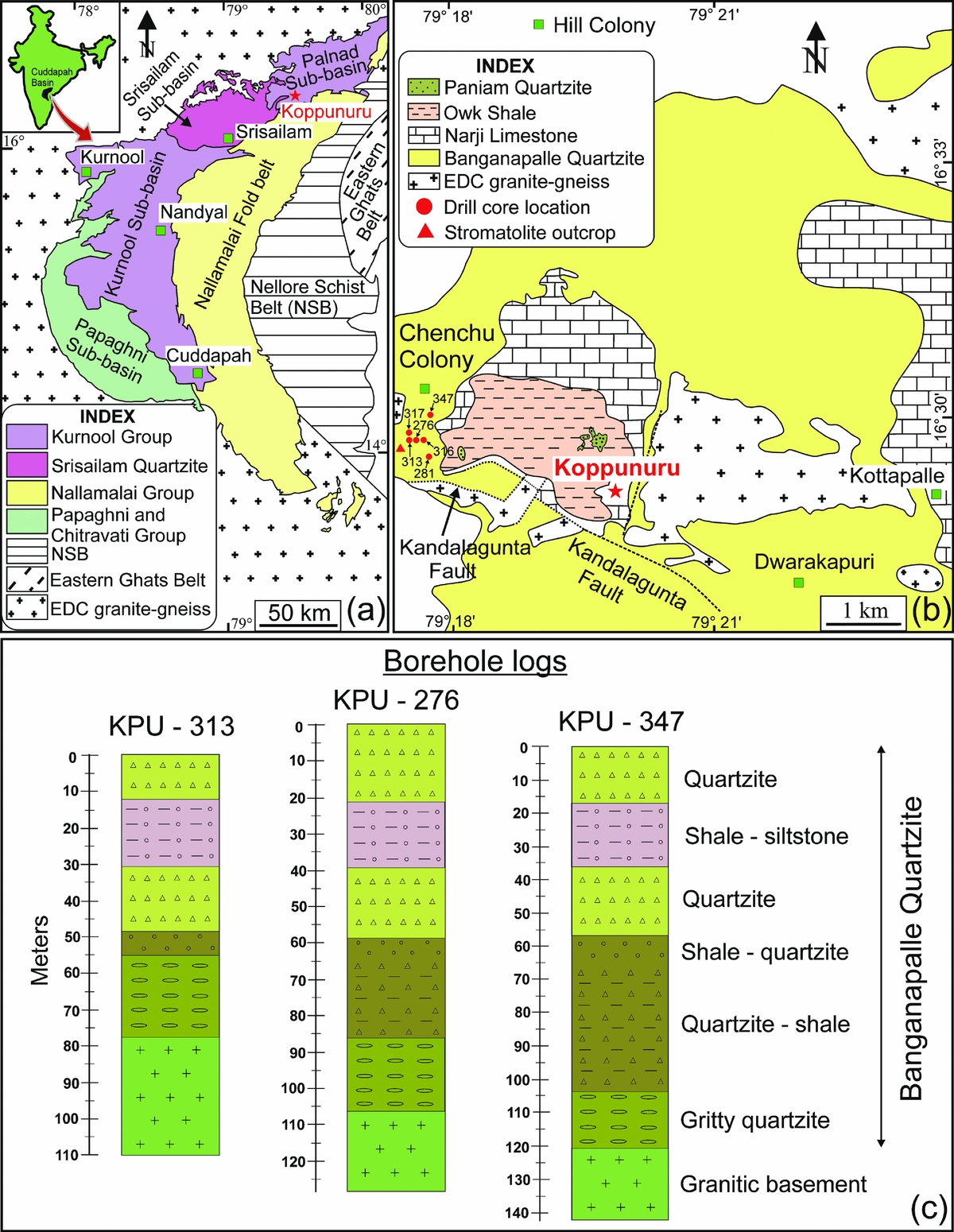
Geological map of the study area and sample locations. (a) The Cuddapah basin in southern India with its sub-basins demarcated (after Nagaraja Rao et al. Reference Nagaraja Rao, Rajurkar, Ramalingaswamy and Ravindra Babu1987); (b) sample drill core sites shown on the geological map of the Koppunuru area in the Palnad sub-basin (after Jeyagopal et al. Reference Jeyagopal, Deshpande, Gupta, Ramesh Babu, Umamaheswar and Maithani2011); (c) three selected borehole logs showing variable thickness and unevenness of the gritty quartzite.
Sharma & Shukla (Reference Sharma and Shukla2012) have argued for a Neoproterozoic age of the Kurnool basin, based on the occurrence of helically coiled Ediacaran Obruchevella species in the Owk Shale and burrow structures in the underlying Narji Limestone. However, the presence of sedimentary carbonate xenoliths, purportedly belonging to the Kurnool or its equivalent Bhima basin (A. Dongre et al. unpub. abstract, 2007; Dongre, Chalapathi Rao & Kamde, Reference Dongre, Chalapathi Rao and Kamde2008; Chalapathi Rao et al. Reference Chalapathi Rao, Dongre, Kamde, Srivastava, Sridhar and Kaminsky2010) in the Siddanpalli and Raichur kimberlites, dated at ~1090 Ma (Kumar, Heaman & Manikeyamba, Reference Kumar, Heaman and Manikeyamba2007), suggests that the sediments were deposited before 1090 Ma. In contrast, the occurrence of diamonds inferred to be derived from the 1140–1105 Ma (Crawford & Compston, Reference Crawford and Compston1973; Osborne et al. Reference Osborne, Sherlock, Anand and Argles2011) Wajrakarur kimberlite pipes (Krishnan, Reference Krishnan1964; Nagaraja Rao et al. Reference Nagaraja Rao, Rajurkar, Ramalingaswamy and Ravindra Babu1987; Chaudhuri et al. Reference Chaudhuri, Mukhopadhyay, Patranabis Deb and Chanda1999) in the Banganapalle Conglomerate, which forms the base of the Kurnool Group, indicates that the sediments are younger than 1105 Ma, in consonance with the observation of Sharma & Shukla (Reference Sharma and Shukla2012).
Bickford et al. (Reference Bickford, Saha, Schieber, Kamenov, Russell and Basu2013) have dated detrital zircons from an apparent felsic tuff bed (Saha & Tripathy, Reference Saha and Tripathy2012) c. 110–200 m above the base of the Kurnool rocks, which yielded ages similar to that of the ~2.5 Ga basement. Collins et al. (Reference Collins, Patranabis-Deb, Alexander, Bertram, Falster, Gore, Mackintosh, Dhang, Saha, Payne, Jourdan, Backé, Halverson and Wade2015) obtained youngest detrital zircon ages of 2516±16 Ma from the Banganapalle Quartzite, which again represent the age of the basement. Thus the timing of initiation of sedimentation in the Kurnool basin still remains unconstrained. A single age of 913±11 Ma (Collins et al. Reference Collins, Patranabis-Deb, Alexander, Bertram, Falster, Gore, Mackintosh, Dhang, Saha, Payne, Jourdan, Backé, Halverson and Wade2015) from the Paniam Quartzite in the upper Kurnool succession suggests a much younger age for the cessation of sedimentation.
In this contribution, we have dated (1) magmatic zircon in the basement granites, (2) detrital zircon in the overlying gritty quartzite and (3) hydrothermally altered zircon from the basement granite as well as the gritty quartzite, using U–Pb isotopes on a laser ablation inductively coupled plasma mass spectrometer (LA-ICPMS). Together with the results of chemical Th–U–Pbtotal EPMA (electron probe micro analysis) dating of uraninite from the gritty quartzite and hydrothermally altered monazite in the basement granite, we constrain the timing of initiation of sedimentation in the Palnad sub-basin. The gritty quartzite hosts uraninite mineralization. We observe that occasional veins of brannerite cross-cut the uraninite occurrences and that uraninite has been partially replaced by later coffinite. The repeated remobilization of U in the quartzite reflects episodic hydrothermal activity that also affected the granitic basement.
2. Geological background and sample
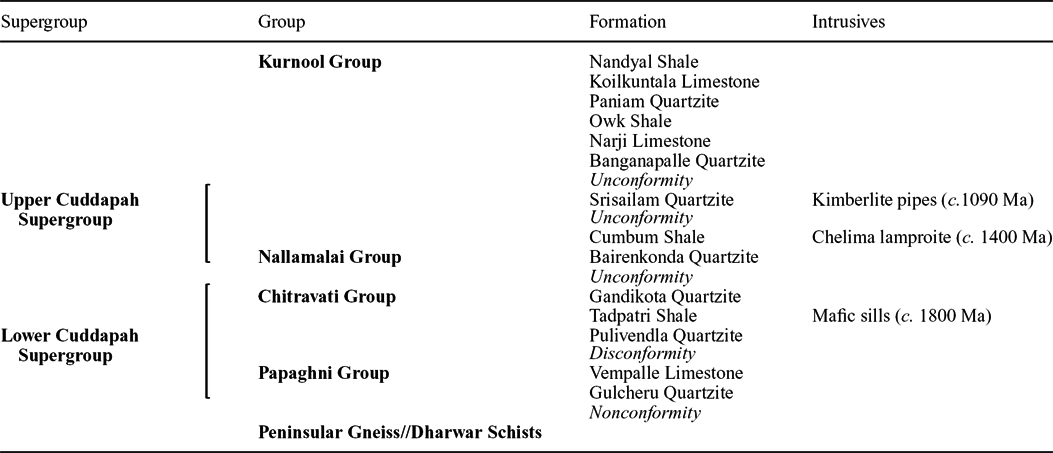
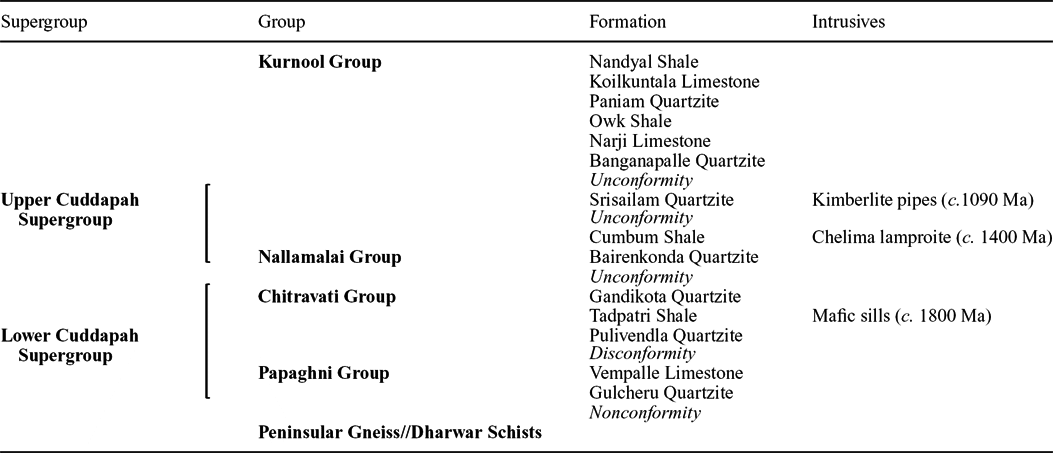
Samples were collected from the Palnad sub-basin, situated in the NE part of the Cuddapah basin. It is considered to be equivalent to the Kurnool Group of rocks exposed in the W part of the same basin (Fig. 1a). Stratigraphically, the Kurnool Group is younger than the Cuddapah Supergroup and lies above it with an angular unconformity (Table 1). Our study area around Koppunuru (16°29′19″N, 79°19′50″E) is located near the western margin of the Palnad sub-basin, where the Banganapalle Quartzite, the lowermost formation of the Kurnool Group, directly overlies the basement granites and gneisses of the Eastern Dharwar Craton (EDC), and the upper two formations, the Koilkuntala Limestone and the Nandyal Shale, are absent. The geological map of the region is shown in Figure 1b.
Lithostratigraphic succession of the Cuddapah Supergroup and Kurnool Group (after Nagaraja Rao et al. Reference Nagaraja Rao, Rajurkar, Ramalingaswamy and Ravindra Babu1987; Tripathy & Saha, Reference Tripathy and Saha2013)
Because of the horizontal to sub-horizontal disposition, the full thicknesses of the formations are not exposed. The samples from the Banganapalle Quartzite are from the drill core repository of the Atomic Mineral Directorate (AMD), Government of India. The drill core sites are indicated in Figure 1b. Logs of three selected drill cores are provided in Figure 1c. The lowermost unit in the drill cores is the gritty quartzite, which is followed by a quartzite–shale unit, a lower quartzite, a shale–siltstone and an upper quartzite. The quartzite–shale unit is more shale-rich at the top and has variable thickness from one borehole to another. The variable thickness of the uppermost quartzite can be ascribed to differential surface erosion. Surface samples of quartzite were also collected from near Chenchu Colony (16°29′45″N, 79°17′20″E) and Dwarakapuri (16°28′05″N, 79°21′05″E). One sample of basement granite showing high radioactivity was collected from the Hill Colony site (16°34′40″N, 79°19′19″E) situated at the margin of the basin.
3. Methodology and analytical conditions
3.a. EPMA chemical dating of monazite and uraninite
Monazite from the granite and uraninite from the quartzite were dated by measuring their U, Th and Pb concentrations using a Cameca SX-100 Electron Probe Micro Analyzer (EPMA) at the Department of Geology and Geophysics, Indian Institute of Technology (IIT), Kharagpur. This method has the advantage of extracting chemical analyses from small domains of a mineral grain because of the small probe beam size (~1 µm), thus providing highly spatially resolved age information. Both monazite and uraninite incorporate negligible Pb at the time of their formation, and the radiogenic Pb accumulated in them is a function of their U and Th concentrations, and the time elapsed since their formation. Fluid-induced dissolution–reprecipitation processes may re-equilibrate and reset the U–Th–Pb decay system in pre-existing grains or may precipitate new grains as well as overgrowths on older ones, thus preserving a record of the geological events affecting the rocks. These individual zones can normally be identified by backscattered electron (BSE) imaging. The relation between Pb concentration and age is given by
 $$\begin{eqnarray*}
{\rm{Pb}} &=& \frac{{{\rm{Th}}}}{{232}} \times \left( {{{\rm{e}}^{{\lambda _{232}}t}} - 1} \right) \times 208{\rm{\ }} \nonumber\\
&&+\, {\rm{\ \ }}\frac{U}{{238.03}} \times \left( {{{\rm{e}}^{{\lambda _{238}}t}} - 1} \right) \times 0.9928 \times 206{\rm{\ }} \nonumber\\
&&+\,\frac{U}{{238.03}} \times \left( {{{\rm{e}}^{{\lambda _{235}}t}} - 1} \right) \times 0.0072 \times 207{\rm{\ }}
\end{eqnarray*}$$
in which λ 232, λ 238 and λ 235 are the decay constants for 232Th, 238U and 235U, respectively. Present-day relative proportions of 238U and 235U in natural uranium are respectively 0.9928 and 0.0072. The decay of 232Th results in 208Pb, and 238U and 235U respectively decay to 206Pb and 207Pb.
For the EPMA analyses of monazite and uraninite, typical operating conditions were 20 kV accelerating voltage, 150 nA beam current and 1 μm beam diam-eter. The Kα lines of Si and Al and the Lα line of Y were measured on TAP, Ca–Kα, Th–Mα and U–Mβ were measured on PET, Fe–Kα, Pr–Lβ, Nd–Lβ, Sm–Lα, Gd–Lβ, Dy–Lα and Ho–Lβ were determined on LIF, whereas P–Kα, Zr–Lα, La–Lα, Ce–Lα and Pb–Mα were measured on a large PET crystal. The elements Si, Al, Fe and P were counted for 10 s on the peak. Similarly, Ca, La and Ce were measured for 20 s; Nd, Sm, Gd and Y for 40 s; Dy and Ho for 60 s; Th and U for 200 s; and Pb for 300 s. Respective background intensities were measured on both sides of the peak for half the peak times. The Pb–Mα line was corrected for overlap from the second- and third-order reflections of Y–Lγ whereas U–Mβ was corrected for interference from Th–Mγ, and Gd–Lβ was corrected for the interfering Ho–Lα. The elements Al, Th and U were calibrated on standards of their respective oxides and Fe on hematite. An apatite standard was used to calibrate Ca and P. All the rare earth elements (REE) were calibrated on standard REE glasses, Si on a Th-containing glass, Zr on zircon, Y on Yttrium Aluminum Garnet and Pb on pyromorphite. All standards were supplied by P&H Developments Ltd (UK).
3.b. LA-ICPMS U–Pb dating of zircon
Zircon grains from the basement granite were dated in situ in thin sections using a LA-ICPMS at the Department of Geology and Geophysics, IIT, Kharagpur. Cathodoluminescence (CL) and BSE images of the zircon grains obtained using a JEOL JSA 6490 Scanning Electron Microscope (SEM) were used as guides for spot selection. The U–Pb isotope measurements were done on a Thermo-Fisher Scientific ICAP-Q quadrupole ICPMS coupled to a New Wave 193 ArF Excimer laser ablation system. The laser was operated at 5 Hz repetition rate, 5 J cm−2 beam energy density and 25 μm spot size. The ICPMS was optimized for maximum sensitivity on Pb, Th and U using the NIST 612 reference glass. The oxide production rate monitored on 232Th16O was found to be <0.5%. The analyses were performed in a time-resolved mode, with each analysis consisting of 30 s background measurement and 40 s peak signal measurement. External standardization was done by bracketing groups of ten unknowns with three measurements of the GJ-1 reference zircon (Jackson et al. Reference Jackson, Pearson, Griffin and Belousova2004). The data were reduced offline using an in-house Excel© spreadsheet that corrects for instrumental and gas backgrounds, laser-induced elemental fractionation, and instrumental mass-bias and drift. The uncertainty on each analysis was estimated by quadratic addition of the 2SE (standard error) internal run statistics of each analysis and the 2σ of isotopic ratios measured in the bracketing GJ-1 reference zircon. To monitor precision and accuracy, the 91500 reference zircon (Wiedenbeck et al. Reference Wiedenbeck, Alle, Corfu, Griffin, Meier, Oberli, Von Quart, Roddick and Spiegel1995) was analysed (n=4) as unknown. The 206Pb/238U (0.1789±1.1%, 2σ) and 207Pb/206P (0.0745±0.33%, 2σ) ratios measured for this zircon match published values within analytical errors. All uncertainties are reported at the 2σ level. The U contents were estimated relative to the GJ-1 reference zircon. Concordia diagrams and age probability/histogram plots were constructed using Isoplot 4.15 (Ludwig, Reference Ludwig2003).
4. Results
4.a. Monazite ages
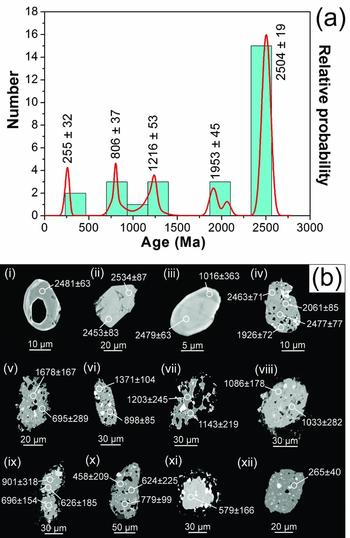
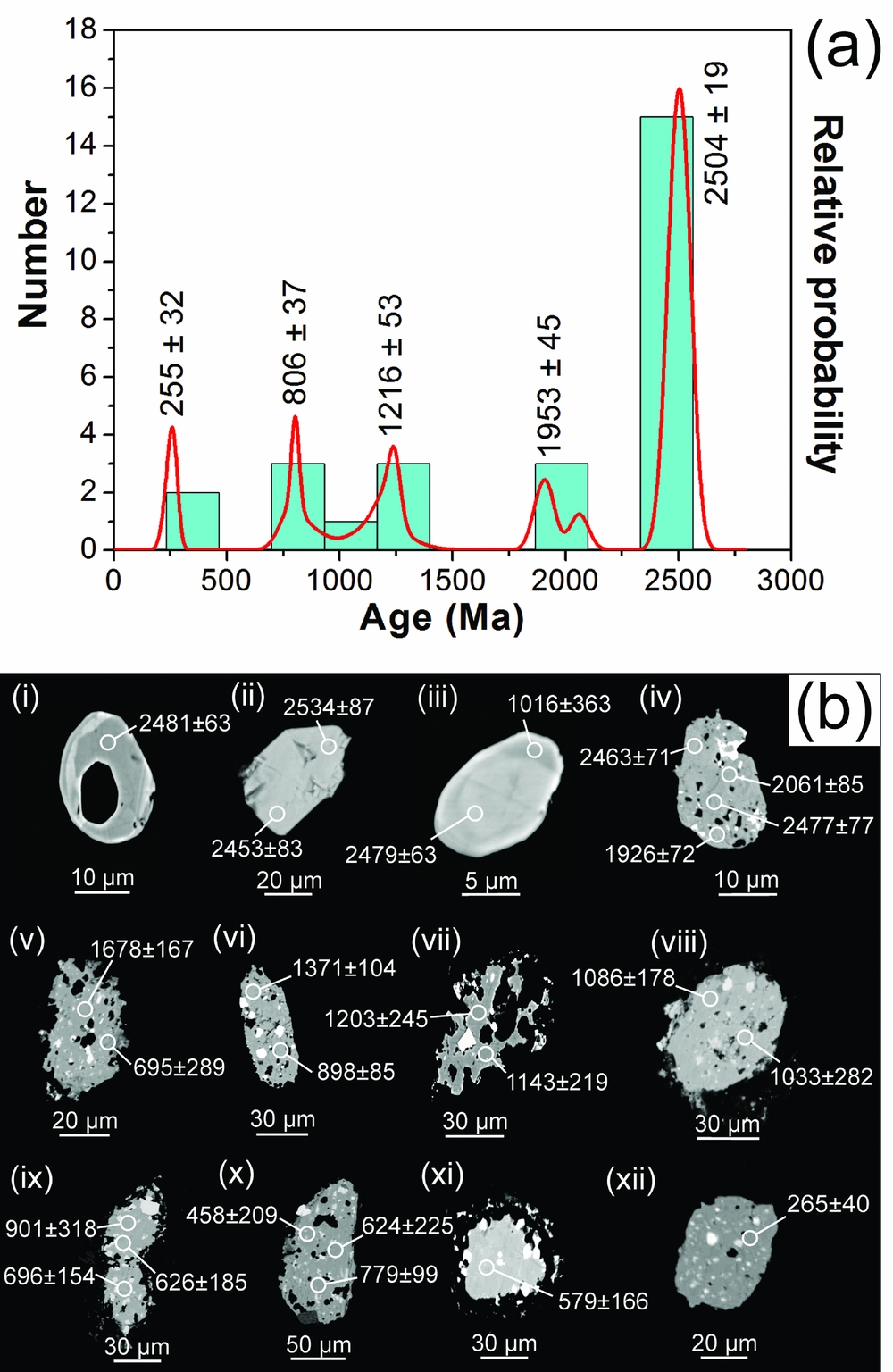
The U, Th and Pb concentrations along with the apparent spot ages from monazites in the basement granite are provided in the supplementary Table S1. Larger errors in some spot ages reflect their low Th and Pb concentrations. Therefore, while older ages with >10% errors have been discarded, ages younger than 500 Ma with up to 15% error have been considered, as these ages are fewer in number and have higher errors due to lower radiogenic Pb contents. The calculated ages span from 2958 to 243 Ma and define one major and several minor peaks in the age probability density plot (Fig. 2a). The majority of the ages define a peak at 2504±19 Ma. The BSE images reveal the presence of two textural varieties of monazites: some grains are relatively euhedral and preserve faint traces of oscillatory growth zones (e.g. Fig. 2b grains i, iii); others are micro-porous and characterized by sieve texture, irregular corroded boundaries and the presence of numerous inclusions of thorite and xenotime (Figs 2b, 3a–d). Such textures are usually produced by extensive fluid-induced alteration involving dissolution of U–Th–Y-rich monazite and precipitation of U–Th–Y-poor hydrothermal monazite (Table S1). Uranium being mobile was removed by the fluid, while Th and Y behaved as immobile elements precipitating as thorite and xenotime inclusions in micropores within monazite. The euhedral and unaltered monazite grains overwhelmingly give ages which define the ~2500 Ma population. This age is interpreted to date the emplacement of the granites. The hydrothermally altered monazites give a wide range of ages which define the minor peaks in the age probability density plot (Fig. 2a).
Monazite EPMA U–Th–Pbtotal ages from the basement granite. (a) Probability density plot showing a prominent peak at the older age end and several smaller peaks at lower ages; (b) representative BSE images showing the analysed spots and the corresponding ages obtained. The monazite microtextures record intense hydrothermal alterations which give ages ranging over ~2500– 250 Ma.
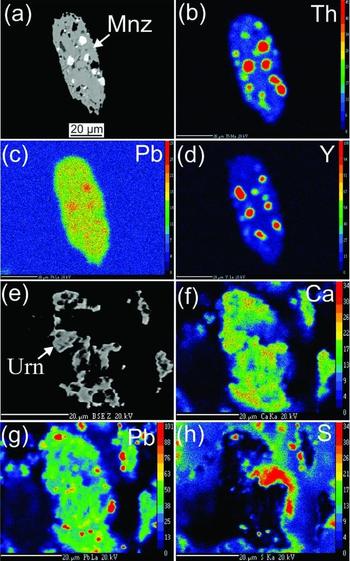
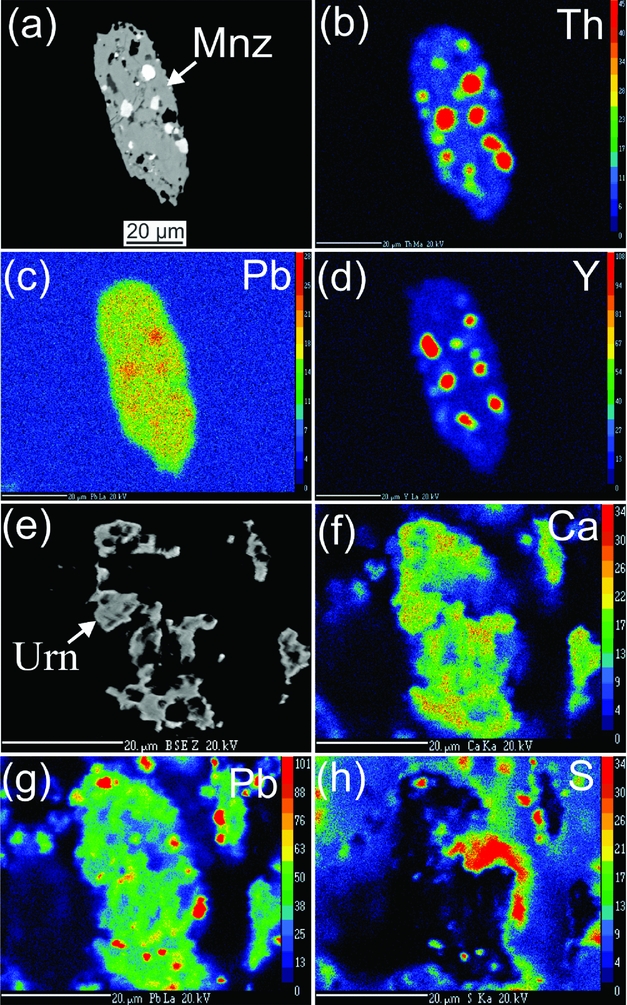
BSE image and X-ray element maps showing alteration of monazite in the basement granite (a–d) and uraninite in the Banganapalle Quartzite (e–h). In monazite, precipitation of thorite and xenotime is evident from the segregation of Th and Y, and Pb is uniformly distributed in the reprecipitated monazite. Fine granular nature of uraninite is evident from the Ca and Pb distribution patterns. Segregation of Pb-rich domains is seen within the uraninite, which may give rise to spurious age estimates. High S in a patch of carbonaceous matter (h) indicates derivation of S from organic matter for the formation of galena (spots with both high Pb and high S). Abbreviations: Mnz = monazite, Urn = uraninite.
4.b. Uraninite ages
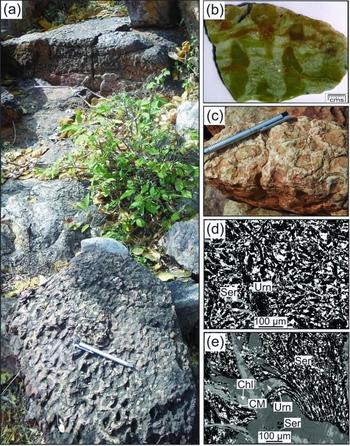
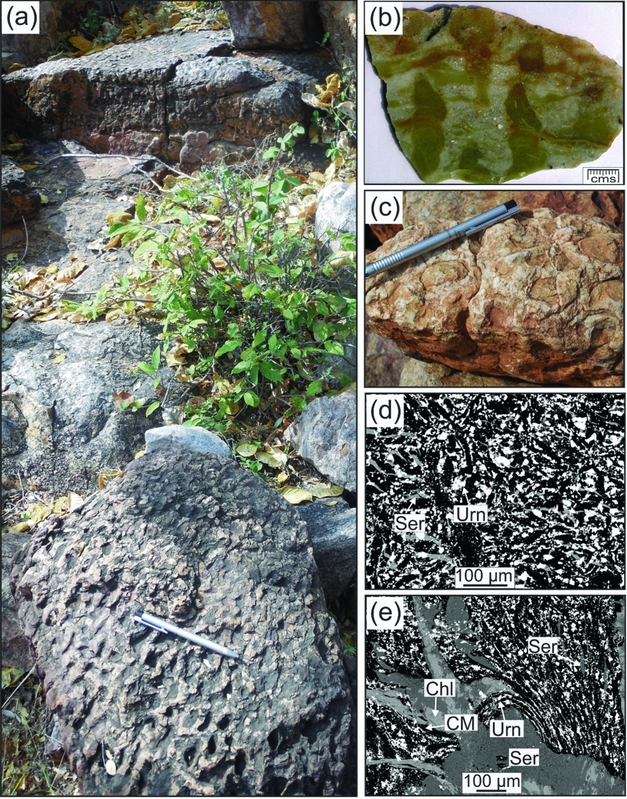
The Banganapalle Quartzite hosts siliceous stromatolites (Fig. 4a–c). Fine-grained uraninite mineralization is associated with sporadic occurrences of well-preserved microbial organic matter. Randomly oriented uraninite and sericite occur within masses of organic matter (Fig. 4d). However, domains preserving stromatolite-like laminations of alternate organic matter and fine-grained uraninite are sometimes encountered (Fig. 4e). Uraninite from the mineralized zones, associated with organic matter in the basal gritty quartzite of the Banganapalle Quartzite formation, was dated using the EPMA.
Stromatolitic structures in the Banganapalle Quartzite. (a) Columnar siliceous stromatolites with raised boundaries of resistant silica-cemented medium to fine sand; (b) unaltered siliceous stromatolite and thrombolite; (c) altered stromatolite resembling pebbles; (d) random precipitation of uraninite in carbonaceous-matter-rich masses, probably due to reduction of remobilized U in oxidizing fluids; (e) fragments of stromatolitic laminations of uraninite alternating with organic carbon-rich layers. Abbreviations: Chl = chlorite, CM = carbonaceous matter, Ser = sericite, Urn = uraninite.
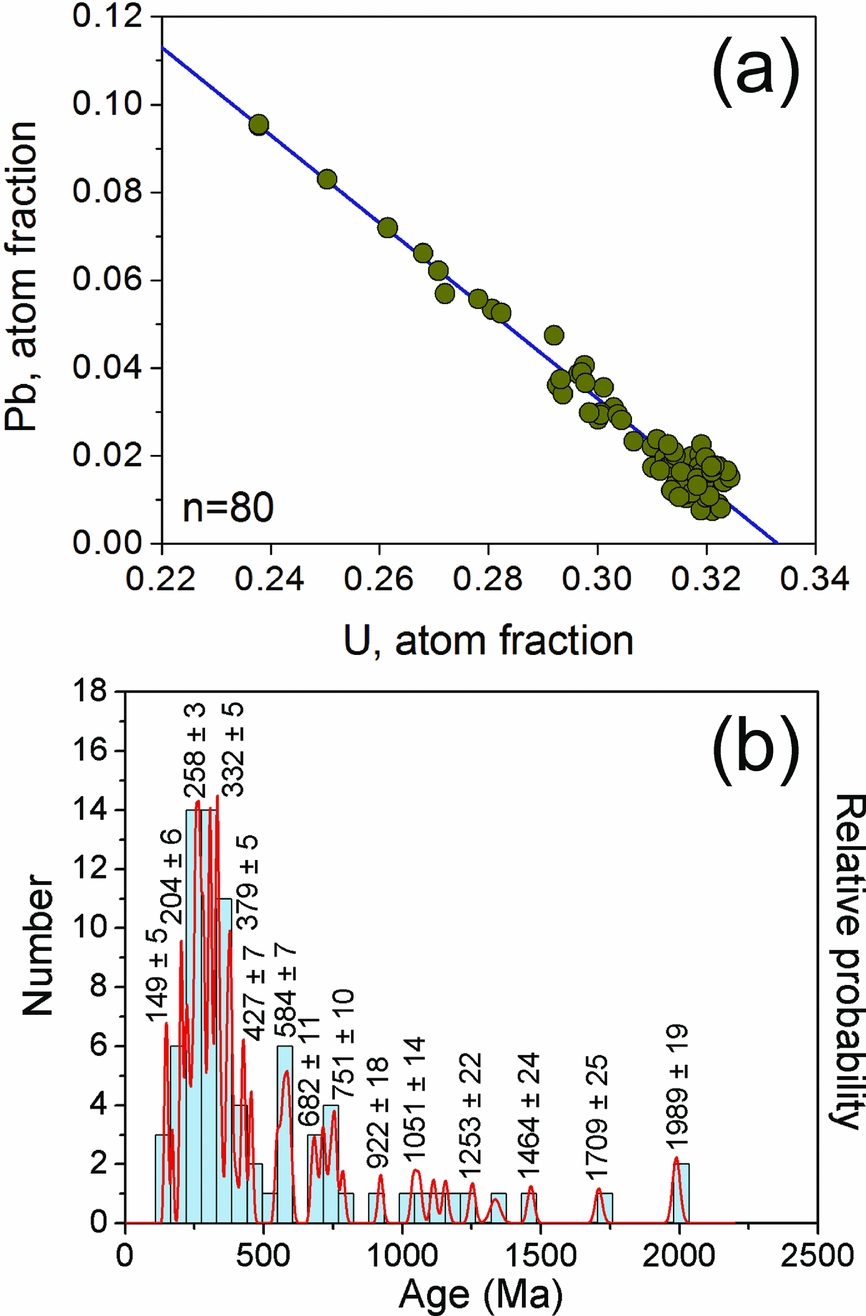
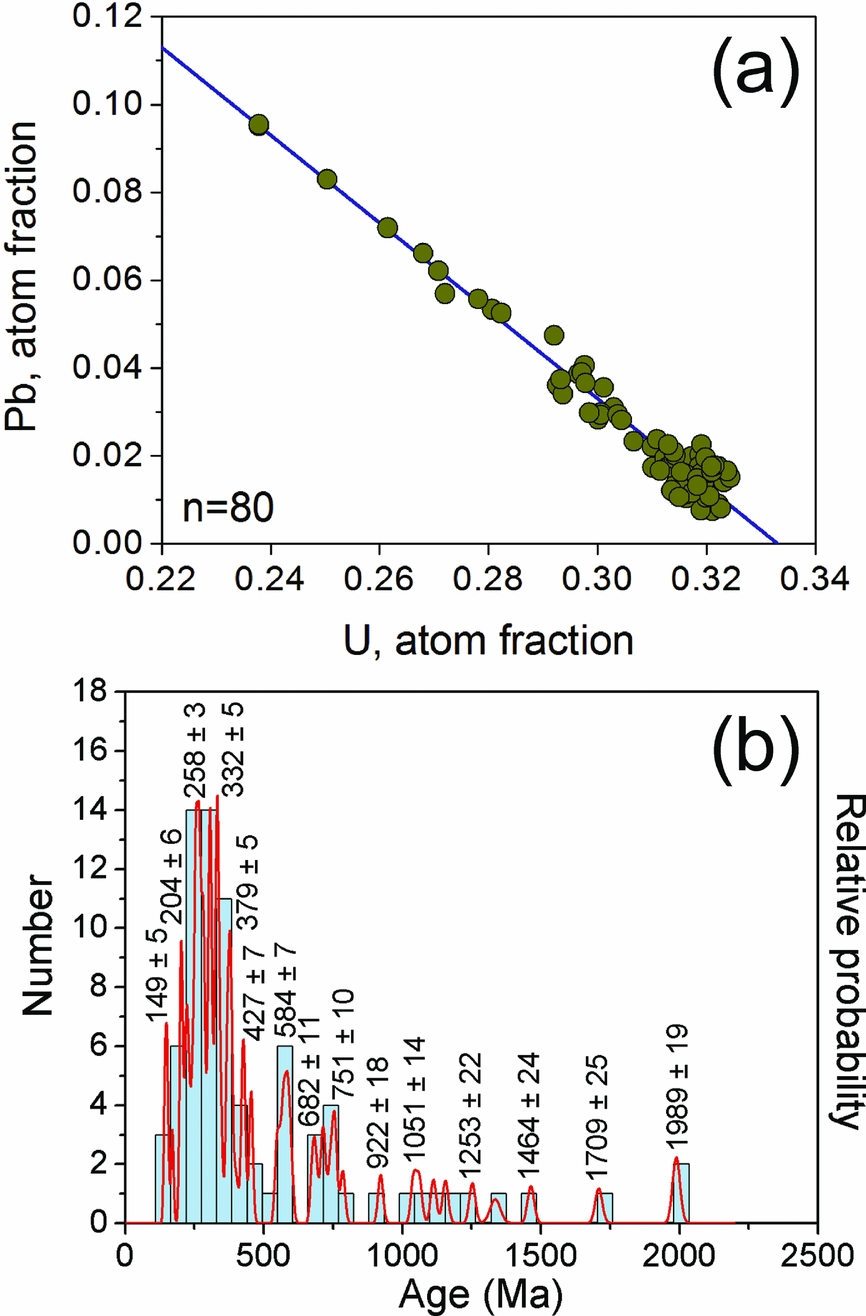
Because of high concentrations of U and Pb, the uraninite analyses have smaller analytical uncertainties even for relatively younger grains (see supplementary Table S2). However, BSE images and X-ray element mapping reveal microtextures indicating fluid-induced alteration in the uraninites (Fig. 3e‒h). In BSE images, uraninite appears as irregular patches, whereas in the Ca and Pb X-ray maps a granular nature is evident, implying that the apparently irregular patches are most likely accumulations of Ca-bearing colloidal precipitates of uraninite. The segregation of Pb to form galena is evident from the correspondence of some high-Pb spots with high-S spots (Fig. 3g and h). Some high-S patches (Fig. 3h) are associated with organic matter, suggesting that the S in the galena was remobilized from the organic matter. The EPMA dating of uraninite is plagued by the following complications: (1) spuriously high Pb concentrations in some spots, due to mixed analyses of galena finely intergrown with the uraninite, resulting in ages that are too old and of doubtful geological significance, (2) low analytical precision on some spots due to mixed analyses of fine sericite associated or intergrown with the uraninite and (3) concentrations below the detection limit of Pb in some uraninites, due to recent Pb loss. Given these analytical complications, only those analyses that plot along a line corresponding to a slope of –1 in the Pb vs U bivariate plot (Fig. 5a) were considered for the age calculations. This is because for every atom of U that undergoes radioactive decay, exactly one atom of radiogenic Pb will be added. The uraninite spot ages range from 144 to 1992 Ma and define a composite broad peak with an age maximum at ~258 Ma (Fig. 5b).
Uraninite EPMA chemical ages from the Banganapalle Quartzite. (a) Pb atom fractions plotted against U atom fractions for the uraninite analyses considered for age estimation plot along a line of –1 slope indicating negligible extraneous Pb; (b) probability density plot showing the effect of younger hydrothermal dissolution–reprecipitation of uraninite reflected in the erasure of the older age records.
4.c. Zircon ages
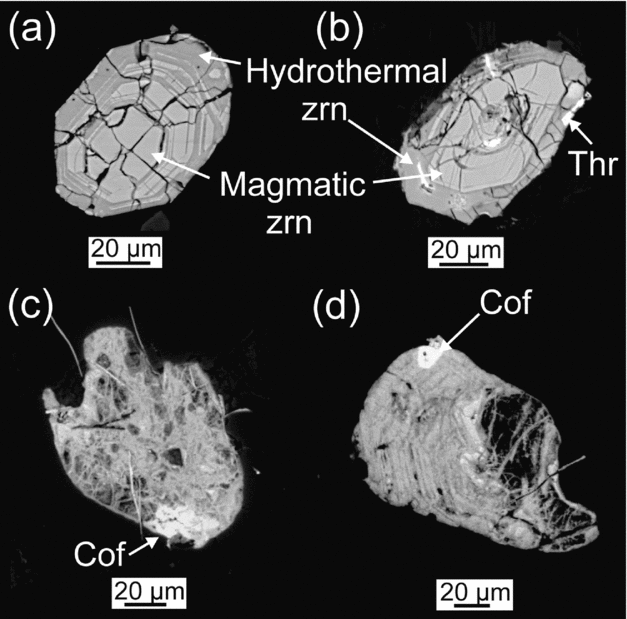
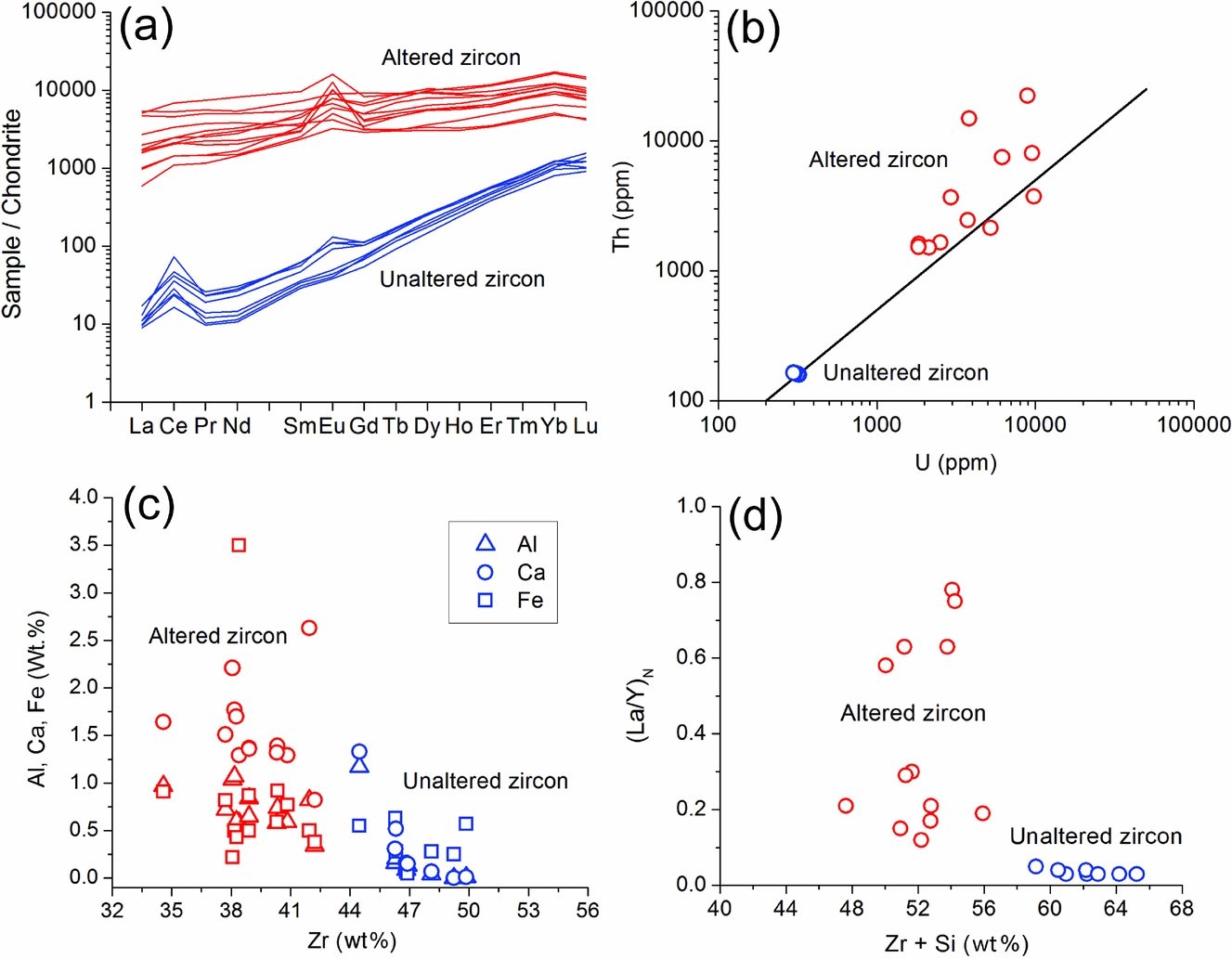
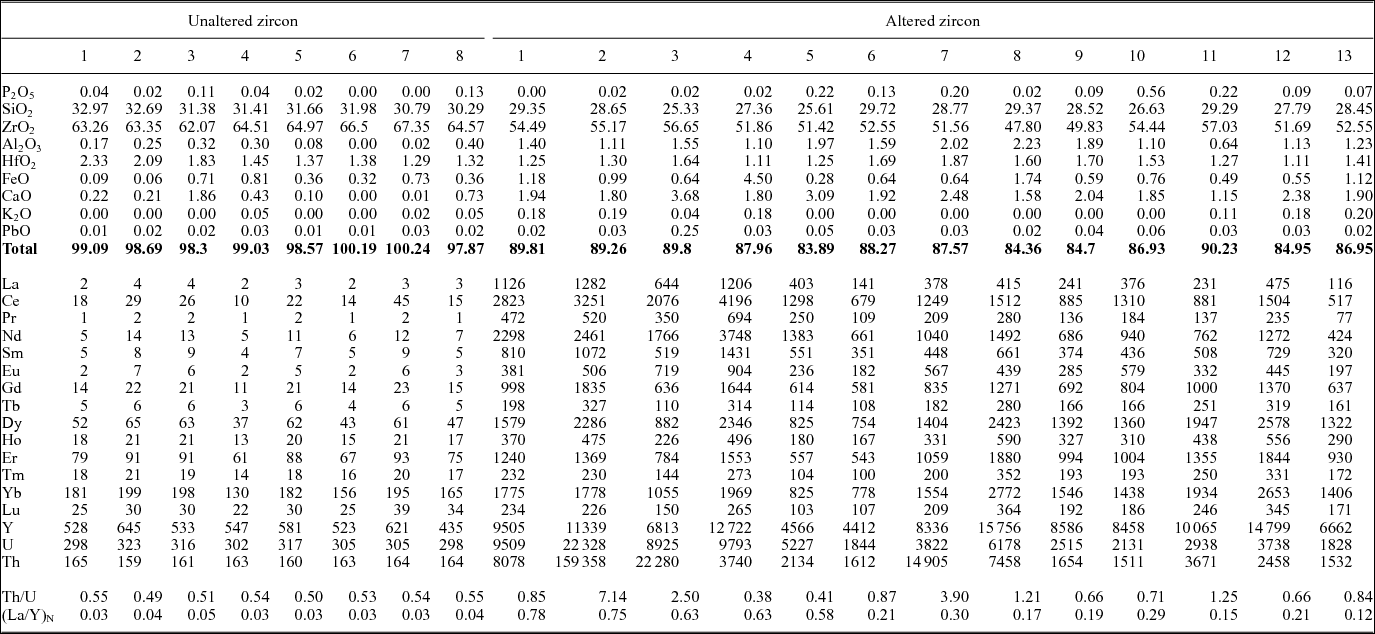
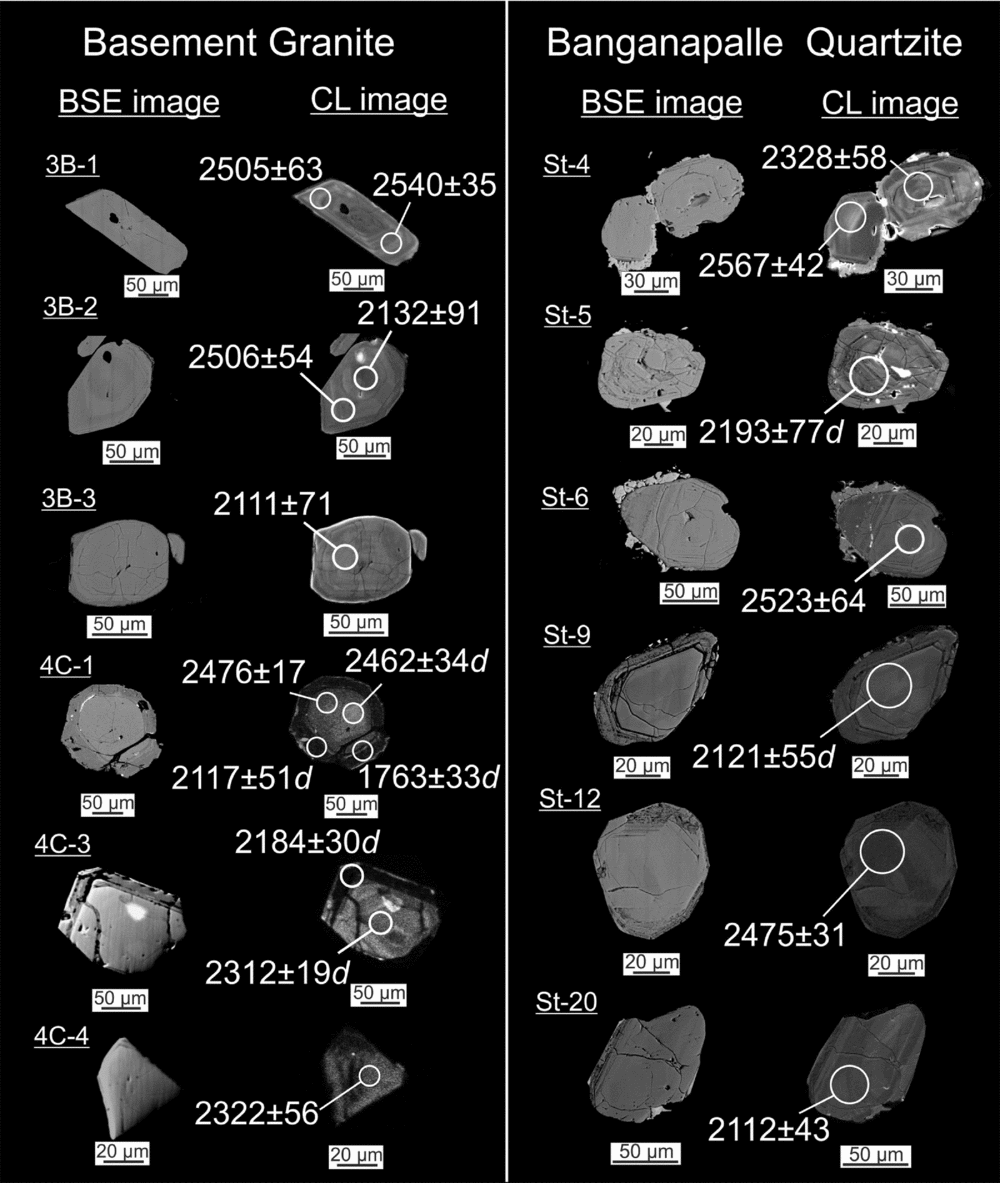
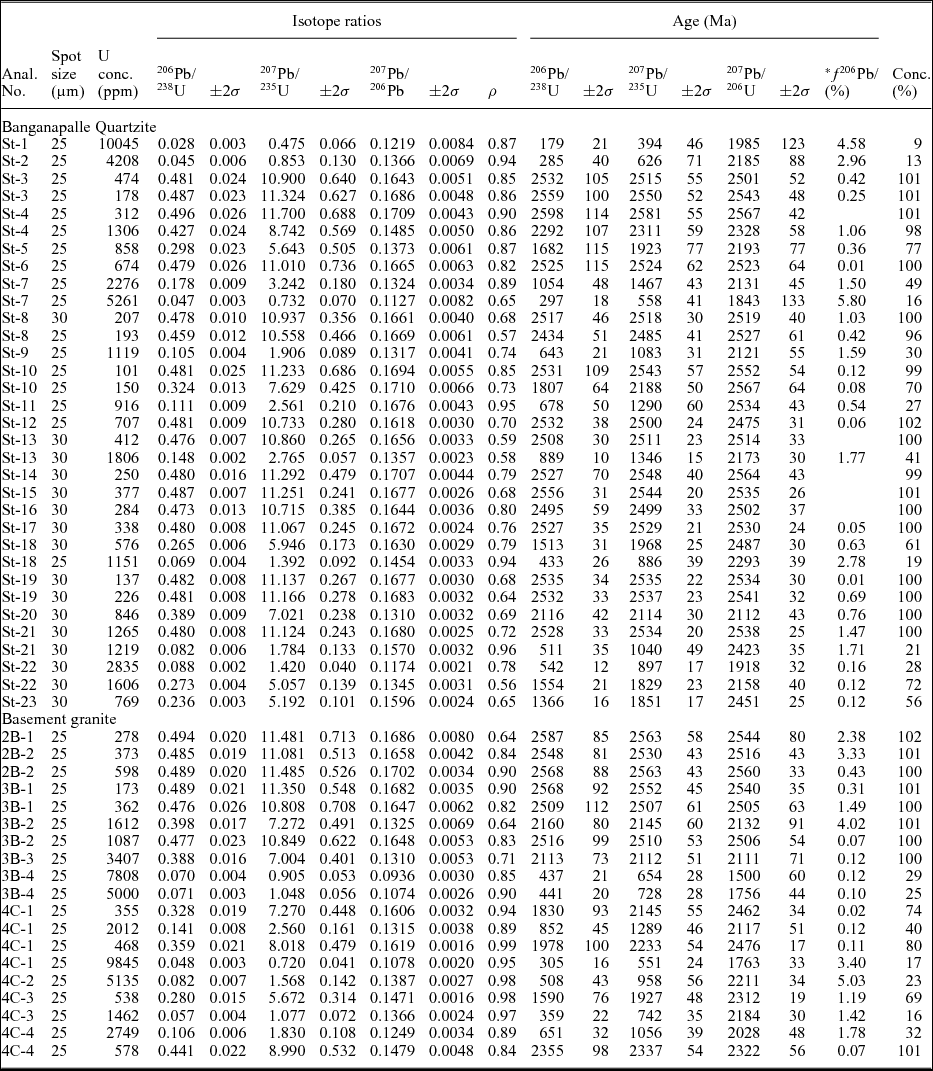
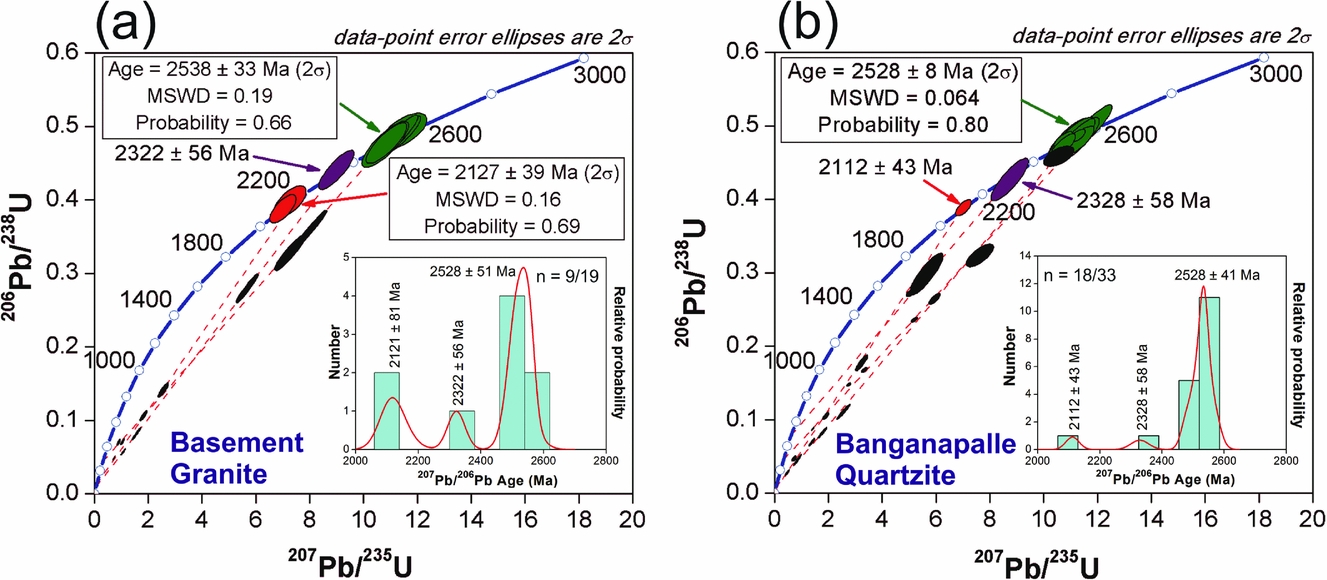
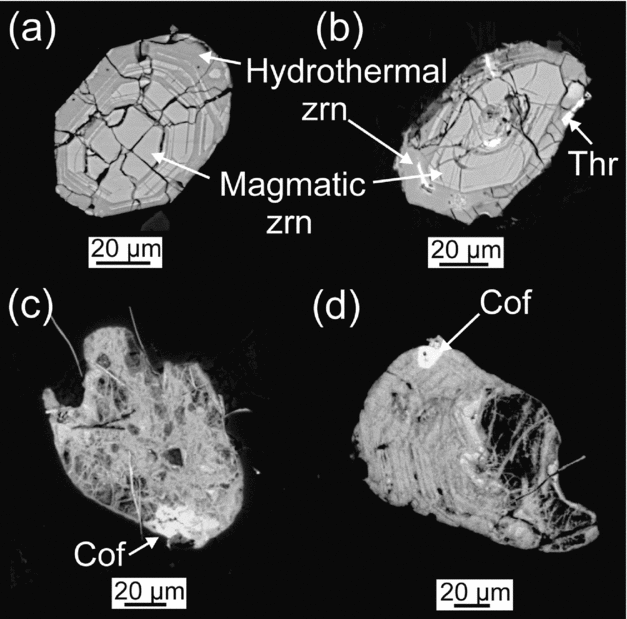
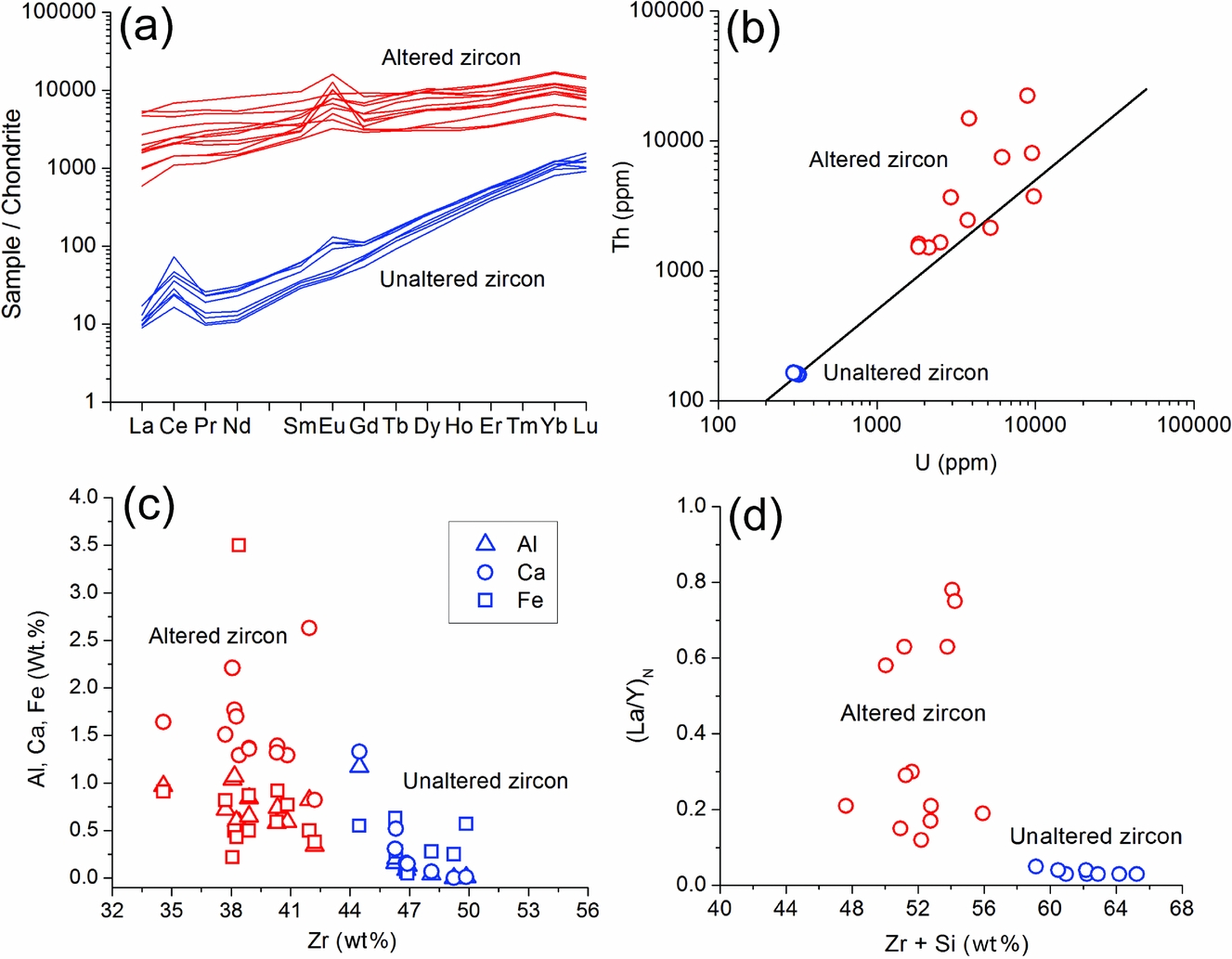
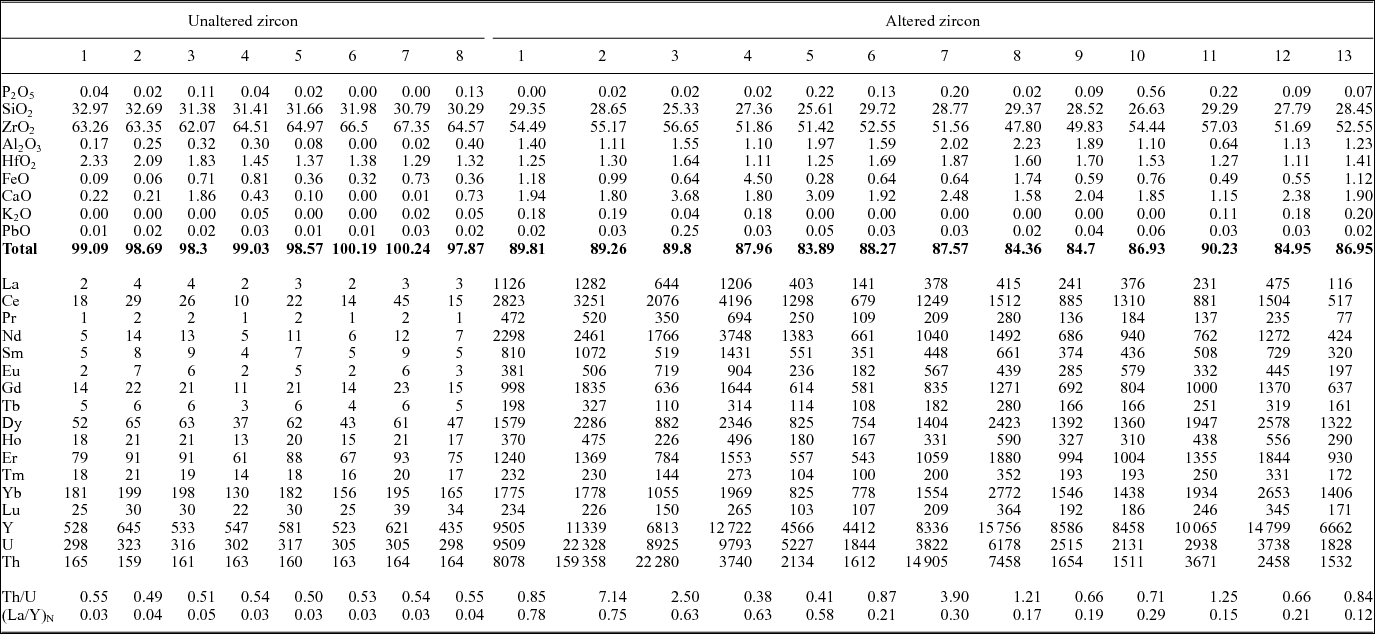
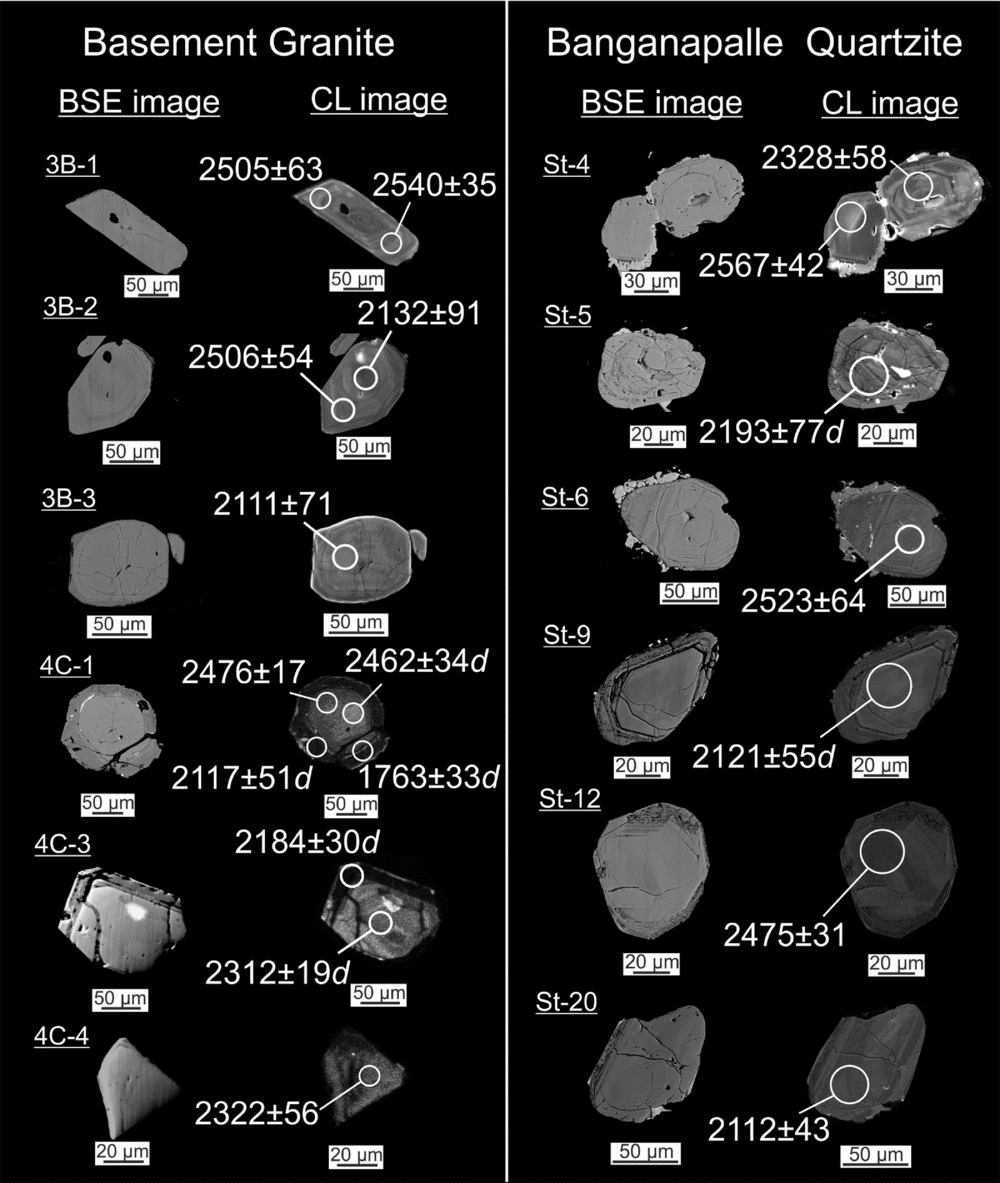
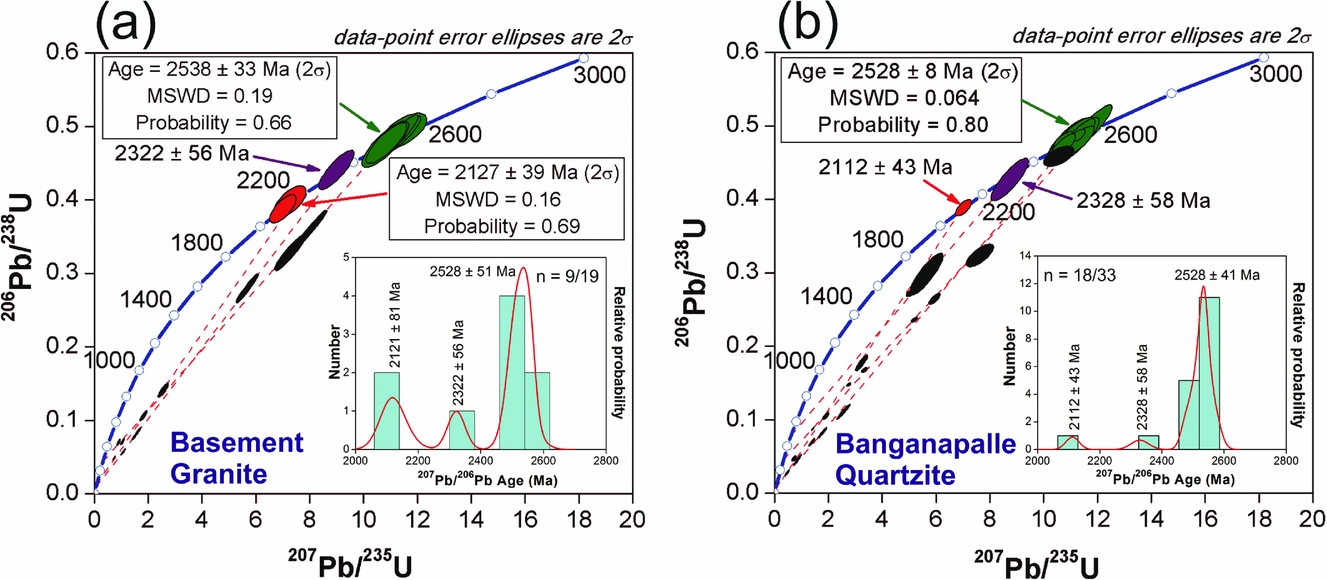
Zircon grains in the basement granite and the overlying gritty quartzite show evidence of extensive fluid-induced alteration via dissolution–reprecipitation processes. In the basement granite, the U- and Th-rich, possibly metamict, oscillatory growth zones have been selectively replaced by relatively U-poor and Ca–Si–LREE (light REE)-rich hydrothermal zircon (Fig. 6a, b). Similar selective alteration of U- and Th-rich growth zones is also seen in zircons from the gritty quartzite, with the metamict zones having been completely removed in some grains, preserving only the skeletal more resistant parts (Fig. 6c, d). The hydrothermally altered zircon and the unaltered zircon are geochemically distinct (Fig. 7; Table 2). The altered zircons have lower oxide totals (~83–90 wt%) in their EPMA analyses and have higher non-formula cations (e.g. Ca, Al and Fe). They are highly REE-enriched, particularly in the LREE (also reflected in the higher La/Y values) relative to the unaltered or weakly altered zircons, which have REE concentrations comparable to that of typical magmatic zircons. The Th/U ratios in the unaltered zircons vary in a narrow range of 0.49–0.55, whereas those in the altered zircons are more variable, having values between 0.38 and 7.14. Representative BSE and CL images with the LA-ICPMS spot ages are shown in Figure 8. The U–Pb isotope data (Table 3; Fig. 9) reveal the presence of both concordant and discordant age domains. The oscillatory-zoned unaltered parts of the grains in both the granite and the gritty quartzite yield concordant age populations, at 2538±33 Ma and 2528±8 Ma, respectively. Zircons from the granite additionally yield two concordant spot ages at 2127±39 Ma. A similar concordant age of 2112±43 Ma is obtained from one zircon grain in the quartzite. These ages are from domains which are patchily zoned or have ghost-like or bleached relic zoning typically seen in recrystallized zircons (Geisler, Schaltegger & Tomaschek, Reference Geisler, Schaltegger and Tomaschek2007; Harley, Kelly & Möller, Reference Harley, Kelly and Möller2007). An intermediate concordant age of 2325±40 Ma is obtained in both the granite and the gritty quartzite. The discordant data points define discordias that indicate Pb loss from both the 2530 Ma and 2120 Ma zircons at ~90 Ma.
Representative BSE images showing extensive fluid-induced alteration of zircon. Original magmatic zoning patterns are preserved in the basement granite (a, b), whereas much more intense alteration giving rise to skeletal zircons is evident in the Banganapalle Quartzite (c, d). Abbreviations: Cof = coffinite, Thr = thorite, Zrn = zircon.
REE and major element characteristics of the hydrothermally altered zircon compared to those of the unaltered zircon.
EPMA (wt% oxide) and LA-ICPMS trace element (ppm) analysis of unaltered and altered zircons from the basement granite
Representative BSE and CL images of zircons from the basement granite and the Banganapalle Quartzite. The LA-ICPMS U–Pb ages for the indicated spots are given. Those with the suffix ‘d’ are discordant and denote the 207Pb/206Pb ages.
LA-ICPMS U–Pb isotope data and ages of zircon from the Banganapalle Quartzite and the basement granite
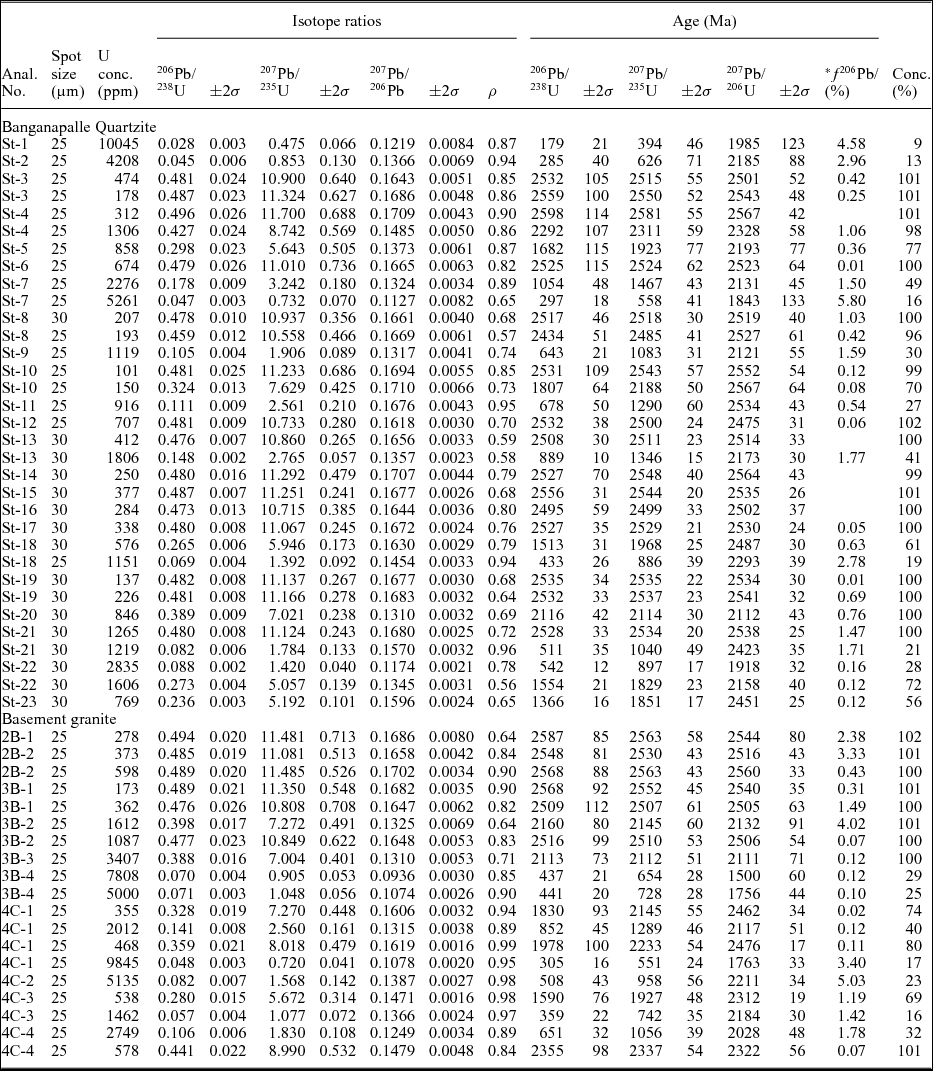
*Percentage of common 206Pb
Concordia diagrams for the zircons from (a) basement granite; (b) Banganapalle Quartzite. Corresponding probability density plots of ≥90% concordant ages are provided in the insets. Error ellipses are at the 2 standard deviations level. The discordias indicate the latest Pb-loss event at ~90 Ma in both the basement and the quartzite.
5. Discussion
5.a. The age of sedimentation of the gritty quartzite
The 2.53 Ga age from magmatic zircons in the granite dates the emplacement of the granitic basement of the Palnad sub-basin. The overlying gritty quartzite contains detrital zircons which overwhelmingly give 2.53 Ga ages, identical to those from the granites. This indicates that the sediments comprising the gritty quartzite were largely derived from the granitic basement or similar sources. It also indicates that the succession was deposited after 2.53 Ga.
The zircon, monazite and uraninite in both the basement granite and the gritty quartzite show evidence of intense hydrothermal alteration. Both rock units were affected by several pulses of hydrothermal activity, with the minerals in the gritty quartzite having been more intensely altered than those in the basement granite, possibly due to the greater permeability of the quartzites for the hydrothermal fluids. Several of the zircon grains in the quartzite have a delicate sieve-like porous structure. The alteration/dissolution that produced these microtextures must have happened in situ after the deposition of the quartzite since both the basement and the overlying quartzites were affected with similar alteration features and because grains with such delicate sieve-like structures are unlikely to survive sedimentary transport. The unaltered domains in zircon have Th/U values close to 0.5, which is characteristic of magmatic zircons (Hoskin & Schaltegger, Reference Hoskin and Schaltegger2003), whereas the altered zircons have widely variable Th/U ratios having values between 0.38 and 7.14. If non-fractionation of U and Th during zircon crystallization is assumed, the metamictized zones should also have had similar Th/U ratios prior to alteration. This would mean that the variable Th/U ratios in the altered zircon can be ascribed to preferential loss of U, causing them to plot above the line shown in Figure 7b, which is corroborated by the precipitation of thorite in the vicinity of zircon (e.g. Fig. 6b). Submicroscopic thorite grains could be contributing to the inhomogeneous distribution of Th in zircon as evident in the LA-ICPMS analyses. The 2.32 Ga and 2.12 Ga ages obtained from altered patchy zones or from domains with ghost-like or bleached relic zoning in the zircons are interpreted to date two hydrothermal events that affected the granites. These pulses of hydrothermal activity could be related to the emplacement of the 2.4 Ga Bangalore dyke swarms (e.g. Halls et al. Reference Halls, Kumar, Srinivasan and Hamilton2007; French & Heaman, Reference French and Heaman2010; Kumar, Hamilton & Halls, Reference Kumar, Hamilton and Halls2012) and the 2.17–2.18 Ga Northern Dharwar dykes (French & Heaman, Reference French and Heaman2010), the equivalents of which have also been reported from around the Cuddapah basin (Demirer, Reference Demirer2012). Furthermore, there are indications of regional-scale metamorphism followed by hydrothermal activity in the EDC at c. 2.30–2.37 Ga (Anand et al. Reference Anand, Balakrishnan, Kooijman and Mezger2014), also seen in the depleted 187Os/186Os of komatiitic amphibolites due to shearing and alteration at c. 2.40 Ga (Walker et al. Reference Walker, Shirey, Hanson, Rajamani and Horan1989), probably associated with the amalgamation of the eastern and western Dharwar cratons at 2.45–2.39 Ga (Krogstad, Hanson & Rajamani, Reference Krogstad, Hanson and Rajamani1991, Reference Krogstad, Hanson and Rajamani1995). A similar age has also been reported by Hazarika, Pruseth & Mishra (Reference Hazarika, Pruseth and Mishra2015), attributed to post-metamorphic shearing and alteration. Ages of 2298±23 Ma and 2373±23 Ma have been reported from altered metabasalts in the Hutti–Maski greenstone belt, and an age of 2298±22 Ma to 2348±23 Ma in the granitoids to the east of it (A. Schmidt, unpub. Diploma thesis, Univ. Münster, 2003; A. Schmidt et al. unpub. abstract, 2004). Accordingly the time span of deposition of the gritty quartzite horizon can be constrained between 2.53 and 2.12 Ga.
The uraninite in the gritty quartzite yielded a wide spectrum of ages (Fig. 5b) that overlap with a major part of the age spectrum furnished by monazite in the granite (Fig. 2a). This again supports the fact that the basement and the quartzite were affected by a common set of hydrothermal episodes. The wide spectrum of ages seen in these two minerals may be linked to the effects of younger magmatic activities from around the Cuddapah region (e.g. at 1788 Ma (U–Pb baddeyleyite age with lower intercept at 400 Ma; Demirer, Reference Demirer2012) and 1192 Ma (Pradhan, Pandit & Meert, Reference Pradhan, Pandit, Meert, Srivastava, Sivaji and Chalapathi Rao2008)) and to tectonothermal events in the neighbouring orogenic belts. Disturbance of isotope systems during younger tectonothermal events is reflected in the wide range of K–Ar (935, 1073, 1280 and 1349 Ma; Mallikarjuna et al. Reference Mallikarjuna, Bhattacharji, Rao and Hermes1995) and Ar–Ar ages (1349 Ma (Mallikarjuna et al. Reference Mallikarjuna, Bhattacharji, Rao and Hermes1995); 800 and 1200 Ma (Goutham et al. Reference Goutham, Subbarao, Prasad, Piper, Miggins and Srivastava2011)) of the Tirupati/Chitoor dyke swarms to the south of the Cuddapah basin.
In the Palnad sub-basin, the lowermost unit of the Banganapalle Quartzite is the gritty quartzite, which contains coarse lithic as well as feldspathic fragments. We have, for the first time, identified siliceous stromatolites in this quartzite which deceptively look like rounded pebbles (Fig. 4b). This probably led earlier workers to correlate the gritty quartzite in the Palnad sub-basin with the conglomerate underlying the Banganapalle Quartzite in the Kurnool sub-basin. As seen in Figure 1c, the top of the gritty quartzite even in very closely spaced boreholes does not maintain a uniform level when the bounding surfaces of the other units are matched. This indicates differential erosion of the gritty quartzite, with a possible unconformity above it which has evaded detection because of inadequate surface exposures. A similar scenario exists for the Gandikota Formation, and a disconformity has been proposed between it and the underlying Chitravati Group (Collins et al. Reference Collins, Patranabis-Deb, Alexander, Bertram, Falster, Gore, Mackintosh, Dhang, Saha, Payne, Jourdan, Backé, Halverson and Wade2015). Further, the siliceous stromatolites in the gritty quartzite are similar to the collenia-type carbonate stromatolites reported from the Vempalle Limestone (Schopf & Prasad, Reference Schopf and Prasad1978). Thus, the gritty quartzite in the Palnad sub-basin could actually be equivalent to the Gulcheru Quartzite that underlies the Vempalle Limestone in the Papaghni sub-basin, rather than to the conglomerate underlying the Banganapalle Quartzite in the Kurnool sub-basin.
The organic-rich layers in stromatolite-like fragments within the gritty quartzite represent microbial mats those produced the siliceous stromatolites seen in the gritty quartzite. Cell walls of bacteria are generally negatively charged and attract positively charged cations. The water adjacent to the cell walls may locally become supersaturated in some cations, causing them to precipitate as stable complexes even when the ambient conditions may not allow precipitation of these cations (e.g. Newsome, Morris & Lloyd, Reference Newsome, Morris and Lloyd2014). The uraninite laminations that alternate with organic-rich layers in the stromatolites thus could be authigenic precipitates on the cell walls of the bacteria forming the microbial mats. Thus, the uraninite ages could in principle closely correspond to the timing of sedimentation. However, microtextural evidence indicates that the uraninite has been extensively remobilized during later hydrothermal alteration of the rocks. The dissolution–reprecipitation and redistribution of uraninite has obliterated the original laminations (Fig. 4c) and remobilized U and Pb, as seen from the occurrence of galena and Pb-oxide associated with the uraninite (Fig. 3g, h). It is also reflected in the large spread in the uraninite age spectrum and the scarcity of older ages. The oldest age of 1989±19 Ma measured from the uraninite is practically indistinguishable from the 207Pb/206Pb zircon ages of 1995±11 Ma for A-type granites intrusive into the EDC basement near Srikalahasti reported by Vadlamani et al. (Reference Vadlamani, Hashmi, Chatterjee, Ji and Wu2014). Those authors link the granite emplacement to the initiation of the Cuddapah basin. However, the uraninite mineralization obviously has to be younger than the gritty quartzite that might have been deposited after the opening of the Cuddapah basin before 2.12 Ga, the age furnished by the hydrothermal zircons supporting at least an early Palaeoproterozoic age for the deposition of the gritty quartzite. Collins et al. (Reference Collins, Patranabis-Deb, Alexander, Bertram, Falster, Gore, Mackintosh, Dhang, Saha, Payne, Jourdan, Backé, Halverson and Wade2015) have reached a similar conclusion from their data on detrital zircon ages. They obtained a discordia upper intercept age of 1924±25 Ma from the zircons in the Pullivendla Quartzite and considered it to be the maximum age of deposition of the Chitravati Group. If so, the sediments of the underlying Papaghni Group of the lower Cuddapah Supergroup must have been deposited before 1.92 Ga. The youngest detrital zircon age reported by them from the Gulcheru Quartzite is 2490±19 Ma, which constrains the deposition of the earliest Cuddapah sediments (i.e. Gulcheru Quartzite and its equivalents) between 2.49 and 1.92 Ga. The maximum age of the gritty quartzite and the Gulcheru Quartzite, and therefore that of the opening of the Cuddapah basin, still remains open-ended and with our new zircon age data can be constrained to a narrower interval of 2.53–2.12 Ga.
5.b. The age of the Kurnool Group
The Kurnool and Palnad sub-basins are considered to be stratigraphically equivalent, and have traditionally been correlated with the Vindhyan and the Chhattisgarh basins (Medlicott & Blanford, Reference Medlicott and Blanford1879; Raha, Reference Raha and Radhakrishna1987; Chaudhuri et al. Reference Chaudhuri, Saha, Deb, Deb, Mukherjee and Ghosh2002), which were earlier assigned a Neoproterozoic age based on Ediacaran-like fossils found in the Vindhyan (Azmi, Reference Azmi1998; De, Reference De2003, Reference De2006; Azmi et al. Reference Azmi, Joshi, Tewari, Joshi, Mohan, Srivastava and Sinha2006, Reference Azmi, Joshi, Tiwari, Joshi and Srivastava2008; Joshi, Azmi & Srivastava, Reference Joshi, Azmi and Srivastava2006; Kumar & Pandey, Reference Kumar and Pandey2008). However, recent age data show that the oldest sediments in the Vindhyan basin are Palaeo- to Mesoproterozoic in age (e.g. 1721–1600 Ma (Rasmussen et al. Reference Rasmussen, Bose, Sarkar, Banerjee, Fletcher and McNaughton2002; Ray et al. Reference Ray, Martin, Veizer and Bowring2002; Ray, Veizer & Davis, Reference Ray, Veizer and Davis2003; Sarangi, Gopalan & Kumar, Reference Sarangi, Gopalan and Kumar2004; Bengtson et al. Reference Bengtson, Belivanova, Rasumussen and Whitehouse2009)) and that the basin closed at ~900 Ma (Gopalan et al. Reference Gopalan, Kumar, Kumar and Vijayagopal2013). Similarly, sedimentation in the Chhattisgarh basin spanned from ~1400 Ma (Bickford et al. Reference Bickford, Basu, Patranabis-Deb, Dhang and Schiber2011) to ~1007 Ma (Patranabis-Deb et al. Reference Patranabis-Deb, Bickford, Hill, Chaudhuri and Basu2007). Thus, the emerging geochronological evidence strongly suggests that the sediments of the Vindhyan and the Chhattisgarh basins may have been deposited during the Palaeo- and Mesoproterozoic and this may also be applicable to the Kurnool Group. This contradicts the Neoproterozoic age assigned to the rocks of the Kurnool Group on the basis of the presence of Ediacaran fossils. Sharma & Shukla (Reference Sharma and Shukla2012) have reported helically coiled Ediacaran Obruchevella species. However, Obruchevella has been reported from Neoproterozoic as well as Palaeozoic rocks (Mankiewicz, Reference Mankiewicz1992), and in the absence of robust isotopic age constraints this interpretation based only on the fossil record is questionable, as has been exemplified by the discordance between the isotopic and biostratigraphic ages for the Vindhyan sediments (Bengtson et al. Reference Bengtson, Belivanova, Rasumussen and Whitehouse2009). Sedimentary carbonate xenoliths apparently belonging to the Bhima/Kurnool basin (A. Dongre et al. unpub. abstract, 2007; Dongre, Chalapathi Rao & Kamde,Reference Dongre, Chalapathi Rao and Kamde2008; Chalapathi Rao et al. Reference Chalapathi Rao, Dongre, Kamde, Srivastava, Sridhar and Kaminsky2010) in the Siddanpalli and Raichur kimberlites, which intruded the EDC at ~1090 Ma (Kumar, Heaman & Manikeyamba, Reference Kumar, Heaman and Manikeyamba2007), imply that the Kurnool Group rocks may not be younger than the Mesoproterozoic. The diamonds from the base of the Banganapalle Quartzite could have been derived from kimberlites or from lamproites. The Wajrakarur kimberlites are the potential sources of these diamonds (Krishnan, Reference Krishnan1964; Nagaraja Rao et al. Reference Nagaraja Rao, Rajurkar, Ramalingaswamy and Ravindra Babu1987; Chaudhuri et al. Reference Chaudhuri, Mukhopadhyay, Patranabis Deb and Chanda1999), which have been dated at 1140–1105 Ma (Ar–Ar phlogopite age: Crawford & Compston, Reference Crawford and Compston1973; Osborne et al. Reference Osborne, Sherlock, Anand and Argles2011). If true, this will indicate a post-Mesoproterozoic age for the Kurnool sediments, in agreement with the inference by Sharma & Shukla (Reference Sharma and Shukla2012), but in contradiction to Dongre, Chalapathi Rao & Kamde (Reference Dongre, Chalapathi Rao and Kamde2008) who advocate at least a Midproterozoic age. Other kimberlites could also be the source of the diamonds. However, all the known kimberlites in the area have late Mesoproterozoic ages (Kumar et al. Reference Kumar, Padma Kumari, Dayal, Murthy and Gopalan1993, Reference Kumar, Gopalan, Rao and Nayak2001; Chalapathi Rao et al. Reference Chalapathi Rao, Miller, Pyle and Madhavan1996, Reference Chalapathi Rao, Miller, Gibson, Pyle and Madhavan1999, Reference Chalapathi Rao, Wu, Mitchell, Li and Lehmann2013; Kumar, Heaman & Manikeyamba, Reference Kumar, Heaman and Manikeyamba2007; Babu et al. Reference Babu, Griffin, Mukherjee, O'Reilly and Belousova2008), so if the occurrence of diamond in the Banganapalle Quartzite and that of sedimentary carbonate xenoliths in the kimberlites are to be reconciled with this, then the source of diamonds will apparently be the lamproites. Chalapathi Rao et al. (Reference Chalapathi Rao, Dongre, Kamde, Srivastava, Sridhar and Kaminsky2010) suggested lamproitic rocks analogous to the ~1417 Ma Chelima lamproites (Chalapathi Rao et al. Reference Chalapathi Rao, Miller, Gibson, Pyle and Madhavan1999) as the source of the diamonds in the Banganapalle Quartzite. Joy et al. (Reference Joy, Jelsma, Preston, Kota, Mazumder and Saha2012) reached a similar conclusion on the basis of the dissimilarity in the composition of garnets from the conglomerate at the base of the Banganapalle Quartzite vis-à-vis those in the Wajrakarur kimberlites. In contrast, Collins et al. (Reference Collins, Patranabis-Deb, Alexander, Bertram, Falster, Gore, Mackintosh, Dhang, Saha, Payne, Jourdan, Backé, Halverson and Wade2015), on the basis of detrital zircon characteristics, support a westward provenance for the Papaghni as well as the Kurnool sediments, suggesting that the diamonds most likely were derived from the Wajrakarur and the Narayanpet kimberlite fields.
Bickford et al. (Reference Bickford, Saha, Schieber, Kamenov, Russell and Basu2013) obtained zircon ages of 2522±36 Ma from the purported felsic tuff bed (Saha & Tripathy, Reference Saha and Tripathy2012) within the Owk Shale overlying the Banganapalle Quartzite. Only two grains yielded ages of 1880 and 3292 Ma. The 1.88 Ga age is similar to the age of baddeleyite from a mafic sill near the base of the Cuddapah basin (French et al. Reference French, Heaman, Chacko and Srivastava2008). Collins et al. (Reference Collins, Patranabis-Deb, Alexander, Bertram, Falster, Gore, Mackintosh, Dhang, Saha, Payne, Jourdan, Backé, Halverson and Wade2015) have presented stratigraphically constrained zircon U–Pb ages from over the entire Cuddapah basin. For the Banganapalle Quartzite, the youngest age reported by those authors is 2516±16 Ma. In the Paniam Quartzite that overlies the Owk Shale, they obtained a single near-concordant zircon age of 913±11 Ma, the next youngest age being 1717±20 Ma. The new age data lead to the possibility that the Paniam Quartzite was deposited after 913±11 Ma, which is also consistent with the post-Mesoproterozoic age implied by diamond occurrence in the Banganapalle Quartzite.
The sediments in the Kurnool sub-basin were probably deposited later in the Mesoproterozoic, most likely after the emplacement of the kimberlites of the EDC at c. 1100 Ma (Kumar et al. Reference Kumar, Padma Kumari, Dayal, Murthy and Gopalan1993, Reference Kumar, Gopalan, Rao and Nayak2001; Chalapathi Rao et al. Reference Chalapathi Rao, Miller, Pyle and Madhavan1996, Reference Chalapathi Rao, Miller, Gibson, Pyle and Madhavan1999, Reference Chalapathi Rao, Wu, Mitchell, Li and Lehmann2013; Kumar, Heaman & Manikeyamba, Reference Kumar, Heaman and Manikeyamba2007; Babu et al. Reference Babu, Griffin, Mukherjee, O'Reilly and Belousova2008), consistent with diamond occurrence in the Banganapalle Quartzite in the Kurnool sub-basin as well as with the report of Ediacaran fossils in the Owk Shale (Sharma & Shukla, Reference Sharma and Shukla2012).
5.c. The cessation of sedimentation in the Kurnool sub-basin
The final closure of the Kurnool sub-basin, and thus the total span of sedimentation in the Kurnool sub-basin, still remains unresolved. According to recently published Pb-isotope data (Gopalan et al. Reference Gopalan, Kumar, Kumar and Vijayagopal2013), sedimentation in the Vindhyan basin ceased at c. 900 Ma. This age is similar to the timing of the closure of the Chhattisgarh basin (~1007 Ma; Patranabis-Deb et al. Reference Patranabis-Deb, Bickford, Hill, Chaudhuri and Basu2007). The interpretation by A. Dongre et al. (unpub. abstract, 2007), Dongre, Chalapathi Rao & Kamde (Reference Dongre, Chalapathi Rao and Kamde2008) and Chalapathi Rao et al. (Reference Chalapathi Rao, Dongre, Kamde, Srivastava, Sridhar and Kaminsky2010) that the Kurnool sediments are older than 1090 Ma is thus in agreement with these ages, but inconsistent with the occurrence of 913±11 Ma detrital zircon in the Paniam Quartzite (Collins et al. Reference Collins, Patranabis-Deb, Alexander, Bertram, Falster, Gore, Mackintosh, Dhang, Saha, Payne, Jourdan, Backé, Halverson and Wade2015). The 913 Ma detrital zircon does not strictly contradict the observation of Gopalan et al. (Reference Gopalan, Kumar, Kumar and Vijayagopal2013) implying almost simultaneous closure of all the Proterozoic basins of India. However, it does not necessarily imply that the age of the Kurnool sediments cannot be <900 Ma. Thus the Paniam Quartzite may even be much younger, if the Owk Shale is truly Ediacaran in age (Sharma & Shukla, Reference Sharma and Shukla2012). Very young ages recorded by uraninite in the gritty quartzite, consistent with the resetting of zircon ages at ~90 Ma, indicate in situ modification of the age record and thus are incapable of putting a constraint on either the beginning or the cessation of sedimentation of the Kurnool sediments.
6. Conclusions
In the Koppunuru area the basal gritty quartzite apparently belonging to the Banganapalle Quartzite in the Palnad sub-basin and the basement granite have been witnesses to several episodes of hydrothermal activity that have left their imprints on the isotope systematics of zircon, monazite and uraninite. Thus the younger ages furnished by zircon are probably due to in situ hydrothermal resetting of their isotopic clocks and should be linked to the sediment depositional events only with caution. In the Palnad sub-basin, the basal gritty quartzite is equivalent in age to the Gulcheru Quartzite. Thus the earliest sedimentation in the Palnad sub-basin was contemporaneous with the beginning of sedimentation elsewhere in the Cuddapah basin and can be constrained between 2.53 and 2.12 Ga. The Kurnool sediments most likely were deposited after 1100 Ma, signifying the presence of an unconformity above the gritty quartzite. The carbonate xenoliths in the Siddanpalli and Raichur kimberlites (A. Dongre et al. unpub. abstract, 2007) are likely to have been derived from rocks belonging to the equivalents of the Vempalle Limestone.
Acknowledgements
This work was supported by a BRNS (Board of Research in Nuclear Sciences) research grant (2011/36/60-BRNS/809) from DAE (Department of Atomic Energy) India to K.L.P. and D.C.P. D.S. thanks the UGC, New Delhi, for financial assistance received in the form of a research fellowship. SEM-BSE imaging and EPMA data were generated by the equipment procured through a DST (Department of Science and Technology) funding (IR/S4/ESF-08/2005) to the Department of Geology and Geophysics, IIT Kharagpur. The LA-ICPMS facility was funded through Diamond Jubilee Grants of IIT Kharagpur and is gratefully acknowledged.
Supplementary material
To view supplementary material for this article, please visit https://doi.org/10.1017/S0016756817000140.